
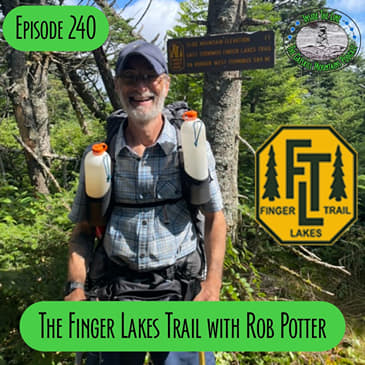
Welcome to episode 240! This week, Rob Potter joins us after completing an incredible 560-mile thru-hike of the Finger Lakes Trail! Rob shares what inspired him to take on this adventure, the challenges and surprises he encountered along the way, and what makes the Finger Lakes Trail so different from other long-distance hiking trails. We also dive into the 2026 Summit Steward statistics, discuss the ongoing fight over the Roadless Rule, and wrap things up with the story of a hiker who apparently needed to hear the same advice three times before getting the message. Make sure to subscribe on your favorite platform, share the show, donate if you feel like it… or just keep tuning in. I'm just grateful you're here. And as always... VOLUNTEER!!!!
Links for the Podcast: https://linktr.ee/ISLCatskillsPodcast, Donate a coffee to support the show! https://www.buymeacoffee.com/ITLCatskills, Like to be a sponsor or monthly supporter of the show? Go here! - https://www.buymeacoffee.com/ITLCatskills/membership
Thanks to the sponsors of the show: Outdoor chronicles photography - https://www.outdoorchroniclesphotography.com/, Trailbound Project - https://www.trailboundproject.com/, Camp Catskill - https://campcatskill.co/, Another Summit - https://www.guardianrevival.org/programs/another-summit
Links: Rob’s Blogs, Rob’s Ultra Page, 3500 Club Service Path, Catskills Trail Crew signup, Roadless Rule Alliance, American HIking Society Petition, All Trails article on Roadless Rule shit,
Volunteer Opportunities: Trailhead stewards for 3500 Club -https://www.catskill3500club.org/trailhead-stewardship, Catskills Trail Crew - https://www.nynjtc.org/trailcrew/catskills-trail-crew, NYNJTC Volunteering - https://www.nynjtc.org/catskills, Catskill Center - https://catskillcenter.org/, Catskill Mountain Club - https://catskillmountainclub.org/about-us/, Catskill Mountainkeeper - https://www.catskillmountainkeeper.org/
Post Hike Brews and Bites - Catskill Brewery, 1911, Athletic NA Beer, Russian Mule Brewery,
#FLT #fingerlakestrail #hudsonvalley #hudsonvalleyhiking #NYC #history #husdonvalley #hikingNY #kaaterskill #bluehole #catskillhiking #visitcatskills #catskillstrails #catskillmountains #3500 #catskills #catskillpark #catskillshiker #catskillmountainsnewyork #hiking #catskill3500club #catskill3500 #hikethecatskills #hikehudson
[00:00:29] The bushwhacks were some of the worst days I've ever had in the mountains, or life really. Whereas Pantsy Mountain is totally opposite, it's a mountain on top of a crater. I think the weather challenges on this incident were particularly difficult. It improves the development of New York State. Catskills will respond to it.
[00:01:02] The Catskills Mountains Podcast Let's do this. Yeah, yeah. I got it wrong last time. I said 338 last time and it was 238 and it was 239. I am getting it wrong. Well, you've done so many of these now. It's, you know, they're no longer, you know, numbered. It's just one continuous thing.
[00:01:27] True. True. So, yes. So tonight is episode 240. Tonight, Rob Potter joins us who just completed the Finger Lakes Trail. It's like 490 something miles. And he just said, well, how long ago was it, Rob? August 29th and it's about 586. 590, geez. Damn, he's like, screw you. Add another 100 miles there. Yeah. But who's counting?
[00:01:54] Yeah, but it seemed like 86 miles. Hey, I said... August 29th, I finished. Oh, wow. So a month ago, exactly a month ago, Rob finished the Finger Lakes Trail, which crosses into the Catskills a little bit more towards the end. So it has to do with the Catskills, but you know, we've never heard about the Finger Lakes Trail. We've never done anything about the really Finger Lakes Trail on this podcast, nor have I really heard anybody on any other podcast do anything about the Finger Lakes Trail.
[00:02:24] So Rob did it in one continuous through hike and we're going to hear about it tonight. And glad to have you on the show, Rob. It's great to have you. Thank you. Appreciate it. Yeah, we're looking forward to it. Got a lot of questions. Got a lot of questions. Again, Ted and I want to dig deep into this and see what it's all about. Well, I have a lot to say about the trail, both good and bad, so it'll be fun.
[00:02:45] Excellent. Yeah, from what I know about it, it would be a good choice for just about anybody who wanted to do a long multi-day hike. Absolutely. Cool. Cool. Let's start off with shooting the shit about the Summit Stewards stats for 2026. And in New York, New Jersey Trail Conference recently released some stats about their 2026 campaign of the Summer Stewards.
[00:03:12] It looks like they engaged in over 5,527 hikers. They educated or assisted 2,200 hikers. 156 hikers had to be redirected to other park destinations. 39 fire rings were removed. 102 bags of litter were carried out. And six lost or injured hikers helped. So, this is from May and October.
[00:03:38] From May through October, they are positioned at viewpoints across the Catskill Forest Preserve, including Slide, Wittenberg, Cornell, Giant Ledge, North Point, and the Blackhead Range and the Wyndham High Peak. And they provide outreach and teaching people and engage with people with Leave No Trace principles and stuff like that. You know, once again, they're out there to help people out, help the hikers out, educate the hikers, and do good things. So, it's really good to hear.
[00:04:05] And, you know, once again, our friend, our good old friend who's been on the show, Myra, she runs the program really on there. Teaches educators. She's a very smart lady. She was been on here a while ago. She's a Trail Steward Program Coordinator. And she said, once again, I think this is her like either third or fourth year for doing this. Sorry, Myra, if I get it wrong. I don't even know if she still listens to this. So, I haven't. I've tried to get a hold of her before.
[00:04:31] But once again, they are doing a fantastic jobs on our summits. Our high are places that, you know, get a lot of traffic and, you know, good for them. And I, Ted, we chatted about this. I think it was last episode. If we ever saw one on a summit, I, did you say you didn't? Same here. I have seen, uh, Trail Stewards on the summit.
[00:04:57] I've seen them, uh, making their way to the summit and I've seen them in the parking areas. Yeah. I've seen them in the parking areas and stuff. And we, I've chatted with them, uh, of course. But, but other than that, I, I, I haven't ran into them. Once again, I'm not in the popular areas on the weekends, especially like Sundays. So, I mean, but once again, I, it's fantastic news to hear. Did, did a great job. They are also down in, uh, those, the Schwangunks and, and, uh, Hudson Highlands area and stuff like that as well.
[00:05:27] I believe up on Breakneck Ridge and stuff. Yeah. So it's good to hear. It's good to hear some, we're out there making a difference. I can say that, uh, sorry. I was in the Catskills last year on slide, uh, for something different, just doing a trip. And I witnessed, um, uh, a trail steward interacting with people who late in the day, we're going to camp on the top of Spide. Um, those two guys that went up there and were like starting to set up their tent.
[00:05:51] And I was just, I had actually taken a nap in the forest that's off to the side and was packing up and getting ready to head down off of side, back to the east side to, uh, uh, campsite. And I saw that interaction. It was just very, very interesting to me. I was very surprised that these guys didn't know you couldn't camp up there, you know, and they put the tip, they started to unpack right in front of her and she handled it so, so well. Hmm. And they just, they acted like they really didn't know.
[00:06:20] And I was just shocked that they had only walked by seven or eight signs that said no camping. Hmm. And, uh, we're very, very excited and we're just kind of like waiting for all the people to leave so they could throw their tents down. And they were like twenties, maybe 28, 30, these two guys. Well, the whole fact that they're waiting for people to leave before they start setting up camp is somewhat of an indication that they knew. So I did think that, but at the same time, there was a lot of people kind of like in the way, like they were going to camp right on the rock. Hmm.
[00:06:48] Like right where you're looking out, where you're above the monument, down below on the lip, they were right there. And so I just, I don't know if they were, you know, full of it, but I'm like, I don't know how you missed those signs. Yeah. True. Yeah. That wouldn't be my place. Like when you talk about education, like I got to see it in action. Yeah. So, so Stosh, if you were going to camp on the top of Slide Mountain and it was permitted, would you camp right on the rock?
[00:07:18] I gotta admit that's a, that's a nice, nice place to do it. Well, do it. Okay. I'm talking about camping. To camping. Yeah. So, I mean, I mean, but you would have to have a thick foam or air mattress, wouldn't you? It would be a, yeah, yeah. Of course. Yeah. That blow up mattress, you know, the ones that you get. I mean, I, I mean, I've camped of course before, uh, up there over on the, we're off of the Curtis Olmsbury trail. They have some really good campsites.
[00:07:46] And then once again, they're more on the Curtis Olmsbury trail and, uh, they're super cool, but they don't, being on the summit, you know, once again, like it really is to camp. It's nice and flat and stuff. And you probably just walk down and once again, to the viewpoint and catch some good, uh, sunrises. But I don't know if I camp there like anymore, like, and a fire tower there. That's crazy to think that they had a fire tower there on a wooden one. So, well, cool.
[00:08:12] Uh, once again, thank you to the New York, New Jersey trail concerts, summit stewards for doing their thing. And we're, we're grateful for it to have you. And we're grateful that once again, everybody's coming together, teaching educated and it has a great effect on people. You know, once again, those, uh, as Rob said, they met those people up on slide and they got turned around and probably, uh, were, were pissed, but you know, they probably went to a better place that. You know, had a fire ring and stuff like that, and they can actually have a good time.
[00:08:42] So speaking of, uh, education and stuff, this next one is, is a little crazy. So a man ignores multiple warnings on Mount Washington and has to get rescued.
[00:08:54] So two days ago, which is, uh, September 26th, 2026 at approximately 10 PM, New Hampshire fishing games, confirmation officers and volunteered from the Anderskogon Valley search and rescue team were called upon a rescue hiker up on the boot spur trail up on Mount Washington. The hiker's name, which is very difficult to pronounce. I'm going to butcher this Nagaragin.
[00:09:22] Tryu, cryopolis Nagaragin try. I'm going to say Nagaragin T 48 of New Jersey, New New Jersey, or Jersey city, New Jersey had been hiking with three other companion hikers that day. And it was reported that he had started hiking with the group early that morning up the good old Tucker ravine where we all know everybody gets rescued. Uh, but he was struggling to ascend. So his companions told him to turn around and not attempt to hype.
[00:09:48] He turned around and ended up taking a shuttle to the top of Mount Washington, where he met his companions after a break at the summit. The three who had hiked up planned to hike back down with him and decided to hike down the body. He did decided to hike down the bottom with them. They started down at 1130 AM. According to one of his companions, it took him nearly two hours to go approximately half a mile. That's worse than what we do through mountain Laurel and bushwhacking.
[00:10:18] I was thinking of that. I'm like, yeah, a mile would take like through bushwhacking through mountain Laurel would take like an hour and you are like totally going slow. But this a half a mile on Mount Washington, which she like, you know, it's once again, open summit and stuff rock. It's not that crazy. Uh, at the time to turn around and return back to the summit for a ride. Come. Um, wow.
[00:10:44] And that's not, you know, uh, my friend Darren sent me this message about this and he goes, that's not even like summit fever. I don't know why this guy was just like, Hey, let's let me, let me hike down. This is, this is good. This is something like, I wouldn't even say that's bragging rights. Cause he got a ride to the top. Let's just emphasize that with a long pause. Yeah.
[00:11:12] Um, I find it very interesting, you know, when we're all operating with less than the full story, because we just get this little. Right up on it. And that's obviously not everything that happened. And I would like to know more about his friends than I would like to know about him, because I find it very interesting that they persuaded him to turn around to think this wasn't going to work out.
[00:11:37] And why weren't they more insistent and could something really, really bad have happened because they caved in and said, or let him tag along. I, you know, I'm not sure it's going to put me in jeopardy. And then you've got to make that decision that we talked about last week where the fellow was on Katahdin and people couldn't help him. And, you know, they have to live with the fact that they came across some guy that was hypothermic. They weren't able to help him.
[00:12:07] And he eventually does. Right? So here you are, you're going to head down Mount Washington with your friend who you told not to go up. Now you're going down. And many people will point out that going down is just as hard, if not harder than going downhill is apparently a hazard. And his friends don't convince him this is a bad idea. I kind of think that I would have said, no, I'm, I'm not going down now. If you're insisting on going down, I'm not doing this.
[00:12:36] I'm going to get a ride down. A ride down. Go ahead. Yeah. Take it away, Rob. I was going to say, I'm surprised that if he was that ill or not feeling well and couldn't go up that someone didn't actually stay down with them. Yeah. That they all just left and went up. Maybe he just was like, you know, tired. I don't know. But I would think that if you're in a group and you've got a friend who's like not doing well and you know you're going to be going all the way up and all the way back down and just going to take you.
[00:13:05] Now, I know that Mount Washington is one of the deadliest mountains in the country, in the continental US, probably for reasons like this. I know it can be sketchy. I don't know how, how long it takes you to summon it, how high up it is. But I would just have to imagine that you're leaving your friend for three, four, five, six hours. I, the whole thing is weird. Like, you know, that was one of my friends and one of my friends wasn't doing good.
[00:13:32] One or all of us are just going to say, you're not going to go up and leave your friend down at the parking lot. Who's not feeling good and be gone and out of reach for like I said, I don't know how many hours. Yeah. That's and so we don't know the whole story. And it's I'm not going to second guess that decision. Yeah. Because they're presumably a lot more to the story than we know. But what we do know is that this fellow who has a history is now at the top of the mountain and history is repeating itself as he's heading down. He's having difficulty.
[00:14:02] Yeah. Obviously, the further down you go with him, the harder it's going to get, you know, until you make it down the totality of that slope. So I would have been just like, you know, sorry, man. I'm, you know, I'm going to hop in the shuttle, take the cog, whatever the means and methods are to get down. I'm going down. You're coming with me. Yeah. It just like a really bad idea, especially after only a half mile. That's like a half mile.
[00:14:31] You're like, this guy's not doing well. We can turn around and it'll be super easy to catch a ride back. Like, like, but they're like, ah, let's go down the good old Tucker, Tucker, Tucker, man, the most difficult trail on the East Coast. And, you know, let's see. Check it out. Like what's, what's going through your head? Like, do you not going down the 4,000 and be like, ha, you're going to be like, hey, man, you fricking save this guy's life. And you avoided a search and rescue.
[00:15:00] We'll kind of praise you. You're just the single guy kick out the three guys and be like, you didn't help me. Or three guys. Like you're no longer our friend anymore, man. That's the best stuff. I'm not, I'm not sure that's a friendship breaker on the one hand, you know, on the other hand, it might be a friendship builder, you know? Um, but, and, and those things are hard to read into it, but it just, to me, it's, you know, I just, if you're in those circumstances and you know, somebody can't make it, or you're reasonably certain of it.
[00:15:28] I think you've got to veto the whole operation and not put more people in peril and let's just take the bus down or whatever it is to go down. Yeah. And I'm curious. So they said they started down at 11 30 AM and then the call came in at 10 PM. I'm curious how they made it to the top so quickly. That's a good point. Right.
[00:15:54] I mean, are they, are the, the other two so superior to the guy that, that turned around that they were able to just boogie up Tuckerman's ravine like that, you know, in a few hours? Apparently. Apparently so. And maybe this guy shouldn't have been hiking with them in the first place that they were that. In much better physical shape than him, but we just really don't know. But yeah, there's, there's a lot of loopholes in this. So. And usually they're pretty good with their, their stories, New Hampshire fishing game.
[00:16:24] Like this is, I mean, I like to know, like, cause you know, a half a mile an hour, like, or half a mile in two hours. Like that's, that's treacherously. Like, this is not like, like safe. Number one. And number two, like, dude, you're going too fucking slow. Let's move. Like, come on. We either got to get down this mountain or move up because like, well, apparently if it was the hike or the call came in at 10 PM.
[00:16:51] So it's not because they weren't equipped to be, and they had like no headlamps and stuff. So they were called because this guy was generally having a struggling time. So they were well prepared so far. I mean, they didn't say that they needed everything and everything. So that's crazy. Just, just crazy. Three, three warnings. This is like that one time when the guy called nine, nine, one, one, uh, three times over on sugar loaf. Like, Oh, it's crazy. Crazy.
[00:17:20] You look at the timeline and I mean, that's a whole interesting element to this is as well, but you know, that time of night, we don't know what the ambient temperatures were and what the wind was, but going that slow, you're not generating a lot of body heat. You know, it's almost like you're stationary half a, half a mile in two hours. Yeah. Yeah. Yeah. We'll keep up to date with it because that's pretty, do you think it's gonna get set?
[00:17:49] I, you know, I don't know. That's interesting. I, you know, one thing I would. Is, and I'm gonna say, you know, if I'm, if I'm paying taxes in New Hampshire and I'm rescuing a guy from New Jersey, cause apparently he kind of did something. He shouldn't, I find that a little upsetting that you've got an outer out of stater coming up here. And if they're not buying a hike safe card and then they're doing something that presumably costs thousands of dollars for a rescue. Yeah. Yeah. I think.
[00:18:19] Vote on it. Yeah. I think, yeah, I think he needs to learn a lesson and that lesson might be writing a check. Yeah, definitely. Definitely. I was, that was, that was a big question up on that, that Facebook post that I had was, is he gonna pay the bill? He should pay the bill and stuff. So send them the bill. Yeah. I'll send them a bill if they don't. I'll say. Yeah. Right. On behalf of the, the fake New Hampshire or whatever.
[00:18:45] Um, so last but not least, uh, I wanted to talk about this, Ted, you brought this up to me. Uh, and I was, you know, I wanted, I try to, I'm trying to avoid politics on this, this podcast, but it's obviously not going in the right direction for us hikers and for us, nature lovers and stuff. And as, as people know, and if you don't know, this current administration is fucking things up with. Well, I stepped away, Stosh. What did you say?
[00:19:12] It's, it's fucking shit up for, for us and in the hiking world and the nature world and the way we're on things. I mean, we have a guy, uh, who's in our, our white house that wants the wolves to be killed and stuff like that for, for game that are endangered species, stuff like that. It's just ridiculous. And then there's this, uh, the roadless rule that protects thousands of popular trails and the USDA would like to appeal it.
[00:19:38] So there is, I'm going to post a lot of links for about this because there's a lot of information out there and it's really cool. I got this, I got another, a couple of different, uh, articles about this and I kind of mashed together. Now there's a cool map that's, that's out there that shows you where the roadless rule protects. And it's a pretty big map. It's 51, 58.4 million acres across 39 states.
[00:20:06] And you, everybody's like, Ooh, that's mostly out west and stuff. No, no, no. Whites have that because it's national forest down in a degree mountain national forest. There's some places that they have this place of where it protects, but the, since the USDA wants to appeal it. Now they're going to think that they, once they appeal it and if it does go through now, they can build roads through this.
[00:20:28] So it's, it's once again, like what the, what the fuck we have these areas that, uh, across the United States that have been protected since 2001, keeping these areas free of road construction. And they want to repeal this and it's opening millions of acres to logging road building and other developments and stuff. And, and it's just like crazy.
[00:20:51] So definitely has some consequences that, uh, you know, some of these places like, uh, white mountain national forest, uh, over there along this, uh, CDT, the PCT Sierra national forest or the Sierra, uh, uh, national park, Yosemite. The, all these places are on the chopping block for this. Um, and there are definitely things we can do.
[00:21:18] Once again, this impacts a lot of things like water forest, uh, watershed, uh, stuff like that logging. They could do mining as well. So once again, people are pissed off about turbines being in their backyard. Don't mind fricking mining fields being out there. I, I, I don't understand how shit shit just hit in the fan these days. It's really weird. I'm not, I don't want somebody who doesn't want a, uh, a wind turbine, uh, that they can see, but they're okay with a, a minefield being out there. Hundreds of them. It's amazing.
[00:21:48] So there are definitely things you can do. Uh, there are out the outdoor Alliance. You can, uh, hook up with and check out their, their stuff. They help you out, uh, sending these, uh, kind of like these pre-made emails to your local people. Uh, and, and then, uh, all over as well. Roadless Rule Alliance, American Hiking Society. They also help out. So wanted to just throw that out there and stuff.
[00:22:15] So, uh, let's, you know, anybody and everybody could send their stuff out to any congressman and stuff like that. I don't know if it'll hit everybody, but, uh, this is, this is crazy because a lot of like our places, 25,000 miles. It's predicted that 25,000 miles of trails across 37 states could be affected.
[00:22:36] So you're walking on one of these trails and all of a sudden you have a good old road going through it when you're middle of the Sierra Nevada, like, or you're up in the white mountain national forest. And I looked at, and it's the Pemi Gossett. So you're going to, in the Pemi loop, there could be a road going through there because they want to, I don't know, whatever the fuck they want to do up in white mountain. That's what I'm saying. If I could add, you know, as someone who just hiked 500 and so almost 600 miles across New York state, there are, there are roads already going to these places. You don't need to be adding more roads.
[00:23:06] There's Jeep roads. There's access roads. And I was going to write an article on this and I've done a deep dive and I know their big argument is we need to get rid of the roadless rule because it will help prevent forest fires. And that is the stupidest fucking thing I've ever heard because they know that roads cause forest fires. And if you look at California, which parts of the PCT are unhikeable this year, parts of the CDT are unhikeable because it's burning.
[00:23:31] And they say something like 35% of those fires are started on roadside just in California, not, not anywhere else. But they know that you're four times more likely to have a fire where there's a road. So this idea that you're going to build more roads and prevent fires is a lie. It's just a straight up lie. Nobody with, with, with the fifth grade reading level would believe that because it's just, it's not even close. It's not like you can massage the numbers and be like, well, it's, I mean, you're, you're four times more likely to have a fire if there's a road.
[00:24:01] So let's put more roads in with, and let's leave our trucks right beside the road that have diesel and gas. And like, I've been walking through areas where the, you know, where they're doing logging and the machinery, like you don't realize how much damage that does till you're there. And you see it, these machines that they want to bring into these forests, you know, they're, they're talking about, they want roads so they can bring in these machines on tractor trailer beds. They're not talking about bringing in your neighbor's bobcat that fits in the back of your pickup truck.
[00:24:30] These are massive machines that they're using for clear cutting and stuff like that. And it's just a ridiculous argument. So it's, it's, it's not just like, if you're a hunter, if you're a hiker, if you don't want to have to walk and go outside and have, you know, smoke warnings, then this is for you. You don't have to really be someone who's like, yeah, I want to go out and hug a tree every weekend. I mean, this is these roads that are already there are causing fires. And they want to add more.
[00:24:58] Like I already, I had to really think about my hike this summer. And I thought about pushing it, moving it because of the smoke warnings. I mean, I'm from Canada as an example, right? This, this forest fire thing is a real problem already. They have fires out in Canada and California and they affect us here. Yeah. Yeah. True. True. Yeah. It's, it's just crazy.
[00:25:21] And once again, like I follow a guy, I got to remember his name on, we talked about him a while back. He followed him on Instagram. His, his delivery is weird. Cause he kind of yells and like, is, is, is crazy. He's over in the California, but he's like showing, it's like, there was a road bill here and it was logging done here. And they planted seeds thinking that everything would be all fine, but all this shit just burned so fast. And then it goes on to the other side of the road. He's like, this is as stupid as shit that I've ever heard.
[00:25:50] His delivery is weird, but it makes sense. So. Okay. And they've said that these will create fire breaks and you know, a 20 foot wide road is not going to create a fire break. Not at all. It's the dumbest thing ever. So. And I just, sometimes with this, I feel like they're treating us like we're stupid. I don't, I don't understand. Ted. Another silence, another break in a silence. He wants to. So yeah. So Rob is spot on in the stat I pulled up is that 84% of wildfires are human caused. Yep.
[00:26:20] Okay. And they're four times more common within 50 meters of a road. There you go. And you know, we, we have enough roads already and we don't maintain them. So what's the point of creating more roads? Well, to access resources, materials, uh, lumber, you know, trees, cut down trees, lumber, other natural resources.
[00:26:42] And I just think that the solution is we need to be more proactive and conserving our resources and recycling and using alternative resources that really don't deplete the environment. And don't impose more demands on the environment because if you don't start doing it now and as the population grows and the need for electricity grows over the next 25 years, you're just going to consume more and more and more.
[00:27:11] So the time is now to kind of, you know, uh, flex our muscles and say that we should stop harvesting everything we can from planet earth and consuming it and not leaving things for future generations. So Stash with the recent increases in gasoline prices, how much more does it cost you in the last three months to fill up your car?
[00:27:41] Well, I mean, uh, uh, my, uh, I'm a lucky guy, I guess I would say in, in, in here, it's an electric car. Your, the price hasn't gone up has. I, I, I know that, but I, I, I, that is true. But a lot of people have complained in the past, you know, two, three years that their electric bills have gone insane. Like I have heard my friends that have smaller houses than me have over a thousand dollars in electric. Like, and I, I haven't gotten that yet.
[00:28:09] And I'm surprised because, you know, once again, I don't, using an EV shouldn't cost you more, much more a month. Maybe like it depends on how long you drive, how many, how many miles you drive. Of course. Do you fill up at home? I do. Okay. The only time I use a supercharger, a fast charger is when I'm out doing a long, long trip. Yeah.
[00:28:30] But my, my point would be is that we could, with electricity and with the resources we have, whether it's wind turbines or solar fields or other means and methods, you know, generating electricity can be largely done off of renewables. And, and we, we need to start focusing on that, particularly when our petroleum prices are largely dependent on the world market and the world market can be volatile. And that creates a national security risk and yada, yada, yada, yada.
[00:29:00] You know, nobody's blocking the sun from shining on this country yet. Maybe Elon Musk at some point in time will have that technology, but he currently doesn't have it. So we just need to build more solar and we need to do so, you know, in a more economical and wiser way. And why everybody's energy bills are going up in New York state is because, you know, New York state has this big initiative to, to migrate towards renewable energy and to get away from fossil fuel generated electricity.
[00:29:30] Well, which is a good program overall. And eventually over time, you know, uh, appliances and other things become more and more electric efficient. And so our demand on those, on electricity will go down with the, the huge footnote or maybe a whole new book and chapter, you know, what AI is consuming now and going forward is going to kind of be a game changer, but potentially over time that will change too.
[00:29:53] As, as those things get more efficient, I, but I just don't think the solution is, is going out there and cutting down a 150 year old tree and taking away some animals habitat. And so maybe, you know, the pretense is you're reducing fire risk on the one hand, but the other risk, you have more erosion risk, right? You're going to have more flooding and it's just going to cause more pollution, you know, environmental pollution like that.
[00:30:22] So I am opposed to eliminating this. And I'm going to call on a March on Washington. We're all going to hop in Stosha's vehicle because he can fill it up. So cheap. And we're going to go down there and drive across the reflecting pool. Well, I mean, it can go that fast that it'll coast across there. We'll see how far it can go.
[00:30:47] I mean, so once again, I I'll have links in the show notes and Rob, you know, you've done some research. Send me some links of where we can like get some different information. Once again, like, like pre-made emails to where we can just mass send this to Congress, anybody, your local law law firms, your local Congress people and stuff like that. But anything to help anybody who's got any suggestions, please let me know. I will put those links in the show notes. And if you want, reach out to me. I'll send you everything that I have because this is just ridiculous.
[00:31:17] I don't. I don't understand, but I wanted to stay away from politics. Fuck politics, especially right now. Whatever. But but but get but get out and vote next month. OK, yeah, right. Actually, we just need fucking October 1st. I heard is the night the day we're supposed to frickin do absolutely nothing. You shut down everything. Do not pay for anything. Do not go to work. Do not do anything but stay in your house for 24 hours. It's what I heard. It's October 1st. So don't call out.
[00:31:47] And then on the second when you walk outdoors, you'll see that they've put a road through your front line. Right. Right. Whatever. But we need we need just a freaking goddamn. I don't know. All right. All right. So thank you for shooting the shit. The shit hit the fan on that last one. Sorry about that, everybody.
[00:32:05] But I want to thank the amazing monthly supporters like Chris Garabian, Eric Rosario, Skana Nichols, John Comiskey, Mikey S, Desert City Radio, Henry Burmeister, Vicky Ferrer, Jeff Jotz, David Oliver, who once again doesn't listen to the show. Dog Dune, Betsy A, Vanessa and Jim C. Thank you guys so much. We love you. Thank you for supporting the show. So it does a lot. Also to our amazing sponsors like Outdoor Chronicles Photography.
[00:32:34] Molly from Outdoor Chronicles Photography specializes in adventure elopin and adventure couple photography in the Catskills, Adirondacks and White Mountains. She's an officiant for getting married, a licensed guide. But most important, she's a story maker. Molly won't just give you photos. She'll give you memories that will last forever. Don't hesitate to get a hold of Molly on every single platform. Also, have you ever wanted to learn more about hiking or backpacking? Or even just brush up on some of your old skills in the backcountry?
[00:33:04] Check out Trailbound Project, a hiking and backpacking school. Scott and Joe from the New Jersey Search and Rescue team have amazing backgrounds in Wilderness First Aid, Wilderness First Responder, and the Mountain Rescue Association. And they are there to teach you old and new skills of hiking and backpacking. They teach anything from first aid, map and compass, and many other skills that could help you and others on the trail. Check them out on their website and every single social media platform.
[00:33:34] I don't know if they're on TikTok, though, but they are awesome. They are all awesome. Thank you, guys. And Tad's just smiling. He's like, what the hell is TikTok? I have a TikTok, but I haven't used it in years. So it's weird. It's weird. I deleted that. I'm good. So who is drinking something tonight? Rob, are you ready to crack open something? I have got... So I'm drinking NA beer. I do NA. So I've got an athletic brewing company, Dark and Gordy.
[00:34:04] Nice. How was that? Yeah. Tell us about it. Can you hear us, Rob? Oh, yeah. I'm sorry. I thought you were talking to Stash. What did you say? No, no. You. Yeah. So, Rob, tell us about your athletic brewing company. Oh, so I'm a big fan. I gave up drinking a few years ago, but I'm a big fan. I used to actually brew, do homebrew, and I was pretty good at it. And so, you know, I just remember being a kid, like when my dad would quit drinking for a while,
[00:34:30] everybody would have to do like O'Doul's, you know, back in the day when everybody was doing like Jenny Cream Ale and stuff. O'Doul's was the... It was just terrible. And so I discovered this athletic brewery company, which was a... They only make NA beer, and it was started by an ultra runner who... There's a lot of ultra runners who used to be, you know, alcoholics. And they trade one addiction for another. And so they started this company, and they just make really good NA beer. They make all sorts of flavors. I love it.
[00:34:59] And I had actually quit drinking when I started ultra running, like right at the same time. And so I just discovered that it's good stuff. Like I said, I'm kind of like a... I was a bit of a beer snob, right? I went for like the barley wines and the Imperial Russian stouts and all that kind of... The triple stouts and all that kind of stuff. And so, yeah, I love a good ABC. They're good. Nice. Impressive. Nice. All right.
[00:35:27] So Stash, you want me to rock and roll with mine? I'm going to go this time. I'm going to take this over for this one. Yeah. Take it over. Once again, it gives me a sec. So I wasn't ready. All right. What is it called again? The... What was that called? The Stash Slurp. Yes. That's... All right. That was good. That was 1911. Sweet apple. Got to go with the times and stuff.
[00:35:57] So... Ooh. All right. Sounded good. Yeah. So in keeping with the Catskill-based theme of this podcast, I have a Catskill Brewery Grass Wagon IPA brewed in Livingston Manor, New York. The brewery over there is a pretty cool place. I've been there quite a few times to pick up some fresh stuff.
[00:36:26] And the Grass Wagon IPA, which comes in this nice green can, boasts a alcohol content of 4.9%. That's half of what you had last week. Yeah, I know. So the story behind my buying this, if you want to hear it... Yeah. So I walked into the beer store about a week and a half ago. I didn't have a lot of time to browse around.
[00:36:56] But this particular beer store, you do need a lot of time to browse around because they're notorious for having stuff that is really, really old. If it was a wine store, that would be good. But as a beer store, having beer, particularly IPAs, that are two or three years old, not good. So I saw this guy grabbing this Catskill Brewery beer. And I started talking to him. And he also knew that this is, you know,
[00:37:26] a notorious place for old stuff. So he assured me that this was reasonably fresh and that he had had it before. And it is fresh. It was canned. I can't say bottled. It was canned in July of this year. So I grabbed it. Eh, I don't think I'll buy it again. But it's good. But it's not... Is it worth repeat? I can't say so. Well, you have to finish the other ones, don't you? Yeah, I got it.
[00:37:54] Well, this is the last of the four-pack. And I actually, I wasn't going to pull it out tonight. But then again, I thought Catskill theme. I knew Rob was on. He has a reputation as a beer snob. Even though he doesn't drink alcoholic beer anymore, he can't shed himself of that. Like reputation tattooed on him as being a beer snob. So I thought, okay, I'm going to just go with something safe.
[00:38:19] Catskill Brewery Grass Wagon 4.9 IPA. Do you want me to do like the slurp into the mic? I can't do that. That's yours. That you own that. I was going to say. And I've never heard of Grass Wagon. So interesting. Interesting. That was an awesome looking can. Yeah, let's show it again. Yeah, they do good stuff with their cans. Oh, yeah, yeah. Those are nice. It kind of resembles me if you look. With the glasses, yeah. Mm-hmm. I wonder if Julie McGuire has had that one. I haven't seen her promote that.
[00:38:49] We can put the hat on it. Oh, yeah, yeah. That looks just like you. So I'm not that good with the right hand to get the can up there. Hey, you're doing just fine. Yeah, I won't be opening for the Yankees for the wild card. That's for sure. But maybe next season. That'll be fine. I'll have my cutter back. You'll be back in hockey in no time. Because hockey players don't get out with an injury. They just run right through it.
[00:39:16] As long as I can throw a left hook, I'll be in the starting rotation for the hockey game. There you go. There you go. Hockey season starting back up. So anyway. Excellent. Excellent. So let's move on to if you were really outdoors. So if you mentioned the podcast, one of your hikes through social media, we are going to chat about it on the show. Hopefully I didn't miss you. So tag us by typing at ITL Catskill MTM podcast.
[00:39:41] So first off, Cam, aka Cammy, CamCam5 and Logan. They are now 46ers. Congratulations, Cam and Logie. Cammy and Logan. Round of applause. Yeah, yeah. Yeah. I guess they can't hear that, but oh well. Yeah, they probably can't. So we tried, Cammy. Yeah. Not as hard as you did, but we tried. Yeah. Congratulations. They are now 46ers. Logan, adorable. You guys had great pictures. That's a great journey.
[00:40:09] A lot of people have been doing their 46 this year, and we are very grateful for them to tag us on their journey through the 46ers. So great to hear, Cammy. Speaking of Adirondacks, Rachel Jean, the Gypsy Cream. Gypsy Cream. Rachel Jean, the Gypsy Queen, did Cascade and Porter in the Adirondacks with Josh Waste, and also did the Hadley Fire Tower. So she's up there in the Adirondacks as well. Yeah, but my recollection is that she hasn't been out hiking in a while.
[00:40:40] So when her and Josh come back out and hit the trail, boy, they do it with some gusto going up to the Adirondacks and doing some hikes up there. Looks like a beautiful day, too. It looks like a beautiful time. That's definitely one that I've heard recommended people start off with Cascade and Porter. A nice, kind of easy intro to the Adirondacks. So, cool. Tracy PinkPony18 was in the Mohawk State Forest doing her thing, enjoying it well.
[00:41:11] It's good to hear from Lisa. Lisa Chaotic was up tagging Alan, and she said it was 19.7 miles for one peak. We've talked about Alan before. Of course, that's where that hiker passed that the rangers couldn't find in the winter, so they had to go back. Well, they had to go back. Somebody found him in the winter. So, not the easiest mountain, as it is 19.7 miles just for one peak. That's a little crazy.
[00:41:40] So, not looking forward to doing Alan sometime. So, we'll see. We'll see. Good to hear back from you, Lisa. So, it's great to hear Chaotic was out. Catskill Mountain Brews. Scott did the Blackhead Range and Windham High Peak with Jen and John, a.k.a. Foolish Not Stupid. Nicholas Golden Money Cat was up on Harmon Hill in Bennington, Vermont. Good old Jim C volunteered and cleaned up trash at the campgrounds near the Blue Hole and then followed it up with a hike up Red Hill. And they were doing the roof on there.
[00:42:09] That's pretty crazy. I see. Not to go away from Jim C, but they're doing the roof up on Red Hill, but they won't do anything up on Balsam Lake. Yeah. Yeah. Silence. Silence. What the fuck? Anyway. Oh, just up there and it's not awesome. So, I just was up at Balsam Lake. I did a little side quest. Wow. Nice. So, that's a... Once again, it sucks. It sucks to hear about that.
[00:42:36] But moving on, Oscana, a.k.a. Catskills Ever After, was out doing Giant Legend Panther on a beautiful day. And sorry that I missed your tag last week, Oscana, when you were down in the Shawanlugs. Definitely, I feel bad. So, thank you for supporting the show. And I deeply apologize for missing it. So, Katie Henderson Hikes made a mad dash up to the Adirondacks before the Northeaster and tags Phelps in Tabletop.
[00:43:05] Tony TJi72 was doing some wild weather leaf peeping, peeping in the Delaware County. I feel so weird about saying leaf peeping. It should be peeping or something, but peeping is just weird. But his pictures looked awesome. He's over in Delaware County all the time. He's exploring the places where, like, nobody goes. And it's just... He is fortunate. Like, solitude. He's got the fortress of solitude over there.
[00:43:27] And then, last but not least, it's been a while since we've heard from this Catskill legend, even though he wasn't in the Catskills, Catskill mowing legend, Sean, Scion72, was at Camp Santioni. Santioni. Santioni. Once again, I'm not an Adirondack guy. So... That's close enough. Yeah.
[00:43:52] Doing the marked and main train trail that did not look like a marked and main train trail. I suggest you look at his reel that I shared, his story. And it's definitely something that we go through in a bushwhack. And it's fun. I gotta admit, even the herd paths are better than that. And it's pretty crazy. Well, you know, you see that in trails less traveled. Yeah. And it's nice. They are. Yeah. All right.
[00:44:22] Thank you, everybody who tagged us. A lot of people crazy didn't get out this weekend because that good old nor'easter had to want to deal with that shit. So good for you for not dealing with that because it wasn't fun. It was just wind and rain and stuff. Nobody wants to have that. So, speaking of that, who was out for a previous hike? Ted, did you get out? Yep. Uh, this past weekend, I did not go out hiking.
[00:44:48] Although I, I thought about it, especially when there was a couple windows in the weather, but I decided the better thing for me in my period of eternal recovery was just to hang out at the house. And I did, I did both days. I did bang out about 20 miles on my bike in the basement where you can ride for an hour and go nowhere. Nice. Nice. I mean, that's feels good. Were you watching TV? Did you watch that? Watch anything or something?
[00:45:18] Uh, yeah. So, um, it's a very interactive, uh, compute trainer that my bike is hooked up to. And so when you're, when you're riding it and suffering, you can watch anything you want on any number of TVs. And I don't know who would be surprised to hear that. I was watching old concert recordings of Jerry Garcia and not so old recordings of the cure.
[00:45:48] Oh, nice. I, you know, I will say the cure. Yes. Jerry Garcia. I'm not a big deadhead. I'm not a, but the cure. Nice. Ted. I'll allow it. Nice. I took my daughter to see a cure concert. It's pretty cool. Do you listen to rush? Are you a rush fan? Oh, yeah. Oh, good. Thank you. I went to rush concerts before you were even born. I bet. Kid. That's awesome. Like, fantastic. Well, good. I mean, once again, this was not the weekend to get out.
[00:46:17] Like, it just, it just wasn't, I mean, unless Rob went out. He did. Let's hear it. No, I, I've, uh, I came home and got the handcuffs put on. I was told I was out for long enough. Nice. And you just stay on for a little while, but I am going out Columbus weekend up to the Catskills for, uh, I'm going to do four peaks. Oh, what do you got? I'm going to do Indian head for there's four there, but 20 miles. Remember what I'm going to do?
[00:46:46] Oh, big Indian for Eagle and Balsam. Nice. Yeah. Nice. Yeah. Where, where are you? Uh, I mean, we'll learn about where you're located, where are you located? Where are you saying? Oh, I'm in the, I'm near Binghamton, New York, any kind of area. So like an hour from, from Oneonta. I know you're from Oneonta area. Nice. Okay, cool. Cool. Nice. I can't say that I went anywhere. I went to today, I went disc golfing with, with our buddy, Alex, uh, to Bel Air.
[00:47:15] We went to Bel Air ski center into the lower nine. It was raining. It was, uh, we didn't meet anybody and it was beautiful. I love their disc golf course. It's nice and open and stuff. And then the funny thing is, is we met a trooper going like up one of the areas that said one way only. And I called them out and I was just like, you're going the wrong way officer. And we had a great conversation and then when he like, he like went a little bit and then he slammed on his brakes and he saw my, my Catskill search and rescue, uh, sticker on
[00:47:45] there. And he was like, Oh, you're part of the search and rescue team. And I was like, well, I was. And he's just like, Oh, he's just like, you guys are pretty crazy. Like we, we really don't want to do that stuff. And he's like, we'd, we'd rather have you guys do that. I was just like, well, thanks man. I'm like, great. He's just like, you guys are crazy for going off on that weather and stuff like that. And I was like, Ooh, cool. It was a cool guy. He's been with the forest for six, 15 years. So, uh, and of course, Alex had to ask what kind of truck he had in a 2026 Chevy Tahoe.
[00:48:15] And so it was great. Alex, go ahead. Alex couldn't tell that from looking at the truck. He said he thought it was a 2024. Oh, he was close. He was hung up on the year, not the make and model. Yeah. He was the 20, 24, he knows, he knows what the, the, the troopers have. Is that with the V six or a V eight? V eight has a V eight. Now, how many, how many speed transmission comes with that? I don't know. We didn't, we didn't discuss that. I told him he couldn't catch me though.
[00:48:43] And he's just like, he goes, ah, I'm like, he can't, I've already run from the cops several times. And he looks at me like with that, with that look at out. It's like, yeah, he's cool. But all I got to say though, with going up there, my drive from Oneonta to Bel Air, you need to get out this weekend because the leaves are at peak. I would, I would say they are either near 90% or at peak.
[00:49:12] Cause I saw colors today that I couldn't believe. And there's, of course there's some places where the, uh, is it the emerald ash borer was where there's just no, no leaves on the trees, but every other place, the leaves were pretty. I couldn't get pictures cause Bel Air was in the clouds in the mist. Um, but below that, like when you got below it, everything was, was at or near peak. So yeah, maybe, well, good to know. Maybe I'll hit the Ashokan rail trail this weekend.
[00:49:41] That'd be a good place for me to get some steps in. But I do have a plan, uh, for going out for a sunset hike up Bramley on Thursday. So if anybody wants to join, uh, I know it's a difficult drive for everybody, uh, but get ahold of me if you're interested. And then Sunday we might, we might go out. Jessica might bang off a, another peak on her list. We it's up in the air. We might, she has balsam in the summer to do. So we might go up balsam.
[00:50:11] So whatever. Uh, I just want to get out there and see those colors because God damn, there's like, there's nothing like seeing those beautiful colors, uh, and the Catskills and such. So get out there, have a good time. Uh, so let's move on. Uh, Catskill news. Once again, volunteer 3500 club Catskill trail. Crew Catskill mountains club visitor center, Charlie rovers trail crew, let me come Bramley mountain fire tower, wherever you can volunteer. It makes a big impact.
[00:50:39] And also if you need stickers, get ahold of me a little bit, uh, into the Catskill trail crew and the Catskill 3500 club. Catskill trail crew will be doing their last outing this year on the Huckleberry Luke. They will be meeting at Plutz road at 8 30. A.M. A.M. On Saturday. Lincoln's in the show notes. So if you're hearing this Sunday and you are interested, you got no plans, meet the Catskill trail crew on Plutz road. And you guys will do, uh, some of the last tale of the Huckleberry loop that they've been working so hard this year on.
[00:51:10] And then, uh, the Catskill 3500 club has a new club service patch. So if you do seven, uh, points of service in the Catskills or such with, uh, different, uh, points awarded, I will name that out in a second. You will get your 3500 club service patch.
[00:51:34] So there's different ways you can accumulate points, uh, over like it shows one point would be trail maintenance at an event, adopt a highway event, adopt a trailhead participation is all one point club relationship. Uh, I got to reach out and talk about that. Uh, lean to, uh, Catskill trail crew participation, Catskill lean to, uh, trail, uh, participation, trail section, uh, maintaining trail section is one point.
[00:52:03] So I would get that, uh, first aid course attendance is one point. And then half a point is fire tower stewards, uh, 3500 club border committee membership, what I think should be like 25 points. Uh, and then being staffed or at a booth or support for the Catskills or the Catskill 3500 club, I'm going to have to reach out and explain a little bit more, but you get seven points. You will be, have a 3500 service patch. So Ted, you got, uh, you did the stewarding.
[00:52:33] So that's one right with me. That was so long ago. I mean, it doesn't matter. It doesn't say a date. No, within 2000 or 2008. Yeah. Yeah. Uh, only activities that took place after the adoption of this award at the 2008 annual dinner meeting count towards the award. So that's, that's a while ago. Well, I think that's a great thing and I think it's, you know, something that people should
[00:53:00] strive for is earning those patches. Correct. Correct. We strongly promote being a volunteer in any place you can, the, uh, any organization doesn't just involve the Catskills, Adirondacks, Finger Lakes, anywhere up in the whites, strongly support it. You know, tell us about it. It's great. We'll promote it. But that's what I want to hear. And, you know, once again, hearing Tad about people getting together with the, the, the club and the show and like all acquainted.
[00:53:30] Once again, this is like my, this was my goal when I first started out to make a little stronger community. And I, I'm, I mean, I'm not saying that we've achieved that. Basically, I would say that we've done that pretty well and I want to move forward, but I feel pretty comfortable where we're at right now. Let's, I mean, we can make it bigger, of course, but I don't know. I feel like the, the goddamn connections we have right now with each other, with this,
[00:53:56] with this podcast is super strong and it's, it's, we're powerful. We need to resist. No, no, I'm just kidding. Let's take over the DEC. That's our next step. Tad's just like, God damn, what'd you get me into? Yeah. Well, I'm here. Yeah. This guy says I'm here and he's off doing mountain lion projects up on Cram and Double Top behind my back. Come on. Yeah. Yeah.
[00:54:26] All right. All right. So once again, check that out. Let's break it into the inaccurate weather forecast. Here is your weekend weather forecast. Subject to change. Friday is looking to be oddly warm for an October day, but keep an eye on the possibility of rain. We'll start the temperatures in the low sixties and the valleys from around the low fifties on the summit in the morning.
[00:54:52] Expect a mix of clouds and sunshine with showers possible later in the day. Valley temperatures could reach the upper seventies while the summit should climb into the sixties. Winds will be moderate and exposed peaks may feel cooler as showers move through in the day. Saturday, October 3rd is definitely going to be the best hiking day of the weekend with colors at full peak. Everybody's going to be out. So have that plan B's for the plan A's because everybody's going to freaking be out there.
[00:55:20] Temperatures will start in the upper forties in the valleys and around upper thirties to the low forties on the summit. Expect mostly sunny skies, light winds, and very little chance of precipitation. Afternoon temperatures should reach the mid sixties in the valley while the summits stay in the low fifties. It'll be a bit chilly up top, but overall a beautiful day to be out and hike and enjoy that amazing fall foliage. On Sunday, October 4th will definitely be cooler with mostly cloudy skies and a chance of rain.
[00:55:50] particularly in the afternoon. Morning temperatures will be in the upper forties in the valleys and around the low forties on the summits. By afternoons, valleys should reach the upper fifties to low sixties while the summits remain in the upper forties to low fifties. Winds will be light to moderate, making it feel a bit colder on the exposed areas like viewpoints. Definitely pack the rain gear if you're heading out on Sunday. So if you're out there, take amazing photos of the beautiful foliage that's happening because
[00:56:18] it doesn't get much better than this. And also be safe, be prepared, and don't become tomorrow's rescue story. Back at it, fellas. Awesome. Thank you for that weather forecast. That's probably inaccurate. So we'll see. We'll see. So let's get on to our last set of sponsors and then we'll hit it off with Rob's quest along the Finger Lakes Trail. So is it time for some new gear for hiking in the Catskills? Say no more.
[00:56:47] Camp Catskill in Tannersville has all your hiking needs. Footwear, socks, moisture rigging shirts, freeze dried meals, Catskill merchandise, and more. They have all the essentials for your hiking needs. Also, check out another summit, a non-profit program that leads outdoor activities for veterans and first responders for free.
[00:57:14] Outdoor adventures like walking, hiking, paddling, and even backpacking. We welcome guardians of all ages and ability levels, including those with accessibility needs. Our adventures are located throughout New York and the Northeast, and we organize transit-accessible adventures throughout the Hudson Valley and the New York City area. Apply today on anothersummit.org. All right. So let's get on to the guest of the night.
[00:57:42] So tonight, Rob Potter joins us to talk about his single through hike through the Finger Lakes Trail. Now, most of us don't really hear about the Finger Lakes Trail or the FLT very often. You hear it up on Slide Mountain, which is the end of the Finger Lakes Trail. Oh, excuse me. Or you hear it down when you're on Table Mountain. You're going up through Denning and you see the unique sign. What does it say again? Finger Lakes Trail.
[00:58:12] Does it say end? East end or something? On Denning or on Slide? Denning. Yeah. But on Finger Lakes Trail, on the end of Denning, you're right with the junction. It says Finger Lakes East End. Something like that. I'll have to pull up. Yeah. So Rob is here to join us tonight to talk about his through hike of the Finger Lakes Trail. You know, he went through the Catskills. We'll chat about that. But what I'm most interested in just hearing in general about the Finger Lakes Trail, you never hear about it often.
[00:58:42] And it's just great to hear. And then, you know, Tad and I have come up with some awesome questions about this and some background and stuff like that. It's going to be a great chat. So welcome to the show, Rob. Thank you. Thanks. Do you want it Rob or Robert? Rob. Rob. You like Rob. Okay. So. Yeah. Okay. Good. All I know is from the first segment to the present, Rob has changed his name. Yes. Yes. Yes, I did.
[00:59:12] I did. Changed gender identities and names at the same time. Yeah. We're transformative here on Inside the Line. Switched it up. All right. Just trying to keep you on your toes. So this is where I guess Rob tells us a little bit about himself. Yeah. So I got into hiking and backpacking somewhat recently. I did a lot as a kid, a lot of car camping, a lot of that sort of thing. Got away from it.
[00:59:37] And then pre-COVID, right around COVID, I started to get into ultra running and ultra marathons. And for anyone that doesn't really know too much, you know, ultra marathons are anything longer than a marathon. Usually 50K, which is 31 miles to 50 miles to 100 to longer. And they're usually done on trails for a whole lot of reasons. There's very few that are done on roads.
[01:00:04] And when I started to train, I had never done any kind of a race ever. I'd never done a 5K, nothing. I was not like a road runner or anything. I just decided I wanted to do ultras and started training and hitting the trails. I realized that looking at the ultra marathons that were available during the COVID lockdown, everything was on a trail. Everything was super remote, rugged, lots of climbing. And I just, you know, again, it was COVID. Everything was shut down.
[01:00:33] Like we have a rail trail here and you weren't even supposed to go to the rail trail. But, you know, all the trails, you know, around here, the actual trails were open. And I just started hitting them and getting into trail running. And I just got really, really like addicted. I have friends that are road runners and they would have a very difficult time getting me to join them on the road. And I was always trying to get them to come out onto the trails. And I was successful a few times, but it just wasn't for them.
[01:01:01] And I got into the outdoors really more and more and more doing the ultra running. And my second ultra marathon was the Finger Lakes 50 miler and Hector. And that was really my introduction to the Finger Lakes Trail. I mean, I live in Binghamton, New York. I'm only 45 minutes from Danby with the trail across the south of Itzacup.
[01:01:26] And I had no idea it was there until I started, like I said, you know, trail running. And I remember going up to the Shindigan Forest and just finding this route and then seeing a sign that said Finger Lakes Trail. I was like, what is this? You know, the yellow and blue sign. And I was like, this is interesting. And then when I did the Finger Lakes 50 miler, it was on, you do like a 16 and a half to 17 mile loop three times. And it's all Finger Lakes Trail.
[01:01:53] And then from there, I did the Kuga Lakes 50 miler, which is also all on Finger Lakes Trail. Same thing. I did that several times. And then I did other ultra marathons, you know, down in PA and other places. But it just kind of kept drawing me in because these most ultra marathons that are going to be in the Northeast are going to be on these kind of trail systems. And in New York State, they're all on Finger Lakes trails.
[01:02:21] I mean, you've got a couple of the Catskills that are like the Manitou's Revenge is out there near the escarpment, I think. But they're just, I mean, you, if you are going to do trails, you know, ultra marathons in New York, you are going to be on the Finger Lakes Trail, period. You know, at some point, I even did a race where you run around Watkins Glen, you're on the lake there in Watkins Glen. And that was a road race. But everything else was on the trails. I always said, nice. That's pretty cool.
[01:02:48] So now this, this, the trail running integrated you into the Finger Lakes Trail because you kind of saw the signs. And were you, have you been through hiking before, before this? No, I had not at that point. I'd never been through hiking. I had gone on some trips, you know, I did the Boy Scouts thing as a kid. I'd gone with my dad on a few trips and we'd, we'd done a lot of like, you know, base car camping when I was little. And so I'd never done anything like that.
[01:03:14] And then really what happened was I went and signed up for a race I did not think I was going to get into, which was called the Ball State 500k race. And it has a big waiting list and it was 314 miles across the heart of the South. And it was, you know, it was terrifying. I was pretty sure I was probably going to die somewhere on the back road of Tennessee. You know, it's, it's tremendous. You get 10 days to run 314 miles in the middle of July, no support, no aid stations. You're on your own.
[01:03:44] They give you the map and you plug that map into your, into your phone, into your watch, you create a GPX file or whatever, and you self-navigate. If you go off the course for a second and they catch you, you're out. So it's a very self-sufficient race. 150 people. You don't see people for days at a time. And they essentially, you, you park your car at the finish line. They drive you in a charter bus eight hours to the start line and drop you off in Missouri and you run to Georgia. Jesus.
[01:04:13] It sounds like deliverance. Deliverance. Yeah, it is. Because you do run through the most absolute rural places in Tennessee on purpose. You do not run anywhere near Chattanooga or Nashville or, you know, any of those cities. You're in the most remote places of Tennessee. You're getting cornered by wild, by like feral dogs that are just loose. I mean, you're running, you know, all that stuff. There's rattlesnakes. But it's all- This doesn't sound fun. It was incredible. And it was terrible at the same time.
[01:04:44] And it was 314 miles of road. You bring your own food for this thing? Yeah. So you have something there like in the trail culture, we have trail angels. Well, they have road angels. And they're discouraged from giving you exact locations. Because if you know, if you've ever heard about the Barkley Marathons Ultra, same guy who created that monster also created this. And he wanted this to kind of still be self-sufficient. So people do post on Facebook, like, hey, my porch is going to be open.
[01:05:13] And I'm going to have food and mac and cheese and power stations and fans and cots. But they're not supposed to give like you exact locations. So you'd have a rough idea. Like I would know on the one end of War Trace, Tennessee, there was going to be a great porch. On the backside of War Trace, Tennessee, there was going to be an old, you know, horse barn. There was going to have fans and cots. And you, otherwise you were just stopping at Dollar Generals and diners and, you know, Dairy Queens.
[01:05:42] And you're carrying like, I mean, a five pound pack. Maybe you're carrying a couple liters of water. You're carrying some charging devices. Stash, I'm calling Tom out, Robert. Stash, have you ever heard of anything as crazy as this? No. Not, you know, Dollar Generals and stuff. This seems a little shady. Well, and going, yeah, going to these shady spots, like with battery chargers, fans, cots to sleep on, people's homemade food.
[01:06:12] Yeah. 314 miles. That's how far it was? 314. Yep. 500K. Wow. And you finish. Wow. I finished in, so there is a supported group and an unsupported. If you're supported, you can have like a band follow you. You can't get in the band. And I just joined unsupported because I didn't think I'd get in in the supported category. It's hard to get in. And so I went in, yeah, unsupported and I got second place in the unsupported group. Wow. That's what the fuck.
[01:06:41] That's impressive, man. This was two years ago and I had been really getting much more into the outdoors and trails where I had become a, we were joking about me being a beer snob. I had become quite a trail snob and my friends would be like, come out for a run. I'd be like, if there's trees, yeah. And I just wouldn't do any more road racing, road running. I signed up for this. I did, you know, train on roads for this race.
[01:07:08] But when I finished that race and I had run 314 miles across roads, I was done with roads. I was like, that's it. I've had it. I was gone for, you know, a week and a half. I think it took me five days to do the race. I was gone for, it took me several days to drive back because my feet were absolutely macerated. I couldn't really drive. I couldn't press a gas pedal. So I got back and talked to my son who, you know, was at the time, I think he was like 23.
[01:07:37] And we hadn't done anything together in a while. He's in grad school. And I was like, you want to go do a hike? You want to just figure it out and go do a hike? I've got some places because again, when you're doing these trail, there's, there's, it's sort of like Disneyland. All these trail races that you want to do so many times are being held at the same time and you got to pick and choose. And they're expensive. And, you know, your wife's only going to let you do so many in a summer, no matter how many you think you can do.
[01:08:04] And like, I heard you guys talking about the Shallow and Gunk Ridge Trail, the SRT and the gunks. That's one of the ones I wanted to do. There's a whole bunch. And I finally just, I thought about it. I'm like, you're running, you know, you're competing. Some of these races, I'd won a couple and I was competitive at a couple. And you're not stopping to smell the roses. You're not looking at the views. You're, you're, you're glancing at the view for a second. And then you're looking over your shoulder to see if somebody's coming on your off.
[01:08:32] And I really just wanted to be able to stop and take my time. And I just thought, you know, for how much I spent on this race, I could probably not do another race and just go buy a bunch of really good backpacking gear for about the same, the same cost. So I said to my son, I'll get you some stuff. I'll get some stuff. Let's go do a trail. We picked up a trail and we went down to PA and did the Black Forest Trail, which was probably not the best choice for a first through hike. That's a tough one. Yeah. It was, it's one of the hardest hikes in PA.
[01:09:02] It's only 42 miles, but it's, it is all punch, all pointless up and downs through rattlesnake country. And mistakes were made. Um, we screwed up on a couple of things, um, whatever, but we really, you know, when we were walking back to the car and we were finished, we were like, we were not talking to each other. We were both like, he was pissed at me. I was pissed at him for being pissed at me, uh, for no reason. And then we're in the car. We had a soda and a burger.
[01:09:31] And 10 minutes later, we were planning the next hike. Like, and it was that like that kind of type two fun where we got in the car and he was just like, stop talking to me, shut up. And then 10 minutes later, you know, all trails, quietly looking at heights and trying to not tell me that he actually wants to do it again. Right. So it was, it was immediate. It was, and like I said, I had been spending an awful lot of time on the trails. I had been doing a lot of mushroom hunting from, um, my, all my trail running.
[01:09:58] I started to get into mushroom hunting and I was spending a great deal of time in really remote places. Before I had gone on any hikes, like I was going to the Catskills on the River Trail to do some mushroom hunting. And I was going off trail and bushwhacking and in and around my area as well. And down into PA. So when we decided to do this hike, it was really just about the overnight aspect. I was comfortable with the navigation. You know, my body was in the shape for, for hiking.
[01:10:26] I was comfortable on really rugged trails. A lot of these, these ultras are done on, in Roxelvania. On really brutal trails in Pennsylvania. You know, the New York trails felt very easy by comparison. The Finger Lakes trail felt like a cakewalk compared to some of these ones in PA. So when we decided to go down to PA, I was like, I already know this area. I know these trails. I, I'd run on the Black Forest Trail. Knew what it was and where it was. And that was what kind of got me into that.
[01:10:54] And then I just started from there, branching out, going, what other races that I not have time to do, that are on these really awesome trails where I can just go and take my time? You know? Mm-hmm. So I did the, the Black Forest Trail. I did a bunch of other trails and, um, PA, and you can sense a theme with me that I just, they got longer and longer and longer. You know? Um, and I immediately went, like I did the Susquehannock Trail. It's a hundred mile loop.
[01:11:22] And it's in one of the darkest spots of the country. So it's just incredible. Um, it's, it's a, it's like an official World Heritage dark place. This, uh, Susquehannock Trail is awesome. Nice. And, and then I just started looking at bigger and better things. And I, I looked at the, uh, Adirondacks and just thought I wasn't quite ready, uh, for, for some of that. And, uh, I planned a big trip and last summer I spent three weeks in the Catskills just kind of, uh, choose your own adventure.
[01:11:53] I, I just had my wife drop me off outside of New Pulse, right there, right at the doorstep of the Catskills where the gunks and the skills meet. And I hunked up into, uh, you know, what is it? Peekamoose and Table and the, the blue, through the blue hole. And I just cruised that up and I did maybe, what are they, 33 high peaks? Is that how many high peaks there are at Catskills? Mm-hmm. Yeah. 33. Yeah. I did about 26. Open to the public. Okay. Yeah. Yeah. Cause you got the two that are, that are cut off.
[01:12:23] Yeah. Yeah. Um, so I did like 25 or 26 of the high peaks in that trip. I did the Devil's Path. I did the escarpment. I did the, what if the Phoenicia one, what was that called? East Bridge. Yeah. East Bridge. Yep. Um, I did all of the Devil's Path except for one little, there's like one little L off to a pocket line. I skipped. I did the escarpment twice on that hike.
[01:12:48] And like I said, I did, I did a couple of peaks actually twice, but I, there was a bunch, I didn't want to go do like bear pen fly that are kind of hell cut out of the way. Yeah. I, I, I skipped those. And so then that leads into this because I'm, I'm doing this hike and I go up to slide mountain, the backside. I went up the herd path. And I, I love hearing you guys talk about all this stuff because I wish I had discovered your podcast before I had gone and done these. But I did the whole never sink nine in like less than 24 hours.
[01:13:16] I did that whole big, um, that whole big group and came up slide mountain, you know, a hurting puppy, um, and just rough shape from all those bush wax. And I just decided I'm going to hang out here for the day. Like I have, like, I don't have to be anywhere. And I sat up there and slide mountain. And then I just, I took a nap. I ate my lunch. I hung out in that grove up there. And I saw that sign and that sign said finger lakes, Eastern terminus.
[01:13:44] And I went, Oh, I had no idea. I just had no clue. And I was like, son of a bitch that the trail ends here. And I didn't know. This is what separates Rob from myself. Cause I've seen that sign a couple dozen times and I've never thought about doing the fingers lakes trail. So before you continue your story, this, this, uh, 30, the 26 peak hike in the Catskills, you're overnighting, you're camping out. Yes. What are you, what are you doing for food?
[01:14:12] Are you like resupplying along the way in Phoenicia and places like that? Or, okay. It was a, it was a really, it was a really circuitous route. My wife tried to follow it from the documents I provided her. And she made a comment that it was like watching a snake trying to eat its own tail. It was, it was no, I mean, it was this, we could do a whole podcast. I just trying to create a route to the Catskills that involves as little road walking as possible. It took me, I mean, it took me six or seven months to put this together.
[01:14:41] And like I did the devil's path in two parts. And the reason for that was the resupply. So I resupplied, um, like I popped into Palinville for a resupply. I was in Phoenicia for a resupply, uh, Wyndham for a resupply. And so some of the double backing that I had to do over peaks was I had just gone down just to resupply. Like I, I did a night, I took a zero at North South Lake campground, you know, so it was a lot of that. It was four to five day food carries.
[01:15:10] It was coming out of Phoenicia and going straight up to Tremper with a, you know, a full pack of food on my back. And that was terrible. What are you carrying for food then? So I, I would go as I, I have a principle that I found in the Finger Lakes chair where I tried to do 150 calories per ounce. That was my goal was to manage the part of my, my extra food weight.
[01:15:34] Um, and so I was doing a lot of like, um, instant mashed potatoes, um, instant rice with span packets. I was trying to stay away from the chicken and tuna because they're just not calorie dense, but I would do beef jerky and I would soak the beef jerk in the water that I was cooking for the potatoes and the rice. And then I'd throw that in the beef jerky would actually be soft and be sort of like a tenderloin. And so I would bring a couple of bags of beef jerky, you know, the rice, the potatoes, and then whatever felt good.
[01:16:04] Like when I stopped in that store at Phoenicia, I walked out with like a can of Pringles and each of my, uh, each of my, um, water container holders. I had, you didn't go, you didn't go down the street to Brio's and just order like four pizzas and sit outside and eat four pizzas. And I wasn't going to do that to anyone. I smelled so bad. Um, I was like, even I didn't even want to go in the store in Phoenicia. I felt bad for those people.
[01:16:29] Well, I had one shower at North South Lake, which was closer to the end. I mean, I was on top of Cornell or Wittenberg at one point and a scout group, like a church group came up with a bunch of young kids and they came up and I'm eating lunch. And this kid says, what's that smell? And the guy says, I have no idea, but that's not right. Something died up here. And I just started laughing. I said, I think that's me. You're saying you smelled like, you smelled like roadkill. Is that what you're saying? Oh yeah, absolutely.
[01:17:00] And they just started laughing and we're like, no, it smells really bad. I'm like, no, I'm serious. I'm 14 to 15 days into a hike, having had a shower. It's me. And they were like, oh my God, it is you. Yeah. So that's what, so, so Stosh, this is what Robert calls a hike. He goes 14, 15 days on trail, resupplying as he goes along. Yeah. The guy, the guy's a really hardcore.
[01:17:23] So Stosh wants to take you down the trail to the Finger Lakes trail now and hear, hear about that. So take over Stosh. So the actual stats, you know, we, I said I was wrong with, with the 400 something miles. We're talking about 580 miles long. It starts at Allegheny State Park and then it ends up on Slide Mountain, correct? Yes. Yep. Okay. It actually starts before Allegheny on the North Country Trail and you have to hike the
[01:17:53] North Country Trail to Allegheny State Park on the New York border and then start the trail. So you get some bonus miles right out of the gate. Okay. So do you have your stats for the whole hike? All right. Go stats. We're talking about miles, elevation gain to start out with. Yeah. So it's, it's 586 miles now total. It used to be about 385 at the start, uh, back in like, I think the seventies and somewhere
[01:18:21] around the 2010s or maybe a little later, they extended it to Slide. And so I think through the eighties and nineties, it was about 560. Now it's 586. I think I did about 625 miles total because I had some road walks in and out of towns to resupply that were off trail. Um, I did some side quests and it was a hundred thousand feet of, of elevation gain over the course of that entire thing.
[01:18:48] I think mine came out until like 110, but I think the official trail status is a hundred thousand. The, the trail itself, the whole system has almost a thousand miles of trail. So you've got a lot of opportunities on this trail to side quest up to Lutchworth to go up, uh, on the Onondaga trail. So the main trail itself is 586, but you could hike, I mean, for a thousand miles on this trail and not run out of things to do. Wow.
[01:19:15] So official stats is over 600 miles, over a hundred thousand feet of elevation gain. So how much, I mean, once again, if, if people heard about the Finger Lakes trail, they're heard of, uh, with like the Catskills and beyond, but before that, there's a lot of big questions. You know, I have, I already know, like a lot of people do it section by section. So percent, well, how many people have finished this? Do you, are you, do you know how many people? I've got the exact number.
[01:19:44] So I was 585, 587 have now finished it as of September, but only about 20 to 30 people have finished it as a continuous end to end through hike. Oh, wow. That's not even, that's going back to the 300 milers who were the first ones, like the first few completers did it as sections. Um, so most people out of those 587, they, they think, you know, they think that they don't keep, didn't keep those numbers back in the day. They're keeping those now.
[01:20:14] And when you finish, they put a little parentheses next to your name that says like continuous through hike, but they just, if you finished, you finished. They didn't denote separately, but they think probably less than 30 people have done it all in one shot. I mean, some people do it as a flip-flop, right? They might live in Watkins Glen and go to one end, go home for a week and then go from Watkins Glen to the other end, but to do it as a continuous, you start West and go East or start East and go West. It's pretty, um, uncommon.
[01:20:41] And when I was researching the trail, I mean, I went on YouTube and found one video from a thru hiker who had done the whole trail and that was six years ago. Wow. And honestly, that was, that added to the appeal for me to me. I was like, I want to do this. Um, cause nobody's doing it. How much research did you do in terms of the logistics planning out the resupply? Uh, you know, what were your resources in terms of figuring out these logistics?
[01:21:11] Why don't you give us that beta? Quite a bit. The logistics I'll get into very specifically why, but the logistics for this trail is rough. It's kind of, it's, I don't want to call it a nightmare, but figuring out the logistics is very, very difficult. And I'll get into more of that, but I used the Finger Lakes Trail Conference has a phenomenal website with a very good interactive map. There's constantly being updated with trail additions, trail closures, logging notices, you know, uh, flood came through and washed out a campsite. They're great about that.
[01:21:41] And so you can, they have an interactive map, um, right on the website, and then you can order maps from them. And that's how they make some of their money is, you know, through printing these maps. I, I use their site and because I had done that, that ultra through Tennessee, I was very comfortable with creating my own map on my, my smartwatch. My, I have a Coros watch for running. And I took that, created a GPX file. And so I had a backup to a backup.
[01:22:07] Like I had the maps, but in case I got wet, I also had my watch and I had a GPX file on my phone that would work in satellite mode. And then I cross referenced all of that with like a couple other sites that, that sometimes more back country hikers use like trail forks and Cal Topo. And I cross referenced and just said, what is the, you know, what is, uh, like in these sections where the FLTC has noted, um, you can camp here, camp there, what other places?
[01:22:35] Cause sometimes people on those other websites will put sites that are, that are legal, but really formal campsites where they can just tell you, this is a good place to camp, a grassy open spot of land. And so I use that also like for water sources and just for, for structures. Like I would use that to mark that there was waterfalls that I could stop and soak my feet in and just like, if I needed a place to camp, you know, near a waterfall is not a bad place. Um, and so I, I cross referenced and put all of that together.
[01:23:05] And I just kept going back every couple of months. I went and checked the FLTC website to see if there are any major shakeups, you know, they did have a couple road walks that got added last minute. They lost landowner permission and a big spot outside of Bath. And that changes your whole course around Bath, uh, New York. And so there's a lot of that. And the logistics was really the, the big hurdle for me because as we'll get into, there's a lot of private land here.
[01:23:33] There are, I think 450 or so private landowners that you walk through their property, which is, I don't know of another trail like that. I mean, when you think about that, that's like a, you know, that's like a landowner per mile kind of a thing, right? For a 600 mile trail, 450 landowners. And you cannot camp on any of their land except for in two places. So you have got to sometimes hop from public land to public land and you have got to plan
[01:24:03] that out to go, what kind of a mile day do I think I can do based on this terrain? Cause you have a, you have some hard choices. You have to say, okay, this is going to be a 12 mile day or it's going to be a 24 mile day. And then something happens, a storm rolls in your 24 mile day becomes a 12 mile day. And now it changes the whole next three days. So I had to have kind of like backup plans for like, here's going to be my food resupply stops. Here's going to be my carries.
[01:24:30] And then when the shit hits the fan, where can I bail out to and jump to a town? Because now I'm a day behind in a amount of food. And I, I knew that stuff from the Catskills. And honestly, that Catskills hike was the best prep I ever did for this because, you know, knowing that like there were days in the Catskills where I had a really hard day last summer and it made me go, okay, like if I was doing this long-term and I was days away from a town, I'd be in deep shit. So that was a, that was a big thing that did come up. That did bite me.
[01:25:00] I did have a problem with resupply. I, um, I did go a little hungry. Um, and that was really the logistics. And there are days where, you know, like I said, you're going to hop from one state forest. You're going to go through, uh, maybe six mile road walk and then some private land. And you're hopping onto another state forest and you're like, do I have the gas, you know, to hop to the next state forest tonight? Or am I just, does this place look pretty enough? Wow.
[01:25:27] So, so Robert, you, you, you reach these points where your, your provisions are running low. Yeah. Do you ever tap out and call your wife and say, Hey, you know, I need a delivery. Badass. No, absolutely not. Um, wasn't going to worry my wife at all. My wife already freaks out when I do these things, you know, uh, when she dropped me off in Allegheny state park, she's just like, are you sure you're at the right place?
[01:25:54] Like she saw that trail just like a little crack in the, in the greenery. I was like, are you sure? You know? And, and so she, I was doing some updates. I have a sub stack page. I was putting updates on there. And even then I had to be really careful about undelicate about what I put on sub stack because I ran into, I saw a lot of bears and I waited until I was like kind of through bear country to be like, by the way, honey, you know, I saw a lot of bears and that kind of stuff freaks her out. So no, I wasn't going to call her.
[01:26:23] I wasn't going to phone a friend. Um, I had, but I had done the plan B. I mean, I had my plan B, um, and I had my, my backup plans so that when that did happen, the storms did slow me down. There was one point where I just bailed out early to a town that I knew was two miles away. I knew it was going to be a really tiny little convenience store. And I was probably gonna be packing out canned food, but I just sucked it up. And we, we didn't, we didn't go over how many days you did this in. Sorry. Oh yeah. No.
[01:26:51] Um, so the plan was, I had thought I could do it in about five weeks, um, based on my other mileage, um, and just giving myself a little fluff time for problems. And I did it in 32 days. So I started July 27th and finished the morning of August 29th, um, on slide. And so it was, it was, uh, you know, what is that? That's a little under five weeks. Could have been closer to four.
[01:27:20] I think I ran into those logistical problems, um, and the shelter hopping and the public land hopping. But, but yeah, um, I felt like that was a pretty good time. And I did it. I also was a school teacher. I had to get back in time. So I was a little at the end kind of pushing it. Like, I was like, you know, I don't want to call my boss and be like, you're going to need to sub for the first day. So, uh, at the end I pushed it a little bit, but, um, that gave me, you know, that was my only thing. We had, we had gone on vacation before.
[01:27:50] And I would tell anybody I'd recommend doing this earlier in the summer. Um, I wouldn't recommend starting as late as I did. I would do it a little bit earlier, but we were, we had a vacation plan. I had a couple other small hiking trips planned before this to test out some gear. Nice. Jesus. You was like, God, I had to rush through this. And when you finished on slide, just, uh, to once again, um, Malabika, I think that's her name, uh, introduced us, introduced you to the podcast. So that that's pretty cool. Yeah.
[01:28:19] That was awesome. And the other lady that was there too, they were, they were wonderful. And when you talked about the trail stewards helping people like the Catskills club was down there in that parking lot doing, you know, helping out the trail stewards. And I watched them very politely turn away several people that had no business walking up that, that mountain at three o'clock in the afternoon, wearing like dress shoes and not having headlamps.
[01:28:45] And they're like, Hey, and, and to see the way they interacted with people. And they were butting in, they were just telling people like, you know, Hey, this is how many miles up this is. And this is, you know, cause I saw down in that parking lot. I saw a lot of Yahoo's to be honest, going up that trail. I saw a bunch of kids going up to camp for the night and carrying plastic grocery bags of their stuff. And they were going up to camp near the base of slide there where those campsites are. I don't, I don't remember seeing you out there. No, I can't.
[01:29:15] It sounds like the 70s. I had my ShopRite bags. These kids had like CVS bags and like plastic bags. And they were carrying all their stuff in there. And I'm like, I didn't see a tent or a sleeping bag or nothing. And they told me that they were going up to camp for the night. And so they were just down there chatting up with everybody, kind of feeling everybody out. And when I came down, they were like, I also had a pretty healthy limp, which we'll get into coming down.
[01:29:41] So they were chatting me up and they were checking on me, making sure I was okay. Yeah. Yeah. Just wanted to say that to give a shout out to her for hooking us up and stuff. It's crazy. So now beginning, let's talk about what you, you had in your gear pack. Like what was in your pack that you brought kind of continuous throughout the whole hike? Yeah. So my base weight, which is, does not include consumables like water, food. My base weight was under eight pounds. It's about 7.9.
[01:30:11] Jesus. I like to go fast. I don't use a sleeping pad, like an air mattress, typically unless it's colder weather. I'll use that for insulation. But I just simply sleep on an accordion pad. And if I'm sleeping on a shelter floor, that's harder, I'll throw like a shirt or my sit pad under my hip maybe, or shoulder. Were you in the military? No. Okay. This seems like military shit. I was just like, just sleep where you can.
[01:30:41] I used the sleeping pad when I was in the Catskills. And they slide a lot and they make noise. And you got to get them just right. If you get too firm, you slide off like a toboggan. And I just didn't like dealing with it. And I like keeping things simple. I like having less stuff in my pack. So I had the accordion and I just figured there was one less thing to go wrong. It's not going to pop.
[01:31:05] And I had done the accordion pad on a couple dry run trips, Allegheny Front Trail. I did a loop with Wyndham and black and a black dome and was like on dirt, on softer terrain. It works fine for me. So as far as my base weight goes, that didn't include what normally people would have like a one or two pound sleeping pad. I had the accordion mat.
[01:31:33] I have an Aegis Max Mini Ultra Light 50 Degree Sleeping Bag for that kind of weather. It's like a 1.1 pound bag. Wow. Yeah, it's super light. But if I was worried that the temp was going to drop, I've got a little really, really warm, really light camp blanket that I brought as a backup just in case temperatures got down below 50, which they didn't. And I had done that before. Like that was something I had tried out.
[01:32:00] I knew exactly what my comfort level was, you know. So I have that. I have a Durston CACWA 55 liter pack. I have a Durston XMID 1 trekking pull tent. So part of the base weight being low is that's a 15-ounce tent. It's not one of these three-pound, you know, freestanding tents that, you know, you pull out of the car, you know, when you're going to the campgrounds. It has no floor?
[01:32:28] It has a Dyneema floor. Okay. Yeah, it has a bathtub. Yeah. So it's got a composite Dyneema floor, bathtub, super thin ultralight material, just the tracking pools. You know, as far as that goes, it's a phenomenal tent. I absolutely love it. But I will say that they are thin. And like the moonlight at two in the morning will shine right through your tent and right in your face like a spotlight. And it will wake you up from a dead sleep.
[01:32:57] They are just... That's crazy to say. They are... They are... I mean, I had at the end of the trail, you can camp near Big Slide. And I had headlights to come in my tent all night long from... What road was that? Denning, maybe? Yeah. Walked by the Russian Real Brewery and went up to the end of the road and camped. And I had headlights in my tent all night long keeping me up. So there's a tradeoff with that, right? It's 15 ounces. Sets up really fast in the rain.
[01:33:27] I can get that up in 10, 15 minutes and a downpour is amazing. The inside stays dry because it's fly first. So it's just... It's a beautiful setup. It's got an integral bug net. So yeah. So I had that. And as far as my other gear, I actually carried a solar panel on my back that carabiner clips to my backpack. It's a 20-watt panel. So I could just plug my phone into that while I was walking.
[01:33:56] And if I was getting some sunlight, it would charge my power bank and charge my phone. That was about a pound. Wow. And for the Finger Lakes Trail, something that we'll talk about maybe a little bit more is I used an alcohol stove. I didn't use an isobutane canister. I went old school. I have a really good fire maple system. It's kind of like a jet boil with an isobutane canister. And I left it behind and took the Tokes alcohol stove because I was worried about the resupply.
[01:34:25] On this trail, you have one Walmart at Watkins Glen or in Ithaca. And if you're going to go into Ithaca, you're going to do a six-mile road trip, round road walk to get to that Walmart. So you've got a Walmart in Watkins Glen and are the only ones on trail that carry. Ithaca isobutane canisters. And I was like, I'm not going to worry about that. I'm just going to know with alcohol. You can get that at a gas station, at a CVS, at a Dollar General because there's multiple things you can use in an alcohol stove.
[01:34:55] You can use high-grade rubbing alcohol, denatured alcohol. You can use the heat that comes in a little yellow can that goes in your car. That's great for an alcohol stove. So I just decided to go with the alcohol stove. And it was honestly a really good call. I went into that Walmart in Watkins Glen and they had like three cans of isobutane on the shelf and they were all dented. And I, no thank you. So... I was going to say, get a discount.
[01:35:25] Be like, oh, this is dead to give me a discount. Yeah. It's like carrying a grenade in your backpack. I will take a hard pass. So my cook system weighed nothing. You know, really what weighed the most was, you know, that one pound solar panel and, you know, I had extra clothing. I had a frog talkish poncho that goes over my pack. So that just drapes right over, goes on really quick and easy. So I always kept that outside of my pack.
[01:35:54] It started raining. I would put my backpack on for the poncho right over the backpack. And you're completely covered. That was the, that's the crux of my gear. I mean, that was, that was most of it. I wore trail runners for the entire, entire trail. And, and this trail tore my trail runners off really badly. They were, they were done halfway through the trail. And I just held them together with duct tape. Nice. Old school. Jesus.
[01:36:23] It ate up my trail runners. I had a good pair of, uh, Saucony. Um, and I'd used them before and the trail just ripped them to shreds. So why is that Robert? Yeah. Why would you, you seem, well, you seem like a guy who had all the logistics, did all the planning. You've, you've done some epic adventures and you're, you're putting your money on this pair of trail runners for 586 miles. Yeah. They don't make it halfway. No.
[01:36:52] And I, with all due respect, it sounds like a big fail. How, how, how, how'd that happen? It was a huge fail. And you know what? Uh, it was the trail. Um, and this is one of the things that makes it a difficult trail to do is that I had used that brand, that exact shoe for a hundred mile trail races. I had done a hundred mile trail race in PA and I had put hundreds of miles on different versions of that exact same shoe.
[01:37:18] And within a week, that thing, uh, was completely full of holes from the trail. There are so many sections of this trail that are not maintained at all. And when I say not maintained, I'm going through Western New York, Allegheny and August. And the last, you know, entering the trail registry was like June 1st, May. And that was probably a DEC worker.
[01:37:44] And so you're walking through nettle and you can't see anything where you're stopping and you're just getting stabbed the entire time by little tiny lances in the brush. I had going to the Watkins, Bob state park. I had massive holes in both my feet from the, the, the, the truth has got ripped up because the six were going right through the shoes. Wow. And I, I mean, I still actually have the scars on my feet and I still have a hole in my back from my lower back from where I backed up into a stick that I didn't see.
[01:38:14] Wow. And, uh, a blackberry thicket where my wife was like, you, you still have a hole back there. Um, I got speared. It's parts of it are, are, uh, I mean, you guys talk about, you've done the bushwax, you've done Lone and Rocky and Friday. And I remember wishing for those bushwax on this trail being like, I would give anything for one of those. Mm-hmm because there's just sections where you cannot see where you're stepping at all.
[01:38:44] And you're just constantly kicking rocks and kicking logs and putting your foot through stuff. I mean, my foot was getting speared pretty regularly. I was, there was a lot of swearing, um, alone. So Robert, what, uh, before we get to the, uh, kickoff when you start the trail, um, given this experience, what, what type of shoes would you wear next time? Um, I wouldn't do the trail again.
[01:39:11] So I would say that's, uh, um, that's, that's nothing. That's how much fun it was. This is like true type two fun. But I, I would definitely, there are large sections of that trail that I'm going to go back and do over and over again for sure. But I wouldn't wear, I still wouldn't wear like a big thick hiking boot. There were too many creek crossings where they would have turned into canoes. And I would have been, it's just, there's a lot of like, where you're crossing like a 20 foot Creek where there's no bridge and you're going to be soaking wet.
[01:39:40] And so I just, I don't think I would have, uh, would have done that. Um, I think it was something in the beginning. I would have just been way more careful at the start. Um, the trail did get better and it was just the start just chewed up those sneakers. So, so Western, so Western New York is what got to you. That's what I'm hearing here. Yeah. All right. So, yeah. So speaking of Western New York, your wife, your wife drives you out there. Puts you out of the car. Right. Yeah.
[01:40:08] And, uh, you, she's going to leave you with the trailhead that you said sounded like, uh, looked like a little sliver cut in the greenery. What was, what was going through your head as you're, you're pulling on your, your pack, lightweight pack, got your gear, your trail runners on all the data on your, your, uh, wristwatch and in your phone. What are you thinking? I was really just thinking, um, I was getting dropped about dropped off about one in the
[01:40:37] afternoon and I was just thinking there was a shelter. I don't remember how far I was thinking, make sure, you know, make that shelter because I knew the next day storms were rolling through. We had thunderstorms, bad ones predicted. And I wanted to wake up in that shelter. So really I was just kind of soaking it in with the beginning being in Allegheny. I'd been out there before my son went to college out in Olean at St. Bonaventure. I, I, I'd been to the state park before I kind of knew what to expect a little bit, but
[01:41:05] it is a very surreal experience because you don't, when you start the Finger Lakes Trail, you're starting on the North country trail and you've got to hike to the Finger Lakes Trail and you're seeing all these entries. And I will say that not a lot of people hike the Finger Lakes Trail, but there's a lot of people hiking this North country trail, which is massive. And they are mirrored from that New York border all the way to Kyler Hill State Forest
[01:41:31] in like Eastern Central New York, where the North country trail breaks off and goes to the Adirondacks and the FLT goes to the Cascals. And so for like 300 miles, these two trails. And so I was just getting there and seeing all these entries from people who had started in North Dakota and we're, we're in New York. And I was like, yeah, this isn't really a big deal. It just kind of like made me go, you know what?
[01:41:56] These people got all the way from North Dakota and they're here and I'm going to do 600 miles and they're doing like 2,500. It kind of actually like made me laugh a little bit and just kind of be like, yeah, it's not that, you know, it's not that deep. You know, that was really what was, what was going through my head. And then that first day was a little bit of a wake up call. That first full day, I woke up that morning and I had to, uh, that morning I got caught
[01:42:23] in a nasty lightning storm at like 930 in the morning and, and had to hightail it to a shelter, um, and wait out the storm for a couple hours and wait for it to settle and chill. And so it was kind of like a, it was a little bit of a kick in the pants, like welcome to the trail. Uh, these are the kinds of decisions you're going to have to make. Cause I was in that shelter going, do I leave today? Or is this like a, this is like a six mile day. Am I stuck here? And, uh, that was my next thought.
[01:42:50] What is your, since you're used to these, these ultra marathons, these marathons and stuff like that, what was your pace at, at the beginning of the hike, you know, compared to the end for you all about speed or were you just about, you know, I want to have a good time. I was, I was at first and for quite a while, I was, I want to have a good time when later on in the trail, when the storms kind of started to screw up my plans a little bit, I picked up the pace here and there, but I kind of went with the flow of the trail.
[01:43:16] This trail 30, probably at 33% of this trail is road walking. So you've got about 200, 200 miles of road walking. And I was very strategic when I hit those road walks, I hammered. Um, so there were days like this where I was like this day, I just said, do just, you know, take what comes today. I waited a couple hours. The rain seemed like a calm down. I went back out. It was a good call. It wanted to be in a beautiful day and it wanted to be in shorter mileage.
[01:43:45] But then a couple of days later, I'm walking through windmill country, you know, outside of Ellicottville at the top of the world, walking by these windmills. And I had knocked out a 32 mile day that day and made up that mileage. That's like by Naples, right? Before Naples? Yeah. Yeah. I remember that place. Before, before. Yeah. So I wasn't, yeah, I just kind of looked at the map and said, you're just going to take it as it comes. There's going to be these days, but there's also going to be days where I was doing like,
[01:44:12] I mean, 15, 16 minute miles on these road walks where I was just flying. Right. So I might do 2.7, 2.8 on the trails and I'd hit the road and I could always just kind of tell, all right, I'm going to, I'm going to bank some miles today. And then if tomorrow the shit hits the fan, it's not that big of a deal. And that did happen. There were a couple of days where I was booking into a shelter at three o'clock and a storm came out of nowhere. And I was like, I guess I'm just done at three today. Yeah. You know, I had a couple of those 14, 16 mile days that run planned.
[01:44:41] And then the next day I might, you know, do a 26 or 28 if that's what the trail has given me. So yeah. So Robert, you have days where you're spending hours road hustling. Yeah. And days where you're setting up camp early. What were you doing to entertain yourself on these long road walks in camp? Did you have like ear pods? Were you listening to anything? Books? Did you have some novels?
[01:45:11] Absolutely not. I am an anti-earbud on the trail kind of guy. No, no earbuds. No, no iPods. I just looked at that as like another thing to suck power on your power bank. Another thing to break and go wrong. And if you're really dependent on distracting yourself from listening to music or iPods, when something goes wrong and that dies, you're just going to be irritated. And I really just from my trail running days, I went, just limit the things that can go wrong.
[01:45:41] Try to bring less things and less things will go wrong. And then you're going to be... Because that's the thing. And if you're having a rough day and something like your earbuds stopped working, it can feel like the end of the world. And that kind of stuff can really weigh on you. And I had those moments on trail where my headlamp stopped working really well. And I was getting really pissy about it because I wanted to get up in the morning and put on some miles and my headlamp just wouldn't hold a charge.
[01:46:09] And I just had to be like, okay, no. And I just had to like, got to a point where I just had to chalk it and I picked up a flashlight at an hour store and I just had to roll with it. But I didn't do the earbuds and do that stuff. I don't know what I was thinking about, to be honest. I mean, I have a pretty good ability to get in the zone from doing the ultras. And when I trained for this hike, which I did train, I did a lot of that kind of training,
[01:46:37] like really practicing, kind of getting into the zone and the flow. So, and if the road allowed it or the trail allowed it, that would happen pretty easily. So, so with this 33, 32% of road walking, how many times were you like people stopped by and asked you to, if you wanted to ride and you had to turn them down? Um, really doesn't happen much. Um, no trail like this. Nah, I have, I had one guy stop and asked me if I was okay. Okay.
[01:47:06] And I, I said, I'm hiking. And he goes, I said, I'm hiking. And he goes, well, duh, I can see that. And I said, I'm hiking the Finger Lakes trail. I'm doing this on purpose. I'm good. And then he just said, do you need anything? Do you need water? And I was like, no, I'm good. And then he said, he's like, I'm not even going to ask you if you want to ride into the town. He said, no, you're going to say no. And he laughed and he drove off. But I did get people there. So there were two times where I was off trail doing a road walk into a town to resupply
[01:47:34] and people stopped to pick me up knowing what I was doing. They saw me with the backpack. They knew where the trail was. And I had a lady was coming home from work and she's like, Hey, are you hiking the Finger Lakes trail? And I said, yeah. I said, are you lost? Are you resupplying? And I said, I just finished a resupply. And I'm going back to the trailhead that I took off from. And she's like, do you want to ride back to the trailhead? And then that happened outside of Cornell.
[01:48:01] There was a guy who passed me and he's one of the private landowners that you hike on his trail. And he was like, oh, this guy's lost. So he pulled over and I was like, no, I was going into Wegmans in Cornell. I got myself a sub into charge and I just finished and was heading back out. So that was one where I walked off the trail and then I was heading back on. And he saved me a couple mile road walk because as it turned out, I was actually going to this guy's house where I was going to be going. Oh yeah.
[01:48:30] So that kind of thing happened, but only in those situations where the trail goes right through the town and they see some people section hiking. Because you do get section hikers every year. I actually had dinner on Saturday with a couple who has a hundred miles left to do in the Catskills. They're almost done. They've been section hiking. So you get people that will spend four or five years just piecing it together. I met him on the trail that was doing 12 days every summer until he was done. Right?
[01:48:59] So in those trail towns, you do get the section hikers. I met a couple of property owners who are like say gardening or whatever, who say they see a lot of hikers on the trail. I think it's those certain areas. Like I was in areas where nobody had been on that trail for months, but then you get other areas that are quite popular and people kind of know like all those, you know, the trail goes through here. That happened in Masonville. I stopped into a store and she knew exactly what I was doing and she knew more about the trail than I did. Wow.
[01:49:28] So how about those experiences with the property owners? How was that? Like, you know, like where were they anticipating? Do they, how, how much do they anticipate people coming on these, these private properties? That's pretty crazy. I mean, that's all. I think that's absolutely amazing. You know, like once again, you're out there, you know, having a hard cider on your, your porch and you see this through hiker coming. You're like, you probably get fricking excited. I'm like, Oh shit. Like, let's see what this guy's doing. Yeah.
[01:49:58] This, this one guy, you know, um, got really excited. He just bought the house and the old, old landowner used to allow hikers. So they approached him and he said, yeah, I'll give it a try. And he's like, he was just making sure I didn't accidentally wander around to a different property. Like when I got past this property, but usually the way this works is usually they're, you're skirting the outside of the property. Like you're walking up a long dirt driveway. You're not typically like, you're not going through their front yard.
[01:50:24] So it's usually a big amount of property and you're skirting around to connect to another one. Um, or it's, you do a lot of farm walks where you're walking through massive, massive farm fields where the farmer said, sure, you can use my dirt road, cut around my corn field or my soybean field. There's a lot of those, a lot of what I call like, like I did the farm walks where you're, you're doing like six miles.
[01:50:50] What would probably be two miles in the road because you're skirting this farm property the whole time. And that is a big complaint, uh, of the figure like struggle people have is the amount of road walking. But I will say they do a heck of a job of trying to get you off the road as much as possible to a point where there was one or two times where I was like, I'm about to do a two mile trail walk to avoid a half mile road walk. And that's funny. Like where I was like, if I just cut across, I'd be done at a half mile, but I'm going to
[01:51:19] do this two mile road walk or trail walk to avoid a half mile on the road. Um, they do as much of that as possible. So they're actively always trying to get you off the road, but you get these idiots that are told, Hey, you can't hike on this property during hunting season in January or May. And somebody does it. And the landowner says, Oh, that was a Finger Lakes hiker and revokes property rights.
[01:51:44] And that will have a domino effect because of that land holder is like a keystone to access other private property. Now you're walking around all of that. And that's, that's like what happened in Bath. You walk through the, you have to walk, do like a six mile road walk around Bath because one guy got mad and removed, removed like a half mile walk that connected to everybody else. And they got new owners to agree to it.
[01:52:07] So you, you have a lot of that and that's, you know, um, really unfortunate, but I do want to say, I was just talking to this couple, like I said, on Saturday, a third of this trail is road walk and probably 40% out West is road walk. When you're out West, much more road walking out West. Once you get to around Hector and you're out through Cortland, only about 10% of the trail
[01:52:33] is road walking all the way from Hector to Finger Lakes National Forest, all the way through to Virgil, uh, the Virgil Crest and a Greek peak and Cortland. You have very little road walking. And then what really surprises people when you hit the Catskills, you do a ton of road walking in the Catskills. And I think that really surprises people about 25% of your Catskills trip is on roads. Wow. Wow. Mm, shit. That, that surprised the couple that I met on Saturday who's got to finish up the Catskills.
[01:53:03] I mean, you do like a 14 to 16 mile road walk on Clariville Road, um, near the end. Oh, shit. Yeah. That's kind of disappointing. You, you want to be as much as in, uh, as a clear territory. Yeah. But you got people driving by you on Clariville. Interesting. Wow. Yeah, yeah, yeah. Now, uh, with this being, once again, the Finger Lakes Trail isn't, like you talk about
[01:53:28] out west, the popular trails, you know, Appalachian Trail, Pacific Crest Trail, uh, Continental to the Vive. With those, those trails, what kind of surprised you the most about the Finger Lakes Trail? I was, I was surprised in some areas by the lack of maintenance and the lack of appropriate markings. And at first I thought I was just being a bit of a dick and I thought I was being cranky to be honest, because I had a couple long bushwhacks.
[01:53:58] It was getting kind of cranky, but I had an experience where I came down onto a trailhead and I saw a pair of boots in a car and I realized I was following somebody. And I followed this person all day long with these hiking boots. And then at one point I was like, I think there's a couple people hiking. And then I realized we're going to the exact same campsite and we're going to have to share. And I followed these people all day long. And I got to the campsite and probably about two hours before the campsite, the boot tracks disappeared.
[01:54:28] And I was like, huh, they went somewhere else because I knew I was going to a smaller campsite. And I'm like, I'm going to have to share this with a whole bunch of people, which will be fine, but we'll have to figure it out. You know, there's not a lot of good camping on this trail. I get to the campsite, there's nobody there, nobody. And I'm like, okay, I guess they went another way. And two hours later, I just hear this incredible noise coming through the perker bushes on the backside of the site from nowhere, nowhere near the trail.
[01:54:55] These three kids come walking through who are, it turns out they're actually from Binghamton, New York, which was funny because I knew one of them from the climbing gym. They have gotten super lost and they had done a six mile road walk before they turned around and realized they'd completely missed the campsite and came back and bushwhacked to come in the backside of this campsite at Six Town Creek. And they were just livid with the trail markings.
[01:55:21] And I was like, I knew exactly where they took the wrong turn because had I not had my GPX and my watch on, I would have missed the turn as well. It wasn't marked. And it was just that my watch was telling me, you've got a turn coming up. And if it wasn't for GPX, I would have missed it. And they, you know, I helped them set up. They were great kids. But I ran into that multiple times and I've heard multiple people say that that's their issue. When I ask these kids, I'm like, you guys are going to come back and do this again? They're like, not this.
[01:55:51] They're like, the marking is just... So, and that's the thing, when you have a trail like this, you've got volunteer groups from all over. And some of them just do a hell of a job. An absolutely amazing job. And I'm going to, I'll give some shout outs. But like, there are other sections where nobody is maintaining it or the DEC is responsible for it. And their catchment area is just too big and they can't get out there.
[01:56:16] I mean, there are some areas where I hiked for five days in the same ranger's name on every side for five days. Isn't that crazy? This guy covered a massive area. It's so crazy to think that. Like, you're going to be rescued. You could be rescued at one end and then it's 50 miles later that you'll be rescued by the same exact ranger. Like... A hundred percent. Wow. It was like if you... Yeah. And I will, I kept seeing, I will tell you, I saw the name was Jeff Seeley.
[01:56:45] It's engraved in my brain because I kept seeing signs that say Jeff Seeley, the ranger here. Does that sound familiar? Days in... I was probably out more east when I was seeing that. That was a section out east towards the Catskills where before you get to the Catskills... I was going to say. Rockford has a big area, huge range. I mean, I saw this guy's name every day for five days and every sign called this guy.
[01:57:11] So there are sections like Rockford Fire Tower that's supposed to be maintained by the DDC and just they're not and nobody's hiking it. I mean, nobody was using the trail registers. So you've got these sections like... And that's the thing. When you're Hector to Cortland, people are hiking the hell out of that trail. And Ithaca, Watkins Glen, Cornell, Hammonsport, those are hiking towns. Like Watkins Glen is a hiking town USA.
[01:57:39] They have a big proud sign up everywhere. It's incredible. You walk through the gorge. The gorge is amazing, right? You have... So you've got really incredible trail maintenance out there and they're doing a lot, a lot of work. But there's other areas where people just aren't... People are only doing this because they're checking off a box on their Finger Lakes trail list. They're not really going out there every day and hiking this like they are in Hector or Watkins Glen or Cortland, you know?
[01:58:06] So Robert, for our listeners and what I'm gathering from your story is that maybe the through hike and even the section hiking of the Finger Lakes trail is not something that should be high on anyone's bucket list. But what would be the two places or segments? And it doesn't have to be a full segment, if you will.
[01:58:30] But where is it outside of the Catskills that you would recommend to our listeners if they had a day or two days to hit a segment or more of the Finger Lakes trail? They ought to do it. Yeah, there's a lot to get ready for to do this trail. And I still would recommend the whole trail to people for a lot of reasons. And one is the solitude and the peace that you get and not seeing people...
[01:58:58] Because people aren't hiking sections, you are not seeing people for weeks. Wow, weeks? I went 10 days early on after I saw those kids at Sixth Town Creek. I didn't see another person for 10 days. And that guy was a trail runner running through a trail swearing at bugs. And then I didn't see another person for two weeks. Wow. Unbelievable. But you did go into town during that time and resupport. Yeah, I saw people in town. I was absolutely, but not on trail. Gotcha.
[01:59:26] But I will say that if you're like, hey, I want to do a section. I know I'm going to go back and do sections. Anywhere from where the Finger Lakes National Forest comes through in Hector, which that is known for being a really muddy section of forest. And it was not when I was there. The trail was great. It was awesome. All the way out from there to Cortland, you can't go wrong. You can't pick up any section of trail in that whole middle section and really have a bad experience. I mean, there's some climbing in Ithaca.
[01:59:57] There was more climbing in that section, elevation gain per mile. Then probably until you get to the Catskills and Slide. So you got a lot of pointless up and downs, but you were going through so much incredible private. And also they have a lot of, what do you call it? Like trust land out there near Ithaca. A lot of private. Yeah. I want to say, I can't think of a word. Nature preserves. You have a lot of nature preserves. Conservancies, stuff like that. Conservancies.
[02:00:26] And they're incredible waterfalls out there that are not in the park. Like you don't have to go into like, by the time I got to Watkins Glen and Ithaca State Park, I was like, yeah, waterfall, schmatterfall. I mean, I've seen so many like that were outside of the parks. And like when you're camping at like Shindigan Lean To in Ithaca, Shindigan Hollow State Forest, your lean to is on a waterfall. It's right there. And it's private. And it's incredible. And they're just beautiful.
[02:00:55] And you're surrounded like you've got fields and mushrooms. You've got the waterfalls. And you've got like, if you were sharing that lean to with say three other people that you didn't know, you all would have your own waterfall. Like you don't got to even share a waterfall. It's amazing. And I will say a funny story about the Shindigan Halloween too. And I got the Shindigan Halloween too. There's a trail registry box there. And in the trail box, there was a bag inside the box. And I just set the bag aside. I signed in.
[02:01:25] I was staying there for the night. And I went back. I was like, I wonder what was in that bag. Like, was it matches? And I realized it was a bag and a bag and a bag. And inside that bag was a box of four joints. Somebody had left four marijuana joints in the, just in the trail registry box. And I was like, that's how you know you're near Ithaca. Hell yeah. That's, that's, that's Ithaca. But I will also say like, you know, that gets a shout out. Obviously, you know, as we were saying, you're in the Catskills and you're doing the Never Sink Trail.
[02:01:55] That's incredible. But when you get out past, I'm trying to remember where, you get out past Portland and you start to hit, there's a huge stretch, the Farsalio, oh, it's the Farsalio Wildlife Management Area. That area all the way out to close to Bainbridge. That is just, there is one state forest after another strung together. And it's a massive area. And I have some of those magical experiences out there.
[02:02:25] That was number one. You know, the trail club out there, the Bull Hill Thistle Hiker Club does an incredible job. And these people clearly love that forest. They love that forest. And I mean, they have hand carved bridges that you're walking over where they've, they've carved like murals and these bridges. And just incredible, like mortise and tendon bridges. When you're crossing these creeks, the lean-to was amazing there. And those Farsalio Woods were incredible.
[02:02:54] I mean, you go to the Cat, you go to Ithaca for the falls. The view is the falls. You go to Watkins Glen for the falls. The view is the falls. You go to the Catskills, right? The view is the Rocky Trails and the incredible Slide Mountain Vista. But you're in Farsalio Woods. The view is the woods. I mean, it is just incredible. Massive, massive white birch stands and pine stands. And I remember being in Farsalio Woods and that lean-to.
[02:03:23] And at one point I realized I couldn't hear anything. Like there was nothing. There was no humming, no noises, no jets flying overhead. There wasn't a cricket. There wasn't a bird. It was utter, I mean, complete silence. I've never experienced like a silence. Like you get out there in the darkness. Like you're not getting ambient light from nearby towns because there are none.
[02:03:51] And that stretch, every forest, there's a whole bunch there. The whole area is connected. It's a massive area. And that is like, I'm going to go back there again and again and again. And I can tell you that at some point I'm going to be helping out some trail clubs. And that's like an hour drive for me. And I would go out there and help out that club at a New York minute. I mean, they just love that place. And I don't think it's a coincidence that the guy that founded that club was the third guy to ever hike the trail. Wow.
[02:04:22] And it's, but that place, you know, I was just, I actually wrote an article where I called it a love story. I went in there and I got the first salient and I was in a bad mood. I mean, I had done a bunch of bushwhacking and there was a hiking club that was supposed to be taking care of the section trail. And I had a 15 mile bushwhack that day and I was just getting ripped apart by blackberry bushes.
[02:04:50] And I was like, nobody had been on this trail for months. And somebody had put in the trail logs. They'd been out there and been maintenance like the day before me. And I was like, this is bullshit. They went about a half mile, quarter mile from the, from the registry and turned around. And I was just, I was in a cranny ass mood and I came walking around the corner and I saw my first, you know, little marker, little red marker that said this trail is cared for by the Bull Thistle hiking club. And all of a sudden I was like, I'm on trail again.
[02:05:19] And it was like that for like two and a half, three days. And it was just incredible. So that's a, it's a two and a half or three day hike through that forest. You're through the whole, all of the sections because it winds up, it's done really, really well where the Farsalia woods might take you a day or half a day, but you go through the wildlife management area. Then you go through another state forest and then you go back into the worst Farsalia woods, actual state forest. Cause you can't camp in a management area.
[02:05:47] Like in most WMAs, you're not allowed to camp like Bear Springs, but it's just stretch after stretch. And it's like a big bird sanctuary there, a big preserve. And so, yeah, and you're, you're spending a good amount of time there and it takes you all the way through to Bowman Lake State Park. Like you're, you're on that all the way through to Bowman too, which is near Norwich. Nice. And as of this time, your, your shoes are shot. Oh, they're, they're, they're wrecked.
[02:06:17] Um, yeah, they were wrecked. I was actually putting, um, duck. I had also, I had invested in a, when I was, uh, in one of the town steps, I invested in a really heavy duty pair of socks to give myself some extra, extra protection. And I was doubling up on the wool socks, but the, the shoes were duct taped and I was even duct, duct taping the inside of the shoes. I had wrapped duct tape around my checking poles for just such an emergency and I had it ready to go. Um, but yeah, the shoes were, the shoes were shot.
[02:06:46] It's crazy. Yeah. Crazy. But that trail was incredible there. That was just amazing. Yeah. And the shoes were your big gear failure of the trip. Yeah. They, they really, they really were. Um, and again, I mean, I, they've always been a really good durable shoe. They have a mesh top and that mesh top just got ripped apart. I would consider getting something with a, maybe a thicker top for that, um, trail or just don't do it. 31 mile days through the brush and go a little slower and pay more attention.
[02:07:17] You know, I just didn't realize, like I would go through a section of bushwhacking and I would think, oh, it's going to end soon. And I would get, I started after a while to just constantly see these, these, these bushwhacks. And I started to just kind of like plow through the brush. And so some of that was just me not accepting what the trail was giving me. I just wanted to keep going. I was getting irritated, you know? Yeah. I could have slowed down, taken a little better care of the feet, you know? Yeah.
[02:07:42] I've, I've had those experiences on some of my bushwhacks and the more weird and different places in the Catskills I go, but at least at the end of the bushwhack, I hop in the Jeep and I drive home and change my clothes, you know? Whatever. All right. That's where some of those waterfalls were nice.
[02:08:03] I mean, there were a couple of days where I was outside of South Oxford and I dropped into a little waterfall area and just soaked my feet for 15, 20 minutes in an ice cold waterfall and let them recover. You know? So, yeah. So, Rob, when you start hitting the Catskill Park around like the Papacton area, correct? You, you hit, you come right out of Downsville and you see the big sign that says Catskill Park as you're walking.
[02:08:30] There's a, there's an old covered bridge in Downsville, which is, uh, you can't use now and you go around the long way. And then you, you get, you pop right up in, there's like the Downsville Motel. You go right by that motel and you pop right up the mountain. What are your thoughts when you see that, that coming into Catskill Park? I, I was so excited and pumped because I had been in the Catskills. I knew what the trails were like. And I was like, this is where I'm going to have, I'm going to start making good mileage, good time.
[02:08:57] I was looking at the Catskills as like the victory lap, right? Like I knew those last three days in the Catskills were going to be the best three days. Once I got through there, I knew exactly where I was going to be. Um, and that first entry in the Catskills was rough. That trail was not maintained. And the first like 10 miles in was just bushwhack. And again, bushwhack and bushwhack hogweeds and Spanish needles. And so I just kept looking forward.
[02:09:24] Like I knew the closer I got to Bear Spring Mountain, the better maintained the trails were going to be. There's going to be more people. And that's what happened. It was kind of like every mile, every trailhead was a little bit better. And then it really, once I got near Mary Smith Hill, it started to clean up quite a bit. And I knew there would be more traffic. Like I had been out there, like I said before, and I knew you, the trail, I was expecting right when I got to Catskills, to be honest, I was like, oh, this is going to be great.
[02:09:52] It took a little while before the, but again, coming up Downsville, nobody's hiking that trail. I had registered somewhere around the end of August and nobody had been on that trail since June. At least not that it used the registry. So nobody had been on that trail for two months. Wow. Yeah. And like, when you're hitting this, is there any differences that you noticed? What day were you at when you kind of like give the estimate when you start hitting the Catskill Park?
[02:10:22] Well, I can tell you when I know exactly, I had a bad fall in Mary Smith Hill coming down. And when I hit Mary Smith Hill, I was three days out from the finish. That was on the 27th of August. So I want to say maybe like the 25th or 24th. Because I had two camps. I might have two camps before Mary Smith. I camped. There's a section of private land you can camp on. I did that.
[02:10:49] I stayed at Bear Spring Mountain Park because that's the only place you can stay. There's no legal camping. Like if you skip Bear Spring Mountain, you have a 40-mile day. Wow. The only place that you can camp. Because Bear Spring Mountain is a wildlife management area. So you cannot primitive camp there. Normally in New York State, for anybody who doesn't know, you can camp on state forest land. You can camp 150 feet from a road, 50 feet from a trail, 50 feet from a creek. In wildlife management area, you cannot camp anywhere.
[02:11:20] So they have the state park. You've got to book a site ahead of time. So I booked a site there, dropped down in the park and stayed the night there. And then I busted out the next day. And then I was on Mary Smith's Hill when I took a header. Oh, okay. And your time in the Catskills, would you say, was joyful? Or would you say it was just as rugged and stuff as the rest of the trail? No. So I will say that it was not nearly as rugged, even though it is more rocky and more technical.
[02:11:50] And the trail is so much better maintained, so much more well-maintained. I was following a DEC Ranger for several days where every time I logged into a book, the last day or two before the fall, I kept seeing this guy. He was ahead of me doing trail work. And I could see the persatoss and the cuts. And at one point, I passed his ATV on the trail. And you got guys out there doing regular maintenance and really working on the trail. And you're also seeing more people log into the books.
[02:12:18] And I think you're getting incidental maintenance, right, from the people who are walking and making a path, right? I mean, you see that in a herd pass. Just from people walking, they create a path. So that was just really great. The last three days wound up really being horrible and being the hardest days in the trail, but not because of the trail. Absolutely not. The trail was amazing. And had that trail not been harder, or had it been harder, I don't know if I would have finished. I was coming down Mary Smith Hill.
[02:12:48] I was not screwed around. I was paying attention, really watching my step. And I stepped on a rock. And before I could blink, I was on the ground. And I just fell really super hard on my right thigh on a big, round, large boulder. And just took quite a header. And I really, at that point, I thought I broke my leg. I was pretty convinced I had broken my femur. I thought I cracked it. I almost passed out. I started to go into shock.
[02:13:18] It was tough. And so that was coming down Mary Smith. And there was a campsite, a DEC campsite, at the bottom of that hill. And so I took a couple hours at that campsite to kind of assess and figure out what the hell was going on with my leg. You know, so on a personal level, those last few days were terrible. But the trail was amazing. Even the road walks. I will say that, you know, you got 15 to 16 miles of road walks in the Catskills. It's pretty road walks.
[02:13:48] It's not. It's really pretty when you're, after you do the Never Sink and you're walking down, what is it? Denning Road. You're walking through that whole Frost Valley region. It's beautiful. Like, the road walks were beautiful down there, you know. I didn't mind those. And being hurt, I wasn't going to complain about a road walk. I needed some level ground. I was really struggling to walk. My leg had swollen up badly.
[02:14:16] And so I was just kind of hobbling in for that last 60 miles. So what was it, like a hematoma of the muscle? Yeah. So my sister's a nurse. And what it sounds like is I had landed directly on my IT band in the middle of my femur on a large run boulder. And I had, hard to kind of describe, but I just put my foot on a rock. And that rock must have been on a plane of mud and water. It shot out. And I went straight down. Nothing else hit the ground, right?
[02:14:45] My hip, my head, my knee, nothing touched the ground. I landed right on that thigh. And so it just caused a massive hematoma in there. And within like maybe 20, 30 minutes, my knee was swollen up like a beach ball. My hip was swollen up. My fingers and toes were tingling. And so I think it was just a massive amount of internal bleeding there. And what that really did was it limited my range of motion. I had to kind of sit down at that campsite, at that DEC site, and say, are you done?
[02:15:13] You know, are you calling it in? Are you calling the wife? Can you do it? And it was just hard to kind of figure out. I had to make sure like nothing was broken. I knew enough from ultra running. I had been injured ultra running, you know, you get injured doing various things. And I mean, I heard no snap, crackle, or pop. I knew I tore nothing. I had no skin breakage. I had no nasty bruising. My right leg just wasn't going to work for two days. So it was...
[02:15:43] So what type of therapy did you have? You know, what type of first aid did you have on hand that you used? So I had a small first aid kit that was really meant for cut scrapes and bruises and like deep gashes and that kind of stuff. I had Lugo Tape, which I tried to use, didn't, wasn't going to do anything. The Lugo Tape is like a kind of a sports tape bandage kind of across and it provides some compression, some stability.
[02:16:12] Didn't do anything. So honestly, I sat at that DEC website and I had cell service. I looked and realized a nasty ass thunderstorm was rolling in. And my screen on my Weather Channel app was red. Like it was like take cover. Or you got a storm rolling in. And so I just popped four acetaminophen and a five-hour energy drink and I just hobbled it to the lean-to. I just said, if you call for help, they're not going to get here before the storm.
[02:16:40] It's going to take a long time before someone gets here. You're at the base of Mary Smith Hill. I didn't know where anybody was going to be at. And I also felt like, you know, as you said, it was kind of like getting a charley horse from a sledgehammer. And I was sitting there just like, you just got a bad boo-boo. That's really what happened. Nothing's broken. Nothing's ripped. You just have a really bad boo-boo. And are you going to get taken out?
[02:17:09] You know, you're going to have someone come and risk their life in a nasty storm. I don't have to deal with all that because you have a bad boo-boo. And so I just decided to try and put one foot in front of the other. I had three camping options. So it wasn't a completely irrational, stupid decision. I had three good options. I was going to be approaching the big pond, little pond tent sites, if you're familiar with this part of the map. Then the older lake tent sites. And then the Beaver Mountain or Beaver Metal Lean-To.
[02:17:38] And I just, I knew I could make the lean-to before the storm if I could hobble at like a two mile an hour pace. And I honestly wound up just being so probably drugged up on the Acetam Edith. And I wound up doing like a three mile pace on some of those road walks. There was a little bit of road walking. And I just hustled. And I got to the lean-to right after the storm hit and just hunkered down there.
[02:18:02] And again, I kind of reassessed and was like, you're going to have a big day Friday. This was on a Thursday. And I was like, you're going to have a big day Friday to make a slide by Saturday, which was the plan. And I just had to really assess whether or not I could do it. I was mostly concerned with coming down slide, to be honest. I knew I could get up slide. It was the eccentric movement like you talked about earlier.
[02:18:26] You fall going down a hill, going down the hills and climbing, even going down a road was rough on that leg. It was rough. Everything hurt. Every step hurt. So it was a question of, I know I can get up slide, but can I get back down? How bad was the thunderstorm when you were in the lead? The thunderstorm was the worst one I'd ever been in. I've never experienced anything like it. But I was a half mile from the lean to Beaver Meadow when the hail opened up.
[02:18:56] And at first I was like, why are there white bees dropping from the tree? And I'm looking all around me and I'm like, oh, there's this hail. And the fog settled in so densely that I had my GPS watch on. And I may watch telling me like, okay, you're a quarter mile from the lean to. And I can see the lean to icon approaching on my watch. And I'm looking and I don't see anything. I don't see a lean to. And I'm like, if there's no lean to here, I'm fucked. Because I'm in the middle of this lightning storm.
[02:19:23] I bypassed the tent sites to make it to the lean to. And I'm not seeing this lean to. And it's on my map. And all of a sudden I realized I got right by the lean to. It was so foggy. The lean to was only 20 feet off the trail. I missed it. I actually had to pull my flashlight out and turn around. And I was like, oh my God, the lean to is behind me. It's like 20 feet away. Wow. I dove in that lean to. And that lightning was just coming down.
[02:19:51] And that storm was supposed to last like an hour. It raged all night. All night. Wow. And you were the only one there? I was the only one there. Yeah. So I didn't have to share. And that's something that I think, you know, should be mentioned about this trail is like I talked about the, I don't want to say the loneliness, but the solitude is amazing. If you go later in the season, you will run into college kids. I ran into three groups of college kids doing a pre-orientation program.
[02:20:18] And so if you're hiking the Finger Lakes Trail and like early to mid August, they're, they're doing this pre-orientation program in a lot of colleges and these kids are out on the trail and you will be sharing lean to's with the whole, you know, with like seven college kids. Those like crazy college kids or normal college kids. They're awesome. Okay. What's that? I was going to say, crazy ones that like the party or. Or no, we're talking about kids that have never been outdoors that are like everything makes them nervous.
[02:20:49] Some of them have never hiked and it's, but a lot of these colleges now are doing this program through Cornell and they'll kind of break up the New York state on a map. And they'll say, some of us are going to go canoe in the Adirondacks and three or four groups are going to be at the Finger Lakes Trail and they'll make sure they're not going to be on the same sections. But I did have to share a lean to area. The one night I ran into some people that had to do the same thing. I ran into three different groups within a period of like a week and a half. But I never otherwise had to share a lean to.
[02:21:19] I never had to share a site. Never. I never saw any through hikers or any section hikers except for those college kids. So. Impressive. So Rob, did you have any crazy human encounters? Any crazy, you ran into nice college kids. What about crazy humans? No, none at all. There was no weirdos on the trail. No, no crazy human encounters of any kind.
[02:21:46] I ran into some really nice people who, by the time I got to Bowman Lake State Park, I was running a little on food and I had people stopping me and just asking what I was doing and offering me food. People who were like out doing day hikes were like, you know, hey, where are you heading to? What are you doing? Hey, do you need a granola bar? Do you need some? Like I had some guy to start handing me pop tarts. Like. Sound like Tad. Is Tad, were you out there at the time? Yeah. That was nursing a shoulder injury. So. But no, so that was amazing.
[02:22:13] But I will say something, a big thing that I missed, like if you're like, why should you do this hike? Again, like my last three days, that last three days for you coming through Mary Smith and then going down by Balsam Lake, because you, the high point of the Finger Lakes Trail is just south of the Balsam Lake turnoff, or is that Balsam Lake Mountain? Yeah. The turnoff goes up. That's not the Finger Lakes Trail. It's like a half mile off the trail. You go straight south.
[02:22:39] That section, even though that road walking is just incredible, but the wildlife that you see on this trail, because you're not seeing people, I probably saw, I mean, no kidding, three to 400 deer easily on this trail the whole time. I was spooking out west, 20 to 30 deer every day, huge bucks, baby fawns. I saw bobcats, coyotes, a lot of coyotes. And out west in Allegheny, in the first seven days, I saw seven bears.
[02:23:08] I saw six bears in six days and saw two bears in the same day. Black bears, obviously. And then like on the eighth day, when I even seen bears, I saw a coyote crossing a stream 50 feet away from me. Wow. Ball eagles. Just, I mean, basically the only thing I didn't say, and I know this will shock you guys, because I know there's a lot out there. I didn't see any mountain lions. I know that there's tons out there.
[02:23:38] I don't know. Did you really hike the Finger Lakes Trail? Yeah, I know. Maybe you weren't on the right trail. With all that bushwhacking, maybe you weren't even in New York. No mountain lions. I saw a bobcat and was like, oh, that looks like a mountain lion. And then I saw a coyote and was like, that looks like a mountain lion. No, I saw just about everything. You know, the only thing they don't have out there, right? Or like wolves, mountain lions, and your elk or moose. And giraffes. Giraffes. No giraffes. Yeah. What time of day did you see most of these animals? Morning?
[02:24:08] Evening? I was seeing them. Well, so I was seeing them every time of day that you could imagine. But I was having deer and I was waking up with deer in camp several times. And of course, when you're camping out in the woods, everything sounds like a bear. So there were a couple of times I got up with my light. I was like, what the hell is that out there? And it was just deer feeding on the grass at like four in the morning. Speaking of bear and rodents and other small animals, were you hanging a food bag at night?
[02:24:37] How were you protecting your food? Yeah. So I had a food bag. I've got like a Kevlar food bag. And at Watkins Glen, I ditched it. My family met me at the state park and brought me a couple subs from Wegmans. And I swapped out some gear at that point and got my bear can. And I used my bear can all the way from Watkins Glen to the Catskills. And what's funny is that when I finished on slide, I ran into a ranger up there. Awesome guy. I can't remember his name.
[02:25:07] Really great guy on slide. And he was talking to me and he asked about my weight and my gear. And I was like, well, you know, the bear can puts me up to like 11 pounds. Now there's like three pounds. And he was funny. He said, why did you bring a bear can? And I said, well, because you got bears in the Catskills. He's like, we don't have a bear problem. He's like, you have a bear problem at some of the parks because people are stupid. But you don't have a bear problem out in the wilderness. So I did have a bear can. Nice.
[02:25:34] A full-sized one, a three-pound bear can that I, I mean, I never had a bear in camp. So. Yeah. I wonder who that was up on slide that met you. Black hair. Somebody had a mustache. Oh, they all, they all have mustaches. That's the thing. Yeah. That's the thing. All awesome guys. I've met several. So. Was that Martin? I don't remember. Ranger Martin. It's probably Ranger Martin.
[02:26:03] Martin's the, I'm sorry, the shit. I mean, Slade and Dawson are up there, but Martin's pretty cool kind of dude. So he's probably over there. Yeah. He was chatting me up. When I got to the top of slide, I met some kids that were backpacking and they gave me some more painkillers. They gave me some more acetaminophen. And so I was just up there. Are you sure there was acetaminophen? Yeah. That's about it. Yeah, I know, right? And the bottle, the bottle said Tylenol on it. So I took him at their word.
[02:26:30] And I was just up there chilling out, letting it kick in before I did the descent. And I was chatting with that Ranger for a while. He was an awesome guy. The trail steward was up there. You know, and it was, it was awesome talking to him, but he kind of like laughed at the fact that I had brought up the bear can. But I will say there were mice in some of these shelters. And I just found that if you made a hell of a lot of noise when you got in the shelters, and if you heard a mice and you just threw something near it, they'd never, but they never came near me.
[02:26:57] Once they kind of realized I wasn't friendly, they did not bother my stuff. Oh, would you say that bringing the bear can was way better than trying to, you know, tie a knot, bring it up, latch it up, you know, stuff like that. Instead of, you know, you'd have to go out once again, if it's raiding and set that stuff up. And then with the bear can, you can just put it bear can and keep it in the, or put it right outside the lead too, instead of trying to hang it up. Yeah. Yeah. And I've got an REI Traverse, which is modular.
[02:27:26] And so you can take the center out and shrink it down. I had it because I did have a seven day food carry at one point. So I had that thing, you know, I wanted the whole bear can and it's just three pounds. But the other thing is when you've got a bear can with you and you're out in a tent site in the middle of nowhere, there's no picnic cable. It's a nice stool. Yeah. It really is. And so it does kind of suck having it, but it is really nice. The other thing I do that I put a, an apple air tag in my bear can.
[02:27:56] And so when I go set my bear can 50 yards away from camp, as long as I have a bar or service of a bear were to knock that down the trail, I can locate that bear can quickly. And I haven't seen too many people on this trail. I've seen this in the catch skills who don't know how to hang a bear bag. And the kids love them that we're at Sixth Town Creek. I was like, what the hell are you doing with your bear hang? And the kids that were the college kids didn't know how to have bear hang.
[02:28:24] And in the catch skills, when I was there last year, I ran into three or four groups and half of them didn't know how to hang a bear bag. I mean, they're hanging the bear bag six feet off the ground. I mean, when I say they didn't know, no idea. All they're doing is putting up a big pinata. That's a good one. Who would have stated it? And I actually said that to the group of kids. I was like, what the hell is what the pinata? And they're like, what do you mean? And I said, is that for bears or do you have that up for robes? And I said, that's for bears.
[02:28:52] And I said, how short do you think they are? Like, even a cub's going to reach that. It's four feet off the ground. Yeah. And they just didn't have a concept or clue. So I'm good with the bear can because honestly, I was worried that a couple of these lean-tos didn't have garbage near them in bags. Like there was a lean-to about last where there was a garbage bag hanging outside the lean-to full of like, like box of cookies and stuff like, like empty cookie boxes.
[02:29:21] And I was like, that is a great way to get a bear problem. So I was very good, comfortable having that extra three pounds, even though I never needed it. Nice. Yeah. Nice. So with this, like, do you, when you were doing this, did you recommend this to people? Be like, you know, somebody would ask you, like, what are you doing? You're like, I'm on the Finger Lakes Trail. You know, definitely recommend this. Or was this kind of like, man, so far it's 50-50.
[02:29:50] This kind of sucks, but it's great. What I would say is that if you are doing, if you're going to go do a long through hike, if you're going to hike the PCT, the CDT, the North Country Trail, the AT, I think this would be a fantastic training hike and prep hike for anything like that. I really, really do. And I think there are a lot of great things with this hike. It's hard. There's only, there's a reason why 20 to 30 people have done it. It's not easy for being 600 miles.
[02:30:19] You can underestimate the mileage on paper. But I mean, you know, if I had a friend who's like, I want to go out for the first time and have a really great time, I'd be like, let me take you. I got it. Let's go do the escarpment in the Catskills. Or let's go, there's other, or I'd say, let's do this section of the trail, right? Like, let's go from Ithaca to Cortland, you know, and do a park and ride. Or let's go do Farsalia. Or maybe even Allegheny. Allegheny State Park out there out west was huge. It's a massive state park.
[02:30:47] And it's attached to the Allegheny National Forest in PA. So you can really bounce all around in that area. I would tell them do that. But if they said to me, oh, I'm getting ready for a big hike, I'd be like, this will get you ready for that. Because you do get spoiled on some of those trails at the AT with road angels and with town stops. And this kind of gets you ready for what are you going to do when the shit hits the fan and you don't have a trail angel on every trailhead. Because I've heard that a lot.
[02:31:16] I know somebody that hiked the AT and he's like, yeah, there's a trail angel waiting for in every trailhead. You know, he's like, sometimes you don't even pack food out of towns because they're just going to give you food to trailheads. And I just, you know, think about a trail like that. That's why 25% of the people make it and 75% don't. They just go out there and they're not ready. This will get you ready. You're going to do the bushwhacking. You're going to do the road walks. You're going to do some of the scrambles, you know.
[02:31:46] So I absolutely would under the right circumstances to the right person, you know. Yeah. I mean, it feels like it's a little bit more rugged, of course, with the bushwhacking and stuff. And then somebody would have to deal with the AT and be like, wow, every 20 miles, I get some trail magic or I get a hostel or stuff like that. This is fantastic. It's a luxury. And the maintenance, the trail maintenance on the AT is, you know, bar none. It's superb.
[02:32:15] It's maintained by all these groups. And so that, I think you asked me earlier, like one of my surprises with this trail was I was really surprised by how remote and rugged it felt when you're like, all of a sudden you're in Watkins Glen or Ithaca or Ellicottville or, you know, Hernan and you're like, oh, there's a city right there. And you're just kind of surprised because it really feels remote and rugged. Like you feel like you're deep in the Adirondacks or the Catskills.
[02:32:43] And then all of a sudden you're like, oh, there's Watkins Glen State Park. You know? Yeah. That's crazy. How many? One last question. Sorry. How much time did you have to spend with your hands above your head bushwhacking? Because, you know, I would. Okay. Okay. Because like I know up in, I've been up in Naples, up in, oh my God. I'm trying to think of that viewpoint that overlooks Italy, the Lily Valley. Oh yeah. What is that called?
[02:33:10] I forgot what that's called, but I had to spend so much time above the golden rocks, put my hands up so I didn't get stung by bees. Um, yeah, I actually got, um, I actually got nailed by some of the giant hogweed, um, through that area. Um, I got giant hogweed in my arm. I forgot about that. And that was, uh, not awesome. Um, and it was in that section. It's not awesome. No shit. I won't get into the details, but for anyone, um, giant hogweed is not great.
[02:33:39] And, uh, basically it makes your skin really sensitive to the sun. So it, it, it removes your UV protection. And I just got, I just got, I took my arm. I did what you were talking about. I had my arms up and a big branch of this hogweed came near me and I took my arm and brushed it away. And I had my short sleeve shirt on. I didn't have my long sleeve on and it hit my arm. I immediately was like, what the hell is with this burning sensation? Uh, and I had to just stop and like, vacillate my arm off and put some aquaphor on my arm.
[02:34:08] And then I had to go throw my, my hoodie on with the longest sleeves because my, you can't, you can't expose that area to the sun. You'll get a, you'll get like, you'll get burn blisters from the sun. It strips the UV out of your skin. There's giant hogweed and the DTC goes through and they've been monitoring these trail areas. They go through and burn this stuff out and rip it out. It's an invasive species. And it's, it's, it's, it's nasty. Apparently not. Yeah, it's nasty. But so. That's, I will go. At least you're knowledgeable in this.
[02:34:37] And, and the giant hogweed. Cause the guy, people. I knew what it was. I was knowledgeable, but it didn't help me because I knew what it was and I touched it anyways. And after I touched it, I went, oh shit. So, um, my, my knowledge really didn't help me cause I didn't use it. But, um, yeah, you know, that's the, that's the thing there are, there is a lot of that wildness and that bushwhacking. And when you're like, huh, am I really on a trail anymore? Having GPX really helps. And I heard that from a lot of people that were, that were checking on me.
[02:35:07] I knew someone that kept checking in on me and was like, she knew my sister and she's like, I hope he's using GPX. Cause parts of that trail are not well marked. Cause as you know, when you're, your trail markers are saying like I love about six feet high, some of those weeds were higher than the trail markers. So you just can't see the markers, you know, cause they're so high. Impressive. So Rob, is the, the time to do this late spring before everything gets grows up that high? Yeah.
[02:35:34] Um, and I will say if you do it late spring, there's a lot of areas. Uh, there's more road walking. If you go in May, because some of these have hunting closures in May, they usually are hunting closures from November to January. And then in May, May must be like Turkey season or something. So a lot of these properties, you're going to do more road walk. But if you wait and head out like June 1st, the closures go to May 31st. That's the, that's the season ends in New York for whatever that is. You got June 1st. That's a great time. For sure. Wow.
[02:36:04] So my last question, what was your best meal? Oh my gosh. My, my best meal when I was running out of food and came out of Bowman Lake state park and settled upon a farm stand in South Oxford, New York, about a quarter mile trail. And this farm stand was like legit. Like these people, uh, they must've had Amish friends or something. They had, they had, um, every kind of baked good you can imagine in this tiny little farm
[02:36:33] stand, the size of a bedroom, just packed with real food, uh, cookies, bread. I just walked out of that farm stand. Cause I, I knew that was going to be a hungry day. I'd run out of food that afternoon. And I was going to hike into brain bridge on an empty stomach the next morning where I found that farm stand. And I just, I mean, I walked out of there with two pies. Um, I, I, I, I walked out of there with two pies. Yeah. Well, you know, I did have those joints from Ithaca. Yeah.
[02:37:03] I was going to ask, I was going to ask you, when did you burn the joints? But, um, well, what I, I, what I will say about Ithaca is when I got to that lean to, there were four joints in there. So I said, so I took two with me. I'm left two for the next guy. That was not the only time there was three different times where I found joints in, uh, in shelters on the Finger Lakes trail, which is funny. But that is what, and that is what we call trail magic. It really is. Um, it was, but this lady. So tell us, tell us about the pies. You got two pies.
[02:37:33] You must've ate them both when that same day. Yeah. So, so I ate the one at dinner and I ate the one for breakfast the next morning. And I also had, I'd hiked out a dozen cookies, um, a couple of granola bars, a bag of popcorn, Oh, I had such hiker hunger. Um, I hiked out. What the hell else did I hike out? Sounds like the finger food trail. What's that? Sounds like the finger food trail, not the finger.
[02:38:01] It was a, it was a, it was an eating contest disguised as a hike. Um, there you go. I mean, I ate all those cookies. I had, um, I had all those cookies, the granola bars. Oh, I walked out with a, with a, with a sundae. They have frozen sundaes in the freezer. And so I walked out with a sundae, walking down the road, eating a sundae, two pies, uh, a dozen cookies. Oh, I walked out with a whole dough, a whole loaf of sourdough bread. Oh, yeah. Yeah. I ate the whole thing for breakfast the next morning.
[02:38:31] Cause I had some ghee butter with me in my pack, some shelf stable butter. And, uh, I had the sourdough for breakfast the next morning, but at that point, I mean, one thing I should mention, I lost 12 pounds on this trail at that point. I was in a calorie war. I was eating 5,500 calories a day and it wasn't enough. Yeah. And as an ultra runner, I'm going to assume you didn't start off with a lot of, you know, excess body weight, uh, bang through the. I'm a skinny dude and I didn't have 12 pounds to give.
[02:39:00] And I just was, I think I was probably short about 500 a day. I really should have been doing more like six to 6,500, but it's, it's hard to have carry that much food. So at that farm store, I just gorged. And I mean, I just, I just gorged and it was all gone by the time I got the brain image the next morning. Nice. A dozen cookies, loaf of bread, two pies. I had more stuff. I can't even remember what else I had. I just, I was carrying food walking down the road because it was a lean to about six miles from that, uh, from that stop. Impressive.
[02:39:31] Yeah. Yeah. Lots of, lots of food. So that was my, everything I had that day. That was my best meal. That was the best thing. Cause that, that farm stand was a surprise. I walked around the corner and saw the sign. I was like, oh my God, this is amazing. Because I was like, I'm, I'm out of food, you know? Wow. Awesome. Yeah. Crazy. So now, um, with this, uh, with all this going on, on a scale of one to 10, what do you rate the FLT?
[02:39:58] I would say for the uniqueness and the beauty and the fact that you're going to see everything in New York state that they have to offer. You're going to see the incredible forest, the trails, um, the, the, the waterfalls you finished on slide mountain, which is a fricking amazing. Um, and you'd have to be an idiot to start and slide and finish in Allegheny where there's nothing. You got to start West and you got to finish on slide. And it's just incredible. You know, I'd say those make it like a six or seven, but the trail maintenance is rough.
[02:40:26] There's spots where if, if, if you had, you know, like the Cougar trails club out in Ithaca did an incredible job. The bull, this whole hiking club out of Norwich did an incredible job, but there's a couple of trail clubs that just aren't cutting it. And I will say I met a regional director on the trail and this regional director almost out to the Catskills was doing the whole region by himself. All his trail maintainers had quit. So that's what you're faced with.
[02:40:53] If, if there was, if you had a Cougar trails club or a bull, this whole hiking club in every region, this trail would be an eight because those, those, those trail maintenance problems wouldn't be an issue. And that's really the biggest, the biggest complaint. I mean, I had days where, you know, 33% of this trail is road walking and I had days where I was begging for a road walk because I was like, I, this just sucks. This sucks. And then of course I'd get to the road walk and I'd be begging for a good trail, you know? So it's hard for me to rate it that way.
[02:41:22] But again, like I said, you have so much solitude and peace on this trail. You do not get that. I mean, if you want to go to socialize, go to the AT, right? It's the social trail. They say you do the AT for the people. This trail, there is so much solitude. And if that's what you're looking for, this is a 10. Wow. If you're looking for people, this is a one. If you're looking for maintained groomed trails, it's a three. But if you want to see everything in New York state, you know, it's a 10. You're going to see every waterfall.
[02:41:51] You're going to be passing incredible like waterfalls that you can't believe somebody owns some of these waterfalls and they're letting you walk on their land. And it's awesome. That's cool. Yeah. Fantastic. So now what's, do you have any plans in the future? Like, what do you got to go, thought about, think about? Yeah. So my, my wife asked me to not do this again next year, right away. Like she was like, you know, there's a lot for me being gone for five weeks.
[02:42:18] And she was like, next year, can you maybe tone it down a little bit? Give me, you know, cause I had to come home and everything was broken. You know how it is having a house. It's going to fix everything. And, uh, and all that kind of stuff. We just had a lot going on. She had a friend get very sick while I was gone. It was hard for her. So next summer, I already do have some things planned on the dock yet, but I'm going to break it up. And I've got a couple of like week long trips planned where I'm going to go out. Like I'm going to do the devil's path again. Uh, and I'm going to do that as an out and back next summer.
[02:42:48] As soon as school gets out, I'm going to go start from the East. I want to say Predator road. Is that the parking lot in the East? And I'm going to do an out and back and do a couple of side quests and hit a couple of peaks and do about 80 miles. Um, I've already got it mapped out. But from 26 miles to 80 miles, that's impressive. So yeah, I'm going to do that trail and add a couple, I'm going to do a couple of the, uh, herd path. Peaks out there, um, off of the devil's path. And I, like I said, I've done the devil's path before.
[02:43:18] I know what I'm getting into. So I'm going to do that. I'm going to go down into PA and do some of the wilds trails down there. There's some really great trails in PA, like a loyal sock. Um, and a few of those. I just plan on doing a couple, like, like I said, like a week, maybe a week or two off. And then there's a couple down in Virginia that I might go do. There's the Dolly Sod's down in Virginia. I don't know if you've heard of the Dolly Sod's. Oh yeah. That's supposed to be epic. And I haven't been there.
[02:43:43] So I'm really planning next summer on, uh, trying to be home a little bit more and just kind of breaking up the trips. I do want to do another one like this again in the very near future, like, like the long trail, you know, the mid state trail in PA or the long path or something like that. Uh, but not next summer, next summer, I'll, I'll break it up a little bit and do a couple shorter ones. Cool. We're looking forward to, uh, to your reports and stuff.
[02:44:09] And, you know, uh, wrap this thing up and, uh, we, we thank you for joining us tonight. And it's great to hear about your journey along the finger trail, you know, not many people talk about this and, uh, you know, it's good to hear, you know, that it, it, it, it somewhat sucks, but it's somewhat fantastic. Yeah. Yeah. Yeah. I mean, they, they asked me about writing an article and I was like, why don't you maybe give me a month or two, you know, so I cool off a little bit and, you know, I'm somewhat of some of the bushwhacking and stuff.
[02:44:38] Um, but yeah, there isn't much information out there on it. Um, which again, if you're looking to do something, only 20 or 30 people have done, that's, you know, that would be right up your alley. Yeah. You know? Yeah. So, uh, let's chat about, you know, you do this for 32 days. Uh, and then, you know, you've been in the Catskills before as well. Do you have a kind of post hike bruise and bites that you want to chat about? What do you mean? Yeah. What'd you say? A post hike what? Bruise and bites.
[02:45:07] Anything that you'd like to recommend to eat in the Catskills and stuff like a brew or something. I mean, you're not involved with the brews, but, uh. Yeah. No, I will say that, uh, when I was heading down again, I think it was Denning Road. It's after Clearville and you're walking to the, you're coming down the, the one parking lot from slide. There's like a six mile summit from slide where the road ends and it's just that parking lot. On the way through there, I passed the Russian mule brewery and that was like an oasis, man.
[02:45:35] I didn't know that brewery was going to be there. I didn't have it on my map. I was limping. I was hungry. I was hot. And they were just so nice and kind. I smelled so bad. I hadn't, I was out for 33, I was out for 30, 32 days. I took one shower and 32 days and wore the same pair of clothes for the entire hike. And I rolled into that brewery and, you know, I rolled into that brewery and they were just super nice, great food.
[02:46:03] Um, looked like they had their own brew, like their own beer there. Um, just like, that was just like fantastic. And that wasn't after the hike, but that was a really great way to be like, cause that was the day before I finished. So that was like, I love that. That was really great. And I have heard other people who've done the trail. Um, only a few of who've talked about like, that's just a great stop. Like if you're doing that trail, you got that last 15 mile road walk.
[02:46:32] That's right in the middle of that road walk. And then you hit the frost Valley area and that place was awesome. Yeah. Nice. Okay. Okay. Ted, you've been there before, right? Russian Russian mule. Sure. I remember before it was open and it was just a little convenience store with a deli and a grill. I used to hang out there as well. Nice. Nice. I was going to say you've been there before. So cool. Cool. So we'll throw that in the show notes.
[02:46:58] Uh, before we end the show, I'd like to give a big thank you to the monthly supporters and monthly sponsors. Uh, once again, thank you for supporting the show. Uh, big thank you to everyone who's donated. We're still looking for donations for that, uh, house at the end of the moon hall road. Uh, it's going to take. But Stosh, some money has come in. I think we're up to like a million, $233,000 so far. The DEC said they would match that if we get up to about 2.6.
[02:47:28] So, so we, yeah, we'd like to thank the gold family for making that initial donation of a million dollars, uh, was welcomed. Uh, but we did not agree to stop defaming them and criticizing them. Um, we probably could have gotten more money. Yeah. We probably could have gotten more money from them, but we have principles here. So we just took a cool million counting on our supporters for the rest. So we're looking for three mil to get that house at the end of the moon. Awesome.
[02:47:57] So, uh, but thank you to everybody who's still donated. And once again, 240 episodes in, we have Rob joining us, uh, and it was a great, fantastic time. And we just appreciate everyone who's still listening. We appreciate Rob joining us tonight. Tell about his amazing journey along the Fingal Air Trail. Thank you. It's great to be on. I love your podcast. I discovered it after the, I met the ladies at the trailhead. They turned me on to it and I'm, I'm super pumped to be on because I love the podcast
[02:48:25] and I wish I had discovered it before I hit the catch skills, but thank you very much. It's awesome. Yeah. Yeah. Yeah. It's great to have you. So, uh, have a good night and we'll catch you on the trail in the future. Hi everyone. I just want to thank you for listening to the show. If you enjoyed the show, subscribe and throw down a smooth review on Spotify, Apple podcasts, or any podcast platform that you use.
[02:48:54] You can also check daily updates of the podcast, hikes, hiking news, and local news on Facebook, Instagram, Twitter, and the official website of the show. Remember this, you gotta just keep on living in the catch skills, man. L-I-V-I-N Wicked, wicked, wicked, wicked. Wicked, wicked.