
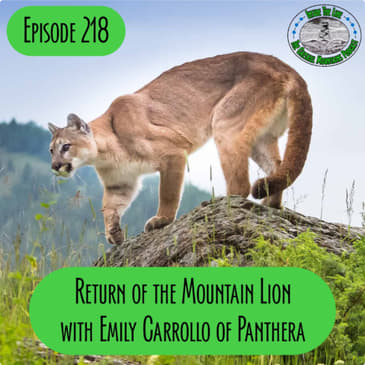
Welcome to Episode 218 of Inside The Line: The Catskill Mountains Podcast! This week, Emily Carrollo from Panthera joins us to dive into the possibility of restoring mountain lions to the Northeast—what it could mean, what it would take, and why it’s even being talked about. We also get into the importance of supporting conservation efforts, and touch on the recent tragic incident at the popular swimming spot, Fawn’s Leap. Make sure to subscribe on your favorite platform, share the show, donate if you feel like it… or just keep tuning in. I'm just grateful you're here. And as always... VOLUNTEER!!!!
Links for the Podcast: https://linktr.ee/ISLCatskillsPodcast, Donate a coffee to support the show! https://www.buymeacoffee.com/ITLCatskills, Like to be a sponsor or monthly supporter of the show? Go here! - https://www.buymeacoffee.com/ITLCatskills/membership
Thanks to the sponsors of the show: Outdoor chronicles photography - https://www.outdoorchroniclesphotography.com/, Trailbound Project - https://www.trailboundproject.com/, Camp Catskill - https://campcatskill.co/, Another Summit - https://www.guardianrevival.org/programs/another-summit
Links: Panthera, Public Support Report, Cougar Reintroduction Reddit, Cougar Habitat Papers, Natural Recolonization Papers, Public Opinion Papers
Volunteer Opportunities: Trailhead stewards for 3500 Club -https://www.catskill3500club.org/trailhead-stewardship, Catskills Trail Crew - https://www.nynjtc.org/trailcrew/catskills-trail-crew, NYNJTC Volunteering - https://www.nynjtc.org/catskills, Catskill Center - https://catskillcenter.org/, Catskill Mountain Club - https://catskillmountainclub.org/about-us/, Catskill Mountainkeeper - https://www.catskillmountainkeeper.org/
Post Hike Brews and Bites - Tavern 23, Industrial Arts Brewing, Hudson North
#mountainlions #pumas #mountainlionreintroduction #mountainlionscatskills #catskillmountains #hudsonvalley #hudsonvalleyhiking #NYC #history #husdonvalley #hikingNY #kaaterskill #bluehole #catskillhiking #visitcatskills #catskillstrails #catskillmountains #3500 #catskills #catskillpark #catskillshiker #catskillmountainsnewyork #hiking #catskill3500club #catskill3500 #hikethecatskills #hikehudson
[00:00:29] The bushwhacks were some of the worst days I've ever had in the mountains, or life really. Whereas Pantsy Mountain is totally opposite, it's a mountain on top of a crater. I think the weather challenges on this incident were particularly difficult. It is really the development of New York State. Catskills will respond to it.
[00:00:52] Passing into Inside The Line, the Catskill Mountains Podcast. Before I get on with cracking open this stuff, I gotta say social media is definitely gonna have a field day with this thing.
[00:01:19] So there's this episode. So once again, share the shit out of this episode because it is a fun episode. It's an informative episode and it has to do with my favorite topic of the Catskills and the Northeast. What's that Stosh? It's not the Goulds. But we do tie the Goulds in later on in the conversation. We do. This has to do with freaking mountain lions. Mountain lions.
[00:01:47] God damn, this is gonna be good. This is gonna be good. Are these cider drinking mountain lions? Because that would be really good. Well, hopefully they'll donate some ciders, you know? Like, I mean, they might. So, uh... So speaking of ciders, is this where you wanna, like, open a beverage or two? I got it right here. Ready? All right. I gotta do this on Facebook.
[00:02:19] At Instagram, I mean. We gotta do the open because people don't get to see this opening of our stuff. Yeah. Let me, let me turn that back to auto before I forget and screw this up. So welcome to episode 218 of inside the line, the Catskill mountains podcast tonight. Emily Carollo joins us from Panthera to talk about reintroducing the mountain lions to the Northeast.
[00:02:49] Fantastic, fantastic episode full of great information. And Emily is, uh, well into the topic of mountain lions and reintroducing them to the Northeast. And once again, I wanna big, give a big shout out to Joanne, uh, Beyond Blazes for bringing this topic up that she went and saw this down in the Hudson Valley area. So thank you, Joanne, for doing this.
[00:03:13] So, once again, share the shit out of this episode because I'd love to see this go on in the Hudson Valley and Albany and Albany and stuff where everybody's claimed they seen a mountain lion and they seriously have not seen a goddamn mountain lion in the Northeast. I mean, once again, I've seen like three or four black bears in the Northeast. I don't think somebody is gonna see a mountain lion in the Northeast. So, well, you never know.
[00:03:39] Well, later on tonight, we hear about some, you know, verified encounters in the Northeast, at least one. And then one that the DEC, uh, did not rule out that it was a mountain lion and felt that it might even be a mountain lion that had been held in captivity. Correct. That's what we've seen here in the state of New York. Yeah. Two incidents. Yeah. So. From 2011 to 2026.
[00:04:10] So, who knows? So, let's start off by saying vote in the Chronic Grammys. You can start voting now. You can vote each day, every day for us as the best regional podcast in the Chronic Grammys. We won it last year. So, let's make it a two-peat. Yeah. And I'll just, let me just add to that. Because the way the voting is, you, you can vote as many times as once a day per email address that you have.
[00:04:39] So, it's really not necessarily the quote unquote best podcast. It is the most vigorously supported podcast by its listeners. And I happen to think because our listeners are hardy outdoor people that they are the most supportive and most enthusiastic, enthusiastic listeners you can have of a podcast.
[00:05:09] So, please vote and vote often to show that you are hardy and outgoing hikers for the podcast. Thank you. Correct. Yeah. Let's do it. Yeah. Yeah. Yeah. Let's do it again. And, you know, thank you once again, if you vote and we'll try to post this as much as we can on social media for you to vote, to remind you to vote and stuff like that.
[00:05:35] So, once again, if you can't, yeah, if we don't win, we still know our listeners are dedicated to the show and that, you know, they love the show. So, speaking of our listeners and our supporters and our donors and our sponsors, I really appreciate you guys. We have made two donations to the Catskills.
[00:05:59] So, $300 recently was donated to the Heart of the Catskills Humane Society over in Delhi that deals with, of course, you know, I wouldn't say wild animals, but domesticated animals, dogs, cats, stuff like that. All around the Catskills, they do everything, adoptions, feralized cats and stuff. Really appreciate it. Once again, to the supporters and the sponsors and the donators, you know, hard-siders, donors, $300 to the Heart of the Catskills Humane Society.
[00:06:28] And then another $500 was donated to the Catskill Mountain Search and Rescue Organization of the Catskills. So, big, amazing thank yous to the sponsors, the monthly supporters and the donors of the show. Once again, as I started this up, God, it was Ted, I told Jessica that it was five years ago that I started this up. Oh, wow. I didn't want to do this to get famous or anything.
[00:06:57] I want to do this to show my love for the Catskills, to my support for the Catskills. And as you can see, $800 was put back into the Catskills from the sponsors and the supporters that we have. Can you give us a sense of what you think the Catskill Mountain Search and Rescue would use a donation like $500 for?
[00:07:18] So, as being a former search and rescue part of Catskill Mountain Search and Rescue, you know, stuff like, you know, like a litter, carrying a litter. I mean, those are not cheap. They go for a pretty good amount of money. I'm not sure, but they go hundreds and hundreds of dollars.
[00:07:36] Gear, as in sort of like, you know, maybe a rescue bag, you know, of certain stuff, medical gear, you know, that they might need on the outskirts of that. They will need to rescue someone in the winter. A lot of different things can go towards the mountain, the Catskill Mountain Search and Rescue Club, various different areas.
[00:08:01] A litter is the biggest thing because, you know, a lot of the times the Rangers will ask for assistance for a litter carryout. They will usually have a litter, but you never know that they might say, bring up a litter and we have a litter for the team and stuff. And, or they might need a, you know, one of those, I would say like on the spot litters that are easy to carry, which is, they're not, they're not cheap. Yeah. I'm just looking quickly on the line.
[00:08:28] I see a titanium litter, which appears to be more state of the art is about $2,800. And then lower cost ones, more basic litters start as low as $350, but presumably it's not as durable, heavier and less versatile than what you get for 2,800 bucks. So yeah, that's what they use it for.
[00:08:57] That's a big chunk towards a nicer winter for the search and rescue. Yeah. And as sometimes, you know, when the, they're called upon by the, by the Rangers, you know, the Rangers might not have that litter accessible at the time. They might be, it might be on the way. So we, as well, the Catskill mountain search and rescue team might have to support with their litter.
[00:09:21] So they, if they have a state of client, like state of the art litter that could be used, like the one up on dry brick Ridge, where they used it on, on a multiple instances of bringing it down by hand and then putting it on the back of a, you know, side by side or a four wheeler and stuff like that. But, you know, it needs to be top notch stuff for it to be comfortable for the patient to be transported down. Yeah.
[00:09:46] And even if you, you're going to go out and use the DEC litter on a real rescue, you ought to have one of your own to practice with. Yeah. Yeah. So, and, and not just a flimsy one. Yeah. Yeah. And, you know, once again, like trainings as well, trainings aren't cheap. You know, do you get your wilderness first aid, which is kind of like the low end and you get your wilderness first responder, which takes five days to complete.
[00:10:13] You know, you got to do multiple things out in the field and they have a bunch of courses that you can do a map and compass, you know, recovery. What, you know, which is unfortunately is like, you know, death, you know, wilderness recovery. You know, it doesn't, it's not, it's not easy. So, and it's not cheap.
[00:10:35] It's, it's seriously, you know, cost a dime and a nickel to get yourself, you know, approved with the search and rescue and stuff like that. You know, it's a good, I, I'd say it's, it's a great donation that once again, the podcast and our supporters and sponsors have, have done for, you know, it's a big impact donation because I'm, I'm sure they're not getting a lot of money from other sources. Correct. And they just started as their file, their own 501c3.
[00:11:05] So they're looking for some first time report. So thank you once again to everybody who is, or participate in the show. Great thing. And unfortunately, let's bring this topic up as a full on, on April 18th, 2026 and approximately 1157 AM teen drowning occurred down at Fawn's Leap.
[00:11:31] So the incident occurred at the base of the waterfall falls where a 15 year old male was swimming with a group of friends, all from Brooklyn, New York. The investigation at the scene revealed that the victim had jumped off the lower ledge of the base of the falls. The hydraulic current caused by the waterfall was too strong for him to swim out. And all three of his friends entered the water and attempt to pull him out, but they were unable to reach him as they started to get pulled under as well.
[00:11:57] The first response in New York Street Forest Ranger was able to get the victim and a pull on the shore. However, at that time, he had been underwater for 20 minutes. Greene County paramedics, hunter ambulance personnel commenced life saving measures and the victim was transported to Columbia Memorial Hospital where efforts were exhausted and the victim was pronounced deceased. An autopsy is scheduled for today's date, which is 420. This was released.
[00:12:28] A sheriff office office was assisted at the scene by the town of Hunter police, New York state police, New York state forest rangers, Hanes falls fire department, green county paramedics, hunter area ambulance and tannersville fire department. The roadway was closed for approximately an hour during the river recovery efforts. The investigation is continuing.
[00:13:17] As we see the time of year, the water is extremely cold. So I would say hypothermia had to be a part of this, but also the current brings them down. And that area is known for the kind of the succulent current to be falling in to drag you underneath. And, you know, with that, once again, hypothermia comes in, you're put in the water as I've been in.
[00:13:45] I've been in black clove during the summer. And I have been, I've jumped in and I have been overwhelmed with how cold it is in the summer. With it being April, I would say that it's much colder. We're in the, I'm guessing we're talking the low fifties of the water temperature. I would probably suspect it was colder than that.
[00:14:09] I mean, even though it was a warm day, you know, that mount, that is mountain water, you know, flowing, you know, out of the ground and down from higher elevations. Uh, I don't suspect the water temperature was comfortably comfortable temperature was probably cold. And there's a thing known as cold water shock that, um, just really kind of like just sucks the life or the air out of somebody when they hit the water like that.
[00:14:38] And then he has the, the being pulled down by the waterfall itself, the hydraulics. It's a very sad situation. And you got to wonder what level of experience and knowledge he had and those who were with him had how strong or not so strong of a swimmer this person was. Uh, but what impressed me was that within 20 minutes of the call being made, a DEC ranger responded and pulled this fellow out of the water.
[00:15:08] Uh, I, I find that, um, impressive that the ranger got there and was able to pull the fellow out that fast. Albeit by then it seems like he had already succumbed, succumbed to the conditions. Yeah. And you, like you said, 20 minutes with the ranger possibly jumping in, in full gear, you know, with the, with the, you know, they don't wear t-shirts and shorts.
[00:15:35] They wear full on long sleeve and pants. So who knows, uh, who the ranger was? I haven't heard yet, but usually it's ranger Dawson. That's of the area. And ranger Dawson is extremely experienced with the caterskill clove area. He is a phenomenal human being. He's a phenomenal ranger.
[00:15:57] As I've worked with him several times with not just only with the catskill mountain search and rescue team, but with just individually hiked with him and talked with him. He is extremely experienced. And he, if that was him or any other ranger that was involved, amazing job. Like, like you said, 20 minutes later, pulled the kid out, you know, who knows where that ranger was.
[00:16:26] And especially like you said, the water temperatures, I said it was fifties. It might've been in the low forties. And, you know, I just, I just pulled up a green County sheriff's report that claims it was ranger Peterson. Peterson. Okay. Okay. I mean, still Peterson. I've, I'm not, I'm not familiar with, uh, in that area, but that that's phenomenal. Phenomenal work.
[00:16:54] Uh, it just, it sucks. And, you know, 15 years old, like once again, I hate to say it, but like the body mass with the cold water shock happens a lot quicker. Hypothermia happens a lot quicker. And, you know, like you said, the, the cold water shock, he might've just jumped in and kind of just.
[00:17:17] It'd been immobilized and pulled in by the current and then the kids couldn't get them out and just, ah, it's, it sucks. And again, it's, this is why. So he was swimming, swimming with, apparently with three other people. You don't know what the level of experience these folks had, and maybe they weren't able to recognize and appreciate the nature of the conditions, the hydraulics.
[00:17:46] And my understanding is that there are safety warnings posted in that area, which apparently they didn't heed to. Yeah. I mean, there's this, it's all over that area. Yeah. Well, you know, talk about, uh, feeling really bad, you know, in retrospect. Wow. Yeah.
[00:18:11] And it's, it's an area that's extremely popular as we've seen from social media and such, you know, people jumping up the top ledge. Uh, I mean, I remember seeing a couple of years ago, some old 67 year old guy doing like three flips from one of the trees up there. So, and it, of course, soared with social media, you know, hundreds of thousands of views.
[00:18:36] And then we, we get this, you know, happening on a somewhat warm winter day in April. So, you know, like I said, I've been over in the Platte Clove area and I've jumped in the water in the middle of July when it was, you know, 85 degrees. And I got shocked with the water. I was like, I, I wish I, I'll probably share it. I've done it before.
[00:18:58] And I was like, and I could barely get up the ledge, you know, it's, it's, it's just extremely cold in those areas that don't see much sun. And it's just water, like you said, running off of the mountains that, that have trees covering the whole time. So, ah, unfortunate incident, you know,
[00:19:19] very sad, you know, feeling for him, his family, his friends, awful, you know, but thank you to all the, the responders that, that went out and to, to get that. So I hate to bring this up, but later on we'll, we'll talk about mountain lions. So kind of rebounds, but better.
[00:19:40] So one thing I would like to do is thank all the monthly supporters like Bob McClendon, Chris Garabian, Eric Rosario, Jeff Jotz, Vicky Ferreria, Mikey S, Henry Burmeister, John Comissy, Summit Seekers, Desert City Radio, Betsy A, Denise W, Vanessa, Jim C. Love you guys so much. Thank you for supporting the show. Once again, as you heard from earlier, your donations, your gifts that the show receives goes back in the Catskills.
[00:20:10] Just like our amazing sponsors, like outdoor Chronicles photography. Molly specializes in adventure couple photography, and she will immortalize your moments of his stunning landscapes of the Catskills, Adirondacks, and White Mountains. She'll craft timeless images that reflect unique bond and nature's grandeur. Embark on an unforgettable photographic journey with outdoor Chronicles photography. Don't hesitate to get a hold of Molly on all platforms.
[00:20:39] Also, if you want to discover the wilderness you should get with Trailbound Project, our expert-led hiking and backpacking education programs offer unparalleled outdoor experiences. Whether you're a beginner or seasoned adventurer, join us to learn essential skills, explore stunning trails, and connect with nature. Start your journey today with Trailbound Project and unlock the wonders of the great outdoors.
[00:21:05] So as I take a swig of this amazing cider, are you really outdoors? If you mention the podcast on one of your hikes through social media, we'll chat about it on the show. Tag us by typing at ITL Catskill MTM Podcast on your post. Now, I don't know how this works on Facebook. I don't think it works on Facebook. Luckily, I saw someone on Facebook that posted about it, and they tagged us. So I got lucky on that one, so I'll talk about that later.
[00:21:36] So Paul 1976 Smith went up Peekamoose from Buttermilk Falls, which he thinks should be renamed Peekamoose Falls. And I think, Tad, you noted that this—I think this was a bushwhack. For him, yeah, that's a cool area to go in from. So that's steep as heck once you get up above that area going up through the Peekamoose Valley. Yeah. It's dicey. Yeah, I suppose so. Suppose so.
[00:22:05] So he went up there on Saturday? I would imagine that was a pretty good day to get up in there. Yeah, 100%. A lot of—it's a lot of good flow with the blue lines right now. Yeah. It's pre-nettle season, and that's significant. Prime bushwhack season, as we all know. Yeah.
[00:22:28] Also, Eric, Catskill Mountain Hiker went up Bear Mountain down in the Harriman area, right? Yeah. Okay, okay. I'm getting more and more familiar with the Hudson Valley area. Sorry. That's a very interesting hike. Just a ton of people, though, if I know where he was. It's just heavily trafficked. Yeah.
[00:22:53] And as—what's the area that's closed off right now that everybody used to go up that has scrambles up? Breakneck Ridge. That's on the other side of the river. Okay. Of Bear Mountain, right? Yes. Bear Mountain's on the west side of the Hudson. Breakneck is on the east. Okay. So, I'm getting—I'm starting to get more familiar with the Hudson Valley area. Yeah. I drove through there today, and I just—I was gazing to the left and the right as I was driving up the Palisades.
[00:23:21] And, you know, there's a lot of appeal to Harriman, and I see why some of our hardcore Catskill hikers who kind of cut their teeth over in Harriman still go back there to do a bunch of hiking like Joe Animal. And moderately—I'm not calling him. What is his new— Moderately mischievous. I'm just—I'm going to call him moderately mischievous. I see him go over there a lot. They take some really interesting photos, and they get around. And I've been there a few times.
[00:23:50] And if he can't make it up to the Catskills, that's a good place to stop and get out and do some hiking. They got great views and stuff. Yeah. I'm jealous of anybody—I know this is weird coming from someone who lives very far away from New York City, but I am jealous. If somebody can see the New York City skyline from some view up in the Gunks or the Harriman area, I—it's just cool.
[00:24:19] I saw it one time when I did a search and rescue, like, drill down there, and I saw it at night, which was something else. So, amazing. So, Lisa Kana Quazotic was up at Westkill bumping out her grid, and she's over 200 now on her grid. Yeah, kudos to her. Yeah. So, she's almost halfway there, right? 210 is when it needs to be? Yeah, 210 would be halfway.
[00:24:45] And I did ask her where her sister is, and apparently her sister is finishing up her studies to become a dental hygienist. And then the two were going to reunite again. So, it's good to hear. Okay. Yeah. Well, once she gets her—hopefully, her practice going, we'll all go to her.
[00:25:07] So, Mike at Red Hand Adventure Guides was out in Pennsylvania Game Lands over the Upper Delaware Scenic Recreation Area, and then went and enjoyed some empty trails at the Loyal Stock State Forest in PA as well. So, good to hear from you, Mike. Also, Scott, Catskill Mountain Brew was uphawkett with Sean and Lori. And then off in the woods, Sean was uphawkett with Scott and Lori. So, it's good to hear from both of them, back and forth.
[00:25:37] Scott and Sean often hiked together, so it's really good. I've hiked with Sean and Scott, both cool MFers. Yeah, I believe I've met them off in the trail before. Yes, you met them on Slide in Wittenberg and Cornell, Burrell's Range. Yeah. Remember the hike. Yeah. Todd, T-Bold Outdoors stayed local in Harriman and did West Mountain, Black Mountain, Silverbine Lake, and part of the 18. He also did some paddling as well.
[00:26:05] So, took advantage of the warmer weather and did some paddling. I am jealous as heck as people that get to do paddling and stuff. I'm jealous as heck of people all these free time. So, good for you. Use that up. Tracy, Pink Pony 18 was up Lenox Mountain in Massachusetts. So, she seems to be getting over in Massachusetts a lot. Yeah, I mean, maybe she's hitting up some list or challenge over there.
[00:26:35] But that too, my impression is over there, it's some pretty interesting terrain in the Berkshires, depending which way she got up there. It's got some elevation or pitch to get up there. But if you were out on Saturday, you had picture-perfect weather to go hiking. Yeah. Absolutely, pitch-perfect. So, Joe J. Kapolow was out doing some hiking at Bear Mountain as well.
[00:27:03] Joanne Beyond Blazes was up Panther and did a WAC. Where was this approach from, Ted? Did you see? Yeah, I didn't get any details from her. That would be interesting to hear which way she went up there. I've been up Panther quite a few different ways. It's always interesting to hear how other people do it and, you know, she just went up and down the same ridge or spotted a car. And what you see along the way, as I pointed out a couple weeks ago, my hike through that
[00:27:34] desiccated hemlock grove, you know, it's kind of overwhelming. So, I know there's a lot of great hemlock groves on Panther. Be nice to know how they're doing. Yeah, correct. I mean, I hit some area from the Panther kill that didn't look too well. So, maybe. I mean, there's several. Like, I gotta admit, there's probably like one, two, like six different arms that you can go up Panther. Well, there's more than that. Do you think? Oh, yeah.
[00:28:02] Because it's, the one unique thing about Panther is how the esopus goes around it. There's really only one contiguous or continuous ridge that connects Panther to any other mountain, and that's giant ledge to slide. Otherwise, all other ridges going around Panther generally go into the esopus. True. So, yeah, that's what makes it interesting.
[00:28:32] You know, when you can have some long hikes, I've hiked up Panther a couple times from all the way down on Route 28. So, that's a pretty long hike, and then you can always take the trail in. You know, what's that? From Fox Hollow. Yeah. You know, and then there's plenty of approaches coming in from the Woodland Valley area and off of Woodland Valley Road. Like I said, you can hit it from a lot of different angles, a lot of diversity there.
[00:29:01] But what does make it unique, it is that it's over 3,500 feet, but it is really isolated from everything other than giant ledge and slide mountain. Yeah, exactly. And several ways to approach it, so check it out.
[00:29:19] So, also, Joe J. Kaplow again did the Pop-a-lo-pen, Pop-a-lo-pen, Torn as part of his seven summit hikes. So, he's doing something that I forgot to, it's like the downstate New York 28. It's pretty neat. So, it's a new challenge that's going around. I'll have to check that out. Maybe I'll do it.
[00:29:50] What I'm… You won't give up your grid. Come on. I'm kind of recalibrating my grid plans, so I don't become… Grid 16.0. Yeah. I don't want to become grid obsessed. I'm not Tom Martone. Right? He's a hiking machine. Same with Jim and Margaret. My God damn, they've done like grid 18.0. Yeah. Yeah. So, God, we got to get Jim on here. He only will do it in person. That's fine.
[00:30:17] So, we got to find out a mutual place. I would say Schneider's. We'll have to do something. So, Vicky, Hiker Goddess Adventures, was up twin in Indian Head and also reminiscing about her awesome accomplishment of completing her winter high peaks this year. So, congratulations, Vicky again. It was a great winter to get out there and finish up your winter list. Yeah. It was definitely a winter.
[00:30:47] Mm-hmm. Let's state that because, you know, previous, I would say 10 years that have hiked, that it just has been like kind of just ice. So, we've barely gotten any snow. This year was significant amount of snow. Yeah. We had some notable weekends up in the Catskills this past winter and we shouldn't exclude this past weekend from that comment. Yeah, right. Isn't that crazy? You know, 80 degree temperatures and then all of a sudden it gets back down.
[00:31:17] Yeah. And then you'll chat about that later, which I'm excited to hear about. I suppose so, yeah. Yeah. And then last but not least, Rob, aka the Sloth Tramps and Matt, did a three-day traverse of the Burroughs Range and got caught in the snowstorm on Sunday on the way back down. So, I just shared this. I'm sorry I shared this late, Rob, but I got to admit that was awesome video of his stuff going through the Burroughs Range. I found it. Yeah. Is this on Instagram? I have to check this out.
[00:31:48] Three days. I did. Yeah. I just shared it. Oh, right. Probably like four or five hours ago. So, was he up there on Saturday and Sunday? He was. Wow. Wow. So, he did. So, was it three days? So, Friday, Saturday, and then came down Sunday. So, he got caught in a snowstorm on the way down. Yeah. So, awesome, awesome video. So, check him out, the Sloth Tramps. Cool stuff. So, thank you, everybody who tagged the show. Really appreciate it.
[00:32:17] Really appreciate you listening to the show and knowing about the show. I just, I find it phenomenal. Once again, this Catskill community is super tight. Also, if you think we're doing a good job and you want to support the show and support the Catskills as well, buy us a coffee, hard cider on buymeacoffee.com. It's really buy me a cider, but it's buymeacoffee.com. It's in the show notes. And you can support us and the Catskills.
[00:32:45] So, also, if you have the chance, rate the show. You know, Tad shared a little experience, the story about someone complimenting the show. So, if you compliment the show with a rating and stuff like that, Tad maybe might share it on a story. So, I mean, I will too as well. And also, don't forget to vote in the chronogram. Yeah, vote at least once a day. Vote more often per day if you have more than one email address. I'm just saying.
[00:33:15] I mean, it's like, do you just have one pair of hiking shoes or do you have many? Do you have just one email or do you have a few emails? You know, I'm just throwing that out there. You know, I don't want anybody to say that the election's rigged. Yeah, I mean, you know. Do you wear Cthulhu's? Do you wear Hillsons? If you wear both, vote both times. There you go. So, what are you drinking, Tad?
[00:33:37] Oh, so I have a industrial arts brewing wrench, hazy IPA. Our guest from a few weeks ago mentioned industrial arts from... He knew the owner. I had discovered these beers a few weeks before that. I've become somewhat fond of their IPAs because they are very drinkable, very little bitterness,
[00:34:06] just enough to serve the purpose of balancing out the hoppiness and juiciness of it. So, this is the lush, zesty IPA coming in at a 7.1% alcohol volume. Definitely drink it again. Nice. That's beacon. That's close. Yeah. Nice. Yeah. And, you know, the nicest thing about you, you buy something like this.
[00:34:33] I think this thing was canned last month. It's not even a month old. Jesus. Yeah. That's awesome. March 10th. So, five weeks. Does it show you on the can? Yeah. I mean, you definitely need to look at the can to see if it's got a package down date because you don't want to drink old beer. Yeah, right? Dasha's looking at his right now. He's spilling it all over his desk. I mean, I don't see that.
[00:35:02] Oh, wait, wait, wait, wait, wait. 1999. 5, 10, 26. Not at all. Yeah. That's maybe a best buy date. Yeah. Whoopsie. Better drink it fast. I know. I was going to say. So, I have a good old Hudson North peach mango. I got to finish these up as I bought these from Hannaford when they were having like a closeout. Like they were all like $4.99.
[00:35:30] So, I like bought like one, two, three, four, 12 packs. So, 12 packs of four. So, that's 12, 24, 36, 48. A buck and a quarter or a can. Yeah. That's not bad. It was. I seriously had to flush out. They were just like, oh, I got to get a cart now. So. Did you like rent a van to take them all home in or? You're in the back. I got a frunk. I got a frunk in the Tesla. Remember? I don't have an engine.
[00:35:58] So, are you worried like if you break open a can and the cider gets out, it'll short out the battery? True. Yeah. I mean, never thought about that. The battery is actually underneath the seat. It's underneath the whole seat. You just keep telling yourself that as your vehicle's going up in flames. It's only under the seat. Hey, you know what's great?
[00:36:20] Is that I see people running out of electricity on their cars, on their gas cars, and they got to get an electric charge for it. Mm-hmm. Okay. I will go first.
[00:36:45] I, on Sunday, I was thinking about taking the day off because it was sketchy weather. Down below around, you know, 1,200 feet of where I live. It was rain. But I knew it was kind of be nice, nicer up above. So, of course, I chose good old Bramley. And I got beautiful snow, wet, heavy snow.
[00:37:13] Didn't have to use micro spikes and such. And I just enjoyed it thoroughly. It's kind of like, you know, I was like, could this be the last time? We usually see this in April, mid-April as the last kind of like hardcore snow, heavy snow, because, you know, it's been warm and stuff. So, I enjoyed it thoroughly. I got called out. On a, on my, my Facebook post of the guy said, I don't have a date or location.
[00:37:42] I'm not going to believe this. I'm like, the fuck's your problem? Whatever. So, yeah, I went up on Bramley, beautiful, heavy, wet snow. Just absolutely enjoyed it thoroughly on Sunday. And then today, Tuesday, I was, my plan Sunday was to go up and do trail maintenance. I'm going to go up and do trail maintenance on Thomas Cole. My, my area from Camel's Hump to Thomas Cole. And I just didn't want to do that.
[00:38:10] So, I did today on a beautiful day. And I decided to choose a different route up Thomas Cole. Okay. Well, sort of, sort of Camel's Hump. So, have you ever heard of the Pine Kill Lane area? Oh, I will. If you keep talking, I'm going to look that up and I'm going to see if I know that area.
[00:38:34] So, if you go down the Big Hollow Valley, there is an area called Pine Hill Meadows. And then it converts over to Pine Hill Lane. I saw this once on the maps that I was just, I was very curious. It's very weird as it's kind of like, I kind of compare it to Shaft Road because the parking area is absolutely insane.
[00:38:59] It's kind of goes up and then it just turns into a big circle area and you have an enormous amount of parking spots. And then as you look at the, the bushwhack, the kind of DEC property up, it goes wide and then it thins very, very narrow up to the top of where it meets to DEC, actual Catskill Park area from the, the Big Hollow area. And I was just like, you know what?
[00:39:28] I'm not, I'm not saying I'm sick and tired to go in the Barnum Road area as I love that hike because it gives you views. It gives you good switchbacks, climbing, stuff like that. But I was just like, you know, I'll try something different. So, I went up from this area. So, what road are you off of now? It's, uh, Pine. Is that off of Big Hollow Road or something? Off of Big Hollow, almost right across from the, the CD lane parking area or CD lane park.
[00:39:59] It's called Pinekill Lane and, and then it, it kind of reintroduces the Pinekill Meadow. It's very, very weird because I looked it up. I know it sounds weird, but on the Tesla, it has a big, huge map that shows you where you're going. And I saw this and I was just like, oh, interesting. Oh, yeah, yeah, yeah, yeah. I know where you are. Okay. Okay. Have you been up there? Uh, I have been up on the next ridge over from that, but in, I've done that, that vicinity.
[00:40:27] I'd be interested to hear about a hemlock forest and spruce forest through there. There's none. No? There's very, there's very little at the bottom. What about any plantations? I know the way I normally go up through there, it's all plantation. Nope. No. It was in the beginning. It was a little bit of hemlocks and it wasn't bad. There wasn't, there wasn't any problems, but there was definitely a lot of blow down and it was, I would say. And what was the parking lot at the end of the road?
[00:40:56] Like it was, it was massive. Yeah. There's. But nobody goes there because there's nothing to do out there unless you're bushwhacking. Yeah. To be honest, I got to admit the bushwhack was uneventful. Yeah. It was just a normal kind of route. Yeah. I mean, it's, you gotta, you gotta know where your, your head route is and you gotta know your destination and you gotta keep kind of like a narrow area because it goes from wide to extremely narrow. Yeah.
[00:41:25] I would say there's a little dog leg to the right to what I see as you're going up. Yeah. Yeah. Yeah. A little, little tiny bit. It, so that, that type of ridge would be harder to come down than go up. Oh, it's pretty easy. Well, but going, no, going down it navigationally, either you've gotta be paying very close attention to your compass and map, or you just gotta pull out your GPS to make sure you do that dog leg coming down to the left. Correct. To the Pine Hill Road or, or what it is, whatever they call it. A Pine Hill. Road.
[00:41:55] Yeah. No, but that looks interesting. I never saw that that was a DEP or DEC land before. Yeah. I'll put it on my list because I've, I've whacked out those other three ridges that go up to the blacks and Thomas Cole from Big Hollow.
[00:42:40] So. Yeah. Yeah. It's just. Yeah. They didn't know what they were getting into. So here, here's my pro tip before you continue. If you're gridding or you just want to whack out the four off of Big Hollow Road, uh, Wind Dome, Blackhead, Black Dome, and Thomas Cole. Um, I would drop my car on this, uh, Pine Kill Meadow Road and cycle over to Peck Road and or vice versa.
[00:43:11] Yeah. And just, and just do that loop. I'm going to definitely check it out my next time. I gotta hit those. It's seriously right there. Yeah. Yeah. And then, uh, also you have the option of walking down that road and doing that parking area that goes up Windham High Peak. You can bushwhack up Windham High Peak, get the trail that goes all the way around and then bushwhack down to the Pine Kill Meadow area. It cuts off from Barnum Road. It cuts off about a mile.
[00:43:40] Yeah. The elevation gain is still the same. So I had any ledges. No, not at all. Doesn't look very, very five foot ledges. Not even. And you meet right up between, between Claude's Hill and Campbell's Hump. And then you hit the trail and you can fly up the trail to Campbell's Hump, Thomas Cole. And that's what I did as it's just, I hit the trail right there, flew up Campbell's Hump and Thomas Cole did some trail maintenance.
[00:44:08] I had, I had my machete with me to knock off some. Jesus. To take care of any, any mountain lions that have been put in the area for, you know, reintroduction purposes. Okay. That's true. I mean, there was some vines hitting out. And I know that area gets shitty during the summer. I've dealt with it before. And on the way up, I had my machete. I kind of just hit a bunch of areas.
[00:44:35] And then I noticed there was actually from my previous, I've been doing this for over 10 years now, that there was blowdown. A lot of pretty decent blowdown that I've had to, I went up and I, you know, to be honest, on the way up, there was still an inch of snow going up to the hump. And then up from Campbell's Hump with Thomas Cole there, it got even deeper. It was like around an inch and a half, two inches going up Thomas Cole.
[00:45:01] And once again, I talk about this later as I followed a coyote trail all the way up from Campbell's Hump on trail all the way up to Thomas Cole. It was pretty neat. It was pretty cool that this coyote broke trail before me. And that's the nice thing about hiking in very thin snow cover like this. It's really easy to see the animal tracks. Yeah, it was pretty cool. And they got up to the summit and they seriously looked like they went and summited.
[00:45:31] And they, you know, that one little spot and then came back down and then went on the black dome. I'm like, oh, this coyote is completing his grid. And I went back down and I actually had to back down. I brought the saw and I used the saw. But, you know, I did not use spikes. I didn't need to. But I was very grateful for my hiking poles.
[00:45:55] I don't know how people don't use hiking poles on these kind of situations of where they have to go down and they kind of catch themselves. Especially when bushwhacking is, you know, I kind of like hyper extended my leg and I'd have to catch myself with my poles. And I seriously don't know how you do it, Tad. Like, it's insane. Well, you know, I think it's part of the ground cover and what there's there to grab on in lieu of poles.
[00:46:21] Because that's what I find myself doing often going downhill is just, you know, grabbing on the beach whips and trees. Hobble bushes are worth nothing going downhill or uphill. They can be helpful. All downhill are just a complete annoyance. And should be considered an invasive species and eradicated by the DEC. Yeah.
[00:46:46] And like, this area bushwhacking down was full of nothing. Like, it looked like it was previously forested and it was taken out and it was very open. And it wasn't bad. You know, it was a quick way down. I think I got faster down going that way than I did with Barnum Hollow. And it was just an uneventful bushwhack, I would say. I don't think I would go there again. Really? I would say.
[00:47:14] But, I mean, there was uneventful. I kind of, like, you know, maybe like a blue, like you do blue line or some different forest. It was just, it was cool to keep along that area of the DEC and to make sure that, once again, as it thins up, it seriously got probably like 20 feet. Like, between property lines. So, I was just like, oh, cool. Like, I made it. I did actually really good navigational purposes.
[00:47:42] And then, once again, you hit that little area and then it's all DEC property. So, you don't have to give a shit. So, it was a cool time. Trail maintained. I was pretty satisfied. Beautiful day. Beautiful views. Hit that, once again, that area between Camel's Hump and Thomas Cole, that little flat area of the call. It's just one of those phenomenal, it's like Panther Plains. It just gives you that vibe of beauty and stuff like that. So, awesome time. Tad, what about you?
[00:48:11] Yeah, and just so we can finish that up, you started on DEP land. Is that DEP? Yeah. According to the tax map, that's DEP. Oh, cool. Cool. That's pretty neat. Yeah, it'd be, it's just shy of 90 acres. It'd be interesting to see when the city of New York acquired it. I can look into that. Please do, because like I said, that whole, as you can see, that whole road is actually well maintained. Mm-hmm.
[00:48:41] And they plow it in the winter. So, I wonder what it was going to be. That's kind of like what I was curious of, like why this was made. Like why was this kind of roundabout? Was this supposed to be some sort of like area where like people were going to build houses and it kind of didn't happen? So, it's pretty neat. Well, I'm seeing, I'm seeing that this looks like there was a recent subdivision there. Pine, Pine Kill Meadows was the name of it.
[00:49:11] Yeah. And sometimes you see these subdivisions, they're able to get the density in the subdivision smaller lot sizes by doing what they call a conservation subdivision. And part of that might've been getting the DEP to take over the land in the back. But I can check that out. It's somewhat interesting to me. Yeah, right? Were the houses nice on that road?
[00:49:39] As a startup, they were. Yeah. They were pretty decent. Yeah. But it still didn't look like the crazy, you know, like half a million to a million dollar houses. They look like normal houses and then from up in there, there was nothing. So, like I said, it was like I was very curious of what this was going to be and then it folded and then it became the DEP property. Yeah. But it says DEC on it though. It doesn't say DEP property. Really? Huh.
[00:50:09] Yeah, there's DEC signs. I sent you that sign. That's the signs all around the area. Oh, really? I know one of the ridges I hike up there, you see the two signs. You see the DEP markings and then you see the DE sign. Literally, it's like in the middle of the woods and nowhere. And all of a sudden there's a DEC sign saying you're crossing over. So, all right. Sounds like a great hike. You've inspired me to like go and explore that area. You do your thing. Now, what did you do?
[00:50:38] So, I spent Friday in my car for 10 hours and 42 minutes driving back to New York from West Virginia. And I spent so much time in the car that the last thing I wanted to do on Saturday, as beautiful as it was, was hop in the car, drive an hour and go hiking.
[00:51:03] And I say that somewhat earnestly because truth be told, come Saturday night when my wife and I decided that we opted for takeout as opposed to making something at home. I really had a hard time getting in the car to go drive 10 minutes to pick up the takeout. Right? And the weather forecast for Sunday just had written all over it, not a hiking day. Rain, rain, and more rain throughout the day.
[00:51:33] So, I had written off the prospect of hiking on Sunday. And so, then I found myself Sunday morning finishing up my second cup of coffee, thinking about all of the boring and mundane things I could do, like clean my home office, put away my tax papers, yada, yada, yada. You know, like these things that really deserve to be put off forever.
[00:51:57] And as I was ready to make the third cup of coffee, I really checked out the weather, checked out color radar. And I realized that the likelihood of it snowing at higher elevations in the Catskills was real. And so, I said, why not? Grab my pack, threw a few things in it, like some water.
[00:52:25] And I actually put an extra rain jacket in it because I figured if it's going to be really, really wet and I get up there, I'm going to wet out whatever rain jacket I'm wearing, you know, halfway up. And then put another one on and I'll have the third one for the way down. And I just headed out. And as I'm driving up, I'm thinking about what's on my list.
[00:52:46] My grid 2.0 list is an easy up and down hike that doesn't really connect with any multiple mountain hike that I would do next April. And I decided to do Southwest Hunter. And the way up, I was considering whether or not to do it from 2.14, which in retrospect, maybe I should have done. But instead, I went out to the end of Sprucedon Road as I'm driving over.
[00:53:16] The rain is, you know, getting more frozen. Eventually, it turns into snow as I'm driving down Sprucedon Road. And by the time I got to the end of Sprucedon Road, where that last parking area is, there was no cars there, but there was snow on the ground and it was snowing.
[00:53:36] So I geared up, hopped on the trail, took the trail all the way up, rail trail out to Southwest Hunter and rail trail back down. And I kind of thought of for a moment, like bushwhacking down, like the last time I was up there this winter and bushwhacked down, which turned out to be an epic bushwhack. But I thought just to do an up and down and get back home as quickly as I could. So I did.
[00:54:04] I banged out the hike and ran around three hours. Nice. Yeah, and less than three hours driving over and back. So I got a quick hike in on Sunday. And yeah, even though kind of like that hike is in general, you can say it's a ho-hum hike. But all things considered, I got out and hiked on Sunday. And that's what's important. Dude, I mean, the ho-hum.
[00:54:31] I would just say that getting up in the different types of forest and then going along the rail trail, it just feels different. And the rail trail just offers an amount of history that you're just like, I used to be on this freaking area that used to have a railroad here. Yeah. Well, I've hiked that hike so many times. And I'll say Southwest Hunter is one of those mountains that I've beaten up from just about every angle.
[00:55:00] So hiking up and down on the trail is not something that in the abstract would be all inspiring. But what was really epic about the day was the fact that the day before people were out in shorts, short-sleeved shirts, and really warm weather and not worried about getting cold.
[00:55:22] And I will honestly say on my way up, as I'm motoring up the Devil's Path off of Sprucedon Road, on my way up, I was probably the coldest I've been all winter with the exception of that day I did Balsam Lake Mountain when with the wind chill, who knows how far below zero it was, but it was epically cold that day.
[00:55:49] But this is the only time this winter that really my hands were cold on a hike, if you can figure that out. I mean, I don't know. It's not like I had big burly gloves on, on the one hand, but on the other hand, some pun maybe there. But yeah, I just like, I'm like, wow, my hands are cold. Strange. So it was great. You know, I mean, it's just one of these things where, you know, just get out and hike, you know, no matter what, just go out.
[00:56:17] You know, and I also thought that it's, if I got up there and it was really raining, raining, I did have an umbrella with me. I did have my rain pants with me. I was really expecting to run into wet conditions. And my thinking on that was, well, that's good. You know, you go up there if it's really wet. Then this is just a good, you know, on a short, easy hike. This is just, you know, good way of testing your gear, how it responds in these conditions.
[00:56:46] And definitely. Yeah. And just putting that, yeah. Imagine your head for the next time that you're out there and you're further out there and it becomes more and more important, you know, staying warm. Because when you're really, when you're out there in those cold conditions, hypothermia becomes a real risk. I mean, you can get hypothermia when the ambient temperature's in the 40s. So it doesn't have to be super cold. Sweet, man. Congratulations. Yeah.
[00:57:16] That's awesome. Now, I mean, the scenery must have been beautiful with the snow. Yeah. You know, I mean, it was scenic, you know. I mean, so the one thing, I had read this article in the past week about different meditative states, consciousness, you know, all this esoteric shit. And one of the things that talked about was the virtue of being in isolation or in solitude.
[00:57:46] And when you're not around other people, it kind of diffuses, if you will, your sense of self and your personal boundaries and your personal character, your personal space becomes more of this fuzzy area. And you can connect more with your surroundings.
[00:58:09] And so that's one of the things I was trying to see is that feeling or experience as I was going up the mountain. So you'll have to stay tuned. Yeah. Read more of that article and do a lot more solo liking maybe every Saturday for the indefinite future to complete this study. Yeah. I'll send me that study, please. I hate solo all the time. So I'll agree. So all right. Excellent. Glad we both got out, man. That's awesome. Yeah.
[00:58:37] So glad people got out. So it was good. So once again, Catskill News, Volunteer, New York, New Jersey Trail Conference, Catskill 3500 Club, Catskill Trail Crew, Catskill Mountain Club, Visitor Center, Jolly Robish Trail Crew. Anywhere you can volunteer makes a big difference in the Catskills. Also, if you need stickers, send me a message or go to Camp Catskill in Tannersville.
[00:59:04] So what are we going to hear from the weather forecast? Let's see. Here is your weekend weather forecast sponsored by Stasha's Mountain Lion Tours. After this episode, you'll be convinced that you want to go on a mountain lion tour with me. Donate a few hardsiders and I'll find you a mountain lion. Mountain weather forecast was surprisingly accurate last week. So let's see how well it will do this weekend.
[00:59:31] On Friday, April 24th, expect some clouds in the morning to partly cloudy in the afternoon, a high of 41, a low of 36 and wind chills reaching down to 23 degrees. On Saturday, April 25th, expect snow throughout the day with total accumulations up to three inches, a high of 34, a low of 32 and wind chills reaching down to 19 degrees.
[00:59:58] On Sunday, April 26th, expect cloudy skies in the morning to rain showers in the afternoon, a high of 37, a low of 34 and wind chills reaching down to 28 degrees. So once again, don't forget those spikes because it might be icy. Be safe, be prepared and don't become tomorrow's rescue story. Have fun with the mountain lions, fellas. Thank you for that detailed weather forecast.
[01:00:27] Appreciate it, Stosh, whoever that guy is. Yeah, hope it's correct. Yeah, right. Last time was actually it was pretty. I mean, we didn't get four inches, but we got pretty. We got snow. So Catskill Mountain, whatever the mountain weather forecast I follow is was accurate this time instead of in crazy. Like out of the world.
[01:00:51] So how about we get on to the last set of sponsors and then we get on to Emily and talk about mountain lion reintroduction to the Northeast. Let's do it. Awesome. So discover Camp Catskill in Tannersville, your ultimate hiking store. Find top quality gear, apparel and accessories for all your outdoor adventures. Our expert staff is to hear and help every hiker from beginner to seasoned pros.
[01:01:17] We also carry a variety of new capsule souvenirs and gifts. Visit us online at campcatskill.co or in the store to gear up for your next journey. Adventure starts at Camp Catskill. Also embark on a transformative journey with another summit. Another summit is dedicated to serving veterans and first responders with free outdoor activities. Activities like walks in nature, paddling, hiking and even backpacking.
[01:01:44] Join our supportive community to rejuvenate in nature's embrace. Experience commodity, adventure and healing at no cost. Take your next step with another summit and ascend to new heights of resilience and joy. Apply today on another summit.org. So let's get on to the guest of the night. Let's go. So tonight, Emily Carollo. Is that correct? Yep, that is correct. Nailed it.
[01:02:14] So the interview can continue. It can. It can. So tonight, Emily Carollo joins us tonight from Panthera, which is protection of mountain lions and reintroducing mountain lions to the northeast. So Panthera is a company that's devoted to conservation of the world's 40 species of wildcasts and the vast ecosystem they inhabit. And Emily is currently the Cougar Research Collaborative Project Coordinator for the program.
[01:02:43] So this is huge. This is huge. And I say, I say this, I'm going to say this in the beginning when we record. Social media is going to have a field day with this. So I am sure it will. It's such a mountain lions in the northeast, despite not being here right now. And as a side note, I'm probably going to interchange between like mountain lions and pumas and cougars, like just interspersed. It's all the same animal just as a side note. I can get into that a little bit further. But if you like, you're like, wait a minute. What? I'm confused.
[01:03:13] What did you just say? That's why. Doesn't it like go by, I would like sectors like down in, you know, down in Florida, their pumas move a little bit more up north, their cougars. And then as you move to the northeast, their mountain lions. Yeah. So, I mean, basically pumas range all the way from the, you know, Canada down to the southern tips of Chile. And so they encounter just so many different people and they've picked up so many common names throughout that process that that's basically where that comes from.
[01:03:40] But there does tend to be, to your point, like there's like a regional dialect or name typically what you see in certain places. Actually, there was a fun little quiz I did the other day from the New York Times like over 10 years ago. And it was like, what's your regional dialect? You know, like how do you speak? And one of the questions was, what do you call, you know, like pumas, right? But it was like this large cat that's typical North America. And they had all the different options. And I was like, that's so wild. That's just, I don't know.
[01:04:07] I thought it was really fun that they, you know, got on that. Yeah. It's definitely a hot topic. I mean, not as crazy hot as it was once was during the COVID era and stuff like that. But, you know, I'm grateful to have you on, Emily. Join us to talk about this because I am a big mountain lion fan, number one. And number two, I love to shut people down and tell them that there's nothing up here.
[01:04:32] So we're going to talk about this and maybe talk about reintroducing them to the Northeast. So it's going to be a great time. So, Emily, how about you talk about your background? Once again, go all out, you know, from your childhood hiking, you know, and then maybe how you progressed into like cougar research and such. Yeah, absolutely. Absolutely. So as a kid, like go way back. I just loved animals like period. That's what I love. That's I watched Animal Planet growing up.
[01:05:02] I would and it's like domestic wild everything. But in particular, obviously, I loved wildlife. That's how this my whole career really snowballed. And I think for a lot of folks, you tend to find that like what you're really passionate about as a kid. And you slowly, hopefully, slowly move into and can make a career because it makes it a little less like a job and a little bit more enjoyable as you go through the day. And then, you know, as I got older and I thought about, you know, where I want to go to school and I was fortunate enough to actually play soccer in college.
[01:05:31] So I had a bit of a variety to choose from, you know, various schools throughout the country. And one of the big things was I just wanted to make sure they had like some sort of environmental program or wildlife program while I could also play in school as well. And in high school, I was like, maybe I'll be like a wildlife veterinarian. And then in biology class, like for the life of me, I couldn't even dissect like worms or frogs. So I was like, this is probably a terrible job choice.
[01:05:59] So like, let's just go to school and see what happens. So I went to the University of Virginia. I got my undergraduate degree in environmental science. And then I actually had a fifth year eligibility. Basically, I hurt myself during the four years at UVA. So I skipped a season and then you're allowed to like take another season if you don't play for one season. And so I graduated from UVA. Actually, I always say transferred, but I didn't really transfer.
[01:06:27] I graduated UVA and then I went to Penn State to play my final season. And then I also entered their wildlife and fisheries program and got my master's there. And my research there was actually on mule deer in Southwest Colorado. So like a little bit random. That program, actually, I got into it because I basically walked into my would soon be advisor's office and was like, hey, man, I need to be in school to play.
[01:06:55] So like, do you want to take on another student and give me a project? And he was like, sure, I guess. Yes, I always joke because I really don't think he thought I was going to make it. And then I did make it through my graduate program and it all worked out. But that's shout out to David. If you're listening to this, he ended up believing in me in the end. But yeah, so I got my master's in wildlife and fishery science.
[01:07:21] And, you know, typically what you find in the wildlife field is a lot of folks in their undergrad will take seasonal jobs during the summer. And so they'll go and do like field work for all sorts of things just to get experience. And when I graduated grad school, I actually didn't have any of that. Like I had never really taken seasonal positions because in my undergrad, I would actually play over the summer. And it wasn't because my undergrad wasn't in wildlife.
[01:07:49] I like didn't know that that was a thing and that you're supposed to be taking like seasonal fieldwork jobs. So after grad school, I actually picked up a job shortly before I graduated working in southwest Louisiana on a pretty cool project that was collecting coyote scat from a whole bunch of like national wildlife refuges.
[01:08:10] And the reason why they were doing that is because they had a suspicion that there might be some leftover red wolf genetics or potentially even actual red wolves because that's where they pulled them from. One of the areas they pulled them from to help establish the alligator river national wildlife population that's in refuge population that's in North Carolina. And so they're basically looking at the genetics of that. And it's a pretty cool project that I was able to help with. I came back, I graduated.
[01:08:37] I actually got another job trapping bears over the summer. So that was my first introduction to large carnivores. And in the Northeast, that's the only large carnivore you're working with, even though technically they're omnivores. They really don't eat that much meat. But and then from there, I just kind of bounced around, took a whole bunch of jobs, was able to go to South Africa at one point and intern working on a project that was studying caracal habitat use and diet and like a whole bunch of things.
[01:09:03] And caracals are like a small wild cat found in Asia and Africa. And they're very similar to like bobcats. It's kind of like same mesocarnivore, you know, niche there. And yeah, I mean, basically the last job I was in was probably really what set me up for taking this job with Panthera. I was the Black Bear program manager for three and a half years with the Pennsylvania Game Commission. So managed like all things Black Bear in the state of Pennsylvania.
[01:09:32] And it was a really informative time. It was a great opportunity to like grow into my wildlife career. And then I really wanted to always work with cats. Like wild cats have always been my favorite, you know, species across the board.
[01:09:52] I knew like I couldn't, you know, unless I moved out west, I wasn't going to work with wild cats necessarily, large wild cats anyway, in North America or in the United States if I wanted to take a job. And so when this job came up, I was like, I'm crazy enough to think about cougar reintroduction. And I think I'm pretty affable. So like people kind of like me, maybe I'll win people over to take the job with Panthera as their cougar research collaborative project coordinator.
[01:10:21] And it's been, it's been fun so far. It's been a lot of like, to me, I love learning as much as I can about wildlife and it's never ending. You literally can never stop learning. There's so much opportunity to learn and grow into your career well past, you know, your initial early stages. So what is the, your, your role there? Like, what is like cougar collaborative reintroduction program coordinator mean? That's a lot of, that's a, that's a word. Yeah. Stosh is tongue tied.
[01:10:51] I am. What is it again? C- C-R-C. Yeah. C-R-C. C-R-C. I'll get it. I just, I try and spell it out at least a couple of times. And then people are like, oh, C-R-C. I get it. Cause there's so many, it's like the joke of acronyms. There's just so many acronyms that people are just like, what are you talking about? So the Cougar Research Collaborative is a group of nonprofits and university researchers that basically came together, uh, around like very late 2021, early 2022.
[01:11:17] And they basically asked the question of like, what would it take to have cougars return to their former Eastern range in the United States and in North America in particular? Because, you know, historically we used to find cougars throughout, you know, the continental United States and going a little bit Northward into Canada. And then when colonization occurred, we had basically just huge persecution and eradication
[01:11:46] campaigns against many different carnivore species. It wasn't just pumas. It was wolves. It was bears. It was meso carnivores like bobcats and coyotes. And obviously some of those got mixed up, you know, as well in the, in the, in the furbearer and fur trade. Um, and then basically this group came together and said like, what would it take to have cougars return? Right. Because they are slowly, but surely moving eastward. But right now the, the most eastward other than the Florida Panther, they're the, like
[01:12:15] the only population East of the Mississippi river right now. Um, the closest ones are like in South Dakota and the black Hills or Pine Ridge area in, um, Nebraska. There's also mountain lions in like Southwest, Western Texas. It's just taking a long time. Right. So they came together. They wanted to ask like three key questions first, before we even got to the topic of reintroduction, because that's like a pretty big step to think about doing when you're
[01:12:41] talking about any species is, uh, a, is there even habitat for them to return to be? Are they going to get here on their own? So why even worry about it? And see, is there social support for them? Right. Is, are people actually interested in having cougars return? And in particular through the action of reintroduction and what they found was, um, a, they are, well, let me start, I guess, kind of try and go in order here.
[01:13:07] When it comes to habitat, we identified, you know, through some of the research we've done and we can talk about it more in depth, but like, yeah, there's habitat here that could support cougars on the landscape. They, they are naturally recos, recolonizing eastward. And it's expected that they will continue doing that up until, you know, we only modeled it through the year 2100 because basically the model itself was massive. It took like months to run it. And so, um, they said, well, let's go to the year 2100. That seems like a good stopping point.
[01:13:35] And besides like, who knows, we might be run by a bunch of terminators at that point. So you never know. It's not, not really smart to go much further. True. And yeah, with the advent of AI, you never know at this point. Yeah. And they found that they are recolonizing eastward, but it's super slow. So basically they're only expected to recolonize about 2% eastward. You know, they're former Eastern range from where they're at now. And we found social support. Um, basically there were people who were interested in seeing cougars actually reintroduced in all
[01:14:05] of the states that we surveyed. That's crazy to think. Yeah. Yeah, it is. It is pretty wild. I think it's honestly, I think that's one of the coolest things about being a biologist is looking at like the human dimensions and how people interact with wildlife and how they think about wildlife. But yeah, it was pretty cool. Nice. I mean, that's good. So before we, uh, hit a couple other things, how long is it you've been with a Pantera? Panthera.
[01:14:35] Panthera. Pantera. Pantera the band. Nice, Ted. Pantera existed before I was born. So no, you know, Pantera. I've been with Pantera just about two years now. So may it be two years. Excellent. And why don't you just go over for us the kind of the demise or elimination of mountain lions from the Catskills in specific New York in general? How did that come about? When did it come about?
[01:15:04] How prevalent they were before they were eliminated? Yeah. So, I mean, as far as the prevalence goes and how common they were on the landscape, that's a pretty tough question because for most Northeastern states, I'll focus mostly on Northeastern states because that's where my best knowledge is. But, you know, at some of the latest confirmed sightings other than the Connecticut cat that got hit in 2011, which we can get to, you know, at some point.
[01:15:32] The last confirmed sightings were, you know, in the early 1900s, even in some more wild parts of the Northeast. And so at that point, as you can imagine, like we weren't doing the same level of monitoring, especially prior to that for any wildlife populations, really. I mean, wildlife management agencies didn't even start to pop up until the late 1800s, early 1900s right here in this region.
[01:15:57] So the main reasons mountain lions, like many large carnivores disappeared, was mostly persecution. There was a lot of fear, right? Of like, these things have big teeth and sharp claws. And I'm concerned about my family's well-being. I'm concerned about my livestock. And you also got to think, too, in early colonization, like there were a lot of family farms, right?
[01:16:25] Like there were a ton of, that's why we actually lost so much of our forest here in the East and forest cover, which has since returned. But that was another kind of part to why we saw cougars disappear from the landscape, is that they lost the habitat as well for them to exist in. But basically, there were a lot of family farms and, you know, they were small. So you might only have a few goats and maybe a couple pigs and a cow. And so like losing one of those individuals, those livestock animals back then was a big deal.
[01:16:55] And so if there was any threat to that income, to that livelihood, to putting food on the table for your family, a lot of people were like, get rid of it, you know? And there's actually these really crazy stories of towns that would like come together and they'd form like these big, you know, miles of a radius around their town out of a circle, right? Of like a whole bunch of, whole bunch of, you know, Joes that showed up with their firearms.
[01:17:23] And they'd start pushing all of the wildlife. They'd start coming in like a drive. You know, we have drives today, but much more regulated and not really done in the same, obviously, practice or reason. But they would drive all of the animals into like the city or town center and they would just like shoot everything that showed up. There's like actual accounts of like, we killed this many pumas and we killed this many black bears and this many deer and this many wolves.
[01:17:51] And so there was a direct persecution element to this that was huge for carnivores. And, you know, in addition to that, they, like I said, they lost habitat because of conversion to these family farms that we see the evidence of in our woods today with all the stone walls and old buildings. And then there also was prey loss. So believe it or not, many game species we see today in super high numbers, you know,
[01:18:18] great abundance to the point where sometimes you're like, oh my God, it's like, you know, rats on the landscape. That's probably not a good way to put it. But, you know, there's so many deer in the landscape, for example. And back in the, they were, you know, we had a lot of translocations done from white tail deer from like the Midwest to recoup populations because they were so over harvested. So, you know, the large carnivores at the time were dealing with direct persecution, losing their habitat. They know where to go.
[01:18:44] And then prey loss, which is actually pretty prominent for other wildcat species around the world where it's when you're trying to recover them. It's not just about recovering the wildcat species. It's about recovering a prey base that has also been lost as well. And that can be really influential on whether or not, you know, you have successful conservation efforts. Yeah. So, you know, I remember reading a while back. I don't know if you've read this, like, uh, uh, unit management plans that they had back in the early days in the Beaver Carolina area.
[01:19:14] I remember a unit management plan. I don't remember, but that they used to do information from like the late 1800s to 1900s of where it was like one of the last confirmed sightings of a mountain lion in the Catskills. And he shot it over in the Beaverkill range. This is, I don't know if you're familiar with the Catskills and stuff. Well, Catskills, yes, but not the, not the story you're telling. Sorry. Yeah. Beaverkill range at the middle of nowhere. We're over by like Balsam Lake mountain and stuff like that.
[01:19:41] And this was like in the dense, dense area of the forest. And he's just like, the guy said, you know, this, this mountain lion has been murdering my livestock. I'm going to sit out here and wait for it. And he finally shot it. And that was like, kind of like the last confirmed. So you say once again, late 1800s, early 1900s of the last confirmed sighting. So that's, that's very accurate. And it's, it's crazy that this is like, you know, about and stuff.
[01:20:09] And then people talk about, you know, the Connecticut cat and, you know, what we had in Rochester as we'll get onto that, uh, as well. So like, um, I mean, besides that, you, you said the Connecticut cat now that was 2011. I remember seeing pictures of it, uh, just a dead mountain lion in the middle of the road. Now this is confirmed 100% correct. Right. Facts. Yep. 110%.
[01:20:34] There's actually a great paper that was written by, um, the current bear manager in Connecticut that, uh, basically tracked this cat through like confirmed sightings, like all the way back to South Dakota. It's, it's pretty wild. Like it's like the game trial cameras and kill, kill sites and cash kills found and like confirmed sightings of like, or tracks or scat or whatever. It's pretty cool. Um, that it goes all the way back. Yeah. I think I've seen that. That's pretty, it's pretty impressive.
[01:21:01] And like, so how would they track like confirmed kills and stuff like that? I mean, I've, I've heard people say like, they leave stuff up in the trees because they catch their prey and then they go up and they eat it in the trees. And this is where the shit hits the fan up in the Hudson Valley. Cause like, Oh, I saw a deer up in the tree and that's. Yeah. So that's actually not, not really like normally what they do. They do cash their kills, um, which basically is the practice of, you know, these animals, especially larger, larger kills.
[01:21:30] So deer or elk at West, um, you'll see that mountain lions, what they'll do is, uh, they'll basically make the kill. They'll consume some of it. And over the course of several days, they'll go back and forth and eat more. And in the meantime, what they do is they kind of, they cash it, they bury it a little bit with all the duff and the stuff on top of the ground. And, you know, it's thought to help preserve the meat a little bit. Um, although in cold areas and when it's cold, you don't have to worry about that too much. Um, but, uh, in addition to that, it's not to maybe like dampen the scent to a certain
[01:22:00] degree, maybe like make it a little less tempting to other creatures that might want to come in and scavenge from it. Um, but yeah, they do, they cash their kills and that's like pretty, uh, it's a pretty, I would say like not unique, but common trait of like what you would look for in mountain lion sign, because there are some other species that will do that occasionally. So like black bears actually will do that very occasionally on the very occasional moments that they do actually, um, you know, kill something.
[01:22:27] Um, or they might even do it on like a, uh, kill that's already occurred and they'll cash it a little bit also. But for the most part, that's like a very typical common kill site, um, sign that you would find. And then in addition to that, to your tracks, you're talking about coyote tracks, right? Like puma tracks are super unique in, in comparison to other species that you would see on the landscape. You know, you have your typical cat track with the three lobes on the bottom and typically those four toes that you see without any, you know, marks, but like much bigger than what
[01:22:57] you'd see from a bobcat track here. So if you saw like imagine a bobcat track, but like a couple inches bigger, you'd be like, yeah, that's not a bobcat. They're like, it's as big, like the, you know, bobcat is about the web of your hand. Correct. And then, I mean, not even, and then a mountain lion is, is about the size of your hand. It's massive. Yeah. It can be, it can be quite large. Yeah. Um, and then it all varies on like age too. And sex, there's a difference between sex and age, which I don't know the exact specifics.
[01:23:26] So I'm not going to speak on it too much, but just imagine your, your bobcat tracker. Actually, what I love doing is looking at my cat, my house cats and looking at their little tracks that they leave. We take them out in the snow and like this, imagine that just much bigger. Yeah. So if you want like a direct look at it. And everybody sees these all the time in their backyard where they're just like, Ooh, this is a mountain lion track. They compare their hand and it's like not even a quarter of the size of that. Yeah. And then it melts over time, you know, and then people are just like, Oh, this is a mountain
[01:23:56] line. It's ridiculous. I, I don't understand. But now we have the Connecticut cat. Do you remember the, the Rochester incident of the mountain lion going through the city? Super recent. It was last year. And I don't know if they ever confirmed anything other than the video that was sent there because I don't think they ever felt like, I think if I'm not mistaken, I, I don't know the exact story behind it or like what, who went in, looked at what, et cetera.
[01:24:25] So like, let me preface this whole conversation with that note. I'm a big fan of saying, I don't know when I don't know things. Um, but I did see that, um, the video is really crazy, but at the same time, like there was not, like, I don't think anything was ever found after the fact. I don't think they found any sign. I don't think they found any evidence of people keeping it like an illegal animal.
[01:24:52] Um, so Emily, you know, this, the DEC is hiding. And this is everybody says the DEC covered it up. It's, it's all wiped out. But I mean, it's just like you said, it's, it's one of those incidents that somebody recorded something and it was kind of legit. And then there was no followup. Yeah. And I do think, like, I think there were people that went out there, like the DEC officers about, like, I think there was some level of an investigation to figure out what happened.
[01:25:20] Um, because I'll give, I'll give two anecdotes to this. A, when I was working for the DEC there, and so I worked out of the Hudson Valley region, right out of New Paltz. I was the bear technician there for like almost two years. And, um, when I was there, there was a picture sent in to us and they were like, dude, mountain lion. And like clear as day was a mountain lion. And they sent, it was on a game trail camera.
[01:25:46] And they sent, um, an image also of like the blank game trail camera photo. And so like literally nothing on it. And so it was like, oh no, this is like replica replicable. I'm butchering that word right now, but, um, and we're both mouthfuls today. I do all that. I do it all the time. Um, so basically like, it was like the picture of the game trail picture of the mountain lion and then like a blank game trail picture that had nothing in it to show like, no, this is
[01:26:16] a legitimate game trail camera that we have set up. And what happened was, again, you looked at the camera and we looked at the picture. It was like clear as day mountain lion. And what happened is there were officers that did go out. They confirmed like, yeah, this game trail camera is here. That is, that is the site. I am looking at all these things. And then we come to find out. Um, and I hope I'm telling this story pretty correctly, but basically it was a joke played on a father by his son.
[01:26:45] And he like put in a mouth. It was like super believable. I mean, he must've been pretty good with Adobe or something. Um, because he basically played a joke and the dad had called it and was like, oh my God, like you're never going to believe this. Like he was so excited. And so like, holy cow, I can't believe this. And then the son was like, oh, wait, like that was a joke. Oh God. I mean, we've had, I mean, not we, but I've seen that on the internet, of course, whether
[01:27:12] like somebody took a game trail camera or a picture of one of them, like crossing a little field. And it was actually just kind of like a cardboard thing. And like a week later, the person came out and like, dude, this is what it was. And they folded it down and everybody was like, oh, but I also always would tell people I'm like, look, I, cause I worked in state systems. I was like, I would actually much rather be a large carnivore biologist.
[01:27:41] Like if, if mountain lions were here, I would be so stoked and I'd be screaming it at the top of the roof, like literally all the mountaintops, all the rooftops everywhere, because I want to be a large carnivore biologist. Like I don't want to just be a black bear biologist. I want to do mountain lions too. I think that would be awesome. Like from a very personal, selfish standpoint. Um, so that's what I always tell people. I'm like, trust me, no agency is hiding anything.
[01:28:07] And, you know, I think a lot of agency staff just like me are actually would be like pretty stoked to know that a Puma was actually, you know, in their state or in the area. Hmm. Interesting. If that makes anybody believe me, I don't know. We'll, we'll find out. So Emily, you, you worked, uh, what I'm going to call locally, cause I'm just down the road from New Paltz.
[01:28:32] You worked over in New Paltz for the DEC, uh, involved with black bears. Uh, but were you aware that often people would report to the DEC sightings of mountain lions or what they believe to be mountain lions? Yeah. Yep. So most of the time they would come into regional offices. Um, I'll give you, here's another quick story. Here's another quick. This one's actually one of my favorite ones.
[01:28:59] So, uh, again, in, when I was working for the DEC, we got an email and, uh, it was like, Hey, I want to report a mountain lion sighting. And, um, basically this person, I mean, like writes almost a poetic email of describing how this mountain lion is eating a rotisserie chicken out of their garbage. And they sent in a picture. I almost like, don't even know if to this day it was a joke. Maybe it was a joke. I don't know.
[01:29:27] But it was straight up like the fattest, happiest orange tomcat. That just was, he was looking dead in the eyes of that camera. It was just perfect. Right? Like they literally, they wrote it like this mountain lion is ferociously eating this rotisserie chicken out of my garbage. And then we look at the picture and we're like, that's, that's just a giant cat, you know, like as in a giant house cat, to be clear. Right.
[01:29:56] So a few years ago, I did a foil freedom of information request on the DEC for all reported mountain lion sightings. Right. And I think I saw that video and read that report to the DEC. And I was, I was overwhelmed with the amount of materials that they sent over that had been relayed to the DEC as mountain lion sightings.
[01:30:22] And of everything they sent over, there wasn't anything that remotely looked like a mountain lion. So how, how is it explainable then that there is, when you look at the Rochester, incident, which as I recall, the DEC said it could have been an, uh, an escaped mountain lion that somebody had been holding in captivity, which means to me that when they saw that video,
[01:30:49] they weren't saying, aha, it's that orange cat again, eating another rotisserie chicken that, that this, this, we just can't tell. And it could be a mountain lion. And then we have the incident in Connecticut where, uh, the mountain lion is, is hit by a car and dies on the road. So at least one mountain lion got here.
[01:31:10] What is it you think in terms of the possibility that there are other undetected mountain lions hanging out in the Catskills? Just one or two. What do you think the possibility of that is? Um, probably zero. Oh, come on. Oh, nice. I mean, this is a professional. So we got a professional saying it was nice having Emily on tonight.
[01:31:39] Um, what's up next week? You can leave now. Okay. This is not the content we wanted. Yeah. So let's, so let's then shift gears. To. Really. Like the bedrock material that Stosh wants to get into. Right. Okay. Let me, let me add one quick comment though, to that. Not to be like the world's worst pessimist when it comes to that. Again, I would love to be a large carnivore biologist. Right.
[01:32:09] But here's what I always tell folks is a, I never deny anybody's reality. Right. Like I will tell people exactly what I told you guys. These are all my experiences. Everything I have seen has not led up to that. However, it is also very important to note that a for a very long time, it actually was exceptionally easy to get your hands on a mountain lion and own one. I mean, the tiger in like the Bronx apartment like that is, I don't know if you guys remember
[01:32:36] that story, but there was literally like a tiger that got busted or the guy got busted tiger didn't. I mean, I guess he kind of did, but you know what the tiger literally in his apartment in the middle of New York city. So for a long time until the big cat public safety act was passed, it was exceptionally easy to get these animals and some species. It's still kind of easy, which is wild. There's much more state regulation around it. So in New York in particular, they have a lot of regulation about owning wildlife, especially, you know, potentially dangerous animals. Plot in place that prevent a lot of that.
[01:33:05] But so a for a long time, it was potentially possible that maybe some people did see escaped captives and be that Connecticut cat is happened, right? Like people saw it. They reported it. I actually remember speaking to an officer in New York and basically like his wife. And I think her mother maybe had like told him, dude, we think we actually really saw a
[01:33:35] mountain lion cross the road. And he was like, no way. That's just absolutely not. And then like a couple of weeks later, the cat got hit in Connecticut and he was like, oh, maybe that actually was real. So it can happen. And actually to get into the stuff that I think Stash wants to talk about in that natural recolonization paper that was published, one of the things that was modeled was like
[01:34:00] dispersal of individuals with a heavy focus on females because they're there's a lot slower to disperse and don't disperse as far, et cetera. But it also like modeled dispersing males. And that's what that animal was. He was a young dispersing age male. And it showed cats like occasionally making it all the way to this region. So it's definitely not impossible.
[01:34:24] We know it's definitely not impossible because the Connecticut cat, but there's a lot of other questions that build into like what actually helps reestablish populations and what could that look like on the landscape? But basically my answer is always, I don't deny people's reality. I will tell you exactly what I know, but if you're like gung ho and you think you saw one, then I can't tell you otherwise. I wasn't there. I didn't experience it.
[01:34:51] So I just want to preface that it's like the nice way of putting it, I guess. So do you know where the DEC stands on reintroducing mountain lions to New York in general, the Catskill specifically, do they have any position on it? Are they for it? Are they against it? Are they just not looking into it? So I'll first preface all of this with, I don't work for the DEC.
[01:35:18] I can't speak explicitly for them. So I just want to be clear. So no one gets mad at me. My friends are kind of like, what'd you say? Good point. So, but as a whole, being someone who has worked in state wildlife agencies for a number of years now, what you typically see with state wildlife agencies is they are a little risk averse. And that's not necessarily a bad thing.
[01:35:45] You know, historically, wildlife management hasn't always made the best decisions. And we've learned a lot since then. I mean, fortunately today, we have made a lot of progress in the information we have and the data we use to make very sound scientific decisions. And so that's far less common.
[01:36:08] But I think that's built into a little bit of like the risk aversion of doing something like bringing back a large carnivore that even in the numbers game, right? Like in the data that we have in the risk, mountain lions actually pose on the landscape to multiple different facets of life.
[01:36:35] So including things like human safety or livestock safety or pet safety are very, very low. Similar to black bears, right? Like even though we hear about black bear, human black bear conflict all the time, it's actually pretty low in the grand scheme of like. I was going to say, yeah, it's never happening as a whole. And so, you know, we have had conversations with multiple wildlife agencies, including New
[01:36:59] York, and I think their position is mostly like we want to get more information. We want to understand the values and the concerns and the considerations of the public more. And I think as a whole, wildlife managers always want to try and do what's best for wildlife.
[01:37:27] And I don't think that there's complete opposition. Matter of fact, I mean, I know plenty of friends who still work for states and would be have told me like, yeah, I'd be stoked. I also have several people who are like, I wouldn't be so stoked. And they work for state wildlife agencies. So I think that's probably the best picture I could paint is that in some ways, rightfully so there's a little bit of risk aversion from state wildlife agencies. They want to make sure they have all the information that they can to make the best decisions possible.
[01:37:56] And that's what we're trying to help with, right? It's like, what information do we need to bring to the table that would make this conversation, you know, a little bit easier to have or more, I guess, what's the word I'm looking for? Like, not just helpful. Yeah, Ted usually knows about this. This is what the word he usually. Yeah. So Emily, if Stash and I were the co-commissioners of the DEC and you found yourself sitting across
[01:38:25] the conference room table from us and you had two to three minutes of our undivided attention to give us your best sales pitch, why the New York DEC should reintroduce mountain lions into New York and particularly into the Catskills. What would you say to us? I think the first thing I would say is that in this region in particular, there are no
[01:38:53] like true obligate large carnivores. You know, again, technically under classifications, taxonomy, black bears fill a large carnivore category, but they're not true obligate carnivores. And when you think about the ecology of what happens when we're missing an entire, you know, class of species, it's not because we're talking about wolves, we're talking about mountain lions, like that has rippling effects throughout our ecosystems.
[01:39:23] And, you know, I don't like to harp on white-tailed deer and white-tailed deer overabundance because I think it's really important to note that if cougars were to come back tomorrow, right, we wouldn't see these drastic changes on the landscape the minute their paws touch the ground. It would take years to slowly come into that and see the ecosystem changes and ecological, you know, interactions that start occurring again.
[01:39:49] But the bottom line is this, is that we know that large carnivores play an important role in the landscape. We're missing that in our ecology right now. And we should be considering how to fix that, how to address those ecological questions, which includes bringing large carnivores back. And I think the second thing that ties a little bit into two different topics, like A, I think the public is interested in this.
[01:40:14] And we've seen wildlife values change throughout the last couple of decades, especially here in the Northeast. And you're never going to get 100% support for literally any decision you ever make, especially in wildlife, right? Like there's a huge dichotomy of like how people feel and you're never going to get 100% support.
[01:40:35] But there is enough support right now that I think a very good, we have a very good jumping off point to build more support in communities and especially local communities that might be more directly impacted, like at a reintroduction site, for example, that could build political support as well for a reintroduction effort.
[01:40:59] And, you know, one of the most important things that ties into this a little bit is, you know, honestly, there's kind of like a moral obligation. And I know that you can't measure that. You can't, you can't like put that into data terms. But the funny thing is, is every single state wildlife agency has already used that same justification to bring back God knows how many species, including in the state of New York.
[01:41:26] You know, we're talking about white tail deer and wild turkey and fisher and river otter and bald eagles, right? Like, I literally see a bald eagle. I live in Pine Plains, New York now. I see bald eagles all the time. And just 20 years ago, even, you know, when they had the hackeries, I think it was what, in like the 80s and 90s, like, they were just starting to come back. And one of the main reasons we said we would do these reintroductions for multiple other species is purely because we're the only reason they're gone.
[01:41:55] We're the only reason mountain lions are gone. And I think we have some obligation to at least consider other ways to have them come back other than natural recolonization, especially since it seems like it's going to be a really long time before they make it back here. Yeah. Was that two to three minutes? Did I get the spiel? Well, you ran a little over, but you captured my attention.
[01:42:16] And if I was the co-commissioner with Stosh, I think the only thing I needed to hear to push me to the yes vote was if you told me reintroducing 30 to 50 mountain lions to the Catskills would eliminate the problem of hikers and gritters going to mountain summits on the unmarked trails. Jesus.
[01:42:45] I would have been convinced. Good Lord. That's all. I would have. Because then you would have killed two birds with one stone. And if you had thrown in that a mountain lion or two stationed at Catterskill Falls would keep the riffraff away, then I would be totally convincing. So if you ever do sit down with the commissioner, throw those in. Yeah. I'm sure you'll sell the point. Back to you, Stosh. Amanda will do it. Yeah. Amanda will do it. So, you know, we're talking about the DEC and the commissioner and stuff like that.
[01:43:15] Who has the authority for this reintroduction to the mountain lions in the Northeast? Like federal, state? Like who, like you guys, you know, how do you have to pitch it to who first and then who down the chain? Yeah. So this gets a little complicated, but the long story short of it is A, there is no federal status for Pumas other than the Florida Panther.
[01:43:39] That's the only subpopulation that has a federal status is under U.S. Fish and Wildlife and also, you know, Florida Fish and Wildlife Commission, you know, under multiple jurisdictions. So right now, the way that federally mountain lions are listed, it can be entirely up to states.
[01:43:56] Now, if there was like a release on federal, some sort of federal land that would potentially, you know, involve some level of environmental impact assessment or obviously engaging whoever owns the property, if it's like U.S. Forest Service or U.S. Fish and Wildlife, whatever it may be. That'd be a little bit of a different story. But the long story short of it is that ultimately right now, this decision is primarily up to the states. Okay.
[01:44:20] Um, so when you break it down a little bit further, every state has different regulatory and like approval systems that you kind of have to work within. So in Pennsylvania, I just, I know Pennsylvania the best because I was there for so many years and like was working in a level where I was interacting with commissioners very often. But like they have almost the entirety of control over wildlife decisions.
[01:44:48] So all we would have to do, actually, I don't know if you heard anything about the Pennsylvania Martin reintroduction ever. That was recently attempted a couple of years ago. Um, but all they needed approval from was the commissioners. They didn't need anything from the legislator. They didn't need anything from the governor. It just had to go through the commissioners. Wow. And I think, you know, Pennsylvania probably has the most power in that aspect of like a board of commissioners that make the decision.
[01:45:16] New York's a little bit different because they're under like governor's jurisdiction. And so if I'm being totally honest, it gets a little bit complicated to the degree of like what level the legislator would potentially need to be engaged, et cetera. Um, so I'm, I'm not quite sure exactly the pathway that would have to be taken, um, in a state like New York, for example, obviously the DEC would be involved. Yeah. Obviously. Because they're the managing authority for wildlife in the state. Um.
[01:45:44] So now with the reintroduction, it would take, as we've seen in the wild, it would take a long time for them to be reintroduced naturally. Now I've heard in your research that you said this would kind of be super duper slow because there would definitely be a lot of like blocks and stuff and that they would most likely die when coming to the Northeast. Uh, why would this, this be kind of like the, the outcome?
[01:46:14] Because for what reasons would it be more difficult, way more difficult for them to be introduced naturally?
[01:46:49] Yeah. This is a lot of great differences and behaviors of males to females, males disperse farther than females. Females typically stick, you know, nearby to their mother's home range. Um, and basically you have the successful dispersal of both a male and a female. and then they end up heading eastward on top of it, right? Like just because there's habitat or potential for them to head eastward, it doesn't mean they always head eastward. Some of them head west, some of them head north, some of them head south. And so-
[01:47:18] Do they travel as like a family or do they, or they're like deer, you know, deer, the males like scatters and then the female goes with them. It's individual. So yeah, they don't go together. It's just individual. And so you need a male and a female to successfully disperse eastward. And by successfully, I mean that they don't experience some form of mortality. You know, it's not unusual for species that kind of have this life history
[01:47:43] of like these younger adults dispersing to have higher levels of mortality during that timeframe, just because like they're moving more in the landscape. So they're more likely to be hit by a car. They're more likely to encounter a hunter and be legally harvested. They're more likely to come into contact with conflict of some type, right? And so they need to survive it. They need to meet each other at the place where they disperse to. They need to successfully reproduce. They need to have kittens and then the kittens survive.
[01:48:11] And then the process goes on, right? So there's like multiple steps to reestablishment. But when it comes to basically why it takes so long for those dispersers to make it is just various forms of mortality. So what that paper basically found was that only around 9% of dispersing eastward females would survive and make it through that whole part, like survive and then get to the place and reproduce.
[01:48:41] And so it's just a super low number. And again, that's partially because of just their behavior, right? And then moving on the landscape. Actually, the number one form of eastward heading of mortality of eastward heading cougars, dispersing cougars was legal harvest. And that's just something the states have, right? Like in South Dakota or North Dakota. But then the second one was road mortality.
[01:49:07] So about like a third of eastward dispersing females were legally harvested. And then another third were hit by cars. And then you have like the other remaining mortality forms, whether it's, you know, interspecific aggression, you know, battles between each other, conflict, et cetera. You have a very low number of females making it, which is really the most important part of the population that needs to make it. Understood. Sorry, guys.
[01:49:32] So Emily, where is it that either the state government, some agency or some private organization has tried to reintroduce mountain lions? And if so, where and when was it successful? So actually there has never been a mountain lion reintroduction ever. New York state's a good place to try. Yeah, right?
[01:50:01] I'm just saying. We can be number one. Wow. Well, I think we were pioneers with the eagles, the bald eagles. Yes, we were. In New York state. So here's another opportunity for the state of New York to show that it's the empire state and it can successfully reintroduce mountain lions to control the nefarious hikers of the, you know, unmarked, trailed summits. Jesus. Yeah, this is what I'm thinking is crushing me.
[01:50:30] I'm trying to tell people they'll be safe when mountain lions. Yeah, I know, right? Come on. So, I mean, I understand that in the Catskills, they've reintroduced the white-tailed deer, wild turkeys, fishers, but not bears. But if they do reintroduce mountain lions in the Catskill park itself, what would be the density of that population?
[01:50:54] How dense would that or how many mountain lions would there be, you know, 25 years after they started reintroduction, 50 years after, 100 years after, and where would it reach that ideal level of density? So hikers would kind of have an idea, the likelihood of having an encounter with the mountain lion if this happens. Yeah.
[01:51:21] So what's pretty cool about, you know, mountain lion ecology as a whole is that they naturally exist at low densities. And that's because the behavior of mountain lions is highly territorial, in particular with males, right? So, like, a male will set up a home range, which can be quite large. It can be, you know, upwards of 100 kilometers squared, 150 kilometers squared. And typically what you'll find is… Whoa, whoa, whoa, whoa.
[01:51:50] This is America. What is a kilometer? Oh, gosh. I think it's like… I think the equivalent of 100 kilometers is around 40 square miles. Don't quote me on that. Please Google that. Like, this is America. But go ahead. Go ahead. So you're talking about kilometers and stuff. Yes, kilometers. It's like the… That's the scientific lingo. We all talk in the metric system because the United States just continues to remain an outlier. Correct.
[01:52:20] Correct. Sorry to interrupt. No, you're fine. So they naturally exist at low densities. And that's, again, because of that territoriality, right? That's very protected. And I always relate this back to black bears. I think for me it helps, right? Because that's, like, kind of my bread and butter. I know a lot of background and information about black bears. But I think for people, too, that live with black bears now in the Catskills or in the Northeast region, like, that's something we know and we kind of can connect with, right?
[01:52:50] And so if you look at black bear behavior, they're far less territorial in that sense. They have many, you know, overlapping home ranges. And in some places in the Northeast, like in Pennsylvania and the Poconos, I mean, you have upwards of one bear per square mile, which is, like, a lot of bears. Yeah. It's a pretty dense population.
[01:53:07] But as a whole, even in different environments, like, on average throughout most of the North American range, like, it's around two to three adult breeding age cougars per 100 kilometers squared. Like, it's really not a high density.
[01:53:27] And so if we were to bring pumas back, A, it would take a second before you'd get up to a density that would be honestly probably even, like, noticeable to people. That you'd start really potentially seeing things like sign, right? That's the easiest way to see wildlife is not actually seeing wildlife. It's just looking at sign.
[01:53:52] But even still, if you go out west and you speak with folks who live in cougar country, they almost never encounter them, ever see them. Maybe they'll see sign. I remember literally I saw mountain lion tracks for the first time when I went to Wyoming. And one of the women that works on the Olympic Cougar Project up in northwest Washington, also with Panthera and our Puma program director, Mark Elbrock, she was like, look, like, here's a puma track.
[01:54:21] And I was like, oh, my God, this is so cool. It was in Wyoming. We were there for a conference. But we are working on right now some research to get more to your question of, like, what could be the potential densities of what pumas could look like on the landscape is we're not, like, 1,000 and 10% sure right now. Because, like I said, we're still answering that question.
[01:54:43] But using information about resource selection and natural behavior, life history, et cetera, survival, mortality forms, right, we're working on trying to get a better understanding of what those eventual densities could look like. And it looks like the east could support slightly higher densities of pumas, maybe about, like, four adult breeding animals per 100 kilometers squared.
[01:55:13] But, again, that's kind of, like, really preliminary information. And the main reason why we believe it might be able, like, eastern ecosystems might be able to support slightly higher densities is because if you look at wildlife as a whole in the east in comparison to, like, out west, we just have so much food here. And we have such a diversity of food. It's actually one of the main reasons when people would ask, like, why do we have so many bears here?
[01:55:40] Like, why do we have so many, such a great abundance and such a great density? And it's because there's just so much, like, hard mass, soft mass, sedges, grasses. We have very regular cycles. Like, typically if one food resource goes out, another one is able to pick up the slack. I think the chestnut is, like, the perfect example of that. Like, chestnuts were wiped out, gone. Like, a primary food source for God knows how many species they were gone.
[01:56:04] But oaks and beaches and walnuts and et cetera, like, picked up where that mass disappeared from. So, basically, there's a thought behind the potential of, like, being able to support a slightly greater density. But it's still because of their life history, because of how they behave with one another, they still have that territoriality. And so, they would keep densities naturally low, especially in comparison to species we're used to seeing here. Yeah.
[01:56:33] So, Emily, I have a question for both you and Tad, actually. Tad, I'm going to ask you, with your experience hiking in the Catskills, and I'll give you my answer first. And with my experience, how many black bears have you seen in the wild up in the Catskills? I have seen in my 10 years in my crazy explorations, I have seen three black bears at all on the trails. I've seen a couple out in the roads.
[01:57:00] But, like, how many have you seen? Yeah. So, going with the perspective of I generally hike once a week. That's my frequency out in the Catskills. I do easily more hiking off-trail than on-trail. And I hike solo. So, I'm not around other people.
[01:57:24] It would stand to reason I'm more likely to see a bear than people that hike in groups and people that stay on trail. I would say it's not uncommon for me to see at least one bear every six weeks. And there are certain areas that I go to in the Catskills where I really, really expect to see bears around top, Catterscale High Peak come to mind. True.
[01:57:49] Believe it or not, areas of Slide Mountain, particularly over by the Winnesick Club, when I'm off trail in that direction, I run into bears often. And, yeah. Yeah. So, like, just imagine that. You know, like, you see very – I mean, it's not very rare, but you do see them. But imagine, like, mountain lions. So, but aren't mountain lions more of a nocturnal animal? Yes. Okay, okay. So, and then they're also stealth as fuck.
[01:58:18] Like, sorry to – do I got to blank that out? Don't throw around the environmental terms. I know Stosh has a PhD in environmental linguistics. It's a measurable term. It's a measurable term. They're stealth. I promise you. So, the – Is that per kilometer or per mile? But still, like, they're stealth. So, like, seeing a bear, you can hear them crack a tree or, like, a tree branch and stuff. And they're goofy and stuff.
[01:58:46] But with mountain lions, they are stealth and they do not want to be seen at all. So, like, just imagine, like, a mountain – like, once again, like, a hunter will say online, like, he saw a mountain lion print. But he cannot produce that. Like, he's like, oh, I forgot to take a picture. You know, we've heard people, Tad, saying they saw a mountain lion cross the road in the snow with the recent snowfall.
[01:59:14] But they didn't get out and take a picture of that print. That's – I call that 100% BS because I would jump out and I would run after that mountain lion to see if I can get a picture. Like – Tackle it. Put the collar on. I know. It's like, get back here. I got some fresh meat for you. Yeah. No, I have, like, my mountain lion attraction scent and my mountain lion net.
[01:59:40] I'm, like, all set if I ever do come across a mountain lion to capture it on my own. But one of the things that I would just point out in terms of, you know, understandably, people have this aversion to mountain lions and they would be fearful of mountain lions being introduced into the Catskills, let alone anywhere else. But last fall, I was at this event.
[02:00:06] And I met this guy that goes all around the country and all around the world hunting big game, spending big money. When I say big money, tens of thousands of dollars to shoot wild animals. And a couple years ago, he was telling me that he actually shot a mountain lion. And I thought it was a particularly sad story, but a true story. He paid this firm. I forget how much it was, but it was multiples of tens of thousands of dollars.
[02:00:35] And they are sending him reports that they're tracking the mountain lion for weeks before he shows up to shoot it. And eventually, when he gets there, part of the tracking is there's like a group of people and dogs running after this mountain lion. Okay. And I'm thinking to myself when he's telling me this story that, first of all, I really don't call that much of a sport. Not at all.
[02:01:02] And on the other hand, if that's what it takes to get a mountain lion in a place where there are mountain lions, I doubt you would ever run into one in the Catskills if they were there. Yeah. I mean, like Emily said before, you barely see them out west.
[02:01:21] And if they do, you do, there's kind of like there's got to be a situation between them and their cubs and their kittens and stuff like that, that they either got to protect or they have something to eat nearby that they do not want you to steal or something like that. There's got to be a wild situation. Yeah. Usually. So what do you think, Emily? And they, I mean, A, I do appreciate the point that you brought up of.
[02:01:45] And this is, again, just relating things to people in a way that they can connect, right? Like if you do think about how infrequently you see black bears. So I actually grew up in northern New Jersey. It's like black bear heaven there. Black bears all over the place. Now, I wasn't much of an outdoors person like growing up, but we had, you know, to be honest, you're probably more likely to see a black bear by your garbage than anything in the woods.
[02:02:15] Especially. But even still, like we, my family, you know, was in the middle of like a pretty wooded place, like plenty of places for bears to roam. I mean, we maybe saw two to four bears a summer, right? Like in a place that, again, the density is so high. It's super similar to Poconos. Like they're just ubiquitous on the landscape.
[02:02:41] And so, and having to some degree, you know, attractants, right? Like artificial human attractants, like bears would get them our garbage. That was one of the ways we saw them. Like, I shouldn't say that. I should be like the ultimate bear manager and never have any conflict in my life. But that makes me relatable, I guess. Yeah. Yeah. It's real. It's, you know, you say that, you know, when you're living like, you know, where you do now is that the most, there's more black bears because they can get their food easier.
[02:03:09] And there's, there's people, you know, like up in Albany, there was a recent incident up in Albany with a black bear. I just saw that. Yeah. Yeah. I shared that. And I was just like, that bear was probably just, you know, smelled some good food and it was easy to get and stuff. You know, it's just, it's, I find it weird that, that, that these people see them frequently and there's no evidence of at all of a mountain lion. So I'm sorry. We went totally off topic there.
[02:03:39] Tad, Tad, take it over. Sorry. Here, wait, let me, let me add one little tidbit. Yeah. Sorry. So the, the sightings that most people have though at West are, are truly just that they're literally just sightings. Like they see a puma cross the trail or they see it run across the road, or you might have someone out in the middle of the woods hunting. Right. And then like, you know, they might have, cause pumas are curious. They're, they're cats, you know, curiosity killed the cat.
[02:04:07] They might come in if someone has like, uh, an animal call or something like that. If they're trying to call in, you know, different kinds like coyotes or bears or something like that. Um, they might unintentionally call in a mountain lion, but long story short, like the sightings again are exceptionally rare. They're so rare.
[02:04:23] And I think one of the, one of the reasons why we do see a little bit of like an uptick to some degree in the last several years of all kinds of wildlife sightings is you have to remember that we have all like camera-fied our homes. And so there were a lot of people like in the DC with bears or, or Pennsylvania or wherever agency I was in, they would like send in videos and be like, Oh my God, it'd be like in the middle of cat skulls. I'm like, Oh my God, we have this bear, like walk through our yard.
[02:04:52] It's on the spring camera at like two o'clock in the morning. Like, I didn't know there were bears here. And I'm like, I hate to break it to you, but yeah, friend. And the same thing is kind of happening with, with pumas too. Like people will be like, Whoa, I didn't know that they walked through my yard. And so, um, those sightings, you know, that's typically like what you get is you're like, Oh my gosh, I didn't realize that these animals just wander through. But most of the sightings or experiences that people have are just entirely benign. The animal runs off and it's not a problem.
[02:05:22] And that's not to say that negative encounters don't happen. They do. Um, it is just exceptionally rare. And that's always what I try and emphasize with people is like a, just like I always did with black bears. Again, black bear negative encounters, they happen, but they're so rare. And there is so much we can do to prevent those encounters from happening.
[02:05:48] So I just wanted to emphasize that like the vast majority of people, if they, of the very small minority of people that do see pumas on the landscape, like 99% of those are just the animal just gone. It's gone, see it, gone, sees you, runs away. Or they don't live to tell about it. Um, so no, I'm thinking of those. Those two brothers, I think it was two summers ago, uh, in California, Western part of California.
[02:06:16] They were, I think they were going fishing and they were attacked by a mountain lion. Oh yeah. Yeah. I remember that. Yeah. And one of them, you know, died of the injuries, horrible thing. Yeah. But if that, if that was, you know, that's the only one that stands out in recent memory is just that one incident.
[02:06:35] So given that they are at that ideal density in certain parts of the country, but there's really, really few encounters, you know, does, does that mean that people really shouldn't be at risk?
[02:06:49] And I guess this takes me to my last question is, is, is there any data that you're aware of that shows where the, the population is in terms of what percentage of people are pro mountain lion reintroduction? Just in general, anywhere in the country and what percentage are against it.
[02:07:12] And if you have some idea about where those two groups are, is there anything about the demographics of one group versus the other, such as hikers are more inclined to want a mountain lions reintroduced or mount or hikers are like no fucking way. I don't want mountain lions out in the woods that I'm camping in. So any idea on that, Emily? Yeah.
[02:07:34] So first I'll mention that there is a published paper out there that folks can find. If you're interested, it's pretty easy read. Just skip through the methods. If you're not, you know, a nerdy person like I am who enjoys reading about all the modeling and things that they did to get to the answers and analyze the data. But there's a paper out there. Let me just pull it out. We'll give you the title. So yeah, send me. Yeah, definitely tell me the title. Cause I'll post that in the show notes. Yep.
[02:08:04] So the title is public support for Puma reintroduction in the Eastern United States. So that was a paper that was published with several CRC folks, some other folks who are with universities and other groups as well.
[02:08:37] And I think one of the coolest findings from that paper was that there was more support than opposition in every single one of those states. Wow. Which might be a little surprising when you think of like, a lot of people probably mostly relate to like politics and where some of those states land and et cetera. But like there was support, more support than opposition in every single one of those states from Maine down to West Virginia.
[02:09:07] Now, there were differences in the level of support. So there was less support in West Virginia in comparison to say Vermont or Maine. And New York was interesting. It was like a little bit in the middle, but I feel like a lot of people forget that New York City goes beyond, or I'm sorry, New York goes beyond New York City. Oh, don't be saying those words on this podcast. Yes. Yeah. You know, they forget there's like a whole northern portion. But there was still support in New York.
[02:09:37] So we basically broke it down to like a couple different categories, just like total support, like percentage support, and then also a ratio of strong support to strong opposition, which is helpful to imagine when you're not just talking about the overall levels of support. Which basically each state had around like 60, an average of like 65% support and strong support.
[02:10:06] Like so those categories that kind of measure it when they ask the question, they have like five choices, right? And so like that represents the people who said I strongly support or support cougar reintroduction. And there was around like 20 to 25% of people who were just neutral. They just didn't have an opinion on it, which is not entirely surprising because, I mean, you guys are nerds like I am who think about these things. But there's a lot of people out there who are just like, I have no idea what you're talking about. You know, like, nope, I got no opinion.
[02:10:36] And it's important to remember in that category, like getting correct information to those folks so they could participate more meaningfully into this conversation is important, right? We want to make sure that they're not getting misinformation or disinformation. And then there was around, I think it was like anywhere from like 12 to, you know, and I'm saying ranges because it varied among states, but like 12 to like 20% opposition in each one of those states.
[02:11:04] So every single state had support, had opposition, but as a whole, there was more support than opposition in each state. And then the ratios are kind of nice because, you know, in a state like, say, Maine, I think they had like a 13 to one strong support to strong opposition, which kind of just helps us measure. And New York, I think was like a six to one, so strong support to strong opposition.
[02:11:28] It helps us measure what kind of people, like what level of people coming to speak about this topic we could expect. So, you know, for example, the question was kind of asked in one way, not just like whether or not you strongly support or strongly oppose, you know, Cougar reintroduction, but there was also a question of like, I strongly support it and I would voice my support for it. And then like I strongly oppose it and I would voice my opposition.
[02:11:55] And that's important because that was kind of like the expectation of voices we would hear coming to the table in this conversation. Emily, how would you do this like sort of questionnaire with by email in person? Like, is this like by like, you know, town by town, stuff like that? Sorry. Yeah. So this survey in particular was done online.
[02:12:18] So it's done through a survey system called Qualtrex, which is like a pretty popular survey system that is used for not just wildlife, but like all kinds of survey systems.
[02:12:27] And actually, we're going to be doing another survey that is going to be surveying Maine, New Hampshire, Vermont and New York and asking similar questions what we asked prior, but then also asking questions that have kind of been highlighted like of concern from some state wildlife agency folks that they want to know more about what I was saying before. It's like getting all the information that we can from folks so we can help inform this decision. And that one's going to be done through a survey system called Verisite.
[02:12:58] Okay. Yeah. There's just like a, there's a couple different ways. Most of the time it's online. You can do it other ways. You can do phone calls. You can do in-person, you know, surveys that might be a little bit tougher, but the long story surveys that this one was done, you know, online. So that reaches a little bit more people than just, you know, having a kind of like this questionnaire going to happen in person at a, you know, you, you did a recent like project down in the Hudson Valley. Correct.
[02:13:26] This is how Joanne, my friend Joanne introduced me to you somewhat, you know, that's, that's, that's pretty cool. But I mean, the, the outreach that you have by via email and by, you know, via website is a little bit more than just in person. Yeah. And so I wasn't surveying anybody there. I was just talking about mountain lions and to a naturalist group. It was a lot of fun. Cause again, it's, it's a whole bunch of nerdy folks like I am. And we get to talk about all kinds of things. But yes, absolutely.
[02:13:53] To your point, like it's way easier to reach more people online, which is why most surveys are done that way nowadays. But you do have to make sure too, that like you try and get some level of representation from whatever groups you're trying to also understand their values or their, their, their answers to these surveys. Right.
[02:14:13] So to get to like the more specifics of your question, Tad, I mean, some of the highlights that came out of that paper was that there really wasn't much of a difference between support and opposition. Or so I say there wasn't much of a difference in support and opposition between rural and urban areas.
[02:14:38] So a lot of people, again, as you can imagine, you know, there's like, there's concern of like New York City is going to just blow the survey out of the water. And it's, you're only going to represent what those people in New York City want. And what about us people up in here in the middle of nowhere? But actually the survey did a very good job of like reaching out to multiple different community levels. Right. So like people who live straight up rural, middle of nowhere, you got like, can't see your neighbors all the way to people who are living in.
[02:15:08] Like Albany or Syracuse or New York City, whatever. And they didn't find a difference between those groups, which was pretty interesting. Actually, if you look like at the percent support from those groups, when you like pulled it out of the data, it was kind of interesting because like in very urban areas, you saw support. And then like it kind of like dips a little bit in the middle communities and then picks back up in like the very rural. It's like it's almost like a very light you.
[02:15:36] But as a whole, like the level of support was pretty consistent throughout all those different community types. Was there Emily? Was there anybody like did they get comments of why they weren't supporting or they were supporting? Like, could you go over that real quickly? Yeah.
[02:15:53] So in that particular survey, there wasn't there wasn't an explicit question about why we're actually considering something along those lines for this next survey to get a better, maybe more explicit reason as to why our people are supportive or oppositional. Right. Like both things matter.
[02:16:16] But there were questions that basically tried to measure people's like values and what they thought about the species and like kind of the level of risk they would assess with these species or no risk. Like and I haven't read those papers in a little while, but the long story short of it is that similar to what I mentioned before of like it's kind of the moral reason.
[02:16:45] It's kind of the right reason we should think about it because it's the right thing to do. That's pretty. Pretty. I wouldn't say common, but it's like the the the largest reason why people as a whole with the questions that we use basically supported this idea of reintroducing cougars, but that like it basically resonated with people the most of like it's just the right where the reason they're gone. And so we should do something about it.
[02:17:15] It resonated with people most. So it's a similar way to put it. I mean, that's pretty cool to hear. Like it's pretty cool to see. You know, I'm looking forward to the future, you know, questionnaire that we have. I would like to participate. So if you could if you let us know, you know, we'll let anybody know at the hikers, you know, tad, you know, once again, did a foil request on this. So I think it's it's pretty fantastic. I mean, we're going to have to do a foil request on your research as well.
[02:17:43] So you're going to have to give us everything and then we're going to make a special episode. Send it. Okay. No foil request needed. I've seen your research. And that's that's where I came up with most of these questions is your research on this topic. And, you know, I find it fascinating, you know, of mountain lions.
[02:18:00] I just I think I tweaked more into it of when people would falsely claim that they saw a mountain lion and they didn't see, you know, they saw, you know, maybe a bobcat print that was eight days old in the snow that melted. And they're like, oh, look at the size of this. Yeah. Yeah. Or there's there's claws in there. Like what I saw today. I I was just like, is this a fox or is this coyote? I did not say it was a mountain lion immediately. But, you know, I mean, I could.
[02:18:29] In the back of your mind, just in case, because you're talking. I'm kidding. Yeah. I was just like this. This guy's, you know, going to summit the mountain. He's probably trying to do his thirty five hundred. You know, he's got Thomas Cole in under the books. He's going on the black dome. But, you know, now with this, is there a timeline that you guys have going on to see the reintroduction of the mountain lions coming back to the northeast?
[02:18:54] So we don't have like an explicit timeline in the sense that, again, we really would need a level of state agency buy in for this. Like bottom line is that's what we're working on right now is working with states to hopefully come together and work with us on. We we would like to do essentially what's called like a feasibility assessment that kind of gathers all of this information into one document.
[02:19:20] So, you know, life history and then also like why they're gone and did we address those issues and what kind of habitat is there? And so like literally everything we talked about conflict, all that jazz, because it kind of an all in one document. And, you know, on the outset of that document, you also identify.
[02:19:40] Basically, objectives of like what kind of makes this possible and what are the desires of multiple different stakeholder groups and then also including like governments. Right. Like what what are what do governments want to see out of this? And it could be it doesn't have to be like, what are the positives? It might be like we don't want we don't. One of the main reasons there is a little bit of concern about doing this project is money.
[02:20:10] Right. Like resources, because all wildlife agencies struggle to some degree. It's why the Recovering America's Wildlife Act, if you ever want to dive deeper into that, was like really important. It would have been great if it passed, but it didn't. That was a couple of years ago. But, you know, it might be something as simple as like we want to spend the least amount of money to do this effort.
[02:20:30] And so kind of like identifying what those objectives are and then coming together to develop a strategy that could potentially address all of the different desires of the different stakeholders that are in that group. And then using those ultimate objectives and strategies to inform kind of this assessment that, again, brings in all this information, helps apply it to what this could look like on the region, not just New York State, you know, throughout the Northeast region and go from there.
[02:20:57] So timeline wise, you know, if we had a state agency or state agencies that were interested tomorrow, it would be several years before you even saw cats on the ground. And a lot of that is because a good conservation translocation project does a lot of planning and a lot of outreach and a lot of communication.
[02:21:22] And so it would take several years before you'd realistically get cats back on the ground. And a lot of that would simply just be like getting together these planning documents to address as many contingencies as possible. And we all know with the DEC how long they take to draft something going on.
[02:21:44] And it's, you know, they could have paid us a tad and 120,000 hard siders to do the cat or skill club visit unit management plan. So they, maybe they should pay us in hard siders right now to do the mountain lion reintroduction, reintroduction to the cat skills unit management plan. I'm in. Yeah. Yeah.
[02:22:05] Well, speaking of you being in Emily, sometimes it takes me a while to connect the dots, but I think I have connected the dots here tonight on this conversation.
[02:22:14] Uh, you work for the DEC ostensibly under the auspices of something that have to do with black bears, but it seems that shortly after you left the DEC, um, the DEC in conjunction with other, another very, very, very, very large private landowner blocked off a term which Stoss used earlier tonight, which is associated with species reintroduction. And blocked off a very large track of land.
[02:22:44] Some of our routine listeners know where I'm going with this. I'm going to refer to it as the Catskill area 51, if you will. I, I know where he's going with this. And, and would you agree with me, Emily, that potentially the most suitable place to reintroduce a male and female, uh, mountain lion would be in a higher terrain area with cliffs and ledges that was not frequented by hunters or hikers.
[02:23:13] Just say yes. As, as little human contact as possible. There's a certain elevation limit to it, but yes, rocks, crevices cover. They love it. So there you go. You got a place. You're good. Yeah. And that elevation would, would be under 4,000 feet in the Catskills and that would be. Yeah. So I'm hearing and Stoss is hearing. Yep. Yeah. I know the perfect place. Uh, Graham, Graham mountain and double top the gold family. It's been on the limit.
[02:23:43] She's not denying it. Folks. There's an awesome drop off spot on, on Graham. Like, you know, it's, it's, it's, it's perfect. It's absolutely perfect. I call it the breeding facility myself. And they could, once again, there's, there's a structure up there that you can make a breeding facility. Yeah. Not that we're getting anything. Emily, are you familiar with Graham and double top? I'm not. No. So now I have to go find it. Bullshit.
[02:24:32] Bullshit. Almost like what? 15, 20,000 acres. Just a massive area. Wow. Really? And they say it's for. She's acting surprised. Yeah. They say it was for reforestation. Mm-hmm. Like who, like the, the areas. But it's secretly mountain lions. You guys got me. Exactly. There you go. There you go. What's the residents? Tad, what's that area that they have down below like Balsam Lake and Graham? What's their residence called? Oh, God. Furlow Lodge.
[02:25:02] Yeah. It's a hunting retreat. Can't be seen from the road. Although, although you do see in the trees surrounding it, a lot of deer carcasses just in the trees. I mean, Valerie said she saw that one mountain lion crossing the road. Yeah. In that same area, I think. God damn. I might believe more of that like, like Bigfoot is bringing those carcasses up the tree before I would see them out of mine. This is what we call a deflection. She's deflecting now. She is, yeah.
[02:25:32] She's secretly working for the DEC and she's deflecting these. I'm undercover. She's wringing her hands like she's been caught red-handed here on Inside the Line where we get down to the scoop. So, Emily, one last question. I just have to, I want to learn this and, you know, you don't have to go all out. How would a reintroduction happen? Do we have to have one female at one end and a male at the other end? They got to meet in the middle and they got to breed.
[02:26:02] Like, is that the process? Like, what would happen? What would we have to do? So, there's a couple of questions that go into that that we're, you know, investigating more so we can have essentially just better answers for a lot of this. But the bottom line is that, you know, you'd probably have at least a couple dozen, if not, you know, upwards of 50 mountain lions that you'd bring in probably over a few years. Jesus. Yeah. Probably over a few years.
[02:26:31] Not one or two, but 50. Yeah. You'd want to bring in more than one or two. Then you might crit up like an Adam and Eve situation where you want to do a couple more than that. So, long story short, you'd want to try and mimic to some degree what I was talking about before. Like, you know, when you see a male home range, you typically have two or three adult breeding females. And so, you'd probably have like a two to one ratio of like females to males or three to one.
[02:26:58] And you'd probably release them in obviously identified areas. Could be the cat skills. You never know. Maybe we're already doing. No, I'm kidding. I really should probably throw up conspiracy theories there. Uh-huh. Got to be careful now. I'm getting far to it. I'm very sarcastic. It sounds like she's reading from a plan. What's that say? DEC Catskill Reintroduction Program. Draft 3, 2026. You guys are going to get me in a lot of trouble with the DEC. We don't care.
[02:27:28] Thank God I got friends there. True. But yeah, I mean, basically you'd identify areas. You'd probably separate to some degree where you'd put in those pairs or those, you know, three groups of three. You'd separate them a little bit to avoid, you know, males potentially, you know, getting in fights with other males. But that's basically what it would probably look like.
[02:27:51] You know, typically the longer period of time that you bring animals in, what they've kind of found is that with conservation translocations, like if you do it over a longer period of time, you tend to be more successful. Which makes sense, right? You're kind of just like re-upping the population over time, bringing in new genetics, et cetera. But there's also been, you know, several examples of wolves, obviously, is probably one of the most relatable North American carnivore reintroduction efforts throughout North America in multiple different spots.
[02:28:21] And they've only brought in, you know, around 20 individuals. So it really all depends on what we kind of end up finding of like what makes for the best genetic diversity and what leads to the most likelihood that, you know, you'd have a certain level of individuals or population survive over a certain period of time. You know, like there's all these kinds of models that you can put together that get a much more informed answer than what I just gave you. But that's kind of initial thoughts. No, I'm just very curious.
[02:28:50] Would they shut off the Catskills? It would be shut off for me, like reintroduction. I don't know. I wouldn't imagine. Yes, yes. We're going to shut it off. Nobody can hike in there and we're going to toss 50 mountain lions in the middle of the Catskills. But you know what? We can only do a reintroduction if black helicopters are used. That is like going to be, I have to tell our donors, like, sorry, even if there's a much better way, we have to use black helicopters because that is part of the lore. Okay.
[02:29:20] Ted, what was that company that did the Wyndham Mountain Club? I think it's just the Wyndham Mountain Club. I know they did. They had like black something that, yeah, they'll be brought in. Well, yeah. No, I'm just, I'm getting the impression that this program is well underway. The pilot program is on Graham and Double Top. Correct. Yeah. We're going to see that. Yeah.
[02:29:45] And that's where, you know, a lot of these folks working on their grid that have been disappearing that no one's talking about on South Double Top. They haven't finished South Double Top. Yeah. Well, making sense. I'm going to find this cool guy. I know, right? Yeah. Be a big donor. Yeah. So, last question, Emily. We always, we have this for people. You're familiar with the area, familiar with going down in the Hudson Valley. Post-hike, bruising bites.
[02:30:13] We asked this after a hike, you know, after you've done your stuff, where do you like to go to suggest to people to have something to eat or drink? Oh, boy. All right. I got a good one. You ready? I used to work there. So, I bartended for a number of years because you make no money being a wildlife technician. One of my favorite places of all time is a place called Tavern 23. It is in Poughkeepsie, New York.
[02:30:40] It literally looks like you don't even know what's a restaurant because when you're pulling like down the side street, it's like has a dip in the driveway and it just looks like a house. Nice. It almost doesn't even look like a bar. It's been multiple dive bars like throughout the past, but it's got the dive bar-y like feel to it, but they have amazing food. They have incredible drinks.
[02:31:06] They have amazing staff there that are just kind and like, you know when you just, you meet a bartender and you're like, yeah, they just get me. They've clearly been doing this a long time. They just get it, you know? That is Tavern 23. You have to go there. Awesome wings. Awesome food. Shout out to Todd and Michelle. Cool. If they hear this. Nice. Well, I mean, I'll check it out and stuff like that. So, yeah, so I'm writing that down. Yeah. I have it in the show notes.
[02:31:36] Anybody want to go there, check it out. So, Emily, big thank you for joining us tonight. Well, I had a fantastic time. Yeah, it was fun. Yeah. It was so much information, so much stuff that we could learn about, you know, the reintroduction of Mountain Lions, the Catskills to the Northeast in general. So, let me know, let us know when you have your next program that is in the Hudson Valley area where you're going to be preaching and teaching about the Mountain Lions because I will try to make it. I tried to make it last time.
[02:32:06] I couldn't make it. So, big thank you, lastly, to Joanne for introducing me to you somewhat and to get me to get this episode possible. I really appreciate it, Joanne. And also, big thank you to the monthly supporters and the monthly sponsors, to everybody who is still listening to the podcast.
[02:32:28] After 218 episodes, Emily joins us to talk about Mountain Lions Puma reintroductions to the Northeast in Catskills. And Panthera, who has greatly to do with the Mountain Lions and the Pumas in not only the United States but the world. So, we appreciate what you do, your research, and your information that you come up with on this lame-ass podcast. You got it, Stash. Thank you so much for having me. This was a blast.
[02:32:58] I truly had so much fun. And I would just say if you're interested in learning more, visit Panthera.org. And I'm happy to share resources with you that you can, you know, feel free to share, links, anything like that. Awesome. Thanks for coming on. Thank you so much. Have a good night, Emily. And we'll hopefully keep in touch with the future. That sounds great. Thank you, Stash. Thank you, Tad. Have a good one. You as well. Hey, everyone.
[02:33:28] I just want to thank you for listening to the show. If you enjoyed the show, subscribe and throw down a smooth review on Spotify, Apple Podcasts, or any podcast platform that you use. You can also check daily updates of the podcast, hikes, hiking news, and local news on Facebook, Instagram, Twitter, and the official website of the show. Remember this.
[02:33:56] You gotta just keep on living in the Catskills, man. L-I-V-I-N Wicked. Wicked. Wicked. Wicked.