
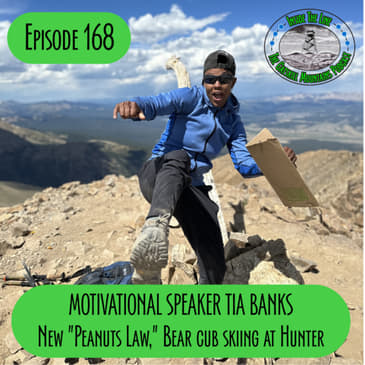
Welcome to episode 168! This week, Tad and I sit down with Tia Banks — hiker, motivational speaker, and all-around force of nature. From trail-tested wisdom to real talk about resilience, Tia shares her journey of finding strength, purpose, and community in the outdoors. Need a sticker? Shoot me an email or stop by Camp Catskill and grab one! Make sure to subscribe on your favorite platform, share the show, donate if you feel like it… or just keep tuning in. I'm just grateful you're here. And as always... VOLUNTEER!!!!
Links for the Podcast: https://linktr.ee/ISLCatskillsPodcast, Donate a coffee to support the show! https://www.buymeacoffee.com/ITLCatskills, Like to be a sponsor or monthly supporter of the show? Go here! - https://www.buymeacoffee.com/ITLCatskills/membership
Thanks to the sponsors of the show!
Outdoor chronicles photography - https://www.outdoorchroniclesphotography.com/, Trailbound Project - https://www.trailboundproject.com/, Camp Catskill - https://campcatskill.co/, Another Summit - https://www.guardianrevival.org/programs/another-summit
Links:
Tia Banks, New Peanut Law in New York, Catskill Town loses FEMA Assistance,
Volunteer Opportunities:
Trailhead stewards for 3500 Club -https://www.catskill3500club.org/trailhead-stewardship, Catskills Trail Crew - https://www.nynjtc.org/trailcrew/catskills-trail-crew, NYNJTC Volunteering - https://www.nynjtc.org/catskills, Catskill Center - https://catskillcenter.org/, Catskill Mountain Club - https://catskillmountainclub.org/about-us/, Catskill Mountainkeeper - https://www.catskillmountainkeeper.org/, Bramley Mountain Fire Tower - https://bramleymountainfiretower.org/
Post Hike Brews and Bites - Any authentic mexican restaurant
#tiabanks #hikehudson #hikethehudson #hudsonvalleyhiking #NYC #history #husdonvalley #hikingNY #kaaterskill #bluehole #catskillhiking #visitcatskills #catskillstrails #catskillmountains #catskillspodcast #catskills #catskillpark #podcast #catskillshiker #catskillmountainsnewyork #hiking #catskill3500club #catskill3500 #hikethecatskills #catskillhistory
[00:00:29] The bushwhacks were some of the worst days I've ever had in the mountains, or life really. Whereas Pantsy Mountain is totally opposite, it's a mountain on top of a crater. I think the weather challenges on this incident were particularly difficult. It is really the development of New York State. Catskills will respond to it.
[00:00:52] You're listening to Inside The Line, the Catskill Mountains Podcast. So I had a whole intro. I do have a whole intro. So this wasn't made by me. This was by ChatGPT.
[00:01:16] But when you say I have a whole intro, I'm thinking this is where you announce that you're changing the intro music. Oh, no, yeah. That's actually, thanks for that. That was the intro. How did you? You read my mind. Oh, yeah? Was it? Okay. So I'm wondering, why are people so like, like caught up in the intro? Like it's not that crazy.
[00:01:40] Because the rest of the show is just so fucking good that that's the only thing that they can criticize us about is the intro music. It's just kind of got a little too... Distortion? No, I'm not going to say distortion, but just, you know, that metal rigidity to it. You know, they're thinking trees and swaying back and forth. That kind of goes with the hiking thing. Not like, you know, jagged metal edges of some shredded...
[00:02:10] Black Sabbath stuff? That's not too crazy. I would even say it's on the edge of Led Zeppelin like... You think that's what you think of Led Zeppelin? Really? Classic rock and roll? Well, that's, you know, that was a little bit, that was a little bit more harder than at the time. But it's pre-metal, wouldn't you say? I would say. Not that I'm an expert on all things rock and roll, but... It is right on the edge of pre-metal, pre-Black Sabbath.
[00:02:40] But before we get into it, while we're on the topic of music, rock and roll, I have, ready for this, I have a friend who is on the nominating committee for the Rock and Roll Hall of Fame. Oh, shit. Yeah. And this guy, he has a collection of rock and roll memorabilia that like fills up one storage space after another. It's insane. And they do nothing with it.
[00:03:10] Well, he's got so much stuff, it's not even in his house on display. It's like in storage. But he's been, you know, he's been basically a rock and roll historian going back to the 60s. Wow. Yeah. Unbelievable. Pretty cool guy. And I think he gave it up that he and a couple of buddies of his used to go around playing rock and roll and dive bars. That was her thing. Same.
[00:03:35] All right. So let me do the intro. So welcome to 168 of Inside the Line, the Catskill Mountains podcast. Tonight, motivational speaker Tia Banks will be on the show to chat about her story of resilience that will have you ready to tackle any trail or life challenge that comes your way.
[00:03:51] We also chat about her volcanic summit peaks. Peanut the squirrel, a Catskill town loses its FEMA assistance and a bear club cub found skiing at Hunter mountain. Not really skiing, but he was sort of, he was on the slopes. So they were on the slopes. Somebody stole his ski gear. That's what I hear.
[00:04:15] I heard this damn snowboarder frown probably fricking went down the mountain and crushed him. So, all right, first things first, big, huge thing. So New York Republicans push peanuts law after beloved pet squirrel killed by state's agents. So we talked about this before, Ted peanut, the squirrel was killed by DEC after he was found in a
[00:04:42] residential home, not being registered as a rehabilitation animal. So the bill, this is called peanuts law. The humane animal protection act will require a 72 hour waiting permit before the DEC can euthanize any seen, uh, seized animal. It also give animal owners the chance for hearing before the state puts down their animals, peanut and another rack pet raccoon named Fred were taken from
[00:05:12] Mark and Daniella Longo. Mark and Daniella Longo's upstate farm last October after someone filed an anonymous complaint. Shame on those person who filed anonymous complaint on a raccoon and a squirrel. Uh, let's find out their names. Ted research, please. Both animals were killed and tested for rabies. Both tests came back negative. Peanut had a huge following on Instagram and Facebook and social media, and he was adorable. Uh, once this happened, I gotta admit,
[00:05:42] when we followed it, when we followed it, shit hit the goddamn fan, it was absolutely insane. And then, uh, of course, like one of those social media presences shit hit the fan and then disappeared. So now we're hearing about it, of course. And we talked about it, uh, a week or two ago that the new DEC instructor informant was starting like a new law about this or looking into it. Yeah. Yeah. They were going to start an investigation. Yeah.
[00:06:37] Before you can euthanize somebody's animal. You think that's going to happen like 72 hours, someone's going to get a court hearing. Does that actually happen? Well, yeah. I mean, it happens all the time. I mean, sometimes, um, people get arraigned within hours. Okay.
[00:06:54] Uh, being apprehended by the police. Um, they go in front of a local magistrate or judge and they enter their plea and then they're either released or they're incarcerated pending a further hearing that happens until recently, at least all the time.
[00:07:11] Yeah. And we heard, I didn't know this about the time. I, I mean, I know I, I gotta admit, you know, I drive a Tesla, but I don't really follow Elon or our president Trump and stuff, but, uh, they weighed in on this and they said, uh, the whole squirrel thing on Joe Rogan's podcast. I don't follow, I've never listened to an episode of Joe Rogan's podcast. He's a, he's an absolute. Yeah. I heard he listens to us, but we don't listen to him. Yeah.
[00:07:39] So, so I just want to make sure we're straight on that. But at the time, Elon Musk had posted, uh, uh, what I guess formerly was known as a tweet. I don't know what they call them now on X, but he, right. But he posted, go out there and vote for peanut. How can it be that we live in America?
[00:07:59] America supposedly land of the free and the government can barge into your home with guns. So that was at the time, Elon Musk's post on X. And I just compare this at the present time that apparently we're more willing to give protection to the euthanization of animals than we are to, uh, people in this country.
[00:08:29] People who by their appearance, uh, seem to be from, uh, Latin American countries and, uh, people that can be picked up off the street without a warrant, without any process by a judge and transported to another country and kept in a prison there.
[00:08:53] Of course, I'm speaking of Elbrego Garcia, who recently was deported and, uh, sent to, uh, a Salvadorian mega prison for terrorists all without a 72 hour waiting period, all without a hearing. But apparently peanut the squirrel was entitled to, or should have been entitled to a 72 hour waiting period. Jesus Christ. Some level of due process.
[00:09:22] I just, I'm, I have to point that out as being a fundamental inconsistency in government. So there you go. There's my, my, I'm, I'm pulling back on the reins and trying to remain cool, calm, and collected without coming across as ranting about this. So that's it. That's all I have on this topic. Stosh, we can move along. What is it? They, what is it? The Forrest Gump would say, right? What the fuck? No, he had that phrase about that. That's all I've got to say about that.
[00:09:51] That's all I've got to say about that. Yeah. So there you go. I agree with you. And, you know, you bring this up and that's, that's absolutely insane to think about. And let's steer away from politics. So the Longos who ran an animal sanctuary said they were never told that why their pets were taken. They hope the new bill will stop similar cases.
[00:10:17] Longo said, I sit here, try not to cry, but passing this law with movement will make sure animal rights are not overlooked anymore. So we'll see what happens within the next, I don't know. DEC usually takes eight to 10 years to resolve certain things like a bridge being built over the NeverSink or a simple kiosk over in the Panther Mountain area.
[00:10:43] Let's, let's hope it takes them that long to come up with some type of restrictive management plan on bushwhacking the trail as mountains over 3,500. Yeah. You know, you know, you talk about that funny thing. Uh, I was looking at the Strava heat maps lately. That's, uh, have you, have you looked at that? No. Ever? It's interesting to see. Uh, the Strava heat maps will show you kind of like where the places where people, of course, have used Strava have been.
[00:11:13] And it's, it's very interesting to see, you know, those places along, you know, uh, you know, loan and Rocky, you know, where they go from loan to Rocky. And all of a sudden it's a, it's a bright, bright white line. And then all of a sudden there's a dissipating fricking web because people just lose it.
[00:11:34] And then, uh, another big place that that happens is going up North dome from the devil's path is where they just follow anywhere and everywhere possible, which is. Yeah. You say that with North dome from the devil's path. And, uh, I think it was last summer. Uh, I went in from the St.
[00:11:53] Anne's peak side of North dome, which is not a common way for me to go up North dome, but I will say the time of year that I went up summertime, that social path or herd path was so well defined that you wouldn't need markers if it was a mark trail. Interesting. Yeah. I mean, that, that could be the new devil's path. Yeah.
[00:12:18] Well, I, it's, it's on my hit list to do West kill, bushwhack West kill out to Hawkett. I mean, yeah, I mean, well, Hawkett, and then you've got to continue it from Hawkett to, uh, fly bear pen and then over to like the more of those rains, you know, that private property. And then to. And then to the Mississippi river.
[00:12:43] I mean, you say booting Jim Bowden said that that was the original plan of the devil's path was to go all the way from Indian had to Mount you because that is like the range. That it hits. I mean, I wouldn't say going beyond Hawkett was as brutal, like, like as challenging as, as the devil's path, but you know, it's pretty cool. I mean, it's mild, but that would be extended by probably two, three times. Yeah.
[00:13:10] So have you ever done Hawkett West over, um, sleeping lion, um, to, uh, South fly. Have you ever done that area? I forget the name of the road that goes up between sleeping lion and South fly, but. I can say I haven't. Yeah. I've done that whole stretch several times. I heard it's very, very live. There's like a lot of artifacts, like, like dishwashers and yeah, there's those up there. Um, but it's also, it's, it's all hardwoods.
[00:13:40] There's a lot of undergrowth. There's all, you start getting into those Western Catskill pricker groves in there, but I'm sure if it was a trail that you would be working around those. But yeah, it's not, yeah, it's not something that's got a lot of high geological intensity or old growth. And it's not something that we're going to see in the next five to 10 years. No, not at all. Not at all.
[00:14:06] If we can't see something about the, uh, like you said, the, the herd paths being developed, it's, it's not going to happen because that's been going on for years upon years. Yeah. Plus there's really no need unless, unless now we go back to. You know, go back like six, seven, eight months. However long ago it was when I mentioned about that loop hike that I had come up with in the Catskills that does go through that area. It does. Yeah. Yes. Yes. You're right. You're right.
[00:14:35] But you know, I was checking out that Strava heat map and nobody that has done Strava or nobody that has, has recorded on Strava has done that way. We went up North Dome and Cheryl. Oh, really? Yeah. Well, that's nobody ever. Uh, what else was there? Catter, like the Catterscale high peak, you know, when going up round top, there are so many ways that people have done that. It's pretty crazy.
[00:15:00] Well, plus with round top being on the hikers anonymous list, it sees a lot of action round drop to Catterscale high peak. Some people do it as an out and back from Galapisi road. Yeah. Yeah. So yeah. So I'll completely, we go, we go off the rim. So, uh, actually. It's called bushwhacking. Yeah. Right. Bushwhacking the topics. Yeah. That's what we should do for that. So what's going to be called. Well done. So, uh, one other, a couple of things.
[00:15:30] So Catskills town hit by Irene loses FEMA assistance after federal program cut. Now the program helped communities like Middletown and Margaretville apply for grants after a natural disaster risk. Now, if you, uh, of course, let's just weapons back in 2011.
[00:15:48] If not, a lot of people that listen to the podcast know about somewhat that they might've heard about hurricane Irene, but that was devastating to a lot of, uh, Catskill towns, Margaretville Pratsville. I mean, Hunter didn't get it that bad, Phoenicia, Phoenicia, uh, Shandakin, bunch of those areas where the asopias or so best went through, uh, this Harry Delaware river, you know, Del high Walton, stuff like that.
[00:16:17] A lot of these places got nailed hard by hurricane. I read it was sudden. It was crazy. And, uh, they got a lot of relief from FEMA. We've got helicopters flown in. And I got sent down, uh, for, uh, not search and rescue volunteer, but volunteer work down in Pratsville, um, tropical storm Irene hit.
[00:16:38] Uh, it pushed the water 4.5 feet over the banks of the Delaware river, uh, and Margaretville local firefighters tried to help out on main street. I mean, if you look back on the videos that happened on Instagram and Facebook, even though this was, you know, 14 years ago, those videos were, uh, mind blowing. I would say where they had ladder trucks reaching the people over a top of Margaretville.
[00:17:04] If you look, if you compare the pictures of Margaretville right now to when there was rushing waters coming through main street of Margaretville, coming through the local, uh, grocery store of Margaretville. I can't think it's like shop right, right now. It's just like a crazy thought that you can't like, like comprehend that. Wow.
[00:17:28] These rushing waters that you see, like, like, like you up on the, the never sink and stuff like that, that this came through a town down on the lower valley. But it did $1.3 billion of damage in New York state, uh, and responsible for 10 deaths. Now Middletown, which, uh, includes the area of Margaretville, which I, I don't know. Middletown is more towards the north of scary, which is, this is really weird.
[00:17:56] This time union, um, has, uh, weather disasters, including super storms standing, heavy snow storms, uh, to help protect against this future disasters. This town, which has fewer than 4,000 residents and limited resources applied for the direct technical assistance program and ministered by the federal emergency management agency.
[00:18:18] Now this program does not provide grants, but instead provides non-financial supports to communities and territories and travel nations that may not have resources to begin climate resilience planning and project design of their own. Now this was cut, uh, as of, they said, 9am. Uh, I think last week, sometime last week.
[00:18:46] Now the really weird thing that, uh, member Robin Williams, not the comedian, uh, said that it was canceling the building resilient infrastructure and community programs altogether. Uh, it was another example of a wasteful, ineffective FEMA program that has announced and it was more concerned with the political agendas than helping Americans affected by natural disasters. Under the department of Homeland Security, uh, secretary known as leadership.
[00:19:14] We are committed to ensuring that Americans in crisis can get help by resources they need. So, uh, trying to scam over this. I look over this usually, but, uh, this one I didn't, uh, this area, basically Margaretville has very little cell phone, uh, service and, uh, is definitely a kind of a difficult area to communicate.
[00:19:38] And so, like I said, once this, this area, 2011, I can remember, uh, helicopters flying in, rescuing people from Pratt'sville from Margaretville and such, uh, rescuing families and, and such that it was a big, huge impact on the area. And it's, you know, when I drive through Pratt'sville, I still see houses that have the mud lines from 2011 up on their areas.
[00:20:06] I still see abandoned houses, which are somewhat making their, their way. Same thing with Margaretville, same thing with, uh, Phoenicia. There are still several houses in that area that, that need assistance or have been abandoned because of the flood impacts of 2011 hurricane Irene. So it's, it's a big loss, uh, but who knows where it goes from here? Maybe we'll get back into this.
[00:20:32] Maybe female will, will direct back into the technical assistant program that they have, but maybe New York state will kick in. We don't know from here on. Uh, I, I can't, I can't say, you know, not that I believe in God or not, but God bless these. These areas that.
[00:20:56] Unify with themselves in the community and their towns and stuff like that, that we all come together to help each other out because that's, that's kind of what these small towns come with now is we got to help each other out. We got to volunteer. We got to give assistance to each other as we've, we've known down in Tennessee where, uh, the hurricane hit as well. And what can I say? I mean, I'm, I'm at a loss for words. I don't know what the fuck to think anymore.
[00:21:24] I hate to say it like this. Like, Ted, you're the smart one. As I say all the time, please give me some, some thought. Yes. It's my comment. Well said. Cheers. Cheers.
[00:21:43] So, you know, what, as I understand it, this, the program that was cut was the, um, government agency involved would set up the, uh, local community, the, the local government with the grant writer. Who was knowledgeable in terms of available grants and in grant writing, which there's kind of an art or talent to, uh, making applications for grants.
[00:22:09] And this would allow a local municipality that didn't have the money to hire or have on staff a full-time grant writer. Or they would be able to get a professional grant writer to work for them at no cost. And then that grant writer would make applications for the community to get grants for local necessary projects, et cetera, et cetera, et cetera.
[00:22:32] So it's a shame that that assistance is not being made available to local communities, particularly when supposedly this money is still out there for the grants to be issued. But now you're just not going to have people applying for them, but that's not to say that your local government can't go out and hire an outside contractor to be the grant writer for them.
[00:22:58] Or there are certain state agencies or in some counties, there's a county office for grant writing, things like that.
[00:23:05] So it's not the end of the road for these individuals, but it's just, I think, an example of the federal government being transformed from a helping hand to not having that helping hand out there to assist local communities in situations where they're overwhelmed by national natural disasters or other things like that. So there you go.
[00:23:31] So after cracking open my beverage, that's what I got to say about that. Yeah. And it's tough up here. Once again, we have small communities. The assistance is here is basically for, I hate to say it, New York City and such, you know, for the reservoirs.
[00:23:53] And it's tough to keep up with stuff, especially with, once again, natural disasters that happen out of our control that, you know, the only thing we can get is assistance from New York State or the government.
[00:24:08] Well, in many instances, what you have is government often should be viewed as acting like a big insurance company where you have these localities that have a 25-year storm, a 50-year storm, or a 100-year storm that hits them, you know, at some point in time. The municipality is financially overwhelmed by the infrastructure devastation.
[00:24:35] They don't have the financial resources to rebuild. So they rely on that big government budget pool of money that's, you know, funded by millions of taxpayers for them to draw on. And, you know, really, that's necessary for people to stay in communities and to build enterprise in that community, businesses in that community.
[00:25:03] It needs to be able to rebound from these significant natural disasters. And it's kind of a shame that government, at least federal government, seems to be pulling away from that function. Yeah. And like you said, you know, this happens, it doesn't happen every year. You know, we saw 2011, it's 2025, it's 14 years. There hasn't been a major flood like that.
[00:25:29] Before that, you know, 2011, I can remember 1996, there was a massive flood in my area. So I can only suspect that, you know, we didn't have social media back then, that there was one down in the Catskills. It took the life of people up where I lived, where we have the Oaxigo River and not just the Delaware and the Esopus and stuff. It's scary, massive flowing mountains that flow into these areas. So it doesn't happen often.
[00:25:59] And, you know, it's crazy. So, God, what the hell is with our negativity in this freaking podcast? Yeah. Let's talk about hiking. You're like Stosh. Yeah. You're freaking ruining this show with your goddamn freaking. Yeah. All right. Yeah. Let's go above the 2750 elevation. And although I did have my moderated political rant earlier.
[00:26:28] Dude, I enjoy that. And I especially enjoyed the cracking up in the beer for your answer. I've been dying to do that. It's not a beer tonight. There's a whole story behind what I'm drinking tonight, but we'll get to that. We'll get to that. So, last topic of shooting the shit. On March 15th, employees at Hunter Mountain Resort in the town of Hunter, of course, contacted the DEC to report a bear cub along the Madison Square ski trail.
[00:26:58] Now, resorting employees managed to get the bear off the trail in the nearby woods. Ecos Police, excuse me, Ecos Police, Marion and Palmatier responded to the location and discovered the cub hiding in tall grass adjacent to the ski trail. Now, the cub appeared malnourished and dehydrated and was very slow with no mother in sight.
[00:27:18] The officers contacted the great operation of Friends at the Feathered and Furried Wildlife Center in the town of Hunter for assistance and together managed to safely catch the cub as it unsexfully attempted to climb a small tree. The cub, believe to me, more than a year old weighing only 15 pounds with transport at the rehab center will have received care until healthy enough to be released back into the wild.
[00:27:45] Friends of the Feathered and Furried Wildlife Center reports that the younger bear is improving and now weighs approximately 21 pounds. Absolutely fantastic. I hear these success stories with Friends of the Feathered and Furried all the time. The podcast have donated to them and I believe in their wildlife center and I support them 100%. Awesome experience.
[00:28:12] Kudos to the Mountain Resort, the Hunter Mountain employees for calling the DEC and calling the DEC for calling the Friends of the Feathered and Furried. They work well together. I see a lot of success stories from both of them. So do you have a clue of where the Madison Ski Trail is? No, I don't. Okay. I know you don't like Hunter Mountain as in terms of skiing. That's true. That's true. I'm sure I'm sure. Just a basic fact. Yeah, yeah, yeah.
[00:28:42] That's true. If it was the only place open in the spring, yeah, I would go skiing there. But these days, Bel Air seems to have a longer season than Hunter. They actually have. Yeah, it wasn't that way 20, 25 years ago. Hunter, back in the early days of snowmaking, Hunter had a phenomenal snowmaking system. They were really on the leading edge on a lot of things.
[00:29:05] But I think snowmaking technology has become somewhat universal these days in the state of New York, having all the money it has. Correct. It has really. I mean, when you look at some of the equipment at Bel Air, it's like, wow. It's a little bit better. It's a lot better. Okay. Yeah, I can't find any easy, fast information on where the Madison Square Ski Trail was. But what do you think about this awesome situation?
[00:29:35] With the bear being taken to rehab, gaining almost half its body weight and improving. That's great. That's a happy ending. Yeah. They do a great job. Friends of the Feathered and Fairy do a great job, of course, helping rehabilitating animals in the wild and the Catskills. I know they've done a lot of bald eagles, snow owls, stuff like that. I've had them on the show previously. I can't remember.
[00:30:05] It was in the 60s, I believe. Just not the 60s as in the year, but the 60th episode. So... Yeah. That's a dig towards me, I take it. Yeah. Yeah. You're right. You're right. So, yeah. So, congratulations once again to the CE Ghost Police and stuff. You know, one thing that the last thing I said, I was going to say the last thing about that I was going to bring up is, hold on, give me a second. This was an email I got from the DEC.
[00:30:34] It was absolutely hilarious. So, the DEC reminds New Yorkers to avoid close encounters with seals. This was an email sent out. Yeah. Yeah. I thought we were going to bring up that during my recent hike because I did run into a couple seals when I was up on the South Double Top recently. I thought so. I thought so. Yeah. I think they were the white seals.
[00:31:00] Did you stay within 150 feet like you have to poop on and pee on trail? I didn't poop or pee in the vicinity of the squirrels or the seals. All right. So, the DEC recommends keeping at least 150 feet from marine mammals, which include whales, dolphins, portipuses, seals, and resist the urge to intervene when animals come ashore. So, at Stewards and Environment, it is a collective responsibility to protect New York State's wildlife.
[00:31:31] That's a new acting commissioner left and said. Maintaining a safe distance from seals is essential to safeguarding. Now, we might see more of these encounters with the Bear Mountain Trail closed April 21st. So, May 21st, April 21st. April 21st. So, more seal encounters are coming. So, watch out. Be careful. Just stay away. I saw that email.
[00:32:00] I was like, interesting. All right. That's, you know, for hiking in the Catskills, that's must-know information. Right. You might see some of them jumping off the first hill of Catterscale High Peak or Catterscale Falls. I heard that's like a new thing is to hike with a seal. Oh, nice. Instead of a dog? Do they have permits on that? No, no permits required. You just need a special harness to get them up and over the rock outcroppings. But, yeah, you're good to go. They come in handy for water crossings.
[00:32:30] Yeah. So, if you have two, one foot on one and one foot on the other. Yeah. The whole crew of you can get across the Esopus with the seals. That's how it works now. Nice. So, thank you to the monthly supporters, Chris Garby and Jeff Jotz, Vicky Ferrer, Mikey S, John Kamisky, Summit Seekers, Desert City Radio, Betsy A, Denise W, Tom Hoos, Vanessa, Jim C, and Eric.
[00:32:58] Thank you guys very much for supporting the show. Really appreciate it. Believe in the show. It is very, very heartwarming. Also, the amazing sponsor of the show, Outdoor Chronicles Photography, capture your love story against breathtaking backdrops with Outdoor Chronicles Photography. Molly specializes in adventure couple photography and she'll immortalize your moments amidst the stunning landscapes of the Catskills, Adirondacks, and White Mountains. She'll craft timeless images that reflect unique blonde and nature's grandeur.
[00:33:27] Embark on an unforgettable photographic journey with Outdoor Chronicles Photography. Don't hesitate to get a hold of Molly on all platforms. Her link is in the show notes. Check her out. She will do wonders for you. Also, discover the wilderness with Trailbound Project. Our expert-led hiking and backpacking education programs offered on parallel outdoor experiences. Whether you're a beginner or a seasoned adventurer, join us to learn essential skills, explore stunning trails, and connect with nature.
[00:33:57] Start today with Trailbound Project and unlock the great wonders of the outdoors. May 31st, they're doing Wilderness First Aid. And June 21st, a bushwhacking intro, part 1 of 4. They have four different sections, times of bushwhacking that you could learn. Phenomenal experience. I suggest you hook up with them. So, the big question of the night. Not really. But still a big question. Who's outdoors?
[00:34:25] Mention the podcast on Woody Harkesview social media and we'll chat about it on the show. Tag us by typing at ITLCatskillMTNPodcast on your post. Now, it's funny because I have been getting that wrong for the past, like, I don't know, like 12 episodes. I just did Catskill. You've been getting what wrong? The tag. Oh, yeah? Jesus. I did Catskill Podcast instead of MTN. No wonder why we're not catching up to Joe Rogan. Right? Exactly.
[00:34:54] Jesus. Exactly. So, Delta Triangle was at Catskill's Collectibles. Apparently, she listened to the podcast, the episode with Catskill's Collectibles. And she went down there and checked out some really cool stuff and got some really great information about hikes. Yeah. I saw that post. Tom was a great guest. And when you see her post, his store looks really interesting. You can see a lot of really interesting things in the backdrop there.
[00:35:25] So, cool. I agree. Definitely. So, glad you could, once again, we could connect the hikers and the people with the podcast to local areas. So, also, Tracy PinkPony818 was once again out and about. I'm very jealous that she gets out this much. Very jealous. She said she had a great morning hike at Fennestock with Roseanne.
[00:35:49] Three hikes along the Appalachian Trail loop for 5.6 miles, did not get rained on, no other hikers, and did see a nice group of guys heading out to save the hemlocks from the dreaded woolly alget. So, kudos to them. PinkPonyTracy, can you tag those people, those guys, if you talked about the woolly alget? I really want to get some more information about that.
[00:36:12] That's a good topic to talk about, the unfortunate ash trees that are going down because of those piece of shit insects. Ouch. So, yeah, sorry to say about that negativity. Richie's nature escapes. My friend Rich was at Shokin High Point with Ranger. We underestimated the snowfall but still had a great time. Richie told me, I hate to embarrass you, Richie, but he had to turn around.
[00:36:41] Great idea because he was post-holing too much and he didn't want to make the trail an absolute crazy mess for other people. So, enjoy that hike next time because you got to go up to the summit of High Point and then I told him where to go from there. Ted, you know the great spot to go from Ashokin High Point, correct? Well, there's quite a few of them over there. True, true.
[00:37:08] Because it's not over 3,500 feet, it's not on a lot of people's radar screen. But that whole hike is a great hike. There's a lot of just interesting things to see on and off the trail. Highly recommend it. Even if you only make it up as far as all the beaver dams and beaver ponds. Yeah. You're in for a treat. The canopy is just one of those hikes. It's like going along the Never Sink.
[00:37:36] It's just one of those breathtaking hikes that you can enjoy and then have still a great experience, not even summiting. Yeah.
[00:37:43] I think the pro tip to relay to people is if you hike in the Catskills a lot and you have a friend who wants to go on a Catskill hike with you but has never done something like hiking out to Cornell or hiking up Westkill and they might not have it in them, you just try to go as far out as you can take them on a Ashokin High Point. Maybe they can do the full loop or maybe they just get out so far and you turn around.
[00:38:12] But either way, it's just a very user-friendly hike that you can enjoy with pretty much anyone. Correct. That's my sentiment. I agree. Yeah. And then you can go oh so much. And it's one of those hikes that kind of like towards the end, it gains a little bit of elevation but not too much. It goes gradually and it's very nice. Yeah. If you make it to the summit and do that walk, I think it's generally to the Northwest.
[00:38:41] It's rewarding up there or if you head in the other direction in Bushwack, it's also very interesting and unique. But like I said, in that area, there's a lot to see and do. Yeah. Correct. So also, who else would we get in this but who's outdoors? So Tom Hoos was at the amazing Ricketts Glen in PA. I've only heard wonder stories about this area.
[00:39:09] And it's full of waterfalls, full of awesomeness. I don't know. Ted, have you ever heard about this area? I've heard about it. And through Tom's stellar photographs, you get a true sense of like the majesty of that area. I mean, he posted some really nice shots. He was telling me through instant messaging that he uses an adjustable neutral density filter when he takes those shots. And it really shows he does a wonderful job with them.
[00:39:39] So check out his posts at who's outdoors on Insta. Some nice stuff. Yeah. Agreed. Ricketts Glen is one of those areas that I have on my list. So it's fantastic. So once again, thank you, everybody who has tagged the show. Keep following the show. You can tag us once again at at. I will get this correct this time at ITL Catskill MTM podcast on your post. And we'll talk about it.
[00:40:09] Also vote for us. Best regional podcast on the chronogrammies. So Tad, once again, GS bar one does a daily story about it. I do a daily story. I will do a post soon about that as well. Tag us best regional podcast. Let's see if we can get the win on this one. So I'm voting every day. You can vote each day, every day until May 15th. So do it. Yeah. Just keep voting.
[00:40:38] Yeah. If you don't vote, you don't hike. It's that simple. Okay. Exactly. Just saying that's the way it's going to be. Exactly. So also, if you want to support the show, buy us a hard cider on buy me a coffee. It says buy me a coffee, but I changed it to hard ciders like our show. If you think we're doing a good job, that'd be fantastic. Support us. Rachel Jean, the gypsy queen, bought a hard cider for Tad. Do you know what she said, Tad? No, I didn't have a clue.
[00:41:09] She bought me a hard cider. Really? She did? I'm touched. Oh, come on. You knew what she said. Oh, so Rachel Jean, the gypsy queen said for Tad. Love you, bud. Personally, I just thought you were upset that you slept on the view overlook with a smiley face. Yeah. Well, I did take a nap up there. My buddy Rip Van Winkle and I hung out for a while.
[00:41:35] So, but at any rate, that's what I'm having tonight in honor of Rachel Jean, the gypsy queen. I am drinking a 1911 original small batch premium hard cider because when the gypsy queen buys you a hard cider, you drink it and enjoy it. So, are you enjoying it? Yeah. You know, it's not bad. I mean, it's not to me.
[00:42:05] It's not. Well, I'm not going to say anything negative because Rachel Jean bought me this hard cider. So, it's damn good. That's all I'm going to say. It's got 5.5 alcohol content. It's direct from the tree to the can, or I think as the gypsy queen says, from the mosh pit to the can. Yes. She's crazy, isn't she? Well, I don't know about that, but I have a sense that this hard cider is going to be good. It is. It is. 9-11.
[00:42:35] I love 9-11. Or 1911. Jesus. Whoa. Whoa. That's a little. Sounds like somebody's had too many hard ciders tonight. Jesus. You know, this is, oh, wow. That was horrible. All right, folks. That's all we have for tonight. Yes. Stosh is, I think he fell off the chair. I can see his feet in the air. Yep. That's it. So, I'm just going to hit. And we're being shut down by the government. Yeah. I'm going to, yeah. They just raided his office at home.
[00:43:03] They claim to be looking for peanut, but we all know peanut's gone. Holy shit. Bang, bang. I think they just euthanized Stosh. Forgive me. You heard it first on Inside the Line. All right. So, I am having a Down East hard cider. I think it's a Blackberry. Fantastic stuff that's just smooth as heck. It's not as, I don't think it has the crazy alcohol or 5.5. I'm trying to look for it. It's tough to look for it under this light. Yeah.
[00:43:32] They usually try to obscure the alcohol content so you don't know how wasted you're getting when you drink it. Oh, this is the upside down one where you drink it upside down and it tells you, eh. Oh, yeah? Whatever. It's really good. But also, I had beforehand a Hudson North. We know you had it beforehand, buddy. Right. This was way beforehand. So, Hudson North blueberry lemonade. That was really good. And cool thing is, is- What's the alcohol content on that?
[00:44:00] Does it start with like two digits and then the decimal? So, like 49.8? It's less than yours. Really? 4.5. Wow. Lightweight. So, I drank that because Kyle from Hudson North Hard Ciders can be joining us on a later episode. So, that's pretty cool. Yeah. Well, remind me and then I'll have to go out and get some of his product. Yeah, yeah, yeah. That'd be cool. So, previous hikes.
[00:44:31] Ted, I know you've been on a hike. I haven't been on a hike, but I did something today, so. Oh, yeah? Okay. Well, do you want to go and talk about your something or do you- Yeah, yeah. I'll go really quick. So, today, beautiful day before all the rain hit and it started getting a little bit colder tonight. I went to Burbine State Forest and played disc golf at this state forest area that they created.
[00:44:56] It was once a plantation that they had for Pine Forest and they made it into a disc golf course. 18 holes. Beautiful, awesome stuff that, you know, like beginners and advanced people can enjoy that just brings the beauty of outdoors while enjoying kind of like a easy walk with playing disc golf. It was- I actually tracked it.
[00:45:24] It was two miles long, 2.1 miles with around 100 feet of elevation gain and loss. So, this is all the way up above Cobleskill, so it's pretty far out reach for anybody that's down in the New York Hudson Valley area. So, but it's near House Cavern and stuff. Just one of those areas that I enjoy getting out in nature and I had that sense of just being away from everything. And I love disc golf.
[00:45:52] You know, it's usually free. You don't have to pay. So, there's very many disc golf places above where I live that I can enjoy. So, that was my day. We beat the rain that came in. Rain came in more of towards like 3 o'clock at a time and it went from 60 degrees down to 42 degrees. It was insane. A matter of like 25 minutes.
[00:46:20] So, that was my day today. I enjoyed it thoroughly. I got out. That's all that matters, I guess. So, Tad, what did you do this weekend? Yeah. So, I decided not to hike on Saturday because of the weather and we got all that snow in the Catskills. It was Saturday, Saturday night and maybe early on Sunday morning.
[00:46:49] The Bel Air ski area reported they got 10 inches of snow at their summit. So, I needed about three miles of the Never Sink Hardenburg Trail to complete that segment for my Catskill Mountain Club All Trails Challenge. And I headed over there. It's on the end of the Black Bear Road.
[00:47:16] But obviously, doing an out and back, three miles out, three miles back, that's hardly a hike for me. So, I thought I would tie it in with a hike up South Double Top, which I've hiked up through that area, but not on the Hardenburg Trail, at least from that direction, up South Double Top before. So, that was going to be the hike. And then I was going to come back and go over this little knob between South Double Top and High Falls Ridge.
[00:47:45] So, as I'm driving over there, the roads are dry and clear, but then you go through Claryville and you make that turn over the West Branch. And you started getting into the snow. And once I got into Black Bear Road, that was just covered with snow. So, at any rate, I'm hiking out the Never Sink Hardenburg Trail. It's your typical abandoned road, one lane wide Jeep trail.
[00:48:15] I'll go out to my three miles. And then I start the bushwhack. And it just went from a great hike to an outstanding hike. I mean, as you climb up an elevation, it got colder, windier, more snow. There was a low cloud ceiling or fog. So, you just hike up into this whiteness. Everything was white. The ground was covered in snow. The trees were covered in snow.
[00:48:45] There was this white, misty, cloudy, whatever thing going on. You'll see on my post that day on Instagram, a shot of some trees as I hit the toe of that final climb up to South Double Top. So, overall, I have got to say it might be the best hike I did so far this year. Probably a lot of reasons for that.
[00:49:11] One of them is just a tremendous sense of solitude going out there. Nobody around, no tracks. The snow got deep enough at around 2,700 feet that I threw on my snowshoes, which were really helpful for uphill traction. You could arguably have made it the whole way without snowshoes, although that would not really be advisable. One of the elements of concern was the snow was really, really wet.
[00:49:42] And for the most part, it was clinging to all the trees overhead. So, as you got higher up and the trees got lower and closer together, you started bumping into more and more trees. We had all that wet snow falling on you. So, that's an issue when you get up there into the wind, although I was prepared for it. But, like I said, it was just a great hike.
[00:50:02] At one point, I was saying to myself, I'm just going to go up to the marker on South Double Top and retrace and head back and not do the hike out to High Falls Ridge. But I'm glad, in part, that I did stick it out and go over to High Falls Ridge, although there's a lot of low vegetation along the way. A lot of, you know, I don't know if it's hobble bush or something else, but somewhat annoying to hike through.
[00:50:32] Thicken spots, but I had never been up that way to High Falls Ridge before, so it was worthwhile. I did enjoy it, and like I said, man, probably could be best hike so far of the year. So, did you park at the end of Black Bear Road?
[00:50:52] Not at the bitter end, because I don't know how legal or not legal it was to park there, but the property owner had, you know, done like one hell of a job of putting up no parking signs everywhere around there. Okay, and so when you're out basically at the end of a dead-end road, you're going to be away from your vehicle for hours, and, you know, my Jeep has got a soft top. There's no locking it up.
[00:51:18] So, I, on my way out, I was scouting places to pull off and park. So, yeah, I think I was about two-tenths or three-tenths of a mile from the bitter end of the paved portion of that road where I parked. It was a nice pull-off there. It wasn't marked for parking, but the snow wasn't that deep there. I was, you know, I felt comfortable pulling in there, parking, leaving my vehicle there.
[00:51:42] And I had your phone number in case when I got back, my vehicle had been pushed off the side of the hill or something. True. Because then that whole part of the Black Bear Road is the FLT. Yes. Yeah, I was actually thinking of our friend Kim when I was out there that she must have hiked through there. Or no, you said the Finger Lakes Trail. Finger Lakes, yeah, yeah. Is it part of the Long Path, too, or not? I don't think. The Long Path actually goes through Biscuit Brook, I think.
[00:52:11] Yeah, this is the FLT, and I was just very curious just because, you know, I haven't been up there, of course, and that was a destination of mine. And where did you start bushwhacking? Yeah, the Fallbrook Lean-To, that's a shelter, right? Mm-hmm. So, you go past the Lean-To. You continue on to where the trail makes a hard left, right around Bullet Hole. Do you see that on the map? Bullet Hole.
[00:52:41] Okay. So, where the trail makes the hard left, and the Beaver Kill kind of intersects the trail at that spot, but it makes a turn towards the cull between Graham and Double Top, right? Yeah. So, you follow along the Beaver Kill for a while, and I've hiked up that stretch of the Beaver Kill and up to Double Top from there. This was probably my fifth or sixth time going through that area.
[00:53:10] And one of the things I found interesting is, without using my GPS, how many of the same landmarks I hit going through there in terms of cutting over this one ravine, a couple very interesting, I'm not going to call them glacial erratics because they may or may not be, but some big boulders on the way up.
[00:53:32] And then the one ridge which goes up south Double Top, I think at a bearing of maybe about 40 degrees kind of sticks in memory. That's the ridge line I went up. Nice.
[00:53:45] Yeah, I think in terms of going up south Double Top, it's probably the easiest way up in terms of pitch and not getting into a lot of really dense balsam fir. So, and you can see that one first photo I posted on Sunday is from that point, you know, going past that tree, that rock, and then heading up the ridge line.
[00:54:15] It's almost like you could drive a snowmobile up there. Wow. It'd have to be a pretty gnarly snowmobile, but you could get it up there. But as you're going up there, one of the things that you're constantly dealing with is, you know, the snow falling on you. So I had, you know, I didn't have a hard shell on, but I did have a shell on with the hood, you know, to keep the snow from going down my back.
[00:54:38] A couple times, you know, I literally had to like almost take my pack off to get the snow out from in between my back and the pack going up there. I'll also point out I was wearing a new pair of snowshoes. I bought these snowshoes on eBay from an outfitter out west. I'm going to tell you that these snowshoes are easily 10 or 12 years old, but they're brand new. So they're like an old stock MSR, uh, lightning ascent.
[00:55:09] And they were, they were good in a lot of respects and a lot of respects. Um, I thought they were better than our evos that we love, but in terms of bushwhacking out where we bushwhack in the cat skills, I'm going to still go with my evo as sense. Nice. I think they're the better piece of equipment, although these were fun and they were a lot of good features.
[00:55:35] And maybe next fall I can do the rundown of the pros and cons of the two, but new pair of snowshoes gave them a good breaking in. Nice. Yeah. That's, that's a hell of a hike. I gotta admit, I haven't, uh, I haven't been up that way. I will agree with that. Uh, I've been in the Gulf of Mexico going up to Graham, but I haven't been up that way. So that's part of, uh, kind of like one of my areas too. Yeah. It's a lot of the same. It's a little bit more low lying.
[00:56:04] You know, it's more of a drainage area than the Gulf of Mexico. I'll say, um, I did, I did the Gulf of Mexico one time. I ran into a guy who was fly fishing up there, which I thought was rather interesting. Oh yeah. Hell yeah. That's a start of it. Yeah. So, but he was, you know, he gave me the whole low down, how we wanted to go up upstream to catch some wild trout. So he was definitely wild. Yeah.
[00:56:30] And I'll say going up along the, uh, headwaters of the beaver kill, there is, you know, uh, you can see and how the branches are broken off the trees. I think it's, you know, almost like the fishermen's path up the, uh, East branch of the never sink. It, I think that sees a lot of activity. Other times I've been up there. I've run into what I call the Walmart camps where you run into a lot of cheap, abandoned camping gear with the snow.
[00:56:59] I didn't see anything this time, but it's very interesting. You start running into a lot of, uh, beaver activity up there. I actually ran into some before the bend. I thought of Mike Kudish with some of these bogs that I was coming across and, you know, if, and I meant to email him to find out if, you know, he studied them and how far back he was able to carbon date. You know, his, uh, Pete samples from them. So maybe I'll get around to that, but it's cool terrain. And I have to say South double top.
[00:57:29] It's one of my favorites. Yeah, I got it. It's a great hike. So, so while, before we move on, I got to ask you some advice on cleaning boots and gators, because as you know, I was in some deep snow. Um, I had my winter boots on. I had my gators on really, you know, if you asked me a week ago, I didn't think I was going to be using them again this season. So I got them all cleaned up last week and then I bring them home on Sunday and they're all muddy and dirty. So I let them dry out.
[00:57:57] And then before we started the show tonight, I went outside and I cleaned off the dirt, you know, shook off my gators and my boots and shook off all that dirt in the backyard as I was doing it is just as I was finishing doing it. You know what occurred to me? What if in that dirt that I just shook off of my boots and gators, there were nettle seeds. Ooh. Ooh. Yeah. It's just mom. Am I it?
[00:58:27] Well, but is it just going to make a multiply? Am I going to come home someday this summer? And like all around my house is going to be a nettle field. I mean, you went through with snow. So there, I mean, it wouldn't have nettle seeds, but later on. Well then, no, the seeds could still be there. They could be germinating in my yard right now. Yeah. Yeah. I mean, I don't, you're just brushing this off. I mean, this is like, I'm going to be losing sleep. Should I go out and get some Scots? No, I think you're good. Should I get Agent Orange and like spray?
[00:58:54] Because should I get a crop duster and spray around my house to kill any potential nettle fields? We'll have to find somebody who flies a small plane to fly over your house. Okay. Yeah. I think so. I think you're fine. You don't have to worry about it. All right. Those are really reassuring words, Stosh. You're fine. So volunteer, Catskill 3500 Club, Catskill Trail, Catskill Mountains Club, Visitor Center, Jolly Roarish Trail Crew, Flamie Mountain Fire Tower, volunteer.
[00:59:23] Tad might, they might need that help over on that, that section that he did, the Neverson Cardingburg Trail eventually. So also stickers, get them at Camp Catskill or contact me for free stickers, free, free stickers. Also weather forecasts. So usually I used Mountain Weather Forecast, but apparently they're changing and they are going pro and you have to pay $24.99.
[00:59:53] That is yearly, I believe, for your membership benefits. So I don't really, I find them useful somewhat, but their wind predictions and their wind chill predictions are somewhat hardcore off, but it kind of makes me prepare for what we're doing. What's happening. So if you don't think it's useful, go for it. If you don't, there are other places to check out.
[01:00:21] I wouldn't say it's, you know, Ted commented that they're expert mountains forecast with an LOL on the side. I wouldn't say it's expert. I wouldn't say it's somewhat close, 50-50. So it makes you over-prepare somewhat. Yeah. I haven't found them to be accurate this past winter.
[01:00:45] I think they've, their forecasts have had higher wind speeds than I've seen out there and they've given lower, much lower wind chills than I've experienced. And I, my understanding is all of these weather services for the most part, get their weather data from the government. And then they have their own. Yeah. Then they just, you know, they use government weather stations and other stations that might
[01:01:11] be on a network, but it's mainly government weather stations, uh, government weather data. And then they have their own, you know, programs that will interpret that data and maybe, you know, some meteorologists who will look at it and, you know, refine that interpretation. But I haven't found any of these forecasting services to be all that useful this past winter.
[01:01:37] I'm a large proponent of looking at color radar, uh, before you leave the house to get a sense of what's coming in, because that's more real time than, you know, yesterday's weather forecast. And then, you know, just have like a big gear bag in your vehicle. So when you show up, if you got to change something or bring something extra, or, you know, you can put, leave something behind that you thought you were going to need.
[01:02:02] You can right there at the parking area, you know, refine, refine your gear selection for the day. And I suggest plan a plan B, you know, if you have some other one summit that is highly difficult and you have, once again, the, the weather forecast change within a couple of days and it becomes extremely difficult go with plan B, which is a non-difficult area or a, a, a, just a, a pretty easy trail. That's what I suggest.
[01:02:32] Or of course, once again, if these, if these forecast change and you cannot make it to the stair with your car from the parking area, have a plan B that you could actually do a hike, you know, in that general vicinity. That's low profile that you can just have fun and just get out in nature. Yeah. Well, that's what I understand. Tom, who's dead. He said he was planning to hike, um, the wild cats in the black bear forest this past weekend. What a beast. Yeah.
[01:03:01] But at the last minute, you know, he, uh, went to his plan B was to go down to Ricketts Glen and where there was no snow and take those waterfall shots. So you had completely different weather and hiking conditions and what we had in the Catskills. Once again. Yeah. And then I'm, you know, I'm trying to use this, uh, this new forecasting, but it only gives me the forecast. Uh, it's called mountain point forecast from the, the weather government area.
[01:03:31] And it only gives me forecast till Thursday. So, uh, I'm going to have to go with a different platform. So it says, uh, you know, Thursday night, mostly cloudy in the morning, clearing highs in the upper forties, Northwest winds about 50 miles an hour. I know a lot of the snow reports up high. Snow has been melting as of today.
[01:03:56] And, uh, Platyc Hill that has a three inch snow army, I believe had nothing today. So we had, uh, 50, 60 degrees, uh, today up in our Oneonta and the Catskill, uh, northern Catskill area. So since Friday, the temperature will dip down, uh, into the low twenties, uh, with no participation, precipitation at all.
[01:04:23] But once again, this mountain weather forecast, I might have to find a total new platform. What do you suggest for, for something that we're going to go into? Uh, I haven't looked into it again. I, you know, I just really look at color radar, you know, to know if I'm going to be getting wet or dry. That's to me, that's really the most important is do you need to.
[01:04:54] Be prepared for wet weather or not go hiking. Cause it's just going to be a torrential downpour. Correct. And then once again, I'm trying to, I'm trying to navigate this area and they're just like, screw you. You gotta pay. Yeah. Yeah. This is the screen I got earlier today. Right? Yeah. Yeah. You're doing just what I did. You got to type in Catskills and. And then search and then go into Appalachian Catskill mountains. Let's choose Balsam Lake mountain. What does it say?
[01:05:23] All right. So Balsam Lake mountain. We got it. We got it. It's locked for a total forecast. So you can see Wednesday's forecast in detail Thursday, Friday, Saturday, Sunday. They just give you three time periods, but really that's it. That's enough. Well, actually that's not bad. It goes out to Monday. Yeah. I mean, and so that's good for you to see what it's generally forecasted for on Saturday or Sunday and then Friday night or Saturday night, you know, the, the evening before your
[01:05:52] hike, you can look at what the detail is and get a better sense. Yeah. So going on Friday, Saturday, Sunday looks like to be rain showers. I wouldn't say can consider it rain showers, but rain showers all throughout the weekend. Uh, high of 59 on Saturday with a low hitting, uh, the low, low 40. So not that bad throughout the whole weekend, but still just moderate rain, light rain.
[01:06:22] So you won't, the viewpoints might be obscured, but you can still, you can still get there. Bring your spikes, still bring your spikes, please. Just for another like two to three weeks. So the, the burning question, everybody wants to know, Stosh. Stosh, you hiking on Sunday? What is this Sunday? Ooh, uh, black bears are playing on the playoffs. So I might be back late. Are you hiking on Sunday? Well, I don't know.
[01:06:50] I'm going to look at the weather on Friday and see, uh, cause, cause my, my forecast down here is showing Sunday, no rain. Okay. So if you're willing to get out a little bit later, I might, I might. It all depends what we hike. Yeah. I can, I can come up with something. Ooh, we can do a fun. All right. All right. So last set of sponsors, when we get onto Tia, let's do this. So discover camp Catskill and Tannisville, your ultimate hiking store by top quality year, apparel and accessories for all your outdoor adventures.
[01:07:21] Our expert staff is to hear and help every hiker from beginners to seasoned pro. We also carry a variety of unique Catskill souvenirs and gifts from anything from t-shirts to hats. Visit us online at campcatskill.co or in the store to gear up for your next journey. Adventure starts at camp Catskill. Also embark on a transformative jersey with another summit. Another summit is dedicated to serving veterans and first responders with free outdoor activities.
[01:07:49] Activities like walks in nature, paddling, hiking, and even backpacking. Join our supportive community to rejuvenate in nature's embrace. Experience commodity and venture and healing at no cost. Take your next step with another summit and ascends to new heights of resilience and joy. Apply today at another summit.org. On May 2nd, they have Catskill's base camping trip. And June 7th, they have women's backpacking trips. So check them out on another summit.org.
[01:08:18] All right, so let's get on to the guest of the night. Tonight we have motivational speaker Tia Banks here. She has done a lot of crazy stuff. Climbed Volcanic Summit, the highest Volcanic Summit. She does training, motivational speaking for people all around the United States and the world. She's here to talk about, you know, being a motivator, keeping your mental health at the above, at the highest peak possible, and how to keep that going.
[01:08:48] Especially with what we'd like to do, Tad and I, and mostly everybody else in this podcast, is hiking. And hiking, how to keep that going, how to keep yourself mentally at the highest. And yeah, that's what we're talking about tonight. So Tia, welcome to the show. Thank you. I'm so excited. I'm glad to be here. Yeah, and we're glad to have you on. I can't wait to hear some of your stuff. I mean, pre-chatted, we chatted about some special stuff. So I'm excited.
[01:09:18] I mean, everybody can hear with that, that smile on my face. So how about, Tia, a little bit background about yourself. Go all out, go from beginning to end. Yeah, so I'm a former pro athlete. So I played professional basketball overseas in France and Spain. I played professional flag football. But before all of that, I was born in Lincoln, Nebraska. And out of 500 students, I was the only black kid. But the cool thing about kids is kids don't care.
[01:09:48] They're like, Tia's good at soccer. We want her on our team. And so it wasn't until I moved from Lincoln, Nebraska, down to Fort Worth, Texas, where I went into a school and it was 50% black, 50% Hispanic faces that look like me. But I didn't sound like everyone else. And so I remember my teacher for the first time. She said, class, this is our new student. And I said, my name's Latia Banks.
[01:10:17] And everybody laughed at the way that I spoke. They said that I sounded very proper. And I was even called an Oreo. So black on the outside, white on the inside. And that was the first time I experienced like I'm not good enough the way that I am. That was the first time I was like, okay, maybe I need to change the way that I walk, change the way that I talk, the music that I listen to.
[01:10:44] And I think, you know, I became a liar at that point. I also struggled with some anxiety and depression over that at a pretty young age. And so when- How old were you at this time when you moved? So this is middle school. Okay. I was about 10, 11 years old in middle school. And you know, middle school, those years are a little weird anyway.
[01:11:06] But I want to share with you also, I was raised in a family where our motto was suck it up. Actually, my dad. You ever been told suck it up? I'm sure both of you have been told suck it up before. So yeah, so my dad, everything was suck it up. I'll never forget we were playing softball. We were playing catch. And he threw the ball probably about 100 feet in the air.
[01:11:35] And the ball bounced off of my glove, hits me in the nose, bloods everywhere. And I remember he ran over to me and he was like, TT, suck it up. And I'm like, dad, I'm six. My nose is broken. Mom's like, what did you do to her? But I always had this, don't tell anybody when you feel physical or emotional pain. That's what I thought suck it up meant. You go into college, your coaches are telling you, be mentally tough, suck it up.
[01:12:05] So now I'm marrying the two things together and even into young adulthood. So I experienced a lot of anxiety, a lot of depression. And one day I was just like, I can't do this anymore. I feel like I need to feel well. And it's probably going to have to be something outside of what I'm used to. I'm used to being an athlete. I'm used to sucking things up. But what if I change the narrative of that? And so I leaned into hiking.
[01:12:31] Like I did something that you probably don't see a lot of Black women doing. I started to hike and get outside and get in nature. And I started to feel better about myself. And so that's what led me to the mountains. And I can't wait to share what followed that. So with this journey into hiking and stuff, Dallas-Fort Worth, I got to admit, you got to get some crazy distance to get some hiking out there.
[01:12:58] Like where did you first start experiencing and start doing your hiking? So the definition of a hike, it just means you take a long walk. So I started taking long walks on the trail at the park down the street. I live not far from a park. Now in Dallas-Fort Worth, there is a hiking trail called Cedar Ridge Nature Preserve. You might get about a thousand feet in elevation, but it's hills. It's the hills that we can get here.
[01:13:27] So I started small and one day I just decided I'm going to climb the highest freestanding mountain in the world. No one in my family has climbed a mountain. No one in my family has ever been hiking. So, you know, this revelation of climbing the highest freestanding mountain in the world, it required more research. Okay. What, where is it? And you all know where the highest freestanding mountain in the world is, or should I share this?
[01:13:57] Is that Hawaii? No. So... I want to say it's the mountain I hiked this past weekend, but I know that's not the right answer. It's just seemed that way. That's all. So it's actually Kilimanjaro, Mount Kilimanjaro. It's... In Africa. Yeah. Yeah. That mountain is the highest standalone mountain in the world. 19,341 feet. And on my face, I have a birthmark.
[01:14:26] I don't know if you can see it. No? Hang on a little bit closer. A little bit closer. All right. All right. I see a little bit. It's in the shape of Africa. Wow. Interesting. And... Go figure. The highest freestanding mountain in the world is in Africa. It's on the side of my face. And so I trained. I trained for years. Probably like three years to financially prepare, to physically prepare, and most importantly,
[01:14:56] mentally prepare for a mountain. Because like you said, in Texas, we don't have high elevation. So what do I need to do to get ready for that? Yeah. And with you getting ready for that, did you push yourself kind of like to the extreme limit on like the small trails? Or did you go, like I said, Dallas-Fort Worth, I'm pretty sure you got to go up to, I forgot where it is, but over west to get it to some pretty tall mountains since there. And you said hills. What is it?
[01:15:25] You said 1,000 feet elevation. And that's still pretty good. What are hills down in Dallas-Fort Worth with the highest elevation? You know, we got some hills over in hill country. So kind of like Austin, San Antonio. But to keep it real with you, I didn't do any of that. I did a lot of stadium stairs. Like I said, I went to Cedar Ridge and I would hike for about eight hours. Sometimes I would hike in my neighborhood for about four hours before work.
[01:15:53] So, and then in talking to people who had hiked that mountain on like meetup groups, they're like, oh, just get on a treadmill or the elliptical. And so I did a lot of like cardiovascular things to physically prepare for this mountain. And one thing that I did that probably was unique because I didn't know how to climb an actual mountain was I hired a breathing coach.
[01:16:21] And so in hiring this breathing coach, I went to them once a week and we would do these breathing exercises. And I think this is what I thought at the time would help me prepare my lungs for high altitude. Interesting. Interesting. So now I want to go back just a little bit. Now I got to be honest with you, you know, race and color and stuff like that is a big thing in hiking.
[01:16:48] Of course, up in the Catskill Mountains, we have New York City down to the southeast and, you know, it's two and a half hours away. But I got to admit, I don't see many, you know, people of color up here hiking. Like, I know my search and rescue friend, Dave, who has been on the show, he is, I'm sorry to say all out black guy. Like you cannot on the trail. He stands out.
[01:17:11] But he is one of the most awesome hikers, mentally prepared, physically prepared and just prepared for anything and everything. But with my time on the trails, I've seen a few black people. How did you bring yourself into hiking with that kind of like motivation that, you know, you aren't like, I don't know how to say it. I don't know how to say it. I don't want to be, you know, racist or anything. We can keep it real here.
[01:17:41] Yeah. Yeah. It's just, how do you, how do you prepare yourself for that kind of thing of where you're just going to see white people on the trail? And yeah, so it's not anything that I thought about, you know, like I'm, I'm not focused on who's, who's climbing the mountain. I was focused on the mountain. I'm like, how do I get to the top? And so, you know, in preparation in hiking on the trails, I saw a lot of white people. I didn't see a lot of black people on the trails.
[01:18:09] Um, but I wasn't focused on, you know, the, the, the race of other people. Um, I think I was just focused on the mission. And one thing that I kind of left out, what led me really to hiking and getting outside? You know, I mentioned the depression that I experienced, but one thing that I, I was able to use as a strategy was I did a lot of journaling and meditation and I came out of
[01:18:38] a meditation and I just wrote, I want to climb the highest freestanding mountain in the world. And, you know, I'm a believer and I'm a believer in communicating with God. It's not just prayer. It's also meditating and getting quiet to actually hear what God has to tell you. So the reason why I was able to hear that message is because I just sat, I got quiet and I got in silence. And so that was my guide to hiking.
[01:19:05] Um, and, and from there, you know, I just focused on what can I do to get to the top? How do I get my body in shape? How do I get my mind in shape? And there were people that I asked my friends, I asked about 20 different friends, different colors. And only one of them went with me. Wow. So. And that's tough, you know, I mean, once again, the motivation to get out there on the trails
[01:19:32] and stuff, uh, is, it's tough, you know, to get yourself kind of going blindfolded. I would say it is really difficult. You know, that's, that's kind of what I did. I hiked a little bit and, but this is like, like you said, little tiny trails around here. And then I kicked myself into the Catskills and I was just like, damn, this is the best. And it's just fantastic. So Tad, you want to, you want to take over from here? You want to go right into the crazy shit?
[01:20:00] No, let's, I just got a couple somewhat random questions about what's been said already. So I know somebody who's listening wants to know what a professional flag football player makes. Is it like, is it like a Aaron judge size salaries? Like we're talking 40 mil a year, 60 mil a year. Tell us, give us the. So honestly, Tad, you'd be lucky if you, you don't make a lot at all.
[01:20:30] You know, when I played for 15 years, I had to pay to play, you know, we would have to pay registration fees. We would have to pay for our travel expenses, but it's at that point I was at the highest level that you could play. And so we would play in some tournaments where you could make $10,000 if you win, which, you know, that's split through five, 11 people. You're playing for prize money. Prize money. Yeah. Okay.
[01:20:58] How about as a professional woman basketball player, what kind of money was that paying? Yeah. So right now I think at the highest paid player is about 250, 255, 255,000. And that's the highest paid player in the WNBA right now. Which, which is probably got a few zeros less than what the highest paid pro gets. Oh God. Few? Yeah. I don't know.
[01:21:27] I don't, I don't follow basketball, but I know there's a huge disparity. Okay. Let's, so we're going to fast forward to my next, what kind of seems random question, but you mentioned, you asked about 20 of your friends if they would go with you to climb the highest freestanding mountain in the world. And only one friend went with you. So my question was, was that the right friend? How'd that work out? It was the perfect friend. Yeah. That's awesome. How, why so?
[01:21:53] What did it, what made it the perfect experience having that friend along with you? So, so she was my partner at the time and I call her my partner in climb, but she was the perfect person because there was a moment where I was really sick. So they had to administer oxygen to me on the first night. And she was one of the few people that could really motivate me.
[01:22:19] There's only a few people that can really motivate me, mom, two of my best friends and my partner in climb. And she was the best person because she was just like Tia, you didn't come this far to come this far. You didn't come just because it's day one and you can't breathe. Like she, she was nurturing at the same time because she's a mother and she was, she was exactly what I needed on that mountain. There was a moment where I could even feel the winds.
[01:22:46] I lost 15 pounds on that mountain because I mentioned to you earlier, I will fast on mountains just because when you're sick, but also I don't like to have to use the restroom. Um, and so unless I'm at base camp. And so there was a moment where I was very frail and the winds were knocking me down and I just was allowing it. And I remember feeling a hand on my back that was pushing me forward.
[01:23:12] And that hand, sometimes that's all you need to help you take another step. Yeah. But so you started hiking and such, uh, you go to the highest freestanding mountain. So how did you get into the vault? Highest, like the highest volcanic summit. How did this lead into that? Yeah. So when I came down from the mountain, the first mountain, which is Mount Kilimanjaro, I really didn't expect to keep hiking.
[01:23:40] I thought that was, I was going to be one and done, but there's something about once you reached the top of something and when you feel that adrenaline rush after your body has healed and your mind has healed, it's like, dang, you kind of crave that adrenaline again. I hadn't been playing sports. I've just been in search of getting that high, the kind of high that you can't get anywhere else. And so I just, I decided, okay, what else can I do?
[01:24:09] One thing that I did is I wrote a book, Mind Over Mountains. And then I decided, okay, I'm going to climb seven volcanic summits on seven different continents. And so in this mission, what's the next mountain? Well, why not start in North America? What's the highest volcano in North America? And the reason why I chose volcanoes is because I felt like everybody was after the seven peaks, which is the highest peak on every continent.
[01:24:37] I personally don't have a desire to climb Everest yet. But if I've already climbed the highest freestanding mountain in the world, and that just so happens to be a volcano, why not go after the seven volcanic summits on seven continents? And so I went to Mexico in 2022. And I took a group and we hiked Pico de Orizaba.
[01:25:03] And that is the highest volcano in North America located in Puebla, Mexico. And 2022, took that group. None of us made it to the summit. Wow. None of us. A year later, I trained differently, had a different strategy, got a different guide, trained my body differently, ate better, ate healthier. And I made it to the top by myself with another guide. I had one guide.
[01:25:31] We made it to the top after three days, two nights. So, you know, now I'm on a mission to keep climbing and to keep summiting these volcanic summits. And so the next one I'm after, it's called Mount Gilwee, and it's located in Papua New Guinea. Wow. Now, with all these like volcanic summits and such, like the training and stuff, do these all need kind of like guides to help you go up and stuff like that?
[01:25:58] Or can some of these be done individually by yourself? So personally, I don't ever want to hike a mountain alone. I will always have at least one person, one guide. And the thing about the guides is that, you know, I will always hire a guide to the short answer. A, because I don't want to have to think about the route. I don't want to have to think about the map. I just want to hike. I just want to climb. I just want to get to the top. And so I want to put my mental energy into that.
[01:26:26] So I'll always hike with at least one other person. I do enjoy a team because I'm a former athlete. So, you know, I'm big on team. I love how it feels because I think when you hike with others, there's like an energy that can enhance the experience. And so I'm always after hiking with other people. In fact, next month, I'm taking a group to climb the highest peak in Texas.
[01:26:55] And this is just a small 8,000 foot mountain. It's called the Guadalupe Peak. It's a fun weekend. And so I'm taking a group of others. And so I always say like hiking mountains is not just for me. It's about getting to the top, coming back down safely to help other people climb their mountains. Yeah. To get them kind of inspired to keep on hiking and stuff and achieve that next goal that they might have.
[01:27:23] Do you get a patch for doing these, all these volcanic summits? Everybody's talking about a patch. I'm hoping you get a patch for this at least. There's no patch. But you know what? When I climbed Mount Kilimanjaro, they gave me a certificate. I don't even know where it is anymore. But they gave me a certificate. I think it's just bragging rights, honestly. Yeah. That's a brag. I got to bet. Yeah. I thought you got a credit card bill. You do. You get that. Yeah.
[01:27:53] You get that. Unless you have sponsors. Yeah. Why don't we go into the logistics of Kilimanjaro? Yeah. What was the planning? What arrangements were made? What'd you bring? What'd you learn? What would be your recommendation to Stosh and I when we set out to do it next weekend? Come on. So the organization.
[01:28:19] So I did my research on different hiking organizations, guides. So different guide services. I'm trying to think because I did this in 2021 who the guide service was. I'd have to find it. But the cost was probably around $2,500. So I think average cost for a guide service is anywhere from $2,000 to maybe $3,500. Okay.
[01:28:45] And then flight there is you're probably right under $2,000, roughly $2,000 round trip. But it was a seven day hike. And so we took what's called the Lamosho route. Now, mind you, there are about eight or nine different routes to get to the summit. The research that I did was what route is going to help me be most successful. And we found that the Western Breach is the most successful route that's helped climbers get to the summit of this mountain.
[01:29:16] So the Western Breach, it comes across. So diagonal up. And then the way you come down is you take, I think it's a Machame route and you just go straight down. So it takes six days to go up. Now they do have options where you can do an eight day, a nine day. I personally knew that I wanted to do at least seven because I had never been on high altitude. So for you two, if you've never been on high altitude, which I think you have, but for a
[01:29:45] mountain like this, the longer you have to allow your body to acclimatize, the higher your success rate will be. But I think seven was a sweet spot because personally, I don't think I'd want to spend eight and nine days on that mountain. Every day is different, you know, but you literally are hiking all day. And so when you talk about equipment, you know, you have your day pack and just a regular hiking
[01:30:14] backpack is fine. But you'll also have your bag that has everything. So the guide service provided the tents, the guide service provided the food. All I needed was what extra clothing am I going to bring for the seven days, which makes it really convenient for us. And here's the beautiful thing. When you pick the right guide service, they typically have porters. So just like Everest, they have Sherpas.
[01:30:44] Mount Kilmandral has porters that carries all of that heavy stuff where all you got to do is carry yourself in your day pack, pack any kind of food for the day. The guide company that I use, they fed us three meals a day. So they fed us breakfast, lunch, and dinner. I even, they had a port-a-potty. So you can pay a little extra for a port-a-potty. Now the thing about this is we didn't get our port-a-potty till day five because the porters
[01:31:13] have to carry it from the base of the mountain. And so using the restroom is like a hole in the ground. They had like a designated space, but it's a hole in the ground. And so that, and the only way to really like bathe yourself is they bring you a bowl in the morning of hot water, wash your face. That's it. Bring some hand wipes if you want. But, you know, the goal is to pack fairly light.
[01:31:41] And so you just, you just make do with what you can. You know, my partner in climb, she got really sick. So she got copper poisoning. She had a water bottle that was made of copper. And after two days, she ended up getting copper poisoning. So now anything that she's taken in, any food, any liquids, it's coming out. So she was sick for about two days.
[01:32:07] So there were moments where she needed me to like encourage her and motivate her. I would say the most important things that you'll want to bring is the right set of people. You know, I personally don't like to hike with negative people because you feel all of that negativity. And let's be honest, hiking a mountain is uncomfortable. Right. There's no uncomfortability to it. But if you have people that you enjoy, if you, if there are people that you have, can
[01:32:35] have great conversation with, or, you know, as long as the energy is good, like the experience will, will be a lot better, um, to help you mentally overcome those moments where the mountain is, is taking you over. So, so let's, let's talk about those moments where the mountain is, you know, trying to, uh, take you over and TT needs to suck it up. So let's, let's hear about some of those. Yeah.
[01:33:01] So, you know, honestly, my whole experience sucked. I was sick before I even got to the mountain. So I got to JFK airport. This was on a Friday. We, we caught our flight at JFK airport and I rarely get sick, but it was like, I sat down in my flight and I just felt so fatigued. I felt like my, I've started to sweat and I had the chills at the same time.
[01:33:30] It was really COVID like symptoms, but thankfully I didn't have COVID. My body just felt like I did. Um, and then I'm starting to cough at the same time. So when we get to the airport in Africa, they gave me the COVID test. My results were negative, but I've got congestion. I've got runny nose. I've got the chills. I'm fatigued. And so the first day of getting there, you have a day to like pack.
[01:34:00] You have to meet with your guides to go over what the trip's going to look like. I was sick the entire time. And so, you know, I'm doing, I'm taking medicine, but the first day, which was the next day after we arrived, we hiked for about three hours and I'm coughing the entire time. I'm feeling like I'm having an out of body experience because I'm also at an altitude. My body has never been at.
[01:34:26] So by the time we got to the campsite, they had to administer oxygen to me. So they had this little tank of oxygen, the size of this microphone, and they put the mask on my face. And I'm just like, I don't have any medicine. You know, there's medication that you can bring for altitude sickness, but I'm like, I don't need that. I wish I brought it. So they give me oxygen.
[01:34:51] And, you know, in that moment, that was a very challenging moment because I'm an athlete and I don't see anybody else struggling. Now, mind you, even though I only brought one person, there are other people hiking. There's other groups that come together at camp and everybody's laughing. And I'm like, I'm the athlete.
[01:35:12] But so I'm comparing myself to other people's experience and I'm frustrated at the same time because I'm hearing my dad like, are you going to give up? Like, this is just day one, TT. Are you about to give up? And I really wanted to. I was like, nobody else in my family has done this. I have nothing to prove. But. That suck it up.
[01:35:36] Well, that's when it kind of came in handy, especially when the oxygen finally reached my lungs, especially when I could think logically and say, OK. Sometimes these experience, these experiences, they may suck, but that doesn't mean you have to give in to them. I started to use a resilient skill that I actually practice in my training, which is positive self-talk.
[01:36:01] And so I just really spoke life over myself and I said, all right, I can breathe. No, this does not feel good. This was not toxic positivity. I was real about how I felt. But I said, OK, if I'm still standing and my legs are here and I'm able to keep taking steps, I'm going to keep taking steps. And so it was day two. I just put my backpack on. I'm locked in step by step.
[01:36:27] You know, and people say, you know, it's one step at a time. It really is on a mountain. You really can't focus on anything other than that next step. That first night on the mountain, what was your elevation? Good question. So I want to say it was probably somewhere between 10,000 to 12,000, right? So it wasn't high, high.
[01:36:53] But again, I had never even been on a 8,000 foot mountain, you know? So 10,000 feet or 10,000 in elevation, like that was a lot for me. That was a lot for my body, especially being sick. Wow. So when you flew into Africa, I'm guessing your elevation, what were you at when you flew in? So you gained a pretty significant amount in a matter of a day. Yeah.
[01:37:21] I don't know what Moshi. So when you fly in, you fly into Moshi, which is where the mountain is. I don't know what the elevation is. I'd only be guessing, but I'm thinking it's maybe about 7,000 feet or so. But again, it's probably equivalent or a little bit higher than what you would be in Denver, Colorado. Yeah. So you're giving a significant amount. So where do we go on day two? Does it get better?
[01:37:51] Is it more of the same? Are you getting into the toxic positivity, to use your phrase? What's going on day two? Yeah. So we're just using positive self-talk. Day two, you know, the conditions are getting worse. The conditions and not just like with my body, we're talking about external. So it's getting colder. And so as it's getting colder, you know, day two, Sheena, she's getting sick.
[01:38:19] So now like we're both like struggling. I would say day three was one of the worst because I had this headache that would not go away. And it wasn't something that could go away with Tylenol. Now, we went, we got to the camp on day four. We got to camp, our base camp or that camp four. And some of the other group members, they went on an acclimatization hike. And we had the option to do that. And they call it hike high, sleep low.
[01:38:51] So the option was we hike for a little bit more, hang out at a higher altitude, then come back down and sleep at camp. My head was hurting so bad. I was like, I can't do anything. I can't see. This is making my sickness worse. And so all I could do was sleep. I had, and I would suggest this, you know, one of those night things that cover your eyes where it's completely black, like a patch. I wear that all the time. I hate to admit it.
[01:39:21] That helped. And then one of the other hikers, they brought, how, what is it called? It's a altitude medication. It starts with a D. I don't know if it's called diamine. Dramamine. Dramamine. Yeah. I think it's Dramamine. And I took that. That was the first time I had taken medication. And then I put my little eye patches on. I slept into the next day and my headache was gone, thankfully.
[01:39:50] But, you know, I still got this cough. I still have this congestion. And so a nurse actually told me, this is after I finished climbing. She said, you probably should have stopped there. I don't know if I was hardheaded or what, but I'm like, I paid this money. I waited years because I was supposed to hike this mountain in 2020, but then COVID hit. And so I had to wait a year. I'm like, I wait. I invested this time.
[01:40:18] I invested this money, this energy, and nothing's going to stop me. So I'm like, not this headache, not this cold. I just kept going. And so seven days, six days, made it to the top. Were you at night five? Were you guys above treeline at this point? Yeah. Yeah. You're definitely above treeline. I would say above treeline there is probably hitting around like 7,000 there.
[01:40:49] Well, no, you said you flew in at 7,000. I'd say 10,000 is above treeline. Yeah, probably after, I want to say after three. After two or after three, we're above treeline. For sure after three. Wow. Yeah, that's some. I've heard different stories about Kilimanjaro where people have had great experience. I'm pretty sure my friend Anne Marie did Kilimanjaro, and she actually got escorted down the mountain on oxygen and stuff.
[01:41:19] She almost didn't survive because of just the altitude sickness and the breathing and stuff like that. So what happened? We're going on five, six, seven, or five and six. What happens when you get to the top, the last final push? How do you feel? Are you saying? What are you thinking with your other peers that you're with? The guide, your friend, your climbing partner.
[01:41:47] At that time, we're all pushing to the summit, and we're like, I hate to say it. I told you, this is a splicking thing. Fuck this. What are we doing? And then you're almost there. What do you think? Yeah, honestly, there were a lot of those moments. But when we're talking about summit night, we get to our camp, night six. We get to our camp, I want to say about six o'clock.
[01:42:14] Every time you get to the camp, you have about 30 minutes. The porters, they set up your food. All you got to do is go eat. None of us had the energy to eat. I didn't have the, all I wanted to do was sleep. So we slept probably from 6 p.m. that night. Now we were supposed to wake up at midnight, but instead we woke up at two in the morning. We woke up at one to hike at two in the morning. And so two in the morning, it's me, it's my partner in climb.
[01:42:42] We got two other friends that we met along the way, William and Yvonne, and they're from Zimbabwe, Africa. We got our two guides, Jumo Valley, and it's pitch black. And all you see is the moon, pitch black, big bright moon, a moonlight lighting the way. And so it's just an uphill battle.
[01:43:06] Now I remember I was so spent that my guide actually took my backpack. He carried my backpack. So all I had was my trekking poles in me, which I don't think I would have made it to the top if I had to carry that backpack. Even though it was a day pack, I didn't have a lot in there. That weight felt so heavy. And so he took my backpack and he took my partner in climb's backpack and we just started trekking.
[01:43:33] And I remember seeing our two friends from Zimbabwe speed past us. And I was just like, dang, it's just us. And so it's just me, my partner in climbing, my guide, and everybody else is speeding past us and we're hiking. And I think you just kind of like, I don't, you black out a little bit.
[01:43:57] Like I just kind of blacked out because it stopped being an enjoyable experience at this point. Because this is something my body has never been through. This is something mentally I've never been through, even in sports. And so I just remember, when is it, when is the sun going to come up? Like you look for mental milestones. So the sun is coming up. And I remember my partner in climb at the time, she was like, stop everybody.
[01:44:26] Look, you know, we're, we're stopped. And you look around and you see the moon sharing the same sky as the sun. And it was beautiful. But I'm like, I don't care about this moon or this sun. Like, let's, let's keep hiking. I just want to get to the top. And I, I, sometimes I regret that I didn't get to enjoy the moment. Like I couldn't be present because I let my pain just take over the experience.
[01:44:53] And I would say to anybody who hikes on a mountain like this, if I ever hike Kilimanjaro again, which I probably will, I'll be sure to be in the moment the best way that I can. And I'll be sure to look around and see, wow, I'm looking down at the clouds. I am in a space that not a lot of people can be. But as we're hiking, here we are. The sun came up. It's eight in the morning and we're stopping because of me. I'm like, stopping.
[01:45:23] I'm sitting down. I'm like, I need a break. I needed a break every 10 minutes. And my guide, I could tell he started to get frustrated. He was like, ladies, every time we stop, we take a lot longer getting to the summit of this mountain. And so he said, push yourselves, push yourselves for a little bit longer and then we'll take a break.
[01:45:49] So I was like, OK, this is like dad telling me to suck it up, be mentally tough and just keep going. And so I'm hiking eight o'clock, nine o'clock, 10 o'clock. Good job. We take a break. All right, let's keep going. Eleven o'clock. It's eleven in the morning. It's twelve o'clock in the afternoon. Remember, we've been hiking too. I see people coming down from the mountain. They made it to the summit.
[01:46:16] So my friend William, he became my friend, William. He's like, hey, ladies, the mountains right above there. The top's right over there. We're like, where? Like how long? And so he was like, it's just up there. But it just felt like just up there was hours. So we hike twelve o'clock, one o'clock, two o'clock. We get to the what looks like the peak. It's called Stella Point.
[01:46:44] This is the highest point before the highest point. I thought we made it. We get to Stella Point. And my guide is like, all right, we got just a little bit further. But here comes the test. Because it's already, you know, two o'clock in the afternoon. And so you have to get to the summit at a certain time because we got to get back down. So the last thing you want to be caught on is a mountain in the dark. And a lot of times, you know, mountains do create their own weather.
[01:47:14] So we didn't know what the weather was going to be. Now, up to this point, we had great weather. We hiked this mountain in the summertime. This was in July. And so it was the best time to hike. But you still, you just never know. So my guide, Jumo, he comes over to me. And I'm sitting on the ground. Me and my partner and Clyde were both sitting on the ground, resting, drinking water, eating our power bars. And he says, ladies, good job. Good job.
[01:47:43] Some people don't make it this high. If you want, we can go back down. You can still get a certificate for making it to Stella Point. I looked at Sheena. Her name's Sheena. I look at Sheena. She looks at me. And I'm like, no, we did not come this far just to get to Stella Point. Let's keep going. I don't know where that came from. Because my body was like, girl, are you sure? You were blacked out at that time, too. Yeah.
[01:48:13] I don't know how you remember this. It was all spirit led. It was all spirit led. So I remember that moment because my body wanted to go back down. But mentally, it was like, no, Tia, you overcame day one where you couldn't breathe. You overcame day two. You overcame that major headache. You kept taking steps forward. You better get to the top of this mountain.
[01:48:36] And so I think, you know, when you get a second wind, when you exercise, that second wind kicked in. And it was like I felt nothing. I never moved faster in my life. And by this point, we're in the Arctic part of it. You can see glaciers in the distance. This is where people would actually prepare for Mount Everest. You could see tents in the distance. But I'm like, let's go. The peak's right over.
[01:49:06] The summit is right there. And I was ahead of everybody. My God, he was surprised. He was like, oh, okay, you got another gear. I'm like, we're getting to the summit of this mountain. And so we're moving. And I could see the sign that says, you have reached the summit of Mount Kilimanjaro. Uhuru Peak is what they call it. And I'm like, I ran with all of my might to that summit. I ran as soon as I reached the sign. I threw my trekking poles. I laid to the ground.
[01:49:36] And I was just the best feeling. The best and the worst feeling. Now, would you call that that whole experience, the great term that we all use in hiking type two fun? Oh, absolutely. You regret it the whole time you're doing it. But as you're coming down or the, I would say more of the afterwards thing. You're just like, oh, yeah, this was absolutely fantastic. Let's freaking do it again.
[01:50:04] I wasn't saying let's do it again. At least you're honest. Yeah. I was like, okay, where is the helicopter? Like, how are we getting down? This was a real question. Because again, remember, I've never hiked a mountain before. And you're at 19,000 feet. 19,000 feet. I'm like, there's no way. Hey, after we did all this, there's no way we're going to hike back down.
[01:50:30] But remember, like, obviously my brain wasn't working properly because I'm like, well, people hike down, coming down. But I'm like, well, it's not going to happen to us because we took so long. We didn't get to the summit until three in the afternoon. My guide said, no, let's take some pictures. And then we go back down to base camp. And I'm like, how? He holds his arm out like this. He said, hold on, Dada. Dada, it means sister in Swahili.
[01:50:58] And we just sled down the mountain. Like, I don't know how many times I fell. But he carried me. And we sled down to base camp. So, Tia, you got to go a little bit more on your African voice. You know, I've been to Jamaica, Yaman, you know. I know these Africans can be very influencing with their accent to be like, you can do it and such like that. He was.
[01:51:26] Yeah, I could only imagine their influence on you. You know, just like, you know, I don't know. 19,000 feet is just crazy. I would agree. Yeah, 19,341. Yeah. Yikes. So, TT. Yeah. I want to know, when you were there at 19,341 feet, did you find what you were looking for?
[01:51:57] You know what? I don't even know what I was looking for. When I got to the summit, I didn't find it. I think I didn't find what I was looking for until I came down weeks after my body healed. And looking back, I think what I was looking for is pulling a strength out of myself that I had never tapped into. You know, I had a big disconnect with my creator.
[01:52:25] And being on that mountain reunited us. So, I can only logically see that when I came down from the mountain. But at the top, I'm just like, okay, I did it. Wow. So, now, does this, with your experience on Kilimanjaro, does it, like, influence you into making your book and motivational speaking? Yeah, absolutely. How did that progress?
[01:52:54] So, after coming down from the mountain, you know, I'm still playing flag football. But I just knew that there was more to me than being an athlete. I had also experienced an injury that actually shifted my ability to play. I ended up in a game, a championship game, where I had a grade five cartilage tear in my right knee. And so, I was going to be out for several months.
[01:53:22] And I had just got accepted to play on one of the USA teams. I had just had the opportunity to possibly play for six figures. This is the first time in my career. And so, after losing my identity of being an athlete, being a sports athlete, I had to find a new identity.
[01:53:46] And so, one of the things that I did was, I was like, well, I reached out to friends. I reached out to family. What could you see me doing besides sports? They said, you should be a motivator. You should be a life coach. You should be a speaker. And so, again, I went back to journaling. I asked people. I asked myself. I asked my creator. And it just came down to write a book. I got a life coach certification. I wrote a book. I started speaking.
[01:54:14] And when I say speaking, like, I wasn't going into schools like I am today. I went to open mic nights. I went to any open mic night. And I'm, like, speaking positivity. Like, where some people are bringing in guitars and doing poetry. I just started motivating people who came into the establishment. And so, that's where my speaking journey started. And then I was like, well, I like spoken word. I like music.
[01:54:43] I created a motivational music album. So, I just threw myself into motivation by showing up at the open mic nights, writing my own book, getting a life coach certification. And then, what did I say? Life coach certification, writing a book. See, this is what makes it real. Be real. Yeah. I like it. Sometimes you get. You're talking about probably altitude sickness right now. So, I mean, I only understand.
[01:55:13] Now, so, what about Mind Over Mountains? Do you want to go over that book a little bit? What is it about? What can we, where can we purchase this? First is where can we purchase this and what is it about? Yeah. Yeah. So, this is the actual picture of me on top of Kilimanjaro. Do you remember that? I do. Okay. Okay. As you can see in this hand, my hand's not even in the glove all the way. It's bottled up in a fist because my hands were so cold.
[01:55:42] But as an athlete, I was always told Mind Over Matter. And you've probably heard Mind Over Matter. But the only way that I could overcome being sick, the only way that I could mentally overcome feeling defeated multiple times on that mountain, it was a mindset. And so instead of Mind Over Matter, I say Mind Over Mountains. It just made sense. And so this is called Life-Changing Strategies to Overcome Adversity.
[01:56:11] It's a workbook. I think it's for anyone who has experienced a hard time or wants to know how to get over hard times. It could be a financial hardship, how to overcome debt. There is a certain mindset that you have to have to overcome that mountain that you're facing. And so that's one of the things that I wanted to make sure that the reader could get and take away from was actual strategies, something that they could work through to help them overcome
[01:56:41] their mountains. Awesome. So Tia, earlier you said that you leaned into hiking. And why is it that hiking was something that you leaned into? What was the chain of events that led to that connection? And do you think that there's something universally appealing or soothing or comforting about hiking
[01:57:10] and nature that makes it good medicine for most, if not all people? Yeah, I love that question. I would like to say I wish it was like a YouTube video that I saw. But, you know, one thing that I did do again, I leaned into meditation. The way I meditated, I had this rock where I lived in South Carolina. And South Carolina is already a very naturistic place.
[01:57:36] But there was this huge stone and I would go sit outside on that stone and get in meditation where I could all I could hear was the birds or whatever message came to me. But from there, I felt safe in nature. I felt nature was a natural healer. And when you research, nature is a natural healer. It's great for your mental health. So if for anybody who's experiencing a form of anxiety or any kind of form of depression,
[01:58:06] the beauty about nature is that it brings you into the present moment. You've got fresh air. One thing about the sun, it's an antidepressant. So, of course, I wanted to continue to expose myself to something like that. And that's what led me into saying, okay, well, let me go for more walks. Let me hike a little bit more. Yeah. Yeah. So, I mean, you talk about anxiety and stuff like that.
[01:58:34] And you kind of thought about when you meditated and stuff. Would you say what happens when somebody is stuck in anxiety or self-doubt and they don't want to kind of hike? Would you consider seeking kind of like a partner? Or how would you go about it and such? Yeah.
[01:58:56] If somebody's ever stuck in anxiety and depression, well, first thing I would let them know is that they're valid for feeling stuck. That's what those, you know, that's what those conditions can make us feel. I would say the first step would be to lean into somebody that you feel safe with. You know, I also did therapy. So, you know, that was one of the things that I wasn't used to doing is telling a stranger my business.
[01:59:25] So I did get therapy. I did get counseling. And so sometimes like just like there's steps to the top of the mountain, there are small steps that you can take to get out of bed. There are small steps that you can take. So I think if you are feeling anxiety, what can you do to be more aware of when you're feeling anxiety? And what were you thinking of that triggered you to be anxious? Or what experiences are you surrounding yourself to make you feel more depressed? Are you drinking more? Or what what things do you need to remove?
[01:59:55] Maybe you should change the way you eat, you know. So and that was one of the things that I also did. I was once a meat eater at that time. And then I went vegan. Now I eat meat to this day. But at that time, I was like, let me let me change the way I eat. And so I would say, like, try little steps. You don't have to take giant leaps because you can't take one step to get to the top of any mountain. So that's the same thing.
[02:00:24] The mountain of anxiety. Take one small step forward. And a lot of, you know, anxiety and self-doubt, you know, like you said, reaching out to people. You know, when you're on the mountain, you have oh so many hours that you're with somebody. And why can't you open yourself up to that person and have back and forth conversation of, you know, how you're feeling. It will be so much a relief. You know, Tad and I have hiked together.
[02:00:52] And he just babbles on and on and on and on. And, you know, I take it in. I love hearing Tad talk about his stories and stuff like that. His previous hikes and stuff like that that we talk about. I am his his talk about the rocks and stuff that Danny Davis and talk. I will take that all in and I'll just be like, damn, this is a great learning experience.
[02:01:15] And, you know, stuff like that people can absorb and be influenced about to be like, man, I want to do this again. Maybe that that rock that I saw that was a different kind of layers and stuff. I want to go see another one of those or, you know, you can have that inspiration like you. Of climbing one of the highest summits, the volcanic highest summits in 19,000 feet. And that can influence somebody else to do it. And why the hell not? Yeah.
[02:01:46] It's all about that. You know, just letting yourself go is hiking is a relief to me. It just gets me away. It's me away from the real world and gets me out into nature and seeing shit that nobody else can see. Or or like what Tad points out to layers of sedimentary rock that he babbles on about for 20 minutes. I'm like, come on, come on, come on. We got to get summit. Let's go.
[02:02:12] He's just like it's my way of calling a timeout without saying we're taking a timeout. I knew it. I knew I don't feel bad. I do not feel bad now. So Tia, speaking of baby steps, how did your second volcanic hike experience go in Mexico? Was it better?
[02:02:34] So the first time, because the second mountain that I climbed, the second really large mountain. Now, mind you, in between the time that I caught, I climbed Kilimanjaro. I climbed some 14ers in Colorado and I started to climb at the Guadalupe Peak, which is 8,000. But I got accustomed to hiking higher, higher than what I was used to.
[02:03:01] So but Pico de Orizaba is about an 18,000 foot mountain. And that was a lot more challenging than Kilimanjaro. I took a group of a total three other women. So there was a total of four of us. And we hiked two mountains. The first one is called La Malenche. This was about a 14,000 foot mountain. Out of the four of us, three of us made it to the summit.
[02:03:28] And it took us, I want to say, 10 hours round trip. One of them is from an area called South Dallas. So I'm in Dallas, Texas. If you know anything about South Dallas, it's kind of like the hood. It's kind of like that's where a lot of crime happens. She had never been on a mountain. So hiking with her, you know, it was challenging.
[02:03:58] It was challenging because I knew what she was about to experience. But she didn't until she got on that mountain. You know, so we trained together as much as we could. But we didn't face anything close to what she was going to experience. And so we made it to the top. Three of the four of us made it to the top of La Malenche. But two days later, we were going to take on Pico de Orizaba. This was where we made a mistake.
[02:04:27] Like, I should not have had a group of amateurs because we were still moderately amateurs. I'm still somewhat of an amateur, even though two of us had made it to the highest freestanding mountain in the world. This was a different kind of mountain because this is where you need an ice axe. This is where you got to have the crampons. This is where you have to have a rope and a harness. And so this was a more technical mountain than Kilimanjaro. Kilimanjaro is a hike.
[02:04:56] But this mountain, like you needed a little bit of skill. Mountaineering, basically. Yeah. And you hired a guide. Yeah. And they don't pre-screen you to get a sense of your experience and to let you know what you're in for or anything like that? The guide company did not. And this is not their fault. Yeah. I think from their experience, they feel like amateurs can hike this mountain.
[02:05:23] And I still think that I'm, you know, somewhat of an amateur. I do believe that some amateurs can hike this mountain with the right kind of mindset or the right kind of body structure, the right kind of endurance level. But I would definitely say, you know, there's a reason why none of us made it to the top. And yeah. So two days later, we took on Pico de Orizaba.
[02:05:52] And I think we lasted, two of them lasted two hours. So we started again. It was a night hike. We started at two in the morning and we're hiking. And I remember, I hear footsteps, but two hours later, I don't hear those footsteps. And it's just me and my partner and climb is just us two. And then I think it was about seven o'clock in the morning.
[02:06:16] We get to the base of the part of the mountain where it's just an uphill sheet of ice. And this is where you actually have to get the harness and the ropes. They say this part of the mountain, it takes about four hours. But by the time we even get to that part, it's seven in the morning. And they, you have to make it to the summit at a certain time. They prefer like an eight, nine o'clock in the morning. So we have hours. So my guide at the time, his name is Christian.
[02:06:45] He said, we're not going to make it. He said, we'll have to turn around. And so me and my partner and climb were like, no, like we want to keep going. We're like, we're fine. We weren't. We weren't fine. You know, so it was the best decision. But we ended up turning back around and we didn't make it that year. And so the following year, I asked those people to hike with me again. They were like, no, I'm not doing it. So they didn't have that type two fund. They did not.
[02:07:15] They were like, I'm one and done. But me, I'm just like, no, I can't let any mountain get the best of me. This I'm hardheaded. I'm probably hardheaded. But I just did not want to end on an L. I don't like to lose. And so I was like, what can I do to have the most success on this mountain? So I reached out to the guide service that I used. I said, I want your best hiking guide. I want your best hiking guide.
[02:07:45] And I want what kind of exercises should I be doing? And so he actually mentioned to me the owner of this company. He said, you need to do a lot of lower back and leg work. Lower back and legs. And so that's where I put my physical focus in. I kept doing the same thing when it came to the mental performance. You know, so working on my own personal mindset.
[02:08:10] And a year later, I hired the guide service. One guide. And it took us three days, two nights. And we took a different route this time. Was that... Go ahead, Dad. Sorry. Less technical? No. So no, it was still the same. So it was still technical. And so, you know, I'm having to use crampons.
[02:08:38] We're hiking in the ice and snow. And so every step, you're actually sinking into the snow. He's literally pulling me. Because this mountain was very challenging. I got the ice axe on my back in case it's needed. Thank God I didn't have to use it. But, you know, this mountain challenged me a lot more than Kilimanjaro. I think if it took me seven days to get up this mountain, I probably would not have made that hike.
[02:09:06] It's very challenging. Wow. So with this, what else do you have left? You have in North America, the highest volcanic summit is... Oh, my God. Why am I drawing a blank? There's St. Helens. And then there's to the north of that... Renier. Renier. Mount Renier. Yeah. But that's not North America, though. I mean, that's North America. That's the United States. But you already climbed in North America.
[02:09:34] Do you plan on going into Renier and different places like that? You know what? I actually thought about Renier for next year. I have someone that I met climbing Pico the first year. There were these two guys. And he asked me about climbing Renier. And I think that would be a good in-between hike for some of the other hikes that I need to do because, you know, I still got to get the highest volcano in Europe.
[02:10:01] And, you know, that one's going to be challenging, too. I think that's in Russia or something like that. And so... And then, of course, Antarctica. That one, that's going to be a challenge. Wow. So, doing hikes like Renier, those will be really good preparation hikes. That's a day hike. A lot of my... A bunch of my friends have done that. Yeah. And that's a technical mountain, too, isn't it? Yeah.
[02:10:29] You have to ice axe cramp on. So, you don't need a guide. But you got to go through some sulfur areas right around stuff. You got to go... I forgot what the certain lash push is called, but you definitely need ice axe crampons, learn self-arrest, stuff like that. So, crazy. Tag, go on. Yeah. My daughter, Sophronia, is hiked dead. Oh, shit. Yeah. She... We're talking about Renier that she's hiked. Yeah.
[02:10:58] And she has some great stories about her experience, not so much going up Renier, but coming down because it's mainly glissading on the way down. She says, like, you start going incredibly fast and then you realize you have to stop. And stopping is kind of hard for them. So, at any rate, Tia, what I'd like to hear from you kind of like going into... Talk about going to different continents.
[02:11:25] This will take us to a little bit different continent in terms of topics. So, you mentioned earlier that you go around to schools and speaking to students at schools. And I think in my experience, having raised two daughters, the younger one who's 22, the older who's 25, I think during their upbringing, there was quite a transformation in terms of what our youth experience is growing up today.
[02:11:51] And I was wondering what it is that you encounter most often with student populations and what is your best advice to them, if you can encapsulate that for us to relate to younger people that we encounter? You know, post-COVID has been the biggest challenge because after COVID, kids, they don't know how to communicate as effectively. You know, they weren't have...
[02:12:21] They did not have to be in person. They did not have to be in class. They were not forced to be present and get dressed. They could literally roll out of bed. So, I think that affected social skills a lot. And so, there are a lot of kids, teenagers, but even preteens that struggle with that anxiety, that struggle with that depression. I speak to a lot of athletes. Performance anxiety.
[02:12:49] You know, you might have, may or may not have heard, an LSU football player just took their own life here very recently. You know, and so, I think the pressures of social media, the pressures of living up to a standard or, ah, I don't really have this lifestyle, so I'm not good enough.
[02:13:11] It's taking all of that on and it's making mental health a really big challenge for the millennials, for Gen Z and Gen Alpha. And so, I think one of the biggest things that I like to say is, you know, our motto, the same motto that we have climbing Kilimanjaro is pole pole. And that means slowly, slowly in Swahili.
[02:13:38] And a lot of that is not comparing what you're doing to other people. So, you all have your podcast being aware of what other people's numbers are, but you're not focusing on it. You're like, what can we do? What kind of impact can we make? And so, when I speak to students, it's like, what can you do to get the A that you want or to get the grade that you need? Because honestly, C's get degrees too. You know, so what is your goal? Focusing on your own race slowly, slowly.
[02:14:07] You know, getting to the top of that mountain, if I had focused on the fact that everybody kept coming down before me, I probably would have felt even worse about myself. And so, I think like bringing the awareness to the fact that social media can be a benefit and a problem. And it can be a problem to mental health. One thing that I do, sometimes I will take a social media fast.
[02:14:36] So, I'll take myself off of social media, not delete the app. But I just won't look at my phone. I won't look at Instagram. I won't, because you can instantly feel like, dang, everybody's on vacation. Everybody has, you know, like a mile already. So, you know, I think that's one of the things that I would help students start with is understanding our framework, which is pole pole and running your own race slowly, slowly.
[02:15:05] And that helps you focus on your goals. Cool. Yeah, yeah. I gotta say that's fantastic. Focus on yourself is basically what that is. You know, your goals at first. Especially, you know, like you said, with kids, people of young age, that that is, you know, you need to focus on yourself to get to that next step and stuff. It's just, it's critical. And social media, like I said, it's a double-edged sword. I've always said this.
[02:15:34] You can find so much awesome stuff with social media. But then, as of like nowadays, it's just, could be so much negativity that sucks so much. But then, like I say, I find so many cool things to explore out west or explore in the northeast or, you know, down south. It's just, it's a double-edged sword, like you said.
[02:16:00] And that's great, Tia, that you keep, you know, kids and you keep educating people on the forward movement. That one step, one slow step at a time is just, it's inspirational. That's what I, now I know why you're a motor spatial speaker. Yeah. Fantastic. Fantastic. So my question, and this is the last question, which will be big.
[02:16:23] How do you keep people consistent, keep kids consistent with resilience and positive mental health during these times? You talk about post-COVID. What a crazy time we had since one of the biggest events since 9-11. Of course, COVID, I think, had a bigger impact. So how do you keep the positivity going with these kids these days, with even adults as well?
[02:16:48] You know, the truth is, is that there's always going to be reasons why you'll have to be resilient. And kind of like you hike. Hiking a mountain. There are moments where you have the highs, you have the valleys. And it's just knowing that you're going to have those valley moments. But how do you manage your emotions? How do you self-regulate? What can you do to control?
[02:17:17] My mentor, he says, control the controllables. So just knowing that life is not going to be a cakewalk. There's nothing wrong with that. You actually want to build the muscle to be resilient. Because next time, when you face that challenge, you'll know exactly what you need to do to overcome.
[02:17:35] So one thing that I consistently do in helping kids stay positive or educators stay positive is just knowing that I'm going to keep putting out that content. You know, I have social media presence. And we put out the same message of pole pole. I'm going to keep climbing these mountains, not just for me, but for somebody who's on the other end of this podcast. For somebody who needs to hear a message of inspiration or motivation.
[02:18:05] Who needs to be reminded, you know what? I am the only me there is ever going to be. I'm valuable. And I'm worth not feeling like I'm insufficient. I'm worth getting over my identity issues. Or, you know, maybe I'm separated from my parent. Maybe one parent is in prison. Like kids, students, parents, everybody, we experience hardships.
[02:18:30] We just got to keep putting out that good content and showing people that resilience exists. And so do good people. Absolutely phenomenal. That's the way I see it. You know, that's what, you know, that's what this podcast is all about. You know, I know, Tia, you are not located here in the Catskills. You know, we are both from different areas. But I think that positivity is why we're all here.
[02:18:55] Is that I want to keep people influenced with hiking and the Catskills and, you know, supporting local communities. And that is the same way that you are. And that's why you're on this freaking show. I love it. Right? Right? Absolutely. And, you know, it would be great to hype with you two gentlemen. At some point, you know, let's go to Kilimanjaro together. All right. Game on. Game on.
[02:19:23] I'm sure our listeners will support Stosh and I's travels. We'll come up with a budget and start a fundraiser. And we'll do it. I was just going to say. We'll broadcast live. We'll bring a satellite uplink and we'll broadcast live from the summit. We'll all be gasping. Oh my goodness. We'll be there. How about we do something in the States? I'm always down. How about like something like a slide mountain? That's 4,000 feet. That's our tallest peak here in the Catskills.
[02:19:53] So it's only 4,000 feet, but it's fantastic. Tia's like nodding her head. Like, yeah, yeah. 4,000. Well, you guys got a long way to go. Those are rookie numbers. No judgment. No judgment at all. Hey, I've been at, I think it was 9,800. So I'm close. I'm close. All right. So Tia, I'm going to thank you very much for joining us tonight. That was fantastic. Great time. Wish you luck in your motivational speaking.
[02:20:22] We'll spread the word, of course. Very positive podcast that we had tonight. I'm glad you could join. I have this last question. I always ask people. This is a little tough. It's called Post Hike Bruising Bites. Now, Catskills, Texas, it's a little bit different. What can you say, if everybody's going down to Texas and you're going to the Fort Worth area,
[02:20:44] where can you say that you like to go after a hike that you could just fill yourself up with food and such to make yourself feel satisfied that you did this for a good reason? Fill yourself up with food. Hmm. Right? It's tough. We have a lot of good burger places around here and stuff. I don't know. Tia might give us like a place to go get some tofu or. Oh, you got jokes.
[02:21:13] Uh, I was going to say, so there is this, uh, you can't go wrong with Mexican food. Yeah. You can't go wrong with the tacos out here. Um, there is, I don't even know the name of it. It's a hole in the wall. That's the best. It's a hole in the wall taco place. Um, I can't think of the name of it. That's how, that's how much like I care.
[02:21:43] I just care about the tacos. I don't care about the name because honestly they speak Spanish. They don't really speak a lot of English. And so I'm like, these are the tacos that I want. They've got amazing tacos, carne asada, amazing tamales, which by the way, when I was in Mexico, that was all I was eating. I went on a taco tour. So I think when you come here to Texas, we would go to a nice taco spot.
[02:22:08] I like, you know, I got to admit those hole in the wall places are just absolutely phenomenal. I, well, I was once, I mean, I don't know how many years ago is, uh, seven years ago we were in Sedona and we went to this hole in the wall place and I forgot what it was. Uh, I can't recall, but it was just the burritos were full and luscious and just Mexican food. And then if somebody's grandma is in the back, it's even better. You know, it's authentic.
[02:22:37] That's the word authentic. That's what we want to hear. So excellent. So if you think of it, if you can think of the place, send me a link, right? I got you. All right. So I want to give a big shout out once again to Tia for joining us tonight. Uh, thank you very much. Uh, wish you success, uh, of course on these volcanic summits and check out her book, mind over mountains, check out her motivational speaking website. We'll have that on the show links. And, uh, once again, uh, thank you to the monthly supporters and the monthly sponsors of the show.
[02:23:07] Really appreciate it. Uh, also everybody who has donated and thank you to everyone who is still listening to the show. Greatly appreciate it. Big thank you last time to Tia for joining us tonight. Hope you had a good time. I had a blast. All right, good. I hope this was different than your other stuff. This is kind of probably be a little bit different and a little bit more relaxing. Yeah. So this was my. And she's gone. Oh, I thought you were gone. I wanted to say that, but I wasn't going to say hanging out with two white guys.
[02:23:38] I was talking about anxiety. You know, no, not even a little bit. So yeah, it was, I enjoyed it. I really did. Good. Hi everyone. I just want to thank you for listening to the show. If you enjoyed the show, subscribe and throw down a smooth review on Spotify, Apple Podcasts, or any podcast platform that you use.
[02:24:05] You can also check daily updates of the podcast, hikes, hiking news, and local news on Facebook, Instagram, Twitter, and the official website of the show. Remember this. You got to just keep on living in the Catskills, man. L-I-V-I-N Wicked. Wicked. Wicked. Wicked. Wicked.