
[00:00:29] The bushwhacks were some of the worst days I've ever had in the mountains, or life really. Whereas Pantsy Mountain is totally opposite, it's a mountain on top of a crater. I think the weather challenges on this incident were particularly difficult. It is really the development of New York State. Catskills will respond to it.
[00:00:52] You've been listening to Inside The Line, the Catskill Mountains Podcast. All right. Spring is here. On and off again. Frickin' weather is just weirdly weird.
[00:01:15] 73 here yesterday, 40, 39 today, and it was snowing this morning up at my house in Oneonta. So, spring, yay! And then everybody's getting sick. Do you have any problem with snow in the spring? Lack of it. That's about it. I wish we had a lot more. That's the downside this year. It seems to melt fast. Oh, it goes quick. Yeah. The past week's been rough.
[00:01:42] I was poking around Windham Mountain. I went up on Friday and then again Saturday. And just the amount of snow they lost between Friday and Saturday was definitely noticeable. Mm-hmm. And that was before the more intensive rain, you know, Saturday evening to Sunday. So, as you're probably aware, they closed on Sunday anyway. To the public, they're still open for myself and others like me, which is good.
[00:02:08] Cool. So, just for the listeners, when you say when you went up to Windham Mountain, I heard the Windham that you hiked up and you were talking about the ski area. True, true, true. So, most of our listeners, they just reflexively, they're like, you know, not thinking of ski Windham, but I caught on after a while. I know Stosh is still trying to figure out. He's like, huh? What? What the fuck? So, all right. Well, I guess I have to watch it if there's a toddler in the midst. All right.
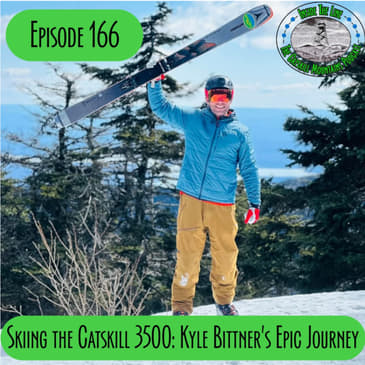
[00:02:38] Oh, no, no. So, Stosh, I'm stealing it right now. Okay. Well, let's welcome episode 166. So, this is episode 166 and skiing with the Catskills. So, Kyle Bittner is here. Fourth person to ever ski all the 3,500 high peaks. And we don't know what else, but he'll tell us tonight. We're going to have a good chat.
[00:03:00] He's going to talk about how many times he's like jumped over trees and done backflips off a slide mountain and went over the ledge on Friday. No, I'm just kidding. I don't know if he's done that, but it'd be really cool if he did. Not really, actually. Let's, we have already had talks with the Rangers, so let's not put them in that suit. But thank you for joining us, Kyle. Good to have you here. Thank you for having me. This is great. Been looking forward to it for the past week or two when you had reached out. Probably even longer than that, actually.
[00:03:29] So, I'm glad that it's finally coming to fruition. Looking forward to chatting with you. Yeah. Well, I heard that the whole reason you skied the 3,500 in the winter was so you could get on the show. Is that right? Exactly. Okay. Yeah. I'm glad we got that straight. That was my vision. I was like, you know, the quickest way I could probably get on the show would be if I do something outside the norm. So, it kind of made sense to ski the cat skills. And it worked. It worked! Yes, mission accomplished.
[00:03:59] All right. So, Ted, I guess you're still on the show, bro. All right. Yeah, I am. So, Stosh, remember way back when we were putting the full court press on our listeners, friends and family members to nominate us for the Chronogram Reader's Choice Award. Yeah. So, I just sent you a text message that has the five regional podcasts that made the cut.
[00:04:28] So, why don't you see if we're on the list, buddy? Oh, shit. No, this is seriously new news. Oh, yeah. I got it. See if the outlaws are on the list. Can we make it? I got to go to fricking arts and entertainment and all the different things. Kyle, this will take a while. So, you can probably go read your kid a book, you know, plan your retirement. All right. All right. Hold on. Hold on. Music festival. We're getting there, right? Get in there. Did we make the cut for best regional podcast? We did. We're there, right?
[00:04:58] We're there. So, now is the time. Congratulations. Thank you. Thank you, Kyle. Yes. And now we need your support. Once again, all of our listeners vote often more than once a day. I don't care how many times a day you vote on, how many pseudonyms you use, false identities, purchased credentials, do whatever it takes. Okay. Yeah.
[00:05:27] We want to be number one. That's our egos drive the entire show. Yeah. I mean, you know what I want to say, if you like the podcast and vote for the podcast, don't, don't just do it just because if you like it, keep doing it. And I, I, I'm not looking to get famous or something like that. I love doing this. I love having fun. I love talking about the casticles. I love bringing people like Kyle on here to have a good time to talk about what he loves to do the most. But if you can do it, do it. Just let's have some fun.
[00:05:57] Let's, let's, let's take this away and let's, let's just kick some acts and take some names. That's right. We went from not being on anyone's radar screen to now we're, we're there. I don't know. I never, I never got an email about that too. Well, that's, you know, that's what you have me for. Okay. Thank you. So this is like the March madness, you know, bracket thing, right? That's football. There we are, man. We need sponsors. Next year. We need sponsors. We have the best sponsors. Don't do that. That's true.
[00:06:27] That's true. And tonight and tonight only we have Kyle. Kyle. So, so he's, he's on. So, you know, usually we have a bunch of stuff to go over, like some, some recent news stuff, but you know, I found this information out on the Catskill park advisory committee page where every year, I think, well, it's every, every quarter they get together. They talk about what's going on in the Catskills. They talk about big events that's going on the Catskills.
[00:06:56] Each personal committee. Basically it's 3,500 club, New York, New Jersey trail conference. All of them are involved in this and they basically give reports out what's going on. So this I got from the Catskill park advisory committee from the Catskill center. And it's showing us a glance at what happened in 2024. So this first part that I'm going to go over with is from the Catskill center, Sue's Catskill steward program.
[00:07:25] So this is pretty cool stuff. I'm going to just chat about stats real quick. We'll go over the, what the Catskill center thing. We'll, we'll get both of your thoughts. So visitation across all locations, the Catskill steward program, which I believe is slide. Wittenberg Cornell Blackhead Panther. And there's one more I'm missing.
[00:07:50] I forgot, but that visit visitation across all location, 90,000 visitors. That counted an increase of 24,000 visitors compared to 2023 engagement, 65,000, an increase of 31,000 visitors compared to 2023. Very good. Very good bags of litter collected 440 Jesus, an increase of more than 140 bags. Yikes.
[00:08:16] Rock dams constructed 20, an increase of eight dams from 2023 rock stack removed. My favorite statistic, 248, an increase of 136 stacks. Jesus. Dogs greeted. That's actually my favorite now. 4,313 dogs compared to 3,200 and 200. I'm trying to do math right now.
[00:08:42] 3,200 something compared to 2023 campsites rehabilitated 109, an increase of 87 campsites. Uh, visitor parking citations avoided 384. That's good. Tell them to get out of there. Basically. I do that in speeding tickets in a year. I mean, it's not impressive. I know. Right. Yeah. When you have a Jeep, you can just, you can just drag the cop off road. It'll never catch you. That's my trick. Do you even hit above like 60 miles an hour in that thing? Yeah. Sometimes.
[00:09:12] And then the wheels fall off. No, no. The tent blows off the tent on top of it just blows away. Yeah. All right. Let's get back to the statistics. So I was wrong about that before where they were at. So, uh, Peekamoose blue hole visitation, 21,000 visitors, an increase of 206, which is really not that bad. Uh, let's, let's, well, let's just pump the brakes right there. All right. Kyle. Yes. Peekamoose blue hole. Do you know where we are? We, yes.
[00:09:42] What's that route 42? Yeah. And do you know where the blue hole swimming area is? Oh yeah. Yeah. Now can you imagine in a single year, 21,601 people visit that area? I forgot the permit length. That's not the length. The, the numbers per day is like 200, right? Well, it 200 a day.
[00:10:10] Do they really even get to 21,601? I mean, they're not during the week. They're not getting a lot, right? It's all, it's primarily weekend distribution. So if this is, it can't be over like 26 weeks, half a year, it's gotta be something less than that. I'm going to assume. So if we knock it down to 18 weeks, what does that get us? That's 21, six divided by 18 just per week. That's 1200 people per week.
[00:10:38] Let's assume 200 of them are during the week. That's 500 people on Saturday, 500 on Sunday. Huh? That's a lot of people, huh? Kyle's got his head bobbing up and down. You, you agreeing with me? I gotta be honest. That is a lot of people for sure. Yeah. In that area. But I'm still hung up on the bags of trash that were collected. And the recent spike of our canine friends being logged in out there.
[00:11:08] I think one of my pet peeves is I'm curious to see how those wasn't 440 bags. How many of those bags was a, a dog turd wrapped in a bag left on the side of a trail. True. Yeah. Nothing annoys me more than seeing that. Whoa, whoa, whoa. Those are dog turds in those bags? I hope so. I didn't know that. They tasted like them. Oh yeah. Anything for protein, right? Yeah. I remember coming down to Carshkill High Peak one time. I think I collected, it was at least six or seven on the last quarter mile stretch going
[00:11:36] back down to Plattecove Road. Just, just baffles me that someone will take the time to pick up the dog poop, put it in the bag and leave the bag right there. Just let it decompose. Yeah. Kick it to the side. Yeah. At least thinking, what are they thinking? They're not. They don't know. Yeah. Yeah. That's a, you know, that's, that's, you know, you're right, Ted. That's a lot, especially to that small vicinity with a parking area.
[00:12:01] I mean, they expanded the parking area now that that goes beyond, I think 80 cars. They have the two different, three different parking areas. So as if having more parking is going to help the situation. True. It's just insane. All right. You can continue. Go on with it. I just had, when you got the blue hole, it was, that's just a huge number to me. I mean, I thousand, that's like a whole city. 21,000. I didn't have to say only on to us around 14.
[00:12:30] So that is pretty good about, but I mean, you know, that compared to that Catterskill Falls had 52,000 visitors counted, an increase of 10,500. I guess. So once again, I was wrong about where they're located. The Catterskill visitor center stewards there at Peekamoose, Catterskill Falls, Devils Paths, Platclove and the fire at our. So it's just based on that staff. So, I mean, 52,000 people, I expected more.
[00:12:57] It felt like, I mean, that was just those, those times when they were there. So who knows when they were not there, how many people came in, but 52,000 is a lot. You know, that's a, that's a, that's a basically a stadium full of people and NFL football game. Yeah. Just not that much. It's not that bad. No, I'm just kidding. It's horrible. Uh, that's why I hike in the winter. Uh, but also, so Devil's Path through 3,600 visitors, an increase of 400 visitors.
[00:13:27] So that's not that much of an increase. Uh, Platt Clove, beautiful little spot down there. 41, 20 compared to an increase of 2,310 visitors. So that's, wow. That's a hell of an increase. Fire towers, uh, 3,177, an increase of 1,991 visitors compared to 2023. So, so what, but you look at this, if that's spread over five fire towers, that's just a
[00:13:56] little bit more than 600 people for her fire tower and the devil's path gets 3,600. Yeah. Do you really, I just sounds like that number for the devil's path, 3,639, that sounds light. You know, I, you know, I, and I would think that the statistics on that were probably they, of course they, the people they run into everybody, you know, not everybody does the full devil's path and runs into somebody.
[00:14:23] They might, you know, be doing twin and then exit. So they exit before the person has gotten off on and off. So, I mean, I guarantee with, Oh, like a person on every single peak, they would probably be double that because I, you know, I go to twin at least three times in the, in the summer because it's just absolutely stunning. And, and a bunch of people like fricking Josh Reed or Jason Lang or something like that does it in fricking three hours.
[00:14:52] It's fricking insane. And they could do it six times by the time I finished basically twin and Indian head. So it's, it's insane. Yeah. They probably didn't even count those people, the trail runners. Cause they went by too fast. They were just like, Oh, was that a person? Like, Holy shit. I want to know how long it takes Kyle to do the devil's path. You ever do it in a day? I have. Um, I was a trail runner. You a trail runner. Uh, I've not completed it yet. I have to do the cranberry 50 and then, uh, the Prezi and penny.
[00:15:21] Um, but I think I, I was, I was definitely sub sub 10 for, uh, the devil's path, which is a phenomenal route. I mean, you get everything there. It's just amazing. It is. That's Stosh. I'm pretty sure that's faster than, uh, you're at my time doing the devil's path. I don't think we've done it under 10. I haven't done the full devil's path ever. Oh, no, I don't think I can. So that's why I'm pretty confident. Kyle is really whipped her ass on that one.
[00:15:51] I think, you know, I could get the plateau. And then once I see going up a hunter, I'd probably just be like, screw this. Yeah. I think I'm gonna go lay in that lake and just, just be done with it. But Hey, well, so, I mean, that's, that's pretty cool to see, but a lot of increases that, you know, after, uh, you know, with COVID and stuff like that, you know, I always thought this would be going down, but apparently it's not. So, but once again, social media, uh, you know, the DC is promoting the fire tower challenge.
[00:16:20] A lot of places are promoting this, which is good. More visitors mean more money to the Catskills, you know, more, uh, here and there. Hopefully people are doing their thing, but it looks like, you know, like what Kyle said with those bags of litter that they've had to collect. And, you know, the campsites, everything's increased. I mean, seen increase in the area.
[00:16:41] I think that you would, you'd still see an increase in that stuff, but that's why these stewards are there teaching, you know, hopefully given education to these people that could pass it on again. Yeah. So, you know, all things considered and all joking aside with that intensity of visitation and assuming that a large percentage of those people are not as astute when it comes to back country, you know, uh, air taking and et cetera.
[00:17:11] You know, the trails in the area are doing pretty good. All things considered, I think for that much traffic. So yeah, everyone who was getting out there and volunteering and all the people that are doing their park packing out their own stuff and the stuff of others. Like Kyle said, he did with some dirty doggy bags coming down Catterskill high peak. Yeah. He did the Tad thing. What was it? Pack five, take five, take five, take five things out on every hike. Right. Yeah.
[00:17:40] So, I mean, just as long as, once again, we're, we're teaching and preaching and stuff like that, it it'll work. And then, you know, a lot of things got to come into play. Like, you know, once again, like improving our trails, like the trails are doing pretty good. The places where it's getting wide, we're, we're looking at it and stuff like that. Like they're doing that work over on a P coin notch and stuff like that to Tahoe's trail crew is doing that. You know, we've gotten, well, of course, Catastical falls and stuff like that.
[00:18:08] You know, it's, it's, it takes a lot of work and it's not, not easy as we've, we've talked with volunteers and people who actually do the job. It ain't freaking easy work. And people think, you know, oh, you know, there should be a build a bridge built over the never sink at the slide mountain trailhead. I heard, I saw a post today on Instagram and if, if there was a post on Insta about it, it's gotta be happening. It's true. Yeah, it's true. 100%. Yeah. Their truth filters are rigorous. Indeed. Indeed.
[00:18:38] So I'm trying to pull up once again, I want to be like facts on this total hikers counted. So, so, so yeah, so I, I think I doubled that, that part right there. The total hikers. Yeah. Yeah. I think I doubled that. So, well, I mean, but visitor engagement then can't be 65.
[00:19:00] If your visitors across all locations is 90 and then you go down to Catterskill at 52, you know, those numbers seem to square. We can have our auditing and review department, you know, tabulate all this and run it by the internal fact checkers and get out a detailed report with graphs. It looks like I messed that up. But okay. So I'm going to go off of this that I have on here for the, the New York, New Jersey trail conference.
[00:19:27] So I'm going to go down here for the, the New York, New Jersey trail. So, I'm going to go down here for a couple of years. So, I've got a couple of people to see the next couple of groups.
[00:19:56] Hikers counted, which once again, I guarantee they're not there seven days a week, 14,000. Hikers dedicated to assisted, 5,900. Backpackers counted, 1,000. Hikers directed to other park locations, 317. And then it goes on, lost hikers helped, 64. Injured hikers helped, 7. So that's the whole statistic. That's for all the ranges they covered.
[00:20:22] So it looks like the, of course, the area that they did the most work on was Giant Legend Panther. Almost 6,000 people. They engaged with 2,000 people. Backpackers counted 379. They helped 21 lost hikers and helped four. The average high was 72, and the average low was 55.
[00:20:46] So North Point, 3,300 people, Blackhead range, which I saw this statistic and I was like, wow. Like I said, I don't think they're, of course, they're not everywhere at every time. Total hikers counted in the Blackhead range, 1,500. So I guarantee that's the place to be if you want to be in the Catskills. I've come out of the trails over there quite a few times and been surprised how many cars are in, at the end of that road.
[00:21:14] I can't even say the parking area, at the end of that road, you know, at 1, 2 o'clock, 3 o'clock in the afternoon. Yeah. And then the hikers that you don't see. Yeah. Because you don't see them. You're just like, well, that's pretty crazy that, you know, one time, like, Jessica and I parked there, and then we see we're parked all the way in the back, but we see two people on the trail. So I guarantee, once again, that's a lot of stuff.
[00:21:38] So big thanks to the trailhead stewards, to the people who do this and stuff like that, to volunteer, and also, you know, get paid to do this because it's not an easy job. I guarantee, you know, being a search and rescue volunteer, you've got to have confidence, especially when dealing with people who are inexperienced with these areas, especially Giant Legend Panther. You know, that's a little rough. If, uh, and the Burroughs Range going up to slide, hey, it's the highest peak in the Catskills. It's 4,000-something feet.
[00:22:07] Let's hike it just because. And, you know, and the same thing, Wittenberg. Hey, it's the best view in the Catskills. I saw it on Instagram. Let's go check it out. And then you're screwed with that frickin' four-mile hike that is endless, going up just to the summit. Like, like. So thank you very much to, to, to the people who do all this volunteering and stuff. You know what? I'm getting a hold of Alan, one of the directors of New York, New Jersey Trail Conference. He's going to be on here.
[00:22:33] And then also, you know, we might have a live show coming up sometime soon. And then that, at the Trail Conference headquarters down in Ramapo, I believe. Are they going to give us some type of reward, trophy, plaque, prize? Six-pack of hard cider. Four-pack. Four-pack. Those will come in six-pack. And so long as it's not an odd number, then we don't have to fight over. Yeah. True. Odd can. True. And, you know, Kyle, what do, what do you think of the statistics?
[00:23:02] What do you think, you know, seeing this stuff? And I think you raise a good point. You know, it's, it's only when they're there monitoring the activity. I know, like, for me, most of my hikes, I go during the week. And very seldomly do I see any trail stewards there. You know, it's usually in the weekend when, when you're hiking up slide with, you know, some other folks wearing Ugg boots and jeans carrying a 16.9 ounce bottle of Poland Springs. So, I mean, yeah, I think, I think those numbers are still a little low.
[00:23:32] You know, because like I said, even, even on a weekday, I still see, you know, there's very seldomly do I get out and not see or encounter anyone, you know. But as long as they remain consistent with how they're pulling the data, I mean, then it's accurate with that context. So, yeah. And, you know, they're doing the hopefully good. You know, Ted, what about you? What are your thoughts? Yeah. Well, I don't know. The last hike I did was 10, 11 miles in the Catskills.
[00:24:02] Didn't see an entire person the whole day. And I was probably 60% on trail. Not a soul. Not a soul. I saw one person signed in ahead of me at Catterskill High Peak. And that's kind of what I love about the Catskills. You're so close to the New York metro area. You're really not that far away from other urbanization. And you can still go out there and get lost, you know.
[00:24:32] So, that's cool. You could be on one side of the mountain like you were. And then the other side is just packed. Yeah. Yeah. So, there's nothing wrong with that. You go out and do what you want to do and have the fun you want to have. And so long as you don't interfere with anyone else, everyone's happy. Everyone can have a good time. Yeah. And we do. And once again, we have people, you know, like the stewards and stuff like that.
[00:24:56] You know, Kyle, you know, preaching about, you know, how to be, leave no trace, how to do certain things the right way is a way to go about. You know, education is key. And it's been like that, you know, ever since I started hiking the Catskills. And I started volunteering and stuff. It's just, it's the only way we can go now. Teach and preach. If they don't do it, then you know what? They suck. And you should shame them all over the internet. Get them on the internet. Get their faces on the internet.
[00:25:24] Just like New Hampshire does when they do one of those rescues. God, I love that. Who else loves that besides me? They're just like, and the person was. Right? Kyle's probably thinking this is like, you know, people, some of these people skiing and stuff. Like that. He's probably like these idiots. Just like, and like, I'm just like, please. Like the one thing I'd be like, don't put my name. Like, sorry. Like, what's your name again? And I was just like, oh, George Clooney. Yeah.
[00:25:54] It's George Clooney. Well, and I'm sure they wouldn't question that when you say it. Do I look like him? No. With your, with your head off. Yeah. Do you up the, so, I mean, that's once again, a cool statistics to see is at an increase in every place, of course. Will it die down? Will it not? You know, it's funny. I wanted to, maybe I'll go back and compare this to like 2021 when they had that and see how crazy of an increase and do like a full math of that.
[00:26:23] Because that, you know, we, we got bombarded with that stuff. And I forgot how many 3,500 club finishers were during that time. The two years were insane. We went from like 2,900 to like 4,000 in a matter of two years. So Kyle brings out a new, uh, interesting and valid point. You know, the data reported is only good as the consistency with which you collect the data.
[00:26:50] And probably the person that has the most regular and consistent data collection is Jim Booton. Yeah. He probably. Well, cause he tabulates all the stuff out of the canisters. Yeah. Oh yeah. You're right. Actually. And yeah. And he reports it to the DEC. So we need to get uncle Jim on the show to give us, you know, he can obviously give us
[00:27:15] a lot of really, really interesting Catskill history, hiking war and tails, as well as, you know, the, uh, upward migration and the data over the last two, three decades or more. You know, in the old days before there was GPS and I didn't even think they had, when Jim started hiking, I don't even think they had compasses. Frankly. Yeah. Right. Okay. They had the sun. Oh yeah. That's good. It's good enough. Yeah. So cool. Cool statistics.
[00:27:45] Um, you know, Ted, you, you sent me a couple of things that I was going to go over, but I read that peanut, the squirrel thing. And that really didn't like doing it. It was just her statement about how she's going to improve the DEC. So the government saw the government's always starting the investigation. It's that they never finish it or report on the outcome of the investigation. Yeah. Yeah. So we'll investigate that. Yeah. We're going to investigate that too. I'm going to be right on that. Yeah. Don't worry. We're investigating that. We're still investigating that.
[00:28:14] You've gotten a couple of emails like that. Haven't you? Yeah. We started that investigation. Yeah, we did. So it's under investigation. We'll have to, we'll have to check it out. Yeah. Ongoing always. So ongoing. Um, so yeah. So like, apparently, like they said, they were getting things stricter with the DEC because of the peanut, the squirrel incident, but I didn't find that to be like a valid information. It just was her statement when she accepted the position of her and her new job as a DEC office court tender or something like that.
[00:28:44] So maybe I'll get ahold of her and she'll be on the show. The new DEC, uh, advisor. So we'll, we'll ask her about the investigation and she'll say, huh? What? Peanut? Who? Who? I had a couple of those last night. Yeah. All right. So that was short shooting the shit. So that's cool. Thank you. Once again, Kyle and Ted for shooting the shit. Uh, thank you to the multi supporters, Chris Garvey and Jeff Jotz, Vicky Ferraro, Mikey S.
[00:29:11] John Kamisky, Summit Seekers, Desert City Radio, Betsy A. Denise W. Tom H. Vanessa, Jim C. and Eric. Thank you guys very much for supporting the show. Now I wanted to explain what this meant. Uh, there's two new members, Jim C. And Eric that have joined the show, uh, supporting the show monthly as a member is basically you're just donating monthly to the show. And it's going to cover the cost of what we do for the show. And then everything else is going to be put back into the Catskill.
[00:29:38] So I'm trying to coordinate, which is, it's going to be a lost cause. I think I've asked several people about maybe putting together some, some money from the show to donate, to put up new trail signs. Cause you know, we have all these places that you see with deteriorated wood trail signs that haven't been replaced for 30, 40 years. Some are gone. Some are just, you can't even read them anymore. I was just like, I got this light.
[00:30:04] I was like, Hey, you know, let's take the money that we've, we've had for the podcast and let's donate it to DEC, uh, specifically for getting these trail signs rehabilitated and put up a couple of people are just like, this is definitely a lost cause. It's, it's a bunch of stuff that you have to go through hoops and pines that it's just not, you know, you can't just donate to this one thing. You got to donate to the whole DEC and then it gets shifted off and then it's just, it's a whole different thing.
[00:30:33] So I'm trying, I'm going to, let me see if I can contact one more person. So, and then we'll see where we can get from there, but you got to bet some of these, the signs that you, you come across are gone or deteriorated or half of it's missing or it's horrible information. And it says like to the summit 4.5 and it's actually like 3.3. I mean, or it's more than that. So, but you know, I talked with Matt Smith about that and Matt Smith, who is catch call
[00:31:01] trail crew person leader, and he's a Sawyer now and stuff like that. He said, you know, we basically got to get a tally of all the, the signs that are broken and then they'll get pictures of them to see what we need to get made. And then maybe we could do something. So if anybody has any pictures of, of trail signs, like trail junctions, pointing to trails, stuff like that, send me a picture, you know, we'll get as much as we can and maybe get some new trail signs, especially out over in those Western Catskills, you know,
[00:31:29] like over on all the ridges over there that just connect with the Huckleberry loop and stuff. They definitely need work. So that's what it's all about. So thank you for supporting the show guys. Really appreciate it. You're not just given to the show. You're giving back to the Catskills. Also, the sponsors of the show, once again, they're not just supporting the show. They're supporting the Catskills. So capture your love story against breathtaking backdrop with outdoor Chronicles photography.
[00:31:55] Molly specializes in adventure couple photography, and she'll immortalize your moments amidst the stunning landscapes of the Catskills, Adirondack and White Mountains. She'll craft timeless images that reflect unique bond in nature's grandeur. Embark on an unforgettable photographic journey with outdoor Chronicles photography. Don't hesitate to get a hold of Molly on all platforms. Also, discover the Wilderness with Trailbound Project. Our expert-led hiking and backpacking education program offer on parallel outdoor experiences.
[00:32:22] Whether you're a beginner or seasoned adventurer, join us to learn essential skills, explore stunning trails, and connect with white nature. Start today with Trailbound Project and unlock the wonders of the great outdoors. On their website, they have a whole bunch of stuff going on from TARP, tent shelter building, wilderness first aid, and I think it's like bear encounters and stuff like that. It's really cool stuff. So check out Trailbound Project. So also, who's outdoors? That's the big thing.
[00:32:51] Mention the podcast, one of your hikes through social media, and we'll chat about it on the show. So Pink Pony 818 was doing a nature and culture outing with the Mid-Hudson ADK group, hiked over 7.6 miles at Fannenstock State Park, hitting Round Hill and East Mountain, and drove two miles down to get to the Italian Art Museum. And lunch was a skinny zucchini panini and a fancy Italian chocolate drink. That is not something I would want after hiking.
[00:33:21] Sorry, Tracy. Not a skinny zucchini panini? It sounds very, very catchy. Yeah. What about you, Kyle? Would you be into the skinny zucchini panini or a cheeseburger? More than likely a cheeseburger. Yeah. Medium rare, a little bit of bacon. Sounds good. Thank you, Tracy, for tagging us. That looks... Have you ever left Fannenstock State Park, Round Hill, East Mountain, anybody? I've heard of it.
[00:33:51] I think there's an old estate ruins, which is the focal point of that state park area. Nice. It's a collection. Yeah. She's all over the place. It must be. She's getting all over the place. She's kicking ass. So also beyond blazes, went to Wittenberg Cornell while doing the Borough's Range. She had a beautiful view of Cornell. It was awesome. I'm jealous. Do you know where that shot was taken from?
[00:34:20] Wait, was she had a... Was that of Wittenberg? No, no. It was of Cornell. So she did it from slide. Right? Well, maybe you're thinking of a different photo of mine. The one I think... Yeah, I saw the photo of Wittenberg, which I thought was outstanding. Okay. So we can agree that we don't have a clue where we are, but then we're not out hiking. We'd be really, really lost.
[00:34:47] And sometimes, you know, they tag us in the stories, and then I'm just like, it gets lost in 24 hours. So I'm like, damn it. And sometimes I don't get it. You gotta do the screenshot. Do the screenshot. Yes, yes, yes. So JBOC223 did Big Bear North Trail. No views, but they listened to our episode on the Hudson Valley. No crowds. And they went to Breakneck that morning and said it was fantastic.
[00:35:16] April 21st is when that place closes. So, yeah. Have you ever been to Big Bear North Trail party? Where is that? No, I haven't, but because Kyle's here, I'll mention that I have skied at Big Bear. You know where Big Bear is, Kyle? The only one I know of is out in California. Well, not the one I'm speaking of. I know the one in California, but there's also a Big Bear ski area in Laksa Waxon, Pennsylvania.
[00:35:45] Good place to take your daughter when she's old enough to ski. Wow. Appreciate that. Yeah. Plus, they have a pretty cool, like, I don't know, with the park, with all the tricks in it, you know. Oh, yeah. Terrain park? Yeah, terrain park. Yeah, with buses, you name it. They've got it there. So, it's pretty amusing. And what's interesting about Big Bear ski area, it's one of the few ski areas that the lodge is at the top of the mountain. Ah. I know one other in West Virginia.
[00:36:16] Yeah, I know the one you're thinking of. Oh, boy. In the smokies. I forgot what it's called. Not white tail. Ah. It'll come to me. But, yeah. It's kind of unique when you start at the top of the mountain and you ski down. Yep. And that's how Bear Pen was. They had the lodge at the top of the mountain. Yep. Yep. Last run of the day was down to your car. Man.
[00:36:41] So, apparently, JBach 22.3 is a trail runner because that's on the Sasquad trail running. So, Kim Levinsky, who's going to be on the show soon, talking about her documentary. Apparently, that Big Bear North Trail party is from them. That is the biggest. So, this is hands down the toughest race in our series. Make no mistake about it. This is a true northeast mountain race.
[00:37:07] Runners and hikers will experience non-trapped trail beauty scrambling epic climbs and vistas. So, I'll have to include that in the show notes. So, it starts and finishes at the Anthony Wayne Recreation Area off the Palisades International Parkway. Interstate Parkway. International. Jesus. I'll have to post that route. So, cool. So, hopefully, he's going to kick ass at that. Also, who would not be able to be in this with Tom Hoos?
[00:37:37] He's Hoos Outdoors. Did a Burrow Range social hike. And that looks like he had a good time. And it was beautiful. It was a good time going up there. Beautiful pictures, as always, Tom. Yeah. So, and what happened? He was coming down slide after the wilderness ladder, which is what he calls it. You hit that set of ledges.
[00:38:00] And at the top of one of those sets of ledges, Tom went down and posted a photo with an injury. We'll call it a minor injury. Just distal of his elbow. Oh. Kind of towards the forearm. Probably hurt. But he continued on. It's not a good place to call in for a rescue. Oh, no. That's actually a great place. The Hell of Kelly. It would fly and you get the hoist right into the summit.
[00:38:30] Would that have to get you up to the summit then? Right? It's right there. I mean, it's not even a quarter of a mile. You're downhill from it. Yeah, actually. So, I guess you're screwed. So, hopefully he's feeling better and stuff. My God. Yeah. It'll be out taking photos and doing more social hikes. Yeah. He's ripping it up. So, thank you, Tom, for tagging the show. Thank you, everyone, for tagging the show. Glad you're tagging the show and talk about your awesome climb.
[00:38:57] So, once again, I'm sorry for all these people that tag us and we have mostly me that has no clue of where they're hiking because they're all down in Harriman and stuff down the Hudson Valley. I have no clue about that. So, I apologize. So, Kyle, where are you located, by the way? I'm located in between Kingston and New Paltz. Okay. So, you're the Hudson Valley. You're an area. So, you might have to be familiar with way more than I do. A little bit. Yeah. Good. Good.
[00:39:27] So, are you on the east or west side of the ridge? I would be east side. Okay. Yeah. Looks like you're writing this down, Ted. It's like, okay. Yeah. So, mentally, I know the terrain he's in. Which is nice because Mohawk, Minnewasca is literally 10, 15 minutes from my house. So, I can zip up there after work. You know, run around with my daughter. There's some pretty cool spots up there.
[00:39:54] I don't want to venture out a little bit further into the Catskills. Yeah. Nice. Nice. That's good terrain to start family hikes on. It's what I did with my kids. It is. Yes. Even for biking. Oh, yeah. I've spent a lot of days up there cycling. Yeah. Well, cool. Thanks. Once again, buy us a hard cider. This is a sports show. You can go on the place called Buy Me a Coffee, but I changed it to Buy Me a Hard Cider. Tom, who's bought 10 hard ciders?
[00:40:24] Way to go, Tom. I know. He's going all out. Like, Jesus. Thanks, Tom. You are the man. Check out him again, who's outdoors. Thank you for supporting the show and supporting the Catskills. Once again, we'll get this out into the Catskills. If you guys have any suggestions on what I could try to do besides the trailhead signs, the trail signs, let me know and we'll get it going. So, also rate the show. You can rate the show on any platform. Five stars is the best.
[00:40:52] Four stars is not acceptable, so don't even do it if you're going below five stars. And also, vote for your favorite regional podcast on the Chronogrammies. I will start posting that stuff immediately so we can get that going. And then, yeah, we'll kick some ass at that, hopefully. We'll have a good time. All right. So, you guys drinking anything? Who's drinking? Anybody? Anyway, Kyle? Kyle, starting off?
[00:41:21] Drinking some bourbon at the moment. Oh, bourbon. Yeah, Angel Energy bourbon. What else is it? Bourbon and what? Straight up? Just straight up. Yeah, Angel Envy. It's kind of my go-to at the moment. Nice. That is a first. Kyle is a first with bourbon. Nice. I guess if you're going to ski the backcountry in the Catskills, you need to be able to drink bourbon straight up with a smile. Like Kyle's got going on. I was going to say, yeah, it does.
[00:41:51] It definitely does. Keeps you warm and keeps you headed downhill. Yes, it helps. Good, good. So, Tad, what about you? Anything? Coffee, I'm guessing? Oh. Oh. It is No Brew Tuesday. Oh, so it's a- Yeah, so I'm drinking. I just cracked open one of these fancy Italian sparkling water with zero alcohol content. Good for you.
[00:42:18] I can support our listeners who, for whatever reason, are not drinking alcohol. Rock on. So, here, let's see if this works. I'm going to keep talking, and then right when I stop talking, I'm going to do it. That might have worked. It might have. Nothing. Nothing. Kyle, did you hear anything? Did you hear anything? I heard a little something. Yeah, it was kind of like a hard cider wanting to be a bourbon. That's what I heard. True, true. So, Awestruck Blackberry.
[00:42:47] It's good stuff. Actually has some pretty- Oh, it's only 5.5 content. So, usually those things are like in the sevens and stuff. And then you get in the IPAs where they're like in the 30s or something like that. I don't know. Those IPAs pack a punch. Kyle's like, yeah, they do. Oh, yeah. All right. So, previous hikes. Guys, I got nothing.
[00:43:13] So, last Tuesday, I was planning on going to hike, but I was sidelined with a back injury. This Sunday, I was sick, and I was like just draining my nose and stuff like that. Plus, on Saturday, Ted, I showed you we went to a Van Halen tribute concert. That was fantastic. I got it. You know, once again, that's the closest I will get to seeing like Eddie Van Halen do stuff. This guy was absolute perfection doing the solos.
[00:43:42] And that's easy stuff to mimic, okay? Kyle's daughter could be doing Eddie Van Halen licks on the guitar in a week. I don't even think you would probably name me one Van Halen song, Ted. I could probably give me five minutes. I'll pull out three or four Van Halen LPs that are original first issue from the 70s. True. So, yeah. This was, I had a great time, dude.
[00:44:09] It was so much fun to, like, Eddie Van Halen is like, I play guitar. I would, nobody will ever be near Eddie Van Halen. You know, everybody talks about the greats of Jimi Hendrix, stuff like that. Jimi Hendrix did bluesy solos that could be, anybody could do. I can't, you're saying, you're saying Eddie Van Halen's better than Jimi Hendrix? Eddie Van Halen is the greatest ever. Kyle, I don't know anything about you or your music interests, but I'm guessing as a skier,
[00:44:39] you're going to go for Jimi Hendrix before Eddie Van Halen. So what do you say? Who would you vote for if it was down to Eddie Van Halen or Jimi Hendrix? Yeah. Tough one. I might even go Van Morrison with, you know, I kind of like that type of music too. Yeah. Yeah. We could go with Van. The flow, the beat, the groove. True. You ever, you ever listened to any of Van Morrison's stuff he did with Mos Allison? I had not. No. Yeah.
[00:45:09] That's some really cool stuff. So get you, get you more of that salty urban, like late night bar feel. So that's cool. No. So yeah, I'm sorry. I think just Eddie Van Halen changed the face of rock and roll and everything because he did stuff that, that Jimmy didn't do and stuff like that. Like finger tapping slides, pinch harmonics, bends, whammy bar, stuff like that. Jimmy, Jimmy was good. Jimmy was good.
[00:45:38] If it wasn't for guys like, for like Jimmy Hendrix, guitar companies would have gone out of business in the mid seventies. Eddie never, Eddie never would have picked up a guitar. He would have played organ for some Baptist church. And he made his own guitars. That's why. Yeah. Well, I don't know. He made the Frankenstein. I get your point. I get your point. But I, I, I can't say that Jimmy Hendrix, when you look at the evolution of guitar music
[00:46:09] and, uh, Jimmy Hendrix was really there. I'm not going to say at the first wave, cause that was really in the fifties, but when you get into the sixties and now you start getting, you know, big amplification, the second generation or third generation of guitar making, but still it's at his infancy. And then you get this guy, Jimmy Hendrix coming along. You're talking about breaking all the rules. You know, the rules were new, but everybody was still playing by the rules.
[00:46:35] Then you get this guy that's just off the chart playing with his teeth, playing the guitar behind his back, just doing these insane licks, Jimmy all day, all day long. That's what I'm going for. So that's it. That's my plug for Jimmy Hendrix. Cast your ballots at the chronogram for Tad's favorite guitar player moving along. Yeah. So who is, who's up next? Who wants to go next with the previous hike? Tad, what did you do? Did you do it? I did.
[00:46:59] I did the three day, three night tour lean in closer, Kyle. So you can hear it closely. Did three days, three nights on the I've got COVID tour. So I think, I think sometime between, you know, late Friday night, early Saturday. Um, I broke through that, you know, upper stratosphere, got out of the COVID round, did
[00:47:27] some housework yard work Saturday, Sunday, actually started doing some spring bicycle maintenance to get some bikes ready for the season. And, uh, I did, I did no hiking last weekend. So, but I did COVID. I did COVID. It seemed like one bitch of a hike through death Valley or something. It's not fun. So you said that was the first time in like 16 weeks that you haven't hiked.
[00:47:51] Yeah, I think it was the first time I haven't hiked in the Catskills since, uh, that first epic snow storm in November, like November 22nd, November 24th. When we just got a huge dump of snow, light and fluffy. Nice. Well, glad you're over. So it's all, it's all on Kyle's shoulders. It is now. What do you do? Well, I actually did hike last Wednesday.
[00:48:21] I was up with a buddy poking around the, uh, the South side of Westkill mountain, um, went up through, uh, was it broad street hollow off. Nice. Yeah. A little bush wax and some pretty cool stream crossings, you know, walking the tight rope across a couple of down trees, but some good, uh, good bush whacking up there. There was a few things I was looking for that I ended up finding. So that was, that was a big score. Yeah.
[00:48:50] So I was going to go, I think it was just, just under six miles, uh, 2000 feet elevation gain. Nothing, nothing crazy, you know, just kind of meandering through the woods. Uh, did find a pretty cool artifact hidden in, uh, kind of like a rock ledge. It was a Coca-Cola can from 1980. Um, and even on the can is said 1980, uh, LA Olympics. And, uh, all aluminum.
[00:49:16] I mean, this, this can just had some weight to it and, uh, the, where, where was kind of like tucked away in this like little crevice of a, of a, of a rock ledge, uh, didn't get any real sun exposure. So it was in pretty good condition. Wow. That's interesting. Pretty cool little score there. So what prompted you to explore that side of Westkill? Cause I actually, this spring I scouted out. I probably know the dead end that you went up to. There's a lot of like, don't park your signs at the end of that road.
[00:49:46] Yeah. Yeah. Well, that's the, that's, that is DEC property. So, you know, as long as you're, you know, respective, you shouldn't, you shouldn't have any issues where you park and whatnot. You know, there, there are signs up there. It's a snowplow turnaround, but obviously that that's not really an issue. But, um, uh, it had to be transparent. There was a, the, I was looking for the, uh, the Westkill, uh, plane crash site up there. Um, which isn't one of the more broadcasted ones, but, uh, was able to locate that and,
[00:50:14] um, you know, spend a little time there and then just kind of poke around that area. It's a dark area. Yeah. Did you find the plaque? I did find the plaque. And I will say that plaque's probably got about another five, 10 years. And that plaque's going to be inside the tree. Cause it, I just happened to literally just, just kind of rest my hand on a tree. I looked up and there was a plaque. So, um, it's one of the more touching crash sites that I've been to in the Catskills.
[00:50:44] Um, for sure. Yeah. Well, as a skier and as a father, I mean, this is a family that was heading up to Vermont to go skiing. I mean, you see the ski gear right there. It's still there. You know, you can imagine how the excitement in that airplane, everybody's going North from Virginia to go skiing. And then you hear the treetops, you know, it's just the horror of all that. So yeah, that's a very sad, solemn place. Yeah. A nice approach though. Yes. Yes.
[00:51:14] I do appreciate, you know, fellow hikers, the respect for the site. You know, it was, you know, like I said, very, uh, very touching area for sure. Yeah. Yeah. It's a, it's definitely a different kind of area. Let's just say that. So glad I'm glad. How much snow was on the ground at that time? Oh, not much. I think zero. As we were walking out, we did get caught in a nice little snow squall, but it didn't amount to anything.
[00:51:42] Just a little, you know, just a little blast of, uh, snow. Um, but, uh, it didn't really stick much. Yeah. So did you go all the way to the summit of Westkill? Uh, that, that day we did not. No. We just kind of, uh, just kind of went, went to the, the, uh, the site and then kind of headed, uh, East along the Ridge there and just checked a few things out and then just doubled down. They're basically scouting up potential ski, ski routes for next year. Nice. So cool.
[00:52:11] That's so cool to talk. We'll talk about that. Definitely. So glad Kyle was the only one to get out. He's the spotlight of the show. So he needs, we were just, we, we lied about everything. Kyle's just a nose. So, uh, Catskill news, uh, spring trout fishing season opened April 1st and runs through October 15th catch and release artificial lures only trout season runs year round. Uh, apparently. So Tad, thank you for that.
[00:52:38] You added that you're a guy volunteer 3,500 club Catskill trail crew, Catskill mountains club, this is our center, jolly rovers trail crew, play me out in fire tower. Anybody where, anywhere you can volunteer. It helps the cat skills. It helps our mountains. It helps anywhere. It doesn't matter. Catskills, Hudson Valley, just donate your time. It helps us out immensely. So weather, what kind of messed up crap do you think we're going to be hitting this weekend?
[00:53:06] Like I've, I haven't even looked. This is my first glance and it looks like it's, it's going to be not too fun. So we're looking at, uh, what do I got it on? Friday mountain. How about Friday? Friday. So on Friday, the 4th looks to be 46 of high and a low of 30 with the wind chill. Rain showers developing later in the evening. As that comes along, once again, this is Tuesday. We're doing this a Tuesday recordings when this comes out Friday.
[00:53:34] It's a, it'll be a little bit interactive, probably move quicker. So Saturday, heavy rain to moderate rain to light rain throughout the whole day. Uh, a total of almost an inch of rain, a high of 39, a low of 41. So that is not fun. Going into Sunday, cloudy in the beginning of the AM and then light rain and rain showers. Another accumulation of around 0.1 inch, a high of 55. And then later in the night, the wind chill starts going really crazy and it gets down
[00:54:03] to 12 degrees with wind chill. So it doesn't look to be a fun weekend, but who knows? Who knows what the hell is going to happen? It might turn to fricking snow like it did here today. And then 73 degrees yesterday. So, so get out, be prepared anything and everything. It's a spring season. You know, we, we spikes bring the spikes. You never know up higher above 3,500 feet.
[00:54:31] You might have a little ice, you know, it's, I don't think it's cool to just go around it. I didn't have to throw our spikes on. We just went around it. I'm sorry to say it like this, but you're fucking up the trails. Stop doing that. Like everybody goes around it. Like, I'm just like, I I've documented this so many times of just like, oh, look, this is where ice was, but everybody went around the tree. Thanks. Now you screwed up the trail. So bring your spikes, wear them, bring your micro spikes, your crappy dull micro spikes. So they're rant over.
[00:55:01] Sorry. Yeah. We call them rock spikes. Yeah. Rock spikes. Yeah. Yeah. When they get worn down enough that you need marginal protection, you're going to run into a lot of rocks, bring the rock spikes. Yeah. So, all right, let's get on the last set of sponsors and then we'll get Kyle's story. All right. So discover Camp Catskill in Tannersville, your ultimate hiking store. Find top quality gear, apparel and accessories for all your outdoor adventure.
[00:55:27] Our expert staff here help every hiker from beginners to seasoned pros. We also carry a variety of unique Catskill souvenirs and gifts. Visit us online at campcatskill.co or in the store to gear up for your next journey. Adventure starts at Camp Catskill. Also discover the beauty of the Catskill's Adirondacks and the Hudson Valley with scenic route guiding. Our expert guides to ensure a safe, unforgettable hiking experience tailored to your skill level.
[00:55:52] From breathtaking vistas to hidden gems or if you're peak bagging to just simple day hikes. We'll lead you to the best spots in back. Book your adventure today and explore nature's wonders with scenic route guiding. Check them out on all social media platforms. Also, if you mention the podcast, you can get 10% off. Use the famous code word, mountain lion. And then also embark on a transformative journey with another summit. Another summit is dedicated to certain veterans and first responders with free outdoor activities.
[00:56:23] Activities like walks in nature, paddling, hiking and even backpacking. Join us for a prorative community for rejuvenating nature's embrace. Experience camaraderie, adventure and healing at no cost. Take your next step with another summit and ascend to new heights and joy. Apply today on another summit dot org. Alright, so let's get on to the guest of the night. Let's go! So tonight, Kyle Bittner joins us.
[00:56:50] The fourth person to ever ski the 3500 High Peaks in the Catskill. Fourth person. Number four. There's not many people that can say that they're number four in anything basically in the Catskill 3500. So Kyle is here tonight. Talk about an experience of skiing the 3500. Which he's had a pretty decent time doing with a pretty decent amount of snow. But I guarantee you've had situations where they're not like that at all. Correct? Yes, yes, definitely.
[00:57:19] Last year, for instance. Oh, yeah. My first year of Alpine touring, which I was pretty much stuck to doing so at the resorts. You know, Wyndham Mountain Club, Hunter Mountain. I did a lot up in Killington, Pico. Didn't have the great year I was hoping for. So my quest to ski the 3500s were kind of pushed to this year. Okay. Nonetheless, we're done. Yeah, yeah.
[00:57:48] Now, great year to do it, you know. Yes. Definitely way better than the previous year. Yes. Yes, totally. So Kyle, why don't you give a little background about yourself? Start with like the non-ski, non-hike, and maybe you can develop into that later. Yeah, absolutely. So I'm actually born and raised in Kingston, New York. So roughly, I don't know, what's that, 30, 60 minutes away from like, you know, the main Casco area.
[00:58:16] So I joined the Marine Corps fresh out of high school. I spent five years in the Marine Corps. And then I got out of the Marine Corps. Actually, I got out of the Marine Corps April 30th, 2004. And I found myself back in Iraq on June 3rd, 2004, working for the government. I was providing services to the government. And I spent pretty much from 2004 till 2017 working and supporting the U.S. government overseas
[00:58:44] in various countries and locations. 2017 decided it was ready for some change. And I relocated from Virginia back up here to New York. And I've been up here ever since. Once COVID kind of hit and kind of changed the dynamic of social interacting and whatnot, that's where my wife and I kind of picked up hiking. We started getting out, exploring a little bit.
[00:59:13] Our first hike we did was actually Balsam Lake Mountain. Probably still one of our favorite ones. I love the end of Balsam Lake Mountain. You kind of walk through that like little like pine forest. And then it just opens up. I just love it. And we did in the winter, which was even better because everything was just crusted in snow, ice. It was beautiful. Ballsy to take her out on a winter hike for her first hike ever. Oh, I had even a ballsy-er one for my daughter's first hike.
[00:59:39] So I do have a three-year-old daughter, Skylar. She's an absolute savage. She's also been on every one of the Catskill High Peaks on my back. So I'm looking forward to starting her journey of unassisted hikes. So she's officially, unofficially a Catskill 3500 member because, you know, the law or the rules do state you have to kind of climb up and climb down on your own power.
[01:00:07] So catching a ride on me wasn't really – didn't meet that criteria. But nonetheless, she's been everywhere I've been, which is amazing. So my wife, Skylar, was literally five weeks old. And I was like, hey, what do you say we get back out there and do some hiking? And I had one of those little, like, Omni 360, like, chest carriers. And I was like, let's do Hunter Mountain. It sounds like a great mountain to do.
[01:00:37] And for some reason, I decided to take my wife up, Becker Hollow, instead of Sprucedon. Yikes. So that was a mistake, to say the least. When was the time of year, though? Yeah. It would have been October. October, early, early November, because my daughter was born September 30th. So it was roughly, you know, four to five weeks after that.
[01:01:03] So not only was my wife, you know, five weeks post-pregnancy, in my opinion, Becker Hollow is one of the more aggressive approaches to Hunter Mountain. Yeah. So nonetheless, it was an experience in more ways than none. So, but we got it done. We got to the fire tower. I did bring my little stove, and I made us some little hot meal up there and drank some coffee, and then we ventured back down.
[01:01:31] So how long after that hike was it that the three of you went on your next hike together? Great question. I would have to go back and look. But ironically, I do think the next hike, I think it was actually Balsam Lake Mountain again. Oh, nice. Because not kind of, you know, just to reminisce and, you know, because ironically, the first time my wife and I did Balsam Lake, unknown to us, my wife was actually pregnant at the time. Oh, wow. So that's kind of where it all started. It kind of came back full circle and whatnot.
[01:02:01] So Balsam Lake Mountain, like I said, was definitely one of my favorite hikes in the Catskills. So, Kyle, if you grew up in Kingston, did you do any Catskill hiking when you grew up? A little bit. A little bit here and there. You know, back then, to be honest, it was just grab a backpack, throw some natty light or some bushes that you found laying around and go hike up there. And, you know, just stay out of trouble and come on back.
[01:02:30] So, but nothing as organized as I'm kind of into now. Gotcha. I think I did do slide. I, Ashokan High Point, actually, when I was younger, I did actually camp up on Ashokan High Point in that vicinity. Couldn't tell you where exactly we set up camp, but I did hike that when I was younger and camp up there. I have great memories of it actually got snowed on that night. Oh, nice. Very, very memorable.
[01:02:58] I remember having a, you know, burning a candle in a tent just to get a little extra warmth in the tent, you know. So, yeah, it was a good time for sure. So when did the skiing start? You know, whether it was inbounds, lift service skiing, Nordic skiing. When did you start skiing? So I started when I was about 12 years old. My father had a cousin that lived just outside of Burlington, Vermont.
[01:03:26] And for whatever reason, they never had children. So one year they asked, hey, what do you think about, you know, having Kyle come up, spend some time with us? So my parents were like, yeah, sure, that's great. You know, some time away from Kyle. Who doesn't want that, you know? So they literally drove me up to Albany and threw me on a Greyhound bus. And I took a Greyhound bus into Burlington.
[01:03:51] And my cousins picked me up, brought me back to their amazing house in Essex Junction. It's an old historic built in 1800s, you know, bed and breakfast house. And ironically, they both worked at Stowe Mountain as hosts. So basically they kind of skied around the mountain, answered skiers' questions, provided directions, you know, things along those lines.
[01:04:17] So my first experience or my first time skiing was actually at Stowe, Vermont, which is a pretty good northeast mountain to have as your first-time ski resort. So I didn't annoy my cousins enough. And they invited me back the next year, year after, year after. Eventually I was of driving age. And I continued the tradition up until I went into the Marine Corps.
[01:04:46] And my father's cousin, he was a phenomenal skier. I mean, old school, tight parallel. You know, he retired from IBM. So, you know, he did a little traveling around the world. So he skied in France, you know, obviously Vermont, northeast, but just a phenomenal skier. So he basically taught me how to ski. And it had a huge impact on my ski style as I kind of grew up and whatnot. Then I had mentioned I joined the Marine Corps.
[01:05:14] So I got stationed actually in the desert on 29 Palms. And we were doing a training exercise up in Northern California. The Marine Corps has a mountain warfare training center up in Bridgeport, California, just outside of Lake Tahoe. So my battalion got sent up there to do cold weather training. And they found out that I had a skiing background.
[01:05:42] So I was selected to go become a scout skier in the Marine Corps. Okay. Wow. Wow. Probably one of the coolest opportunities I had in the Marine Corps as far as training goes, experience, memories, and whatnot. So the base camp where we reside, it was just below 10,000 feet in altitude. So right up the bus, literally coming from, you know, the desert.
[01:06:11] I mean, that altitude hit and it hit hard. I mean, just walking to the chow hall, we're out of breath. You know, I was 19 years old, 20 years old, you know, invincible. And walking to the chow hall, you know, I almost had to take a knee because I was so winded, you know. Well, we got acclimated. And, you know, then the fun started.
[01:06:32] You know, we did a lot of land navigation, a lot of orienteering, did a lot of with avalanche, training, probes, things along those lines. We did do a lot of snowshoeing, snowshoeing, carrying sleds, making snow caves, snow forts, setting up tents, you know, how to hunt, trap, snare, how to track.
[01:06:59] So it was just an amazing experience, you know, to be 19 years old, to have all this presented was just surreal. This is like you said the Palm Springs. So that's like the San Jacinto Mountains. And just outside Joshua Tree. So I was stationed at 29 Palms, which is like the high desert. There was nothing there. I think there's like 28 Palms because there's nothing out there. There's nothing.
[01:07:29] But the cool thing is we're, you know, I did not take advantage of it. I wish I did. But we're literally 10 minutes from Joshua Tree National Park, which is I would like to go back and visit. But, yeah, so we got bussed up to, you know, it was a horrible. I don't remember how long the bus ride was. It was way longer than any of us wanted. But bussed up to Northern California. And the Marine Corps actually sent us to Kirkwood, which is a very nice ski resort in Lake Tahoe.
[01:07:56] And they taught us how to telemark ski, which was hilarious because you had, you know, 50 Marines wearing camouflage, Gore-Tex jackets, pants, you know, zipping around Kirkwood Resort with, you know, all the other civilians wearing, you know, their fancy jackets and whatnot. So it was a great experience.
[01:08:19] Once we were proficient enough to telemark ski and whatnot, you know, the Marine Corps is kind of, as far as, you know, government funding goes, they kind of get the brunt of it because we're technically Department of the Navy. So we kind of get leftovers. But the California National Guard, their helicopter squadron needed to get some hours in.
[01:08:40] So they graciously volunteered to lend the Marine Corps to Chinooks, which are like CH-47 helicopters, the ones with the two rotors on them. Massive, massive. Massive. Massive, yeah. Massive, yeah. So our FinEx, which is, you know, a final exercise, we were literally given a map. We had all of our gear and equipment, and we got dropped off on the top of a mountain. And we were given like a series of coordinates.
[01:09:07] And we had to, you know, go from point A to point B to C to D. Obviously, looking on a map, you know, quickest way to point A to point B is a straight line. But then you start analyzing that map and see those contour lines, and that's not an option. So, you know, as a crow flies, it's two miles away. But, you know, 10 miles later, you know, we're still rucking it, skiing it, snowshoeing it, working our way there.
[01:09:34] And then along the way, each checkpoint, they would strip gear from us, you know. So obviously, the first thing to go was our nice north face tents with a nice vestibule. Then the next thing was our nice MSR stoves. Then the next thing, you know, so towards the end, we were literally, you know, living in little snow caves, trying to purify water.
[01:09:58] I don't know if I'm sure you've experienced, you know, one of the most demoralizing thing is being dehydrated and trying to boil snow. To get altitude. Oh, my God. I mean, a pot, a pot of snow boils down to two sips of water. It's horrible. It was horrible. I did have some life learned lessons there, too. I did experience, I did get frostbite on my nose. So if you do see me in person, I'm missing parts of my nose, my lips, got a little bit on my toes.
[01:10:27] Nothing really too serious about my toes, you know. Wow. So I got the full experience of Marine Corps mountain warfare training at its fullest. So that sounds like a relatively hardcore experience. How many days and nights were you guys out there after you got dropped off by the helicopter? It was a five-day Phoenix. Wow. So we got dropped off. Wow.
[01:10:54] And then to make matters worse, once we graduated from the scout skier program, then we got reattached to our battalion. So we had to go back out for another five days with the rest of our battalion and our company. So at that point, we kind of acted as advisors.
[01:11:14] So now that we were, quote, unquote, trained up, you know, we would help our fellow Marines navigate through, you know, different tasks and different, you know, team building exercises. Because I have one guy who's from Lake Placid, Florida, which I don't know when it existed until the movie came out years later. But it's literally in the swamps. So the poor guy had never seen snow in his life.
[01:11:42] And not only was he exposed to snow, he was exposed to altitudes, exposed to adverse climate conditions, you know. So it was a team bonding experience for sure. So I have two questions. Did anybody suffer from altitude sickness? We did not. But to my knowledge, none of us scout skiers at Haas, Haas, none of that. A few of us did get frostbite for sure.
[01:12:13] I was on the lesser severity. I mean, I did lose parts of my nose. But, I mean, a couple other folks were a little bit more severe for sure. So you said scout skiing. What is that, a scout skiing for the Marines? What does that involve? Basically everything you just advised? Or are you like, what's the process? So the Marine Corps, you have your primary MOS. So I was infantry. So I was in 03. And then I happened to be a tow gunner and then a machine gunner. So I was in 03.52 and 03.31.
[01:12:43] And then if you go to certain schools in the Marine Corps, you can get a secondary MOS or job specialty. So going to mountain warfare training, you do not necessarily get another designator to your military occupation. You just kind of get that school on your record that you went to and attended it. For the scout skiers, it was a separate designation. So I forgot what the designation was.
[01:13:11] 85, 40-something. I forgot what the designator was. But basically it just stated that I did go to a secondary school that I can claim the title of scout skier. And the Marine Corps also has a summer version of that. They have assault climbers, mountain assault climbers as well. So they have the cold weather one and then also the normal assault climber package you can go to as well. Interesting. Wow.
[01:13:41] Unbelievable. Yeah, very cool. I had no clue about this. So this is just like, holy shit. Kyle's way beyond that. Oh, no, no, no. So you have some pretty hardcore skiing pedigree that was your base coming out of high school, your military training. And then roughly, I take 20 years passes before you start skiing the Catskills?
[01:14:08] Or are you doing other skiing during that period of time? I was a partier that liked to ski at ski resorts. Nice. Downhill, Alpine. Downhill, Alpine. Yeah. You'd wake up around 10, 1030, go stand in the lift line. No, no. Make a few runs. Actually, I was the opposite. You didn't even have skis. You didn't sleep. You stayed at the bar, right? Yeah, yeah. My skis are outside.
[01:14:38] But I got frostbite 20 years ago. I don't ski anymore. So tell us the story. Well, ironically, I was living in, I was working in the U.S. Embassy in Seoul, Korea. And I did make friends with some other government employees at the embassy. And they organized a ski trip to Austria.
[01:15:01] So we flew from Korea to Frankfurt, Germany, where we picked up a few other government folks at the consulate there in Frankfurt. We spent the night in Frankfurt. And then we got one of those Mercedes Sprinter vans, loaded it up, and we headed to Austria, which was just amazing. And we got to Austria. And, you know, we skied St. Anton's, Kitzbühel.
[01:15:30] I mean, I forgot some of the other mountains that we skied over there. It was my first time I ever skied where they actually had avalanche lights flashing. You know, I think every night we'd get, like, a foot, foot and a half of snow. So over there, avalanches, it's part of life, you know. First time I ever got vertigo. I remember getting off the lift and started to ski. It was complete whiteout. And the only thing I could see was literally the bindings on my skis and my boots.
[01:16:00] Didn't know where I was going. And it was pretty freaky. But the fog lifted, and then it was, you know, it was amazing. But back to ski a pre, I'm kind of the opposite. I like to kind of ski first thing in the morning, make it to lunch, then go in, have a few drinks, and then kind of call it a day. That's kind of my MO, you know. You know, I don't like to, just for responsibility purposes, I don't think alcohol and skiing go hand in hand.
[01:16:30] In most cases, a lot can go wrong, not just for yourself or for others. And to be honest, you know, it may not be my doing. You know, there are some folks that, you know, are not all on the same levels, and you could easily get hit by somebody, you know. So, you know, I do take skiing pretty seriously with regards to that for injury prevention and just, you know, being a good human being.
[01:16:53] So, you end up back in the States in 2023-24. Did you do any backcountry skiing in the Catskills? No, I did not. No, to be honest, it was all resort skiing. The one year I was working, I would routinely deploy to Iraq, Afghanistan, and a few other countries.
[01:17:16] So, the one year, I kind of timed my deployments, and I took off, I think, from like December to like April. And that year, I bought a, back then it was, you know, there was no epic pass. It was, you know, a Hunter Mountain season pass. So, I brought a Hunter Mountain season pass, and I think I skied like 60-some days at the Hunter. You know, obviously not full days, but nonetheless, I did ski 60-some days up there.
[01:17:46] Then I kind of took a sabbatical. I ended up moving down to Virginia, and there's not much going on in Virginia as far as downhill skiing. We had a few spots down in Pennsylvania, but the chair ride up took longer than the ski ride down. So, at that point, I ended up picking up snowboarding because I was like, you know, I was just so bored. I got tired of sitting on these chair lists to take eight turns down. I'm down.
[01:18:15] So, I kind of picked up snowboarding. And I did that for a little bit, but then when I relocated back up to New York in 2017, that's when I got reacquainted with, you know, skiing the Catskills, Vermont, and whatnot. So, when is it then that you step out into the backcountry and start backcountry skiing in the Northeast? December 18th, 2024. Wow. You got to be kidding me.
[01:18:44] Well, so, every winter, you know, my wife and I, we try to take our daughter. We'll go up to Lake Placid, spend a few nights. Then we'll take the ferry over to Burlington, you know, spend a few nights. Well, 2024, we did the opposite. We went to Burlington first, and we did some great snowshoes. We snowshoed camels. It was a camelback. Camel's hump? Camel's hump. Thank you. Camel's hump. Outside of Bolton Valley. Love that. It was great.
[01:19:14] Complete whiteout. To be honest, you know, that's kind of like a lollipop hike, how we were attempting to do it. We summited camel's hump, and I'm not kidding. It was complete whiteout. I had my baby, my daughter on my back, and our little osprey pack with the cocoon. My wife on the snowshoes. I was on the snowshoes. And we got to the summit. It's insane winds, zero visibility. And up there, from what I remember, there were really no trees, no trail markers.
[01:19:43] You know, in a normal environment, you could see where you're going. I remember taking my phone out, trying to cross-reference, get a bear. I'm like, you know what? It's too cold, too windy. Let's just backtrack. So we were literally 800 feet from, you know, missing the route back down. And I just made a judgment call. This is getting a little too insane. Let's double back, follow our snowshoe tracks back. Added an extra mile or so to the hike.
[01:20:12] But, you know, we made it down safely. And my wife didn't chastise me too bad for, you know, one of my other – one of many extreme adventures we get into. But anyway, nonetheless, so we end up getting ready. We pack up, getting ready to leave Burlington, head over to Lake Placid. And there was one of the ski shops I really liked. It was called the Alpine House. They recently relocated from South Burlington to Shelburne. So I was like, you know, do you mind if I stop?
[01:20:42] You know, I want to get a new pair of skis. And she was like, yeah, go ahead. You've been talking about it. So I went in the shop, spoke to the gentleman, told him what I was looking for. He recommended, you know, some Atomic Backlands, ATK buy-ins, blah, blah, blah, blah, blah. So got them. Wife and I and the baby went and got lunch, came back. Skis were ready for me, picked them up, headed over to Lake Placid. The next day, my wife had to work at the hotel. So my daughter and I threw her in the pack. First time on Alpine Tour and skis.
[01:21:11] And her and I skinned up the White Face Veterans Memorial Highway. Wow. So definitely a high learning curve because it was the first time I was on those type of skis and having my daughter on my back. So it was great, though. I have a video of us skiing down and she's giggling, laughing, you know, just having a great time. And that kind of set the precedent for that. Get back to the Catskills. No snow last year in the mountains.
[01:21:41] So I was kind of, you know, stuck, you know, skinning at the local resorts. Winter Mountain Club, Bel Air, Hunter and whatnot. So that kind of was the start of my uphill journey and wanting to kind of venture off into the backcountry and pursue skiing on the Catskill High Peaks. So now you're number four for skiing the Catskill High Peaks. But you're number one for doing it in one season? Yes, yes.
[01:22:11] And, you know, there's no doubt in my mind that had the canards had the right conditions. Same with Julie, obviously. Her tenacity is next to none. You know, the right conditions, you know, right work-life balance. They'd all bang it out in one season. You know, for me, everything just kind of fell in a line. I had, you know, I had adequate snow. So my work schedule was conducive to getting out a couple of times during the week, weekends.
[01:22:40] I had a great ski crew. Obviously, Julie, Alex, another guy, David, and another Kyle. Super supportive, you know, always pushing where we're going to go, where we're going to go. But most importantly, obviously, none of this would have been possible without my wife. You know, she basically allowed me to spend my, you know, at least one if not both days of my weekends.
[01:23:03] You know, skidding around the Catskills while she kind of remained home, holding the fort down with our daughter and whatnot. So definitely would not have been possible without her. So what did this start on? What was the first official peak that you did? Yeah. So first of all, Ted mentioned earlier, you know, we had that November 22nd nice little snowstorm early on.
[01:23:30] So going off of some advice from someone you may know, Julie. Spent on the show. Why don't you start out with, you know, Spruced in, Bear Pen. They're a little, you know, a little easier. You know, so I took her up on that advice. And so I drove to Spruced in. And ironically, you know, right before you get to that last bridge, it's like a tight little turn.
[01:23:56] You go to that bridge and there's like a weather station on that bridge. But a power line went down. So I wasn't even able to get to the actual Spruced in trailhead. So I kind of looked around. I had a shovel with me. I dug out a parking spot on the side of the road and put my skis on and started skinning to the trailhead. It was maybe, I don't know, maybe half a mile away from the Spruced in trailhead. And then, you know, when you get there, you have a choice.
[01:24:25] You can go clockwise, head up towards Rusk and Hunter, or you go counterclockwise. And you can head towards Southwest Hunter or even Westkill for that matter and come around that way. So, you know, being a thick headed Marine, I'm like, well, let me go the hard way. So technically my first peak I summited was Southwest Hunter. So that was a fun one. And my first experience, you know, kind of backcountry skiing down Southwest Hunter, that was fun for sure.
[01:24:53] Very humbling, very tight, confined turns, if you even want to call it that. Did you go from the summit and then go to like the Devil's Path from the summit? Like you took, you guys, straight north from the canister all the way to the trailhead? No, I ended up skiing back down the way I came. Oh, wow.
[01:25:15] So, yeah, the way I cut off from Devil's Path along that long traverse, I ended up skiing back that same way. Okay. Because I was by myself. It was my first time back there. I'm still trying to, you know, learn this and kind of understand my limitations and capabilities. So I ended up with that. Here's a guy who dropped off on a Chinook at 10,000 feet saying, I'm trying to learn my capabilities on Catskills.
[01:25:45] You know, 23, 24 years old, there's, I got to be a little bit more humble. True. I don't want to be a liability. You know, I don't want to be, like we mentioned earlier, having my face blasted on social media for being that guy. They got stuck and had to call search and rescue. Yeah, Kyle Bittner was up on Southwest Hunter and has got his ski stuck on a tree and flipped around. Exactly.
[01:26:11] So, yeah, I leave Southwest Hunter, make my way up to Hunter Fire Tower, and then I ski back down to the Spruce and Trail and make my way back to the vehicle. It was great. I met a few other folks out there during that day. I met a buddy, John, who's a split boarder, which is like a snowboard that kind of comes apart, and you kind of put them on as your feet, kind of act like skis so you could ski up.
[01:26:35] And then when you get to the top and you want to ski down or snowboard down, you put the board back together and you hop in it like you're snowboarding. Wow. Yeah, it was cool. So, Kyle, the gear that you were using is the gear that you bought at the Alpine house up in Vermont, I take it. Was that gear that was the most suitable gear for doing the type of skiing that you did this past winter in the Catskills?
[01:27:03] Or was this gear that was more suited for inbound skinning and touring skiing at a ski area? The setup I got was more tailored towards the backcountry setup and less tailored towards the resort uphill. Really lightweight. My skis are woodcore, 180 centimeters, 100 underfoot. We call it tech bindings.
[01:27:29] There's different manufacturers that make bindings that are more suited for uphill resort. Marker makes a great pair, Solomon, Atomic. But the ones I had were more oriented towards the true backcountry, super lightweight. So you had this in your mind when you walked in that ski shop that you were going to do some tight backcountry uphill skinning and tight turns or no turns coming downhill, right?
[01:27:59] I did. However, what I encountered was not what I envisioned. So tell us about that. Look, I've done a ton of skiing in my lifetime, and I've skied all over out west, all over in the northeast. And every now and then, I find myself fantasizing about doing what you and Julie and others have done, right? On the one hand.
[01:28:25] On the other hand, I say to myself, God, it's got to be one hell of a hellish of an experience. Like going down some of these rock shoots with like there's no place to turn at the bottom. You're just going to hit a tree or something. I mean. So as you're getting into this, you told us about Southwest Hunter Hunter. What's going through your mind? Are you thinking this is as fun as you thought it was going to be? It's funner than you thought it is? Or when is this going to get fun? What's going through your head?
[01:28:55] I think my definition of fun slightly changed as I kind of got more into it. You know, I consider myself, you know, I'm an easy word athlete. I consider myself an endurance person. I like doing longer, more challenging tasks. So for me, you know, backcountry skiing was just like, oh, that makes sense. Let's do it.
[01:29:21] Once I realized what I was getting myself into, you know, it's not where you look in the backcountry skiing videos where, you know, nice wide open turns, skiing bowls, going off of cliffs. Unfortunately, that's hard to come by in the Catskills. You know, I was literally skiing up and down the Devil's Path, the Burroughs Range.
[01:29:46] You know, a lot of the trails that other folks hike and snowshoe on, I was skiing on. So to your point, yeah, the ability to turn, turn quick, it's challenging for sure. Majority of the time, I left my skins on. We use skins, obviously. It's basically like a mole skin, synthetic skin that we put on the bottom of our skis. It sticks to the bottom of our skis.
[01:30:15] So when we glide forward, there's less resistance. When we pull back, the resistance from the mole hair, the skin, kind of like scales of a fish, will help add friction to the snow and allow us to kind of carry ourself up the mountain. And I learned quickly that leaving those on also does add a little bit of friction on the downhill. So it'll actually slow me down a little bit. The downside is, you know, when you do leave the skins on, you don't have as much of your edge exposed.
[01:30:45] So your ability to carve is kind of reduced. But in most cases, it wasn't really a factor because I was just trying to fit myself between various trees. You know, I was a lot of like unweight in my skis. There'd be a lot of times where I'd come through like a rock garden where all my weight would be on my left ski momentarily. Right ski kind of coasting over that I have to quick transition to navigate another set of rocks, you know.
[01:31:11] So that's what kind of drew me to it because it's constant problem solving, constant being in the moment, constant thinking, looking ahead, scouting your next move. So it's just, you know, five, six, seven, eight hours in the woods of just problem solving, which I really enjoy. Sounds like an marine. So I last teleskied in, I'm going to say, 95, 94, 95.
[01:31:41] I did a lot of teleskiing prior to that. I did a ton of alpine skiing, mainly competitive mogul skiing for years. And I look at you guys doing what you do in the Catskills. And I say to myself, because I've never skied with these technical alpine touring skis, which I understand are easier to go uphill than teleskis because you get better heel lifting and less resistance at the toe on the one hand.
[01:32:11] But when you talk about all of your weight on one leg and shifting it to the other way leg and trying to be able to turn shiftly and pivoting. To me, that's what teleskiing was all about. You just drop the other. You pull up on one knee, you drop the other knee. And that turn is with your weight shift. It all just happens at once. Did you ever want to go back to teleskiing and do this? Or did you find this newer gear is better suited?
[01:32:38] So ironically, I was implementing some telemark techniques throughout my journey. Because just like telemark skis, the only main difference is the pivot point is at the end of the boot for both. But there is no flex like you have on a telemark boot.
[01:33:00] So I did find, though, if I did drop my knee as if I were telemark skiing, I would get a lot better glide on the downhill. So I would implement that a lot. Actually, if you look at my backcountry boots, you could see on the toe piece where my boot would always hit my binding. And it's kind of like a big divot dug out for me dropping my knee to kind of emulate the telemark turn.
[01:33:29] Your gear is meant to have your heels locked in going downhill, isn't it? Going downhill it is. But full transparency, very seldomly did I ever fully lock in on the way down. Yeah. You know, obviously like Balsam Lake Mountain, yes. Bear Pen, yes. Hunter Mountain, yes. As far as the 3500s go, not many more did I actually take the skins off, rotate the bindings and lock in.
[01:33:58] Some of the other peaks below 3500, like Round Top, Lion's Head. You know, there's a lot better backcountry skiing there than there is at the 3500 peaks per se. Yeah, because it's more open. There's fewer trees. More open, yeah. Less, the pitch is less, you know, it's more traditional backcountry skiing.
[01:34:26] So what length ski were you on? For the 3500s, I skied on the same ski, same setup for the entire journey. I was on Atomic Backlands. They're 180 centimeters, 100 underfoot. So in retrospect, we just wanted a shorter ski, a 165. Since then, I have purchased another version of the back land, but wider, 109 underfoot.
[01:34:56] I purchased that at, I think it was, what is it? I think that's 176. So I did go shorter, and then I have another pair of DPS skis that are in that range too, sub 180 centimeter range. Yeah, definitely for the peaks, you definitely want something shorter, more maneuverable. I do like, I wouldn't go any narrower than 100 underfoot for those.
[01:35:24] I think for me, I could get a 170, 103 underfoot. I think that would be good for the cat skills, for my size, my weight, my skier type. So what's here are your numbers? How tall are you? I'm 5'10", roughly 200 pounds. Okay. So you're recommending something like a 170 to 180, at least 100 millimeter underfoot.
[01:35:50] And you're telling us that you'd like your heel to float more often than you lock it in and maybe keep the skins on. Yeah, absolutely. And is that essentially what you learned about your gear setup for skiing the 3500 and the cat skills? Absolutely. Yeah. It was a quick learning experience too. Once I got away from your more mainstream, like Balsam Lake, Hunter Mountain, and kind of get into the more tire, more technical areas,
[01:36:20] you really had to adapt to the terrain. Because there's just no way that you can take the skins off, lock in, and ski down from Westkill on the Devil's Path. It's just maybe with, you know, five feet of snow, you can pull it off. But not the conditions we were encountering this winter. Yeah. Well, yeah. I think one of the problems is even though we looked around this winter and we had a ton of snow cover this winter,
[01:36:48] for the most part, you're still dealing with a ton of hidden obstacles, fallen trees and rocks under the snow that you don't see until you get caught on them. And then it whips you around. 100%. Yeah. You're nodding your head up and down. Did that happen quite often? Yeah, absolutely. I definitely learned to be very light on my feet. I spoke about it a little while ago where you kind of weight in one ski versus the other.
[01:37:15] I mean, as soon as you feel a ski grabbing on a rock or like a shark, you know, sharks, like little piece of a rock sticking out. You don't see it, but it grabs you. You got to be quick to unweight that ski, put the weight on the other ski so you can glide over. Otherwise, to your point, yeah, you're going to get caught. You're going to spin out and then, you know, hopefully you're in an area where you could do a nice snow angel versus, you know, getting wrapped around a tree over a cliff. So how many tree hits were there?
[01:37:45] I was very fortunate. I was very fortunate. I did not sustain any issues this year. We did have one person on our crew did take one hospital trip. Shoulder? Shoulder? No, ironically, knee to the chin. Okay. Having a couple stitches. But handled it like a boss, you know what I mean? Just literally ate it. And it was a long day. At that point, we were on our way down. This was our second peak.
[01:38:14] We had summited. Totally different area in the Catskills. We kind of left one area. The Catskills went to another. At this point, we were not skiing 3500s. We were legit looking for good skiable terrain. Julie was with us, obviously. But yeah. Besides that, very, very fortunate. Even the crew I ski with, whether it's Julie, Alex, Dave, or Kyle, luckily none of us, nothing serious. That would know.
[01:38:40] So, before I send it back to Stash, the one point maybe I want you to emphasize or talk about is, we see your posts. We see Julie's post. We're going to see other people posting their photos on it. Can you convey to us how dangerous this is? Yeah. Did you ever do it alone? Did you ever go out alone?
[01:39:08] Majority of mine, I was by myself for sure. Do you recommend that? Somebody who goes skis at Hunter and they're an intermediate or better skier. What's your advice to them? No. I've had friends reach out to me that have an alpine downhill background. And they're like, hey, take me to go with you.
[01:39:33] And I'm very, very cautious with who I ski with because, one, I don't want to be a liability to them. I don't want them to be a liability to me. I don't mean that in a negative way. We'll have to start somewhere. But we need to be humble with where we start. You know? To kind of ski the Catskills, not only do you need a good foundation of a good, solid alpine skier, you need to have a good endurance background.
[01:40:01] I highly recommend you've already hiked or snowshoed what you're going to be skiing because it's a totally different perspective, you know, hiking up something on snowshoes and down something on snowshoes than doing so with skis. You can't be strapped on your feet, especially the downhill part. I do think having a decent medical background helps, you know, obviously you don't have to be an EMT, but some, you know, decent buddy aid, first aid type stuff.
[01:40:29] Make sure you pack, you know, your essential equipment with you. You know, I always go out with a Garmin inReach. I also have a Rocky Walkie Talkie that I carry with me. I have two cell phones. I have a Verizon cell phone, AT&T cell phone, just because I have the ability to do that with my job and whatnot.
[01:40:52] So I'm big with having a communication plan, you know, pace, primary, alternate, contingency, emergency, because when you at least expect it, that's when something's going to happen. I have predetermined bailout points.
[01:41:05] I did have a couple longer ski days, and I kind of mapped out bailout points to where if I wasn't meeting my time hacks or if I started to have gear malfunctions or if I just wasn't feeling it, instead of being stubborn and pushing through, I had the ability to bail out and had a contingency plan in place. So it kind of comes back to, you know, kind of mentioned, like, problem solving, pre-planning.
[01:41:31] It can be serious out there, you know, because where most hikers, snowshoers, they hike at, what, a one and a half mile, two mile pace. You know, and skis coming down, you know, I've hit speeds up to 17, 18 miles an hour on my Strava, you know. So, you know, it's a little bit more serious. You know, obviously, you hit a tree going 1.5 miles an hour versus 17, you're going to have different help.
[01:42:03] Yeah, that's insane. So now, like, I'm, you know, with me, you know, Tad, the technical guy, he knows all about skiing and stuff like that. I have no clue. So we're going to, like, kick it back into the high peak stuff. So what was, like, so you said you started this December and you finished it when? I finished March. Oh, let me see. I have him here, actually. Jog my memory. That's four months.
[01:42:28] It was, like, I think it took me, it was, like, 106 days to complete it, which was, you know, fairly dedicated. You know, like I said, I have a very understanding wife. She allowed me to get out there because she knew I really wanted to do this, you know. And for me, you know, it wasn't about, you know, being number four. But for me, it's like, you know, I set my mind on a goal. And, you know, who likes to fail?
[01:42:57] You know, I don't really start anything to fail, you know. So I'm very, an addictive type of person. So once I started, I knew I was going to finish it. What was your favorite? I think the one day I did Westkill and then headed over to Blackhead. That was a fun day for sure because it was challenging. Met a lot of folks out on the trail that were really supportive.
[01:43:24] At that point, I think I was, you know, kind of halfway through my journey. So people were like, oh, hey, you know, I've seen your post, you know, cool, cool. So it was kind of very motivating, you know, just to, you know, kind of get words of wisdom. Hey, this is great what you're doing. Conditions were favorable, which was nice. Nice. And then, you know. That's always nice. And then heading over to Blackhead was cool because it was, we pulled in the parking lot, you know, mid-afternoon. Parking lot was full.
[01:43:53] So kind of start the journey up to Blackhead. That was a fun one too, obviously. Kind of gnarly coming down the backside of that. Now, when you do most of these, are you doing trails down or is it basically like, you know, this looks like a good spot to kind of descend on skis? Or, you know, percentage-wise, what would it be? The majority was out and back. So I would return the way I came. Okay.
[01:44:21] I didn't do a whole lot of reconnaissance on some of the other peaks and areas. So my fear was kind of, you know, after six miles of skinning and then, you know, starting my ski journey down, I didn't want to end up in an area where I had to skin back up another five miles, you know. Because, you know, things do go a lot faster on the skis. And I just wanted that familiarity of, you know, okay, I kind of know what I'm getting myself into on the return trip.
[01:44:50] And I kind of, you know, I was able to spot some fun little areas. Well, I'm going to go off of this rock. I'm going to go around here. You know, I'm going to veer off a little bit on the trail side. So, you know, it was kind of fun. What was the most difficult? My second to last ski day, I did eight peaks in one day. Wow. So that was very, very, it was, you know, accent of the mind, accent of the body, equipment.
[01:45:19] But I did the Catskill eight. So it's basically the Catskill nine, except I did not do slide. I wanted to save slide for my last summit. And I just want to save that one, kind of like a standalone peak.
[01:45:38] But started out at Peekamoose Route 42, hit Peekamoose, Table, Lone, Rocky, Balsam, Cap, Friday, then Cornell, Wittenberg, and then ended at Woodland Valley. Nice. Epic day. By far the worst time in the Catskill was going from Friday over Dink back over to the Cornell Wittenberg slide trail.
[01:46:08] It was measurable. I mean, I would hike the nine every month in the non-winter months. So I kind of knew what I was getting myself into. But doing that on skis, it was worse than what I envisioned. Yeah, well, I mean, you have your up higher from the skis, number one, and then the snow. So you get more branches. Oh, God.
[01:46:34] I, you know, I have certain, I'm sure you can relate to this, certain garments. Certain garments I wear on my bushwhack days because I got nothing but holes in the sleeves, holes in the chest from, you know, taking branches and whatnot. So I definitely went through some clothes on that day as far as just taking hits to the body from tree branches and whatnot. But that was a brutal one.
[01:46:59] It was 16 miles, still over 16 miles, a little over eight hours, about 5,000 feet elevation gain. So. What about the Cornell crack? Did you jump down that like a backslip? No, it was funny. You pulled a back scratcher, right? I'm not going to lie. I stood on top of it, you know, mapping out in my head. But at that point, I think I had like 11, 12 miles under me, you know, six plus hours. So I was a little exhausted.
[01:47:29] But what's funny was when I did, you know, so I ended up jumping down up, took my skis off, threw my skis off, then jumped kind of down the crack, you know. But then Jamie Kennard, who was the first gentleman to ski all the Catskill Peaks and also the Adirondacks Peaks, he messaged me saying, I wonder who's the first person that's going to be is to send it off the Cornell's crack, you know. And kudos to whoever it is. Hopefully they survive it.
[01:47:59] Hopefully they have amazing conditions. And hopefully they get it on video because they're going to be a legend. I was going to say, there's got to be, like you said, favorable conditions of heavy snow, a lot of nice fluffy snow for you to jump off of that area. Some people call that the most difficult. I really don't think it is. With ice, it is. But, I mean, if you can jump off of that, it's got to be, you got to please have a lot of snow up there. Like, just don't fucking do that just because you want to be an Instagram.
[01:48:30] No, no, no, absolutely not. And also with that, there's not much runoff because that was my major concern was there's not much runoff. You know, you land it. If you land it successfully, you then have to stop very, very quick because you're going to have a tree sandwich. There's a floor right in front of you. So, not much runoff. So, my last question. Yeah. Is there any times of when, you know, we have all the Devil's Path.
[01:48:55] You have a bunch of spots on Wittenberg and Slide and stuff where you were just like, oh, shit. This is a sketchy situation. What the hell am I going to do? Yeah, absolutely. Coming up from, what was it, Predator Road, going up to Sugarloaf. There was a couple dicey areas there where I ended up unclicking my skis and kind of similar to Cornell and Crack. Just kind of chucking the skis down and slithering my way down.
[01:49:25] So, once again, you know, I had to really humble myself because, you know, in my mind, oh, I could ski that. But also, the room for error is not worth it, you know, and I don't want to be a liability. I had a goal. I want to finish my goal of skiing all the peaks. The last thing I want to be is a news story of, you know, some dipshit gets injured skiing the Catskill Peaks and has to be carted out. So, I was very cautious.
[01:49:55] And plus, you know, to be honest, you know, my wife was gracious enough to allow me to do this. I didn't want to injure myself, you know, come home broken. So, it was – I try to be humble about it for sure. It's definitely sometimes you get to that one point and you're like, yeah, and then you stop and pause and you kind of get that one thought. And you're just like, all right, so this might not be – like you said on Sugarloaf, you know,
[01:50:19] I've been on Sugarloaf with the ice and you're just like – even with like crampons, you're just like, this is a little sketchy. I couldn't even imagine with skis. Yeah. Yeah, and we came off of that actually at night. By that point, we went up, we hit – That's a whole other freaking risk. Yeah. Jesus. That's a double whammy. Yeah. So –
[01:50:42] No, this is – when you talk about night skiing and the Catskills, this is where I have to mention Julie McGuire's light that she wears. Oh! Right? I'm not going to call it a headlamp, okay? Because I think she stole it off of 747. Am I wrong? A spotlight. Ah. Come on, Kyle, tell us, does the snow actually melt in front of her when she turns it on?
[01:51:06] I was – I upheld with Julie on Saturday at Wyndham Mountain, and there was – one of Julie's friends joined us. Or maybe I joined Julie and her friend will say. So we get to the top of Wyndham Mountain Club, and we're transitioning, and Julie takes out her helmet, puts her helmet on, and the other woman we were with, she's like, holy cow! That's a massive light, you know?
[01:51:33] And Julie's like, yeah, you know, people say it looks like a light off a Jeep, like one of those, like, rigid soundbar lights, you know? Yeah. But yeah, she has one heck of a light on her helmet. The thing is massive. And the craziest thing is, I think she paid, like, 20 bucks off of Amazon for it. Oh, really? Wow. Yeah. And it's like 2,000 lumens, you know? Wow. It's massive. It's massive. Yeah. I got one of those, but it's expensive. Yeah, exactly.
[01:51:58] But when you think about it, skiing at night, you're heading in one direction, but you could be looking in a different direction because you're searching for where that next turn is going to be. So I know back in my mountain biking days when we go out ride at night, we'd have lights on the handlebars and a light on the helmet. So we'd kind of have both directions covered. But skiing, you have less control over that. So I guess you kind of want a big light like she has on her helmet.
[01:52:28] Yeah, absolutely. One of the first things I learned early on, so I ski, I skin up, ski down. I wear a black diamond rock climbing helmet. I sweat. I sweat uncontrollably. So I wanted the ventilation. And I obviously wanted the head protection because there's even skinning up, you could take tree branches to the head, fall on ice. We've been out there a couple of days where the ice falling from the trees was just insane with the wind and whatnot.
[01:52:53] But one of the first things I did was I went and got a little Petzl headlamp attachment, double-sided taped it to my helmet. And then that way I could put my headlamp on my helmet. Definitely need at least two headlamps. One is none. Two is one. And, you know, if you bring one, the batteries are going to be dead. And then what are you going to do? You know, so I'm a big proponent of having backup to the backup.
[01:53:18] So when we're on the topic of advice, what's the best advice that somebody gave you relative to this Catskill skiing experience? Yeah, you know, probably Julie. I reached out to Julie early on and she was basically like, hey, have you even uphilled before at a ski resort? And I was like, oh, no, I haven't done that yet. Let me start there. And then, you know, obviously, you know, start out with some of the easier peaks.
[01:53:49] I think, you know, definitely planning. You can never plan too much. Definitely, you know, it's always good practice. Whenever you plan what you're going to do, write it down and share it with somebody. You know, leave a note behind on what your game plan is. Leave a note with what your timelines are going to be. So God forbid something did happen, you know, they can narrow down your location and where you might be. But definitely planning, checking your equipment every time.
[01:54:19] Start small, work your way up to big. And, yeah, enjoy it. It's a blast. It's fun for sure. So, and of that advice or of your own, what is the best advice that you would relate to somebody else? You haven't gone through this experience.
[01:54:37] What is it that you think that the novice to this experience, not the novice skier, but the novice to backcountry skiing in the Catskills would not think of on their own that you would want to share with them? I think duration. You know, in my mind, I know how fast I hike, how fast I snowshoe. But skiing, you know, believe it or not, it's a lot slower.
[01:55:03] There's been times where my wife and I, she snowshoed Caternary High Peak. I skied it. She snowshoed Vli. I skied it. And Bear Pen even. And believe it or not, when it all came down to, we were going about the same speed. You know, where I was able to make up in the streets, she blew me away in a technical section. You know, especially going up Caternary High Peak. Some of those traverses, some of those ledges you have to get up. You know, she was waiting for me.
[01:55:34] So, you know, in my mind, you know, I always like to have a plan. I'm like, oh, you know, to ski that? It takes me, you know, three hours to hike it. It'll take me three hours to ski it. Five hours later, I'm still out there skiing, you know. So, I would say be humble. Start small. Incrementally increase the intensity. Increase the complexity of the terrain you're skiing. And then don't be afraid to jump back a notch, you know. You may get in over your head.
[01:56:02] Man, don't be afraid to bail out because it's down to safety. You know, being able to ski tomorrow. You know, it's great you're out there today, but the goal is to be able to ski tomorrow and the day after. Wow. Definitely. Are you like a motivational speaker for like skiing or something like that? That was big. Might be my calling, maybe. I don't know. I don't know. I'm going to have to put you at that. I'm going to have to get that recorded. What time is it? Two hours. I might need a reference.
[01:56:29] So, Kyle, why is it that the skiing is slower? Is it because of the transitioning with the skins on, the skins off, or something else? Well, going up, obviously, you know, having a kick turn, being able to navigate the skis through tight terrain, the rocks, the roots. Coming down, you kind of ski in bursts. It's, you know, because it is mentally draining because, you know, it's like driving a car.
[01:56:58] Like when you drive a car, hopefully you're not staring at the hood. Hopefully you're staring 100 feet down the road so you can kind of anticipate what's coming at you, you know, proactive versus reactive. So, you know, for skiing, I found myself kind of doing a lot of the things I learned driving I would kind of do in the backcountry. You know, I'm not worried about that rock that's a foot away from my ski.
[01:57:21] I'm worried about that low tree branch and that hairpin turn, you know, 20 meters up from me, you know. So a lot of it, you know, you kind of go a little bit, then you got to kind of slow down, regather yourself, you know, look ahead, get the game plan for there, and then kind of work your way down incrementally. So when you say regather yourself, is that referring to like a holy shit moment? Like, fuck, that was close.
[01:57:51] I got a kid at home. What the hell am I doing? Is that what you mean by regather yourself? Well, some of the folks I ski with, I do say you don't always have to follow me, you know, because, you know, we all have different levels of comfort. And I'm not saying mine's higher than others. I'm not saying my ability is better than others. I think truly I'm just maybe I'm luckier than some or how I negotiate, you know, high stress situations just from my previous life.
[01:58:19] But there's definitely been times where I've been skiing with some buds and they're like, dude, I don't know how you did that. It's not crashing and burning. And I look back, I'm like, yeah, I don't know either. You know, you just kind of act instinctively, you know, and make your way through it. But I will say, though, after going through sections like that, that's when I kind of take a deep breath and kind of dial it back a little bit.
[01:58:43] I'm like, you know, I'm kind of out running my headlamp, you know, per se, you know, you only want to ski as fast as you can see with your headlamp on, you know, day or night. You know, this is why, you know, sometimes I love watching those Instagram reels where people actually have the audio when they're skiing and they actually have what they're saying because they'll go down one of these steep shoots and be like, oh shit. And then they'll save themselves.
[01:59:08] He's like, oh, I want to I want to hear that real stuff from people instead of like them going down like, you know, like a 12 foot clip and landing it with music in the background. I want to hear the oh and then like, yeah, and then they're like, damn, I made that. Like that's that's probably like a lot of, you know, what what you were doing was just like that you catch yourself.
[01:59:29] And yeah, that is one thing I wish I did a little bit better job of not that I want to get into, you know, creating films, movies or documentation or like that or documents. But I wish I did did use a little bit more GoPro footage of kind of the the journey. You know, I do have a few videos here and there. You're just comedy. Holy crap. Oh, my God. Oh, you know. But, you know, I'm really looking forward to Julie's video coming out hopefully next next fall.
[01:59:59] We're looking forward to that. I have not seen the Knauer brothers film variable yet. I just keep missing it. I've met Jamie a couple of times. So I'm really looking forward to finally get a chance to view his film because I can really relate to what they endured and really look for the Julie's film coming out next next fall. All right. So the next time we're taking the microphone and GoPro footage and we're following you, I will.
[02:00:25] Ted will follow you and I will be on a tug rope behind him with a snowboard on. So but that'll be good because you'll be breaking me. Right. If I got you. Yeah. Right. Yeah. Yeah. It'd be better than having skins on. Yeah. I'll just be trying to hold the microphone up and just falling down and Ted's like, hold on. He's like 200 yards ahead of us. Yeah. We'll make it work. So who's who is the better skier? Yeah. This is our this is the only reason we we need to know.
[02:00:55] Who is it? You? The Knauer brothers. You're you or Julie McGuire. Come on. You know, hands down. You got to go with Julie. Yeah. She's accomplished so much. I know she's been on your podcast before. There's so many more layers to her and her life. You know, what I most admire about Julie is her tenacity and resilience. You know, it takes a certain type of individual to kind of to set one of these goals and go after it.
[02:01:23] And, you know, I had a little bit better conditions. A little, you know, I live a little bit closer to the cat skills. So I was more fortunate. But her tenacity resilience is next to none. And she's already working on other projects. They're just going to, you know, blow your mind when she when she accomplishes them. Yeah. So, yeah. Yeah. Julie is one of a kind for sure. And, you know, first female to do this. I mean, she's out there with, you know, men doing this. Not that there's any difference or equality issues, you know. But she's out there and she's holding her own.
[02:01:52] There's been times where I have a risky alliance head. And I was drained. I was done, you know, just done. And she's like, do you want me to break trail? And she took off. She was gone. I was like, okay, you can slow down a little bit, please. You know, there's, you know, I'm behind here, you know. Yeah, simmer down now. Yeah. Come on. Nice. Hang out with us normal folk. So, yeah. Yeah. She's, like you said, tenacity. She's also, you know, doing stuff with the 3500 club now.
[02:02:19] It's, you know, once again, her inspiration is sky high. She seems to do everything with a smile, too. Oh, yeah. Right? Yeah. Her winter for kids. You know, that's amazing. I'd love to try to get involved with that and help her out with that. But, yeah, it's just amazing what she does. All right. We'll see. Well, next time, I'll try to get a Chinook and we'll drop you off somewhere. And we'll see. We'll see. Between you and the brothers and Julie, we'll drop you off from a Chinook somewhere,
[02:02:48] blindfolded, and we'll see who the better skier is. Yeah. We'll have it all documented. Yeah. I would love to do, like, a trilogy. Get all of us on a future podcast, too, maybe next year when some more accomplishments and projects are completed. Well, that would be a fantastic time. That'll be odd. That'll have to be in person. That can't be over soon. Oh, yeah. Definitely. I'll bring the bourbon. Okay. I'll bring all the, everybody will bring the booze. I mean, Julie will bring everything. I'll bring the fancy water. She'll bring the IPAs.
[02:03:18] Yeah. She's got the stuff. So, well, Kyle, thank you for joining us. One last question. Biggest question. Not really. But post-hike brews and bites. What do you like around the Catskills area? Yeah. So, myself, my wife, and my daughter absolutely love Woodstock brewing. And that's pretty much our post-hike stop. Nine times out of ten. Great quesadilla for my daughter.
[02:03:48] Amazing IPAs. The fruit. Their fruit's top-notch. I really enjoy their food. Second to that would obviously be burritos in Phoenicia. Yeah. Woodstock's got some good burgers. I love their burgers. Yeah. And they got the outdoor seating. That's beautiful. Outdoor seating. You can't beat it. Yeah. It's right there. I mean, by the time you get done doing a nice hike, it's a short drive. For me, it's on the way home back to, you know, Kingston, New Paltz areas. So, it just makes sense. Yeah.
[02:04:18] So, once again, thank you to Mary Tietria for that suggestion. It's been a long time since I've thanked her. So, once again. So, Kyle, thank you for joining the show. Really appreciate you joining us tonight. Big thank you to the monthly supporters and the monthly sponsors, once again. Not just supporting the show, but supporting the Catskills. Thank you to everybody who has donated so far. Thank you to everyone who is still listening to the show. 166 episodes in with Kyle talking about his amazing ski adventure. Number four of skiing the 3500 peaks.
[02:04:47] And then, number one of doing it in a single season. So, number one. We've got the number one guy here. Very cool. Yeah. So, thanks for joining us tonight, Kyle. Really appreciate it. Thanks for taking the time out. Hope you had a good time. I appreciate you guys. Thank you. Yeah. Have a good night, buddy. Take care. Hey, everyone. I just want to thank you for listening to the show.
[02:05:12] If you enjoyed the show, subscribe and throw down a smooth review on Spotify, Apple Podcasts, or any podcast platform that you use. You can also check daily updates of the podcast, hikes, hiking news, and local news on Facebook, Instagram, Twitter, and the official website of the show. Remember this. You gotta just keep on living in the Catskills, man.
[02:05:42] L-I-V-I-N Wicked Wicked Wicked Wicked