
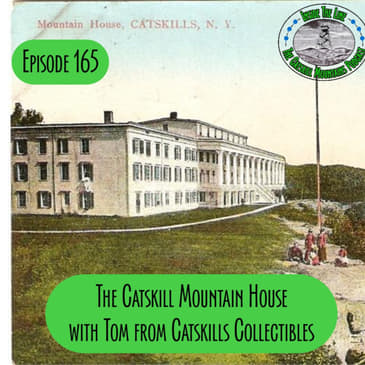
Welcome to episode 165! This week, Tad and I chat with Tom Illari, owner of Catskill Collectibles. We dive into his collection of Catskills memorabilia and the rich history of the legendary Catskill Mountain House. We also cover private land purchases becoming public, the 3500 Club’s new stewardship grant, and recent SAR callouts. Need a sticker? Shoot me an email or stop by Camp Catskill! And hey — subscribe, share, donate... or don’t! I’m just glad you’re here. And remember… VOLUNTEER!!
Links for the Podcast: https://linktr.ee/ISLCatskillsPodcast, Donate a coffee to support the show! https://www.buymeacoffee.com/ITLCatskills, Like to be a sponsor or monthly supporter of the show? Go here! - https://www.buymeacoffee.com/ITLCatskills/membership
Thanks to the sponsors of the show!
Outdoor chronicles photography - https://www.outdoorchroniclesphotography.com/, Trailbound Project - https://www.trailboundproject.com/, Camp Catskill - https://campcatskill.co/, Scenic Route Guiding - https://adventurewiththescenicroute.com/, Another Summit - https://www.guardianrevival.org/programs/another-summit
Links:
Catskills Collectibles, Catskill Mountain House, Blue Hill Purchase,
Volunteer Opportunities:
Trailhead stewards for 3500 Club - https://www.catskill3500club.com/adopt-a-trailhead?fbclid=IwAR31Mb5VkefBQglzgr
fm-hGfooL49yYz3twuSAkr8rrKEnzg8ZSl97XbwUw, Catskills Trail Crew - https://www.nynjtc.org/trailcrew/catskills-trail-crew, NYNJTC Volunteering - https://www.nynjtc.org/catskills, Catskill Center - https://catskillcenter.org/, Catskill Mountain Club - https://catskillmountainclub.org/about-us/, Catskill Mountainkeeper - https://www.catskillmountainkeeper.org/, Bramley Mountain Fire Tower - https://bramleymountainfiretower.org/
Post Hike Brews and Bites - Hemlock Cocktail Bar. Last Chance
#hikehudson #hikethehudson #hudsonbvalleyhiking #NYC #history #husdonvalley #hikingNY #kaaterskill #bluehole #catskillhiking #visitcatskills #catskillstrails #catskillmountains #catskillspodcast #catskills #catskillpark #podcast #catskillshiker #volunteers #catskillmountainsnewyork #catskillspodcast #catskillshiker #catskillshiking #hiking #catskill3500club #insidethelinecatskillmountainspodcast #volunteercatskills #catskill3500 #hikethecatskills #catskillhistory
[00:00:29] The bushwhacks were some of the worst days I've ever had in the mountains, or life, really. Whereas Pansy Mountain is totally opposite, it's a mountain on top of a crater. I think the weather challenges on this incident were particularly difficult. It is really the development of New York State. Catskills will respond to it.
[00:00:52] You've been listening to Inside The Line, the Catskill Mountains Podcast. It is. There it is. There it is. Let's do it. Alright, alright. So I'm cracking mine open right now. I need it. Alright, alright. You're gonna crack your open, and then I'm gonna...
[00:01:17] Let me turn off my whatever background mute, and I'm gonna crack mine open, and then I'm gonna bitch at you. Okay, so get ready. Yeah, I did it last time. I couldn't hear it, but... You know what? I don't care. I'm just cracking it. Couldn't hear anything. Sounded good. I got that down, man. That's probably the only thing I'd do well in my life. Highly doubtful.
[00:01:45] Alright, so 165. So Tom from Catskill Collectibles is joining us tonight to talk about his store, and about the great legendary Catskill Mountain House. But we also have a bunch of other stuff to talk about. We do, but I have something first, Dosh. Yeah. You said this is episode 165? Yeah. Mm-hmm. Did I fuck it up last time? Mm-hmm. Mess it up, sorry. Did I mess it up last time? No, but you know what you messed up? The show notes. You know what you forgot? What? You know what you forgot?
[00:02:17] What was my first episode with you? This is your 40th episode anniversary. It's my 50th. 50th? My 50th. 50th episode. Technically 51 because we did the Rangers in part one and part two. Oh. But this is the number 50, so I've brought back for the 50th the Dead Rabbit Dry Irish Stout.
[00:02:37] Because after the show, if you're a frequent listener, you know that last week's Dead Rabbit Dry Irish Stout from the Westkill Brewery really wasn't a showstopper. But after that recording, I had another can of the Dead Rabbit Stout, but I had it at almost room temperature.
[00:02:59] So, the key is you need to let the rabbit go from cold in the fridge, warm up, get it to room temperature, and it comes to life. So, that's the trick. Yeah, that's the trick. I think most stouts are better off served warmer than a Pilsner or a Pale Ale. So, that's my pro tip.
[00:03:23] If you need a pro tip on how to open it and get the sound on Zoom, I can cover that or just how to drink a room temperature stout and enjoy the taste. So, there you go. I did my rant about this being the 50th episode, and I've instructed people how to drink stout beverages. I don't think I would ever, I don't want to drink something at room temperature.
[00:03:46] Yeah, well, you think back in the day when they didn't have a lot of refrigeration, your beer was probably consumed at or about your ambient temperature. So, this one works well. It really springs to life. Last, if you remember last week, it kind of had that dead finish to it. Yeah, you weren't too impressed with it. Yeah, it opened up good and then it just kind of died on me.
[00:04:12] But like I said, after a couple days later, I cracked open another one, which had been sitting on the counter for a little bit because I forgot to consume it when I first took it out of the fridge. And I said to myself, wow, now that it's warmer, it's got more pop to it, more character. Either that. Worthy of the dead rabbit name. Either that or did Mrs. Ted say, get this off of my counter? No. Okay. She's cool about it.
[00:04:40] She's a cool wife and mother. Okay. I'm surprised she tolerates me like you do. Oh, yeah. I tolerate everybody. Come on. Yeah. The two of you must get together and compare notes. Yeah. Right. So, we have some like big breaking news in the Catskills. A couple of actually, you know. Yeah. So, this next one I've been following this for a while now and a lot of people have been sharing it and stuff like that.
[00:05:09] So, place called Open Space Institutes, which we'll talk about later. Talk about now, but we'll talk about the Open Space Institute organization is celebrating a monumental wooden for clean water, wildlife habitat and recreation in the Catskill Park with their conservation of the Blue Hill property. At more than 3100 acres, the Blue Hill site is one of the last and largest privately owned contingent forest remaining within the Catskill Blue Line.
[00:05:38] OSI intends to transfer the land to New York State D.C. And as addition to the Willowemick Wild Forest. And once transferred, it will be the largest addition to the Catskill Forest Preserve in nearly 25 years. So, Tad, I know you've probably looked at this and checked it out and stuff like that. So, we're looking at right outside of the, not deading area, but the NeverSink area and such.
[00:06:05] And this is actually a very nice little addition to the Catskills that I can see so far, like that I know. And it's pretty nice. Like, it's a good addition. Yeah, I'm totally stoked about this.
[00:06:24] It doesn't allow you access to anything over 3000 feet, but at 3100 contiguous acres, it gives you a big area to go out and explore land, which you haven't been able to legally explore previously. Right. And this is pretty undeveloped. I mean, almost like 95% of it is all undeveloped.
[00:06:52] Yeah, the folks that owned it, according to the news reports, it has been owned for investment purposes going back to, I think it was the mid-1960s. And in the research that I did, the fellow who bought it, bought it for what purpose? Do you know, Stosh? To develop.
[00:07:20] Like, I remember it was like farmland or something like that. And then it progressed into something a little bit more. Yeah. Well, he bought it to build a ski area. Oh, of course. Yeah. So, I thought that was pretty interesting. And you know, back in the 50s and 60s, that was like a developing industry to build ski areas. It was growing in popularity. Ski lifts were coming out, innovations in ski technology, et cetera.
[00:07:49] So, this fellow bought this 3,100 acres. And for the last 60 years or so, they paid taxes on this land. And eventually, they reached the point where they sold it to open space. And then, open space often gets involved in these deals where they realize that land is available.
[00:08:18] And it sometimes takes quite a while for the state to mobilize to buy land. So, in the interim, the Open Space Institute steps in and purchases the land with an arrangement that eventually it's going to be resold to the state of New York. And that's what I understand happened here. Yeah. The Open Space looks like it's a leader in advocating for public policies that promote innovative and effective land protection.
[00:08:47] So, now with this area, you know, this is, what is it? To the south of Claryville? Direct south of Claryville. I'm going to say it's more to the west of Claryville. Oh, yes. Yes. Sorry.
[00:09:04] As you come up out of Gramsville on 19, and before you head into the thriving metropolis of Denning, you bang a left on 47. And don't go, you just barely go over the bridge and there's Blue Hill Road. And that's kind of the eastern boundary, more or less, of this track of land.
[00:09:29] Blue Hill Road intersecting with Hunter Road, which takes you west to 84 in the Willow-Wemack area, which is the western area. And then to the north, west north, it's Pole Road. I mean, it's a pretty expansive area. So. Oh, yeah, yeah. To the west of Claryville. Sorry. Yeah. So. And it looks like, was there a former ski area there?
[00:09:58] Well, that's what I'm saying, that they, the fellow who bought it actually started cutting some slopes. Were you looking like at an aerial? Yep. Yeah. I'm talking right off a pole road. Yeah. That you can still see. So that's going to be accessible to us. Yeah. Yeah. Ooh, definitely. Yeah. And this looks like, uh, you know, with the, with looking at like the different types of maps and stuff like that, it's a decent, you know, I think like 2750 is the maximum height over there. It was around 2750, 28. Yeah.
[00:10:28] Blue hill. 2749. Close. That was close. Yeah. So, I mean, it looks like it's some good integrated land and stuff like that. It looks very like pristine. There's not, it looks like logging wasn't done and stuff like that. Like as much as you think. Oh, I'm sure it's been logged out over the years. Yeah. But not as crazy as, as you think, like you're, you're talking about over towards the 23, eight and stuff like that. 23. Yeah. Um, but this looks like a great addition to the Catskills.
[00:10:57] And I, I mean, it's pretty neat. And this has been going on for a long time. Of course, it's back and forth. They've been trying to sell it to probably different types of people, you know, different types of resorts and stuff like that for a long time. And, you know, it's, it just hasn't, it hasn't happened. And this, I mean, this kind of gets you in that state of mind. Well, well, the Goulds do this. This open space looking at this for the Goulds.
[00:11:28] We're going to have to take that land back through trickery and deceit. I would say something else, but I'm not sure I probably would get arrested if I said something. By force. Yeah. I mean, this is pretty neat. Like looking at it, you know, like what, what's going to happen here? What's the DEC going to do? It'll take like 30 years to build a trail, but. And who knows? Yeah. Yeah. I'm looking at those ski slopes right now, man. They're really well defined.
[00:11:57] I never noticed that before maybe because it wasn't publicly accessible. You wouldn't think about it, but. Yeah. They look really nice. Like, like real well groomed. There's it's. Yeah. It looks like somebody has been up there with a brush hog, you know, keeping them trim. Yeah. I don't see any, I don't see any evidence of any lifts being there previously. Yeah. I'm trying to see if there's going to be like, if there can be any connecting trails. But it doesn't look like it could be.
[00:12:24] You'd have to do some road walking if they were to make a trail through that area to go over, like into the sundown wild forest. Cause this borders the, the, the big Indian wilderness and the sundown wild forest area. And we're just gonna have to go over there and. You know, check it out.
[00:12:47] But I see, um, I S I saw on some other maps, um, where there, there's a relatively extensive network of logging roads in there. Oh, okay. Okay. So I was wrong. I was wrong. Um, but it looks good. I heard there's a lot of maple in there. That's what I, one of the things I've heard. Sugar, sugar, maple. Well, maybe that's why it's called. I think there's a road down there called sugar maple road.
[00:13:15] So yeah, it looks like, it looks like the only, like there's long ponds right around there. And, uh, you go up to the willow emac area. So it's like long pond. And then you could connect something to clarity, but that's road walking up the FLT. So it'll be, it'll be interesting to see what's gonna, what's what the UMP is gonna be for that.
[00:13:40] Eventually, eventually, cuz it's a good chunk of land and it looks to be pretty nice. And it's right in that area and get people out there. So good, good for open space and to, uh, to get that, that area thing, because who knows what that would have become if, if somebody would have bought it. I know, I know like the price probably was astronomical to probably try to purchase that stuff. And, uh, I, it's a good chunk land 3,100 acres. That's good chunk.
[00:14:11] 25 years. It's taken to purchase that. Well, yeah, I don't know if it was on the market the whole 25 years. Um, but I know a couple of years ago there was filings in the town of never sink about developing the land for, you know, residential home sites.
[00:14:31] And I think that were what precipitated the interest of the open space to get involved and acquire it because it's certainly a unique acquisition 3,100 acres in this spot. Yeah. Sweet. Yeah. It's pretty cool. So it'll be good to see. Yeah. We'll take it. We'll keep an update on it. Uh, and see what, what develops. I'll keep an eye out for the, the UNPs for it and such like that.
[00:14:59] So other breaking news. So congratulations to the Catskill 3,500 club. They received a grant to enhance the trail head steward program. So the 3500 club was awarded, uh, $4,798 matching grant from the environmental protection funds park and trail partnership grants program to engage visitors to two significant trail heads to promote leave no trace principles. Share regulations commute and communicate with information.
[00:15:29] Uh, it's one of 22 awards totaling $1.7 million for organizations, organizations dedicated to the stewardship promotion of New York state's parks and historic trails. Now this parks and trail grants are administered by parks and trails, a statewide nonprofit organization in partnership with the New York state office of park recreation, home preservers and department of DSE.
[00:15:52] Uh, four years ago, the club adopted the slide mountain and Woodland Valley trail heads through DSE adopt a trail head program and enhancing it annually. Lords was on here talking about it. Uh, once until our two times about, uh, the trail head stewards program, Ted and I have both participated in this. It's an excellent program. Uh, and, uh, they had a great time. So, well, we had a great time. So it was really, really fun.
[00:16:20] Uh, it's the program is a volunteer initiative dedicated to enhancing the experience and safety of hikers in the Catskill mountains while promoting responsible outdoor practices. So, uh, great stuff to happen to the 35 hundred club. Uh, I, I, I know $4,000 doesn't sound like a lot, but it is a, it's a pretty great amount, especially for, you know, the little areas that we, the two little areas that we have. So it's, it's pretty neat.
[00:16:50] It's good for them. Good for you. Like a 3,500 club. Let's get going with this. Yeah. So if that's a matching grant, I think the implication is they get about $9,000, um, for them a little over 9,000 bucks to, to do this program. And it seems like they get a lot of mileage out of it.
[00:17:11] Um, being at the trail heads meeting and greeting people, making sure that they're informed and setting off on the right foot into their Catskill adventure. Yeah. We did that last year up at, down at Woodland Valley. It was a beautiful day. Yeah. And, uh, I was surprised by the lack of people that there was.
[00:17:33] Uh, you know, I, I thought we had a, you know, a few good folks, um, there that day, people might've stayed away from us because we didn't have the right snacks available. Come on. We had those, uh, we had, I had the, what's it called? They brought the, the, the cookies, the cookies. And there was that one young fellow at the end that like took them all. Right. Remember the young kid, he was like, you know, 11, 12, something like that. He took like five and then came back and took eight. Yeah. At gunpoint.
[00:18:02] So we saw Danny Davis was there and, uh, Ed, uh, the trail runner. No, I don't think I didn't see that day. Oh, that was, that was, oh, that was when I was with SAR. Okay. That was my bad. That was with Ed. Sorry. He came in and like sprinted in with sorry. We're like, what the, he finished it in like two hours. It was insane. Crazy. So that's a good dude. Yeah. Congratulations. That's pretty cool.
[00:18:31] I'm looking forward to doing it again this summer with you getting out there, putting my time in with, uh, that program. And again, with Matt Smith, Catskill trail crew. Yeah. It's, it's going to be, it's going to be cool. So that's, uh, I mean, I know the Catskill 3500 club will put that to great use and, uh, we'll, we'll see a great, it's a great. Contribution to the Catskills, you know, just getting people like they're coming there, you know, coming to slide mountain and coming to.
[00:19:01] Uh, of course, Wittenberg to, to go hike for the view and they have a water bottle and slippers and stuff. And, you know, to have stewards there to be like, Hey, you don't want to go down the Ashokan rail trail or something else is, is great to have these people be up there and then rescued by the Rangers. Yeah.
[00:19:20] You know, I, I saw two weeks ago when I was setting out to do the hunter loop at the end of Spruiston road, I had a fellow come over and ask me, um, if he was in the right spot to, to hike up Westkill. And I said, yeah, you are, you know, and he wanted to know where the trail was. And so I pointed him towards the end of the road and told him, when you get to the end of the road, just keep walking. And then I asked him cause he didn't look like he was well equipped. I asked him, so do you have any type of traction gear?
[00:19:51] And he didn't know what to say. I said, do you have like micro spikes, crampons, anything like that? And he said, no, I don't. And I said, well, you might think when you head out, you might, you know, think that you can get far, but I'm going to tell you, you're going to run into ice and it just is going to keep getting worse and worse. So I told him if you want to set out to have a good time today, hop back in your car, drive over to Tannersville, camp Catskill, pick up a set of micro spikes.
[00:20:18] And while you're over there, maybe you just head over and do Indian header twin, if not come back here. So I think that's what he did. Well, good. Yeah. That's crazy. You know, stewards are there to help us out. And then people like, you know, you and me and the other, uh, Catskill hikers that have the knowledge will hopefully help these people turn around and not get injured.
[00:20:41] Well, sometimes just, you know, what you read on the internet or out of a guidebook, um, it's not going to be the best information to then speaking to somebody who's out there a lot and knows what the current conditions are. So, uh, and that was probably the, the situation with that fellow is he read about the height, but did not know what to expect that time of year. Yeah.
[00:21:07] They definitely have a lot of guidebooks out about, you know, the Catskills hiking, but they don't have it about the winter. Yeah. And it's a whole different story as we both know. So, um, and speaking of, you know, park rangers helping out and stuff like that. So overtime issues, once again, keeps going back and forth with the Rangers that, uh, there's definitely the Rangers are looking to get their overtime.
[00:21:30] Uh, kind of like balanced, uh, with, with stuff that's going on with the state. Uh, it's concerning overtime disembursement is back to square one after a union representative said the state changed its course last minute, effectively ending a meeting to attending the resolving matter.
[00:21:49] So, uh, the PBA says it's been a negotiating with the state over addressing emergency and non-emergency overtime opportunities, but the DC's choice to issue its own policies without the union agreement has frustrated. So a former ranger, uh, Rob, whatever, I forgot how to say his last name, Prozdecko, uh, at the state or New York state police benefit association.
[00:22:15] So Robert's echo said that the, uh, last meeting at the union was scheduled to have the DC was abruptly canceled last year. That's because the D received removed an order that issued regangers regarding overtime disbursement. Now the removal of what the PDA have hoped for, but then the DC sound new one, uh, the Rangers are Rob claims. It's too, it too violates the Rangers contracts and sidetracks previous overtime negotiations.
[00:22:41] DC does not want to comment on the pending grievances, but records show Rangers supervisors believe the new directive follows the contract. So what, what's, what's going on here, Ted, did you fully read this because I did. Yeah. Well, I didn't do a deep dive, but the depth to which I explored this issue revealed to me that it's an issue between generally between proximity and seniority.
[00:23:08] Where, as I understand it, the state wants to, when it calls in Rangers for an emergency situation, um, and they're going to be earning overtime. Um, the state wants to call them in relative to their proximity or closeness to the area that needs the emergency response response. Whereas the Rangers want it triggered by seniority.
[00:23:34] And obviously the, the reason for having a based upon proximity is a quicker response time. And that seems to make sense. But then when you consider it, there's probably some areas that have more emergent situations requiring more overtime responses, et cetera.
[00:23:55] So Rangers who live in close proximity to those areas, we're going to get more overtime work, leaving out those Rangers who either have seniority or even those Rangers who don't. Um, but need overtime to make extra money. Um, it's going to leave them out of that pipeline to get that extra for work.
[00:24:17] So, you know, while there's, I think there's good arguments on either side, I think it really comes down to if the Ranger isn't necessarily the closest to the situation, but is willing to step in and do it. You know, he should be on the list and be able to respond to that because it's overtime. And, you know, Rangers have families as we heard when we interviewed, uh, our two Rangers.
[00:24:43] Um, I made the comment, well, you know, you had all this fire response time, this overtime during the fire season. Wasn't that great? And they're like, well, Hey, yeah, it was great, but we have families and we have other things as well.
[00:24:55] So let's be considerate with the Rangers and if, and if they have a way that they want to do this, allocate the overtime that doesn't diminish their ability to respond to situations, then why don't you let the Rangers decide what they want to do and not the government? Exactly. Yeah.
[00:25:17] Like if they can get to you faster, uh, and then not, I mean, not saying not have overtime, but you know, get this situation done quicker than that's, I would think that's the way to freaking do it. Yeah. But it's also, you know, sometimes like we, you know, we you'll see in this one story further down that you pulled on the white mountains, you know, these guys went, were called in at like, um, nine o'clock and they didn't get back nine o'clock PM.
[00:25:44] They didn't get back until four in the morning. And maybe just because you're the closest Ranger that can respond doesn't mean you're the best suited. Maybe you just got off of a long shift. Maybe you just got done with another response. I mean, there's a whole number of factors that would seem to go into this and I would hope they have some flexible rule that takes all these relevant factors into account.
[00:26:08] And one of them should be, you know, not forcing a Ranger to go and do work overtime work when they're not available or they've got other things planned or they just got done doing overtime the day or two days before. So my prep, my preference would be defer to the Rangers because obviously from what we can tell these guys have the best interest of everyone in mind, you know, going out and doing what they're doing.
[00:26:36] They just, they're not in it just for the money. They, they love what they do and they're, they're very good at it. So let's trust them to do their job. That's my sense. Agreed. Agreed. And previous interview shows that, that they're compassionate about this job and that they do it for their love of the mountains. You know, the help of the hikers, stuff like that. It's, it's not because they're like, oh yeah, hell yeah, I'm racking up the money on this.
[00:27:01] No, not from our previous times that, you know, you have been here and then I have been here with the Rangers. There's no way that they're doing it for the money. Yeah. Well, that's, it's not to say on the one hand that they don't make decent or better money. Um, but I think as we pointed out previously in comparison to what a state trooper makes, they don't make as much money as a state trooper.
[00:27:24] Um, based upon different ranks and seniority, they're not on the same level as, as troopers and they're probably more often called into overtime situations than state troopers are. And so, you know, the, you should let the Rangers have more of a say in what works for them. So long as they're not putting people at risk, I say, defer to the, the Rangers. That's my opinion.
[00:27:52] And I'm sticking to it because they're the ones that are going to call my ass out of the woods. If I'm in trouble, not some bureaucrat and Albany. Correct. Correct. So Slade and Martin, anybody let us know how we can help you and support you. Yeah. With this situation. We're behind our Rangers. 100%. Speaking of the Rangers, just got this in today, Ranger report.
[00:28:16] So in the town of Denning, uh, March 18th, 10 13 AM, Ray Brook dispatch requested forced Ranger assistance for a hiker with an ankle injury on the Biscuit Brook trail. Two miles up from the trailhead, Ranger Sweeney located the 58 year old from a court and her husband. Ranger Sweeney splinted the hiker's ankle and provided first aid. Ranger's friend, Suskina Martin and Schwinder hiked in with a wheeled litter. Rangers worked with the Woodburn EMS to transport down to the trail.
[00:28:46] Rangers met the Clairville fire department, uh, who transferred the patient on the UTV and brought her down to a staging area for EMS evaluations. Resources were cleared at 4 PM. So what, when you say UTV, that's the, uh, wheeled litter. That's what that refers to. Uh, well, the wheeled litter is the one wheeled thing where they have four Rangers on each side or yeah. Yeah.
[00:29:11] I've four, two Rangers up front, two Rangers in the back and it's, and it's just one big, huge fricking wheel. Yeah. Oh, I see. And then, and then they transported her to a UTV and that's like an all terrain type motorized vehicle. Yeah. The question, the question I have is for that of course, is there's nowhere where you can bring a UTV up on the biscuit brook. Yeah.
[00:29:36] So I was, I, I, once I saw you put this in here, I, I pulled up my guy a mapping and those of us who have hiked that trail know that the, the first half mile in from the road is a real bitch. It is. Right. Yeah. I mean, there's just a lot of that exposed, you know, rock boulders. It's just really rough, irregular.
[00:30:02] And I'm sure many, many, many of our listeners, if not every single one of them know that when you go out and hike a big Indian and fur or other points out there and you're coming back to a biscuit brook, man, that last half mile is like, why, why, why? Yeah. Because you, you gain and you lose so much. Yeah. And then you have that nice flat, flat walk to the lean to. So, you know, I'm wondering if their, their staging area was down at the frost valley, uh, area.
[00:30:33] And I, I don't know why, you know, they must've had the UTV at the end of the trailhead. And then the staging area was over at the frost valley. Yeah. Unless it was like a really, really rugged go anywhere, new TV that would be able to get out there and go over those rocks. But I just don't imagine that because it's, it is very hardy area. I mean, your side hilling of that half mile stretch, it, a good half of it is some pretty rugged side hilling that you got going on.
[00:31:01] And then down there by the sign in going out to the side of that slope is, is also just rugged terrain. Usually a few fallen trees along the way, especially this time of year, nobody's been out to clear it. Yeah. So 10, 10 to four. So that's, I mean, that's, that's a good amount of time. Yeah. Six hours. Yeah.
[00:31:23] So once again, like, uh, thank you to the Rangers, uh, for doing that looks, looks like, you know, a simple ankle injury. So unfortunate incident that they, that just happens should happen. So, ah, then next SAR call out call out that, uh, didn't have to do with New York. So I found this pretty crazy to happen.
[00:31:48] And this is a great, uh, reason or a great showing that the winter can be here at different places that we don't think that it's still there. So this happened in New Hampshire, uh, on Mount Moriah, uh, March 16th through 17th, uh, rescuers worked diligently to assist a hiker down off Mount Moriah after she got stuck in dangerous current conditions along the Carter Moriah trail at approximately six. 6 45 PM.
[00:32:16] On evening of March 16th, New Hampshire fishing game received a call from a distressed hiker who is in snow and pelted by rain three miles into the woods off of route 16, New Hampshire. The hiker explained that during the hours of hiking that day, the deep snow and trail had become increasingly soft, causing her to sink even in snowshoes. She had fallen many times, gotten soaked and was dealing with increasingly pain, a leg injury.
[00:32:43] The hiker further explained that she had a little, very little gear left, but used most of what she had and that everything was becoming soaked and steady brain and falling. As a result of the call, a rescue team composed of four conservation offers and 11 volunteers off, uh, volunteers from the address. The hiker's scogging valley search and rescue team responded to the assist rescuers began hiking up the Stony Brook trail shortly after 9 PM.
[00:33:09] And slogged their way through the soft snow towards the hiker at 11 15 PM, uh, 4.5 hours for when she called in. So once again, bring as much as you can, especially with these situations. The first crew of rescuers, uh, located the hiker a short distance from the Spony Brook trail intersection. The hiker was immediately given first aid and given warm and dry clothing to wear. After being warm up, she was able to hike with assistance back down to route 16.
[00:33:38] During the duration of the rescue effort, rain fell steadily and melted the snow. Rescuers ended up having to spend significant time setting up ropes and figuring out how to cross brooks that had swollen into torrents from that rain. The rising brooks was also both visible and audible where rescuers worked and the roar of the swollen streams became more noticeable as the night wore on.
[00:34:01] After hours and hours of hard work and careful maneuvering, the rescue crew arrived safely with the hiker at the roadside at 4 18 AM. About 10 afters, 10 hours after she called in on the next day, the hiker had walked with assistance the entire way down, was found to be uninjured and reunited with a one loved one following the ordeal. This is what I love about New Hampshire is that they, they just blatantly give out the person's name. Like, here you go. Yeah. Yeah. I just love this.
[00:34:31] Like we just talked about New York state and they didn't tell. So this hiker was identified as Lauren Pule 33 of Manchester, New Hampshire. Pule wasn't a bad of a hiker, but a novice when it came to hiking in spring conditions. Pule and her family was extremely grateful for all of our efforts and sincere gratitude for the incident. Now the one thing was an experienced hiker that lived in New Hampshire.
[00:34:56] How do you know, not know when you're living like there of the crazy conditions that have it in the base and mountains and the top of the mountains? Like, I mean, it's different. It's when I get out of my car at the parking area, it's not going to be the same at the summit of the mountain. Tell me more. Right.
[00:35:16] I mean, this was fricking 10 hours of stuff, which is, is actually pretty amazing for, for all that they had to battle through like setting up ropes to go across the, the swollen, like streams and stuff like that is amazing. And, you know, slugging through, I've done it before and slugging through that slush is just.
[00:35:40] I could imagine the silence between everybody, you know, they had a, what 14 pier, 15 people there. Yeah. But she's, she's walking, right? Yeah. She's walking. But just imagine the silence between everybody because of like, we're up here during this shit. So what's, so what's going on? Yeah. Is that what you guys are thinking? You're a SAR guy. Tell us, what are you guys thinking? You, you schlepped all the way out there, took these guys like four plus hours to get out to her. She was only three miles from the road. Right.
[00:36:10] That's three miles on Mount Moriah. That's probably like 2,000, 2,500 feet of elevation gain. Oh yeah. Yeah. So this is, so you got to go out some rugged terrain to get to her. It's slushy snow, right? From prior winter snow falls. You're getting pelted by rain. It's nighttime. You got like headlamps on whatnot. You get to her. She's complaining of a leg injury, right? We read that in the story.
[00:36:38] And then when she gets, she gets back out to the road, what do they say about her injured leg? Done. Not injured. Not injured. She wasn't injured. She didn't have a leg injury. So, um, it's so, so what happened? Not that we're, we're picking on her, trashing her, but what, what's what really happened here? What do we learn from Lauren's tale of hiking Mount Moriah? Turn the frick around if you, if it's not going good, if he sucks. Yeah.
[00:37:07] I think turn around early, early. Um, that makes sense. Like I said, last week I had that episode going, trying to do big Indian and fur, um, and really, really deep snow. I set my mind a point where, you know, an elevation at which if I didn't get there by 11 o'clock, I knew I wasn't going to finish the hike for the day. So I just turned around. There was no point staying out there, but from what I learned from this woman's story is it was raining.
[00:37:35] She, you know, the weather forecast probably showed that there was going to be rain. Um, and although she was apparently an adven hiker, she wasn't experienced for these types of conditions in the spring, where, when you step out of your car, like I did this past weekend, everything around me, there was no snow, you know, looked like an early spring day. And then later on in the day, I'm like, you know, got my spikes on trying to get up to
[00:38:02] the summit of cat or scale high peak, because it's just the way I was going was just, you know, covered with ice. You wouldn't have known that from the parking lot, right? Somebody, somebody else might not have brought their spikes with them and then not made it. So be look at the weather conditions. And in the spring, when it calls for rain, man, that rain is just bitter cold. Cause you get socks. Yeah. Your gear gets soaked through pretty fast.
[00:38:27] I don't care if you have a rain jacket on, they wet through in 45 minutes to an hour. And then, you know, it's not just the, the, the rain, you know, your feet get cold. Like in the summer rain, rain, rain is, is okay. So what your feet get cold, you can somewhat put on new socks and they will dry, not dry up, but they'll heat warm up quick and the winter, your feet are going to stay cold and it's going to suck. Your boots will stay cold. It'll suck.
[00:38:54] Well, in the winter, and you can also in the summer, but the best thing to wear on your feet in the winter is wool socks. Yeah. Particularly with a, like a, a liner or some type of wicking liner, and then a wool pair of socks. I mean, that's a good combination, but that, that damp cold in the spring, when what they call the bulb temperature is, um, up high, you know, so that damp coldness just really feels cold. And it lingers. Yeah. Yeah.
[00:39:23] So, and also in the story, it talked about all of her gear getting wet. I wonder if she had like a dry bag or something inside of her backpack to keep her stuff dry. Cause if you're going out and it's raining and you don't have your gear in a waterproof bag, it's going to get wet and it's going to be no good. Really? Yeah. Yeah. Surprise. Surprise. Avid hiker. And it gets, and it gets heavy. I'm sorry.
[00:39:53] We're picking on you. I know. I'm sorry if you listen to Lauren. That's what we do here. We're shameless. So. It's just, I just, I, sometimes I, I don't understand. Like, you know, with my experience with hiking in the rain, I'll, I can take it in the summer. In the winter, when I see like a mix happening, I am very, very skeptical about going to the mountains just because not, not number one of my stuff will get wet.
[00:40:20] But my feet will instantly get wet because the trail is either water or slush. And that just, I mean, I have waterproof brutes and I have the wool socks and then I have the liners, but I do not want to be at the summit and be like, man, I got three miles left and my feet are freezing. Right. Like, yeah. So like a few weeks ago when you texted me that the weather was coming in and I was, you know, on my way from Balsam Lake mountain over to Vlai and Bearpen.
[00:40:48] Um, my, my initial concern was, is whether or not it was going to be frozen precipitation or wet. Right. Because if it was going to be wet, I, I might've still done it those two mountains. Cause I could have grabbed an umbrella and you can get up both of them and you can certainly get up bear pen easily with an umbrella. And Vlai, I would say so too. Um, and that would make sense if I really wanted to bag them. But if, if I was doing something else, like on the devil's path, trying to carry an umbrella when it's raining. Hmm.
[00:41:16] No, I would think twice about that. Yeah. And then everything would be sheer ice. Yeah. And it would, well, it'd just be wet. And then, so what if you did have an injury and you had to sit down and wait for a rescue when it's raining? It's just going to go from bad to worse. And that's, that's my thought of, of hiking in a mix precipitation injury. Mm-hmm . You are wet. You will stay wet. Yeah.
[00:41:40] And like, it's a whole different thing from snow, from nice fluffy snow to where you can kind of, if you have like a, an emergency blanket or something, you can bury yourself and stay somewhat warm. We're wet, you're going to stay wet. Yeah. And it's just going to, it's just going to suck so bad. It pulls the heat right out of you.
[00:41:59] So when you're confronted with that situation and your hiking plans get derailed, then what you do is you use the other information that we parlay to you on our podcast. And that is you go out for a post hike, ruin bite. Right. You go to last chance, mama boy burger, you know, Brio's, Phoenicia diner. There's a lot of places to go hang out, get a warm cup of coffee, something hot to eat and then go on your way.
[00:42:29] Yeah. And you can tag that mountain fricking another day. It's not worth it. Yeah. Like seriously, like I, I love extreme stuff. Like I do not love extreme. I love extreme wind. I love a lot of snow. I love pelting snow. I do not like rain, cold rain and cold, like sleet and stuff because it just gets you wet. And then you're miserable and the conditions are miserable.
[00:42:58] Did you know that I used to spend hours on end in those conditions? Well, yeah, you did. I mean, when you fricking did your sailboat stuff, like. Yeah. Racing offshore. That's what you, you, you, but you're prepared from the outset to be exposed to. And then you had the heli tons of water. Yeah. That's right, man. You're like, you know, all taped up. So water can't get in. Yeah. I, you know, I got to watch some documentaries on that shit. So. Yeah.
[00:43:26] So moving along, what's next? Yeah. So don't hike in the rain. Basically. It's not worth it. I mean, in the summer. Yeah. I hiked. I did the Pemi Gossett loop in the rain. That was fine. I could dry off and have a good time, but then the sun in the winter in the spring. Nah, I'm good. I'm good. So thank you to the monthly supporters. Chris Garbian, Jeff Jotz, Vicki Ferreira, Mikey S, John Comiskey, Summit Seekers, Desert City Radio, Betsy A, Denise W, Tom H and Vanessa.
[00:43:56] Thank you guys so much for supporting the show. Thank you for believing the show. Love you guys. Really appreciate it. Also our amazing sponsors. So capture your love story against breathtaking backdrops with outdoor Chronicles photography. Molly specializes in adventure couple photography and she'll immortalize your moments amidst the stunning landscapes of the Catskills, Adirondacks and White Mountains. She'll craft timeless images that reflect unique bond in nature's grandeur.
[00:44:24] Embark on an unforgettable photographic journey with outdoor Chronicles photography. Don't hesitate to get a hold of Molly on all platforms. Also to discover the wilderness with Trailbound Project. Our expert led hiking and backpacking education programs offer unparalleled, excuse me, outdoor experiences, whether you're a beginner or a seasoned adventurer. Join us to learn essential skills, explore stunning trails and connect with nature.
[00:44:50] Start with your journey today with Trailbound Project and unlock the wonders of the great outdoors. You can't even tell that I'm suffering from a fricking injury from doing all that. Can you? Yeah. Yeah, I can definitely. What? You can see my face. Yeah. Yeah. I can. Yeah. I hear it in your voice. For real? Yeah, definitely. For sure. So everyone. What about you, Tom? Can you hear it in Stasha's voice? Tom has got his head. Yeah. Yeah. Yeah.
[00:45:18] It's just, I, so I've had a bub, like chronic back pain for the past week. It was coming and going. And today, like, well, I'll talk about it in a little bit with, uh, but like, it's just today or it killed me. So sorry about that. So. Mentions. Mentions. We got a lot of good mentions this week. All right. Awesome. Awesome. Our folks are, our fans are getting out hiking like to see it. Yeah. So mention the podcast. One of your hikes through social media.
[00:45:44] And we'll chat about on the show tag us by typing at it. L cat skills podcast on your post. So. Who's outdoors. We're going to shout out to Alan Betancourt. I'm getting this WFA is wilderness first aid. So good job, Alec. Uh, that's great to have. No, very cool. Yeah. It's great to learn that stuff, especially out in the trail. You're out solo. You can helps anybody else out. You have that experience. It's a great skill to have. And congratulations on that.
[00:46:15] And, uh, keep kicking ass. I like, hopefully you get back out a little bit more and see your posts a little bit more often. Also pink pony, eight 18 Tracy ranking. Was that bull hill coming from a lone star trailhead 6.4 mile lollipop loop? And I got to admit, tad from her pictures. These were fantastic views, man. I am jealous. Have you got on there? Uh, no, I haven't.
[00:46:41] But as I'm starting to, you know, uh, do a rough sketch of, uh, hikes for the coming white spring and summer hiking season, I'm putting some stuff on the Eastern side of the Hudson. And I'm going to be on the list. Dude, that, that view of the New York city skyline, man. I know a lot of people don't like the city, but I got to admit that is mind blowing. Yeah.
[00:47:07] You know what I, when I'm, so when I'm up there on one of those mountains and you can look down and see all those skyscrapers down there, you know what I think? God bless America. Something like that now. No, I think it's just a, what a paradox that here you are out in the middle of nowhere. Right. And there's no one around and you can see these skyscrapers with like thousands of people. Millions. Yeah. Well, yeah, there is, there's millions, but it's on a weekend. I don't know who's in this. Oh, okay. Yeah.
[00:47:36] But, but it's just like, you know, you're just, you're within eyesight of that metropolis and there's no one around you in your immediate vicinity. They're still all down there on the weekend. Okay. I think that's crazy. Yeah.
[00:47:52] And, you know, I see that and, you know, I'm of course from upstate New York Orienta sometimes like I, I drive down there and you get to that certain part right outside of New Jersey where it's like a little tiny hill and you can see the skyline and I am seriously always blown away. I'm just like, God damn. There it is. There's New York city. I'm like, holy crap. And like, to, like you said, to be on like a hike and the pop over.
[00:48:16] I remember one time when I was down in the Ramapo area and we did a search and rescue drill and we had to hike up to a certain point. And my, one of the guys that was with us was the New Jersey SAR team. And he's just like, oh, up here, you'll be able to see the city. I'm just like, what, what city? He's like, New York city. And we pop up onto this little ledge. I'm like, oh my God. And it was just one of those moments of just like, I will never forget that.
[00:48:45] I could see the whole New York city at night at night. This was, and I was like, whoa. And absolutely jealous. So maybe sometime I'll get down there. I'm going to have to spend the night. Ted, I'm going to have to pitch a tent in your backyard and just, yeah, well, we'll provide us. Yeah. We'll have a little glamping site for you charging. What? How much? Yeah. I hear it's four 50 a night. That's how much we charge. That was 50. Like the Katzko mountain house.
[00:49:15] Thank you. Precisely. It comes with a no chicken dinner prime rib only. Yeah. So you'll have to stay tuned for the rest of the show to, to learn more about the difference in fried chicken and prime prime rib. Or was it just roast roast beef? Yeah. And then you also have to learn the difference of $4 and 50 cents compared to what it's today. Yeah. Yeah. So also who was outdoors besides Tom who's. So who's outdoors?
[00:49:42] He did up a bushwhack up the Delaware water gap and got some amazing pictures of, uh, different waterfalls and such up the Delaware water gap. So did your, uh, did your, uh, did your batteries run out? Oh no. I, um, this time of year I get cold really easy. So I had a little auxiliary heater going on. Okay. I was like, it looked like your batteries ran out. You had to use a plug in. It was either, it was either, um, turn on the heater or I was going to put like all my puffy gear on that.
[00:50:12] I haven't worn all winter long. And I was going to sit here, you know, with like, uh, mittens and a big puffy pull hoodie and you know, the zip on pants. Like I was waiting for a SAR rescue or something. Cause that's how bad this podcast has gotten. Or you could take a picture and be like ready for Everest. Yeah. Yeah. So Tom was out, uh, doing a bushwhack up the Delaware water gap. So hopefully he'll be back up to the cat's clothes, but thank you everyone for tagging us.
[00:50:40] Also, if you want to support the show, buy us a hard cider, AKA coffee at buy me a coffee. Uh, that it L cocktail podcast also rate the show on any platform that you use. That'd be fantastic to just be really cool to hear about the ratings. Uh, we already kind of chatted with you about what you're drinking. You said the dead rabbit. Yeah. Um, but now I'm thinking, you know, it's a 16 ounce can. I'm kind of now wishing it was an 18 ounce can.
[00:51:08] That would be like perfect for the, this segment of the show is for 18 ounces of dead rabbit, dry Irish stout. So, but that's enough about my drinks. Dosh. What do you got over there? I'm looking at it. I have a 16 one too. I think that's standard. Yeah. Standard. You know, unless you're going to get a, like a natty daddy and stuff like that and go all out. Nineteen seventies. Natty dad. Is that what they're called?
[00:51:35] Well, the, the, the cheap ones are natty daddies where you get like 98 cents. No, I have an awestruck honey, honey cider. I already finished it. Cool. I was almost going to pull out a cider tonight, but then, you know, I thought I'm going back to the lukewarm dead rabbit dry Irish scout. Sounds so horrible. Luke one dead rabbit. You say, you say it sounds horrible. Look at the picture of the rabbit on the can. It's like a rip van winkle rabbit. Yeah.
[00:52:04] So they have interesting artwork, but all right, let's move along. So previous hikes, I will go with what I did today. So today I was supposed to go out with my nephew and do a hike of the upper reservoir in Bilboa. And then we were going to go play some disc golf at mind kill state park and just have one of those nice days. It was a beautiful day out, but I woke up this morning and I'm like, all right, my back feels fine. I've had some chronic pain for the past couple of days.
[00:52:34] And then, uh, I bent over, I bent down to like pick up something. And then it just like, Jessica said, it looked like a sniper hit me in the back and I like fell over and she was just like, seriously, it looked like somebody took you out and fell down. And she was laughing and I was like, I understand it was probably look really funny, but it was extreme pain to my lower back.
[00:52:58] And, um, I sent my nephew a message and I'm like, I cannot do anything today. I gotta like rest and stuff. And it's just been, it's been a fun day. Let's just say that. Hmm. You ever worry if that happened to you in the woods? What, what would you do? You know what? I actually feel better moving around. Mm hmm. I lay down and it feels fine. I'm sitting like this and it feels fine moving around. It's difficult, but it's okay.
[00:53:25] It's when I'm like standing up straight and doing nothing that I'm just getting some chronic pain and I'm like, God damn it. But in the woods, I don't know. Like I know it's a muscle pain, so I kind of deal with it. And I have before because I've had my sciatica and I've just put on a backpack. The doctor's like, oh yeah, you'll never backpack again. I'm like doctor always give them the finger and be like, listen, that's my life. I'm going to do it no matter what.
[00:53:54] And, uh, but you know, I, I would just try to hike out and I would try to take as much ibuprofen as I could to, to get out. But it, it, if I, it's been soon that hits me in the woods and somebody is around, that'll be hilarious. Cause somebody is going to be like, like, what the hell happened to this guy and go crazy. I'm like, oh, it's my back. I'm getting old. Sorry. Yeah. Well, that's the thing about backs is they can be unpredictable at times. Sure.
[00:54:22] All the weight is it's, it's like my, it's like my lower hip too. I think it's somebody said it's like my SI joins is what I think of this, but yeah, well, I got all those problems. I have that. Fuck that. It sucks. I'm not about what ready to let anything slow me down. Right? Exactly. I was trying. I was thinking about it, man. I should have, it was a beautiful day, but then I'm thinking like, like what would have happened if that sniper happened right on the trail? Like, and I just had to lay there.
[00:54:51] My nephew would have been laughing, but he's Derek is going off. The reason why I was going to spend it with Matthew. My nephew Derek is going off to trooper, like camp, like trooper. He's going to be a trooper. He's going to be a trooper. Yeah. So I, he has this week off before he goes on. So I was going to be like, let's spend the day together. And then unfortunately I didn't, but he's like, we'll go in the summer to, to where basically he can destroy me on the mountains because he's six foot eight. Yeah.
[00:55:20] And after all that trooper training, he's presumably going to be in top physical form. So 100%. So, yeah. Ted, what were you up to buddy? Oh, well, you know, so I got a couple lists I'm working on and I was on the fence on, in terms of what I was going to hike right up until like six o'clock Saturday morning. But I settled in, I settled in on, you know, cause I was looking at the weather, you know, and what the conditions were going to be like at higher elevations.
[00:55:50] Uh, they were calling for precipitation in the afternoon and I didn't want to be like a, a new Hampshire search and rescue on Mount Moriah. Um, so I settled on starting in Palinville and hiking up the long path that goes up the, uh, southern side of the escarpment to pull its ledge and then continue to points beyond.
[00:56:11] Um, there's a nice string of some waterfalls that you go by and then you continue on that trail to the junction with the snowmobile trail that goes around Catterskill high peak. And so Stosh, do you know what I refer to that snowmobile trail as? Uh, the moat. The moat. I think it should be renamed as the moat because, cause it's always full of water. It's like a muddy sinkhole. Full of shit.
[00:56:40] That's what it is. Yeah. So, and that was one of my considerations is I had to finish that segment of the, what's the long path that comes out of Palinville to a poet's legend up to the moat. But just doing that as an up and down wasn't going to be enough of a hike to, to make it fun for the day. And obviously this time of year, only a fool would walk around in the moat. Okay. So I wasn't going to do that.
[00:57:10] So I thought, okay, I'm, I'm going to set out, do this hike, and then I'll, I'll bag Catterskill high peak. But the, the issue is going to be, where am I going to run into the ice doing that? But so nonetheless, I, I arrived early in Palinville. I started out the hike, um, at the base at the, where I parked. Um, and you have to be careful where you park there because there really is no public parking where this hike starts.
[00:57:33] And you need to respect the space and the privacy of those homeowners along that road. So I parked, um, about a half a mile away and walk to the gate where this starts and then started off, um, on this, uh, single lane road, which really ends up going up to somebody's cabin on the escarpment.
[00:57:59] Uh, you turn off that road before then and start on this, this trail that from that point, um, where it goes off this access road to out to the turn to go out to poet's ledge. It's a rather enchanting trail. And in the early morning, I enjoyed it with the light coming through a lot. And then you go out to poet's ledge, which I had not been to before. And you get a great shot of Catterskill high peak and Catterskill cove.
[00:58:28] Um, very interesting down at that elevation and the, the high teens to the low 2000s, you get some of that, almost like that pitch pine forest that you go through. Oh yeah. You start running into some of the, the, uh, glacial remains, you know, of the big boulders moved around, um, by the glaciers or the presumably it was more of an ice sheet that flowed through there. So I checked out poet's ledge.
[00:58:57] It was rather divine, uh, continued back out on the trail, uh, checked out some of those waterfalls, all very neat. Um, our friend, uh, Zach from Zach and action fate of fame is actually bushwhacked from the cove up to some of these waterfalls, um, which must've been a really awesome bushwhack.
[00:59:19] But that, that whole segment, once you're like on that ledge traversing over the tops of these streams that then go off and make these waterfalls. Um, I have to say that section of the trail was somewhat poorly marked, not well defined, um, quite a few times. And I'm not great at following trails for one reason or another, um, particularly when they're not well marked.
[00:59:47] But, but so that, that section, um, you know, I did a little wandering through and then, um, you head, um, south towards Catterskill high peak and, uh, went through some enchanting, um, spruce forests on my way up to the moat, got to the moat. And then I went off to hike up the north side of Catterskill high peak, um, which was, it was snowy.
[01:00:14] Um, at the, you know, in the higher two thousands and eventually that snow transitioned into that frozen river of ice. So I had my, uh, Hillsound micro spikes on or Hillsound trail crampons, I guess is what they're really called on my way up, which represented my 19th hike this year.
[01:00:41] Well, not this year, it goes back to November of last year, my 19th, uh, weekend in a row hiking on the snow in the Catskill mountains, which I think is notable because we haven't had such consistent snow. So in any of the prior eight winters, um, there were a couple of sections on my way to the summit where I really, really hit some sketchy ice sections where I had to depart the normal herd path and make my way up via, you know, some other means.
[01:01:11] But eventually I got to the summit signed in and then headed off towards, uh, Eagle Ridge, which is that ridge that you and I went down that day. Uh, on my way, I was somewhat concerned that I'd run into snow and ice in that one shoot. And I kind of wondered how it was, but once actually, you know, once I was a few steps off the summit and heading into that direction, there was no snow on that side of the mountain. Nice.
[01:01:37] So on the, so on the North side, it was caked in snow and ice. And on the east side, it was almost completely bare. And I got to that shoot. Yeah. I got to that shoot and there was a, you know, kind of like a little monorail section in one spot, but it was either easy to put my foot, um, on one side of it or the other. So I made it down that without incident. I didn't break my pole. Like, uh, one of us did. I think in that area, you know, you broke both of them there. Shame on you.
[01:02:05] So then I made my way back down to the moat, uh, continued North on the moat. And then the moat starts to turn towards the West. And when I got to that point where the moat turns towards the West, I just continued heading to the North over to what is called Hawk. I Ridge. Did you know what's called that? Uh, that's the kind of like the.
[01:02:35] Uh, the edge of the Huckleberry, uh, amphitheater. Yeah. I wanted, yeah, I actually wanted to, uh, make my way out to the amphitheater and hike that rim, but I sensed and confirmed on my color radar that a storm was blowing. And so I thought it was best not to dilly dally around. And so I went over there, uh, Hawkeye Ridge. It was kind of pleasant, uh, hiking down Hawkeye Ridge.
[01:03:04] So it was a bushwhack all the way down from Hawkeye Ridge back to the car. So I got to say it was very interesting hike. I probably went through at least three, if not four different types of forests and the Catskills. Um, just a lot of interesting stuff. A lot of, you know, great viewpoints, those waterfalls from the top. Overall, it was 11 miles, just shy of 3,500 feet.
[01:03:31] So as I, as I recall, I started at somewhere between five or 600 feet of elevation and you hike up to just over 3,600 at, um, Catterskill High Peak. So that's some prominence to get up there. It was a worthwhile, it's a worthwhile hike. The bushwhack was, there was nothing tech, technical descending was all easy stuff to figure out. Not a lot of rock, rock ledge.
[01:04:00] Um, there was a lot of low growth that in summer months would presumably be all leafed up and, you know, the hobble bush is always fun to contend with. So I gotta admit when you're coming down, you know, I call it the, the, the North Eastern part of Catterskill High Peak. The pitch pines are absolutely phenomenal.
[01:04:24] It reminds me totally of, uh, like the, the area of artist ledge or artist rock and sunset rock over there. It's just, they extend so long and it has like a flat vibe feeling that it's just, like you said, the glacial stuff over there is just. Yeah. Dominant. Um, yeah, I got a picture of a cool rock. I might post a big boulder on stop on top of, um, one side of it just propped up on a smaller rock.
[01:04:52] Say rock could be a boulder in its own right. But obviously at least to me, the larger boulder settled on top of the smaller one when the ice melted. Yeah. Those things are cool. That, that, that area is a nice, nice, fantastic area. Like I said, going up the poet's ledge is, is, is nice and one hell of a game. Like it's, it's steady. It's not like it's, you're, you're gaining so much and so little. It's just constant. Yeah.
[01:05:20] Well, the, the first section off of that access road to somebody's house or cabin, um, you're, you're buying a lot of vertical gain, um, on your way up to that. And then you, you have a long traverse where you walk past what appear to be a lot of old stone quarries. You see a lot of, um, you know, rock piles that have been made, you know, over a hundred years ago along the way with trees and whatnot growing up in them now.
[01:05:48] And then you, you, you take a bend off to the, I guess you kind of cut back to the north, uh, or Southwest, it would be going towards poet ledge. And then you, you hit a lot of, uh, pitch pine and spruce areas. And so on my way up, I was planning to, to bushwhack, whack down Hawkeye.
[01:06:08] And so on my way up through that segment, that was trying to pick out where it would be best to hike through that area, through those, those, that forested area off the trail without getting into that really, really thick pine grove stuff that we all love to walk through.
[01:06:31] And it's like walking through, you know, like a car wash with, you know, everything like, you know, brushing up against you and trying to clean shit off your pack and body. So I did fairly well. I mean, I came out pretty much right at the junction with that trail going out to poet's ledge and other than one spot way up, uh, which I couldn't see on my ascent. But, um, for the most part, coming down Hawkeye, uh, was fairly interesting.
[01:06:59] What, uh, what are your thoughts on the view on poet's ledge? Uh, it's worthwhile. I would imagine, you know, I had decent light when I got there, decent color in the cove. I would imagine, um, at certain times a day and certain seasons, it would be even more spectacular, but gives you an interesting shot of, uh, caterskill high peak. That was my post, I think on Sunday was of the view of caterskill high peak from poet's ledge.
[01:07:29] Yeah. Interesting. Interesting. At one time they thought that was the highest mountain in the catskills. Right. And they were only, they were only off by about five or 600 feet. Yeah. I think, I, I find it, I, uh, when I did poet's ledge and this was a long time ago, it was like, I forgot, it was like 2016. I was just like, eh, the view is okay. I was like, all right. I, I enjoyed more of the, uh, the waterfall traverses over wildcat and hyler and Santa Cruz.
[01:07:59] Yeah. And I, I went, when there was decent water flow, I can imagine there's a time of year where that's dried up and, you know, it isn't as, um, enchanting, but it's, you know, it's always great when you hike through there, you see how just crystal clear that catskill mountain water is. And I, I find that amazing. Untouched. Yeah. Yeah. Fresh, pure, clean. Only can only contaminant in it is. Bare poop.
[01:08:29] And mountain lions. Ah, the mountain lion piss. Yeah. Forgot about that. Yeah. That's a big issue up there now. So crazy. All right. Well, glad you got out, Ted. I'm jealous. I'm jealous. So. Yeah. Well, open invite any Saturday want to take off. I'll even change my plans. I go out on the Sunday with you. You're so nice. You're so kind. As long as I don't have to carry you out of the woods cause your back, you know, goes out on you. I know. Right. But I do that. I do that. You're such a nice guy.
[01:08:58] I'll bring the, the mono wheel rescue. Right. We'll just haul it up. Yeah. All right. So volunteer. Uh, 3500 club, Catskill, Trelcu, Catskill mountain clubs, visitors sending Jolly rovers, Trelcu and Bramley mountain fire tower. And the forest fire lookout association is looking for volunteers as well. If you need stickers, get ahold of me or go to camp Catskill. Pretty sure I gave them more. We'll have to, we'll have to ask them again. I'll have to ask Ryan.
[01:09:28] Um, what, what is this about the Easter egg hunt? Yeah. So next Tuesday, April 1st, the DEC is having the second annual Easter egg hunt in the Catskills.
[01:09:39] Um, it's going to be at overlook mountain, uh, in and around the fire tower up there again on April 1st, bring your Easter baskets to overlook mountain and participate in the DEC's second annual Easter egg hunt. Why are you giving me that look? Because I don't know.
[01:10:07] I'm not gonna, I'm not gonna, I, if I find information, I'll post it on there. Is that true? Yeah. Well, it's April 1st. It's April 1st. Yeah. Yeah. Outrageous. Yeah. Yeah. That would have been, that would have been funny. Everybody goes up to, nobody will go up there on a, on a, on a, on April 1st, whenever that is. It's Tuesday. Tuesday. Oh, that's, that's when I would be up there. That's fine. Yeah. So there you go. You go up there. You and Alex would be up there. I'll win. You and Alex go up there. Yeah.
[01:10:36] With your baskets and, uh, Easter eggs and hard ciders. 10 pin or no nine pin, nine pin hard ciders. Canned to tree. Canned to tree. Yes. You got it right. Canned the tree. Fuck yeah. Nice. Hey man, it's my, it's my 50th episode. 50. Celebrate 50. It's my 165th or something like that. Yeah. Yeah. I'm closing in buddy. You watch. Yeah. Closing right. And I'm right on your heels.
[01:11:06] Damn straight. Damn straight. So weather forecast, uh, looks like this weekend it's going to be okay on Friday, but Saturday and Sunday propose a little different story. So Friday, uh, looks like it says some clouds in the AM and PM and then night, a little bit of moderate rain, a high of 30 with a wind chill of, uh, 25 degrees. So winds are going to be a little bit larger late at night. Saturday starts out at cloudy in the AM and then light rain into the PM.
[01:11:37] Temperatures are going to be a little bit above somewhat normal, more springtime, a high of 52 and a low of 39. So no, barely any wind basically. And then Sunday it says steady light rain all day long, uh, with accumulation of near an inch possible, uh, a high of 52 later in the evening with a low of 37. So this weekend, you know, there's once again, we're, we're, we're days away. The forecast could definitely change.
[01:12:07] Yeah. And it did last weekend. So yeah, check it, check it all the time. Like I said, I was out Catterskill high peak. I hit the summit. I've, you know, felt the wind picking up and, uh, turned on my phone, check color radar. I saw a storm was blowing in. It happened to disperse, you know, by the time I got over to Hawkeye Ridge, but. I checked it out.
[01:12:31] Make sure that I was going to have to call, um, you know, New Hampshire SAR to come down and get me. Nice. Nice. So excellent. We'll get out, be prepared, have some fun. All right. So let's do the last set of sponsor. We'll get on to Tom and we'll talk about his shop and, uh, the Catskill mountain house. All right. So discover camp Catskill Tannersville, your ultimate hiking store.
[01:12:59] Find top quality gear, apparel and accessories for all your outdoor adventures. Our experts staff here to help every hiker from beginner to seasoned pros. We also carry a variety of unique Catskill souvenirs and gifts. Visit us online at campcatskill.co or in the store to gear up for your next journey. Adventure starts at camp Catskill. Also discover the beauty of the Catskills, Adirondacks and Hudson Valley with scenic route
[01:13:24] guiding our expert guides to ensure a safe, unforgettable hiking experience tailored to your skill level from breathtaking business to hidden gems. Or if you're just peak bagging to simple day hikes, we'll lead you to the best spots and back book your adventure today and support nature's wonders with scenic route guiding. Check them out on all social media platforms. Also, if you mentioned the podcast, you can get 10% off. Use the code mountain lion.
[01:13:51] And you can also embark on a transformative journey with another summit. Another summit is dedicated to serving veterans and first responders with free outdoor activities. Activities like walks in nature, paddling, hiking and even backpacking. Join us, join us, part of the community to rejuvenate nature's embrace. Experience commodity, adventure and healing at no cost. Take your next step with another summit and ascend to new heights of resilience and joy. Apply today on another summit.org.
[01:14:19] They have spring forest ecology going on on Saturday, May 29th at 10 a.m. in Rhinebeck. Backpacking 101 on April 5th at 9 a.m. in Beacon. Get a hold of me, get a hold of another summit or get a hold of Guardian Revival if you want more information. All right. So let's get on to the guest of the night. Let's go. So tonight, Tom Alari. Did I get that right? It's Hillary. Hillary. Hillary. What is with me in the last names? Tom Hillary. It's fine.
[01:14:49] Everyone makes the same mistake with my name. So Tom is joining us tonight talking about his shop called Catskill Collectible. And he's also going to talk to us about the Catskill Mountain House, the great place that we all know that existed over on the eastern side of the Catskills. That was the biggest attraction in the world. So welcome to the show, Chubb. Thank you. Thank you for having me. Yeah, yeah. Dude, looking forward to this. I've been, you know, I've been following you for a very long time.
[01:15:18] We've chatted here and there. Yeah, yeah. And I look forward to hearing about your stuff. So why don't you give a quick background about yourself? You can go as in-depth as you want. Yeah, yeah. Sure. Thank you. So I'll start off with where I am right now. I am a full-time resident in the village of Catskill, which is where I was aiming to be at some point in my life. Because it didn't start out that way. I was born and raised, grew up in Brooklyn.
[01:15:48] And my introduction to the Green County Catskills came around 1964 when my parents decided to take my brother and I up here on vacation. And it turned out after that to be an ongoing vacation. We probably came up here maybe four or five times a year. Any extended weekend, you know, we got in the car and drove up here. And we went to, I have to give them a plug.
[01:16:18] We went to Winterclove, which is up in Round Top, and they're still around. And... I know the place. Yeah. Yeah. It's a great place. And people that own it are phenomenal. The same family has owned it for generations. And I loved being here. You know, as a kid, you know, think about, you know, this little kid from Brooklyn, you know, coming up to the country. You know, it had a substantial influence on me.
[01:16:45] And every time we were coming up here, you know, getting ready to come up here, I was all excited and just loved being in the woods and hiking and being out in nature and all that stuff. And I kept coming up, you know, as I got older, as I had my own car, kept coming up here. And then in 95, I was able to buy a weekend home.
[01:17:10] So I had bought an old house in Palinville, fixed it up and had a weekend home there for about 15 years. And the reason why I never moved up here permanently was my career. You know, I went to Queens College, got an accounting degree, went on to St. John's University, got a master's in finance and had a really good career in New York City. Something that I really enjoyed doing.
[01:17:38] And I did not want to give that up. And I got married. I had a kid. You know, all this stuff in between that tends to happen. And so because of that, I kept coming up here on weekends.
[01:17:53] And after buying the house in 95, I would say that was a turning point with me for getting more involved with hiking, primarily around Cadascale Clove and behind Palinville along the Escarpment Trail. And the trails behind Winterclove up to Stopples Point. And I don't know if you're familiar with all of those. Oh, yeah. Yeah. And at that time, I started collecting.
[01:18:22] I started developing an interest in the area because I loved it so much. And I wanted to learn more about it. I wanted to get more involved with its history, understand its history. And I started collecting memorabilia from the old hotels, the railroads, postcards, you know, vintage souvenirs, you name it.
[01:18:44] And I developed, you know, over the years, I had a substantial amount of items that I would just like sitting in a closet. And I would show people like, oh, you want to see my collection, you know, and then someone came up with the idea and said, why? You ever think of going into business, maybe selling this stuff, you know, so much about it. And I'm like, yeah, you know, maybe. So I think it was around 2005. I actually did do that.
[01:19:12] And I rented a booth or a table at the Catskill Farmers Market in Catskill, down at Catskill Point. And that's how Catskill Collectibles started. It was at a farmers market.
[01:19:30] And then after that, went on to eBay, tested things out online, went back and forth a while until about, I would say, 2012, maybe, when I decided I really want to do this. I want to get more involved in this. This is my passion. This is something I love doing.
[01:19:51] So I created a Facebook page where I can publish history, publish images, publish pictures of old items from the old hotels, from the railroads. And I created an Etsy shop, which has been pretty popular. And the Facebook page has been very popular, too. I've almost 11,000 followers at this point all over the country. Wow. Pass them on to us.
[01:20:23] And so it's been fun. You know, it's been, you know, it's a business. They always say, if you're going to open a business, do something you love, you know, do something you're interested in. And I had the opportunity to do that. And now I've gone full speed into it because now I also have a shop on Main Street in Catskill, which kind of came by chance. The shop became available.
[01:20:53] And I don't know if I mentioned this before, but I also have a bookkeeping service in Catskill. I have two businesses. And the bookkeeping service is typically for some local merchants and shops. And so I was visiting with one of those shops and they said, oh, there's, you know, there's a shop available on Main Street. You're interested in, maybe you should rent it and open a retail shop. I'm like, retail? It's like, I'm not certain, you know, I wanted to get into retail.
[01:21:23] But after two weeks of thinking about it, I signed the lease. And it's turned out to be a great venture. I'm going to be approaching my third year anniversary in June. So where's the exact spot that you're located in Catskill to address? Shop is at 386 Main Street in Catskill. All right. And, you know, and it's not just it's not just about selling the items.
[01:21:48] You know, the thing that I enjoy most, people will ask me, how was your day at the shop? I'm like, well, you know, I had a couple of sales, but I met the most interesting people. You know, there are people who come in and want to talk about the history and talk about their experiences. You know, their great grandparents owned a boarding house in Leeds, and they want to know if I have any anything on that or, you know.
[01:22:13] So it's it's been a great experience, not just having a business and, you know, making sales, but but also having the opportunity to meet people that I would not have otherwise met. Great experience. So with your I got a little quick question. And with your time spent so long in the Catskills, did you see like what are the differences between, you know, back in the like the the 90s, the 80s, 90s?
[01:22:40] And then now I know we've we've seen a huge influx in the Catskills and stuff like that. But like, I mean, Ted and I have been talking for the past, you know, this this winter has been a phenomenal winter for us in the Catskills. You know, we've gotten snow. We've actually gotten to enjoy the snow for the past, you know, first time in the past, like 10 years. Yeah. The differences are, would you say it's crazy that it's been or? Well, COVID changed a lot, didn't it?
[01:23:07] You know, I remember going to Cadascale Falls the first time. I don't remember when it was probably in the 70s, maybe 80s. I don't remember. And I remember the stuff I love to hear, Tom, by the way. This is the stuff in the 1970s. Like, did you get there by horse and wagon? Is that how you got there? Do you know Thomas Locker? I know that. Children's book illustrator.
[01:23:35] And he did, he kind of copied the Hudson River School style. And he did a book on Rip Van Winkle. And I met him a while back at Olana. I was at Olana. You know what Olana is? It's Frederick Church. And he was there signing his Rip Van Winkle book. And I picked up the book, going through the pages. And I'm looking. I'm like, wow. Like, he kind of copies the style of Cole.
[01:24:05] And so we started chatting. And one of the images he had was Cadascale Falls. And I was never at Cadascale Falls. I knew of it. It was never there. And I said, how do you get there? And he drew a map for me in the back of the book that I had bought. And I remember going there with a friend of mine. And I'm sitting there looking at the falls. It's probably a weekday. I don't remember.
[01:24:33] And just thinking, why is no one here? Times have changed. I said, this place is amazing. Why is no one here? Now I won't go. You know, I'll go on a Wednesday morning at 6 o'clock in the morning if I want to go to Cadascale Falls. You know, so that's kind of a long answer to your question. But there were less people around. Okay? There were less people around.
[01:25:03] And going back to the 70s and, you know, the 80s and early, even the 90s, you know, my son was born in 89. You know, there were places to go. There was the Cadascale Gang Farm. There was Carson City. There was still amusement. There was still places to take your kid. You know, where now there kind of isn't. There aren't any, like, kiddie places left anymore.
[01:25:26] So it's changed dramatically, you know, with the type of tourism that's happening now. You know, and I see it too. People come in my shop. You know, 30-something-year-olds come in my shop. They have kids. They don't know what to do. You know, what do you do with the kid? You know, well, you take them hiking. And, you know, most restaurants are more geared towards adults.
[01:25:50] And there was more of a family-type atmosphere up here back then than there is now. Yeah. Yeah. There's no question. I mean, it was based more on tourism, you know, coming to the towns and stuff like that back in those days. And now it's based on hiking and, you know, like sports, I would say, you know, like, you know, Hunter Mountain, Bel Air, stuff like that. Yeah. And we're kind of seeing a rebound, I would say, with the tourism into there.
[01:26:20] It's not like you said. It's not like, you know, the kids and stuff like that. But it's kind of a rebound. We're getting back into it, hopefully. No, I could tell you here in Catskill we are just based on my shop. You know, so when I opened my shop, my shop was created. Catskill Collectibles was created as a means to sell and promote vintage Catskill memorabilia. Okay.
[01:26:47] So when I opened my shop, I had these, you know, the plates from the Catskill Mountain House. I have all these bartlett prints from the 1800s. I have stuff from the Catskill Game Farm, Carson City, old postcards. And what I realized within a matter of months after opening my shop, there was a need for something else. And there was a need for new souvenirs. People wanted to come in and buy a souvenir of their visit to Catskill.
[01:27:15] You know, a shot glass, a magnet, you know, a pennant, you know, a postcard, you know, something like that, which I didn't think existed much anymore. But it's alive and well here in Catskill. I can tell you that. So I see, right, that whole tourism is starting to turn around. It's obvious in what I sell in the shop.
[01:27:42] So, Tom, before we kick into more of Catskill Collectibles, I was in Palinville on Saturday. Yes. Hiking up, I guess, what would be the southern side of the cove up to a poet's ledge and points beyond. And I have to say, when I walked through that area, that side of Catskill Creek, what an amazing… Isn't it? Yeah, it's so neat. There's all these little cottages throughout there.
[01:28:10] And I was kind of like wondering, what is the vibe like there in the summer? So, was it a cool place to hang out in the 90s when you moved there? It was wonderful to hang out there in the 90s. You know, so at that point, you could still go to the swimming holes. Okay. You could still hang out down by the creek, even though it was privately owned. You know, people had more respect. And, you know, and you did that. You know, I used to take my son down there all the time. Yeah.
[01:28:38] It, it, it, it, that doesn't exist anymore. I still have a lot of friends in Palinville and I hear, you know, what they're telling me. And it's, it's, it's actually very sad that, that, that, that world doesn't exist anymore. Yeah. I got that sense that it's, it's kind of territorial now. It is. It is. Which… It is very, it is very territorial. But I was thinking back in the day, everybody probably knew everyone. And all got together and, you know, enjoyed the area. Yeah. It must have been just…
[01:29:08] The guy, the guy who owned the property behind me, his name was Richard DePue. And he was the local, he owned hundreds of, I don't know, maybe hundreds, well over a hundred acres. I'd go hiking on his land. He didn't care. He was my plumber, you know. And, you know, his, his kids lived all around White's Road, which is in Palinville. We all knew each other. We all respected each other.
[01:29:33] And, you know, it was total, it was a totally different vibe than it is now. You know, I have people come in my shop asking me where there are swimming holes that they can go swimming to, you know. And I'm like… Sorry, I don't know. I hate to say it. I used to know like… I mean, what's like… Yeah.
[01:29:55] And then, I think one of the problems that at least I have today is when you turn somebody on to a cool spot, a couple Instagram posts later, it's, you know, overly popular and it just, it's on the road to being ruined. So, you got to be very cautious with publicizing that intel, particularly just indiscriminately putting it out there. Yes. Someone had posted, I forget where, somewhere on Facebook.
[01:30:23] I follow a lot of Catskill Facebook pages. And someone posted one of my favorite places at Winter Clove, which is a water, beautiful waterfall right near the hotel with a covered bridge. It's called Artist Falls. And someone posted a picture. 50 people responded, where is this? And I'm like, don't tell them. Right. Yeah. Right.
[01:30:51] I go there on weekends with my dog. On Sundays, I typically go to Winter Clove. I have someone working the shop for me on Sundays. And I go walking on the trails. Since I was six years old, I still go there and I'm still walking those trails, you know. Yeah. And I enjoy that it's still pristine. It's still quiet. There isn't garbage thrown around, you know. And I'm hoping. No one knows about it. I mean, those trails over there are just gems. Aren't they? Yeah.
[01:31:21] They're a little rugged. Some of them because they're not maintained. Yeah. It just gives you a whole different flavor of the Catskills than you'd get if you're in the Slide Mountain area or the Willow-Weemock area. Right. That whole escarpment area is so diverse from the base elevation to the top of the rim. Oh, yeah. Right. Very cool. Yeah. And in Palinville, you may know this, there's a trail called Harding Road. Yes.
[01:31:49] And that's the road that was built by George Harding to go up to the Hotel Catterskill. So, and that's become very, very popular now. I drive through Palinville on the weekend, just cars all over the place, you know. Yeah. There's cars and garbage bags of beer cans everywhere. That sucks. Last time I parked in that parking lot, I probably hauled out four or five dollars worth of returnables. Yeah.
[01:32:17] It was just, and I didn't have to walk very far to collect them. They were just all scattered around the parking lot. Right. That's sad. Yeah. So, Tom, what got you, like, hooked with the history of the Catskills? I know being a kid, you were up there a little bit longer and stuff. It's just kind of an evolution of things. So, you know, so here I am as a kid coming up here on vacation, and I'm totally hooked with the place. I don't know why.
[01:32:45] I just love it, you know. So, and because I was so intrigued with it and so influenced and admired it so much, I wanted to know more about it. You know, it's almost practically that simple. So, I'm like, okay, I have a sense of place here. There's something that's pulling me here. Let me learn about it. Let me see what this place is all about. So, I went in.
[01:33:14] I was one of those nerdy kids that just read books all the time. So, I started collecting books. I was learning about the Ice Age and how the mountains were formed and, you know, and finding fossils in the creeks up the mountain. I'm like, how is there a shell up here, you know, and all that stuff. And I started doing research, which slowly moved into history. But I will say there was one thing that happened.
[01:33:42] I don't believe it was by chance. And I was in my high school library. And I was always into history. And even though I became a finance guy, I was always into history. And I was looking at the history section in the library. And there in front of me was the Roland Van Zandt book, The Catskill Mountain House. Good stuff. I've never heard of that book.
[01:34:06] But I will say when I was probably a preteen at Wintercloaf, I remember an older man. He's probably 30. I remember an older man telling me that, and he's pointing up to North Mountain. And he said there used to be a hotel up there. You know, it wasn't North Mountain. But he was pointing in that direction, you know, towards North Mountain. And I'm like, really? I'm like, how did they get up there? Oh, there's horse and carriage and this and that.
[01:34:36] And he really couldn't tell me much more than that there was a hotel up there. And I remembered that. And I see this book on the shelf, and I pull it off the shelf, open it up. And I'm like, I wonder if this is it. So I took the book out of the library, probably read it in three days, immediately bought it. You know, I found the internet wasn't around back then. I figured who was publishing it back then.
[01:35:06] And you can't see behind me, but I probably have four copies of it behind me. One of them signed by Van Zandt. And read the book no less than 20 times. Because it was filled with so much information, whether it was the history of the region. It's not just the mountain house.
[01:35:25] He goes into, you know, the Hudson River School, the romantic motif, the, you know, the writings of, you know, Cooper and Washington Irving. And how everything kind of melded into the development of this area. And the industry is the tanneries and the bluestone, you know, and all that stuff. So I have to say that, you know, I was searching for knowledge because I liked the area so much.
[01:35:55] But the Van Zandt book just threw me over the edge. Oh, yeah. That's where I was like, okay, I want to know more about Thomas Cole. I want to know more about Hudson River School. I want to know more about everything I've read in this book. So, and it just, you know, just opened up from there. Yeah, I got to admit that book is a great source of information. Like you said, he doesn't just talk about the house.
[01:36:23] He goes in from New York City and then develops it into the Catskills, even deeper into the Catskills. And I thought that I forgot. I have the book out there and I bought it used from someone and the cover was peeling off. I got to see what number of it is. But I've read it twice. So not as much as you. So, but it's just. I become obsessed with these things sometimes because I want to know more. I want to read about it and I want to retain the knowledge.
[01:36:51] And, you know, and then there's Alf Evers too. You know, his book, you know, the Catskills from Wilderness to Woodstock, which when people come in, I sell that book in my shop. When people come in, I kind of say, well, this is kind of the Bible of the region. And it's not as well written. It's written more like how I would write a book. It's very factual and, you know, but it's still filled with vital information if you want to know the history of the area. Well, I'm going to throw those on my must read list.
[01:37:21] Absolutely. And while we're talking about. Come to the shop. I have some of those books to shop. Yeah, well, why don't you tell us about the shop, what you sell there, where you get your merchandise or the goods that you sell. Give the place a plug and some reasons to swing by and spend some money.
[01:37:42] So, like I said, originally the shop was developed based on historic items, memorabilia, souvenirs, hotels, railroads, local businesses, ephemera. You know, stuff like that. But quickly after I opened the shop, I realized I needed to expand on that. There was a market for other things.
[01:38:07] And those things were more modern contemporary type souvenirs, you know, that people can buy. You know, the tourist trade items such as, you know, maple syrups and local. Everything's locally made, by the way. So, whatever I have in the shop is either pertaining to the history of the region or was made in the region. Okay.
[01:38:33] Whether it's maple syrup or whether it's, you know, something else. I try to keep everything as localized as possible. What I've also done in the shop is expand to include local artists. So, there's a local photographer in Catskill. I sell her photography. I sell her images in the shop.
[01:38:56] There are a guy who makes wood signs out of salvaged barn wood. He's based here in the Catskills. And I sell his work in my shop. There's other local artists that I have. So, I try to keep things local. If there's soap that I'm selling in the shop, it's made locally. If there are candles, they're made locally.
[01:39:23] So, I try to keep that Catskill, everything Catskill theme going in the shop. One of the interesting things I just probably just obtained about a year ago. I don't know if you know the old Milton Glaser posters. Are you familiar with that? That's a ring of bell. I think I'm familiar. It was the I Heart New York. New York State still uses that for tourism.
[01:39:51] He developed the I Love New York campaign back in the 80s. And he did the artwork for multiple travel posters. To the Catskills, Woodstocks, Saratoga, Niagara. And those posters were meant to be put up in hotels and establishments for the season and then thrown away. And most of them were. Now they're collector's items.
[01:40:19] And I know someone who worked with him and who has or had a fair amount of posters in her house. And I've been selling those online and in the shop. And those have been very, very popular. Nice. I'm looking at them right now on your Etsy page. Yeah. And they come up as $425. Some of them. Yeah.
[01:40:47] So what is in your store, Catskill Collectibles, what's the hottest selling tourist item? So it depends how you look at it. From a quantity or from a dollar? You can tell us by quantity. What is the item? By quantity? Yeah. Magnets postcards. Nice. Are those like vintage styled postcards? No. Okay.
[01:41:17] So yes, many of them are. Some of them are designed locally. And some of them are reproduction of vintage postcards. And if you're looking at my site, if you look at prints, you'll see there's a Mr. and Mrs. Catskill print that I sell. And that's an image from a 1930s postcard. I reproduce some of those postcards. And they are very popular, very popular images on both postcards and magnets. I see.
[01:41:44] It looks like Stosh and his wife, remarkably. Probably. I see that with the cats. Yeah, that's nice. So from a volume point of view, it's, you know, I'd say magnets, postcards. From a monetary, I would say, clothing. Oh, yeah. People like T-shirts. They like caps. They like hiking.
[01:42:11] I sell some hiking stuff, like hiking socks and stuff like that. So there's that component. You know, you think like when you go on vacation, if you're going to buy anything, what do you bring back? You know? So those are the biggest items. What is the rarest or most unusual item that you've ever had in the store to sell? Well, a few things come to mind. But I will tell you one. And I'm actually sorry. I sold it.
[01:42:40] It was a tin teapot from the Catskill Mountain House. And it was engraved on the side. And it was found. So in 1963, was it? When they burned the mountain house. After they burnt the place down, they bulldozed everything over the edge.
[01:43:05] So the people that knew better went up there and started digging around over the edge and finding things. This was a tin teapot that was crushed. Wow. For demolition and fire. Someone had the smarts to take that and mount it on a piece of wood. And it became a hanging piece of wall art. Okay. I forget how I got my hands on that. But I did.
[01:43:35] I actually had it hanging here in my living room. And then I'm like, you know what? I'm going to try to sell it. I sold it in like two days. You know? True collect. That is probably so unique. You're not going to find another one. Yeah. And the story behind it and the fact that it was crushed. And, you know, it just fits with the whole story of the demise of the mountain house. From its glory days to its demise. Yeah. Yeah.
[01:44:05] Sad demise. So I guess, you know, we talk about you love the mountain house. You've read about it so much. That's your big part of Casco history. So, I mean, you've read so much. You have so much about it. Why don't we break into about the mountain house? I mean, is that one of the most? I would have to say that is the most fascinating time in Catskill Mountains. History. Catskill Mountains. I mean, the Borscht Belt is great to talk about.
[01:44:34] Great to learn about. But the Catskill Mountain House in its glory days just blows everything away. Okay. Now, like we can picture like a lot of people know that it was there, but they can't like see, you know, that they had to travel from New York City up to there. Yeah. So when was it? Do you remember when was it built? Like why was it built? Stuff like that. Like the history. Yeah. So, yeah, it was built in 1823.
[01:45:02] It opened for the 1824 summer season. So last year was its 200th anniversary of it opening. There were a lot of historical talks. There was some up here in Catskill about the hotel. Why was it built? It was built because there were a lot of things happening in the 1820s. You know, and you have to look at it.
[01:45:28] It's not just someone came along and said, oh, let's build a hotel here. You know, you have to. The view is great. Everyone talks about the view because in the 1800s, where else did you get a view like that? You know, outside of New York, you know, there weren't any airplanes or any skyscrapers. You know, you had to go to the top of a mountain. So, you know, the view is one thing. The view is phenomenal. But there was so much more going on in the 1820s.
[01:45:56] And it had to do with New York City and how prosperous that city was becoming. And the prosperity of that city allowed for people to take vacations, right? No one took, how many people took vacations back then? You had to be pretty wealthy. But in the 1820s, other things were happening. What else was happening? The Erie Canal opened. Okay. That created this massive amount of commerce going up and down the Hudson River to New York City.
[01:46:26] Made lots of people very wealthy. What else happened? The Hudson River School. You know, so all of a sudden you have these images and writings of the mountains up here and the whole romantic movement. I don't know if you're familiar with that, but, you know, the whole search, you know, the picturesque and sublime. And people wanted to follow in the footsteps of the Hudson River School artists, you know. And what else happened?
[01:46:55] Rip Van Winkle. Okay. Washington Irving wrote, Rip Van Winkle takes place in the Catskills. Everything up here became Rip Van Winkle. You know, Rip Van Winkle Rock. Rip Van Winkle Hotel. You know, even when I was a kid, everything was Rip Van Winkle and still is to some extent. James Fenimore Cooper mentions the view of the mountain house from the pioneers. This all happens in the 1820s.
[01:47:25] So there is this outpouring of literature, art, to those who have access to it and to those who have the means to go away and take a vacation, which you got to be pretty wealthy back then to do it. And you also had to understand what this New York City was like in the summers in the 1820s. Oh, God.
[01:47:52] You know, cesspits and you had malaria and you had, you know, streets full of horse manure and, you know. Freaking humidity is sky high because there's just no trees and everything. Everything is just bluestone stuff. Yeah, yeah. So, you know, back then doctors were prescribing to go away to the country if you had any ailments. Was there any place in the U.S. like New York City at the time? There wasn't, was there? Like Boston, maybe? Oh, Boston.
[01:48:21] Philadelphia, maybe. Close to it, but not quite. It was the Erie Canal. The Erie Canal is the primary piece of history for New York State and for New York City. You know, when you look at what it did, it opened up the West for commerce into coming down the Hudson River into New York City. You know, and all of these things were happening at the same time.
[01:48:46] You know, so, you know, the Catskill Mountain House was great, you know, great location, beautiful building. But if all this other stuff wasn't happening, we might not be sitting here talking about it. You know, there's a lot of other things that were happening at the time that really promoted and, you know, promoted this region, the Catskill region. And the 1820s is before the railroads came to prominence. Yes.
[01:49:12] And so waterways were of particular importance back then. Yeah. Yeah. Hudson was a great way to travel. Yeah. That plus the Clinton's Ditch, right? The Erie Canal. The Erie Canal. Yeah. If somebody was living in Boston, Philadelphia, or some other East Coast town, where would they go to vacation back then? What was the equivalent to the Catskills? I don't know. Yeah.
[01:49:39] It was really the first and foremost wilderness area for vacation. It is. You know, and it was, and think, you know, so even the Catskill Mountain House, when the Catskill Mountain House first opened, they had a, the building, the property was about 300 acres. By the 1880s, it was 3,500 acres. You know, so what Charles Beach did, he created a park. You know, but it wasn't like, very unlike Central Park.
[01:50:09] It, it was, he was preserving the wilderness. You know, he, people were coming up to see it. You know, the whole concept of, you know, with the Romantic Movement and, and the Hudson River School was, America's forests are pristine. They're not touched. You know, they're Eden. They're not like the Europeans, you know, with their, you know, castles falling apart and all that stuff. Everything here is pristine.
[01:50:34] It's the way it was meant to be, you know, and, you know, and so the Catskill Mountain House used that also by buying up all this land so no one else would build anything nearby and like set up, you know, a bluestone quarry, you know, or something like that near, near the hotel. So they were on this constant improvement, renovation, making it more grand. And, yeah.
[01:51:02] And so what type of attractions did they have for their visitors over the course of time? Can you give us a sense of what people would do other than sleep and eat up here? They had a lot, you know. So, you know, in order to keep everyone busy, so to speak, they had quite a bit of things going on.
[01:51:26] So one of the first, one of the most prominent, other than the view, but one of the most prominent things to attract, you know, for tourists was North South Lake.
[01:52:06] Okay. Inside the Mountain House itself, they had a formal ballroom. You know, they had a full-time orchestra there. They had billiards. They had bowling. They had tennis courts. They had all kinds of dances scheduled. And one of the big events, and Roland Van Zandt talks about this, is in the morning, getting up and going on the piazza and looking at the sunrise coming up over the Berkshires.
[01:52:35] And that was something that was very popular to do if you were staying at the house. In the early 1900s, they even installed a searchlight, believe it or not. This would never fly now. They installed this massive searchlight. It's actually a postcard of it. And in the evening, they would shine this light down into the valley, down to Palinville and the Hudson River and light up the boats that are on the Hudson.
[01:53:04] And, you know, people would be sitting there watching them light up the valley below. Jesus. I think it's like aliens or something. Those are drones this day. But was that illuminated with electricity or oil, gas, something else? I think by then they had electric. Okay. They were pretty progressive, you know, with the telegraph and electricity.
[01:53:32] They did things pretty quickly as technology developed. Yeah. I actually read a recent article. Well, I read it recently. I don't know how old the article was. But it talked about the fellow found the concrete foundation where that floodlight or spotlight was mounted. I've seen it. Yeah. Yes. Really? You can still look around the old mountain house for that relic. Yes.
[01:54:01] And you can tell where it was looking at this postcard image. It was near this main staircase. And if you go to the ledge, to the ledges, it's actually not a foundation. They cut out the rock. So they put an indent into the rock to place the mechanism. And they actually ran a little channel out of that indentation, I guess, if it rains to get the water out of it so it drains away.
[01:54:29] And you can see it. It's still pretty clear. It's a big square cut into the rock ledge. Interesting. Wow. Yeah. That's just, I mean, nature was their big attraction. Like, of course, a lot of their cards and a lot of their, I wouldn't say advertisements, but advertisements was the view and then what's going on, you know, North Point and Artist Rock and stuff like that. Right.
[01:54:56] And they had lots of maintained trails and carriage roads throughout the property, too. People go back between the Hotel Cadascale and Cadascale Mountain House and off to the Laurel House and see Cadascale Falls. And, you know, so they were very well-maintained roads and trails throughout the area for people to walk. Just imagine when you're hiking nowadays and seeing people in dresses and formal clothes hiking up to some of these places.
[01:55:24] I've seen it before to Cadascale Falls, but now, and Giant Ledge with people getting married. But, like, man, I just, like, it blows my mind, you know. Yeah. I mean, that was his, like, his big thing. I got to admit, like, just the area is, like, when you come, like, you're going from New York City. And the one thing that I find fantastic about this whole story is how many days it took to get to the Cadascale Mountain House.
[01:55:52] We can get there and from New York City maybe three hours. Yep. Then it took, what, like five days, right? Well, in the early days, it took a few days. You know, and before the steamboat, you know, to get up to the Catskills, before the steamboat, they used to use sloops, which were old Dutch boats. You know, they had sails. Oh, yes. Yep. And, you know, the Hudson's tidal.
[01:56:18] You know, so if you don't have the wind to push you up to Hudson when, you know, when the tide's going down, you have to dock and you have to wait for the tide to change. You know, so there were those elements, too, before the steamship. You know, the Hudson River is an estuary. It's not a river. You know, so it's tidal. Yeah, that blows my mind of just how long it took.
[01:56:47] It took days to get to Albany back then, yeah. Yeah, and then they would have to dock at Catskill, and then they would have to go horse and buggy all the way up to the Mountain House. Yeah, there was another four hours. Yeah. Yeah. And then eventually, of course, you know, Beach built the Otis Railroad, which got up there. And then I'm pretty sure, like, the Delaware and Hudson was connected to Tannersville, and they had their own personal railroad that came up to the backside of the Mountain House, correct? Yes. So, okay. So there's a few things.
[01:57:16] So the Hudson River Railroad, which is what is now Amtrak on the east side of the Hudson River, that was opened in the 1850s. Oh, wow. That was the earliest. So what happened there was, if you go to Catskill Point and you look across the Hudson River, if you were to do that in the 1850s, you would see a train station.
[01:57:43] There was a train station directly across from Catskill Point. It was called Oak Hill. There was no Oak Hill town. There was nothing. The station was just called Oak Hill. And you got off the train at Oak Hill, and you took a Charles Beach ferry over to Catskill Point, okay, to get on a Charles Beach carriage to go up to the Mountain House. Okay.
[01:58:06] So then after that, the Ulster-Delaware Railroad came up from Kingston into Phoenicia and then through Stony Clove. And that didn't happen until 1880. You know, it took a while. And so then the Stony Clove branch went to North South Lake. And what's his name?
[01:58:29] George Harding of the Hotel Cataskill was prominent in making that happen to get people to his hotel, which is what made Charles Beach open the Catskill Mountain Railroad, which didn't open until 1882. Wow. Okay. It was all rather late. You know, the railroads developed kind of late here. But it was all for tourism. You know, think about it. You know, the Catskill Mountain House was only open for four months out of the year.
[01:58:58] Oh, that's something I didn't know. Oh, yeah. Yeah. They closed the end of September. You know, so these other hotels, too. It was all seasonal. So they built these big infrastructures, you know, railroads, just to basically move people. They did move some, you know, the Catskill Mountain Railway did move, I think, Shale on the extension that they built to Cairo. So there was some commercial work done on these railroads. But most of it was tourism.
[01:59:28] Wow. And it was only for four months. So they had to make money in four months. Yeah. So, Tom, this makes me want to ask in terms of percentage of somebody's income or today's dollar. How much would the typical stay at the Catskill Mountain House cost? So I actually looked into that. And it doesn't sound like a lot, but people didn't, comparatively speaking, people earned less.
[01:59:55] So in 1880, they were asked, the fee cost $4.50 a day per person. Okay. And I did an equivalent on that. It was about $150 today. Wow. It's not bad at all. Yeah. Also, I'm going to spend a few nights. But you have to think of something else. That the average worker only made $1.50 a day back then. Yeah. Yeah. So this wasn't for your average person. It was not. Yeah.
[02:00:26] You know, the Laurel House above Catastical Falls charged half that rate. So they were geared more towards the middle class, upper end of the middle class. You know, and then, you know, the hundreds of boarding houses that opened around the region, like Winter Clove. They were, you know, very affordable to the average. But think of what it would cost you to get here. Yeah. You know, it's not just the daily rate.
[02:00:55] So for a family of four to get wherever they're living in New York City, to get to the train, to get to a ferry, to get to the transfer to the next train or whatever. You know, nothing was direct. You had to transfer multiple times on your trip up here. It was very costly, you know. And then, you know, like you said, factor in everything else. It's just like the cost of traveling up there by steamboat and then by horse and buggy and stuff.
[02:01:25] And it just now when you talk about like cost, Ted asked about like cost. How many rooms were there in the in the mountain house? How many like what is it like the physical features of the house? Yeah. So when the house opened, it was in 1824. It only had 10 rooms. Wow. What? No way. That's crazy. Wow. No, it was pretty small. The picture. Is that like the pictures that you see is only those 10 rooms in the front, like when they first advertised it?
[02:01:55] I've got a tent that holds 10 people. No, 10 rooms. 20 people, 30 people. So this is the mountain house before they have the Corinthian columns. This is the mountain house when it was federal style, had a peaked roof in the front. I don't know if you're familiar with those images. This is when it was first built. Okay. But within a year, they added 50 rooms, I think. Yeah, about 50 rooms.
[02:02:23] They must have been building those right from the point when they opened. Yeah. Yeah. Yeah. And so when it reached its peak, how many rooms did it get to? It goes from 10 to 50. It could accommodate 500 guests and it had about 300 rooms. Wow. Good Lord. Now, just to give you an idea, that's a third of the size of the Hotel Cascope. Wow. Hotel Cascope.
[02:02:50] We're going to get into the relationship between the two. Yeah. It's an interesting relationship. Yeah. I'm sure you know all about it. But if this was a seasonal business, what do they do for staff? I mean, you only have your staff there for four months. So this, yeah, this goes on to what else happened here.
[02:03:12] From an economic standpoint, that these hotels hired or needed a great deal of help. Okay. And whether they brought them in, you know, I'm sure they had rooms at these hotels where people stayed. You know, housekeeping, maintenance, you know, all that stuff. You know, they would advertise all over the place. You know, and you could, I guess you could spend the season there if you're a worker.
[02:03:41] There isn't that much literature on this, but there aren't that many people, you know, when you think the season, you know, what was happening here in the Catskill region? It was a farming region at the time. You know, you had to work your farm. You know, you couldn't go get work at the Catskill Mountain House. You know, the farmers would work odd jobs in the winter.
[02:04:04] Like the farmers up here would go do work on the ice harvest in the Hudson, for example, to get money during the winter while their farms were idle. You know, but in the summertime, they had to bring people in. There's no question in my mind that they had to somehow make accommodations for workers. You know, it was just such a need for it. It had to be.
[02:04:28] No, all like, like with all the people coming in and stuff like that, were there, of course, I mean, this was built for the more wealthier class. Like famous people came here all the time, correct? Yes. Residents came to both hotels, Hotel Catskill too. Different military leaders from the Civil War. Oscar Wilde from the UK came, went and stayed at the Hotel Catskill.
[02:04:55] So I'm sure there were much more names, but there was, it was, you know, it was the place to be. It was a prominent place. You know, it was, you know, you had bragging rights if you stayed there, you know. I can only imagine. I could seriously, I mean, go in there and just seeing what, like, it used to be. If you know what used to be there, like, you're just, you're just amazed by that people would be able to stand and wake up. Yeah.
[02:05:23] On the second floor and watch the sunrise from there. And just look at people and drink something and be like, I'm here, you're down there. You know, and, and the one thing I think about a lot is, you know, of course, going from New York City to up here is like what people said in the Borscht Belt. Like there was no air conditioning down there. So it was hot, swampy, disgusting. You come up to the Catskills, it's fresh mountain air. I mean, not like what you get over at Wyndham Mountain Club, what they say, fresh mountain air.
[02:05:51] But the stuff you get over here at, at the Catskill Mountain House, that's probably what their big thing was just like, you know, grabbing those people's attention and be like, hey, you know, you're stepping in shit down here. You won't do that up there. Exactly. You know, and, you know, and the climate was different then. Yeah. Let's admit it.
[02:06:13] You know, so even when I was a kid, I remember coming up here and we used to come up the last week of July for the whole week. And I remember wearing jackets at night. Okay. And that's in the 60s, early 70s. Okay. Unless there was a heat wave where, you know, it became repulsive. I remember wearing jackets, you know, and, you know, it's just the way it was, you know, and it's not that long ago.
[02:06:43] So I imagine in the 1800s, climate was even cooler at that altitude than it is now. So I've read a lot of, you know, letters and things that people have written from the 1800s that, you know, they had to sleep under blankets and this and that. And I know the Overlook Hotel above Woodstock, when they built the third iteration, the remnants that are there now, I think they had steam heat put in.
[02:07:06] You know, and it was a summer resort, you know, but they had, because it got cold, cold and damp, you know, so. Yeah. It's just crazy. It's the crazy stuff. It's a whole different time. Yeah. It was. It's hard for us to imagine. So, Tom, can you have any sense of where they got their supplies from, the milk, the meat, the other provisions? Was it locally grown? I know nearby where I live is the Mohonk Mountain House.
[02:07:36] And the proprietors, the Smiley family, owned a lot of farmland around it to help control the supply of milk, chicken, et cetera. What do they do at the mountain house? I'm not aware that he owned any farmland. Isn't there anything I've ever read over the years that gave any indication that he was in that industry? He was in a lot of different industries, but not that.
[02:08:03] So, it was all, you know, you think about it, especially in the 1800s, there wasn't any refrigeration. You know, so they were bringing up produce, fresh meat from, you know, slaughterhouses here in Catskill. You know, this stuff came up every day. You know, so, and it wasn't just the Mountain House. It was the other hotels, too. So, there was this huge demand for local produce, meats, and dairy that were provided locally. It had to be local.
[02:08:34] And then, there's no refrigerator. Like you said, there's no refrigeration. So, it had to be daily. So, like, they had to supply that daily amount. And then, like, the rest, God, it was history. They had to ship off. Like, yeah. I think it's in Van Zandt's book that every morning a stagecoach came up from Catskill delivering meat from the slaughterhouses every single morning. Wow.
[02:09:02] And now we have refrigeration places that will keep it refrigerated and frozen for weeks. Yeah. But eventually, they had ice houses, too, where they probably got ice from North South Lake. And, you know, as that kind of technology developed, I'm sure they had. And there were huge ice houses here in Catskill.
[02:09:26] So, I'm sure in later years, they were able to keep the food longer in an ice house somewhere. I'm sure there was an ice house somewhere on the property. So, Tom, speaking of food and, in particular, chickens. We're at that point of the interview that those who know a little bit about the history,
[02:09:51] I'm assuming that you can really do a deep dive into the story behind what brought the Hotel Catterskill into existence. Why don't you tell us about that? This is the story. Whether it's true or not, you know, and I've mentioned this story to a few people who have come in the shop who are local historians.
[02:10:15] And, you know, I wonder if it's true, you know, and it could very well be true. But the story is that George Harding, who eventually built the Hotel Catterskill, was visiting with his family at the Catskill Mountain House in 1880. And for whatever reason, his daughter was on a diet. She could not eat red meat.
[02:10:44] And what was on the menu that day was roast beef at the Mountain House. So as rich as you were, you still had to eat whatever they were serving because, you know, it was tough getting food up there to begin with. So George Harding asked the waiter to make special accommodations for his daughter, you know, who's on a special diet, and to make fried chicken. And the waiter comes back and tells him, no, we can't do that. We can only serve what's on the menu.
[02:11:13] He then asks for Charles Beach to come. Charles Beach is the owner of the Catskill Mountain House. And he confronts him and says, I, you have to make me fried chicken. And Charles Beach basically told him, no, you're going to eat what's on the menu or you don't eat anything at all. And Charles Beach then tells George Harding, you want a hotel that serves fried chicken? Go build one yourself. Okay.
[02:11:42] Within a year, the Hotel Catskill was there. So story goes, George Harding goes, storms out, buys the summit of South Mountain. I don't remember from who. And builds a hotel. In one year, he builds the main building. The annex came later. But in one year, he builds the main building at a cost of $500,000.
[02:12:10] And builds the road up the mountain, Harding Road, to get to his hotel. And later, invests in the Ulster, Delaware, through Stony Clove, to get a railroad to North South Lake to bring people to his hotel. So he builds this monstrosity. The cost of it, the cost of the entire hotel with the annex at the time was $1.5 million.
[02:12:37] There are homes in Catskill going for $1.5 million now. Yeah, right? That are like, there are bedrooms now. Small homes. Fixer-upper. But $1.5 million in today's dollars is $47 million. And that was just to build the hotel. That wasn't his investment in the railroads and the Harding Road and anything else.
[02:13:02] And it's debated whether the hotel ever made money, if it was more of a vanity project. Whether it came out of this fried chicken argument or not. But I don't think anyone's ever going to really know if that's true or not. That's a great story. It sounds like an expensive chicken dinner to me. Well, that's the thing.
[02:13:25] So I guess, you know, if you have that much money and you don't care, and you're just like, look at what I got. You know, this massive hotel. That's, you know, I think when it was built, it was the biggest wooden hotel in the world. I think I've read that somewhere. It was massive. Where did he get his money from? I don't remember. Yeah, yeah. Hardy.
[02:13:52] I mean, I always wondered about Beach as well. They're both millionaires at the time. If you read the Catskill Mountain House book, you'll see how Beach got his money. It was through transportation. And his father had a transportation business too. It was a stagecoach. And then he started buying up the competition, and he had his own little monopoly for a while.
[02:14:17] And when he bought the Catskill Mountain House from the original investors, I just read it was, he leased it around 1839, that the Mountain House was in default. So he acquired it with money that he, you know, he was a smart businessman. Yeah. And he was in the, you know, he's known for running the Catskill Mountain House.
[02:14:46] But he's, most of his money probably came from transportation, the railroads and steamboats and stagecoaches. Yeah. He had the logistics of delivering customers to his venue. Yeah. He had that nailed down. Yeah, he did. He got people there. And he owned them. Yeah.
[02:15:06] And it sounds like during his lifetime, you know, he got to know different modalities of transporting people from stagecoaches to railroads to schooners to the Otis elevated railroad, which is an interesting thing. Yeah. Yeah. We could, we should do this for like eight hours. We could go on and on. Oh, yeah. We could take anything we spoke about and like dig a lot deeper into it. To like a fraction of it.
[02:15:36] It sounds like Tom's coming back for a sequel, a repeat performance. I mean, just the hotels up in that area would be fantastic. I would like to know more about the Laurel House and, and of course, uh, Catterscale, the hotel, Catterscale Hotel, like that would be just like phenomenal. Now with, uh, the hotel Catterscale, how many rooms did that have? Wasn't it like it was. They, I think they, they, I don't know how many rooms they could accommodate, I think, 1100 people. Wow.
[02:16:04] And, and then you have the Laurel House down, down there, which looks like, like maybe. That was smaller. That was, she's like small, but it's sitting like, you know, three, 400 yards from the ledge, not even. Correct. Yeah. Right, right above the falls. Wow. It's amazing when you go there now and you can, you can kind of tell where it was if you look close enough. You can still see some lines of stone, which I guess we have from the foundation. There are some exposed pipes there.
[02:16:31] If you look close enough and it's just astonishing that it was built right there. And, you know, and, and, and you have to understand too, it was very commercial. You know, you look at, you look at, you know, the painting of Catterscale Falls that Thomas Cole did in the 1820s when he first took a trip up here.
[02:16:54] And, you know, he has this pristine waterfall with an American Indian standing on a ledge, you know, and, but in reality there was an observation deck. Yeah. Yeah. There, before the Laurel House was even built, you know, and in my shop I have a sketch, copy of a sketch that he did of the, of the waterfall when he visited it and he included it.
[02:17:22] You know, you know, so even back then it was pretty commercial. People were coming up here. And before the mountain house was built, not to go backwards, but before the mountain house was built, there was some type of shanty. There's some kind of structure there where people would come up the mountain and spend the night. It was, it wasn't like a hotel, you know, with window.
[02:17:45] It was more like cabin type place for people to rest and probably eat. But, yeah, it's, it was, you know, the 1820s, it was still commercial to some extent, you know, to get people up here and get tourists. People wanted to see it and they wanted a way to get here. Yeah. It's still, I mean, it's still the way it was, you know, back.
[02:18:12] I mean, it's not, not, not much, but people are still coming here for that same reason. The fricking beauty. 200 years. Yeah. And they're still coming to the Catterskill Falls for the beauty. They're still coming to the ledges for the beauty, stuff like that. So. Yep. Yep. It's still happening to this day. So Tom, we're going to wrap it somewhat, wrap it up with one, two last questions. Now you're very big into the history of the Catskills.
[02:18:37] Do you have any like crazy, like, like history, part of history, interesting fact that you want to share about the Catskills that, that you like to tell everybody? Or something that you don't want to tell anybody you want to share on this podcast, because this podcast is a no holds bar podcast. We do not hold anything back. I know. I've been listening to it. See? Yes. He understands. All right. Fine with that. Well, there is one component.
[02:19:06] So that it's, it's, it's, it's a debate, I guess, where, you know, you look at a region like this and people will say, oh, what a terrible thing. We burned up. Catskill Mountain House was burned to the ground. And we, we tore down the Laurel House, you know, burn that, you know, intentionally burn that.
[02:19:29] And, but I will tell you that if I had the means to rebuild the Catskill Mountain House, do you know how much resistance I would get? Oh. Were you talking about just from New York State or just from, like, people? Let's say the state said, hey, Tom, we'll lease you the land. You could build a replica. Yeah. Oh, yeah. Oh, yeah. Okay.
[02:19:53] So my, my view is this, that for 200 years, New York City people have been coming here, providing resources to the community, you know, spending money and, you know, having a great time.
[02:20:09] And now I'm watching as things progress, arguably progress, you know, if someone wants to build a new hotel somewhere or do something, there is all of this argument and fighting amongst people about, about building, building these hotels.
[02:20:33] You know, there was one recently, a few years ago in Catskill and people complain, oh, it's going to be noise and traffic, this and that. You don't even know this place exists. They're so quiet. They don't have live music. It's a very quiet place and it's just there. Yeah.
[02:20:50] So one of the things, you know, I know so much about the history and people want to talk about the history and they want to talk about the, you know, the great heyday of, you know, the Catskills and the Grand Hotels and how it's terrible that it's all gone. But I also wonder if people really want it back or not. I'd just like to reminisce about it. Yeah.
[02:21:16] Well, I think the interesting nugget of information to factor into that is Stosh pulled up some data that was recently published that in 2023, do you know how many visitors there were to Catskill Falls? No. Not at all? More or less than, what do you say, Stosh? 50,000? More or less than 50,000?
[02:21:47] Yeah. I was going to say 10. You ready? You ready, everybody? You ready? Radio silence after this. There was 52,405 visitors to Catskill Falls in 2023. What do you think of that, Tom? I have mixed emotions about it. Right, right? It is. Yeah. It is.
[02:22:09] You know, like I'm going to go back and say, you know, what I said earlier in the interview that I was there in the 70s and saying, how come no one's here looking at this magnificent thing that we have, you know, here in the Catskills? Now I don't go because, well, I'll go, like I said, six o'clock in the morning because I want to enjoy the pristine aspect of it and not feel like I'm walking around Disney World. Yeah, precisely.
[02:22:37] I have very mixed feelings about it, you know, and what upsets me more than anything else is that people don't respect it. You know, that's the biggest component for me is like if you're going to come here, respect it, just don't come, you know, go away. But that's just our culture right now. But the, you know, think about it in the 1880s, thousands of people were coming up here. Thousands.
[02:23:04] And Ticaro and Catskill and Leeds and Durham and the mountaintop and thousands and thousands of people. I wonder how different it was than it is now, you know. I bet you 10 bucks that none of those people that came here in 1880 had a Poland spring water bottle with them. Right? Not a single one. Yeah, they drank right from the water thinking it was pristine and then the mountain house stuff is running.
[02:23:36] What I like even more is when people are walking along the trails with their dogs, their dogs take a poop, they put it in a bag and then leave the bag. Yeah, right? Like, we've had so many discussions about that. I picked it up. Yeah. Yeah. But yeah, it's, you know, so that's the thing. You know, we sit here and reminisce about days when thousands of people were coming up here. I know it was different. The culture was different.
[02:24:04] You know, there wasn't all these plastics and garbage that we deal with now. But I'm sure there was still some animosity then. Mm-hmm. Yeah. You don't read about it or hear about it or anywhere. But even though it contributed tremendously to the local economy, which it still does now, you know, there is a financial benefit. But there's another component that needs attention, I guess, too. Yeah. It's, you know, we love our area.
[02:24:34] We just want to protect it. And hopefully, you know, the word will get out. The word has been getting out about, you know, leave no trace and stuff like that. You know, education is key. And that's what we're here to do. You know, people like Tad, you and me, to teach people about leave no trace. Right. Teach people about, you know, to protect this area, to keep it the way it is. Right. But can you imagine the hotel cadisque there now? Oh, God. No, I can't. People walking around North South Lake and all.
[02:25:03] Can you imagine what it was like? You know, it's probably worse than it is now. You think so? It may be. Yeah. Stosh was there last summer. A guy had a gas-powered generator. Is that what you saw, Stosh? Up on North South Lake? Yeah. Oh, yeah. Yeah. I videoed it. I was just like, you've got to be kidding me. I guarantee the rangers did not like that. But, I mean, I don't think it's a rule, but, like, still, it's just. Well, yeah. Have some decency.
[02:25:32] Have some respect for the other people there. Yeah. Part of the beauty is you're going into the wilderness. So, don't bring your generator with you. Right. Right. Yeah. So, last question, Tom. We have a post-hike bruising bites. Where do you like to go after exploring the Catskills and stuff? And a big suggestion. I'm sorry. I really like to go when? Well, to, like, out to eat, have a drink, stuff like that, when you're exploring the Catskills. Like, right afterwards. Your favorite restaurant or something.
[02:26:01] So, when I used to go, I don't do as much hiking as I used to. But when I used to go up on the mountaintop, I used to like going to Tannersville and hitting Last Chance Cafe. That was a popular spot for me. But now that I'm in the village and live in the village, I tend to support village businesses. And there are some great, if you're into cocktails, there's a great cocktail bar here on Main Street
[02:26:30] in Catskill called Hemlock. If I can give him a plug. And a great Italian restaurant here in Catskill called La Concadoro, which I very much enjoy going, either hanging out at the bar with some of the locals or having a nice dinner. Nice. Well, I'll plug them in there. I'll put them in the show notes. I tend to, if I go out to eat, I don't know. I'm so close to Hudson. You know, I'm two minutes to the bridge. I could be in Hudson in under 10 minutes.
[02:27:00] But I don't, if I'm going to spend money, I tend to keep it here. And if at all possible, within Catskill. Of course. That's what we like to do. That's why we do that. All right. So, Tom, thank you very much for joining us tonight. I really appreciate your knowledge and stuff. And we'll have you on again. Definitely talk about the other. Thank you. It was a lot of fun, Tom. And I look forward to stopping in your shop sometime. Please do. Yeah. Stop at Catskill Collectibles down in Catskill.
[02:27:29] We'll have you plugged into the show notes and stuff. I just want to give a big shout out to the monthly supporters and monthly sponsors. Thank you guys very much for donating and supporting the show. Everybody who is still listening to 165 episodes. And thank you, big thank you to Tom for joining us tonight. Taking his time out to talk about his shop and about the Catskill Mountain House and the history of the Catskills. So, Tom, have a great night. Thank you. And hopefully see you soon. Very good. Thanks.
[02:28:02] Hey, everyone. I just want to thank you for listening to the show. If you enjoyed the show, subscribe and throw down a smooth review on Spotify, Apple Podcasts, or any podcast platform that you use. You can also check daily updates of the podcast, hikes, hiking news, and local news on Facebook, Instagram, Twitter, and the official website of the show. Remember this.
[02:28:31] You've got to just keep on living in the Catskills, man. L-I-V-I-N Wicked, wicked, wicked, wicked.