
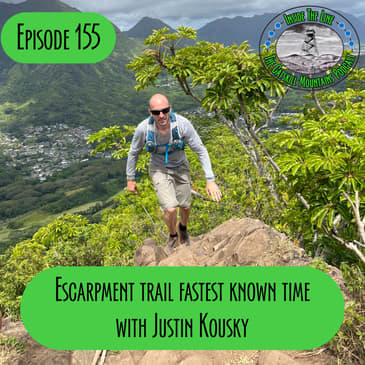
Welcome to episode 155! On this episode, Tad and I chat with Justin Kousky, who back in May of 2024, set the fastest known time for the Escarpment Trail! Justin chats about his experience setting the FKT and his other experiences in being a FKT trail runner. If you need a sticker, email me or go to Camp Catskill! Subscribe on any platform! Share! Donate! Do whatever you want! I'm just glad you're listening! And remember... VOLUNTEER!!!!!!
Links for the Podcast: https://linktr.ee/ISLCatskillsPodcast, Donate a coffee to support the show! https://www.buymeacoffee.com/ITLCatskills, Like to be a sponsor or monthly supporter of the show? Go here! - https://www.buymeacoffee.com/ITLCatskills/membership
Thanks to the sponsors of the show!
Outdoor chronicles photography - https://www.outdoorchroniclesphotography.com/, Trailbound Project - https://www.trailboundproject.com/, Camp Catskill - https://campcatskill.co/, Scenic Route Guiding - https://adventurewiththescenicroute.com/, Another Summit - https://www.guardianrevival.org/programs/another-summit
Links:
Justin's FKT page, Manitou's revenge, Zion going carless, human remains found in Utah, Michelino Sunseri charges
Trailhead stewards for 3500 Club - https://www.catskill3500club.com/adopt-a-trailhead?fbclid=IwAR31Mb5VkefBQglzgr
fm-hGfooL49yYz3twuSAkr8rrKEnzg8ZSl97XbwUw, Catskills Trail Crew - https://www.nynjtc.org/trailcrew/catskills-trail-crew, NYNJTC Volunteering - https://www.nynjtc.org/catskills, Catskill Center - https://catskillcenter.org/, Catskill Mountain Club - https://catskillmountainclub.org/about-us/, Catskill Mountainkeeper - https://www.catskillmountainkeeper.org/, Bramley Mountain Fire Tower - https://bramleymountainfiretower.org/
Post Hike Brews and Bites -
#FKT #FKTescarpment #FKTCatskills #FKTescarpmenttrail #justinkousky #husdonvalley #hikingNY #kaaterskill #bluehole #catskillhiking #visitcatskills #catskillstrails #catskillmountains #catskillspodcast #catskills #catskillpark #podcast #catskillshiker #volunteers #catskillmountainsnewyork #catskillspodcast #catskillshiker #catskillshiking #hiking #catskill3500club #insidethelinecatskillmountainspodcast #volunteercatskills #catskill3500 #hikethecatskills
[00:00:29] The bushwhacks were some of the worst days I've ever had in the mountains, or life really. Whereas Pantsy Mountain is totally opposite, it's a mountain on top of a crater. I think the weather challenges on this incident were particularly difficult. It improves the development of New York State. Catskills will respond to it.
[00:00:52] Passing into Inside The Line, the Catskill Mountains Podcast. My middle name is Reddy. Yeah, it is actually. I gotta admit. I gotta admit. So awesome. Welcome to Episode 155 of Inside The Line, the Catskill Mountains Podcast.
[00:01:19] Tonight, Justin Kousky joins us for talking about his experience doing the fastest known time on the Escarpment. And this is not his only fastest known time. Justin, I read your fastest known time. Holy shit. Yeah. We're gonna start this off with a bag. He's like the envy of fastest known time people. Yeah.
[00:01:42] Out there. And he's being bashful. He's just sitting back with a big shit-eating grin saying, yeah, I'm the business here. So. I'd say there's a lot of beautiful trails in the Northeast and a lot of trail density too. So it's easy to rack up a lot of FKTs in this region. Yeah. Yeah. That's Justin's modest way of saying he's got his name splattered all over the FKT board.
[00:02:07] And he's like the unknown, the unsung hero back there. Like, you got all these people doing like other things like, you know, Kim doing the long path and Chris. And then I'm just like, Justin has done the Escarpment. And then I see everything else he's done. I'm like, Jesus Christ. This is like beyond what I can comprehend. Like, so we're going to try to keep it on the Escarpment tonight, but yeah.
[00:02:32] So, well, we're going to try to keep it on the Escarpment, but just to put things in perspective, Justin, is it true that you set the FKT for the Devil's Path out and back? Yeah, I did. That was probably a few years ago when I did the Devil's Path, but yeah, that's, you know, the Catskills have got a lot of great trails. That's certainly one of them.
[00:02:52] Our Escarpment's another one. I think I just really enjoy the trails up there. So yeah, we'll, we'll talk about that. Yeah, definitely. So, I mean, the big, huge discussion has got to be, we'll go through it real quick because it's just, it's devastating stuff. The California wildfires. I mean, we have had our experience out here with the Northeast or nowhere near as extreme. We had the, uh, the White House fire over in Peekamoose area.
[00:03:17] And then the, the Green Lake fire. Uh, what was that called again? That had a different name than the Green Lake. Oh yeah. How soon we forget. Yeah. So that, that was 5,000 acres. And then this fire out west is just raging through everything. Cause everything's just so dry out there. Just one little.
[00:03:36] Spick a fire and then, and then it catches through everything and we see it go massively, but it's common. So, I mean, it sucks. It happens. It's, it's mother nature kind of doing this thing. We don't know what, what it was started with yet. I, I haven't heard anything. Uh, but you know, thoughts, uh, go out to everybody out there and hopefully, you know, everything gets back to normal, but I highly doubt it is with, with climate change.
[00:04:03] Yeah. Nothing will get back to normal. Justin, you know, anybody out there that was affected by the fires? No, not directly. I've just been watching on the news and yeah, just made as everybody else about the whole thing. So. Yeah. It's, it's crazy, but you know, like we've had, you know, Canada's come down to help out. Uh, Mexico has come to help out with their tankers or their airplanes.
[00:04:24] And seeing these airplanes doing that stuff is absolutely insane with these jet liners. You know, they look like 737s just like pressing right along the mountain and then pulling up. I'm like, wow. You know, I thought my flights were bad when I was landing, but these guys like put it to a whole nother level.
[00:04:44] So when I see these airplanes and helicopters dumping water and whatever else it is that they dump on the, the fire and the perimeter of the fire, it, to me, it puts in perspective just how much bigger a rainstorm is. Right.
[00:05:05] Yeah. These guys are up there with all sorts of like literally jet liners you see, you know, uh, coming in and, and prop planes and helicopters they're dumping water and other stuff on these fires. And it's just literally a drop in the bucket compared to a big storm coming through and, you know, hammering it with inches of water. So yeah, just goes to show you the power of mother nature.
[00:05:33] Yeah. And those, those, those air, the airliners and stuff like that, they, they hold, I don't know. I think it's like hundreds and thousands of gallons of stuff, whatever they hold. It's just not enough. Yeah, exactly. And it's insane. And we see this now, now it's, it's, it's kind of gotten more, a little bit bigger because of it's in residential more of area than out in the forest that we see, you know, over in the Sequoia is the King's Canyon.
[00:05:58] It was like a whole city. Yeah, it was. Right. And then he burned in a day. Yeah. And you know, it's, it's, it's devastating. And, and, you know, maybe we'll have Alex Mara come back on and we'll talk about. He, I chatted with him quickly about climate change, but he, he didn't want to talk about it. So maybe we'll have him come back on and talk about climate change.
[00:06:19] So Justin, while you're sitting there and you're rather sophisticated digs, I even see what appears to be some child artwork in the backdrop, but do you have an opinion? Should they rebuild? Should they be allowed to rebuild these houses on the shoreline and other areas? Like I saw how closely together these houses were, you know, when, if one starts on fire, the next one's just seems to be five, 10 feet away.
[00:06:49] Do you think they should rebuild this area? Yeah, I guess it's probably because the real estate there is so pricey, right? That's why they build so closely. And I don't know, I guess the history lesson from the prior times is to sort of happen is people do tend to rebuild. They, they want to put things back the way they found it. You know, you look at what happened with 9-11, maybe it'll be slightly different in terms of how they rebuild, but I imagine folks will put their homes back up and that'll be cathartic in some sense.
[00:07:16] Yeah, I wonder if they'll do some type of study to ascertain whether newer homes that were built to the modern standards of being resistant to the spread of fires with non-flammable materials were less likely to have, you know, burned up in this fire than other homes.
[00:07:38] If there's any correlation with the building standards employed or not employed, it'll be interesting then to see if they force people when they rebuild their homes to make them more fireproof.
[00:07:50] Hmm. You ever know, we could only, we can only advance something to move forward on this. So, so on this past weekend, uh, green county, uh, GC EMS and hunter ambulance was dispatched for an injured hiker due to falling ice at catarscale falls unable to hike out under their own power. DC Rangers and technical rope rescue team were dispatched. The medic nine entered the trail system along the multiple ropes and team members and ranger and fire, uh, personnel.
[00:08:20] DC Rangers went in amongst, uh, IC conditions. Uh, thank you the fully they were able to find an X rate the patient after a long and crazy process and below freezing conditions. Uh, this is the second legalization of multiple resources in 2025, which we know it's only been 14 days, two weeks. So without them, their jobs would be much more difficult. Again, falling ice at catarscale falls.
[00:08:46] It happens with the power of the water just comes down and, you know, could break off a piece of ice. And that piece of ice could be 50, 60 pounds and it nails you and knocks you out. And then gives you a broken shoulder or broken, whatever. And this looks like from the pictures, uh, was looks like on the second, on the first level with the cone shape area of, so that's 150 foot drop.
[00:09:11] That you first get down to, uh, when coming from the top of, yeah. Yeah. From, uh, Laura house road. So sorry. I was trying to get that in there, but yeah. So awesome jobs by the, you know, the Rangers, the local volunteer firefighters.
[00:09:26] I'm guessing it's the twin clove rescue team was helping on that as well. So awesome job that time of year, man, it's that time of year, but it looks like they did this at night. So it looks like it took a significant amount of time. Maybe. I mean at night, it's like five 30 right now. So.
[00:09:44] Yeah. Well, it was it, it, I think the response time was around four 30 PM. Okay. And it was dark up there. I was just down the road when this was happening at the stewards and Haynes falls getting a cup of coffee and, uh, was dark. It was cold, a little brisk. Uh, but I imagine they were able to mobilize and, and get to this area quickly. But one of the things I wonder is.
[00:10:12] Should they, because they have elsewhere around the waterfall put up, um, railings platforms and things like that. Should they in the winter time put up some type of barrier cable or chain restraint that people can't go past?
[00:10:30] Because maybe some people just aren't aware that number one, that ice can break off. And number two, when it breaks off, it's not necessarily going to fall straight down. It might hit something on the way down and then change its direction and go into people and they get hurt. What do you think, Justin? You know, we're, we're talking about catars.
[00:10:50] Yeah. I've actually, I went there over the summer, no icicles in the summer, but it's a beautiful spot. And I can imagine the, in the winter time is super dangerous, but it's also very heavily traveled, right? You get a lot of tourists coming in, perhaps without a full understanding of what they're getting themselves into. I don't know in this particular case, but yeah, it just seems like, um, maybe a few more signs or a bit more of a guidance about those icicles can fall and, and kill you. Um, might be helpful. Yeah.
[00:11:20] Yeah. I mean, one thing, one little thing, you know, might lead to another, you know, might help out might not. I think just people are. Want to get, you know, to get there and look at, and then they'll explore even more and then they'll just get themselves in a dangerous situation, especially at, you know, one of the most popular area in the, in the Catskills. But I'd have to say it's, you know, Ted, I know you've only been there. Have you, have you been there once?
[00:11:45] I've, I've only been to the falls one time. And when Justin says they ought to put up some signage, I'm thinking, you know, if the sign says, uh, serious injury or death, that's like a, a implied sign to take a selfie there with the sign in the backdrop. So true.
[00:12:06] But yeah, my, when I, I, my sampling of one and only time at Catterskills falls is a lot of people with not a lot of experience go there and more handholding, whether by signage, uh, railings or fencing is probably required than elsewhere in the Catskills to take account of the people that visit there.
[00:12:32] So yeah, the, the ratio of visitors per like injuries is, is like a low percentage, but you got to admit the amount of visitors that come there to compare to like Friday mountain or any, even like Hunter mountain is just substantial. And, you know, once again, they, they've done a fantastic job, even though it's, it's, it's, I hate to say it's like commercialized, but that's what it is.
[00:12:56] It has to be because the way it used to be was absolutely impossible to get up to that second tier, uh, without an injury or without, you know, if, if nobody had proper, I would say gear, I mean, in the winter gear, but you know, like. Like in the summer they would have flip flops and stuff, just getting up to that second tier was, was almost near impossible. So they've done a great job bringing it, of course, the steps and stuff. That was just a great amount of engineering and, and it's going to last for a while.
[00:13:25] And, and you talk about, you know, barriers, that's good. That's good. A great idea, especially in the winter. We, we all know that people are just gonna. Just gonna not follow that stuff and break the rules and go in there and get their selfie and, and then fall off that first tier. And yeah, it's horrible to think about. Yeah. It's probably just one lawsuit away from the, the state putting up something else to restrict access. There can't be lawsuits in there. There's nobody's done a lawsuit there. Cause it's, it's like hike at your own risk. Right?
[00:13:55] Oh, that's, that's what you say. But then you get a jury in the Bronx. They'll see it a different way. Okay. Yeah. It's hike safeguard now. Now we need to hide a safeguard here. Yeah. Let's, let's move on to the Utah hiker. Tell us about that. Don't know those you brought this up. This was actually fresh off the press, actually from this recording. So this is January 14th. This is under two hours ago. Tad brought this attention.
[00:14:22] So, well, that's again, it's our research staff is on top of it. Oh, I said to you, I didn't say our research staff. Well, yeah. Makes it sound bigger. True. So, so police say that humans remains in various forms of decomposition have been found near a public trail in Southwestern Utah. So, uh, the bone wash to the man, the remains were found near the bone wash term elephant arch hiking trailer area areas in Washington city, near the Arizona border about 125 miles Northwest
[00:14:52] of Las Vegas. Uh, they were discovered Sunday after hikers spotted them, uh, officers from Washington city police and deputies from Washington County sheriff office responded promptly to the scene and confirmed the presence of human remains in various forms of decomposition, indicating that they had been there for an extended period of time. Uh, of course, the identity has not been released. At least you can't identify the fricking person after like a day or two or something like that.
[00:15:18] They, they said, uh, have been there a long time and they don't think that the foul play is suspected. So, uh, they, out of respect to the family, the identity will not be disclosed. They are definitely reporting, uh, transported the remains with Magnus, the ambassador in his office and, uh, are looking a way to a further, uh, investigation to see what actually happened. So, you know, being, uh, recently out in Utah two years ago, I'm trying to think of the bone wash trail and the elephant arch.
[00:15:48] I think I, I sorta know where that is. If that's closer, that's closer to the grand Canyon. Uh, uh, what's that area that everybody loves not the wave, but the, uh, page Arizona that's down near there. So it's kind of, yeah. Yeah. Page is a little bit south of there and in Arizona proper, but yeah, I'm checking it out on the map right now and my daughter is about 10, 15 miles away from that area. So, okay. Yeah.
[00:16:17] She's, she's hanging in St. George. Oh, that's it. Yeah. That's a popular area. Actually, we're going to be talking about that. Oh, wait a minute. So, oh, Canara falls. So we're talking about Cedar city, Dixie national forest. Okay. Let's just wait a minute. Um, yeah. Yeah. Well, that's that whole region, which is a pretty big region, but it's, it's like tourist city USA in the summertime. Oh yeah.
[00:16:45] With Zion, Bryce Canyon, Canyon de Chez, uh, the outer reaches of the grand Canyon page. Um, you know, that's all out there. Interesting. So this is a different. Oh, interesting. So I have, I've driven through there, of course, going to Zion. Cause you go through there, you go to the main, it's the main highway. It's highway 15 that goes leads over the Virgin, the Virgin river. So interesting. So, yeah, I see the red reef trail had that. We were supposed to go.
[00:17:14] Jessica and I were supposed to go there, but we went straight to, uh, Vegas instead of going there. So interesting. So that's. Yeah. You know, it's interesting though. They say that the hiker stumbles across the human remains on trail. That's the impression I get on trail. So this is must be in, of course, a, not a popular trail. Yeah. You would think so. And then presumably at some point someone was searching for this person, some, some group of responders.
[00:17:44] You would think, I mean, I guess the, uh, the story will unfold over the coming days, weeks and months. Yeah. I mean, if it's like, I don't know the stages of decomposition that, uh, that a human remains go through, but that's like a, a decent amount of time. Justin, you have any like thoughts or words about this? This is definitely different. Yeah. I haven't read the article. It's sort of interesting.
[00:18:10] I guess this time of year, it may take a while for the remains to, uh, sort of decompose if it's cool out there. And it's always very dry in that, in that part of the country. But generally I thought the temperatures were well above freezing most days. So yeah, I would imagine maybe the remains, um, were moved onto the trail or maybe nobody used that trail this time of year. Cause that's pretty unusual. Yeah. Yeah. It's definitely one of those unique areas, of course, because you know, it's all that,
[00:18:38] that red rock area that leans upon, uh, the St. George area. And, uh, as I'm looking at the map, I'm seeing a couple of stars that I have around there that I want to go visit, that I did want to go visit. We'll go visit again, but wow. Just imagine, you know, you're walking, you know, you're doing the escarpment trail and you're, you're coming between Arizona and blackhead and you see some human remains that have, uh, yeah. Yeah. And then you see it, the tail of a mountain lion running away.
[00:19:08] Yeah. That's, that's, you know, I mean, the desert is not home to, you know, there's coyotes and stuff like that, but you would think that maybe, I mean, maybe they didn't disclose this information that it might've been ripped apart by coyotes. Cause you know, there's a lot of coyotes out there and stuff. Yeah. Maybe that's why I was in various states of decomposition is certain parts of the, I hate to make a joke about this, but I already started, but certain parts of the body might've, might've
[00:19:35] been consumed by a coyote or, uh, other carnivores. Yeah. So crazy. Thanks Ted for hot off the press right there. Another, you know, we're in the area, uh, Springdale, uh, the town that surfed the gateway to Zion national park is considering it to go carless as traffic jams at the parks and entrance sometimes stretch for a half a mile into the small town.
[00:20:01] So I was reading the air like two, two years ago and I went in during the, the pre like crazy times and there was still, it wasn't bad. It was flow through. So it was, it was not that bad, but Springdale, uh, Utah town council has awarded $60,000 to a consulting company to study the feasibility of a carless travel. Now the company called parametrics is tasked with educating the community and visitors
[00:20:27] about transportation alternatives that can improve the quality of life in the community, including safety air quality and preserving the small town character. Now, somebody said this, uh, looks like Tom days director of St. Jordan news said most people who arrive in a private vehicle, park their cars, vehicles in Springdale. And, uh, if you imagine 5 million people trying to park their cars in the set town of 600 people, that's a pretty big impact.
[00:20:52] So now don't think that this person saying 5 million people per day, because it's not that way. 5 million people per year. You break that down. You know, uh, of course it's not that crazy, but to be honest, there is only one stretch in and out of Springdale and that's SR nine that cuts right up through the Zion national park goes through all the heavy hit areas. You're talking about the switchbacks that show you the views of Zion.
[00:21:17] Everybody takes, uh, the lower part that goes into, uh, Oh God, I forgot that, that famous river that everybody does that I never did because I just didn't want to see people. Uh, that goes down to, uh, Oh my God. Are you talking about the narrows? Yes. The narrows, Jesus. And then angels. Way to go Justin. Right. I've actually been there. So I know a little bit about, so I don't know too much, but okay, well, good. So Justin, how, what are your thoughts on this?
[00:21:47] Because you've been there. When did you go? What was your time of year that you went? I think it'd been a couple of times in the last five years. Um, my mom actually used to live out in St. George. So it was pretty convenient when visiting her to go, go there for a day trip. And yeah, it's totally right. There's, um, you know, there's probably three entrances to Zion and that's the one that 95% of people use the other two are not very popular. And I believe they're also like, um, you know, the attractions there aren't quite as glamorous.
[00:22:16] And so that's why everybody does the main entrance and yeah, the town's pretty small. It's like a one lane road, either direction to get in or out. And, um, I recall it logistically, you got to get there early if you want to park inside the park and then you take the shuttle bus once you're inside the park. And so perhaps, I mean, off the top of my head, they could just extend that shuttle, bus notion a few miles down the road.
[00:22:41] Um, I do see buses, uh, and bus stops in that town that people will sometimes park like in the town rather than in the park. And then they just sort of make to the front entrance. So yeah, maybe in a more extended bus system could probably help out a lot. I think, you know, some folks, uh, we'll, we'll do bikes through there. I think there's good bike lanes and good infrastructure there, but it, it, for most folks, the walking is, is just too much.
[00:23:07] It's a, you know, maybe it's 10 miles to get to the narrows from the main entrance or something like that. Most people are not interested in doing that in addition to whatever hikes they've got planned for that day. So maybe it's like 10 or 20 miles. I don't know. It's a, it's a long distance, so there are sidewalks there, but I rarely see people on the sidewalks there. I think most folks are, uh, taking the shuttle bus just to get from point A to point B and, and yeah, the shuttle buses were great.
[00:23:33] Uh, so I dunno off the top of my head, that's, that's probably the best way to do it. Yeah, it's, you know, being there, I went there in April, like a little mid to late April. So we're, I would say mud season more of a, than, or it was a little bit earlier than, than usual. And it wasn't bad. I would admit my, my wife and I, I'm a guy that stays away from the popular areas. I don't want to be around people. I want to go do the different crazy areas, but we did have to travel through there to get where we were staying.
[00:24:02] We stayed in, Oh God, order bill. So that's on the other side of St. George, you're heading east. It was very beautiful town, but you had to go through there. It's nice and slow, but you know, I do understand. The, the amount, I mean, it's, it's just the places. 100% stunning. Uh, there's nothing to be like forgotten about that place inside on national park. I was just blown away by everything.
[00:24:29] Just a simple drive could blow your mind away with that. And then the hiking goes beyond that, you know, just will expand that. And it's Zion. I wouldn't say is very similar to the Catskills, but it's, it's, it's so small that you have only a couple routes going to the popular places and they have tried so hard to kind of like compact that to get as much people as they can.
[00:24:56] But it's just, it's impossible because of a social media has just blown up everything in, in every place possible. And you know what? I don't blame them. Like the, you know, Justin, you've been there several times. God, that place is just absolutely stunning. There's, there's so much out there. Yeah. I think it, you know, obviously you go to places like, um, angels landing, like that's kind of the premier route. And it's not that long either.
[00:25:21] It's totally doable by just about anybody at any level of fitness and, um, the views there are tremendous. It's a little scary. You know, you get some exposure or there's some cliffs. So, I mean, if, if you're doing it for the likes, there's a lot of likes to be had. There's a lot of views and, um, and then, yeah, just, just stunning views. So I totally understand why they get whatever 6 million people a year out there. Um, it's worth it. Yeah, it is. It is.
[00:25:50] And, you know, Tad, your, your, uh, your daughter's out that towards that way. And she's probably sent you pictures and you're just like, this is unbelievable. It's fantastic. Yeah. I've, I've been out there one time myself, but. Oh, nice. Sorry. Yeah. She, uh, she's spending the winter out there and, you know, checking out those surroundings. And, but I, I feel for these folks in the summertime, I spent my summers in a little resort town and Friday, Saturday, Sunday were, you know, congestion.
[00:26:19] And then the rest of the week, it was like a ghost town, but I'm a proponent of, uh, you know, mass transit or community transit. I don't think everybody should be able to take their car wherever they want to, particularly when they're trying to get away from congestion. And, you know, the annoyance of driving from point a to point B and crowded roads and people with road rage and whatnot, just, you know, give people a seat on a bus or on a trolley or something else.
[00:26:49] And let them, let them relax. And this also might encourage people to spend some time in town and shopping at the local businesses and eating at the local places. Yeah. Yeah. I mean, the time we had out there in April was fantastic. I mean, I couldn't say that, uh, the only other place that has blown my mind besides that is, is Western Canada or the Canadian Rockies.
[00:27:12] So I had to say Zion and, and, and Utah was just the, one of the moments of my life that I, I was just like, wow, this is unforgettable. And I, I seriously didn't go to the Narrows. I didn't go to angels landing. Like you said, I went to, I know it's, it's probably another popular era observation point, which is on the opposite side of the Narrows. It's a little bit longer. It's eight and a half fricking miles, but it's fantastic. Eight and a half miles go through different parts area, get different viewpoints.
[00:27:41] We went to different little canyons that were not the, the big canyons that everybody went to, you know, like, uh, trying to think the wave and stuff like that. We went through different areas and I was just like, wow, this has so much to offer. And you always think when you go out there, Justin, you probably have thought this like, man, I could live out here. And then you're like, man, I should buy a home here. And then you're like, oh man, let me look at the houses.
[00:28:07] Ah, minimum 1.5 million for two acres of land. Sweet. Yeah. I think, um, well, first of all, you've got to deal with the traffic and everything else. It's, it's really, when you're making a decision to live in a place like that, you're taking the good and the bad. And there's a lot of bad to go along with it. Like there's not a lot else out there. You're just that there's that one little town and then you got to drive 20 minutes and it's just rocks and horses in any direction, uh, to get, to get to anything. And yeah, with traffic that could easily be an hour.
[00:28:37] So you're kind of isolated and cut off from the world there. So, uh, yeah, but if you can afford, uh, you know, maybe a summer home there, uh, maybe I'll get myself on, uh, uh, some, you know, the government job and maybe I'll be able to afford it sometime. But the only thing I have to say is BLM at BLM land stuff is absolutely phenomenal.
[00:29:01] Cause you know, I see that and I'm just like, I look at a, at a plateau over there, you know, that has like maybe like 600 feet in elevation gain instantly. And I'm like, man, I could park over here and climb that freely without any trails. I'm like, Hmm. But then I could get attacked by a mountain lion or bison or some wild boars and stuff like that. So it's all going through my mind, crazy stuff. So, uh, so we'll see what, what goes on with that. We'll keep you up to date about that.
[00:29:31] That's a interesting. Once again, these, these places out, uh, the national parks are becoming overpopulated, uh, with Instagram and Facebook and stuff, but I don't blame them. You know, Justin, once again, he's, he'd be grieving me. I don't blame him. It's absolutely stunning. And I don't plan on stopping to go there. So you'll see me there just in the off seasons. So, uh, so Ted, why don't you go in on about this, this next topic that we have? Oh yeah.
[00:29:58] So, you know, because we have Justin, the King of fastest known times on the show tonight. Uh, I remember this story of, um, Mitchell Lino soon Siri. I hope I'm saying that right. But, uh, in September, 2024, Mitchell Lino, uh, cut a signed switchback during attempt to claim the fastest known time for summiting the grand Teton peak.
[00:30:28] He made record time running the 13.2 mile out and back route in just two hours, 50 minutes and 50 seconds, which is about seven minutes faster than the prior FKT of Andy Anderson set in 2012. Were you aware of that? Justin. I have not followed that FKT around at all. It's a little outside of my neighborhood.
[00:30:55] So, so, uh, Mitchell Lino, uh, when it was revealed to the fastest known time organization that he cut a switchback, his record was revoked. And that was just the beginning of his troubles. Later, park rangers reviewed the Strava data and considered the accusations against him resulted in them filing charges.
[00:31:18] And he was officially accused of having ignored national park signage and took a prohibited shortcut, cutting a switchback in a national park as a misdemeanor and typically carries a fine of $5,000 or up to six months in jail. Stosh, did you, did you know that it's a, could be a misdemeanor, $5,000 fine, six months in jail. Were you aware of that for cutting a switchback?
[00:31:48] Yeah. Damn. I better stop. Well, wait till they make bushwhacking illegal in the Catskills. Jesus. $5,000 fine. Okay. So we'll go on with the story. At a court appearance on December 18th, the prosecutor's best plea offer was a plea to a class B misdemeanor. A five-year ban from Grand Teton National Park and a fine. They didn't disclose the amount of the fine.
[00:32:17] The shortcut that Michelino took is an old climber's trail that the National Park Service claims it has been trying to close for almost 12 years, which makes it sound like a lot of people take that shortcut. Yeah.
[00:32:39] So, in 2012, Killian Jornet cut the same switchback during his Grand Teton FKT attempt and the Park Service did not pursue charges against him. Apparently, Jornet returned to Europe before action could be taken against him. Instead, the National Park Service issued a warning that any park visitor caught cutting trails would be cited, yada, yada, yada.
[00:33:05] And Jornet's FKT was, he was allowed to keep it, but his record was flagged. Wow. So, as I scroll down through this, it reminds me of in 2022, Pierce Bronson was prosecuted for going off limits in Yellowstone National Park.
[00:33:26] And he agreed to pay a $500 fine in order to donate $1,000 to the Yellowstone Forever non-for-profit that supports the park. So, he wasn't banned from Yellowstone Forever. And he was like caught total red-handed where they saw him going out and doing this shit. Yeah. He was caught red-handed. I'm sure that he hired a lawyer, but this Michelino also hired a lawyer.
[00:33:54] And I bet you his lawyer is charging him more than $1,500 for representation. But what I'd like to know, Justin, what do you think of that? Should Sun Ceriri be banned from setting any other fastest known time attempts because he took this shortcut? Yeah. Well, it's interesting. There's a lot of angles you could think about this situation.
[00:34:21] So, I mean, the first one, obviously, those punishments seem pretty severe relative to what I imagine. Like, a lot of people are doing that every day and getting away with it. But also, I would say there's probably a higher standard for somebody who's trying to be, you know, an established athlete, maybe a professional or something at that level and setting records especially. So, I would say you really can't be cutting switchbacks, especially if they're signed.
[00:34:49] And I believe this athlete knew that this switchback was, you know, off limits and is very familiar with the area. So, it wouldn't be an accident. He lives out there. Yeah. This is his home turf. He's a bartender down the road in a tavern or a resort. And he trained on this route. And then he cuts the corner. Yeah.
[00:35:15] So, that to me feels more like probably why the punishment's so severe there. Because obviously, if they've been working on this for 12 years, I mean, that's another angle, though. Which is like, why is it taking 12 years to close this thing up? Like, can't you put a bunch of deadwood in front of the path and like just sort of block it off or you can put people there and hand out tickets or give warnings or something?
[00:35:39] Like, I don't know if going after people on Strava is really the best recourse if you're really trying to close that route up. I think there's probably more practical ways to close it. But they probably felt like they were cornered at the point when he submitted to FKT, it's like a lot of publicity goes along, perhaps this route and FKTs in general in that area. And so then if you don't make an example of this guy, you're just basically inviting other people to do it again in the future.
[00:36:09] So, it's probably why they come down so hard on him. And, you know, I'm trying to look up the statistics for hiking that. So, I'm getting like a lot of controversial thing that says it's a round trip of seven miles, 7,000 feet of gain. So. And he did it in three hours. Yeah, that's why I'm like looking so further into it. Is that possible? I don't know. That sounds impossible. It's got to be.
[00:36:39] It might be seven one way. Yeah. Okay. Yeah. But still at 7,000 feet of gain, like one way, seven miles up to the top. And then 7,000 feet in one way. Yeah. So, that's. Of course, that's the Grand Tetons, but it's still that. Yeah. But that's in half that distance, you know, what, 3.8 miles you're climbing 3,000 feet. Is that what you're telling us? I don't know. That's what I'm trying to find. Yeah. Yeah.
[00:37:05] Well, what really irks me, and I don't know if I'm going to strike a chord with Justin, but if Sun Siri knew he cut the corner but still submitted for the FKT, how can you trust this guy in the future when he says he did an unsupported FKT? Because that's not going to show up on his Strava, right? This showed up on his Strava.
[00:37:33] I mean, it's, you know, it had to stick out like a sore thumb when you cut a corner. You know, his tracks are going to show going up, and then there's not a mirror image going down. There's where he, the line diverges, where he goes through the switch, cuts the switch back. He knew he did that, presumably. I mean, the guy, you know, could have been a big brain fog from like, you know, aerobic deficit or something. If that exists, I don't know.
[00:38:02] But he should have looked at it. Whether he did or didn't, knew or didn't, he sends it in. How can you trust him a year from now when he says he did X unsupported? Do you believe him? You don't have to answer if you don't want to. I mean, it's kind of an ethical question of like, if you're going to cut the trail, would you also cut corners on the supported versus unsupported rules? Yeah, it might speak to the character. I guess it's always a question.
[00:38:30] And FKT is not really in any sense policed in that fashion. Like, if there's clear evidence somebody's violated the rules, they'll flag or remove the posting as it was with this case. But most of the time, it's just on the honor system. Yeah. Yeah. And so we had Chris LeBlanc on the show who set the FKT for the unsupported long path. Is that right, Stosh? The long path? Right. Long path. Yep.
[00:39:01] From south to north to south. And when he got to the George Washington Bridge to continue on to New York City at like 11 or 12.01 a.m., the gate was locked. The gate was locked. He was like doing, I forget how, over 50 miles that day, how many hours. But Justin, you know how these are. You're just like in the zone. You're coming into the end. You're just totally running on fumes. He gets to the gate.
[00:39:30] It's locked. And in his mind, he calls the people and they're like, yeah, it's locked. They tell him the next day, had you asked us, we would have come down and opened it for you. But instead, he curls up at the gate and sleeps overnight until it like opens up five hours later. That added five hours to his FKT. He still set the record. But this is, you know, talk about honor. That's a lot of honor and integrity there.
[00:40:00] And going forward, how can you trust a guy who cuts a switchback? Yeah. Single switchback. Yeah. And thinks he can pull it off. Look, I don't know. Maybe it was an innocent mistake. Maybe it wasn't. But wow. Crazy. Insane. So any other thoughts, Justin, before we move along? I don't know. From a legal perspective, I was curious if there's any precedent on GPS information being used to prove that somebody cut a switchback.
[00:40:29] That's kind of interesting to me. That's your electronic fingerprints all over the side of the mountain. You can obviously, you can tamper with that data. It's not very hard. You could construct alternate paths. But when somebody posts it as their own, there's an understanding that they're vouching for that. And they didn't just create a fake file there or something. And so there's a little bit of an implied culpability there. But I'd be interesting to see how the courts treat it. And in particular, what the lawyer argues.
[00:40:59] Because I don't know if somebody's done that before. And maybe it's just a warning to everybody that your data is constantly leaking out there. And you better watch your ass if you will. Yeah, right? Yeah. Yeah, don't talk the talk and walk the walk. And then you can't back it up and be like, oh, yeah, I did this. And they're like, wait a minute. Didn't you cut that little area that was redirected over there? Oh, well, what? Yeah. Panic, panic, panic. I've done a lot of runs.
[00:41:28] And I'm looking back and thinking, there's got to be times when I've accidentally gone on private property or done something else, like unwittingly. And if somebody could go run a program against all my Strava files and then say, okay, where did he break the law? And then use that to get me, like, as a person? Like, that's a little bit big brother, right?
[00:42:19] Yeah.
[00:42:43] I mean, I wouldn't say that again. Thank you for Mike Sawatowski, John Comiskey, Summit Seekers, Betsy A., Denise, Tom, Vanessa, Jim C., Michael, and Derek. Thank you guys very much for supporting the show. Really appreciate you doing it. Also, sponsors of the show are fantastic. Thank you very much. Capture your love story against breathtaking backdrop with Outdoor Chronicles Photography.
[00:43:12] Molly specializes in adventure couple photography, and she'll immortalize your moments amidst stunning landscape of the Catskills, Adirondacks, and White Mountains. She'll craft timeless images that reflect your unique bond in nature's grandeur. Embark on an unforgettable photographic journey with Outdoor Chronicles Photography. Don't hesitate to get a hold of Molly on all platforms. Also, you want to learn more about the outdoors? Discover your wilderness with the Trailbound Project.
[00:43:39] Our expert-led hiking and backpacking education programs offered unparalleled outdoor experiences. Whether you're a beginner or seasoned adventurer, join us through an essential skills. Explore stunning trails and connect with nature. Start your journey with Trailbound Project and unlock the wonders of the great outdoors. They're doing awesome winter stuff like snowsewing projects, GPS training, and such like that for the winter. Check them out. Trailbound Project is fantastic.
[00:44:07] So, Hard Ciders Mentions. Tracy Rackin donated 10 Hard Ciders. Really appreciate it. She said, Happy New Year to my favorite podcasters. Thank you very much, Tracy. Really appreciate it. Pink Point 818. She rips it up all the time, so can't wait to see her adventure in the new year. Also, Jeff Jotz went up North Dome and Cheryl with Orla, his dog. Around 2 inches of fresh powder with 12-inch drifts.
[00:44:33] We faced that kind of somewhat when we went up there, Ted, like a week or two ago. Definitely agreed that the slog up Cheryl is tough. He said he lost his snowshoe twice but found it. And that's a good discussion about how you pack your snowshoes. Because I have been seeing a lot on the Facebook pages that people lose their snowshoes. And I don't know how they do this. Yeah. I find that interesting. Interesting. Okay. That's not just me.
[00:45:01] You know, I know you can, like I have mine on the brain, so mine widened out, but they're like as wide as my shoulders. But when it catches on something, I always kind of look back because I'm less like, oh, something fell. But like somebody losing a snowshoe, a spike is, you know, that's considerable. But a snowshoe is pretty. Yeah. I can't tell you how many times I've seen folks at the, typically, you know, early on in winter when they're getting out there the first time with snowshoes.
[00:45:29] And they look at the snowshoes and they look at the parking area and they look at the snowshoes and the parking area. And they realize that they're not going to start that hike wearing their snowshoes as they thought when they left like their house in New Jersey or out on Long Island, they thought that there's going to be snow in the mountains. And really the snow starts like a thousand vertical feet up or 500 vertical feet up. So they have to pack their snowshoes in some distance and they weren't prepared for that.
[00:45:57] They never thought, gee, how am I going to put these on my pack? So over my eight plus or minus years of hiking in the Catskills, I've used different methods. I've got a pretty good method now for the pack I'm using, but it's one of these things you see people, you know, on top of the pack, on the sides of the pack, on the back of the pack or one under each arm. And you do yours on the back of the pack, correct? Yeah.
[00:46:23] This pack, I just use two straps and snug them up against the pack. And the other thing I do is I have a cord that goes up through the middle and doubles back. So if those two straps come off, then my snowshoes are going to dangle on the pack without falling off it. And that's kind of like a little alarm that, yeah, I've got a snowshoe problem here. Justin, do you have any preferred way? Do you hike in the winter? Yeah, I've done a bit of snowshoeing.
[00:46:53] And generally, I've been lucky enough that I can just put them on at the beginning and keep them on the whole time. I'll just pick a day when I know there's snow throughout the distance. But yeah, I think putting it on the outside of your pack is probably the best treatment. You know, that keeps the spikes from cutting up things inside your pack. They're accessible. You know, sometimes when you're moving, you don't want to stop and take things out of a pack and it's too much hassle.
[00:47:20] I find myself just convincing myself, oh, I don't really need these snowshoes. And I'll just walk out a few miles without them and then regretting that. So yeah, I'd say on the outside of the pack is probably the right treatment. Yeah. Yeah, it's, you know, and I put mine on the brain, like below the brain, and then I hook it through those hooks that they have. So it's kind of like attached and it won't, it won't move. It's a little bit wider than what everybody does. Of course, Tad, you know, you do it on the backside.
[00:47:48] So it's kind of like it's vertical instead of horizontal. So, I mean, we all have our preferred ways, but just as long as they're, they need to be at least two or three loops in there just to make it. So it's, you don't lose it because that's, you know, that's a lot of money that you lose and you can't, you can't lose, you can't lose one and be like, oh yeah, I can use this. Yeah. Yeah. It's not like you can go to the store and buy one snowshoe. Yeah. You're basically screwed with that or spikes too as well.
[00:48:18] Like you can't buy one spike. Yeah. Well, you can buy two spikes and, you know, save the semi-worn out one as a spare to bring along with you, but it's hard to carry like that third snowshoe along, you know, as a spare. That doesn't make a lot of sense. Yeah. So glad you had a good time with Jeff up on Northam and Cheryl. We had a good time up there. It was nice cold weather. So. Yeah. That's a fun hike. Yeah. So once again, rate the show. Usually five stars are good.
[00:48:47] I would suggest five stars and a good complimentary thing about how fun we are that. So, uh, so also anybody drinking anything tonight, tad you drinking anything or just, let's start with you. You having something to drink. I did see you take a sips of something. Just water. It's water in a fancy cup. Nice. Yeah. That's it. That's good. That's good. Ted, how about you?
[00:49:11] Oh, I just got some home brew or home roasted coffee in my Yeti tonight. Okay. So, well then here, let's see if this works. All right. I don't know if that worked, but I got a 1911 cranberry hard cider. So, of course it's small. Oh, wow. That was good. Oh, damn. That's potent. Cranberry. Yeah. Cranberry. Yeah. Time of the year. So you're a big cider guy, as we all know.
[00:49:40] When I was out hiking this weekend, I ran, I ran into a couple, um, on Thomas Cole. We were chatting and while we're chatting, the, the fellow opens up a big thermos and he pours out into two cups, something which at the beginning, I didn't, it smelled really, really intriguing and delicious. I didn't know what it was offhand. And then he told me it was spiced cider. Warmed up spice there. Yeah. Yeah.
[00:50:09] And it really, it, it smelled divine and they offered me some, if I had my own cup and I thought, wow, the one and only time I wish I had a cup on a hike. I mean, some of their cider. The, the warmness would, would, would warm you up. And then also the, the spiced side that it's had some alcohol and it would warm me up on the way down. So yeah. Yeah. It smelled really good. Very smart. Very smart. Yeah. So, so excellent. So previous hikes, Justin, let's go with you.
[00:50:36] Have you been out on the trails lately that you want to chat about? Not really hiking. Uh, it's running the last couple of weeks. I just mostly just winter training. So nothing too fancy, just trails around here. Um, I am going to try to get up into the Catskills pretty soon, maybe this weekend, although it looks like it might be a little too cold, uh, maybe subsequent weekends. So I've got some hikes in mind, but nothing, nothing recently. Where's around here? Where's your located at? Oh, I'm in Westport, Connecticut. So it's pretty close to the coastline.
[00:51:07] Um, there's a lot of good trails around here though. You can, you can find local rolling Hills is how I would describe it. Nothing really like mountains. And we've gotten a few minor snow storms in this neck of the woods, but it's like an inch here and inch there. So you feel like you're running on snow, but it's not enough to really use anything different than normal shoes. Okay. Nice. Nice. What are your, what are your like, uh, your distances that you usually do to, uh, out there in Connecticut and such.
[00:51:37] For train for winter training. Yeah. We're just normal training. Like if, if I'm going out to do a longer run, maybe it's 15, 20 miles per training run, but most days it's, you know, you're doing 10 miles or something like that. Yeah. Yeah. Stosh and I, we do 10 miles all the time before work. Right. Oh yeah. Definitely. Easily. Pull up in the parking lot. And it's like, uh, you get there hour and a half early. I'm just going to crank out a 10 miler and. Wow.
[00:52:05] Rush off the sweat and walk in the office. Yeah. Exactly. Like it's nothing. Like it's the jealous. Yeah. So I, I wasn't out this weekend. Uh, I had to work. I actually went ax throwing this weekend. It was actually fun. Wow. A little time. That sounds cool. It was fun. It was good. How was your aim? Were there any fatalities? No fatalities. I actually got to throw knives as well. They let us throw knives, which I don't like. I like throwing the axes better. I'm very more accurate.
[00:52:33] The knives, it just, you know, there's you, you throw three of them compared to the one ax. So you get a hit with the ax. You're like, oh, good. You missed three of the knives. You're like, wow, I'm a failure. Like this is, this is horrible. So it was cool. It's cool. Axe throwing is very fun. So I suggest you support your local area, like local ax throwing business and go there. I suppose it's more fun when no one's throwing the ax back at you. So correct. This isn't medieval times. We don't do that anymore. Excellent.
[00:53:03] So how about you, Ted? What'd you up to? What'd you, where were you up to? Uh, I, well, I had planned to hike with Danny Davis. Um, but he had to back out at the last moment. So I went to my list and I decided to do Wyndham Blackhead Black Dome and Thomas Cole. Nice. On my way over, I was planning to do it as just one big loop hike. And I got up to, um, the top of Wyndham and I just realized that coming down Thomas Cole,
[00:53:33] cause it's kind of a talus slope that I'd be bushwhacking down. There wasn't going to be a lot of snow cover. It was just going to kind of be a, I don't know, not so fun. I was looking for something with deeper snow in the higher elevation and, you know, have some fun going off trail. This wasn't going to be that hike. So I just did an up and down on Wyndham and then, uh, went to the end of big hollow road and just did the traditional kind of loop with that one arm or leg down to Thomas Cole and back. It's a good hike.
[00:54:02] Saw a few people out there made, made really good time. Uh, Justin, I don't know what you would think of my time, but I did set an FKTT on that hike. Pass the tone, tad time. That's it. Stasha's got it. Stasha, you know, Stasha spent too much time with me when he can figure that out. Fastest known tad time. Do you have the, do you, what's, what's the, what's the, do you have that or are you just? Oh yeah. Yeah.
[00:54:30] So it's, it was like, I don't know, maybe Justin will be impressed or not impressed. It's like, it was like a 12.75 miles, 3,800 vertical feet of gain. It took me 42 minutes. Oh shit. Yeah. Wait, no. What do you think of that time, Justin? And my last time was, was 45 and I didn't cut any switchbacks. So help me God. I'm going to have to send it to the national park service for validation here. I guess I need a lawyer. Yeah. Right. Yeah. Oh, well.
[00:54:58] And he's saying he's not going to admit his time. So that's good. Yeah. I'm not sending it in. With that, with the conditions that you were in the pictures you had, time is nothing. I would have just been floating through that time of time on trail. That's the best. It's just fantastic. He gets you that. Like, like I said, he going out there and it's a complete reset and I can't, I'll be out Tuesday. Uh, hopefully I'll be out Tuesday. Uh, if it's not raining, but it's, it looks like it's going to be cold.
[00:55:27] So I don't mind. So awesome. Glad you guys got it. Be the first rain we've had in quite a while in the Catskills. I don't, I don't want rain. Please. No. With rain comes ice. Yes. Horrible. So once again, uh, volunteer everybody, 3500 club, Catskill trail crew, Catskill mountains club, visitor center, Jolly rovers, trail crew, blaming mountain fire tower, volunteer as much as you can. They're making their schedules up for the 2025 season.
[00:55:55] So check it in, keep checking in and we'll see when we can get it out until the volunteer times. Definitely. So also stickers. You need a sticker. Let me know. Send me a personal message and tad personal message. We'll get them out to you ASAP. Easy peasy. One, two, three. Nothing doesn't cost anything. So Justin, give me your address after this, by the way. So we'll do. All right. So forecast for this weekend, let's go into it. This is from sugar loaf mountain. Of course, we're on a Tuesday recording.
[00:56:25] So this might be inaccurate, but it looks to be the weekend to be an absolute fantastic and cold weekend. Friday, some clouds, a high of a 28 later in the day, a low of zero. In the morning. So it gets nicer out in the day. It gets nine degrees, a wind chill in the day. Saturday looks to be an absolute phenomenal winter day. Cloudy with some sort of snow showers here and there. Winds hitting pretty, pretty steady at 25 miles an hour.
[00:56:53] A high of 30 with a low of seven degrees with the wind chill. Fantastic. Sunday, some clouds, mostly sunny. And it looks to be hitting maybe a high of 19 with a low at night of negative 20. So it started getting cold towards the week. So hopefully I haven't seen Tuesday yet. So I'm hoping to be down in the negatives once again, and then I can do something pretty crazy in the negative.
[00:57:19] So get out there, hike, tag us, tell us what you did. So, all right, we're not going to do history tonight. We're already an hour into this and I'll do the last set of sponsors. We'll take a break and then we'll, we'll come back with you, Justin. Great. All right. So last set of sponsors, discover camp Catskill in Tannersville, your ultimate hiking store. Find top quality gear, apparel and accessories for all your outdoor adventures.
[00:57:47] Our expert staff is here helping every hiker from beginner to seasoned pros. We also carry a variety of unique souvenirs, Catskill gifts. Check us out online at campcatskill.co or in the store to complete your next journey. Adventure starts at camp Catskill. Also, discover the Catskills in Adirondacks and Hudson Valley with Scenic Route Guiding. Our expert guides to ensure a safe, unforgettable hike and experience tailored to your skill
[00:58:13] level from breathtaking vistas to hidden gems, or if you're peak bagging to just simple day hikes, we'll lead you to the best spots and back. Book your adventure today and support nature's wonders with Scenic Route Guiding. Check them out on all social media platforms. Also, if you've been on the podcast, you can get 10% off. Use the code Mountain Lion. So, also, you can embark on a transformative journey with Another Summit. Another Summit is dedicated to serving veterans and first responders with free outdoor activities.
[00:58:42] Activities like walks in nature, paddling, hiking and even backpacking. Join our supportive community to rejuvenate in nature's embrace. Experience commodity, adventure and healing at no cost. Take your next step with Another Summit and ascend to new heights of resilience and joy. Apply today at anothersummit.org. All right. So, let's get on to the guest of the night. Let's go! So, tonight, Justin Kowski joins us.
[00:59:09] We're talking about his fastest known time on the Escarpment Trail. So, Justin set this on May 18th, 2024. What was your time? Let's see. It was about 3 hours, 56 minutes, I think. Somewhere in that range. Jesus Christ. Distance? I think the stats have changed a bit over the years. I think right now they say it's about 22 and a half miles and maybe about 6,000 feet of vertical change. What the f***? All right. Yeah. That just makes me speechless.
[00:59:40] Basically, four hours to do 22 miles on the Escarpment Trail. Okay. All right. There's a lot of downhill. There's probably more downhill than you ran from predominantly downhill, right? No. No? And, well, he said going up Blackhead. So. I mean, that's. But that's just one. That's a hell of an effort, man. Four hours. Yeah.
[01:00:06] I mean, in the Catskills, I got to say that's the best, one of the best through hikes in the Catskills. But we're not even talking about a through hike. We're talking about a f***ing, what the hell do you call that? Yeah. Like a fast run through the f***ing Escarpment Trail. I'm like through hiking with 40 pounds on my pack. And then this guy flies by me. He's like, hey, take it easy. So, Justin, set the fastest known time for there. So, once again, awesome to have you on the show. How are you feeling tonight? Good? Good with the small talk? Yeah.
[01:00:35] I'm feeling great. I haven't gotten sick in a while, which is unusual for the winter. So, I'm pretty thrilled about that. Interesting. Interesting. So, why don't you tell us a quick background about yourself? Go all out childhood to now, whatever you want to do. All right. Try to keep it quick and feel free to interject with any questions you might have. So, yeah. I'm 44 years old. I live in Westport, Connecticut. I'm a software engineer. So, I spend most of my day just sitting behind a screen.
[01:01:06] I grew up in Maryland. And to give a little bit of the backstory about how I got into hiking and running, as a child, my brothers were in Boy Scouts. I was in Boy Scouts, too. I had two older brothers. And so, I just sort of tagged along on a lot of the adventures that they went on in Scouts. And so, we did some hiking, some backpacking down there in Maryland.
[01:01:32] There's like a C&O Canal, if you guys are familiar with that, which is a really nice path. But it's very flat and looks nothing like the Catskills. And then there's the Appalachian Trail down there, which is a lot more, you know, got the Catskills type of feel. You know, backpacking up and down those mountains, I think, was my first real introduction to hiking or backpacking. And so, yeah, that's how I got into hiking.
[01:01:57] And that's, you know, sort of in high school, I had done cross country and track and did a bit of running. And then in college, I just took a break from running mostly. And then I didn't do much running and trails until probably my late 30s. And so, that would have been, you know, six or seven years ago. Got back interested in those sort of things. Realized I was getting older.
[01:02:23] Probably had a limited shelf life and wanted to make the most of it while I was still rather young. And so, got back into running, hiking, outdoor activities. And, you know, these days I've got a wife and three kids. And so, I'm getting to the point now where it's also a lot about getting out with the kids. I can do a lot of hiking and lately running with the kids as well. And so, that's what I'm generally motivated by. And that's what keeps me interested.
[01:02:53] So, Justin, when, like you started hiking down in Maryland and stuff like that. When did you start getting more, like at what age did you start getting more aggressive into the running, the trail running, the faster kind of paces? Yeah, I guess in high school, I did cross country, which isn't really trail running. It's pretty tame by comparison. But that's probably the first exposure.
[01:03:18] And then I remember I did one ultra marathon maybe when I was about 30 years old. I did a couple. And I just found that down in Maryland especially, it's very hot, very humid. And I just don't like the heat and the sort of conditions. And so, I just decided I was done with that for a while. So, I took a break for about 10 years.
[01:03:41] And then, you know, luckily moved up to Connecticut where, at least historically, temperatures have been a little bit more temperate. And, you know, maybe not quite as much humidity as Maryland. I think it's getting a little hotter and more humid as the years go on. But still, you know, much better running conditions. And so, now I find that I can pretty much be running, you know, 12 months a year if I want to. And not as limited by the climate up here. At 44 years old.
[01:04:12] Yeah. Yeah. Jesus Christ. You know, I went up the hike with Tad up North Dome and Cheryl. And afterwards, I'm just like, God damn, these knees are getting freaking old. And Tad's probably just like, wow, what a little wuss that this guy is, you know, doing this amount of stuff. And then there's Justin over here who's two years older than me doing Fastest Known Times.
[01:04:38] Yeah, this is a good time in my life where I can run everything. And, well, all right. I'm going to quit hiking. And then, Justin, you could take over my name and just set everything for me. Thanks, buddy. Amazing. 44 years old. Wow. Like, so progressively in high school, you were athletic. And then you even got more athletic. Because, you know, once again, you said cross-country running is just, you know, like rolling terrain.
[01:05:07] Whereas you get into the freaking mountains, you start going up to 3,000 feet of elevation gains at some times. Yeah, I'd say it's a completely different approach. Like, when I was young and less experienced, like, I would get out on the trails and you just have to go a lot slower. And I probably didn't have the patience for that at that age. And so I mostly stuck to the roads or the track or that sort of thing and the easy terrain.
[01:05:35] But, yeah, I've gotten a lot more appreciation as I've gotten older for the really tough, challenging trails. I think it gives you a lot more chance to walk, which is nice. So we're going to hear more about your story as we go on, Justin. But when is it that you realized you were fast as a runner? Was it when you were younger?
[01:05:59] Was it, you know, as you were in high school when you started running in your late 30s? When did you discover that, wow, I got a set of legs and lungs on me. I can do some damage out there. Yeah, I'd say in high school I was somewhat competitive. I don't think I trained very well. And so I probably left something on the table there. But, yeah, I was competitive. I could win some races in high school, both in track and in cross-country.
[01:06:26] And I was really a little more interested in cross-country, so I did better there. But I don't consider myself particularly talented in that regard. Like, there's a lot of folks that have a lot more natural talent and can go a lot faster. And especially as a guy in his mid-40s now, I mean, that's the age at which your speed really starts to decline.
[01:06:47] And so if I'm out there racing against anybody, you know, half my age in a short distance, like a half marathon or a marathon, there's just no way I can keep up anymore. So, but that just sets your sights on distances that are a little bit longer where that factor just doesn't matter as much.
[01:07:07] But a marathon, though, compared to the Scarp and Trail, 8,000 feet of elevation gain loss, and then you've got a marathon, which is what? Like a couple hundred feet? Like, come on. A marathon's 26 miles, but, you know, most marathons are very flat. And so, like, the pros knock that out in two hours. And so that's a quick run.
[01:07:32] But then you could take on these pros in mountains and destroy them and be like, ha, ha, ha, screw you, man. If they've never run a trail before, maybe. Yeah. I want to see that shit. Yeah. Well, that gets pretty ugly. If you've never run a trail before and you've shown up on the Escarpment Trail, that's probably not an introductory trail to try. That would be a funny thing to watch, man. It's like some, oh, man. Ooh, that's a good idea. Let's bring them all. No, no.
[01:08:01] Let's have Justin keep setting the fastest on time. Yeah. What you find, though, is that, you know, a lot of people make their way to trails later in life, I think. And certainly the road scene is much more competitive. And so I think that keeps a lot of folks on the road. They're just looking to optimize and squeeze every minute out of their, you know, 10K or their marathon time. And the programs, they're very set.
[01:08:27] Like the training philosophy and nutrition, hydration, like everything. They've got it nailed. Like it's a solved problem. And so if you just follow the rules, you'll gradually get faster and you'll get to the point where you're very competitive, like as competitive as you can be. But for me, I think that that sort of challenge is just a little less satisfying than something like trail running where it's a lot more open-ended, especially when you're doing FKTs that are a little more like unsupported or self-supported.
[01:08:55] You have to navigate yourself. You may be unfamiliar with the area. Like that represents a lot more challenges. And that just keeps it a little more fresh as opposed to, you know, today I'm going to run a six-minute mile for 26 miles. And then maybe in six months, I can do that at a 550 pace or something like that. Just like, I mean, it's cool if you're into that. But for me, I just wasn't into that as much. Unbelievable. Yeah.
[01:09:23] It's a total different beast when you go from flat rear end to a thousand, 8,000 feet of elevation gain and difference in 22 miles. So it's crazy. So how about we go over fastest known times? Like what is a fastest known time? So we're talking about like mountainous and stuff like that. When did you become interested in doing the fastest known times? Yeah.
[01:09:48] So the concept, I think, has been around for probably, you know, 15, 20 years as a term, fastest known time. There's a website out there, fastestknown time.com, where you can go and see all the routes that people have put up. And the routes are somewhat varied. It's not just pure trail running. There's a lot of road running there. There's a lot of sort of interesting courses that people just find that, you know, it's a unique course. It's challenging in some way.
[01:10:17] And people want to repeat that and keep track of who's done it the fastest. And so that was how the sort of concept began. And I'd say through time what's happened is there's just a ton of courses out there. And you can, there's a wide variety. So you've got pure roads. You've got shorter distances. You've got long distances. You've got these things like the Teton FKT, which we've talked about, which is you just run up a mountain and you run back down again.
[01:10:46] And that's a pretty classic style. So there's just a lot of courses out there. And it's interesting if you look at just anywhere in the world almost, you can probably find a few courses nearby. And it's supposed to represent sort of the pinnacle of the trails out there, the most interesting things in a neighborhood. What you'll find is some areas may be a little more saturated than others.
[01:11:09] There's like there's still a, I'd say, a North American bias in terms of the routes that are on the website and the people that participate. And certainly, like I said earlier, Connecticut has just a ton of trails and all of them are on the site. And it might be a little overkill. Like you can go do a two-mile run on an easy trail and technically set an FKT for that if you really wanted to.
[01:11:34] And so it's not all premier routes that are, you know, 200 miles over a couple days that you have to go do. The other thing I'll mention is just the different styles of FKTs. There's basically three styles these days. There's unsupported, self-supported, and supported. And they've changed the rules of that over the years. But lately, it's unsupported means you carry all your stuff, you navigate, you're all by yourself, there's no pacers, you're not getting help along the way.
[01:12:03] You're carrying all the food from the start to the finish, so you're not, like, getting resupply points or anything like that. And so that probably represents a bit more challenging in terms of, like, you have to pack everything in, you have to filter water. Oftentimes, you have to navigate yourself. You have to keep your electronics charged so that you can navigate, you know, things like that. The self-supported is more of a middle ground where you're allowed to, like, cash items along the way.
[01:12:33] So maybe you leave something in your car, and when you run by halfway through the trail, you can grab it from your car or something like that. You know, grab some food or some water or something like that. And also, I believe they allow you to, like, stop by in a store or other places like that so you can go pick up some food or drink along the way. I think people tend to do that sort of approach with longer distances.
[01:12:58] So if you did the Appalachian Trail self-supported, you could stay in hotels. You could go to convenience stores along the way and pick up food, whatever's available to the general public. But you couldn't have a pacer. You couldn't have somebody driving a car and feeding you along the way or things like that. And then the supported is the last category, which just basically means everything. You can have as much support as you want. You could have somebody carrying your stuff and with you the entire way.
[01:13:27] So all you have to do is run. They'll navigate for you if you want. You could have, like, as much support as you want. And so I think there's obviously those three different styles. There's a lot of variety baked into that. But supported should probably feel, to most folks, a little bit more like a traditional race. Whereas unsupported, I feel like that's a little bit more of an adventure. You're out there solo and you've got to figure things out on your own. And so that's the appeal to me.
[01:13:56] I do most of my FKTs unsupported because I just think that's more fun. Yeah. So it sounds like it adds another competitive dynamic other than just running the course or the terrain. It comes down to now your ability to figure out those logistics as you go. Yeah. You certainly, if you're going unsupported, you've got to figure everything out ahead of time.
[01:14:23] Because if you get halfway through the run and you realize you didn't pack enough granola bars or whatever you want to eat, you just have to suck it up. You don't have a choice. Yeah. You can't stop and get more. So, I mean, you could always bail out if there's a bailout point. But for a lot of these courses, it's not really that option. So, yeah, there's a lot of burden on logistics and planning ahead of time.
[01:14:50] But I think the advantage is much less burden on relying on other people. And so, in my situation, I've done a lot of these FKTs. If I had to do every single one of them and drag my wife out there and the kids out there and they had to go feed me along the way and all these things, that's a big drag on their time. I don't think I'd be doing it that much if it required that level of support and help from other folks. Because that's a big ask. Yeah.
[01:15:19] So, it sounds like you do these FKTs to get away from the family. That's what I've heard. Jesus. Well, I say it's certainly a way to clear your head. Yeah. To just, like, disconnect from everything. So, I find that super helpful. I actually got started during COVID. And I don't know. Your first thought there probably wasn't too off. Because we were all locked together in the house. And I needed an outlet. I needed a place to go.
[01:15:49] Or I didn't have kids screaming on their Zoom calls, trying to do homework or things like that. So, that's how I first got into the FKT scene was through that time period of just wanting to get out and decompress and get some change of scenery. So, what was your first FKT attempt? Yeah. I think it was early 2020. Just after COVID had hit and in the lockdown. There's a trail nearby here called the Saugatuck Trail.
[01:16:19] And I just basically went out there and did that one-way Saugatuck Trail, which is, I think it's about 10 and a half miles or so. So, pretty short. Easier trail by most standards. And that really, you know, a lot of the trails were actually closed at that point in time. And so, that was one of the few trails that was not closed. And we went out there and didn't see anybody. Had a good run. And I figured, this is pretty fun. I might do this again.
[01:16:47] And so, the first time, did you set an FKT for that trail? Yeah, I did. There was already an established time. I don't remember. I think I beat it by just a few minutes. So, it was a pretty close run. I sort of looked at the time. I was like, oh, that's not a very good time. I probably could have done better. Maybe I won't even bother to submit it to the website. And then, you know, I was thinking about that. And then I thought, well, you know, I'll just put it on the website. And that's where I'm at right now in terms of fitness. And maybe I get better.
[01:17:17] And maybe I can look back at this a couple years from now and be like, well, that was a good baseline. But now I'm much faster. Like, that was my thought at the time. Wow. So, where did you progress from that first FKT you set in early 2020? How many more did you try to set in 2020? And how successful were you? Yeah, 2020, I remember being very busy on the FKT scene.
[01:17:44] Like, it was something where I was trying to get out there almost every weekend. And so, it would have been, you know, two or three times a month. I forget exactly how many I got that year, but probably a lot. And I just use it as a, you know, an escape getting out of the house. And also, just there's so many nice trails in this neck of the woods. And I hadn't seen any of those trails really at all. Maybe a handful of trails.
[01:18:13] And so, it was a good forcing function for me to just go out there, see some new scenery. You know, some trails you go out there and you're like, oh, this trail's not very fun. I won't come back here. But what I found is most trails were, like, surprisingly good and interesting. And now, it's a little bit more of a variety where, you know, if you're in the mood for this type of trail, I will go to this place. If I'm in the mood for that type of trail, I'll go to this different place.
[01:18:41] And so, it's nice to have a lot of trails around here that I've actually been at and know what the conditions are like there. So, a lot of times you're going out and you've never run that trail before. And you're nodding your head yes. Yeah, yeah, that's right. And for me, I think that adds a little bit to the challenge. Like, certainly, if you're going to do any premier route that is very competitive, you're going to have to know that trail at the back of your hand.
[01:19:10] Like, you can't afford to be making navigation decisions on the fly. But, you know, the scene around here is pretty chill. It's just, hey, there's this trail. Maybe there's no established fast, there's no time. Or the time is soft. And I think I could probably just do that if I just, you know, run strong and don't get too lost. And I think that's just part of the fun challenge that I appreciated was going out there. You've got some navigational tools. You've got the watches in them. And you can put apps on your phone and whatnot.
[01:19:40] And so once you learn how to navigate off of those tools, you can sort of figure it out. And then it's a little more like, you know, that's just baked in as part of the challenge. And I think that it's fun. As I progressed, you know, the first couple times I went out on new trails, I just got hopelessly lost. Like, I remember one time in particular, I was at its intersection. And I must have been there five times. I'd go away. It was the wrong way.
[01:20:10] I'd come back. I spent half an hour at that intersection going the wrong way five times before finally figuring out, oh, I have to cross the stream. That's the path. But I think those are good learning experiences. And then if you can navigate just from, like, a paper map or from the tools we have at our disposal, like the GPS watches and the phones, like, I think that sets you up to be much more successful in the future as you go out and tackle new trails.
[01:20:39] And there's always going to be new trails out there. So it's a good foundational skill to pick up. And I think I enjoyed it, although it was painful at times. Yeah. So with those, like, kind of times of when you were, like, you said you got lost and stuff, were you more of, like, in the zone and you just kind of, like, flew through it and you're like, oh, shit. Like, something's not, something doesn't feel right. Or was it more of, like, you, I don't know, you realize you're just like, oh, damn, I should have, this doesn't feel right right here.
[01:21:08] So maybe I should turn around. Yeah, I think I've invented numerous ways to get lost. I feel like I'm an expert on this now. So there's certainly the one you described of, like, oh, I'm in the zone and things are feeling great. And every time you feel that way, you're just lost. You just know it sooner or later. Because, and there's also a variant of that, which is, like, oh, this is a nice, easy trail. And this is a really comfortable downhill. And I thought this trail was challenging, but it's actually very easy.
[01:21:38] Well, it turns out you're on the logging road and you're not on the trail anymore. And, yeah, that's happened, like, so many times. But other times it's more of, like, the case I described. There's this intersection. There's five trails. And I don't know which way to go. And maybe it's blazed in some parts, but you can't find any trailblazes or you just have to sort of go down a path. And maybe it's the wrong path. Like, that's just the sort of thing that tends to happen pretty often.
[01:22:07] But, yeah, I think, luckily, in the Catskills, like, there's pretty good signage. There's good blazes. And in a lot of spots, there's not too many places to get lost. So it just sort of depends on the neighborhood. There's other places, like trails around here where it's like a mountain biking course almost where there's intersections every quarter mile. The trails are twisty-turny. Like, those are impossible to navigate, right?
[01:22:35] And those trails can change very often when they're frequented by mountain bikers. At least that's my experience. So, Justin, before we move on to your escarpment trail experience, I'm not going to give up on piercing through your modesty and getting you to admit in 2020 you sat over 20 fastest known times. Is that true? Well, that probably feels about right.
[01:23:03] I came out of the game pretty hot in 2020. And then, yeah, I think I've backed off a bit the last few years. But, like, there's just not as many trails nearby. And it's more of an effort to go out and do them. And I don't feel the need to repeat most of these trails. Like, if I've got a record and nobody's gone and beaten it, I won't probably go back until somebody breaks that record. But, yeah, I think about 20 a year or so. I think I'm up to 76 now.
[01:23:33] So, if you do the math, 76 over about a four-year period, that would average about 20 a year. Wow. That seems about right. Wow. You're catching up to stosh. Yeah, okay. Yeah. So, now, do you know, like, what do you do in Fastest Known Time and stuff like that? Do you know other people who do Fastest Known Times around here? Like, I've previously interviewed, like, Joshua Reed. He was a fantastic guest. He did the Fastest Known Time in Devil's Path.
[01:23:59] And then before him was Stephen Lang, I believe, did the Fastest Known Time. They're going back and forth at it. Kim Levinsky, Chris LeBlanc. Like, are you guys, like, ever in touch of somewhat? Yeah, I'd say it's a pretty small community. So, I recognize all those names. And most of those folks I've met before and, you know, shared race or just, you know, after race conversations with. So, yeah, I'd say everybody is very friendly and everybody's sharing information.
[01:24:29] And, you know, it's a good community. It's not, you know, sometimes you get in these hyper-competitive communities where people are just trying to, like, beat you. Or you're trying to beat them and you're not sharing information. And it feels like a competition. And it's not really like that here. You know, folks are trading off records. It's great. My view is whatever gets more people excited about going out and visiting those trails, that's good. Yeah. And competition can be good all the time.
[01:24:59] You know, the back and forth. I mean, I'm not talking, like, shit talk and stuff like that. But, you know, and being like, yeah, you won't be able to beat that. And then them, you know, trying. It gets you a better friendship. It kind of gets you, like, more into, like, each other. And then you know each other. And then all of a sudden your guys are, like, best friends. And you're trying to beat each other. That's what Josh and Steve said they did. And they're back and forth. And now you go, let's see if they can set the fastest known time of out and back of the devil's path.
[01:25:27] So I know Josh listens to this frequently. So, Josh, let's see if you can go set that. So let's see if you and Justin can. Yeah. I think that time is pretty soft. So anybody could take it down. Soft. 10 or 11 hours out there. Soft. Got to be kidding me. So was this your first time ever on the escarpment trail when you set this fastest known time? No, I don't think so.
[01:25:54] I think probably in 2020, I remember, I did the out and back version, which is a little more chill. You just do the 22 and a half miles out, 22 and a half back. And a lot slower, obviously. A lot more walking breaks. But then a longer distance, too. So I remember doing that. And, yeah, that was awesome. How many days? What was your time on that? It was probably a little over 10 hours, I think. How many days? Jesus Christ.
[01:26:24] I love it. A little over 10 hours. Jesus. And then I went to work. It was certainly a full day. Because I remember driving in the morning. You get to the trailhead. Like, whatever. Sun up. You do 10 hours. And then you pop back in the car and you drive two hours home. So that's a full day. I was hoping a three-day answer would be the thing. But, you know, 10 hours. How many overnighters, you know, resupplies. Not 10 hours. Yeah.
[01:26:50] Well, you hit this inflection point where it's either going to be 10 hours or three days, right? Because if you've got to carry all that stuff, especially on that trail, yeah, it's going to take you three days. You were unsupported? You did that unsupported? Yeah, I did that one unsupported too. I've done, I think, just about every FKT I've done is unsupported. Nice. Just because I prefer that style. But so I remember doing it in 2020. And I really liked the course. And thought, well, I looked at the one-way time.
[01:27:19] And it was pretty competitive at that time. It was like four hours and change. And I thought, well, when I get the chance, I'll go back out and do that. But it just happened to take, whatever, four years for me to get the chance. And so finally got the chance this spring to do that. And you're, I mean, that's, I got a, that's a big gem in the Catskill. So like, are you, have you ever gone back and done that like kind of casually? So where you would like enjoy those beautiful viewpoints and stuff like that?
[01:27:49] Yeah, I think I've done parts of it casually. So I went backpacking with the family and then that was obviously like a much slower pace, like maybe like one or two miles an hour type of pace. And we did, you know, some of that same, I remember going up and doing Blackhead at least in some of those areas. And so I did that with the kids and the family. I think we backpacked overnight.
[01:28:15] It's a state somewhere, I think north of Blackhead. Yeah. And so been there in a casual way. I don't think I've ever been there in the winter. So I'd love to hear thoughts on like how I see it is and what sort of gear you would need to do that in the winter time. But that's what I'd love to hear. Changes every day. Oh yeah.
[01:28:39] That, that east side of the Blackhead is probably one of the most notorious areas of ice that you can even think of. It doesn't, it doesn't get sunshine, just keeps melting and then freezing. It's, it's insane. It's, it's a very scary area. Yeah. That area is always wet. And so I imagine in the winter time, it's just buckets of ice there. And so maybe I'll avoid that one because I'm not really interested in dying out there. Um, so.
[01:29:08] So, uh, Justin, um, when I went through this outline and wrote up these topics, I knew very little about you. And then candidly after I did this, I listened to a couple podcasts that you were on and I got the impression about this, this next segment of questions about training. I was off base. You just basically start off your season in shape and you stay in shape all season long.
[01:29:37] It's not like you ramped up your training to get ready for the escarpment trail. You were already in shape leading into it. You didn't do anything special. Is that fair to say? Yeah, I think that's fair to say. I'm, I'm sort of this, like everybody's different and, um, I think we should all just recognize our strengths and weaknesses. I think one of my weaknesses is, um, it takes me a long time to get in shape.
[01:30:02] And, um, if you just grab me off the couch after like a month of inactivity, uh, I'm not setting FKTs. I'm not winning races. I'm not doing anything special. It takes, it takes a few months for me to get back into it. And that means I'm very reluctant to take time off because I feel like I'm giving up so much when I do that. And, and so, yeah, I'll, I'll maybe have one or two weeks a year where I do some downtime
[01:30:31] and usually it's around injuries or travel where I just can't avoid it. But other than that, I try to stay active. And that means I'm always sort of operating off of a good base. And I'll certainly ramp up in periods that I'm training for like a big race, like, uh, maybe the most important race of the year or something I'll be ramping up and thinking strategically about, okay, what sort of training runs do I need? What sort of training races or FKTs should I do to sort of prepare for that longer, bigger effort?
[01:31:00] Um, so that's always in my mind, but, but yeah, you're right. I'm not, um, I'm not taking the approach of, I have this one FKT and I'm trying to optimize for that and I'm starting from nothing. And how do I build up a calendar for like 12 weeks to get there? It is really not that approach. And when you train, do you use a heart rate monitor? Yeah, I do. Um, I never really, uh, got into it until maybe like three or four years ago.
[01:31:27] I, what happened is, um, I was just, I had a nice GPS watch and it would just have the heart rate function built in. And evidently those are notoriously inaccurate. And so every, every time I looked at it, I would just get upset because it's like telling me lies. And some of the time I'd be like, man, I'm out of shape. Maybe I should go to the doctors. I don't know what's going on. I'm like falling apart here on this easy run. And then I finally did some research, realized that no, that's just the optical heart rate monitors aren't accurate.
[01:31:57] And so you can get a chest one. They even have ones that go in your arm now. And those are pretty accurate. They're not like a hundred percent accurate, but they're, they're accurate enough. And so once you know that and you can get the right gear, then you can use the heart rate monitor. And that's actually very useful information because, uh, especially on, you know, if you do the same run once a week and you know, the heart rate data, you know what you normally do, you know, your speed. If you get, um, sort of a baseline there, you can compare your fitness through time.
[01:32:26] So I think it's very helpful for that sort of thing. So one, one more question before I turn it back to Stosh. If you, if you know, and you're willing to tell us, do you know what your VO two max is? No, the watches have an estimate. They're not accurate. It's sort of based on, uh, you know, extrapolating efforts at certain like speeds and then figuring out what that means, but I find the watch is pretty inaccurate because I don't do a lot of VO two. What is VO two?
[01:32:57] Somebody's got to explain this. So the O two max is basically how much oxygen you can process your body can process. And I forget the exact measurement, but it's something like, uh, you know, leaders per minute or something like that. And the higher that number is, it's highly correlated with speed in just about every distance. And so, um, it's something that for a lot of folks is mostly like it's innate to a degree and then you can train it.
[01:33:26] So if you do a lot of speed work or things like that, you can probably raise that. If you do altitude training and have more red blood cells, perhaps you can increase that number a bit. Uh, but then you'll find too, as you age, that number sort of reduces. Um, but the only way to get a proper measurement is to do lab testing, um, which is like pretty invasive and costly. So I've never bought it, but you can certainly do that if you're curious, but the watch gives an estimate and it's not, it's not very accurate. So interesting.
[01:33:56] So with your, like with your training and such like that, your logistics, do you get yourself into like a pace? Like, do you have a certain, I know you don't want to give away anything, but do you have a certain technique that you do to keep yourself going kind of like up and down, uh, during certain elevations and such? Like I know some of my friends listen to a certain music at the time to keep their beat
[01:34:22] going at a certain pace to get your heart rate kind of like you're flowing at that certain speed to be like, you know, faster, better, stronger. Yeah, I think that's, that's a great strategy, especially if you're on flat ground, because a lot of the music tends to be around 180 beats per minute, which corresponds to the cadence of running on flat ground. And then it totally falls apart if you're on varied terrain, because, you know, sometimes
[01:34:50] I'm walking up these hills or if you're going down the hill, your cadence is much faster than that. And so I wouldn't generally use music in that way, but I certainly look at the heart rate data on a lot of the training runs. And so I have a pretty good understanding. Like you can just glance down at your watch and see if you're in the place you want to be. And so for something like an FKT or a race, I think it's really important to keep your effort exactly where it needs to be.
[01:35:17] If you work too hard, you're going to flame out and you're not going to finish strong and you're going to have a poor performance. And if you're taking it too easy, well, sometimes you just want to take it easy and that's okay. But if you're trying to optimize your performance, you really got to keep it in a, in a range where you're working like basically as hard as you can, but not any harder. So did you have any special, uh, like training or such you did for the escarping or did you just go right into it from your other training that you did basically with your fastest known
[01:35:47] times in the area? Yeah. I remember I did a couple other FKTs and races in the spring leading up to it, but actually the escarpment attempt was mostly a buildup for the Manitou's revenge race, which happened in June. And so I was, as the reason I picked this at all was just because Manitou's revenge was about a month after that.
[01:36:12] It's on the same part of the course, like the Manitou's revenge course goes through part of the escarpment trail. And so I thought it'd be a good, like tune up exercise and maybe I could run that and get an approximation for how fast I can do certain segments and, uh, you know, get a little more data on, um, you know, what I'm going to feel like on race day, uh, for that. So that's kind of why I kept in my back pocket for a couple of years. I was always thinking it would be a good buildup to the race.
[01:36:41] And then some years I just wasn't able to do that training run in advance of the race. So, I mean, I mean the Manitou's revenge, what is that 55 miles? Right. Or is 50, you can choose your own length, right? Well, I guess if you dropped out, you could choose your own length. Most folks, uh, it used to be 54 miles and I believe they shortened it. Now it's 53. And yeah, what is it? It starts, uh, on the roads for a couple of miles and you go up to the escarpment, you
[01:37:11] hit the, most of the escarpment trail and you take the long path for a few miles and kind of connect it back. And then you finish mostly on the devil's path. And then you hit, um, I think the Lorna Creek trail, which is not very heavily used. And yeah, it hits a lot of the, the big peaks and the Catskills. It's notoriously technical, like probably the most technical race you could find in the Northeast, I would say. My, yeah, it's probably that.
[01:37:38] Um, and, um, so yeah, it's, it's a real beast of a trail and, and so 53 miles and, um, and that's, that's, it's a, it's a race that a lot of folks show up for. So it's pretty competitive. I'd say it's, uh, you know, for, for me last year, it was, it was the race on my calendar. That was sort of circled as like, I'm going to do the other training and all the buildup so that I can perform well on that race. And you do. Yeah. Yeah.
[01:38:07] Well, I, I had a, I had a rough day. Let's just say. I've heard a lot of that though. Yeah. It was, um, that course is like, I was prepared for the course. Uh, I wasn't quite prepared for the, I'd say the combination of the heat and the humidity on that particular day. It was really rough for me. And I've kind of gotten some heat training, but probably not as much as I needed to.
[01:38:30] And, and what I found a few hours in is I wasn't taking on enough fluid or, um, or electrolytes or, or calories. And I think it was about, I don't know, four hours in, I was starting to feel like I wanted to throw up because I was just taking in a lot of food and not processing it. So I really had to do a complete reset at the halfway point where I just, um, I, I drank a bunch of water.
[01:38:59] I rehydrated a bit and then got some calories back in and I was able to finish the race pretty strong. Um, so ultimately like I won the race, so that's nice. And, um, and so I feel good about that. That was pretty strong. I won the race. Jesus Christ. So I feel good about that, but, um, but I feel like I left the wall on the table at the same time. And I don't know when the next chance I'm going to be able to get back to that races.
[01:39:27] So I'd love to give it another go where everything comes together and then maybe the weather's a little better. The weather's never good for that race, but at least it could be a little better than it was. So I'm, I'm sitting here thinking that this guy is going to be like, yeah, I finished third or fourth. I won the race. Jesus Christ. And then, you know, I've, I've never, you know, to be honest, I've never heard Manitude's revenge to have actually good weather to be actually perfect weather.
[01:39:55] It's always been like rain fog, you know, like just, uh, you know, stagnant clouds and stuff like that. So it's never been perfect terrain, perfect dryness ever. Yeah. It was, it was rough because I did a training run. It was, I think it was a week or two before the race and the weather was perfect. It was like in the fifties, probably the rocks were dry. I was like, this race is going to be easy. This is wonderful.
[01:40:25] Like, uh, perfect conditions. And then it got really hot and humid for the race. And I feel like, uh, you know, mentally I was prepared for that, but it was just something else when you're dealing with it after, you know, 10 hours of running, it was just horrendous on the body. Yeah. Crazy. Uh, amazing. Congratulations on winning that as well. Jesus. Well, thanks. Thanks. It was, it was, uh, definitely like, I felt like I put in a good effort.
[01:40:51] I just feel like, uh, maybe things could have come together better in terms of the, uh, you know, the weather or my conditioning up to the race. Maybe that was a little bit of the room for improvement, but yeah, I can't complain. I guess if, if you win the race, that's probably, you know, pretty good. Yeah. I would say. Yeah. So moving on to the escarpment trail, uh, FKT, uh, for those of you who don't know, but
[01:41:21] it should, uh, the escarpment trail is 23.9 miles long starting at, uh, route, uh, 23 and East Wyndham and continuing on down to shot road near the North South Lake campground goes over Blackhead Wyndham. Um, some other smaller mountains along the way. It's noted to have some great views. Uh, it's some pretty rugged train as Justin indicated.
[01:41:51] The climb up Blackhead is one of the more epic, uh, trail climbs in the Catskills. And Justin's going to tell us a little bit more about his FKT on the escarpment. So what, what time was it that you were setting to beat when you did that? Yeah, I think the prior record, I just looked it up was, uh, about four hours and five minutes. And so that was, that was a pretty good time.
[01:42:20] And it had been dropped, uh, I think in 2020 or 2021, somewhere in that timeframe. And you did it in three hours and 56 minutes. Yeah, that's right. Yeah. So you, you cut nine minutes off the FKT. Jesus. Yeah. You don't, you don't, you know, sorry to break in, but you don't think nine minutes is a lot, but it actually is. Yeah. Just stand in one place for nine minutes with a car going through and then wait another nine minutes.
[01:42:48] It's that's, that's almost a couple miles, isn't it? For you, Justin. Well, on this trail, it's probably about a mile. It's still a mile though. Yeah. It's, um, I think this, the, the one way escarpment trail seems to have gotten a few folks out there over the years. So that time was pretty competitive. I still think there's plenty of room to bring it down. Um, I don't think running in May or in the summer in general is going to give you a very fast time.
[01:43:17] Like I think the day I ran it, it was okay weather, but, uh, you know, it's muddy, it's humid. It's a little bit warmer. I think if you find a nice, maybe like an early spring day where it's about 35 degrees and there's no ice and there's no mud, you can probably get a much faster time on that. You want, you want good cloud cover, right? Keep the sun off you.
[01:43:43] So yeah, I think, um, yeah, I guess in the early spring it should be cool, maybe cloudy or at least can't be muddy. Like the mud will slow you down a lot and the rocks being wet and slippery. That's like the biggest thing that could slow you down on that trail. Yeah. That's scary. Yeah. I mean, to me, that's that almost scary is, especially on this carbon trail. There's rocks everywhere. So tell us about your run up, uh, blackhead that day. Do you remember it? Yeah.
[01:44:09] I remember, um, I remember it was just, as I described, it was wet, like, especially like blackhead to get up from that, um, escarpment trail from the, I was traveling, you know, north to south, which I think most folks tend to do from the escarpment trail. And, um, blackhead comes like a couple hours into the run. Um, I think I got to the top in about an hour, 45 minutes. And so you're, you're not super tired at that point.
[01:44:35] You've still got a lot in the tank, but the climate blackhead is like, just it's, you hit a wall and you basically, I think I just walked the whole thing. I don't know if I ran a step up blackhead. Once you get to the steep part, you weren't looking to, to be like full power going up blackhead. You were going to throttle back, take it easy, not burn up a lot of energy. Was that the strategy?
[01:44:58] Yeah, basically I had a sort of a target pace that I was trying to hit, which corresponded to what I expected to do in that Manitou's revenge race. I didn't want to just, uh, you know, go, uh, full throttle on that thing. I also think is if you're running up that, you're probably just going to fall and hurt yourself. Yeah. Right. Pretty rough.
[01:45:21] Along the way to, had you set out certain milestones or mile markers and what time you wanted to reach that point along the trail? Yeah, I guess the advantage of, um, other people having run it before is you can look at when they got to certain points and then you could set up a pace sheet or something like that. I'm pretty sure I did that. I usually write that sort of thing down on my phone. Maybe I'll memorize a couple of key splits.
[01:45:47] Like I want to be at the top of blackhead and, you know, whatever, an hour and 45 minutes, or I want to be at, you know, this peak at that time. I think that helps, uh, both to, you know, break down the problem where you don't have to think about the whole course. You can just think about the next big climb. Um, and also, yeah, if you're, if you're trying to race an aggressive, uh, FKT, sometimes you get a little like nervous or anxious about that. Like, am I ahead of schedule? Am I behind schedule?
[01:46:15] And that's not really a good time to be doing math in your head. Like, usually if you're doing math in your head, you're going to do it wrong. And that'll either get you, uh, more anxious or, um, less anxious when you should be feeling more anxious if, if you're doing the math wrong. So it's, uh, it's better to just have that stuff prepped out ahead of time. And that's easy to do in a race like, or a course like this. I think other courses you've maybe never done before. Nobody else has done before.
[01:46:43] That's where it gets a little harder to estimate, but I think this one's got plenty of data on it. So as you're, as you're running along the escarpment trail heading North to South, uh, were there any points in time that you were behind schedule that your splits were slower than what you were expecting? Yeah, I think overall, I was hoping to do the thing faster. So obviously I had splits to beat the record and that was fine.
[01:47:08] I didn't feel like I was in any great danger there, but you know, if I, maybe I wanted to do it in three 50 or something, I can't remember, but probably somewhere around there is what I imagined I wanted to do. And yeah, I think first three miles, you're just running uphill to Wyndham. Um, and, um, I think by the second mile, I knew things weren't going to quite be as fast as I hoped. So I just had to adjust there.
[01:47:32] And, um, that's the sort of thing where I think you just get that from experience of like, I knew if I continued at that pace that I was probably not gonna, uh, have even splits, you know, I was probably going to slow down towards the end or feel really bad. And I didn't want it to feel that way. I just wanted to sort of have a nice control day out there. So there's any times where you were like along your way trudging and killing it.
[01:47:59] And all of a sudden some fricking slow hikers, some walking in your way and you're just like, can't say anything, but you want to say something like any, any time that happened? Well, obviously it's a multi-use trail. Everybody has a right to be out there. And, um, and I always try to pick nice days to go running. Like I don't want to be out there in the rain or any sort of slow conditions. So yeah, I, I totally picked a day that there was a lot of people out there.
[01:48:24] And, um, yeah, it, it tended to stack up, uh, towards the end of the run, like the first half, but I didn't, I maybe saw one or two people because that's just not the very popular part of the trail. But as soon as you get like down blackhead towards, um, you know, the second half where you is, especially right in North South Lake and then towards the end of the trail, there's just a ton of folks around there. And, uh, what, what was your, uh, like thought of going, you're going down.
[01:48:52] So you're going down Arizona into Dutch or not up the stopple. I got to admit that's a very, like when people first do that, they're unexpected of that, that huge drop between Dutch or not and stopple. It's it's, it's, it's awesome. Yeah. I mean, that's how you get to the, whatever, 6,000 feet of vertical change. It's you're either going up or down and you can't always go down.
[01:49:13] So yeah, that, uh, you know, I obviously knew what I was getting myself into because I've done it before and I've, I've seen the profile, but, uh, yeah, you just have to remind yourself that on those uphills that, uh, you know, exactly how long you have. I think that uphill is probably like two miles of, you know, uphill here and there. And, um, you could still run in some sections. So you just have to know that like, once you get to that, um, after that, that last big hill, then it's kind of all downhill to North South Lake.
[01:49:42] And after that, it's pretty easy. It's, it's, it's a little bit of what you might call like rolling hills or something. So there's, it's, it's actually pretty nice in terms of, uh, feeling like all the big climbs are behind you and you don't have much to worry about. I couldn't even imagine, you know, being like a casual hiker and then having, you know, being you're going up on North South Lake, you're going to stop a point. You're like, dude, it out of that. And all of a sudden fucking Superman comes flying right by you. And you're like, what the hell was that? And it's Justin.
[01:50:12] And the fastest don't time. And we've been out there when trail runners, maybe not as fast as Justin, just kind of float by us, you know, like the breeze, you know, these guys, they, they just look like they're just. A fast, yeah. A fast sonder, you know, it doesn't, it doesn't look like they're trying hard. That's what always impresses me with these trail runners is they're just, they just seem to float down the trail and motor along. It's pretty cool. Yeah.
[01:50:41] I guess if you, if you catch us on a downhill and we're not falling, it can look graceful, but sometimes you're falling and on the uphill, we're just hiking like the rest of us. Yeah. So have you taken any bad falls out there? Break any bones? Yeah. Right. That sprained ankles. Not, well, yeah, I've probably taken bad falls in the escarpment, but I don't remember, but certainly, yeah, I've broken a toe before just stubbing my toe on a rock and that wasn't even on a, like a tough trail. It just got unlucky, I think. Yeah.
[01:51:11] And yeah, I think most trail runs I go on, I fall. That's just how it tends to be. And usually, I guess I've gotten pretty good at falling. I don't know. But usually, you'll just sort of roll with it. You'll land on a soft patch. It's not a big deal. Luckily, I haven't had any big falls in like high-risk areas that have been, you know, that can get super dangerous. But I suppose it'll happen sooner or later to me. It's just a matter of time.
[01:51:41] So we talked about the tourist people, you know, with all the people. What was your way to get them out of the way to be like coming? Do you have like an air horn? Like boom! Oh, that seems like a good idea. You know, when it was COVID time, you could just cough a little bit and people just jump out of the way. That would be great. Yeah. Yeah. Yeah. These days, no, that doesn't work anymore. So I'm just going to play.
[01:52:05] I'm like, I'll usually advertise if I'm coming up behind folks and I'll just say, I'm coming up behind you. And that leaves it up to them how they want to deal with it. Some folks will just get out of the way or they get off to the side. And there's certain like bottlenecks on that escarpment trail where you just got to wait in line. Like I remember there was one down scramble. It was probably around Stop the Point area. And it was just the line of tourists. And I just waited in line. You don't try to bump people.
[01:52:34] You don't try to pull rank and say, I'm out here doing an FKT. Can I cut to the front? Yeah, I guess you could. And, you know, if they give the right away to me, I'll just take it. That's fine. And thank them. But at the same time, I don't feel like I have any more right to be doing that than they are. So if we got to wait in line, that's fine. And it really doesn't make a difference. When you have four hours to run, you know, 30 seconds of wait time is not going to kill you. Yeah.
[01:53:01] I mean, it's just funny because, you know, I'm picturing you once again, like you said, past Stopple Point, like Sunset Rock. There is that one descent that's crazy. And all I can picture is like I've been there on the weekend and just a tourist. I'm just insane. And I just see you kind of jumping and leaping like eight feet over everybody and doing like a kind of like a little like a Spider-Man loop jump. And then looking back and be like throwing up your hands, be like, take it easy, guys. They're just like, what the hell?
[01:53:31] Yeah. You also don't want to give trail runners a bad name. So you don't want to be out there either. I guess that would be more like showing off. But I think the way it would happen for me is I would try to do that. I'd fall on my ass. And then people are like, what is this guy trying to do? Why is he jumping around us? And then they got you on video and you're posted on Instagram and then you're done. Exactly. So sometimes you just have to be patient, I think.
[01:53:58] Well, let's talk about some gear and general advice for our hikers and trail runners. Have you experienced any gear failure on a fastest known attempt or time? Yeah, I think probably the most common failure I've had is just losing something, which is pretty devastating. Like I've lost phone chargers a few times.
[01:54:25] Every once in a while, I might lose like some calories. Like maybe I remember once or twice there was like a hole in my bag and things were falling out. And so you just lose something that way. Yeah, so probably losing stuff is the biggest gear failure. And so nowadays I'll try to make sure there's no holes in my bag or things like that.
[01:54:46] And I'm pretty good at just, you know, packing a minimal set of things I need and then having a home for everything and making sure that, you know, you get into a habit of like you only go in certain pockets at certain times so that you don't make a huge mess of things. But yeah, I remember one time I was running and I had a pocket and I had a key in it. And I also had something else in it. I forget.
[01:55:13] Maybe it was like some salt tablets or something. I went in there to get the salt tablets. I lost the key. And, you know, 50 miles later, I get back to the car. I'm like, okay, time to go home. And now I'm not going home anymore because I lost the key. And so that's the sort of thing, like, I think you make that mistake once and then never again. Ouch. So what are you using on your feet? What type of shoes? What works best for you?
[01:55:40] Are there different types of shoes for different trails and conditions? Yeah, I think I mostly wear Hoka shoes. It's just a brand that works well for me. I tend to go with more like maximalist shoe. And so if you've heard like barefoot running and the Vibrams and all that stuff, it's pretty much the opposite of that. I'm an old man. You know, I'm trying to take care of myself. I need some cushion. So I like the Hoka brand in general.
[01:56:08] And then, yeah, if I'm on the roads, I'll wear like a nicely cushioned road shoe. But for a trail like this, I probably wore Hoka has like a speed goat shoe, which is pretty versatile, but good for technical terrain. And so I'll wear something like that. Nice. Yeah, I've played around stuff that's a little more technical oriented, like really optimized for the rocks. But they're just not cushioned enough for me. And it just hurts my feet too much.
[01:56:37] So I'll stick with something a little more general purpose. And then I just can't be as nimble on the downhills as like some faster folks probably could. So what about like blisters, stuff like that, like kind of like injuries, small injuries that you can kind of do on the trail and continue without the hike? What is your blisters were a thing of mine, especially with the rain and the wetness and stuff like that. So how do you deal with that?
[01:57:03] Yeah, I guess I've been lucky that maybe it's probably because I just do so much training volume and time on feet. I'm always running like almost every day I'm out there running and and I've gotten used to my shoes and the socks. Like I don't tend to get blisters very often. And when I do get blisters, it's something like I'm wearing a different shoe that I'm not used to. And maybe the toes are a little too cramped or yeah, if they get wet, that could be a problem.
[01:57:32] Like there's some races or courses you go on that your feet are just going to get wet. And that that's where it could become more of a challenge. But I think the big takeaway I'd give folks is like experiment with socks and shoes that work, train in them. And if you're constantly training in those, you shouldn't get very many blisters. And if you do, like I would just sort of run through it because there's not a lot you can do when you're out there on the trail. I'm not going to stop and like pop a blister or something. That just takes too long.
[01:58:02] So Justin, are you running with a waterproof shoe or something that's more breathable that's going to give your feet more air and time to dry? Yeah, I do have a pair of waterproof shoes like the Speed Ghosts that are Gore-Tex basically. And they're not super waterproof, but they're much better than like the off the shelf. But I would only wear those if I really needed to. Like let's say it was a race where I couldn't control the weather.
[01:58:30] It's very muddy, but it's not the case that you're just wading through streams. Because in the mud or like just puddles, I think those waterproof shoes can actually keep your feet a little drier. But if you're getting inundated, like they're actually worse because the water gets locked in there and you can't get it out. And so it's a little bit of a, I don't know.
[01:58:55] Through my experience, I've found it's better to normally just wear shoes that dry well and drain well. And especially for a longer distance, I'd prefer that over trying to go waterproof and running the risk that all that water gets locked in there. So what are you doing for a sock? Are you wearing a higher sock, a taller sock, a wool sock, a wicking sock? Yeah, I haven't experimented too much.
[01:59:23] I have ankle length dry max socks. And I just buy the same sock over and over again because they work pretty well. Other folks like the toe socks. Like that's cool if that works for you. I've never tried those. I have basic like socks that I'll use for road training and those socks aren't very good. So I really like the dry max brand, but there's probably something better out there for me. I just haven't experimented it enough to know.
[01:59:51] And that combination of the shoe that breathes more of the dry max socks. That's what's keeping you away from the blisters. Yeah, I think so. And just the fact that I'm out there training every day as my feet have gotten calloused and sort of used to it. Yeah. They've gotten beaten up so much that they don't really give a shit about water anymore. Yeah. What do you go out yourself supported?
[02:00:15] So I'm curious about what are you doing for fuel, hydration, electrolytes? You mentioned salt tablets, but I assume it's something more than just salt. Yeah, I have tried a few things here through the years. And when I started, you know, I would just like pack a bunch of granola bars and water. And that was my that's how I would hydrate and fuel.
[02:00:43] And then I quickly realized it's a lot of work to chew all those granola bars. And I ended up not having enough calories when I did that. And yeah, experiment with salt tablets, too. But then I realized there's these forms of liquid hydration and fuel. I use Tailwind myself, but there's a couple competing brands out there. But basically, all you do is you get this powder, you throw it in some water, and it's got everything you need in there.
[02:01:10] So you don't have to chew anything and you don't have a bunch of wrappers or other things like that. And I like the simplicity of that. But if you're going unsupported or you're basically just taking care of yourself, I think you need a very simple solution that doesn't require a lot of unpackaging or preparation or trash or other things like that. Because that just gets in your way. So I like it for that. But if I'm doing races, I might go with...
[02:01:39] They have gels and other things like that that are probably a little bit more optimized. You probably get a little more calories in that way than just Tailwind. But the Tailwind works pretty well for me. Yeah, I use something similar like that that I get from Aldi's is that it adds a lot of electrolytes and stuff to your water. And you can just replenish yourself. Just be with water. Not with water, but with the electrolytes and stuff like that.
[02:02:07] It just totally demolishes everything else compared to just water. I love it. So on a longer day, are you concerned about ingesting protein or not? Yeah, I think... A three-hour to four-hour day isn't a longer day. Yeah. Right. There's probably a point which is about two days in when you have to start thinking about protein. I've gone... I haven't done two days, so I don't know what that feels like.
[02:02:36] But I've gone a day and a half on just Tailwind. And I mean, I felt like shit at the end, but I think that's mostly because I ran for a day and a half, not because of the Tailwind. And yeah, I think the body can't really absorb protein very fast. And so it might just get stuck in your stomach and lead to GI distress or other issues. And so most folks, I think the science advises that you just sort of do the protein after the fact.
[02:02:59] But certainly in longer efforts, especially if you're taking breaks, like maybe a three-day effort where you might sleep for a few hours every night, that would be probably a great place to put some protein in there. Interesting. Interesting. Yeah, you've got to admit, three- to four-hour hikes, you know, you're not packing as much protein if you're not going to be stationary for a certain amount of time. So you just want to get through it. So, you know, good point, good point.
[02:03:27] So my biggest question, I mean, I know that once again, we're talking about three- four-hour hikes, is I always have this question, like, what do you do for your pooping situation? You just hold it out and just go through it? Well, you've got to ask it. I always ask it. This is nothing new. I know, but I like the way I wrote it down here. Cat hole or mud pie? That's a little crazy. Luckily, this is the end of the show.
[02:03:56] So mud pie. There's only like a half a person listening now. Is this a Stuart Ice cream or something? Yeah. Cat hole or mud pie? I'm going to have to go with mud pie to make a choice between the two of those. That sounds much better. Jesus. That's disgusting. Yeah. I'd say to answer your question a little more seriously, like, yeah, when you're out there on the trails, it's every once in a while, you might find bathrooms and you should just use the bathroom there if they're available.
[02:04:25] But usually you might have to go off trail and dig a little hole and cover it up. You know? Or to leave no trace? Yeah, exactly. I haven't seen anybody and I don't recommend just pooping on the trail. That tends not to go well. Although lots of dogs tend to do it. And so. Correct. There's are solid though. And except that they're not having that good flow. So. Well, good. Good to hear that you follow leave no trace principles, Justin. I do my best. Appreciate it. Okay.
[02:04:55] So winding down the hike or the hike, Jesus, the chat. How about we could we do a last question called post hike bruising bites. Now, after completing some of these fastest known times that you've done, do you have any places that you love to go in the Catskills that you want to give a shout out about? Gosh, in the Catskills, I generally hop back in the car and I drive home and I'll hit a McDonald's on the way home if I'm hungry. That's my go to.
[02:05:25] And that's I think that's more of a product of ignorance or where I'm parking. Like sometimes I'm driving out and I literally don't see a restaurant for like 20 miles. And so I would love some pro tips. I think the only place I've been to that I really liked is near the finish line at Manitou's Revenge. There's a restaurant, I think in Phoenicia. I don't know what the name of the restaurant is, but there's like a couple of restaurants in that area. It's pretty nice. So. What do you get at McDonald's?
[02:05:54] Oh, I will probably get four double cheeseburgers or double cheeseburgers, 20 piece chicken nuggets, large fries and then four fricking sodas. Yeah. What happened is I did a couple of these FKTs, I think 2020. And it was like two or three of them in and I went to McDonald's after a couple of them. And then I finished the next one.
[02:06:22] I finished the run and I just had this intense craving for McDonald's. And I realized I had trained myself to associate the running and the McDonald's. And so they got me. And so that, that's my go-to now. Oh, you have to approach them for a sponsorship. Yeah. Right. Right. Oh, there you go. Yeah. Yeah. I imagine they don't have very many like trail running athletes under their umbrella. So maybe I can be there first. Yeah. Exactly. Open up the whole market for them. Yeah. Yeah.
[02:06:50] You heard it here on Inside the Line, the Catskill Mountains podcast. And what you need to do, Justin, is get away from the tailwinds and just mix up like dehydrated McDonald's double cheeseburgers with your fluids, shake it up and have that be your way of fueling on trail. I like that. I'll have to consider that. You don't have to agree with that, Justin. That sounds horrible.
[02:07:19] I think it's a great idea. Sounds horrible. You dress up like Ronald McDonald. Yeah. Yeah. So your mascot. All right. All right. It's a late night for me. Something was in my coffee. Agreed. Agreed. So thank you very much, Justin, for joining the show. I really appreciate you talking about your, your FKT attempts, especially on the escarpment trail and the Catskills. Awesome job. Congratulations on killing it. Hopefully we'll, we'll see you back out in the trails.
[02:07:49] But one thing I want to say is thank you once again to the monthly supporters and the sponsors of the show. Real appreciate it. Thank you to everyone who has donated. And thank you to everyone who's still listening to the show. So we're 155 episodes in and we're talking to Justin about the escarpment trail fastest known time and just crushes it and has amazing, awesome knowledge and information about his fastest known time that we are just once again, blown away that it's done in under four hours
[02:08:19] that I'm just, I can't comprehend. I still can't comprehend. No, just getting all these things. So Justin, thanks for joining us tonight. Uh, hope you have a good night and, uh, let's, let's meet again in the future and, uh, we'll see you whisking by us in the trail in a, in a brisk wind done. Yeah. Thanks, Justin. And good luck in 2025 and whatever you're going out there to crush. Yeah. Yeah. Keep us up to date. Yeah. Thanks guys. Uh, anyway, thanks for having me on. It was a pleasure and I got to say the podcast is great.
[02:08:48] I've listened to a few of your episodes and I'm finding it very helpful. Might do some, uh, some of the 3,500 club peaks, uh, over this year. And so I think, uh, you guys are putting out a great resource for folks. And so I appreciate it. Well, thank you. That's, it's great to hear. It's great to hear. So thank you once again for joining us and, uh, have a good night. All right. Take care. Yep. Bye.
[02:09:24] Bye. Bye. Bye. Bye. Bye. Bye. Bye.