
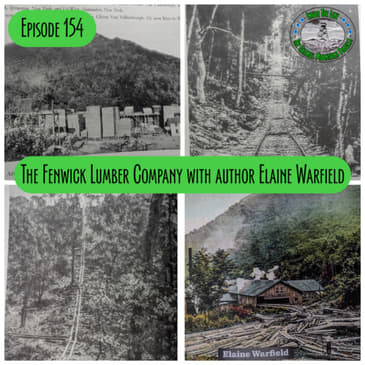
Welcome to episode 154! On this episode, Tad and I chat with author Elaine Warfield about the amazing Fenwick Lumber Company. Fenwick existed over 100 years ago and did logging operations on the steep slopes of SW Hunter and Hunter Mountain. If you need a sticker, email me or go to Camp Catskill! Subscribe on any platform! Share! Donate! Do whatever you want! I'm just glad you're listening! And remember... VOLUNTEER!!!!!!
Links for the Podcast: https://linktr.ee/ISLCatskillsPodcast, Donate a coffee to support the show! https://www.buymeacoffee.com/ITLCatskills, Like to be a sponsor or monthly supporter of the show? Go here! - https://www.buymeacoffee.com/ITLCatskills/membership
Thanks to the sponsors of the show!
Outdoor chronicles photography - https://www.outdoorchroniclesphotography.com/, Trailbound Project - https://www.trailboundproject.com/, Camp Catskill - https://campcatskill.co/, Scenic Route Guiding - https://adventurewiththescenicroute.com/, Another Summit - https://www.guardianrevival.org/programs/another-summit
Links:
Elaine Warfield, PFAS Ban in NY, Nikiwax, Wolf 907f Passes Away, Hiker passes away on Mt Whitney, DEC Licensed Guide Program, DEC Podcast, West Kill Brewing, Upward Brewing Company
Volunteer Opportunities:
Trailhead stewards for 3500 Club - https://www.catskill3500club.com/adopt-a-trailhead?fbclid=IwAR31Mb5VkefBQglzgr
fm-hGfooL49yYz3twuSAkr8rrKEnzg8ZSl97XbwUw, Catskills Trail Crew - https://www.nynjtc.org/trailcrew/catskills-trail-crew, NYNJTC Volunteering - https://www.nynjtc.org/catskills, Catskill Center - https://catskillcenter.org/, Catskill Mountain Club - https://catskillmountainclub.org/about-us/, Catskill Mountainkeeper - https://www.catskillmountainkeeper.org/, Bramley Mountain Fire Tower - https://bramleymountainfiretower.org/
Post Hike Brews and Bites - Brave The Flames, Van Duesens
#fenwicklumber #catskillsauthor #hunter #3500cub #catskillshistory #husdonvalley #hikingNY #kaaterskill #bluehole #catskillhiking #visitcatskills #catskillstrails #catskillmountains #catskillspodcast #catskills #catskillpark #podcast #catskillshiker #volunteers #catskillmountainsnewyork #catskillspodcast #catskillshiker #catskillshiking #hiking #catskill3500club #insidethelinecatskillmountainspodcast #volunteercatskills #catskill3500 #hikethecatskills
[00:00:29] The bushwhacks were some of the worst days I've ever had in the mountains, or life really.
[00:00:36] Whereas Pantsy Mountain is totally opposite, it's a mountain on top of a crater.
[00:00:42] I think the weather challenges on this incident were particularly difficult.
[00:00:47] It is really the development of New York State. Catskills will respond to it.
[00:00:52] Passing into Inside The Line, The Catskill Mountains Podcast.
[00:01:05] We'll record. So welcome to Episode 154 of Inside The Line, The Catskill Mountains Podcast.
[00:01:16] Tonight, author Elaine Warfield joins us and we're going to be talking about her book on the Fenwick Lumber Company.
[00:01:22] The Fenwick Lumber Company is an amazing establishment that happened over a hundred years ago,
[00:01:28] up on the high peak of Hunter Mountain and Southwest Hunter Mountain.
[00:01:34] So it's just an absolutely amazing time in history to happen over a hundred years ago that can say this happened over there.
[00:01:43] And Elaine's going to talk about her wealth and knowledge of this certain topic.
[00:01:47] So welcome to the show, Elaine.
[00:01:49] Thank you. Thank you for having me.
[00:01:51] Yeah, it's good to have you on here. Your book was fantastic.
[00:01:54] It's going to be in the show notes. So everybody go out and check this book out because it's absolutely phenomenal.
[00:01:59] I'm going to put her personal, her personal link on there so you don't order it from Amazon.
[00:02:04] Don't order it from Amazon. Elaine, actually, you got it to me with faster than Amazon did.
[00:02:09] Well, I try to send orders out the same day.
[00:02:14] Yeah, I got to admit it came within three days and I was just like, oh, excellent. Jumped right into it.
[00:02:20] Yeah. My wife was kind of ticked off because we were watching TV shows and I was focusing on the book.
[00:02:27] And I was just like, I can't.
[00:02:29] There's a lot of information in that book. I'm amazed that you got through if you got through the whole thing that fast.
[00:02:35] Three quarters, three quarters. I'm three quarters away from it.
[00:02:37] So, Tad, how about you? I know you got it.
[00:02:40] Yeah, I think I did a pretty good job of hitting what I wanted to.
[00:02:46] And there's a couple add-on questions I got to remember to ask.
[00:02:49] So.
[00:02:50] Well, hopefully I can answer them.
[00:02:52] Well, I think you can. I think you can.
[00:02:55] She will. She'll be answering a lot of questions.
[00:02:57] So, Elaine, if you can't answer the questions, you just bullshit your way through it and nobody's going to know. Okay.
[00:03:04] Thank you to you, Mary. I know.
[00:03:07] That's the way I do it. That's the way I do it.
[00:03:09] So, one of the things we want to talk about, well, I want to talk about my sister's boyfriend brought this up to me and I had no clue about this when we were meeting for Christmas, was New York State Governor Hulchel prohibited the intentionally added PFAS outdoor apparel for severe weather conditions.
[00:03:31] So, after January 1st, 2028, a new restriction will go into effect that applies specifically to outdoor apparel for severe wet conditions with internationally added PFAS as described and blah, blah, blah at ECHL.
[00:03:45] According to that procedure, no person shall sell or offer for any sale in New York not previously used outdoor apparel for severe wet conditions containing, which is PFAS, prophyroactyl and polyphyroactyl substances.
[00:04:01] Did I say that right?
[00:04:03] Absolutely, Stosh.
[00:04:04] Wow.
[00:04:05] You nailed it.
[00:04:06] Yes.
[00:04:09] So, A, at or above the level of department shall establish a regulation or B, intentionally added chemicals.
[00:04:16] So, with that being said, I have a shell that I believe has that, that I purchased a while ago for, for a search and rescue and for situations that apply up in the high peaks of the Catskills and stuff like that, that, of course, protect you from the elements and such.
[00:04:35] And, you know, this is not one of those shells are like a puffy jacket.
[00:04:41] This repels everything and it actually works phenomenal.
[00:04:45] So, I have to look more into this, but it's good, but it's, it's not good at the same time.
[00:04:53] Like, I like those shells.
[00:04:55] They're phenomenal.
[00:04:55] They block everything.
[00:04:57] Like Ted, you know, we'll talk about our experience later of being on the high peaks of Cheryl and North Dome and that worked fantastic.
[00:05:03] But at the same time, I do see why they're doing this because the breakdown of that stuff has to take, I wouldn't say thousands, not even thousands.
[00:05:12] It never breaks down.
[00:05:14] Yeah.
[00:05:15] But so my personal opinion gear like that, and I'm not faulting you because as time goes on, our awareness of the harmful effects of that treatment, we're becoming more and more aware of it.
[00:05:29] And thankfully there are suitable alternatives to it.
[00:05:34] So I added to our notes, this product made by Nikki wax called TX direct.
[00:05:39] I've been using it for a few years.
[00:05:42] Um, because when you buy something from Patagonia as an example, that has that, a water repellent treatment, uh, because it's not made with the forever chemical.
[00:05:52] It's going to wear off over time.
[00:05:53] So you can, uh, we knew your waterproofing treatment with something like this TX direct.
[00:06:02] So you can buy a bottle for just shy of 15 bucks.
[00:06:07] It should be enough to treat two jackets, maybe a pair of pants stosh those pants.
[00:06:14] I was wearing this weekend.
[00:06:15] I've had them for three seasons now.
[00:06:18] And at the beginning of this season, I gave them the Nikki wax TX direct treatment.
[00:06:24] I don't have a problem with water getting through them.
[00:06:27] I'll tag that, uh, in the show notes.
[00:06:30] So that's, once again, it's understandable because that stuff doesn't break down like anything else does.
[00:06:38] You know, of course it's basically like a plastic, the shell.
[00:06:42] So applying this TX direct, you know, could help.
[00:06:45] Good thing.
[00:06:46] What do you think Elaine?
[00:06:47] You have any comments?
[00:06:49] Well, I know you hear about those chemicals being not, not good, you know, um, for the human body.
[00:06:56] Other than that, I didn't realize it was anything to do with outdoor clothing.
[00:07:01] That's the first I heard about that.
[00:07:03] Yeah.
[00:07:04] I, my, my, my shell is, has that on the out, like the exterior part.
[00:07:09] And I know that, you know, I've used that several times in wet conditions, like hard, severe rain up in, you know, uh, New Hampshire and, uh, cold conditions in the Catskills and Adirondacks.
[00:07:22] And it is worth like insane, but you know, I haven't, you know, like Tad, you said, I haven't tried this Nikki wax.
[00:07:29] So I might have to do that.
[00:07:31] Yeah.
[00:07:32] I mean, even with this forever chemical is there, there come to be known, they do wear off, but when they wear off, they just go into the environment and they just linger on forever, but they're off your garment.
[00:07:44] So it starts to wet through because it doesn't have a fresh treatment on it.
[00:07:49] So that's when you apply this Nikki wax to renew the finish of, of your garment.
[00:07:55] And the, the better practice going forward is to look for products that aren't made with these forever camp chemicals.
[00:08:03] And I think everyone is, they get more and more into the outdoors.
[00:08:07] They ought to look for products that are more in harmony with leaving no trace.
[00:08:13] I mean, you may not be throwing out your, you know, cliff bar wrapper on the trail, but you're throwing out these microscopic particles, which scientists tell us ends up in the food chain.
[00:08:28] Yeah.
[00:08:28] And Elaine, you brought up a great point, of course, with it leaching onto our, our skin and stuff like that.
[00:08:35] I never really thought about that.
[00:08:37] Yeah, that, um, I mean myself, especially the last year I've tried to eat a cleaner diet.
[00:08:44] I've always kind of been a little conscious of it, but you know, you hear the statistics with so many people being sick that I've tried to amp up a cleaner diet.
[00:08:54] So I'm more aware of chemicals and whatnot.
[00:08:57] But like I said, I had no idea it was on outdoor clothing.
[00:09:00] So that makes me think this one raincoat I have that, you know, is pretty, uh, waterproof.
[00:09:07] So that makes me think that, you know, okay, what's that got on it?
[00:09:10] Yeah.
[00:09:11] I wonder as well as I actually just ordered a new coat, a new shell from Helianton.
[00:09:17] So am I going to get like arrested?
[00:09:19] Yeah.
[00:09:20] Next year, I think if you're out in the Catskills hiking with that shell and you don't have proof that it's, uh, you know, forever chemical free, you'll, you'll be asked to take the jacket off.
[00:09:30] Put your hands behind your back.
[00:09:32] They'll cough you and drive you away in a dark green F two 50 Ranger vehicle to, uh, some woodchuck jail and the Catskills.
[00:09:45] So, so, so this time, so this time next year, folks, you'll know when Stosh has been apprehended wearing his Heli Hanson forever chemical jacket that, uh, when he's not on the show anymore, it's just me.
[00:10:00] And Elaine broadcasting live.
[00:10:04] Yeah.
[00:10:04] Chemical free, but chemical free.
[00:10:06] Yeah.
[00:10:06] So look into it.
[00:10:08] It's, it's, uh, you know, when Ted makes a point and Elaine makes point, you know, there are, there could be harmful.
[00:10:14] And of course they take a long time to break down.
[00:10:16] And, you know, actually I was at a REI today and I checked out, I think I saw some of that, uh, Nikki wax and I should have purchased it, but, uh, I'll purchase it directly.
[00:10:26] I think, you know, a lot of camp Catskill supports the eco-friendly stuff.
[00:10:31] So let's see what they're, they have in contact cat catskill from some more information.
[00:10:36] Yeah.
[00:10:37] He's, he's very in tune with his product line being, uh, green.
[00:10:42] And I think he's also a member of that give back 1% program where he gives back 1% of his revenue to, uh, the environment.
[00:10:52] So very cool sponsors, the show go in, buy lots of stuff there.
[00:10:58] Yeah.
[00:10:59] Elaine, you ever, you ever been in that store camp catskill?
[00:11:02] I haven't, but is that run by Mo?
[00:11:05] Mo works there.
[00:11:06] Mo's an employee.
[00:11:07] Yes.
[00:11:08] Yes.
[00:11:09] I do know Mo.
[00:11:10] I haven't been in there though.
[00:11:12] Cool.
[00:11:12] Mo's a cool dude.
[00:11:13] I love him.
[00:11:14] He's a nice, really nice guy.
[00:11:16] Yeah.
[00:11:16] He loves the, the catskill.
[00:11:18] So that's good.
[00:11:19] It's always good.
[00:11:21] So unfortunate news, uh, that we got to move on to is a wolf.
[00:11:25] Nine Oh seven F also known as queen of the wolves has passed away in Yellowstone national park.
[00:11:31] She was 11 years old, two or three years or times older than most wolves achieve in the wild.
[00:11:36] So nine Oh seven F was famous for being blind in one eye and for being a beautiful mother.
[00:11:42] She died December 22nd after being attacked by a rival wolf pack while eating bison carcass with her pups.
[00:11:48] Um, she's also compared to grizzly three nine nine, who we talked about a while back was known as the queen of the Titans, uh, Tetons.
[00:11:57] And, uh, the mother wolf and the mother bear had very many similarities, including a large fan following and also being well known well known for their maternal instincts.
[00:12:07] And they have been, uh, along in the wild for, for a big time.
[00:12:13] That's why they were being followed as well.
[00:12:15] Uh, sadly three nine nine died recently, uh, being a vehicle strike, which is very unfortunate, but they said this was actually a very good death because 907 F.
[00:12:26] And that was actually just a real death instead of being struck by a vehicle and stuff.
[00:12:33] Um, Taylor rabe, who was a recent wolf researcher was tracking her radio color and indicated that she lived for three days after the initial attack before dying.
[00:12:43] And after Nick, uh, crop see, she said, it's sad, but we always love to see wolf died naturally rather than the hands of a human.
[00:12:50] So it gives us peace that no, she went in a natural manner.
[00:12:53] So RIP to, uh, 907 F.
[00:12:57] Uh, I've seen videos on her.
[00:12:58] It's beautiful to see her walking around, taking care of the other wolves coming together and like being excited when they saw her.
[00:13:06] So she was a real big icon of the wolf family.
[00:13:10] And hopefully those wolves will make it over here to the Catskills soon.
[00:13:14] And we'll see that man in the wild.
[00:13:18] Silence, silence.
[00:13:19] That was a really weird ending to that.
[00:13:21] Well, that's moment of silence and memory of 907 F.
[00:13:29] Can't they, can't they do better than that?
[00:13:32] Yeah.
[00:13:33] If she was such a popular and well liked, uh, animal, you know, couldn't they do better than 907 F?
[00:13:41] What do you think Elaine?
[00:13:41] Do you think they could have come up with the name for her?
[00:13:44] Not the state.
[00:13:46] Yeah.
[00:13:48] What state was she?
[00:13:50] I think that's got to be one.
[00:13:51] Oh, in the yellow.
[00:13:52] Yeah.
[00:13:53] You know, a state agency, you know, they're efficient, whatever.
[00:13:57] Yeah.
[00:13:57] Right.
[00:13:58] We all have our numbers.
[00:13:59] Yeah.
[00:14:00] Good points.
[00:14:01] Yeah.
[00:14:02] It's it stinks.
[00:14:03] But you know, once again, it was a natural death and you know, these to see the, the progress of the wolf expansion that has happened out west is actually like phenomenal.
[00:14:15] Like I love seeing that they introduce the wolves to different areas or reintroducing into Colorado, you know, certain parts of ups, upper Montana and stuff like that.
[00:14:25] And that they're actually doing well is pretty phenomenal.
[00:14:30] And you know, I remember hearing something about up near towards me up, up in the Shenango Valley area that there was a wolf spotted.
[00:14:37] But I mean, that's all hearsay all the time.
[00:14:40] But yeah.
[00:14:41] Well, I can add to that just a little bit.
[00:14:44] I mean, I live in the northern Catskills.
[00:14:46] I live in East Jewett.
[00:14:47] We have a lot of mountains, a lot of state land around us.
[00:14:50] And I know we have coyotes, but I know there are wolves too, because once in a while we hear, you can hear at night, a long drawn out, very eerie something that isn't a coyote.
[00:15:08] And it's just that there's just a total difference in the sound.
[00:15:11] You know, we don't hear them that much, but way, way, way, way up.
[00:15:14] Yeah.
[00:15:14] Well, I beg to differ, Elaine.
[00:15:16] That's really not a wolf that you hear making that long drawn out sound.
[00:15:21] That's the sound that our listeners make when the podcast is over.
[00:15:25] Okay.
[00:15:27] Jesus.
[00:15:27] Who knows?
[00:15:28] A long gasping howl into the night sky.
[00:15:32] But while we're on that topic, Stosh, what do you think?
[00:15:34] They say that 907F died a natural death.
[00:15:39] What about us?
[00:15:39] You want like a natural death where a younger pack of podcasters comes and eats us one night while we're recording?
[00:15:48] Would you like that?
[00:15:49] Is that what you want your demise to be?
[00:15:52] No.
[00:15:52] No?
[00:15:53] No.
[00:15:54] You want to die in your sleep?
[00:15:55] I'll die in the mountains.
[00:15:56] Die recording.
[00:15:58] The mic's into the mountains.
[00:15:59] I mean, that's pretty, that's pretty hardcore.
[00:16:02] I don't want somebody to hold me out, but I don't know.
[00:16:06] I'm just, I'm just, I'm just happy to see that the wolves are doing well out there.
[00:16:11] And it's, it's great to see, you know, even with the media and stuff like that, you know, that we have the social media and stuff.
[00:16:18] It's really cool to see this progress of the wolves thriving.
[00:16:22] Uh, once again, just like, you know, they happen to have, I forgot what they are up in a glacier.
[00:16:29] That's not the minks, but it's the Wolverines.
[00:16:31] The Wolverines are thriving up there again, that they reintroduce them again.
[00:16:36] And it's really cool to see.
[00:16:37] And unfortunately, 907F, hopefully she passed on her, you know, expertise on being a mother and there will be new 907F up in Yellowstone and out west.
[00:16:48] So.
[00:16:49] Mm-hmm .
[00:16:50] RIP to 907F.
[00:16:52] So.
[00:16:53] Last thing, Tad, you added this last second, looks like, right?
[00:16:56] Yeah.
[00:16:57] And this is a sort of breaking news.
[00:17:00] A missing hiker attempting to climb Mount Whitney in California found dead.
[00:17:06] The hiker was reported missing on January 2nd in California's Sierra Nevada mountains.
[00:17:13] He was found dead in an elevation of 12,000 feet.
[00:17:17] Uh, Inyo County search and rescue said the hiker's body was located around 1 PM Saturday.
[00:17:24] Near the North fork of Lone Pine Creek trail.
[00:17:30] At an elevation of 12,000 feet.
[00:17:33] Uh, in the, the article, it said at this time, no further details are available.
[00:17:39] Uh, the deceased hiker was identified as Taylor Rodriguez, a 29 year old from San Antonio, Texas, but the cause of his death has not yet been determined.
[00:17:50] Authorities believed that Rodriguez was attempting to summit Mount Whitney on December 30th.
[00:17:58] Before he was reported missing on the 2nd of January.
[00:18:03] The search and rescue operation was initiated by Inyo search and rescue, which is a volunteer search and rescue unit.
[00:18:12] When they started the search and rescue authorities were unclear, which route Rodriguez intended to take.
[00:18:20] And there were concerns that he may be out there without adequate gear and limited hiking experience.
[00:18:27] And another article I saw that friends of Rodriguez reported that he had no back country experience and began climbing in an indoor gym only in the past few months.
[00:18:43] Hmm.
[00:18:43] Yeah.
[00:18:45] So, um, at more than 14,500 feet in elevation, Mount Whitney is the tallest mountain and the lower 48.
[00:18:53] And for winter hiking and climbing proper gear is a must.
[00:18:58] So one of the things I remember, I don't know if you remember this stosh, but in November, Inyo search and rescue was the operation that found the two struggling hikers and their 150 pounds.
[00:19:14] Yep.
[00:19:14] Of gear going up Whitney.
[00:19:16] So.
[00:19:16] You can follow their stuff on, on Facebook and Instagram, and they are active.
[00:19:22] One of the most active search and rescue teams that I have ever seen.
[00:19:24] Yeah.
[00:19:25] Well, I, Mount Whitney is so popular that in the prime hiking and climbing months, you need to enter the lottery to get a permit to go out there.
[00:19:36] Yep.
[00:19:37] So I also note that, uh, Inyo is a volunteer unit that was allowed to go out there and do this search and rescue in an area with elevations over 12,000 feet in extreme winter weather.
[00:19:49] But the New York, New York, New York DEC didn't call in local volunteer SAR teams to search for the 22 year old Canadian hiker.
[00:19:59] Who's still missing in the Adirondacks.
[00:20:03] Oh yeah.
[00:20:04] I remember you commented on that stosh and how there's all these volunteer units in New York state that weren't called in for that search.
[00:20:11] So I thought it was a sad irony.
[00:20:14] Yeah.
[00:20:15] Any comments on that stosh?
[00:20:17] I follow the Inyo team.
[00:20:20] You know, I've actually talked with one of their members asking, you know, what their apparel is and, and search like there's no rescue techniques that they do.
[00:20:30] And they are seriously besides, I would say there's the New Hampshire teams.
[00:20:36] They're the most active, of course, with Mount Whitney being the tallest in the lower 48.
[00:20:41] They just go, everybody has to do it for some reason.
[00:20:44] And we talked about, you know, not even just the people with 150 pound packs, you know, we've chatted about a lot of people dying.
[00:20:52] And there was a, uh, uh, an actor that died up on there that they found the Inyo team town found that was, you know, passed away for like seven days and they went back up, you know, and these are volunteer teams, volunteer teams, searching above 12,000 feet in the winter.
[00:21:08] And December out there in the Sierra Nevada's, which might have over, who knows, you, you know, out there that they can get, yeah.
[00:21:17] Yeah.
[00:21:18] For 12 to 14 feet of snow.
[00:21:20] Yeah.
[00:21:21] And, you know, with, with this, this whole thing that happened in the Adirondacks, you know, there was over 60 search and rescue or, um, Rangers, but there were no volunteer people that who are willing to go out there.
[00:21:35] And that I wouldn't say are as, as experiences as the Rangers, but they are willing to do that and they are experienced to handle that situation.
[00:21:46] So, and we all know when, you know, these search and rescue people, we all know when to turn around.
[00:21:51] We're all like, this is not safe.
[00:21:53] This is not worth it.
[00:21:55] We're going to turn around.
[00:21:56] So it stings, it stings a lot that these, you know, good for them, the Inyo team.
[00:22:03] If you follow them on Facebook and Instagram, they post a lot of stuff.
[00:22:06] They do every single thing from helicopter rescues to rope rescues to anything.
[00:22:13] They're fantastic team.
[00:22:15] So that's all I got to say.
[00:22:18] All right.
[00:22:19] So that's, yeah.
[00:22:21] So Elaine, you got, do you know anything about West and stuff like that?
[00:22:25] You know how crazy it is?
[00:22:26] You mean out in California, the one that you were just talking about or the Adirondack one?
[00:22:31] Either, either, or, I mean, the one out West is, is the one we're specifically talking about, but you can add on to the Adirondack one.
[00:22:38] Yeah.
[00:22:39] I, I had just followed the Adirondack one just because I follow, I don't know if you know a guy by the name of John Bulmer.
[00:22:47] He's a B U L M A R.
[00:22:49] He's on the Adirondack rescue, but he also started, I think the Adirondack mountain news.
[00:22:55] He runs that, and he's also a phenomenal photographer and he does a lot of different stuff.
[00:23:00] He's a very talented guy, but he, I had just followed his posts on the Adirondack one.
[00:23:04] And it was just really sad.
[00:23:05] I think it was over the holidays and I didn't know if they had ever found that guy.
[00:23:11] Um, I know they hadn't found him around Christmas time or so, but, um, I don't know if they ultimately did find him.
[00:23:18] I, I know they had a change it to a recovery from a search and rescue.
[00:23:23] They haven't found him yet.
[00:23:24] I haven't heard any though.
[00:23:25] Okay.
[00:23:25] I haven't heard anything either.
[00:23:27] Yeah.
[00:23:28] And you know, I've, I follow the, the Adirondack mountain news as well.
[00:23:31] He does it.
[00:23:32] That's him that he does that.
[00:23:34] Yes.
[00:23:34] Wow.
[00:23:35] He does so much.
[00:23:37] I can't believe he's out there doing photography every morning.
[00:23:40] He's got sunrises.
[00:23:41] He's got sunsets and then he's interviewing people.
[00:23:44] Yeah.
[00:23:45] He does a great job.
[00:23:46] Yeah, he does.
[00:23:47] I agree.
[00:23:48] I would have admit that he is the most up to date with the news and the Adirondacks by far.
[00:23:54] So I'll, I'll tag him in this.
[00:23:55] So thank you, John, if you listen to this podcast for your updates on, on upstate New York and the Adirondacks, cause you do a great job.
[00:24:05] Yeah.
[00:24:06] So unfortunate news on both ends, both sides of the country.
[00:24:10] So we have that.
[00:24:11] But in 2025, Tad, a good point.
[00:24:14] I was, I was thinking about this.
[00:24:16] I didn't write it down, but there is a license guide examination schedule for the New York State.
[00:24:21] So February 7th, March 1st, February, February 7th, February 5th, March 1st, February 21st.
[00:24:29] Uh, you can do these license guide examinations and, uh, it requires some certain tests that you gotta do book tests online tests as well.
[00:24:39] Uh, I think it's like a three day test.
[00:24:42] I don't, I'm not sure.
[00:24:43] I remember hearing about this.
[00:24:45] The impression I have from the flyover I did on the information is the first test for the year is on February 7th.
[00:24:55] You need to mail in your, or electronically submit your application by February 5th.
[00:25:00] The testing on the 7th is online.
[00:25:03] The testing on March 1st is in person.
[00:25:08] And then throughout the rest of the year, they have other testing dates online.
[00:25:12] I think the only one that's in person is on March 1st.
[00:25:15] You also have to have your first aid and, um, wilderness first aid certification, CPR, things of that nature.
[00:25:24] And there's some other requirements, but if you're thinking about doing it, your first opportunity, you have to have your application in by February 5th.
[00:25:32] Yeah.
[00:25:33] Uh, I mean, I, I, I'm reading that email that I got and it says that they have very many different dates.
[00:25:42] February 7th, March 1st, May 9th, June 6th, July 11th, September 12th.
[00:25:46] All exams will be online except for the in-person exam offered by the New York state outdoor guides association, which I know Sean and a new cheese is part of, I believe.
[00:25:56] So Sean hooked me up, I guess.
[00:25:59] I don't know.
[00:26:00] No, I don't really want to.
[00:26:01] Uh, so I will post the, the email, the link and stuff like that for the guide.
[00:26:06] So if you want to be a guide, it's pretty cool program.
[00:26:09] You get a wilderness first aid wilderness.
[00:26:11] And this, I don't know if it's first responder that you go into, but I'm pretty sure it's pretty serious stuff, but, uh, it's very cool.
[00:26:20] Uh, thing to receive in New York state, cuz you can take people on an expeditions and teach them leave no trace, teach them New York state guidelines and stuff like that, that.
[00:26:30] That would be helpful for them and maybe influence them to become a future guide, a future leave no trace influencer, a future podcaster, maybe.
[00:26:39] Maybe, or maybe just a guest on, on ours, which is exciting, which is exciting.
[00:26:44] Right Elaine?
[00:26:45] Yes, it is.
[00:26:46] Yeah.
[00:26:47] She looks, she looks thrilled.
[00:26:49] She looks thrilled.
[00:26:50] Yes.
[00:26:51] So are you going to go over this DEC episode 18?
[00:26:54] Yeah.
[00:26:55] Well, I don't know if you're going to let me or not because it it's relating to the DEC podcast.
[00:26:59] Am I allowed to talk about that on our show?
[00:27:02] Sure.
[00:27:03] You can do that.
[00:27:04] All right.
[00:27:05] So I threw it in the show notes.
[00:27:06] Jeff will love that.
[00:27:07] Yeah.
[00:27:07] So, uh, the DEC podcast, which I forget what their, their name is like what the DEC does
[00:27:15] what?
[00:27:15] Yeah.
[00:27:16] DEC does what?
[00:27:17] Okay.
[00:27:17] And with our tax dollars, we paid for that creative title.
[00:27:21] So episode 18 is titled.
[00:27:24] Don't be salty.
[00:27:25] New York.
[00:27:25] It focuses on the use of rock salt on roadways and sidewalks, which is necessary for safe
[00:27:32] and efficient travel during snowy winters, but can have negative impacts on lakes, ponds,
[00:27:38] rivers, streams, and groundwater.
[00:27:40] And in fact, up in the Adirondacks, there's a farmer who's suing the state over the excess
[00:27:47] use of salt on a state highway up there because it's, uh, contaminated his well water and interfered
[00:27:54] with his ability to continue his farming operations, particularly in the winter when he's reliant on well water
[00:28:01] to, uh, give to his cows to drink.
[00:28:05] So at any rate, episode 18 spotlights, the latest environmental news from the DEC, including things about ice
[00:28:13] fishing, great winter hikes, encouraging New Yorkers to be aware of winter hiking safety.
[00:28:20] And now correct me if I'm not reading this, right.
[00:28:24] One of the things that, oh, I see.
[00:28:26] It's the DEC paint collection program, which I suppose.
[00:28:33] Yeah.
[00:28:33] Which I suppose is interesting because you're not supposed to throw your paint away with your household garbage.
[00:28:41] Hmm.
[00:28:41] Because if it goes to a landfill, it just leeches or has the potential of leeching into the ground.
[00:28:47] And then you talk about forever chemicals.
[00:28:49] Paint is pretty bad on that list.
[00:28:52] Yeah.
[00:28:53] Sarcasm aside, that's probably a worthy read, uh, learning about how you can properly dispose of your paint through the DEC's
[00:29:02] paint collection program.
[00:29:04] So with that, I'll turn it back to you Stosh.
[00:29:08] Why?
[00:29:08] Why?
[00:29:09] That's I'll, I'll have that and that's show notes.
[00:29:11] So yeah.
[00:29:13] Good job.
[00:29:13] DEC.
[00:29:14] We'll be getting with them soon.
[00:29:15] Actually DEC Rangers.
[00:29:18] Hopefully you got to respond to that Ted, by the way.
[00:29:21] Oh, for the dates.
[00:29:22] Yes.
[00:29:22] Yes.
[00:29:23] So cool.
[00:29:24] All right.
[00:29:25] So thank you, Elaine, for sticking through that.
[00:29:28] Awesome.
[00:29:28] So thank you to the monthly supporters, Chris Garby and Jeff Jotz, Darren White, Vicky Ferraro, Mike Sawatowski, John Kamisky, Summit Seekers, Betsy A, Denise W, Tom, Vanessa, Peggy, Jim C, Michael, and Derek.
[00:29:42] Thank you guys very much for supporting the show.
[00:29:44] I really appreciate it.
[00:29:45] I really appreciate that you still believe in the show.
[00:29:47] So the sponsor of the show, thank you guys very much.
[00:29:51] Outdoor Chronicles Photography.
[00:29:52] Capture your love story against breathtaking backdrops with Outdoor Chronicles Photography.
[00:29:58] Molly specializes in adventure couple photography and she'll immortalize your moments amidst studying landscape in the Catskills, Adirondacks, and the White Mountains.
[00:30:07] She'll craft timeless images that reflect a unique bond in nature's grandeur.
[00:30:12] Embark on an unforgettable photographic journey with Outdoor Chronicles Photography.
[00:30:16] Don't hesitate to get a hold of Molly on all platforms.
[00:30:20] Also, discover the wilderness with Trailbound Project.
[00:30:23] Our expert-led hiking and backpacking education program offered unparalleled outdoor experiences.
[00:30:29] Whether you're a beginner or seasoned pro, join us to learn essential skills, explore stunning trails, and connect with nature.
[00:30:37] Start today with Trailbound Project and unlock the wonders of the great outdoors.
[00:30:41] They see anything from map and compass to wilderness first aid.
[00:30:44] Check them out.
[00:30:46] Trailbound Project is available for basically anything.
[00:30:50] So, mentions.
[00:30:53] So, Chrissy G went up Balsam Lake with her beautiful dog last weekend.
[00:30:58] She said basically she only needed spikes going up there.
[00:31:01] I kind of figured that for high traffic as well.
[00:31:04] So, Chrissy, you had some great photos.
[00:31:07] Thank you very much for tagging the show.
[00:31:08] Balsam Lake is one of the most phenomenal spots in the Catskills.
[00:31:13] Elaine, has you been there?
[00:31:14] Balsam Lake Mountain?
[00:31:15] No, I have not.
[00:31:17] All right.
[00:31:17] We'll take you up there.
[00:31:19] Ted and I will take you on a visit up there.
[00:31:22] It's a phenomenal place with a fire tower.
[00:31:24] So, but Elaine, if we take you, you can't wear anything that's made of forever chemicals.
[00:31:29] Yeah.
[00:31:30] Okay.
[00:31:31] Just clue me in.
[00:31:32] Where is Balsam?
[00:31:32] I know I've heard of it, but where is it actually?
[00:31:35] That is down below Arkville in the Seeger area.
[00:31:39] Oh, okay.
[00:31:40] Uh, it's Dry Brook Ridge down there in the area.
[00:31:43] You take a, a right or a, depends on where you're coming from down onto the Dry Brook Ridge area.
[00:31:48] And you'll go down to Seeger all the way down, almost all the way down to the end.
[00:31:51] So fantastic spot.
[00:31:54] So also, uh, you know, Ted, we met Hunter, Robin, and Daniel on the Western descent of North Dome.
[00:32:00] And also Denise Madison on the summit of Cheryl.
[00:32:04] So you guys first listening to the show.
[00:32:07] Thank you guys for doing some good hiking in the Catskills and we're glad to meet you.
[00:32:12] And hopefully, uh, you remember to listen to the show.
[00:32:15] Yeah.
[00:32:16] Well, I think we need a little more backstory there.
[00:32:18] I mean, uh, Hunter, Robin, Hunter, Robin, Daniel.
[00:32:22] Um, I forget if it was all three of them or two of them are listeners of the show.
[00:32:28] Two of them, the, the, the Hunter was the one that, that was experienced and he didn't listen to it.
[00:32:34] Yeah.
[00:32:35] So, but, uh, yeah, it was cool to run into some listeners out there and, uh, we had a fun time with them.
[00:32:41] Yeah.
[00:32:41] And Denise took a great picture of us, which I'm going to post later.
[00:32:45] That was a phenomenal picture.
[00:32:47] So glad you guys were out and about.
[00:32:50] I heard you're going to get that tattooed on your bicep.
[00:32:52] That picture of you and I know what do you never.
[00:32:55] Oh, come on.
[00:32:57] It looked good.
[00:32:58] Yeah.
[00:32:59] So also rate the show.
[00:33:01] You can go on anywhere and rate the show, share the show, whatever.
[00:33:04] Thank you.
[00:33:04] If you do, uh, if you just comment on any of our stuff that gives us a little bit, uh, more advertisement somewhat.
[00:33:10] So Tad or Elaine, are you having anything to drink tonight?
[00:33:16] Like any beverage that you want to shout out about?
[00:33:20] No.
[00:33:21] Okay.
[00:33:21] Okay.
[00:33:22] Like we do, I should probably add that a little bit more, uh, like bring a local brew or something like that in there, Tad.
[00:33:29] Sorry.
[00:33:29] So we, what we do is usually should give a shout out to a local brew or pub or something like that, that has their, their drink.
[00:33:37] And we, we chat about them.
[00:33:39] So.
[00:33:40] I'll be prepared next time.
[00:33:42] Next time.
[00:33:42] Yeah.
[00:33:43] We'll have you and Dr. Kudish on here.
[00:33:45] There, and there will be a next time.
[00:33:48] Yes.
[00:33:49] So Tad, what, uh, you got it.
[00:33:51] You said in no brew Tuesday.
[00:33:52] Well, that was last week.
[00:33:54] Oh yeah.
[00:33:55] So here I'm, I'm ready.
[00:33:56] I'm ready to do the official crack.
[00:34:00] Oh, are you joining me or not?
[00:34:02] I already, I already did.
[00:34:05] Sounds good.
[00:34:06] Yeah.
[00:34:07] So, um, I have a, a black dome dark beer from the Westkill brewery, which is one of the same that I munched with you after our hike.
[00:34:22] Is it good?
[00:34:23] Yeah.
[00:34:23] Oh yeah.
[00:34:24] It's very tasty.
[00:34:25] Very tasty.
[00:34:26] Nice.
[00:34:27] So I have upward brewing company.
[00:34:30] Uh, I got this at Van Dusen's after our hike and it's, uh, from Lexington Manor.
[00:34:37] Very good stuff.
[00:34:38] Nice straight up cider.
[00:34:40] I would say nothing too crazy, you know, to sweet or dry right in the middle.
[00:34:47] It's actually very good.
[00:34:49] So upward, uh, brewing company and Westkill as usual.
[00:34:54] So previous hikes, who wants to, Tad, you, Elaine, you got any previous hikes that you want to chat about that you've done?
[00:35:03] I haven't done any in a while.
[00:35:06] Um, I've done a couple 3500s, but that was when I was younger, mostly these days, my, my, my, one of my kids is a logger and he works by himself.
[00:35:17] So he works on top of mountains and I just walk up.
[00:35:22] I'll bring him lunch.
[00:35:24] I mean, I would call that as a hike.
[00:35:26] Yeah.
[00:35:26] And I'll, I'll stay for like, you know, like a half hour, 40 minutes.
[00:35:31] Then then I'll walk down, which he thinks I'm crazy, but good, good exercise.
[00:35:34] And the views are phenomenal.
[00:35:36] And there's somewhere that you won't see anybody else.
[00:35:39] Like he was on, uh, this job on Scribner Hollow that was looking toward, um, well, one side, you could look toward Hunter mountain and see their, their, um, their, their, their lodge, their whatever at the top.
[00:35:52] And then if you turn slightly to the left, which would be wet, no East, you could look toward, um, let's see, uh, Haynes falls and the clove.
[00:36:02] Oh, nice.
[00:36:02] So that was about 3000 feet elevation.
[00:36:05] Yeah.
[00:36:06] Yeah.
[00:36:06] That's a hike.
[00:36:07] What the hell are you talking about?
[00:36:08] That is a hike.
[00:36:11] And I started zero, you know, so I only went up like 700 feet.
[00:36:17] That's a hike.
[00:36:18] You can 700 feet.
[00:36:20] That's still a hike.
[00:36:22] Good job.
[00:36:23] Where are now?
[00:36:24] Now, where are you?
[00:36:26] This is towards East Jewett, right?
[00:36:29] I live in East Jewett.
[00:36:31] Yeah.
[00:36:31] Okay.
[00:36:31] Yeah.
[00:36:32] Scribner Hollow is on East Jewett.
[00:36:33] Yep.
[00:36:34] I think I know that name with Ted.
[00:36:36] Why do I know that name?
[00:36:37] Scribner, the S or hollow.
[00:36:39] There's a, um, motel hotel at the end.
[00:36:43] Yeah.
[00:36:43] That's the Hunter side.
[00:36:45] Okay.
[00:36:45] And then it goes all the way straight through to the Jewett side.
[00:36:48] East Jewett.
[00:36:49] Okay.
[00:36:49] That's how I remember that name.
[00:36:51] Yeah.
[00:36:52] Excellent.
[00:36:53] So don't say that you don't hike.
[00:36:54] That's a 700 feet.
[00:36:55] That's a hell of a gain.
[00:36:57] Yeah.
[00:36:57] Okay.
[00:36:59] And Elaine, I'm also going to say, if you're hiking fresh logging roads, you're hiking in
[00:37:04] the mud and muck.
[00:37:05] Yes.
[00:37:06] Rough.
[00:37:08] Yeah.
[00:37:09] So.
[00:37:09] Yeah.
[00:37:10] Some good hiking boots and some waterproof boots with that stuff.
[00:37:13] Yeah.
[00:37:14] It's like hiking in the old days on the family lumber company.
[00:37:17] Right?
[00:37:17] Yeah.
[00:37:18] Well, I hope, uh, Elaine's son appreciates the, the, uh, hub grub delivery that Elaine's
[00:37:26] provided mountainside.
[00:37:29] I'm sure he does.
[00:37:30] You don't get that stuff from a, like you said, hub grub or who, what is the door dash?
[00:37:34] You don't, that's like your door dash.
[00:37:36] I mean, yeah, I like make chicken soup and just bring it up.
[00:37:40] Nice.
[00:37:41] Nice.
[00:37:41] Cool.
[00:37:42] Fantastic.
[00:37:44] So Ted, do you want to go out about our previous hiker?
[00:37:47] What was up?
[00:37:48] Are you, why don't you tell the way of the land on that one?
[00:37:52] I'll, I'll fill one the, I'll fill in what you miss.
[00:37:55] Yeah.
[00:37:55] So.
[00:37:56] Tad and I had, I had a Sunday off.
[00:37:58] Tad decided that he would like to go on a hike.
[00:38:02] We had a bunch of options for, I'm completing my winter 3,500, which is weird because, you
[00:38:09] know, I should have completed that a long time ago, but I've done a lot of winter hikes on
[00:38:13] different peaks that I would like that.
[00:38:15] I just love to complete, you know, like slide and, and twin and stuff like that.
[00:38:20] And Tad and I decided to go up North Dome and Cheryl and Ted had a great route going
[00:38:28] up from, I would, it's not Mink Hollow.
[00:38:32] I didn't even know what they call it.
[00:38:33] I call it the, the, the water wash area.
[00:38:37] What did I call that?
[00:38:38] Well, if you're a fisherman, it's known as the fishermen's lot on Scrooge
[00:38:44] Ston Road and it's, uh, pretty much across the road or just a little down the road from,
[00:38:51] I think it's Tumbleweed.
[00:38:52] Is that the name of the other?
[00:38:53] Tumbleweed Rancher.
[00:38:54] Yeah.
[00:38:55] So it's, uh, across the way from there.
[00:38:59] And what, what did you think about the start?
[00:39:01] That first little forest area we went through.
[00:39:04] The, uh, the conifers and stuff, the plantation, that was a magical area.
[00:39:09] You know, I thought that whole ascent was actually pretty like nice and decent, you know?
[00:39:15] Yeah.
[00:39:15] And we started off with, I remember it was like 15 degrees at where we.
[00:39:21] That's probably right.
[00:39:22] Yeah.
[00:39:22] Yeah.
[00:39:23] And you know, I had to D layer once going, going up and you know, it was a fantastic, no crazy ledges.
[00:39:32] We had some little tiny steep ascents, like one or two, and it's a straight up good.
[00:39:38] You got it.
[00:39:38] The property is very narrow.
[00:39:40] So that's the thing you got to know when you're on property, the private property in DC land.
[00:39:46] But that guy from the coyote industries, what was it?
[00:39:49] Uh, coyote systems.
[00:39:51] Coyote systems marks his territory.
[00:39:54] Every eighth tree, I would say like, so you get fence.
[00:39:59] Oh yeah.
[00:40:00] Picket fence with bright green posted signs all the way up to his, his DEC, DEC slash area.
[00:40:08] So, and you know, I thought that route was absolutely fantastic.
[00:40:11] I wouldn't, I'm, I have never gone up that way.
[00:40:14] I have gone down that way from North don't.
[00:40:16] So, uh, it was pretty cool going up very nice, easy ascent.
[00:40:23] And when we, we hit snowshoes, we, we decided to bare boot it all the way up to like, I'm guessing 3000, maybe a little bit over.
[00:40:32] Yeah.
[00:40:33] And we only put snowshoes on because you know, there was nice drifts that we had no clue about what was below us and stuff.
[00:40:42] And I, I'd admit that was a great idea.
[00:40:45] It was.
[00:40:46] Yeah.
[00:40:46] Well, I thought we were getting enough slip bridge, um, by not having any traction on the, the, the shows, the shoes gave you that added traction to push off of.
[00:40:55] Plus you could use your televators to take some of the incline out of your step.
[00:41:01] And I'd also just like to note that that route that we took up the benefit of that route, whether you're going up or down as you avoid the ledges over on the St.
[00:41:09] Ann side of North and those ledges in the winter can just be, you know, layered with ice on them.
[00:41:20] Yeah.
[00:41:21] And, and going up them maybe isn't all that bad.
[00:41:25] If you have some real beefy, you know, spikes on your feet, but coming down them in the winter, I wouldn't want to do that.
[00:41:33] I've never done it in the winter going down to my voice taken this route.
[00:41:37] Um, but yeah, it's got it.
[00:41:38] It's just a nice climb up to North dome and I'll turn it back to Stosh to pick up with the recent hike story.
[00:41:45] Yeah.
[00:41:45] Um, I, so we got the snowshoes on very, very nice gradual.
[00:41:50] Once again, like you said, there's enough grip to go up.
[00:41:53] Uh, we hit, you know, I'm guessing it was like 34, 3500 feet.
[00:41:59] And we started getting some good snow, like five inches of maybe new snow, uh, drifting here and there.
[00:42:05] So it was a great choice with the snowshoes.
[00:42:08] We kept them all the way on until probably like 3000 feet good descent down Cheryl, uh, Cheryl, whatever you want to call it.
[00:42:16] And, you know, I remember that there was one time on North dome where we separated because I was like, oh, this way looks good.
[00:42:23] And you were like, I'm going to go this way.
[00:42:25] And we kind of lost each other.
[00:42:27] Luckily you had your good old faithful whistle.
[00:42:31] Yeah.
[00:42:32] 50 cent piece.
[00:42:33] Yeah.
[00:42:33] The whistle helped.
[00:42:35] Yeah.
[00:42:35] And, uh, we summited, you know, the, the temperatures were, we summited North dome.
[00:42:41] We signed in quickly.
[00:42:41] It got cold.
[00:42:43] There was some nice steady wind happening.
[00:42:46] So I'm guessing the wind chills were down in the low ones twos and then maybe negatives.
[00:42:54] Like we, we didn't stay on there for more than, you know, like two minutes.
[00:42:59] Yeah.
[00:42:59] Well, one, one thing we did do, you're leaving out on North dome.
[00:43:04] You, as I understand you for your first time during a Catskill winter hike, you had, I told you about it last show.
[00:43:14] Oh, the hot cocoa.
[00:43:15] The hot cocoa.
[00:43:17] It's a game changer, isn't it?
[00:43:18] It is.
[00:43:19] I got to get a new mug though.
[00:43:20] That helps it keep it warm.
[00:43:22] Yeah.
[00:43:22] Well, I, I don't think anything really would have helped you on Sunday.
[00:43:26] It was cold enough that, you know, you're just losing a lot of temperature during the, the entire day, but it's, it's one of those things.
[00:43:33] Some of these, I was like, I'm drinking tea tonight.
[00:43:36] I was, I normally drink tea in the winter, hot tea, but typically like an hour into the hike, it's, it's just warm.
[00:43:43] And by the time you get to your second or third mountain, it's ice tea.
[00:43:48] Um, but it wasn't, you know, I, I'd admit it wasn't bad.
[00:43:52] You know, we both have an hour and a half drive.
[00:43:55] So that kinda, you know, it's.
[00:43:57] Yeah.
[00:43:58] So yeah, I, I noticed you, you, um, mixtures up on North dome.
[00:44:03] And so doing that, you had the top off.
[00:44:06] So you're losing heat when you do that.
[00:44:08] I mixed mine up at home.
[00:44:09] So I was able to keep my full top on it.
[00:44:13] I have a sipping top on it.
[00:44:14] So I probably keep more heat in that.
[00:44:16] Sure.
[00:44:17] Another, another hack in the winter is you, uh, put your thermos in a sock or just tape or just tape right on it.
[00:44:27] Hand warmers.
[00:44:29] So that's a little extreme.
[00:44:31] Yeah.
[00:44:31] Well, I've, I've been out there, you know, in the old days when I would bring tea with me and you just, I mean, drinking cold tea on a cold day is not fun.
[00:44:39] Yeah.
[00:44:39] True.
[00:44:40] I, I used to, I used to use, that's the only time I would use hand warmers on a hike is to tape them to my, my tea bottle.
[00:44:47] So.
[00:44:47] Yeah.
[00:44:48] So I pre previously, like when we, when we, before we, we went out, I heated up both my nail gene bottle water.
[00:44:56] And then my, my, you know, hot teas, my Stanley cup thermos.
[00:45:04] And I actually felt like the, again, I put them both in socks, you know, smart wool socks.
[00:45:09] Uh, they were interior.
[00:45:11] So they were on the inside of the bag.
[00:45:13] They kept warm for North dome, a little bit lukewarm.
[00:45:17] And then when we, when we went over to Cheryl, Cheryl, it, it, they got very, very like now when it's a cold, but they got to that point of where it was just.
[00:45:26] Chugging down normal water.
[00:45:28] So, you know, it's tough on those days when you had those wind chills hitting the zeros and such.
[00:45:34] So.
[00:45:34] Yeah.
[00:45:35] Unless you get something that's a lot more beefier, but you know, unless you're out doing the six or the nine, I think you're good for the whole day.
[00:45:42] Yeah.
[00:45:42] With, with that combination.
[00:45:44] But also I know is I, I tried it two hikes ago and it was just so pleasant to have like hot cocoa on a hike.
[00:45:52] So also if you're, if you're going to join in the hot cocoa rage and the Catskills this winter, don't buy the mix that comes with those mini mushrooms or mushrooms, marshmallows.
[00:46:06] Yeah.
[00:46:07] Because, because they'll get stuck coming out your, your cup.
[00:46:12] If you have the mushrooms in there or marshmallows, I rarely keep saying mushrooms.
[00:46:17] Yeah.
[00:46:17] Who does though?
[00:46:18] Maybe I had some mushrooms before the recording tonight.
[00:46:22] So, and then after that, you know, we, we go onto Cheryl and I forgot how steep that ascent is up Cheryl.
[00:46:29] You know, it's only 500 feet, 500 and something feet and it's steep as heck.
[00:46:34] Yeah.
[00:46:35] But that's a fairly common pitch that you run into along that range.
[00:46:40] I mean, that frankly, that's just a continuation of the water bar that got busted up when the ice sheets melted.
[00:46:47] So you're running the same thing between a plateau and sugar loaf and sugar loaf and twin, you know, uh, it's, it's that same.
[00:46:57] Catskill pitch.
[00:46:58] It seems going through there, but that's a nice hike up there.
[00:47:02] Oh yeah.
[00:47:02] Yeah.
[00:47:03] We, we summited Cheryl.
[00:47:05] We met Denise was awesome.
[00:47:07] Yeah.
[00:47:08] Denise was working on her first round of the 3,500 while her family was over skiing at Hunter.
[00:47:15] Yeah.
[00:47:16] Yeah.
[00:47:17] Once again, we descended down.
[00:47:20] I don't even know.
[00:47:21] We got to name that Ridge.
[00:47:24] I don't know.
[00:47:25] I don't, we don't have a name for it, but it was Bennett brook.
[00:47:28] There's a love.
[00:47:29] Once again, a little sliver of land that you can go on a nice, fabulous descent that had, you know, one or two ledges.
[00:47:36] Maybe if you chose the right way, which Ted did tad was the navigator in this.
[00:47:41] He's very good.
[00:47:42] And, uh, I gotta say we kept on our snowshoes for quite some time.
[00:47:47] It just, it just felt right.
[00:47:48] I don't know why.
[00:47:49] Yeah.
[00:47:49] Well, you know, it, to a certain extent it, it wasn't necessary, but I'll say that ridge that we descended back down to the Sprucedon Valley on.
[00:48:27] And then we had a little slippage.
[00:48:57] In the process of queuing.
[00:48:58] But there's a lot of work that we did to take off a layer to keep yourself.
[00:48:59] So, you're not getting sweaty and then frozen and stuff.
[00:49:02] It's such a, a, a beating process with the winter that, you know, you gotta learn what works for you.
[00:49:09] basically precisely just you know part of it is you just got to be able to keep moving
[00:49:14] and part of it is you just need to anticipate the right layering combination so you're not
[00:49:22] over perspiring and have to deal with getting rid of that moisture or waiting too long to
[00:49:29] throw a layer on and then once you start to get that shiver you need to stop it right away or it's
[00:49:35] it's hard to control yeah so definitely definitely so stash did you have a good time
[00:49:41] hiking with the old man phenomenal i i gotta admit you know you're you're pretty rugged so
[00:49:47] yeah i'm pretty well i didn't hear you can you say that again what was it did you hear what he
[00:49:51] said i didn't hear what he said yeah what was it yeah i want you to write a book about this now
[00:49:56] right yeah right he's pretty rugged he's pretty rugged that's the title he's pretty rugged
[00:50:03] as i chugged down my stout beer a black dome yeah i thought it was a great hike you know i i enjoyed
[00:50:10] it you know and and some of the times you push me pretty hard and i i tried to keep up but you know
[00:50:16] i was like you know stop trying to enjoy this like all right yeah at least at least one of us enjoyed
[00:50:21] ourselves i i enjoyed it i had a great time i'm only kidding i had a good time so i let me tell you
[00:50:26] i made you did not know i made the hugest mistake i've ever made that day were you aware of it were
[00:50:36] you aware that like when we first met up i was like what the fuck i just made the hugest mistake
[00:50:41] did you have any clue i did not no so i'm driving over to the hike and what am i doing what am i doing
[00:50:51] i'm doing like the stupidest thing you could do you have the heat on no no i didn't have the heat
[00:50:57] on i was in my tent you know on top of my jeep driving down the road and it occurs to me is i'm
[00:51:03] like coming down the hill to make my right hand turn down sprucedon road it occurs to me that for the last
[00:51:10] hour and 15 minutes i've been listening to the podcast and i'm like i'm like i'm gonna spend the
[00:51:17] rest of the day with sosh and here i spent the whole time on my way over with our like our you
[00:51:23] know show from the prior week it's like what the fuck why did i do that to myself i can't listen to
[00:51:28] myself no way no especially when you're if you're gonna go if you're gonna go to a hike and meet up
[00:51:33] with me you can't listen to the podcast on the way there so i'm like wow what a way what a way to
[00:51:38] just get the i don't know the wrong vibe going so what did i do i quickly i quickly you'll appreciate
[00:51:45] this i quickly changed gears and i threw on some allison chains as i'm driving down sprucedon road
[00:51:53] living listening to rooster cranking away in my ear pods to get me like back into the right vibe so
[00:52:00] that was my mistake of the day right the pre-hike game nice nice that's good that's a i'd have to say
[00:52:08] that's a good good mistake all right so great hike uh afterwards we went to west hill brewing
[00:52:16] enjoyed some brews uh we'll talk about that later uh all right uh a little bit so let's uh move on
[00:52:26] catskill news once again volunteer they're not up and going right now we'll uh talk about that a little
[00:52:31] bit more in the summertime but you can look into it catskill 3500 club catskill trail clue catskill
[00:52:37] mountains club visitors center jolly rovers trail crew brantley mountain fire tower all those places
[00:52:42] are definitely doing some volunteer activities in the summer spring summer and fall check them out
[00:52:48] definitely support it um if you need stickers let me know send me a message on any social media
[00:52:54] platform or my email uh let's talk really quickly about the weather forecast that's going on this
[00:53:00] weekend looks to be pretty chilly like a consistent that has been the past couple you know four or five
[00:53:08] days uh so this is a forecast that's going on i selected sugarloaf it's a pretty good uh area in the
[00:53:15] inner head wilderness and the devil's path so friday looks to be clear uh with 30 mile per hour winds to
[00:53:24] 10 mile per hour winds a high of 27 a low of seven degrees with the wind chill so saturday uh looks to
[00:53:33] be light snow not a significant amount of snow about a half an inch total a high of 18 with a low at
[00:53:41] nighttime of negative four during the day it's going to hit negative four degrees with 10 mile per hour
[00:53:46] wind chills which is pretty significant so layers once again sunday looks to be a little bit better as
[00:53:53] in terms of like the forecast it looks to be cloudy with some clouds later on in the day still lingering
[00:54:01] around 18 degrees wind chills will bring it down to zero degrees maybe into a little bit negatives if
[00:54:07] you get into those higher peaks areas so once again layers layers layers spikes spikes spikes i would say
[00:54:15] snowshoes i don't think so not not yet but you might as well bring them like we did and they might feel
[00:54:19] good for you yeah you'll hike in this weekend uh sunday no i'll be working uh saturday and sunday
[00:54:27] we're not going out then no all right sorry do your thing do your thing all right so we'll do
[00:54:34] last set of sponsors and then we'll get on to elaine's sections it's gonna be fantastic
[00:54:39] so discover camp catskill in tannersville your ultimate hiking store find top quality gear apparel
[00:54:45] and accessories for all your outdoor adventures our experts staff to hear how to help every hiker
[00:54:51] from beginners to seasoned pros we also carry a variety of unique catskill souvenirs and gifts
[00:54:57] visit us online at campcatskill.co or in the store to gear up for your next journey adventure starts at
[00:55:04] campcatskill also discover the beauty of the catskills adirondacks and the hudson valley with scenic
[00:55:10] route guiding our expert guides to ensure a safe unforgettable hiking experience tailored to your
[00:55:15] skill level from breathtaking vistas to hitting gems or if you're peak bagging to just simple day hikes
[00:55:21] will lead you to the best spots and back book your adventure today and explore nature's wonders with
[00:55:26] scenic route guiding check them out on all social media platforms also if you mention the podcast you can
[00:55:32] get 10 off use the code mountain lion and you can also embark on a transformative journey with another summit
[00:55:40] another summit is dedicated to serving veterans and first responders with free outdoor activities activities
[00:55:46] activities like walks in nature paddling hiking and even backpacking join our supportive community
[00:55:51] to rejuvenate in nature's embrace experience camaraderie adventure and healing at no cost
[00:55:57] take your next step with another summit and ascend to new heights of resilience
[00:56:00] enjoy apply today on another summit.org all right so how about we get on to the guest of the night
[00:56:13] so tonight author elaine warfield joins us in the talk about the femwick lumber company now she has a book
[00:56:19] about the femwick lumber company i will put it in the show notes and i will also post this on all
[00:56:24] our social media platforms i suggest you purchase this book if you want to learn a great piece about
[00:56:30] catskill mountain history because you know what i hate to say it but it blows my effing mind that this
[00:56:37] existed and i'm guessing that's why elaine wrote this book correct yes absolutely yeah it's just a
[00:56:45] phenomenal piece in catskill mountain history you know we have amazing stuff in just catskill mountain
[00:56:50] history we have the tanneries we have the the railroads and then we have this which kind of
[00:56:57] tops everything off i gotta admit tad you could agree well i don't know the reservoirs factor in
[00:57:03] there but i think that what we're gonna learn tonight we're gonna learn tonight from elaine that
[00:57:08] the fenwick lumber company played a substantial role in the building of the reservoirs and uh the aqueduct but
[00:57:15] there you go yeah i yeah i think what um and we're gonna ask elaine this but uh and in comparison to
[00:57:23] other lumbering operations in the catskill where where did fenwick rate you know was it a small
[00:57:30] operation was it like you know the mega operation of lumber operation she's going to tell us so stay
[00:57:39] tuned and before i turn it back to stash i just want to say um i did get elaine's book and even if you
[00:57:46] don't want to read the book but you should i mean it's worth reading but it's a minimum just the photos
[00:57:54] make fun the bird oh yeah while yeah i mean it's just you because you you hike this territory all the
[00:58:01] time and when you see what used to be there and and how that forest is regenerated since then i mean
[00:58:09] these the photos you you collected to put in this book are just awesome yeah i'm looking at it right
[00:58:16] now and it's just like it's it's really really cool yeah yeah and those pictures are actually far and few
[00:58:24] between it's been really hard i mean i got them from other people that have collected them i found some
[00:58:30] online i found some at the library some at the mountaintop historical but it was like grabbing
[00:58:34] bits and pieces here and there and there were a lot of people taking pictures back then but
[00:58:39] who knows they might be still in somebody's attic yeah they might know what they are but do you really
[00:58:45] think there was a lot of people taking pictures back then because it's not like the smartphone i don't
[00:58:49] think the smartphone was invented until after fenwick shut down their operation so there were several
[00:58:56] like um there was a guy named harry lane lanesville who owned a couple different hotels and boarding
[00:59:02] houses and he used to go around taking pictures uh he was one a guy named william longyear who was
[00:59:09] originally out of jewett moved to kingston and he took a lot of pictures down in kingston but
[00:59:13] he took a lot of fenwick pictures and he also for some odd reason was capable of doing their phone lines
[00:59:21] up there um and then there was another guy aj i think it was alan leah lea who had a place over
[00:59:31] fenicia way he had a magazine place so there were various people going through there taking pictures and
[00:59:38] we came across some postcards that somebody said um on the back of the postcard uh the owner of this
[00:59:46] place goes and takes pictures and then he sells them so i'm not saying in abundance but there were
[00:59:54] from all accounts different people in and out of there taking pictures because it was something totally
[01:00:00] different than what you know had ever been seen in especially in the area yeah so we'll break into that
[01:00:08] uh in a little bit but how about you tell us a quick background about yourself elaine okay well i'm
[01:00:14] from albany and i've lived in jewett since 1983 i came up here for a job and i never left and then um
[01:00:22] i married someone local up here so i kind of integrated myself and my kids have you know they've
[01:00:27] grown up here so basically i like to tell people i'm only related to my kids and my kids are related
[01:00:33] to most of the people on the mountaintop through my uh you know getting married and my mother-in-law
[01:00:39] so i'm the town of jewett historian i was appointed back in august uh the town asked me i mean i was
[01:00:45] already doing this history related stuff and then the town asked me if i'd like to fill the vacant
[01:00:50] position and right now my primary focus these days is publishing local history i just have a real
[01:00:56] passion for it even though i'm not from here i just see the history and it just fascinates me
[01:01:01] yeah so with your being the east jewett historian i'm guessing that brought you into the fenwick lumber
[01:01:08] company you know just searching the history of the catskill mountains to grab your attention what
[01:01:13] brought you into that the fenwick organization that's that's the town of hunter and i was kind
[01:01:20] of like doing different uh i would write different articles sometimes for the mountaintop historicals
[01:01:25] like i did some on lexington i did some on the fenwick i did but then once i became the historian
[01:01:30] for jewett i'm still doing the other towns but my primary focus now is jewett so the fenwick i heard
[01:01:39] about it about i want to say about 10 or 12 years ago just out of the blue um the mountaintop
[01:01:45] historical was offering a hike up to uh where the operation took place over in edgewood slash lionsville
[01:01:52] and rick brooks uh the surveyor brooks and brooks uh he was leading it now i had said well boy that's
[01:02:02] not really interesting i'd like to do it but i had a conflict so i couldn't make it and then a couple
[01:02:08] years later rick did a presentation a really nice presentation at the mountaintop historical um they
[01:02:14] had in their old barn in the back there uh he had this whole presentation set up about fenwick
[01:02:20] now rick is from east jewett and um we're about the same age and he's still a surveyor but i think
[01:02:27] he sold his company and he's gradually um you know helping in the transition but he did from the 70s
[01:02:36] from what i understand he did all this research because he was fascinated by fenwick and he essentially
[01:02:43] opened his files to me when i expressed interest so the further i delved into it and i'm looking what
[01:02:49] he has being a surveyor he had i believe has all ed west who is a surveyor all his files wow uh yeah
[01:03:00] he had all of renwick dibble files who was also a surveyor and among other things at up at fenwick he
[01:03:11] laid out the from what i understand renwick dibble laid out the initial like the all the camps he and he
[01:03:19] laid out the lines and you know he he basically set it up and rick has from what i understand those
[01:03:25] notes so that's you're talking 1906 1905 1904 so he has all that stuff and uh like i said it was like
[01:03:35] a treasure chest just he let me go in i was there one day for five hours and i was just pouring over
[01:03:41] everything and the more i looked at this stuff i just said to him well are you going to do a book and
[01:03:46] he said well my idea originally was to do a book but he said i've got so many other things that he
[01:03:51] said i'm not going to do a book so he basically just said you know what whatever you want to use go ahead
[01:03:57] and use wow so i i have uh intentions to get a hold of him so if he can get a hold of rick brooks for me
[01:04:04] is it i need his uh contact yeah please yeah yeah i you know i before uh dr kudish actually recommended
[01:04:13] me to him and i wasn't sure if he was still around here or stuff like where i can get in contact with
[01:04:19] him but you know that's phenomenal information went to nine 1904 to 1907 is what you're talking about
[01:04:28] so over a hundred years ago that surveying and stuff like that was was happening about this at at that
[01:04:37] elevation and stuff like that over a hundred years ago that just is insane yeah and um it was pretty
[01:04:44] detailed the notes were pretty detailed from back then and um he had he named the different people
[01:04:51] that were helping him out uh renwick dibble and since then i had gotten and it's in the book too i had
[01:04:58] gotten information from a relative of renwick's and she gave me some pictures of him and all these
[01:05:08] pieces just kept coming together um so that wet my interest when i started looking through rick's stuff
[01:05:14] and then i contacted um mike kudish because i wanted to know about the vegetation and and what he saw going
[01:05:20] on up there and how it had recovered and whatnot and then i contacted different people that
[01:05:26] their parents or uncles or whatever had actually worked at fenwick or great or grandfather uh had
[01:05:34] worked at fenwick and i got stories that they remembered you know their relative telling them
[01:05:41] about you know how things worked up there and then um i just pulled everybody that i possibly could
[01:05:48] together to find out all the information i could and yeah i just kept going because i just i just kept
[01:05:55] getting more and more fascinated by it and when i start research i just kind of like dive deep i mean
[01:06:00] this thing is like 260 pages yeah i yeah i do the same exact thing you know i was tad you probably
[01:06:08] remember my kick on the reservoirs like it's like every other show was a reservoir show because i just
[01:06:14] went into a kid now every other show is going to be a fenwick lumber company show yeah well all of us
[01:06:19] listeners remember the reservoir aqueduct craze that was 2024 so yeah like just i mean this blows my mind
[01:06:30] yeah it's uh it's very interesting so let's let's let elaine dive into it so they they came up from west
[01:06:38] virginia correct so some of them came from west virginia some of them came from upstate new york
[01:06:48] uh most of them from west virginia and the rest of them came from wilkes-barry pennsylvania
[01:06:56] the money people for the most part came from pennsylvania
[01:07:00] there seemed to now the one thing that rick always said to me was he felt and that was another
[01:07:08] reason he didn't want to do a book because he felt the more he delved and he really delved into it um
[01:07:13] the more questions there were he could never find um the actual like accounting books or any actually
[01:07:20] really any kind of paper trail or anything but there were some articles in the papers about the
[01:07:27] operation but not a lot and every time they did different articles which i pulled um everyone i
[01:07:32] could find they had the names are all wrong they miss like morris and morrison it was just kind of
[01:07:38] hilarious and then like you didn't hear anything so this operation went on for at least 10 years
[01:07:45] so the first people that started it that started the whole thing roland was uh two brothers by the
[01:07:51] name of slauston they came from steuben county new york and they were loggers and um they had devised
[01:07:59] this shoot to come down the mountain and the big part about the operation was uh if you go into
[01:08:06] edgewood there's ostrander road and just next to it just beyond ostrander road is the myrtle brook
[01:08:14] and it crosses under 214 and you'd think that's a little tiny brook but that water source at the top
[01:08:22] supplied this whole operation with water for cooking the people that lived up there the horses
[01:08:29] uh the steam engine for the the steam donkeys and two steam donkeys they had and that was another
[01:08:36] thing rick pointed out if that water source had not been so sufficient this operation never could
[01:08:41] have taken place wow and this is once again this isn't like one of those big brooks that we talk about
[01:08:49] it's myrtle brook like it's not like something you see on the esopus and stuff like that no it's a tiny
[01:08:54] little thing at the bottom by the 214 yeah yeah so elaine let's let's talk about uh the slauston's uh
[01:09:02] two brothers from steuben county new york they they're the ones that acquired the acreage that
[01:09:09] eventually was logged out by uh the fenwick company yes and when when the swenson brother or the
[01:09:15] slauston brothers were acquiring that acreage were they doing it because they had a contract with the
[01:09:22] city of new york and did that come later no that was later they weren't involved with that as far
[01:09:28] as i can tell uh they just came in uh there was some talk that they might have had some association
[01:09:35] with the town of jewett but i haven't been able to find anything about that uh but they did i found
[01:09:41] they did have quite a history in steuben county um nanda nanda i think that was name of one of the
[01:09:48] cities but um they came here and they logged they built that chute as i mentioned it it was a chute that
[01:09:58] quite a steep grade from the top down to the myrtle brook and they kind of we're talking about the east
[01:10:05] side of hunter mountain southwest hunter right yeah so we're talking into lenin still in edgewood
[01:10:11] edgewood technically and in the double acre area where the lean-to is now yeah i don't know that
[01:10:17] the chute went up quite that far but still it was insane but eventually they'd have to carry the
[01:10:23] chute up that far as they you know worked further up the mountain harvesting you know trees i'm not
[01:10:30] sure how far the slawson's actually went up okay now they utilized a mill that was already there
[01:10:36] it's about a little over a mile from route 214 and uh it was on what they call the old harrison
[01:10:45] benjamin lot now there's like a 25 acre piece there and the chute would have been on um the myrtle brook
[01:10:53] side and then the mill was about a mile a little over a mile up in fact there's still like
[01:10:59] concrete formations and stuff up there and uh that's where they had dug out a pond
[01:11:06] to um feed the the lumber the trees into the mill so this chute they kind of miscalculated the the
[01:11:15] the trees came down so fast that they busted when they got to the bottom so that obviously
[01:11:22] kind of defeated the whole purpose of trying to get lumber out of these trees i'm not saying all of
[01:11:28] them but that was a big fault problem yeah yeah in their operation so the the slawson brothers
[01:11:36] financially they don't make it right well that's what everybody says oh but i found an article
[01:11:45] they sold it to fenwick well fenwick and their partners in i think it was 1905 and their local
[01:11:55] newspaper reported that they sold it for a tidy sum of one hundred thousand dollars wow wow and back
[01:12:02] then i forget what the the uh conversion was back then that was a lot of money yeah but now so did did
[01:12:09] so let's talk about the fenwick outfit there it looks like it's a an assemblage of uh different
[01:12:16] people from new york pennsylvania west virginia they come in they throw a hundred k at the slawson's
[01:12:24] to buy them out and and then ted how many acres was that elaine by the way several thousand
[01:12:32] several thousand okay yeah go ahead sorry which which is a lot for a logging operation isn't it
[01:12:38] for here yeah i would say it was a good chunk yeah yeah especially at that time yeah and so
[01:12:44] do we know then when the the fenwick uh company comes along if at that time they did this in
[01:12:51] contemplation of having a contract with the city of new york relative to the construction of the ashokin
[01:12:58] aqueduct yes what i can deduct and from different news articles they already had a contract when they
[01:13:08] decided to however it was approached because you know the thing is like a lot of industries even
[01:13:13] though they were in different states the logging industry is kind of small people know what other
[01:13:18] companies are doing and whatnot and somehow they decided to come uh they worked a contract for uh i think
[01:13:26] it was five million board feet i think that's what they had the contract to supply i i wasn't able to
[01:13:32] find uh only news articles mention that but i wasn't able to find it in the actual ashokin book from
[01:13:38] 1909 they mentioned lumber contracts but other companies could have fallen under the main company that was
[01:13:46] supplying the lumber and one of them could have been uh fenwick and the ashokin also had their own
[01:13:52] on-site mill yeah because they had all that land to clear so they would have had lumber from that
[01:13:58] so tell us why did they keep the name fenwick they're they're not that's a name from west virginia
[01:14:05] they're not operating in virginia these are guys from three different states why fenwick any idea
[01:14:11] no idea but fenwick was already in west virginia uh logging and mining town and it was one of those
[01:14:20] towns that they built like a company store a company town and eventually it died out i think in the 40s or
[01:14:27] 50s but yeah that's i don't know i tried to find that out but i couldn't find why they chose fenwick
[01:14:34] because the primary amount of the money it seemed came from people businessmen in pennsylvania
[01:14:41] yeah well they had the coal they had coal money probably and you know i would say if they built a
[01:14:47] contract with new york state first and then purchased the land you know they want to keep a
[01:14:52] a good name like fenwick and and and nothing else you know kind of like fenwick is i would say a more
[01:14:59] american name than anything else that it would just be established among make popular among you know
[01:15:05] the east coast and stuff you know possibly so tad you talked about ted and lane you talked about
[01:15:12] uh the land being purchased for a hundred thousand dollars i i checked that out online to see how
[01:15:18] much it would be worth in 2025 wow 3.3 million dollars there we go yeah for 200 or 2 000 acres of
[01:15:28] land 3.3 million dollars yeah so elaine what we all want to know is do you know what the slausons paid
[01:15:36] for the land they sold for 3.3 million no i don't yeah i looked at the deeds which i include the the
[01:15:45] information for the deeds in the book also uh they made a lot of purchases from local people but some
[01:15:52] of the some of the land deals were not outright purchases it was very interesting to me when i was
[01:15:59] reading some of the deeds that after 10 years they had the option to renew um but obviously they didn't
[01:16:08] because you know they sold to fenwick before but what happened was a lot of these deeds were only about
[01:16:14] rights they weren't actually okay you own the property yeah so it's like when when an oil company
[01:16:21] comes in and they buy the mineral rights but they don't buy the land itself probably similar yeah and
[01:16:27] there was a lot of um revision rights and there was a lot of um like okay you can you can build a
[01:16:34] road here and you can pile lumber here they had everything spelled out i mean even the slausons
[01:16:41] even the slausons the people that um they were dealing with that own the property it was spelled out
[01:16:46] very clearly as to what rights there were and then those rights kind of went along when fenwick
[01:16:53] bought the property well so same rights so in your book you kind of show the property purchases now
[01:17:01] if you can bring to our viewers where the property existed now we're going from all the way from stony
[01:17:07] closed notch which is 214 all the way over to the spruced inside correct yes wow they they had a base camp
[01:17:16] on the spruced inside and they had a summit camp on the very top and then they had the mill on the
[01:17:26] edgewood side about a mile a little more in the mile up from what's now 214 it wasn't technically 214
[01:17:33] then yeah that was basically that the railroad it was the ulster delaware railroad right yeah and the
[01:17:41] the big thing about besides the water is there was the railroad there already if the railroad had
[01:17:47] not been there if they didn't have their own industrial siding this couldn't this operation
[01:17:52] couldn't have happened plus the water unbelievable so everyone if you're if you're picturing this
[01:17:58] anywhere you hike from devil's path from 214 all over to stony clove notch was once deforested
[01:18:05] and was a lumber company that existed there so picture that you're on top of desert devil's acre
[01:18:11] lean to and there was a summit camp up there yes yeah wow yeah it was quite a few buildings up there
[01:18:19] so elaine why don't we why don't we start off um diving into this telling us about because i read in
[01:18:25] your book that the workers were mainly hungarians did i get that correct yeah that's what um rick's
[01:18:34] notes had indicated and the way he explained it to me because i attended one of his presentations
[01:18:42] the way he explained it is they had like different lumber companies say or different companies had
[01:18:48] agents go to ellis island and when people came in they had a list of the type of laborers or workers
[01:18:54] they needed so people came in they would hire them and then coming across the sea and then literally within
[01:19:03] a day or two they'd be on their way to lanesville which is amazing when you think about it 1906
[01:19:12] um and they stayed at those camps wow oh yeah up on the summit just the hungarians and you know of
[01:19:22] course the russians area are hardcore workers so i mean at this time and i we're talking about 1907
[01:19:27] in 1917 you know um a low wage and stuff like that and they're doing some heavy hardcore work
[01:19:35] like that isn't that isn't like nothing i can't like the pictures show the work that they have to do and
[01:19:41] i'm like yeah i'm sorry to say this but what the fuck like oh my god these people are working back that
[01:19:48] yeah it's it's dangerous work and especially even back then but they were building roads i mean some of
[01:19:54] the roads are still all the hiking trails up there basically follow a lot of the whole roads a lot of
[01:20:01] where the trams were so the state just went through and essentially and and pete centerman told me that
[01:20:06] they basically went through and followed uh what was already there but if you go up there there's like
[01:20:13] banked roads oh yeah yeah it's very intricate yeah when all of us uh hike out to southwest hunter
[01:20:21] were hiking over the old rail bed yeah that went out in that direction and you'll see on other trails
[01:20:26] where the one side of the trail the downhill side is built up so it's level and you're on an old the
[01:20:32] old rail bed that was used by the fenwick lumber company yeah and it's lasted oh yeah yeah and it's
[01:20:39] it's amazing how quickly they did all that work right so that's like another thing yeah it's like they
[01:20:46] they built this huge lumber operation within you know a year or so and we can't do trails within 10
[01:20:54] years oh well outrageous yeah because we go ahead yeah sorry that so elaine let's talk about these
[01:21:01] hard-working hungarians uh what were they paid was it competitive wages for the time you know what was
[01:21:08] included in their wages the living conditions because they're all living on site on site why don't you
[01:21:13] give us the uh the info on what it was like to be a worker for the fenwick lumber company yeah i i couldn't
[01:21:22] even imagine it now i i did read that the living conditions were i mean they had like kind of a
[01:21:28] bunkhouse but the living conditions were not what you would consider optimum i don't think now there was
[01:21:35] a fellow who was local eli lane and his stories in the book and he tells a story of his father now he was
[01:21:43] supplying horses for labor because his horses were used to being in the mountains and um he was
[01:21:49] staying up there for a week or two week or whatever during the winter he and his father with their
[01:21:54] horses and you know probably hauling logs and hauling um whatever needed to be hauled up the whole road
[01:22:01] supplies and whatnot and his father woke him up in the middle of the night and he said son
[01:22:06] my my mustache is absolutely frozen so obviously not you know but at any rate apparently the pay was
[01:22:16] good enough it it not only did it employ um employ hungarians for um the skill they had a skill set for
[01:22:26] whatever labor was necessary whether it was the logging or building the roads or maybe even building
[01:22:32] uh the bunkhouse and whatnot but um they were paid a buck and a quarter a day and in 2010 i had 1910 i had
[01:22:43] checked out the wages and that was that was pretty much what they were getting at that time period for
[01:22:51] the type of work that they were doing now if you were it some of them got paid a little more like the
[01:22:57] guy that kept the saws sharp the guy that sharpened the bandsaw in the mill he got paid like maybe two
[01:23:03] or two and a quarter a day he got paid more because that was a skill set that obviously was really
[01:23:10] uh very important and he would sharpen the axes and whatnot but they had a whole bunch of different uh
[01:23:17] people that were doing you know different types of labor whether they were running the steam engine the
[01:23:23] steam donkey or they were uh cabling the log buggies and bringing them uh the logs down to the mill or
[01:23:33] they were coming up uh on the tram from the spruce side after they cut them up to the summit and then it
[01:23:40] will be brought down to the mill and they would you know mill all the the the trees and then they would
[01:23:46] sit outside in their piles and if you've seen some of the pictures i have in there there's they show
[01:23:51] the two-story superintendent's home and the and the piles of lumber way way way above that two story
[01:23:58] yeah very neatly stacked it's the the pictures in the book tell a tell the story basically
[01:24:06] yeah it's just you you i mean you you do it so perfectly that it gives you hunger for more
[01:24:13] like it's just like okay so what's gonna go on next now we you talk about 125 per day in 19 to 10
[01:24:21] so that's 41 in today's wages per day still it's not per hour it's per freaking day yeah so they got
[01:24:32] fed yeah they got fed and this is also something i researched only because my son is in the industry but
[01:24:39] when you're doing that type or anybody that's doing that type of manual labor you have to be fed a really
[01:24:45] good diet you need you know really high calories because they would work from probably sunup to sundown
[01:24:51] and i think they got sunday off well it's a holy day yeah six days a week yeah so elaine you have any
[01:25:00] idea what they did with their free time on sunday i have no idea yeah especially at the summit camp
[01:25:07] you know if everyone if if you don't if you can't picture this you're at stony clove notch
[01:25:13] which is 1500 feet to 3500 feet at the devil's acres lean to so that's 2000 feet of elevation
[01:25:20] you're not going to be taking a uh a horse down to 1500 feet and then go over to hunter
[01:25:26] like you're going to have to stay at the summit and occupy yourself right that's what they did right
[01:25:33] i would think so and a lot of them from what i understand were you know they came from out of
[01:25:39] the country and they were sending money probably back home why otherwise why would they come
[01:25:45] and there doesn't seem to be a big indication i don't know this for sure but there doesn't seem
[01:25:52] to be a big indication that a lot of them stayed when the operation was done yeah well they probably
[01:25:59] got like moved to a different area right that's possible or they went back well one of the things
[01:26:04] i i noticed is uh there's not really a big hungarian influence in that part of the catskills there was up
[01:26:14] until recently the old margo's hungarian restaurant that had been out of business for quite a while
[01:26:19] and i think last summer the summer before they tore it down on route 28 but you had a few how many
[01:26:26] workers were working for fenwick was it in the thousands or hundreds no i think at any one time
[01:26:32] i'm trying to think of the number i would say about a hundred at the high point yeah she's
[01:26:38] two thousand acres with a hundred people wow unbelievable but so they're all being housed and
[01:26:45] fed by uh fenwick and and that was provided to them above and separate from their pay and fenwick had no
[01:26:54] recreational or social activities for them on on sunday i don't know there wasn't any mention of
[01:27:00] that that i could find or that rick mentioned and he did some pretty deep diving yeah so was there any
[01:27:06] like local taverns or you know restaurants bars that these guys would go to on sunday or was it just
[01:27:13] on sunday they just hang around the camp and smoke cigarettes and drink root beer but that's possible
[01:27:20] i wouldn't think it would be root beer it'd be probably like hungarian folk songs
[01:27:26] so i remember reading that there was a woman i'm pretty was it the wife of fenwick that was up atop
[01:27:35] cooking bread like every day and stuff like that okay so that was mrs dolan she was a local lady from
[01:27:43] elka park her husband was the engineer on the job uh i'm trying to think his name i think was william
[01:27:50] and i think her name was mary but don't quote me on that but yes she cooked and the big story is that
[01:27:58] they had like uh steel rails like from a tram or a railroad and she had an oven with these rails in
[01:28:06] it and she could make like 25 loaves of bread at a time wow but yeah she cooked for them yeah and you
[01:28:14] know bread's very good for protein and stuff like that but thank god i mean that's pretty pretty crazy
[01:28:21] unfortunately to to just be fed bread i'm guessing they hold probably a chicken and other stuff up top
[01:28:28] to feed them protein to go throughout the day right they would have to yeah i mean you would have to
[01:28:33] in order to sustain you know you don't want people feeling faint and to do that kind of work
[01:28:38] you have to be fed pretty good i would think i mean that's how it is today yeah so like uh you said
[01:28:45] her name was like mary dolan do you i believe her first name was mary yeah and her last name was
[01:28:50] dolan so does that have anything to do with like the jimmy dolan notch over there there you know it's
[01:28:58] a local family oh wow it's a local family the dolan name i tried to like bring up history about the
[01:29:05] jimmy dolan notch and i couldn't find like they don't have much history about that in the catskills
[01:29:10] and apparently wow yeah you really have to dive deep and and sometimes there's so many layers to get to
[01:29:18] you know what you're trying to find i'm still learning how to do that actually and i've been
[01:29:22] doing it a while but there's also uh dolan's lake and hunter oh that's uh towards the base of hunter
[01:29:29] mountain right yeah so i assume that might probably be the same family in relation to the same family
[01:29:35] yeah so now let's let's get into the logistics of the the operation on fenwick so now with your book
[01:29:47] you have all these amazing pictures and the amazing descriptions now there was a tramway slash railroad
[01:29:57] that went from the mill up to 3 500 feet uh to me with the the existence of 200 over 100 years ago
[01:30:09] that is absolutely insane so to can you chat about like talk about the the tramway railroad
[01:30:15] 100 years ago now how did what how was that enabled and how was that built and done that's just insane
[01:30:24] so obviously it was hand labor well they had horses and oxen but there were um because i'm looking at
[01:30:31] the map now which is in the book so you have the summit camp at the top and then there was a major tram
[01:30:39] that went down toward the sprucedon valley that went to around like 20 20 or 2 000 feet so
[01:30:48] so it was i mean from what let's see rick told me the average grade was 28 which is pretty steep
[01:30:59] jesus yeah yeah i mean it was less in some places but on average it was 28 grade so there are some old
[01:31:07] postcards around and i include it in the book too of a guy standing at the bottom of like this tram slash
[01:31:15] chute and that even though it says on the postcard uh fenwick fenwick it says uh lumber operation
[01:31:22] lanesville it's technically sprucedon he said they they mislabeled it but it's that's the sprucedon side
[01:31:29] so i've never seen the chute uh the tram that goes from summit camp to the mill site now back then it
[01:31:38] would have been a pretty noticeable scar that you could see now it's it's kind of still there but you
[01:31:45] have to kind of know where to look so what i understand is they would they would cut the timber
[01:31:51] um say on the sprucedon side and they would load what they call the log buggies which is basically a
[01:31:57] flat car with these wheels that rode on the tram on the little like railroad and they would haul
[01:32:06] with the horses the logs to uh to load the the the log buggy and then the log buggy would go to the main
[01:32:15] tram which is the one i was just talking about the one that came from the summit down the sprucedon
[01:32:22] side and then they would haul it up using the steam engine with these big gigantic cables now these these
[01:32:30] uh these logs were chained on they were chained on these log buggies and sometimes they had accidents
[01:32:37] in fact in the book there's there's a couple pictures with accidents where they got away from
[01:32:42] them and they went down over the side of the mountain so they from sprucedon say they would haul
[01:32:48] on the main tram up to the summit camp and then there was another steam donkey at the top
[01:32:54] and that would then then they would take that load of logs down to the mill site
[01:33:02] so they're hauling it up once they get to the top they're then hauling it down wow and the mill site
[01:33:10] uh they had like uh a spot where they dumped them off and it went down a hill into the pond
[01:33:17] where the mill was and then they had guys i like with pv sticks these big sticks with like hooks on the end
[01:33:23] and they would stand on the logs and they'd push them into what they call the green chain
[01:33:27] and that would push them into where the mill was so they could mill the lumber whatever they needed
[01:33:33] unbelievable operation that happened you know once again from the sprucedon side that went all the
[01:33:40] way over to the top of 3,500 feet and then went down into around 2,000 feet of the stony clove side
[01:33:47] so over a hundred years ago once again that's i i have to say that over over a hundred years ago that
[01:33:53] this existed and it just blows my mind yeah well one of the other things that stosh and i both were
[01:34:02] uh interested in was the heated pond the heated pond tell us do you know how they heated it and why it was
[01:34:12] heated so and i talked to beecher smith about this um beecher was a long time logger he walked log for
[01:34:19] like 65 years and he was very very interested he lived in lanesville he was very very interested
[01:34:25] in the whole history of fenwick so he was a wonderful resource and his wife also who is a lane
[01:34:32] descended from the lanes of lanesville and what he told me was uh the pond they had dug out
[01:34:39] and they ran lines they ran like um pipes and they would push the well they had the steam engine so
[01:34:47] they would push the hot water through so that the pond did not freeze and it would clean off uh
[01:34:54] the ice and stones whatever from the the logs that were in there and then um it cleaned it off so that
[01:35:02] when it went in the mill you don't want logs going in that have stones on them and then they're going to
[01:35:06] wreck you know the saw teeth in that or the the band saw teeth so that was the reason for the pond and
[01:35:12] from what i understand the uh some of the pipes are still there if you poke around you can still see
[01:35:18] them i have seen them i gotta admit i was over i explored over on the spruced inside and i've seen
[01:35:24] the pipes i haven't explored over on the myrtle brook side no i'm i'm looking forward to doing it so
[01:35:31] where were the well were the pipes on the spruced inside for the heated pond or was that to get
[01:35:37] water to the camp on the spruced inside that you might be right about that i know more particularly
[01:35:44] about where the mill site was while while we're talking about water and getting water over to
[01:35:50] the camp i don't want to forget to ask you this question but one of the things in looking through
[01:35:56] your book and all these fantastic photographs and we talk about these hard-working hungarians fresh
[01:36:03] off the boat that were brought up here to do this work why is it in every picture i mean look at the
[01:36:09] picture on page 116 the line of men at the bottom they're all clean shaven right i'll pick another
[01:36:20] i'll pick another the next picture um look at the picture on 113 all clean shaven why is it these
[01:36:27] did they know the photographer was coming and they they shaved for the day why is it that all these
[01:36:33] guys were clean was there like a dress code a cleanliness code was that the style of the time i mean you're
[01:36:39] you're out there the way you talk about the one guy said his beard or mustache was frozen
[01:36:44] um but they're they're up there in the winter you know it's maybe the pond is heated but the cabins
[01:36:51] weren't but these guys are still shaving i mean what's with that i don't shave every day i mean and
[01:36:58] i have water in a bathroom and a toilet that flushes what is it with this i think it's more the times
[01:37:04] because i mean if you look at some of the fenwick pictures too they're wearing ties they're wearing
[01:37:10] suits well those aren't the guys cutting down the trees are they yeah right it's the fenwick lawyers
[01:37:18] were on site that day but that's how that's how they seem to dress back then yeah they dress what
[01:37:25] you would call decent you know yeah and they probably didn't have many many changes of clothes
[01:37:31] i don't know i'm assuming yeah so with this like operation that they have how long did it take for
[01:37:39] them to set up kind of like everything we're talking about start to beginning of operations
[01:37:46] of the like they truly had it going how long did that take to set up with the manpower uh from the
[01:37:54] newspaper articles it was about a year from when they incorporate it wow in 1906 to when they shipped
[01:38:01] the first they said they were ready to ship the first load of lumber and i'm trying to think how
[01:38:06] i think it was i think it was 5 000 board feet and that was a year later wow so that was they had
[01:38:17] already dried it they heard i sawed it and it was already dried the required amount of time
[01:38:22] and a lot of it was spruce and spruce has to be dried well spruce dries faster i guess but they have to
[01:38:28] like um they have to sometimes strap it down otherwise it twists i mean they they used other a show can
[01:38:35] used other wood also but spruce seemed to be uh it's light when it dries that was like one of the more
[01:38:43] favorite ones and they had different requirements like maybe they needed beams for the um you know
[01:38:51] the actual under when they were building uh you know the forms and whatnot that's what a lot of the
[01:38:58] the lumber went to a show can was for forms and beecher smith had told me that
[01:39:03] yeah that's phenomenal so it took a year of manpower horsepower oxen power to build this huge
[01:39:12] facility that existed on the the hunter southwest center area wow and then ship out the first load
[01:39:20] of lumber yeah wow and was all this work done by the fenwick lumber company or they bring in like a
[01:39:27] contractor to build the tram way the the small railroad they employed some local people and they
[01:39:37] employed uh the people that they had you know that had come in through ellis island also so whatever
[01:39:43] their skill set what that that's what they were doing whether it was building road putting the tram
[01:39:48] together and if you look at um some of the pictures that the log buggies rode on that was a pretty
[01:39:55] intricate thing um they had different layers like they had several layers of timbers underneath
[01:40:00] so that i assume it was pretty sturdy and then they had to lay the iron on top of that so it rode
[01:40:07] securely um so i know there were local people that came up that had also worked on the railroad
[01:40:15] and uh and then the people that they brought in outside the country yeah so when we're talking about
[01:40:21] the intricate uh log buggies that rode on this kind of like a railroad but the the rails were
[01:40:30] had a wooden bottom to them and then they were capped or had a top layer of of steel yes the the wheels
[01:40:38] rode on uh that was the impetus to roller coasters the first wooden roller coasters and log flumes
[01:40:50] were derived from these mountain logging operations going over rolling terrain that maybe that's what
[01:40:58] these fenwick guys did on sunday when they had the day off is they would hop into one of these things and
[01:41:03] you know do that 2 000 foot descent you know at full throttle into the heated pond yeah that would
[01:41:09] i'm tying this all together elaine this is the book so it's sunday the fenwick guys they were up late
[01:41:16] hooting and hollering saturday night singing hungarian folk songs saturday morning they got up they they
[01:41:23] wanted to shave and get cleaned up to go to church so they hopped in the log buggy or whatever it was
[01:41:29] they go down the 2 000 foot descent they plow into the heated water they lather up and they shave
[01:41:36] now i've solved the whole thing now i've solved the whole thing it's like the sequel to the fenwick
[01:41:41] lumber company in the northern catskills book we can we however they did have hauled roads that kind
[01:41:48] of serpentined up that horse or oxen would bring supplies so i would assume that's the way they went
[01:41:56] down instead of who knows maybe they hopped on a log but yeah well my my way sounds funner so but yeah
[01:42:02] yeah at any rate um so the operation is from 1906 to 1917
[01:42:12] approximately yeah and during and during that time the ashokin reservoir construction was from
[01:42:17] uh 1907 to 1915 so yeah so there's a strong correlation between the two that fenwick is up and
[01:42:28] running the year before they start constructing the ashokin and maybe initially some of the lumber that
[01:42:34] fenwick is generating is going to build the facilities that the ashokin workers are in
[01:42:40] but can you give us some backstory if you can on the interrelationship between
[01:42:46] what fenwick was doing and and how it was supplying the work on the ashokin and what the lumber was being
[01:42:55] used for in connection with the building of the reservoir the aqueduct or anything else
[01:42:59] well in the book i had uh taken some photos from um let's see what's the name of the book uh
[01:43:08] it's the book about 1909 book about the construction of the uh aqueduct was that the last of the handmade
[01:43:18] dams no no that's a little bit later the ashokin uh main dams and dikes of the ashokin
[01:43:25] reservoir and that was written in 1909 and that has an abundance it's in the public domain
[01:43:31] an abundance of pictures and those are the pictures that i pulled that show the forms
[01:43:38] like you know the ashokin was the tunnels are tremendous and in the book i had pulled some of
[01:43:44] the um and it has the year also uh and they were the the projects were numbered um but it shows the
[01:43:51] forms and some of those forms what i understand for that wood came from fenwick like maybe i don't
[01:43:59] know what they would have been uh four by fours eight by eights whatever but whatever ashokin need
[01:44:06] it it was in the contract and that's what fenwick supplied and i understand it was mostly for uh the
[01:44:14] support and uh the forms to actually build the dam around the reservoir so do you think this is why
[01:44:22] fenwick jumped into this project was like they they saw the opportunity with the ashokin reservoir and
[01:44:31] the katska aqueduct and they're just like let's purchase all this land up on southwest tundra and then
[01:44:37] we could make a crap load of money with the new york city that would be my assumption because there
[01:44:44] were other places that some of the the milled lumber went to like there were chair factories
[01:44:50] uh in the areas like chichester chair factory and there was some in hunter and some of the lumber
[01:44:56] did go there but it would seem like the big money maker would be a show can because they were assured
[01:45:02] of you know what five million board feet wow unbelievable jesus like how like five i mean i'm
[01:45:13] i wish i could have somebody that that could confiscate what that means five million board feet but like
[01:45:18] to build that that dam and such like that you know during that time fenwick was right there
[01:45:24] the the supply was short uh not short but like the the area was short to deliver to so like the called the
[01:45:34] yeah the ulcer in delaware was right there right there yeah with an industrial siding so they could
[01:45:42] load the cars up so they they had the railroad there and there's like um there's like little uh
[01:45:49] side thing where they could pull the cars off load them up and then put them right back on the railroad
[01:45:56] when the train came through hook it and take it and it wasn't that far like you said
[01:46:03] wow just it was i i'm guessing somebody the word got from this person to that person this person that
[01:46:09] person it connected and then all of a sudden boom wow what a a great i don't know that was it's
[01:46:18] financial opportunity that they had that they jumped in on yep so elaine do you know if the fenwick guys
[01:46:27] walked away with a big pile of money i mean the slossons sound like they made out they they got
[01:46:32] the land together they had this wacky idea of sliding logs down the side of the mountain and it
[01:46:38] didn't work out too well for them and the fenwick group came and threw what in today's dollars is
[01:46:45] 3.3 mil at the slossons who went back up to steuben county how'd the fenwick group do any idea did they
[01:46:54] make a lot of money a little money was it a failure for them i don't think it was a failure i'm not sure
[01:47:00] they made as much as they thought they would but they did it for 10 years now there was uh some
[01:47:06] discussion in notes i found about them continuing across 214 what's 214 now up on silver hollow i
[01:47:16] believe but there was no water up there so they didn't pursue that and when they left they literally
[01:47:23] took everything because you know there's no buildings i mean there's artifacts up there sometimes
[01:47:27] you find wheels or pieces of iron or something but they literally took everything they took everything
[01:47:33] down and they went back to pennsylvania and they went back to west virginia and they took the mill but
[01:47:40] we don't know and that was a revolutionary that was a uh like um one of the newest mills and rick uh said
[01:47:49] that he turned up something that said it came from england and what is was one of the most modern mills
[01:47:55] of that time the the steam engine with the the bandsaw and they took that somewhere i assume
[01:48:02] maybe pennsylvania or west virginia down to fenwick but there's no no records that have turned up
[01:48:10] yeah from what you you've written in the book it shows that that was like the first operations that
[01:48:18] existed of the steam engines and stuff pulling stuff up going stuff down making that big of an impact
[01:48:25] with lumber companies and stuff like that like they they totally destroyed that and then like you said
[01:48:31] they left everything's gone except for foundations i i found very little over on the spruce inside you
[01:48:38] know i found pipes and a little bit of railways maybe some uh glass bottles but uh what i thought i
[01:48:46] would find i didn't find well you got to remember too 100 years ago there could be it could be kind of
[01:48:52] buried under leaves and dirt and true you know true i mean but it's still it's still just amazing that
[01:49:00] that place was wiped out of trees and you know from your book i remember you saying that fenwick was
[01:49:06] really good at keeping their their boundaries of where they cut trees yeah and stuff like that they never
[01:49:12] went over the private property areas they did very well that and that's very respectable of course with
[01:49:18] what was going on in the the time of the people of the locals and stuff like that
[01:49:24] and that was renwick dibble who laid out the initial the whole operation for them uh and he marked
[01:49:33] apparently the lines very well and they were respectful as to because everything was laid out
[01:49:38] all the rights were laid out so they didn't want to i would assume they didn't want to encroach on
[01:49:44] anybody and then have a lawsuit and have to deal with that yeah i mean i it's once again just phenomenal
[01:49:52] piece of catskill mountain history that we're just blown away by and it's just it's it's funny how
[01:50:00] that white mountain was wiped out of its trees and now i guarantee the novice or somebody
[01:50:07] that has never been up there or looked in the catskill mountain histories could never tell that that
[01:50:13] existed no probably not unless somebody pointed out and said well this is the history of what
[01:50:20] happened up here yeah well i'll say my personal experience uh walking out to southwest hunter on
[01:50:25] that rail trail it's not the first time i hiked to southwest it was uh like the second or third time
[01:50:31] that i was taking that route there and i i wondered why is it they call this a bushwhack
[01:50:38] right it's not a mark trail but this is like the most stable and fortified trail that you can find
[01:50:47] that high up in elevation in the catskills and that's really what got me into my interest into
[01:50:54] why was this there and then i uh started doing that research and then i one day i was out there
[01:51:00] and i found an old um rail railroad rail up there which i thought wow that's crazy because they're
[01:51:09] you know they they seem to be all gone but then you stumble across this lone rail out in the middle
[01:51:14] of nowhere it's an interesting find right if you're not just summit searching yeah i mean you're you're
[01:51:20] looking you're you're enjoying nature and then you can see that and you're like the hell is this crap
[01:51:25] and then all of a sudden you're just like who leave no trace and then you're like wait a minute i mean
[01:51:31] the freaking person had to haul this 18 foot rail up here like come on yeah well they brought it up
[01:51:37] with an ox or something so speak speaking of bringing things up elaine we you know stash and i we
[01:51:43] kind of had our our list of topics and questions but you've spent all this time uh researching the
[01:51:51] fenwick lumber operation uh reading the materials that are out there and speaking people
[01:51:55] that have looked into this before you what interesting things that uh did you learn
[01:52:02] about this that we haven't covered tonight um well the first person i spoke to was a guy named
[01:52:10] carl van valkenberg who is now 97 years old i didn't know who he was i just heard some strange oh it
[01:52:18] was in a new york state white papers they had written about the area for some some research they were
[01:52:25] doing and they mentioned carl van valkenberg's uh article about fenwick so then i started hunting
[01:52:31] i'm like okay was this a book was it what was it so i started asking everyone i could possibly
[01:52:38] before i even met with rick and it turns out carl was the one who did research initially before anyone
[01:52:47] else uh back in i want to say the early 70s and he was asked to write an article by a local person who
[01:52:54] was interested in fenwick and that was mr vredenberg out of sprucedon and um he worked on that article
[01:53:00] for like seven years uh he went up there with a lot of different people like ed west being one of them
[01:53:05] and different people that knew the history and this was just very important to me because then finally
[01:53:13] i found out where his article was i got a copy of it and i found out he was still alive
[01:53:19] so i talked to him and he was i think he still is he would have been let's see three years ago 97
[01:53:26] so if he's still with us he's 100 or so now wow his article was like set the tone for every other
[01:53:34] article that anybody published anything about fenwick and there were a lot of in the 70s 80s 90s there
[01:53:41] were a lot of different articles about fenwick little articles in the newspaper but his set the tone and
[01:53:47] everybody took from his article the main information so for me that was like the main
[01:53:54] interesting starting point of pulling everything together i'm not sure if that answered your question
[01:54:00] but that was just um amazing that you know the guy was still alive and he talked to me on the phone
[01:54:05] and explained how he did his research he had resources up in albany he had access uh
[01:54:12] to uh the the main deeds up in albany that the state kept and that and that article is in your book is
[01:54:20] that the article that starts off at page 15 yeah by carl van voxenberg yeah and and then did you
[01:54:27] are these photos that you supplemented it with yes uh some i got from him from uh carl and some i got
[01:54:37] from old postcards and some i got from john ham who had a uh a collection of uh pictures also
[01:54:45] yeah so if we turn to page 18 and we see that photo stash you have the book candy i do not
[01:54:52] no page 18 here i'll hold it up oh that's the freaking rail line from the spruce and trail that i
[01:54:57] never found yeah but i mean that's just that's just crazy i mean you buy you have to buy the book to
[01:55:03] see this and you i i hated myself so i mean we'll go up there during nettle season we'll go up there
[01:55:10] and yeah and so elaine i went up there with my friend mark sudick who uh i i met up on a on a
[01:55:18] mountain and he listened to the show and i was like let's check out this you know you have to summit it
[01:55:24] let's check it out a different way so we went across the rail line we found stuff and then i wanted
[01:55:30] to find that that tramway that goes up to southwest hunter we found we never found the the tram line
[01:55:38] so we just went straight up to southwest hunter and i i see your picture i purchased your book i see your
[01:55:44] picture and i beat myself every day i'm like how did i not find this like it's it's there it's dominant
[01:55:53] so here's another interesting piece that i want to touch on beat your smith told me that he heard
[01:56:00] years ago on the spruce side there is a log buggy somewhere down over the ledge that they could pull
[01:56:09] out so if you guys ever hike over there i want to know if you ever find it and i want pictures
[01:56:16] all right we're we're on a mission we're gonna get some metal detectors and we're gonna we're gonna
[01:56:22] find ourselves a log buggy yeah definitely definitely no i you know it's gonna be fair i mean the
[01:56:29] the general area where it is is probably fairly obvious it's just the fact that like stosh knows
[01:56:35] you're gonna have to do like a grid search through there yeah so get your buddy joe
[01:56:41] myself a few others we'll go out there we'll find ourselves a log buggy all right so elaine i have one
[01:56:49] of my other questions is at or about the time the fenwick had its uh summit camp which we now know
[01:56:57] is devil's acre was it called devil's acre no that wasn't i actually looked it up because i saw that
[01:57:06] question they didn't name that the state named that around 1936 or so on the devil's path so i don't
[01:57:16] think it had anything to do with fenwick per se okay and and the and the gang you know the hungarians
[01:57:24] that worked for the fenwick lumber company they didn't realize or know that uh this is a an area
[01:57:31] of the catskill park that the state had named or would name devil's acre who knows okay i was just
[01:57:39] wondering if you had any intel on and on that story and and any relationship to fenwick so we're we're at
[01:57:47] that point in the show elaine where i got about two more swigs of this really delicious black dome stout
[01:57:55] beer left and we'll give you an opportunity to plug uh other books that you've researched and published
[01:58:06] and anything that you're working on well if anybody's interested in logging books i have a couple others
[01:58:13] plus some kids books uh elaine warfield books.com currently i'm working on uh as the town of store and
[01:58:21] for jewett i'm working on a book on the town of jewett because there actually is no dedicated
[01:58:27] book just for jewett and i've already talked to probably about 50 different people my idea is i
[01:58:33] want to touch on the oral histories the remembrances because you know once people pass away that's it it's
[01:58:39] it's pretty much gone but i've also got a lot of people have wonderful family pictures or pictures
[01:58:46] of different times that they've been in family albums and nobody perhaps has seen them except
[01:58:51] close family so that's what i'm working on now okay so how did the town of jewett get its name uh
[01:59:01] let's see back in the 1800s uh freeborn jewett was a judge and for whatever reason they decided to name
[01:59:11] he was newly elected at that time they decided to name the town after him maybe nobody wanted to get in
[01:59:17] trouble with the the judge back then and so in your research of um the town of jewett what can you give
[01:59:26] us like one interesting story that we're going to find in your book the wetter appetites um well i just
[01:59:33] read an article actually for the mountaintop historical society about and you might have seen them if you
[01:59:39] you've been to any of the old cemeteries and whoever thought i think to myself that i would be interested in
[01:59:45] cemeteries but they have these distinctive looking grave stones that are they look brand new but
[01:59:52] they're from the 1800s and they're what they call the zinc metal and they were a special process back
[01:59:59] then if people couldn't afford granite or stone these were very affordable you could put pretty much
[02:00:06] anything as long as there was space pretty much anything you wanted on them like decorative
[02:00:10] motifs or whatever and the town of jewett has i want to say about six or seven or eight of those
[02:00:18] throughout the day we have 12 different cemeteries and uh there's uh several of those very interesting uh
[02:00:26] gravestones well i might i might have to pull over next time in the town of jewett going by a cemetery to
[02:00:31] to try to to find one of those oh they stand out they're very different from anything else in the cemetery
[02:00:38] yeah huh interesting that sounds interesting now one one last thing before i turn it over to stosh
[02:00:45] am i right that you also take photos and sell them online yeah i i do photography uh well you kind of
[02:00:53] like say that kind of like ho-hum yeah yeah yeah yeah why so i checked you know i i fancy myself as
[02:00:59] somebody who can take a decent photo i checked out some of your stuff online it looks pretty good thank you
[02:01:05] so okay i will uh uh attach that in the show notes so once again people can look for your your books
[02:01:12] and your photos as well and i would suggest strongly and purchasing this book if you want to learn more
[02:01:20] about the fenwick lumber company because this just goes into great detail about the operations i had over
[02:01:29] a hundred once again i say this very often over a hundred years ago it just blows my mind that
[02:01:34] existed over 100 years ago and elaine has the information the pictures that just wants you for
[02:01:42] more and once again the interviews with other people as well that bring into this information the catskill
[02:01:48] mountain history that once again that we are just some of us don't even know about you know with the
[02:01:54] reservoir with this the connection to the reservoir of the fenwick lumber company so elaine i i'm so
[02:02:00] grateful to have you on the show and uh i'm glad you can join us tonight i hope you had a good time
[02:02:06] i did and i really appreciate you uh you know bringing this to light it's a niche market not
[02:02:11] everybody's going to be interested but for anybody that you know has an interest in the history it's
[02:02:17] well worth a look it's got it's it's packed as you saw it's packed with information yeah absolutely
[02:02:23] definitely and you know you talk about the mountaintop historical society uh we have
[02:02:27] a live episode that's going to be happening there on i believe it's june 14th oh good so hopefully
[02:02:34] you'll you'll maybe you can join us and maybe talk a quick little chat about the uh fenwick lumber company
[02:02:42] sounds good yeah yeah june 14th so maybe i'll invite you to the the show and we'll get a little
[02:02:48] coordination going on and people can get a little bit more history about the fenwick lumber company
[02:02:54] sounds good thank you yeah so we have this last question called post hike bruising bites where do
[02:03:02] you go in your local area to get something to eat that you will will want to shout out about
[02:03:09] um there's there's some really nice places um oscars the mexican restaurant in uh tannersville is a
[02:03:18] favorite brave the flames right next to the tannersville post office the place in hensonville is
[02:03:23] really nice uh what's it called it's breakfast and lunch it's the only one in uh no i shouldn't say
[02:03:29] it's the only one it's right in the middle of hensonville there okay the name escaping me but
[02:03:36] really nice food nice prices good food nice well i will add those all to post hike bruising bites so
[02:03:44] thank you once again for thank you and your information so i'd like to thank the monthly
[02:03:50] supporters the monthly sponsors once again for donating the show believe in the show and once
[02:03:55] again soon we'll be making a huge donation to the catskills can't wait to do that uh also thank you to
[02:04:01] everyone who has donated the show and everyone who is still listening once again after 154 shows
[02:04:07] with elaine here that talking about the fenwick lumber company we appreciate it and we appreciate
[02:04:12] definitely elaine taking the time to talk with us about the the lumber company that existed that
[02:04:18] just fascinates me again and again that i i can't stop thinking about it so thank you for joining us
[02:04:25] tonight thank you have a good night and uh hopefully see you in the future yes i hope so thanks elaine
[02:04:33] thanks thank you all right bye bye hi everyone i just want to thank you for listening to the show
[02:04:44] if you enjoyed the show subscribe and throw down a smooth review on spotify apple podcast or any podcast
[02:04:53] platform that you use you can also check daily updates of the podcast hikes hiking news and local news
[02:05:02] on facebook instagram twitter and the official website of the show remember this you gotta just keep on
[02:05:11] living in the cat skills man i the i am wicked wicked wicked wicked