
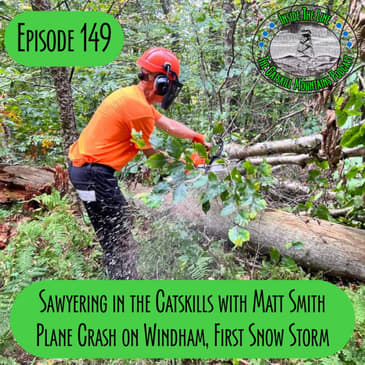
Welcome to episode 149! Tonight, Tad and I welcome back Matt Smith from Catskills Trail Crew! Matt chats with us about sawyering in the Catskills. We also chat about the recent snow storm, an unfortunate plane crash on Windham and a poop study in Colorado. If you need a sticker, email me or go to Camp Catskill! Subscribe on any platform! Share! Donate! Do whatever you want! I'm just glad you're listening! And remember... VOLUNTEER!!!!!!
Links for the Podcast: https://linktr.ee/ISLCatskillsPodcast, Donate a coffee to support the show! https://www.buymeacoffee.com/ITLCatskills, Like to be a sponsor or monthly supporter of the show? Go here! - https://www.buymeacoffee.com/ITLCatskills/membership
Thanks to the sponsors of the show!
Outdoor chronicles photography - https://www.outdoorchroniclesphotography.com/, Trailbound Project - https://www.trailboundproject.com/, Camp Catskill - https://campcatskill.co/, Scenic Route Guiding - https://adventurewiththescenicroute.com/, Another Summit - https://www.guardianrevival.org/programs/another-summit
Links:
Catskills Trail Crew, OHLEC training, NYNJTC, Plane crash on Windham, Colorado Outdoor poop study
Volunteer Opportunities:
Trailhead stewards for 3500 Club - https://www.catskill3500club.com/adopt-a-trailhead?fbclid=IwAR31Mb5VkefBQglzgr
fm-hGfooL49yYz3twuSAkr8rrKEnzg8ZSl97XbwUw, Catskills Trail Crew - https://www.nynjtc.org/trailcrew/catskills-trail-crew, NYNJTC Volunteering - https://www.nynjtc.org/catskills, Catskill Center - https://catskillcenter.org/, Catskill Mountain Club - https://catskillmountainclub.org/about-us/, Catskill Mountainkeeper - https://www.catskillmountainkeeper.org/, Bramley Mountain Fire Tower - https://bramleymountainfiretower.org/
Post Hike Brews and Bites - Your Local Stewarts
#catskillstrailcrew #sawyering #sawyer #sawyercaskills #planecrash #snow #snowstorm #husdonvalley #hikingNY #kaaterskill #bluehole #catskillhiking #visitcatskills #catskillstrails #catskillmountains #catskillspodcast #catskills #catskillpark #podcast #catskillshiker #volunteers #catskillmountainsnewyork #catskillspodcast #catskillshiker #catskillshiking #hiking #catskill3500club #insidethelinecatskillmountainspodcast #volunteercatskills #catskill3500 #hikethecatskills
[00:00:29] The bushwhacks were some of the worst days I've ever had in the mountains, or life, really.
[00:00:36] Whereas Pantsy Mountain is totally opposite, it's a mountain on top of a crater.
[00:00:41] I think the weather challenges on this incident were particularly difficult.
[00:00:47] It improves the development of New York State. Catskills are responsive.
[00:00:53] You're listening to Inside The Line, the Catskill Mountains Podcast.
[00:01:05] So welcome to Episode 149. Tonight we are here with Matt Smith from the Catskill Trail Crew.
[00:01:13] He's going to talk about sawyering in the Catskills. Now he recently got his sawing license and we all know that if you don't know what that is, it's a big deal in the Catskills blowdown.
[00:01:23] Massive blowdown that us volunteers can't, well, Matt's a volunteer. The volunteers that normally take the trails can't clear.
[00:01:31] You have to have a license to do that and Matt is going to talk about this tonight.
[00:01:36] So welcome to the show again, Matt. What is this? Number four?
[00:01:39] Three or four. I can't remember. It feels like home. So it's a start lose count.
[00:01:46] Yeah. Well, you're a big part of the Catskills, you know, you, you helping out the trails immensely and your crew and stuff like that.
[00:01:54] So we welcome to the show as many times as you can, because it's just a phenomenal effort that you guys have done for the Catskills.
[00:02:01] Thank you. Yeah. Well, I, it's definitely a labor of love and I'm glad to be here to talk about it and spread the word.
[00:02:07] Maybe get some more volunteers to join in.
[00:02:08] Hell yeah. Hell yeah. So as we record this, it's going to be released. Happy Thanksgiving.
[00:02:14] That's going to be the day after Thanksgiving. So happy Thanksgiving to you both.
[00:02:18] Hopefully you have some good stuff planned ahead with family or friends or love dogs or whatever.
[00:02:24] So happy Thanksgiving. So yeah, you too. Yeah. Thanks.
[00:02:29] Taddy. You got anything going on with your whole family coming back from mountain climbing of 12,000 foot peaks over in the Cascades?
[00:02:36] Uh, our oldest daughter, the feral one will not be home for this Thanksgiving.
[00:02:43] She's, um, currently in Tennessee, soon to make her way out to California to ski for the season, but she's, yeah.
[00:02:53] So she's, but she's not going to be home to eat Turkey with the family this year.
[00:02:57] Outrageous.
[00:02:58] Yeah.
[00:02:59] Well, a little sad about that, but we'll survive cause she's having fun.
[00:03:02] Yeah. Matt, Matt, any plans?
[00:03:05] Just going to be hanging around at home, getting together with some friends and doing a little bit of hiking.
[00:03:10] Good. Good. Sounds good.
[00:03:12] I mean, so unfortunately the big discussion of course, in the Catskills is the plane crash that happened on Windham mountain.
[00:03:21] Unfortunately, one guy perished.
[00:03:23] And at the time that this came out is, uh, they all survived.
[00:03:28] And then all of a sudden the guys, uh, perished and two of the dogs perished.
[00:03:32] Now the report is the guy perished and two dogs are rescued and one dog passed away.
[00:03:37] So incredible, uh, amazing rescue efforts by every team that was involved.
[00:03:46] I'm guessing the Windham police, the, uh, the easy Rangers and, uh, the local volunteer firefighters have responded to this, but tragic incident that happened.
[00:03:57] And, and you know, it doesn't happen often.
[00:04:00] We had this of course happen up in up near where I live, Sydney, uh, six people unfortunately perished in the plane accident up here.
[00:04:08] And this is, hasn't happened in the Catskills for over.
[00:04:13] I think the last time it was like Joe and I recorded was like 1986.
[00:04:17] So when it happened.
[00:04:19] It's been that long, huh?
[00:04:20] Wow.
[00:04:21] Yeah.
[00:04:22] I mean, aviation's definitely come a long way in terms of instrumentation, GPS, um, you know, the ability for pilots to be aware of where they are.
[00:04:29] So it definitely is sort of an anomaly for, for that to happen and for it to happen right in the escarpment, kind of like the place where all of the Catskill plane plane crash.
[00:04:38] And crashes have been concentrated for so many years, um, suggests, you know, kind of a, he maybe followed some old patterns.
[00:04:45] I'm not sure if he lost his instrumentation and was flying by sight.
[00:04:49] Cause it's hard to think of what could have led to him hitting the ground.
[00:04:55] Um, you know, not being aware of his elevation.
[00:04:57] Yeah.
[00:04:59] Tad.
[00:04:59] Yeah.
[00:05:00] I want to suspect that if I was a pilot heading north or south through the Hudson Valley, I'd follow the Hudson River.
[00:05:08] Right.
[00:05:09] And, and then with, uh, cross winds or some type of, um, uh, turbulence or whatnot, you know, obviously from time to time, you'd have to make cork horse corrections.
[00:05:21] And maybe he just drifted too far to the west and he was not expecting to have mountains.
[00:05:29] I mean, the blacks are nearly 4,000 feet.
[00:05:31] Yeah.
[00:05:32] So you go from the Hudson river, which is at that point, you know, maybe 150 feet.
[00:05:38] If that above sea level.
[00:05:40] Yeah.
[00:05:41] Go to the west.
[00:05:41] The river itself is sea level, but yeah, the land there is super low.
[00:05:45] Yeah.
[00:05:45] It's huge.
[00:05:46] Yeah.
[00:05:47] So if, if you're normally cruising at 4,000, 4,500, 5,000, I don't know what his normal cruising elevation is, but just takes a few things to be off by a few degrees to put you into the trees, so to speak over there.
[00:06:02] Yeah.
[00:06:03] Right.
[00:06:03] Yeah.
[00:06:04] I mean, if, if the margin of error is that close, um, it makes you wonder is, is that is everybody else been really lucky or was he flying in extraordinarily difficult situation?
[00:06:16] Um, like, did he get consumed by the weather or was he like flying and suddenly like the, the bad weather hit him and kind of trapped him out there?
[00:06:24] Or was there any indication?
[00:06:25] Yeah.
[00:06:26] Hasn't, hasn't the, the investigation hasn't really been, uh, conducted as of like, yet it's been.
[00:06:32] Going on, going and stuff like that.
[00:06:34] So his name was Siuak Kim and he was doing an amazing deed and he was transporting dogs from Maryland up to Albany to be, uh, rescued and adopted.
[00:06:47] So tragic event.
[00:06:49] And, you know, I was once again, I, you know, me being involved in plane crashes, the guys that has visited.
[00:06:56] Oh God, I don't know how many, almost 30 plane crashes here in the Catskills.
[00:07:00] I was like intrigued.
[00:07:01] I was like, so what happened?
[00:07:03] And I, I followed his pattern that he had.
[00:07:06] I actually got to see what he did.
[00:07:09] And, uh, I went on one of the websites and I found out that he was flying at around 8,000 feet.
[00:07:16] And then when he hit the Catskills, he started to descend down to like 6,000.
[00:07:21] I'm like, you know, you're still 2000 feet away from slide.
[00:07:24] And then all of a sudden he went down to 5,000 hitting over, you know, plateau and stuff.
[00:07:29] And I'm like, that's a little close.
[00:07:31] And then unfortunately his signal was lost.
[00:07:34] And I was just like, you know, at that time, Sunday, around 6, 10 PM, he crashed.
[00:07:40] And I, I remembered that there was some high winds hitting the Catskills.
[00:07:44] So who knows I've always like my, my assumptions are that there was some winds flowing into the valley of the Hudson.
[00:07:52] It's always either flowing up from the Hudson, hitting the escarpment and going upwards.
[00:07:56] So that brings the updraft.
[00:07:58] And if you're flying south, that brings you into the escarpment.
[00:08:02] But if you're flying over the top of the Catskills, you might have some downwind going into the valley.
[00:08:07] And that going right through the Maple Crest area might've pushed him into, into Wyndham High Peak where they said that he was crashed.
[00:08:16] And that, I mean, that's, that's, that's what I think, you know, I'm not a professional at this and make sense.
[00:08:23] Yeah.
[00:08:24] And he would have been naturally descending towards the valley at that point.
[00:08:27] Anyway, might've assumed he was a little bit closer and just descended too quickly, too soon.
[00:08:32] And fortunately clip the mountain.
[00:08:35] Well, it's unfortunate.
[00:08:36] You know, I guess he, he sounds like he was one of these guys who dedicated his life to helping dogs and, and, you know, helping them transport.
[00:08:42] So, you know, if it's any solace to anybody, I guess I would say, you know, he did, you know, died doing what he loved.
[00:08:49] Right.
[00:08:49] I don't, I don't think that the same could be said for the dogs.
[00:08:52] They didn't have a choice to get into that plane.
[00:08:54] And I can't help, but think of the terror that those poor animals suffered and, and, you know, glad to hear that.
[00:09:01] It sounds like one or two of them survived, which is just quite amazing.
[00:09:05] And the resiliency of, of animals and their ability to rebound from this is incredible.
[00:09:10] Whoever adopts, you know, one or either of those animals definitely is a hero in their own right.
[00:09:16] And, you know, deserves, you know, a lifetime of love and dedication from, from those animals.
[00:09:22] Cause it came a long way.
[00:09:23] And, um, you know, let, let this guy's trip not be in vain.
[00:09:26] You know, he, he traveled that way to get these dogs adopted.
[00:09:29] And I hope that there's some good stories about, you know, them finding a home and having a happy life.
[00:09:34] Yeah.
[00:09:35] Tad, what are your thoughts?
[00:09:39] Hey, it's very sad, you know, guys out trying to do a good thing and whatever the circumstances were, obviously it wasn't planned.
[00:09:49] And, uh, hopefully the, whatever suffering if any was minimal.
[00:09:54] Yeah.
[00:09:54] Yeah, absolutely.
[00:09:55] And I will have links, uh, on the, the show notes of where you can donate and stuff.
[00:10:00] I've seen a lot of donations going towards, uh, the animal, the sanctuaries that he was helping out and stuff like that.
[00:10:07] And a lot of people are, are chipping in, uh, but once again, you know, this is an event that you shouldn't just chip into like this sort of event chip into your local animal shelter, shelter and stuff like that.
[00:10:21] Just to spread the love and, and crazy, but, you know, hopefully, like you said, the, the pain was minimal.
[00:10:29] And he didn't suffer.
[00:10:31] And it's a tragic event that happens very rarely nowadays.
[00:10:35] Hasn't happened for a very long time.
[00:10:37] So unfortunate event, but before that we had an amazing snow storm that blanketed the Catskills and, uh, put some rain and some snow in here in the, the Northeast, which was very needed.
[00:10:51] And, uh, some places in the high peaks received more than two feet of snow.
[00:10:55] I over here and over in, uh, or the onto received seven and a half inches.
[00:10:59] And, uh, we've had several good reports of awesome snowshoeing, even though the snow has been wet, but awesome snowshoeing that's been going on.
[00:11:08] So once again, great time.
[00:11:11] Uh, it's all melted by now.
[00:11:13] Frickin', you know, we had seven inches and it's gone now opening or an O'Neonta.
[00:11:17] I don't know what it's like in the Catskills.
[00:11:19] I remember my friend Mo previously on the show reported that there was 17 inches and it's gone down to four inches.
[00:11:27] So crazy stuff.
[00:11:28] I know.
[00:11:28] Did you both have good times?
[00:11:30] Ted, how about you?
[00:11:30] You've had, you had a good time on, on Saturday is Sunday, right?
[00:11:34] Uh, we went out on Saturday.
[00:11:36] I'm not going to complain.
[00:11:37] It was, uh, I don't know.
[00:11:39] It was, it's always a good time hiking and snow, especially the first time of the year.
[00:11:47] And sometimes it's hard.
[00:11:48] Sometimes it's easy, whatever it is.
[00:11:50] It's always fun to get out there.
[00:11:51] It's like riding a bike.
[00:11:52] First time you throw those snowshoes on, it feels like last season all over again.
[00:11:57] Yeah.
[00:11:58] Matt, what about you?
[00:11:58] Were you out?
[00:12:00] I've not experienced the snow in the Catskills yet.
[00:12:02] I did a couple of flurries a few weeks ago, but this latest snowstorm, I haven't been able to get out there yet.
[00:12:07] I'm maybe going to go out tomorrow.
[00:12:09] So if there's a little bit left over, I might get some of the, uh, the last little bit.
[00:12:13] It still looks white from the distance.
[00:12:15] If you look at the Catskills, they look like they're in the throes of winter.
[00:12:19] So it might just be, you know, a little bit on the high peaks, but that's enough.
[00:12:23] You know, it starts to, uh, um, you know, encapsulate the mountains in that cold, icy feeling.
[00:12:31] And, and it just kind of builds throughout the entire winter.
[00:12:33] Like that first snowstorm, if it sticks around, it creates a good base for everything else.
[00:12:37] So, um, even if it, you know, it isn't 17 inches, if it's still a couple inches and the next storm comes on that and it keeps building, you know, that's when you really get good skiing and snowshoeing weather.
[00:12:47] Yeah.
[00:12:49] Well, I, I understand it was raining up there overnight, early morning and temperatures are going to drop and that's, it's going to have at least, you know, a half an inch or more of just hard ice layer on top.
[00:13:04] I suspect.
[00:13:05] Right.
[00:13:05] Which, which isn't bad enough.
[00:13:07] You have the right traction equipment.
[00:13:08] It just kind of flattens out the trails.
[00:13:10] You don't have to deal with the rocks, the small low down.
[00:13:13] You just motor right over it and you have a good time.
[00:13:15] Yeah.
[00:13:16] It softens it up a little bit too.
[00:13:18] Yeah.
[00:13:18] Your heels just kind of sink down into the little bit of crusty snow and yeah, sounds good.
[00:13:23] Well, quads working.
[00:13:25] Yeah, that's right.
[00:13:26] The first time I wear snowshoes every year, I find that there's certain muscles that I don't use any other time of the year that just kind of, they bug me.
[00:13:33] Yeah.
[00:13:34] You know, it's like the front of the thighs that, you know, I kind of drag it or lifting those snowshoes and it's kind of an exaggerated stepping motion.
[00:13:40] And it always gets me the first time of the year.
[00:13:42] I have to do some extra yoga moves just to kind of stretch it out.
[00:13:46] Yeah.
[00:13:46] Yeah.
[00:13:47] And so, Ted, you said that, you know, I was talking about the winds earlier coming up from the Hudson and then them coming down from the area that 23A was closed, right?
[00:13:58] Yeah, I saw that.
[00:13:59] I wasn't aware of that when I drove up on Saturday, but I did see in the news, it was impassable four miles outside of Palinville due to the snowfall.
[00:14:10] It makes sense.
[00:14:11] And I'm sure that's a hard road for them to keep open when the snow is really coming down and for that and for just safety concerns in general, I'm assuming they don't want people unnecessarily driving up and down that road during a heavy storm event.
[00:14:27] Especially as these people aren't really aware of snow and don't have this proper, you know, tires and stuff like that to go up there or the proper like driving techniques that you should use when you're driving in snow and stuff like that.
[00:14:41] So they would just slide down the mountain and slide up the mountain stuff.
[00:14:44] It would be horrible.
[00:14:45] Yeah.
[00:14:47] What's the proper driving technique?
[00:14:49] So like the Dukes of Hazzard style where you just let the rear end swing out wide and you just got to like gun it a little bit extra when you go into the corner.
[00:14:57] I mean, you would just, I mean, I usually use the technique of it. I don't have my snow tires out of just twisting and turning. So it grips every section and stuff like that to get up there.
[00:15:06] Yeah.
[00:15:07] But I would never go up that kind of section of Palinville to, to Hanes falls. That's a, that's a little crazy.
[00:15:13] Can you imagine if you lived up there? How would you get home?
[00:15:15] Yeah.
[00:15:15] You have to drive all the way around the window, my guess. Right?
[00:15:17] Yeah.
[00:15:18] Yeah.
[00:15:19] Going, going uphill is one thing coming down. It's a complete disaster. Doesn't matter. Doesn't matter if you have four wheel drive, all wheel drive, even studded snow tires going downhill.
[00:15:29] It's going to be an issue when it ice is up. Forget, forget about it.
[00:15:33] Start sliding. That would not be a fun trip.
[00:15:36] Yeah.
[00:15:36] Breaks on or breaks off. You're just, you know, once you're in a sliding on the ice, you're sliding on the ice.
[00:15:43] Oh God, that terror, that feeling just is just not cool. So, and then, you know, with this snowstorm, we, we had a, it was heavy snow. It was very heavy snow shoveling. It was shitty, especially where I live.
[00:15:55] So there was a lot of power outages and, you know, it took a lot of time for them to get help and there's still help going on. There's still a couple of power outages, but, you know, Ted did some research central Hudson, which, where is that located Ted central Hudson?
[00:16:12] I'm not familiar with that.
[00:16:13] Yeah. So central Hudson, I'm going to assume is in the, uh, Western. Well, no, no, the Eastern cat skills. Um, and then New York state gas and electric is probably more in the Eastern cats.
[00:16:29] Mm. Eastern.
[00:16:31] I remember central Hudson being in Woodstock growing up. At least that was the, uh, provider there years ago.
[00:16:36] Yeah.
[00:16:37] 1,200 outages in central Hudson and 1600 outages in a nice second. Then, you know, I remember my, my wife's parents, my, my in-laws live up in East Meredith. And then we went three days without power. So, and they're one of the last in the area to get to, because they just live in the middle of nowhere. So that's a tough, that's a tough life. I got to admit.
[00:17:29] Yeah.
[00:17:31] And certainly for me, I had where I had to turn around. I basically had to go all the way back to the Ashokan and I drove down to Kingston to get home because, you know, I was, wasn't going to bother with taking any other of the side roads out of the cat skills and dealing with the road closure again.
[00:17:47] Yeah. So you, you had a question, Ted, is it wrong to hike after a significant snow storm? You know, it, it, it, it kind of depends, you know, like what, what it's a circumstances, light, heavy snow.
[00:18:07] You know, you know, where are there going to be the plowed areas where they're not going to be plowed areas. So it's, it's, you know, it's, it's all like slide.
[00:18:18] Maybe Panther would be plowed. Blackheads might be plowed a little bit, but you never, you never know. That's the whole thing.
[00:18:25] Yeah. I, I just saw some comments people were making about, uh, it being inconsiderate for hikers to head into the cat skills when folks who live up there were dealing with power outages and road closures and city.
[00:18:41] Idiots and others were heading into the territory to, you know, uh, be on the roads, uh, arguably, you know, be in places where they could get stuck, have accidents and whatever, and divert emergency services that were already being deployed for just people's, you know, uh, daily necessities who, who live up there.
[00:19:02] Uh, so on the one hand, I thought it was an interesting comment on the other hand, I guess it depends who you are going up there.
[00:19:10] Some people are better equipped to get around and, uh, not be in the way during those types of conditions and other people, you know, just become part of the problem.
[00:19:20] But I think the, I think the moral of the story is, you know, just be cognizant of the situation and don't expect like an immediate response.
[00:19:29] If something happens to you, when you go up in the cat skills after a bad weather event like this, because the local emergency services are probably already attending to a lot of other things.
[00:19:40] Yeah.
[00:19:42] It's a good thing that you call them the local emergency services.
[00:19:46] Cause it, you know, it's sometimes hard to re remember that the cat skill park is not like Yellowstone where you have a bunch of rangers who are dedicated to just rescuing you no matter where you are.
[00:19:57] Right. The rangers and cat skills are just for the state land.
[00:20:00] The rest of it is towns, right?
[00:20:02] And they're, they have budgets that are based on the people who live there.
[00:20:06] And so they have relatively small emergency crews and they're really not set up to handle all of the extra people who are going to show up in these crappy conditions.
[00:20:17] And as you point out, potentially put themselves into harm's way and become another statistic who now needs to be saved by these guys who are already handling the people who live there full time.
[00:20:29] And so, you know, I don't know, inconsiderate might be a strong word, but maybe not really thinking about the fact that there are people living in the place where you're going.
[00:20:39] And, you know, just like any tourist activity, you wouldn't go to, you know, the beach during a tidal wave, right.
[00:20:47] Just to watch it or just, I want to do my thing there. Right.
[00:20:50] Because you typically would think, well, that's, you know, you've crossed the line into a real emergency situation.
[00:20:56] And there are times when the local communities do speak out and they say, we don't want you coming here. Please stay away.
[00:21:04] And, you know, and they do it because they knew they need to protect their people, right?
[00:21:09] The emergency workers are often volunteers who are stepping up to do this work on their own time and they're just overwhelmed.
[00:21:15] And so the communities do, you know, speak out and ask for that.
[00:21:19] I didn't hear that during this latest storm.
[00:21:21] It seemed like it was a bad storm, but it didn't reach like that emergency level criticality.
[00:21:26] So I guess maybe just listening to the local media and just kind of be respectful and responsive to like what they're saying.
[00:21:34] And if they are saying stay home, well, maybe think that just because you have a Hummer and, you know, a shovel that, you know, maybe that's not enough.
[00:21:42] Like maybe just go in someplace else is a good thing to do and let the, let the mountains be for the weekend.
[00:21:48] They'll be there again the next weekend. And I don't know, it's as somebody who grew up in the Catskills and who kind of always just thinks about the balance between recreation and the people who live there.
[00:22:00] It's there's never an easy answer. But I say whenever there is a choice like error on the side of respecting the people who live there, because that's their home, you know, 24 seven.
[00:22:09] Yeah, definitely. And that's tough. Once again, it's tough. You don't know where certain help is or is needed and stuff like that.
[00:22:17] You know, you might go down to Maplecrest and they got more snow than outside of Wyndham.
[00:22:22] So always have a plan B, you know, or plan C to turn around and just go home.
[00:22:28] You know, you never know.
[00:22:29] Yeah. Yeah. I mean, Harriman Park is open. There's all sorts of places where you can go that are not the Catskills.
[00:22:36] Now, I realize that like a lot of people, like when they hear extreme snowstorm, that's a magnet.
[00:22:41] They're like extreme conditions. Like, I love that. I want to be challenged.
[00:22:44] I want to be, you know, I'm training for the Himalayas. I'm training for the Cascades and I want to take on that extreme challenge.
[00:22:51] And that's cool, too. Right. And as long as you're, you know, able to get there safely and able to deal with the situation, I think, you know, there's a lot of fun in getting out into that extreme weather. Right.
[00:23:03] Yeah. Yeah. Definitely. Just the sunny days aren't the only fun ones. You know, sometimes when you're battling the wind and all that, it's there's there's a real bad ass attitude that you have to, you know, adopt to make it through that.
[00:23:16] So a lot of people like that kind of thing. Yeah. And I think it's cool.
[00:23:19] But, you know, just kind of balance that out with, you know, not not being somebody who gets in the way or puts anybody else at risk.
[00:23:26] Correct. Yeah. And so hopefully everybody has gotten back to the norm up there and, you know, a lot of stuff has melted.
[00:23:34] And hopefully, you know, there was a splendor here in the Oneonta area or like crazy hundreds of trucks.
[00:23:43] So hopefully they all got their help that they needed and stuff like that to get everything back to normal.
[00:23:48] But, you know, this also means with the snow and the rain and areas that there is some sort of at least moisture in the air and coming back into the Catskills, coming back into the lower Hudson area.
[00:24:01] The DEP posted this and they said, with our historic lack of precipitation this fall, the regions continued severe drought conditions and the cities and the state's drought warnings declarations.
[00:24:12] And DEP began diverting water to the Roundout reservoir in anticipation of putting the Delaware aqueduct back in service.
[00:24:20] This reduces releases from the Cannonsville, Pecaptain and Never Sink reservoirs pursuant to Table 4A of the Flexible Flow Management Program.
[00:24:30] And then it lists a bunch of numbers that I had no clue about.
[00:24:33] I'll have to check that out.
[00:24:35] So they're starting to kind of restore that stuff in the Pecaptain and the Cannonsville reservoir where it's been totally drained out due to the Delaware aqueduct being repaired and stuff like that.
[00:24:44] You know, I had a crazy video and a crazy time visiting the Pecaptain and the arena area that was dried out and I got to see some of that stuff.
[00:24:55] So it's pretty cool.
[00:24:56] So glad they're getting stuff back up to normal.
[00:24:59] Crazy to see that stuff.
[00:25:01] So I saw your pictures online.
[00:25:03] It was pretty cool.
[00:25:03] It was definitely different.
[00:25:05] It was surreal and definitely different.
[00:25:10] Definitely kind of eerie.
[00:25:11] And like, is the reservoir only that low because of the lack of rain or did they specifically drain it because of the work they were doing on the aqueducts there?
[00:25:22] Both.
[00:25:23] Ah, the, it was the, the drought and they drained the Pecaptain and the Cannonsville to get the Delaware aqueduct.
[00:25:30] They had a leak somewhere down in the lower Hudson area.
[00:25:33] I think it was crossing the Hudson.
[00:25:35] So, but it was crazy.
[00:25:37] And, you know, something that's crazy is all the rich people.
[00:25:44] There's a big news happening on window mountain club.
[00:25:47] So blade X.
[00:25:48] Uh, so there, this is their ad from blade X.
[00:25:53] And this is trade crowded city sidewalks for pristine ski slopes and fly to window mountain every weekend between December and March.
[00:26:01] Blade is now offering scheduled helicopter flights between Manhattan and window mountain club landing on site only 45 minutes for $695 per seat.
[00:26:14] These first of a kind of flights will depart on Thursdays from blade lounge west at TKM, which I have no clue and return to window on Sundays at TKPM throughout the season featuring 54 12 trails,
[00:26:26] 11 lifts and restaurants and a helicopter service.
[00:26:30] When the mountain clubs have everything you need to fill a long winter weekend with adventure and relaxation.
[00:26:36] Spend your days on the slopes, not the highway.
[00:26:40] Hmm.
[00:26:41] So did you just get paid for that advertisement?
[00:26:43] Cause that was pretty good.
[00:26:44] I should, I should tag them in this.
[00:26:45] I think it's retroactively a phony up some money for some advertising.
[00:26:49] Yeah.
[00:26:50] Right.
[00:26:51] That's a little extreme.
[00:26:53] Uh, I would, would you, you know, you know, a lot of like, some people are like, don't be negative, but like, that's a little extreme.
[00:27:00] Don't you think?
[00:27:01] Like, are they desperate?
[00:27:03] What desperate for what?
[00:27:05] Rich people from the city to come up and let's spend their private club up here in Wyndham, which used to be a family oriented area.
[00:27:13] Local family oriented area.
[00:27:15] And I remember.
[00:27:16] I grew up skiing at Wyndham, but it was always a private mountain, but it was pretty folksy back in the day.
[00:27:23] And, you know, it's, it's definitely evolved into a very exclusive, you know, resort community over the last decade.
[00:27:31] So it doesn't surprise me.
[00:27:33] I, you know, I wonder if like, you know, how far away from the actual slopes it's going to be and how that's going to affect the community.
[00:27:39] It doesn't sound like there's just going to be flights in and out all the time.
[00:27:42] It just sounds like maybe like one flight per week or something like that.
[00:27:46] And they're just going to book all the, you know, the seats or something like that.
[00:27:49] I mean, do you think there's just going to be like helicopters in and out of there or something like that?
[00:27:54] It's just going to be like a helipad.
[00:27:56] Tad, I don't know your, your, your daughter is going to be working at Tahoe.
[00:28:00] So is that what she's experiencing?
[00:28:02] Well, she's going to be at mammoth, but while, while you're talking up, you know, this promotion you're doing for the Wyndham ski club that you don't want to admit that's going on here.
[00:28:11] I just priced some tickets, round trip tickets from JFK to Denver and you can fly round trip JFK to Denver for under $600.
[00:28:23] Right.
[00:28:24] And when you get, and when you get to the Denver airport, you rent a car and you go west to Breckenridge, Arapahoe, you know, Winter Park, Copper, Vail.
[00:28:36] I mean, you know, right, right down the road from Denver, you're going to get some just really world-class skiing.
[00:28:44] Well, extra hours of driving and yeah.
[00:28:46] In the Rocky Mountains.
[00:28:48] Okay.
[00:28:48] So it's going to take a little longer to get there, but damn, if I'm going to lay out, you know, close to 700 bucks for airfare to go to Wyndham, shame on me.
[00:28:57] I'm just going to, I'm taking an extra day.
[00:28:59] I'm going out to Denver.
[00:29:01] And someone tells me that the people may not be going there for the skiing.
[00:29:04] They're going there for the, you know, the appraised ski lifestyle that's sitting around the fire with, with the beer and, you know, schmoozing with their friends, maybe take a couple of runs.
[00:29:16] It's not about like, you know, you can do all that at like Arapahoe, Breckenridge, Vail.
[00:29:24] I mean, come on, Matt.
[00:29:25] I mean, it's definitely, it's got more, more cache to do it out west for sure.
[00:29:29] Yeah.
[00:29:30] It's Tuesday morning hanging out by the water cooler.
[00:29:32] What, what has like more, you know, of a vibe to it.
[00:29:36] Yeah.
[00:29:36] I went up to Wyndham for the weekend.
[00:29:39] Yeah.
[00:29:39] And I drank some beers and ate some buffalo wings.
[00:29:44] Yeah.
[00:29:44] It, it Snyder's or, or yeah, I was out at Vail at this new French restaurant that they open, you know, come on.
[00:29:55] I know it's true.
[00:29:57] I, you know, French restaurant, Stewart's chili.
[00:30:00] I don't know.
[00:30:01] It's it's a, yeah.
[00:30:02] Yeah.
[00:30:03] Right.
[00:30:03] That's a real toss up.
[00:30:04] So you both are Stewart's fans.
[00:30:06] So.
[00:30:07] I do like, I could, yeah, I can right here.
[00:30:09] Hold on.
[00:30:10] I can go to Tad's already got his.
[00:30:12] Yeah.
[00:30:13] It's like people know they just give me Stewart's gift cards.
[00:30:15] So I'm hitting up one here.
[00:30:17] Look at this one, Matt.
[00:30:18] Feast your eyes on that.
[00:30:19] What's it?
[00:30:19] Oh shit.
[00:30:21] We're going to, that's a lot of cheeseburgers and chili right there.
[00:30:24] Right there, buddy.
[00:30:25] Hundred beans.
[00:30:27] I like to give out the Stewart's gift cards to the Sawyers because they have the ethanol free gas.
[00:30:32] Anybody who runs a chainsaw love Stewart's gas.
[00:30:36] So if you love a Sawyer, give him Stewart's gas card.
[00:30:39] Got it.
[00:30:40] Well, well done.
[00:30:41] So if you want an awesome helicopter ride going from New York city up to a Wyndham, go ahead and book that $700 flight for a round trip up to where they have it.
[00:30:54] Have to make snow year long.
[00:30:56] You know, I don't know.
[00:30:57] So, so, so, so you started out talking about a plane crash in the cat's Hills.
[00:31:00] Now we're talking about like flying in the helicopter to the cat's Hills.
[00:31:04] I don't know if this is actually the best advertising for this whole Wyndham thing.
[00:31:08] Maybe, you know, a little too soon after the tragedy to be repping like a, a flight oriented travel service to the cat's skills.
[00:31:17] Um, leave your dogs at home.
[00:31:19] Like that's all I can say.
[00:31:20] Like for now.
[00:31:21] Yeah.
[00:31:21] Please, please.
[00:31:23] Yeah.
[00:31:24] I'm glad you brought that up, Matt.
[00:31:26] Cause you know, is somebody who's affiliated with the show?
[00:31:29] Like I am.
[00:31:30] I can't, you know, talk trash on one of our sponsors and the window mountain club is certainly one of the up and coming sponsors of the show.
[00:31:37] What no absolute lies.
[00:31:42] So beyond that.
[00:31:43] Okay.
[00:31:43] So we've, I don't think they'd ever even talk to us with all the trash talk.
[00:31:47] I don't know.
[00:31:47] Somebody at, at Wyndham has put like $200 Stewart's gift cards in an envelope and sending them to Stosh right now.
[00:31:53] It's it's.
[00:31:55] Come on right down the street.
[00:31:56] So favor.
[00:31:57] Right.
[00:31:58] So now I don't know how this, I, I, this is really like weird and kind of embarrassing, but pooping is,
[00:32:07] is, is, is life.
[00:32:08] You know, you got, you gotta do it.
[00:32:10] And pooping, uh, is definitely a crazy top topic to study and stuff like that.
[00:32:18] But there are people out in Colorado that wants to change the way hikers poop in the back country.
[00:32:23] So this is a study that's been going on.
[00:32:26] Uh, it's from the PACT outdoors, uh, corporation up in Colorado said they want to change the way people poop in the outdoors.
[00:32:36] They want to put more outhouses up on the trails.
[00:32:39] Um, this past summer hikers in Colorado's highest peak, the 14,000 foot Mount Albert were met by a particular welcome committee.
[00:32:46] Now these volunteers from the Colorado 14ers initiative handed out wag bags near a padlock receptacle marked human waste pack out bags only.
[00:32:56] So now they are, you know, having volunteers going up the stewards going up on the mountain saying, Hey, poop in these bags.
[00:33:03] Uh, and, uh, on some days they're from Penn state.
[00:33:06] So, which is really odd, Penn state, Colorado.
[00:33:09] Um, they are studying the way people poop out in the outdoors.
[00:33:14] Uh, they're called the clean 14, an infrastructure that was latest in the multi-year research project undertaken by the PACT outdoors.
[00:33:21] A company that based in design product for sustainable pooping in the back country.
[00:33:27] So this comp, this company specializes in pooping in the back country.
[00:33:32] Uh, they want to improve this.
[00:33:33] And, uh, you know, I can't help, but agree with this, you know, seeing, uh, stuff on certain sides of the trails and stuff like that.
[00:33:42] And also being a person that, you know, once you get into a hike and you have to poop, you have to poop.
[00:33:48] I know the proper pooping procedures, dig a cat hole six inches deep, bury it, stuff like that.
[00:33:54] But sometimes it's crazy and stuff like that.
[00:33:58] So, uh, kudos to them for doing this study.
[00:34:02] It's it's, I gotta admit, it's crazy study to do and, uh, to improve this stuff, you know, only helps out our areas.
[00:34:09] And, you know, some of the places to poop in the Catskills, uh, thunder boxes, stuff like that are a little crazy.
[00:34:17] And has anybody ever been in that good old thunder box near Fern and big Indian, the biscuit brook area.
[00:34:25] That's a little insane, especially when the leaves aren't on the trees.
[00:34:31] Jesus.
[00:34:32] Am I the only one?
[00:34:33] No, you know, look, I mean, it's, I remember the title of a book that we used to read our kids when they were.
[00:34:39] When they were younger, it was called everybody poops.
[00:34:42] Yeah.
[00:34:42] And everyone does poop and it's just part of hiking is you need to learn how to poop outdoors responsibly.
[00:34:53] So, uh, the more you hike, the, the better you, you get it taking care of your business outdoors.
[00:35:00] Um, and I can imagine these places out West with all the traffic they get and are above tree line.
[00:35:05] And, you know, there's very little organic earth.
[00:35:09] It's all hard, rocky material that you really can't have a cat hole, you know, doing the proper biological process to decompose human waste.
[00:35:23] So you got to pack it out.
[00:35:24] Yeah.
[00:35:25] It's, it's, it's tough, you know, like your dog pooping and stuff like that.
[00:35:29] It's, it's, it's, and then, you know, we, we have the Catskills.
[00:35:33] Of course, we have some great soil here, uh, depending on where you are and stuff like that.
[00:35:36] But lower elevations, higher of oceans, a little, a little bit more difficult, but out West, God damn, that's, that's tough.
[00:35:44] You know, if anybody has ever hiked, uh, even above tree line and the whites and the Adirondacks, you have very limited space and you got to carry out what you carry in, you know, you know, it's just like your dog.
[00:35:57] You'll strap it to the back of your backpack and haul it out.
[00:36:00] You know, it's, it's, it's, it's shit.
[00:36:03] It's life.
[00:36:04] It's life.
[00:36:05] Matt's just staring at there.
[00:36:07] Like, what did I get myself into?
[00:36:09] Well, I'm just saying that there's a reason why we flush our poo away from ourselves and wash our hands.
[00:36:16] Cause it's inherently, um, a disease ridden substance that you don't want to handle or have around you.
[00:36:25] And so, uh, coming up with convenient and practical ways to do the removal is really important.
[00:36:34] So I'm interested in what these folks from Penn State are doing.
[00:36:36] And as somebody who works in, um, you know, engineering and biomedical engineering in that world, you know, watching, you know, some of the folks I work with designing like, you know, these intense, uh, medical devices that allow you to inject, you know, medicines into your body in unique ways.
[00:36:54] Like somebody has got to come up with a way to like, you know, I don't know, strap a bag to your butt.
[00:36:59] So you can like poop in it, like conveniently, like, there's gotta be some kind of like wire hanger thing that'll like, you know, like attach the, the, the, the, you know, like, like kind of like a fodder bag or something like that, like underneath your butt.
[00:37:11] Like, and you can just, you know, cause like, you know, it's, it's really uncomfortable.
[00:37:15] You, what are you going to poop on the ground, pick it up like a dog?
[00:37:18] Uh, you know, like, you know, human thesis is a lot bigger.
[00:37:21] It's like, how are you going to handle that?
[00:37:22] It really becomes difficult.
[00:37:24] And I think there's probably some outdoor pursuits like rock climbing that have perfected this.
[00:37:30] I watched a documentary not long ago, um, Alex Arnold climbing up, um, one of the, uh, Al Capitan.
[00:37:37] It was actually, uh, uh, Alex Arnold and, or not, not Alex Arnold, uh, the other, uh, fellow, uh,
[00:37:43] The young kid?
[00:37:44] Uh, Tim, uh, I want to say Tim.
[00:37:48] No, he's not a young guy.
[00:37:49] He's an older guy, actually older than, um, climbs the Dawn wall that there's the movie called the Dawn wall.
[00:37:54] Uh, maybe you can edit this out and, uh, but the point being that they were on this rock face for weeks at a time and had to poop in bags because they're living on these portal ledges and climbing all the time.
[00:38:12] So they can't just, you know, poop off the side.
[00:38:14] And so they have a whole technique of pooping into a bag.
[00:38:18] And I think they have some kind of like a little frame or something that kind of holds the bag open so that they can kind of like, you know, sit or, or, you know, drop their butt off the side of the, the, uh, thing that they're sitting on to do it.
[00:38:30] So, so it's possible.
[00:38:32] Um, is it worth it?
[00:38:34] Like, I mean, if you're on a cliff, like, you know, like if you're pooping, it's just going to end up on the cliff.
[00:38:40] Like if you're on a rock climbing route, you're like pooping on people below you potentially.
[00:38:44] So I don't even think it's possible or practical to, to just poop without containing it somehow.
[00:38:50] Um, there's that movie, um, the, the Martian with, uh, uh, that, you know, guy, he uses all of the, the poo that they had stored to grow some kind of potatoes or something on a planet.
[00:39:03] And so like capturing the poo, like space poo and like dehydrating it and putting it into like a little bag.
[00:39:10] So maybe, you know, there's some technology or some science that we can apply here, um, to make it practical.
[00:39:17] I don't know.
[00:39:18] Yeah.
[00:39:19] Somebody, everybody's basically, but me, I was like, what the hell is Stash coming up with it?
[00:39:24] These fricking.
[00:39:26] Yeah, exactly.
[00:39:27] Long silence.
[00:39:28] They're like, Jesus Christ.
[00:39:30] Well, you know, I mean, there's major problems with, uh, you know, ever space camp with, with, um, you know, all the fecal matter building up there, you know, just disease and contamination of that whole area from just people pooping and not cleaning it up for, for generations.
[00:39:46] Yeah.
[00:39:48] Tad is silent.
[00:39:49] You know, I'm, I'm still kind of getting over some of Matt's animated hand gestures when he was going through the wireframe plastic.
[00:39:58] I know I got it.
[00:39:59] I got it.
[00:39:59] Something our listeners just really don't get to appreciate when they listen to this, but I, I'm just, I'm just one of these people that we, you know, we have so much technology available to us and CAD design and artificial intelligence.
[00:40:15] Yeah.
[00:40:16] Figuring out a sanitary and convenient way for people to poop outdoors should be one of the more solvable problems that we have to deal with.
[00:40:26] But the real problem is motivating hikers and participants to be willing to partake in compliance, such a process.
[00:40:36] Yeah.
[00:40:37] It's tough.
[00:40:38] Yeah.
[00:40:38] People won't even pack out their, their own dog poop.
[00:40:41] So don't, don't really expect a high level of compliance in the Northeast on, you know, human waste.
[00:40:47] It'll take a few generations maybe of hiking along, you know, uh, trails that are, you know, they have human waste to the left and the right.
[00:40:56] Yeah.
[00:40:57] Mark my word that there'll be a pile of human, uh, doggy bags at, at the, uh, trailhead.
[00:41:03] Oh, no.
[00:41:04] Horrible.
[00:41:05] People dropping their stuff right there.
[00:41:07] Horrible.
[00:41:08] All right.
[00:41:08] All right.
[00:41:08] All right.
[00:41:10] That's it.
[00:41:10] A pooping.
[00:41:11] All right.
[00:41:11] Enough with the shit.
[00:41:13] There we go.
[00:41:14] So thank you to the monthly supporters, Darren White, Vicky Furrer, Chris Garbian, Matt Salotowski, Jim C, Tom H, Betsy A, Denise, Tom H, Vanessa, Joseph, Jim C, and Michael.
[00:41:28] Really appreciate you guys.
[00:41:30] And also John Comiskey.
[00:41:32] Thank you guys.
[00:41:32] Really appreciate you.
[00:41:33] So that's a lot of people supporting the show.
[00:41:35] Wow.
[00:41:36] They didn't have a bunch of impact.
[00:41:38] Once again, your, your impact is going to back into the Catskills, not just to the show.
[00:41:43] Uh, also our sponsors of the show.
[00:41:46] Thank you guys very much.
[00:41:47] Discover the beauty of the Catskills, Adirondacks, and Hudson Valley with scenic route guiding.
[00:41:51] Our expert guides ensure a safe, unforgettable experience, hiking experience tailored to your skill level from breathtaking vistas to hidden gems, or if you're peak bagging to just simple day hikes, we'll lead you to the best spots and back.
[00:42:04] Book your adventure today and explore nature's one doors with the scenic route guiding.
[00:42:09] Check them out on all social media platforms.
[00:42:11] Also, if you mention the podcast, you can get 10% off.
[00:42:15] Use the amazing code word, Mountain Lion.
[00:42:19] Also to cover Camp Catskill and Tannersville, your ultimate hiking store.
[00:42:23] Find top quality gear, apparel, and accessories for all your outdoor adventures.
[00:42:28] Our expert staff is to help every hiker from beginners to seasoned pros.
[00:42:33] We also carry a variety of unique souvenirs and gifts.
[00:42:36] Visit us online at Camp Catskill or in store to get your next journey.
[00:42:41] Adventure starts here at Camp Catskill.
[00:42:43] They have spikes, micro spikes, and crampons.
[00:42:47] So go there if you need micro spikes and crampons.
[00:42:50] So also embark on a transformative journey with another summit.
[00:42:53] Another summit is dedicated to serving veterans and first responders with free outdoor activities.
[00:42:59] Activities like walks in nature, paddling, hiking, and even backpacking.
[00:43:03] Join our supportive community to rejuvenate in nature's embrace.
[00:43:07] Experience commodity, adventure to healing at no cost.
[00:43:11] Take your next step with another summit and ascend to new heights of resilience and joy.
[00:43:16] Apply today on another summit.org.
[00:43:20] So mention the Hub podcast through your social media platform.
[00:43:23] We'll chat about our show.
[00:43:24] Also, if you donate a hard cider, that will go to the show and towards the Catskills.
[00:43:29] Back into the Catskills.
[00:43:30] Matt will talk about that later.
[00:43:31] We have donated from the show.
[00:43:35] Mostly the people has donated back into the Catskill Trail Crew.
[00:43:38] So Rachel Jean, the Gypsy Queen, I want to note that last week she was at West Hill.
[00:43:43] She tagged us in one of her Instagram posts and we had no clue what she was doing, but she completed her fire tower challenge.
[00:43:50] So congratulations.
[00:43:51] Great place to have a finishing touch on your fire tower challenge at West Hill.
[00:43:56] So Rachel Jean, the Gypsy Queen, thank you very much for tagging us in the show.
[00:44:00] Hopefully you had a good time up at Sprucedon Trail.
[00:44:03] It's just one of those phenomenal areas.
[00:44:06] So Tom Hoos, who was recently on the trail, he said in one of his posts that we did a good time for his drive to Twin.
[00:44:13] So that was like a two and a half hour show, Ted.
[00:44:15] That was a pretty long show.
[00:44:17] And then he ended up doing West Hill with Joe T.
[00:44:22] He decided to, I guess they didn't have the Roaring Hill Trail, the Roaring Hill Park and area plowed.
[00:44:28] So he went to West Hill.
[00:44:29] Did you see his pictures?
[00:44:30] They were nice.
[00:44:31] Yeah.
[00:44:32] It looks like those two had a good time hiking together.
[00:44:35] Great conditions for them.
[00:44:38] Glad to see not only our listeners, but our prior guests hooking up and getting out and doing some hiking.
[00:44:46] Yeah.
[00:44:47] Glad Joe T was back in the Catskills again.
[00:44:49] So he's been up in the Finger Lakes, killing a lot.
[00:44:51] And Tom is just always ripping it up.
[00:44:54] He was just on Big Indian and now he's up on West Hill breaking trail.
[00:44:57] So that was awesome.
[00:44:59] Everybody was breaking trail this weekend.
[00:45:00] So it was great.
[00:45:02] Todd Bolt had a stunning photo of Bear Mountain Bridge.
[00:45:07] Great area to just get out and just to see some amazing photos of the Hudson Valley area.
[00:45:13] Todd, you're very familiar with that, right?
[00:45:17] Yeah.
[00:45:17] I don't know.
[00:45:18] There's some people that know it inside and out.
[00:45:20] I've only been over there a few times.
[00:45:21] So I'm not going to, it's beautiful and it's, you know, much more, it's much different from the Catskills.
[00:45:30] Different geology, rocks, forest, fauna, the whole nine yards.
[00:45:37] It's a completely different area vibe.
[00:45:39] And there's a lot more present or tangible old industry and human development as you hike through there.
[00:45:50] True.
[00:45:50] But it's very cool, worthwhile.
[00:45:53] Get out and hike wherever you can.
[00:45:55] Yeah, definitely.
[00:45:56] So Brian U35 went to Catterskill High Peak, got stunning views of the Devil's Path and I shared his stuff.
[00:46:05] I have never seen a more awesome profile of Indian Head that he got from Catterskill High Peak.
[00:46:13] It was just absolutely fantastic.
[00:46:16] And once again, he probably broke trail going up to the top and it was just absolutely phenomenal.
[00:46:22] Although those views going over to the Devil's Path from Catterskill High Peak are just absolutely stunning.
[00:46:27] And with it, blanketed in snow really shows the awesome profiles of Indian Head, Twin, Plateau, Sugarloaf.
[00:46:36] It's just absolutely breathtaking stuff.
[00:46:40] I mean, those views you get when the snow is sitting on the landscape and shows those different profiles of the geological features of the Catskills just blows me away.
[00:46:51] That's like the craggy and intense part of the Catskills.
[00:46:56] That whole Devil's Path region is, I think, kind of renowned in the region.
[00:47:01] It kind of is the part that's like a little mini Adirondacks in a way.
[00:47:04] Those steep climbs and the more challenging terrain.
[00:47:08] I think it's a lot of people when they think about the Catskills, that's the place that they kind of naturally go to for that kind of challenging mountain terrain.
[00:47:17] Everything else is just kind of rolling hills to some folks.
[00:47:21] I like both of those parts of the Catskills.
[00:47:24] I think there's, you know, you go to the Western Catskills, you know, maybe closer to where you live, Stash.
[00:47:28] And it's not that kind of craggy, intense, deep cloves.
[00:47:33] It's maybe a little bit more rolling hills that kind of slowly gain an elevation as you get into the central part of the range.
[00:47:43] So it's maybe a different approach.
[00:47:45] When you come to the Catskills from the east, from the Hudson Valley, I mean, you know you're hitting mountains because you just have to drive up like 23A, right?
[00:47:53] It's just an intense elevation gain.
[00:47:56] Whereas coming from the west, they sneak up on you a little bit.
[00:47:59] You know, you're just kind of slowly going into hills.
[00:48:01] And then before you know it, they're bigger mountains.
[00:48:04] Yeah.
[00:48:05] Absolutely fascinating stuff.
[00:48:07] Everywhere.
[00:48:08] Everywhere.
[00:48:08] Everywhere.
[00:48:09] So also, thanks for tagging us, all the listeners.
[00:48:13] Really appreciate it.
[00:48:14] Keep doing that if you want.
[00:48:15] And we'll talk about your hike on the show.
[00:48:17] Buy us a hard cider to support the show.
[00:48:19] That'll go to the show and the rest will go to the Catskills.
[00:48:23] And we've donated almost $2,000 towards the Catskills so far.
[00:48:27] So it's been fantastic.
[00:48:29] Also, rate the show wherever you can.
[00:48:32] Doesn't matter when you can.
[00:48:34] Just rate the show.
[00:48:36] Five stars is only acceptable.
[00:48:38] So drinking anything.
[00:48:40] Who's drinking anything?
[00:48:42] Matt, you having something?
[00:48:44] Start off with you.
[00:48:45] I've got some coffee.
[00:48:49] And I guess you can't see the logo there.
[00:48:51] It's blurred out.
[00:48:51] They blurred out due to publicity reasons.
[00:48:55] That's right.
[00:48:55] Yeah.
[00:48:55] The New York, New Jersey Trail Conference logo is copyrighted so that you can't see it.
[00:49:00] I don't know.
[00:49:00] Whatever's going on with my camera.
[00:49:02] AI.
[00:49:03] I think I have some kind of blurring technology going on.
[00:49:05] Yeah.
[00:49:06] I want to see that.
[00:49:06] So yeah.
[00:49:07] Just coffee and cannabis.
[00:49:08] It's like the combination.
[00:49:10] Perfect.
[00:49:12] Nice.
[00:49:13] Nice.
[00:49:13] Tad, what about you, sir?
[00:49:14] Are you doing anything yet?
[00:49:16] Well, I'm having coffee without the dash of cannabis that apparently Matt is having.
[00:49:23] And I think that's why his coffee bug was blurred out.
[00:49:27] It's kind of like protecting him from incriminating himself from the imagery or whatnot.
[00:49:34] Yeah.
[00:49:34] I'm just having another copper homebrew.
[00:49:36] I do have a brewski off to the side that maybe I'll crack open when the conversation gets flowing.
[00:49:43] Maybe.
[00:49:43] Maybe.
[00:49:44] Maybe.
[00:49:44] We will.
[00:49:45] Once things get spicy.
[00:49:47] Yeah.
[00:49:47] Yeah.
[00:49:48] No blurring out of that image, Matt.
[00:49:51] That's real.
[00:49:53] That's not AI.
[00:49:54] Yeah.
[00:49:55] Right there.
[00:49:55] So I'm having a Down East Hard Cider Blackberry.
[00:49:58] Awesome.
[00:49:59] Unfiltered.
[00:50:00] Delicious as heck.
[00:50:02] Beautiful.
[00:50:03] Is that a beer or is that some kind of other alcoholic thing?
[00:50:07] Hard cider.
[00:50:08] Just straight up apple cider.
[00:50:10] Delicious.
[00:50:40] So Catskill News.
[00:50:41] Free stickers make great stocking stuffers.
[00:50:45] They do.
[00:50:46] Imagine getting a free sticker and just be like opening it up and they're like, wow, inside the lines?
[00:50:51] No way.
[00:50:52] It's a hot topic.
[00:50:54] Everybody wants them.
[00:50:55] They're selling like hotcakes on eBay.
[00:50:58] Right?
[00:50:59] Right, Matt?
[00:50:59] Have you seen that?
[00:51:00] They're just flying off the shelf at your local Walmart, Target.
[00:51:03] It's a guaranteed fist bumper on Christmas morning when Christmas is bedding.
[00:51:09] Yeah.
[00:51:10] Right?
[00:51:10] So weather forecast.
[00:51:11] This weekend looks pretty absolutely fantastic.
[00:51:14] I know it's Tuesday, but it says down in the Catskills Friday, some clouds getting clear skies, a low of negative two with the wind chill, but a high of 25.
[00:51:26] So put your layers on.
[00:51:28] And it only gets kind of worse with the temperature changes.
[00:51:32] It's still some clouds both Saturday and Sunday.
[00:51:35] A low on Saturday of negative six with a high wind chill of 30 miles per hour.
[00:51:40] Only a high on Saturday of 18 degrees.
[00:51:43] Sunday, it looks like it's going to be a high of 16 degrees with a wind chill of negative two.
[00:51:47] So the winds are dying down.
[00:51:49] But it looks to be a phenomenal time to get out.
[00:51:52] Still pack your snowshoes.
[00:51:53] Still pack your micro spikes and crampons.
[00:51:56] Pack it all because you're going to need it this weekend.
[00:51:59] So I'm going to go on with our last set of sponsors and then we'll get into you, Matt.
[00:52:07] It's good.
[00:52:08] All right.
[00:52:08] So discover the wilderness with Trailbound Project.
[00:52:11] Our expert-led hiking and backpacking education programs offer unparalleled outdoor experiences.
[00:52:17] Whether you're a beginner or seasoned adventurer, join us to learn essential skills, explore stunning trails, and connect with nature.
[00:52:24] Start your journey today with Trailbound Project and unlock the wonders of the great outdoors.
[00:52:29] Also, capture your love story and get a breathtaking backdrop with Outdoor Chronicles Photography.
[00:52:35] Molly specializes in adventure couple photography and she'll immortalize your moments amidst the stunning landscapes of the Catskills, Adirondack, and White Mountains.
[00:52:45] She'll craft timeless images that reflect in your unique bonding nature's grandeur.
[00:52:49] Embark on an unforgettable photographic journey with Outdoor Chronicles Photography.
[00:52:54] Don't hesitate to get a hold of Molly on all platforms.
[00:53:00] Now, we're going to go back a little bit, Tad.
[00:53:02] I just forgot.
[00:53:04] Holy shit.
[00:53:05] Previous hikes.
[00:53:07] Sorry about that.
[00:53:08] I have nothing.
[00:53:09] I guess I just skipped over that because I have nothing.
[00:53:13] Matt, do you have any previous hikes to go with the last week or two?
[00:53:18] Last hike I did was up Lost Clove.
[00:53:23] Oh, nice.
[00:53:24] Which is an underrated trail.
[00:53:27] It's in a wilderness area, but it's basically an old tote road that goes all the way up to the top of Bel Air Mountain.
[00:53:34] So, it just gains a tremendous amount of elevation.
[00:53:38] We're kind of one of those relentless hikes that just doesn't stop.
[00:53:41] No real ledges or scrambling, but no real resting points either.
[00:53:46] So, you're just kind of going up and up and up and a lot of fun.
[00:53:49] We were clearing blowdowns up there a couple weeks ago.
[00:53:51] And it's the first time I've been on that trail in a while and really enjoyed it.
[00:53:55] So, if anybody's looking for a blowdown free hike to give your legs a challenge, that's a good one.
[00:54:01] And if you like, you know, like sledding, like there's a few places in the Catskills where you could probably like bring a sled and slide down.
[00:54:10] That trail would be a really good one.
[00:54:12] You could probably get extended times when you're just kind of sliding.
[00:54:16] And as long as you can control yourself, you could probably get some good sledding.
[00:54:19] Becker Hollow Trail is another trail that could provide some really good sledding.
[00:54:25] Steep, relentless, just goes and goes and goes without any real ledges.
[00:54:30] So, you know, as long as there's nobody below you and you're able to control yourself, it'd be a real fun time.
[00:54:36] Yeah, I'll echo those comments.
[00:54:37] And I think Lost Cove in a lot of respects is similar to Becker Hollow, except the higher elevations of Lost Cove brings you into a first growth area.
[00:54:51] And that's what Mike Kudish has mapped out to be one of the largest continuous segments of first growth in the Catskills.
[00:55:00] And so once you get into that area, I think it's just divine.
[00:55:04] So it's a worthwhile hike.
[00:55:06] And there's a lot of, you know, old roads and trails that go off of the Lost Cove Trail.
[00:55:14] So it's worth going over there.
[00:55:16] Yeah, that's right.
[00:55:17] So you're saying Lost Cove and I thought it was Lost Clove.
[00:55:21] Clove?
[00:55:22] Clove, yeah, I think it's Clove.
[00:55:25] What is it?
[00:55:26] I'll take a look.
[00:55:27] Yeah, I think it's Lost Clove.
[00:55:29] And right next to it is Giggle Hollow.
[00:55:32] Yeah, all those there.
[00:55:33] There's some great trails that you can go up and kind of do like a loop pattern to get off, like to cross off your, you know, all trails trails.
[00:55:41] That's what I'm looking to do.
[00:55:43] Well, there's a new trail that was just built.
[00:55:45] And I just happened to.
[00:55:47] There you go, Tad.
[00:55:47] You got to complete it.
[00:55:50] Well, this is, there's a, it's a, it's a mountain biking trail that was built by the Tawas Trail Crew.
[00:55:56] So they're the professional trail crew who does a lot of work for the DEC.
[00:56:00] And they built a mountain bike trail that goes from the Lost Clove parking area up to Bel Air via the Giggle Hollow area.
[00:56:10] So at that trailhead, you're basically at a point where you go left, you go into wilderness area, you go right, you go into wild forest.
[00:56:17] And the wild forest way, they built a mountain bike trail because they can do that.
[00:56:21] And it has all kinds of like switchbacks with berms, like a legit hardened mountain bike trail with like, you know, areas of like rock pavement.
[00:56:29] So it doesn't get muddy.
[00:56:30] It's been burned.
[00:56:31] Yeah.
[00:56:32] So really well engineered mountain bike trail.
[00:56:34] Don't think it's open to the public quite yet.
[00:56:36] I think they're maybe just finishing the last bit of work to make it official.
[00:56:41] But I think the actual work was announced, finished at the end of last year.
[00:56:48] So I think it's just a matter of going through the administrative work to make it legal.
[00:56:52] But yeah, that whole area is really kind of cool.
[00:56:54] And it's one of the Bel Air ski areas, kind of unique in the Catskills.
[00:56:59] It's one of the only, if not the only intensive use area that's run by the DEC.
[00:57:06] So most of the Catskills are either wilderness or wild forest.
[00:57:10] And those land use designations have certain rules around them in terms of like where you can camp, what you can do, whether or not you can have a lean to or privy, those type of things.
[00:57:22] And intensive use, obviously, as the name suggests, you can do things like have a ski area that is, I think, now even run by the Olympic authority, if I'm not mistaken.
[00:57:34] Bel Air is now run by the same group that runs Whiteface.
[00:57:38] So I think as part of sort of the economy, New York's public ski areas works on Gore, Whiteface, and Bel Air are now kind of run by the Olympic authority or something like that.
[00:57:49] So, yeah, it's an interesting little area in the Catskills.
[00:57:54] And I grew up skiing at Bel Air.
[00:57:57] And it's amazing how it's evolved from kind of like a small community slope side kind of feeling to now they have a gondola that goes all the way from the bottom of the top.
[00:58:09] So it kind of has that big amount of appeal.
[00:58:11] Not quite as big as some of those places you're mentioning out in Colorado, Tad, but they're aspiring to have that kind of big mountain feel.
[00:58:21] Who knows, Stosh?
[00:58:22] Maybe someday they'll have a helicopter landing on top of Bel Air.
[00:58:25] They'll achieve like that premier status.
[00:58:28] Yeah.
[00:58:30] Great.
[00:58:30] That's, like I said, a wonderful area.
[00:58:33] I'm looking to cross a couple.
[00:58:34] I got to cross Giggle Hollow off of my list for the all trails.
[00:58:38] So now if I do like Giggle Hollow and Lost Clove, can I take the railroad back to the Lost Clove?
[00:58:48] There's some parts that are private, right?
[00:58:50] Lots of it are private.
[00:58:51] Yeah.
[00:58:51] It would end up being a road walk or a car drop.
[00:58:56] Or a bike ride like Tad would do.
[00:58:58] You could do that.
[00:58:59] Yeah.
[00:58:59] It would probably be only about 10 miles of riding, a little bit on Route 28, but not too bad.
[00:59:06] All right.
[00:59:06] All right.
[00:59:07] Ted, what were you up to this weekend?
[00:59:10] I mean, remember you say Friday in Balsam Cap.
[00:59:12] How was that?
[00:59:14] Well, it was fun.
[00:59:17] You know, the drive in, no snow on the road, no snow in the parking lot, no snow really to speak of until you got further up on the ridge.
[00:59:27] But we bare booted all the way up to, I want to know, about 2,800 feet.
[00:59:33] And then we threw the snowshoes on and spent the rest of the day with the snowshoes on.
[00:59:38] We saw no one, except interestingly, on the way down, we ran into Melissa from Girl Gotta Hike.
[00:59:47] Nice.
[00:59:48] Yeah.
[00:59:49] She apparently was out guiding someone.
[00:59:52] But it was just some hiker named Davis, myself, and Lori Beer.
[00:59:59] Lori Beer is a two-time gridder.
[01:00:01] About a third of the way through her third grid.
[01:00:05] I think she said she's done 14 single seasons in a row and is working on number 15.
[01:00:12] Jesus, quite.
[01:00:14] Yeah.
[01:00:15] Yeah.
[01:00:15] Well, I guess she's retired now.
[01:00:17] You look at her Insta page, she travels all over the place.
[01:00:20] And when I say all over the place, I mean all over the place.
[01:00:23] Northern hemisphere, Southern hemisphere.
[01:00:26] She just really gets around.
[01:00:28] So it was fun to get out and hike with her.
[01:00:31] And the conditions for the first snowfall of the season were just splendid.
[01:00:38] Nice.
[01:00:39] And those pictures were absolutely phenomenal.
[01:00:41] It's one of those times of where you feel like you're a little bit more higher up than you are in the Catskills of 36 to 3,800 feet.
[01:00:50] You know, it just, everything's hanging low.
[01:00:53] Everything's just feeling.
[01:00:55] I don't know.
[01:00:56] I don't know how to say it.
[01:00:58] Like, you're up more up in the Canadian Rockies of where those big, huge furs are just hanging below and you're skiing in like six feet of powder.
[01:01:07] Yeah.
[01:01:07] Well, I think a combination of it being warm leading up to the snowfall.
[01:01:11] And when the snow started to fall, it really clung to the trees because nothing seemed to be frozen up until the time the storm came through.
[01:01:21] So there was just a lot of accumulated snow on these trees.
[01:01:26] They were all, all the smaller stuff was bent over.
[01:01:29] And I remember what was interesting for me is I had not been up to those mountains from Moon Hall Road in quite some time.
[01:01:38] And it was interesting to see how much, I'm going to say recent blow down, but not from this storm, but blow down within the past year or so.
[01:01:48] And Laurie, who's been up there, you know, basically every season for the last 14, 15 seasons.
[01:01:56] She said that, yeah, the traditional route is got some significant obstacles.
[01:02:04] So if anybody knows somebody with the chainsaw with a tank full of gas from Stewart's that can get up there, that would be awesome.
[01:02:14] Just saying, Matt, you know.
[01:02:16] We want to keep that bushwhack.
[01:02:18] We only do authorized cutting.
[01:02:19] Oh, okay.
[01:02:20] All right.
[01:02:20] I wasn't suggesting anything illegal.
[01:02:23] We'll wait for the unit management plan.
[01:02:25] And I think the DEC is pretty close to announcing their plans to handle these traillist peaks, right?
[01:02:33] Matt, we had a great discussion.
[01:02:35] That was actually one of the bigger episodes that we've had.
[01:02:38] And you think that they're closer to that?
[01:02:42] Like, I haven't heard anything.
[01:02:43] Well, so they've done the studies, right?
[01:02:46] So you saw Pine's original study that used Strava and other data to basically frame the question of impact on the traillist peaks.
[01:02:57] And since then, the trail conference was contracted by the DEC to do a survey of hikers, both in person and digitally.
[01:03:08] And so they collected information from hundreds, if not thousands of individuals to provide perspectives and information to the DEC.
[01:03:18] And the DEC, the way that they do all of their land management is through unit management plans.
[01:03:25] And so with all the information that they've collected through this study about impact,
[01:03:30] as they update the unit management plans for Big Indian Wilderness Area and all the different places where these traillist peaks reside,
[01:03:38] they're going to make plans.
[01:03:39] They're going to write them into the unit management plan.
[01:03:42] And this is where they're going to interpret the data that they've gotten.
[01:03:46] And they're going to make some educated guesses about the long-term impact of continued visitor impact on these high peaks.
[01:03:58] They've got some really experienced groups who've dealt with user management plans in other parks and other areas of the country,
[01:04:07] working with the DEC right now sort of on a consulting basis.
[01:04:11] So I think they've got a lot of good things going for them in terms of their approach of using science and data to make good decisions.
[01:04:18] And they're going to use the standard planning process.
[01:04:21] And they're not going to rush into it, right?
[01:04:23] So when they write a unit management plan, this has to go through layers of approvals through foresters and land managers and lawyers
[01:04:31] to make sure that everything meets the right standards.
[01:04:34] And so I think that we'll be pleasantly surprised that over the next few years,
[01:04:39] they're going to roll out the first of the unit management plans that include these remediations or control of the uncontrolled trellis peaks.
[01:04:50] So, yeah, I mean, things move at the speed of Albany bureaucracy, right?
[01:04:55] So I'm not going to say that.
[01:04:57] I'm sure that there's people who know exactly what they want to do.
[01:05:00] And if they could do it, they'd go out tomorrow and they'd start doing the work.
[01:05:03] But they have to get all of the right legislative approval and the funding and everything else in order to make it happen.
[01:05:09] Because building trails in wilderness areas and designate them, it's not a small undertaking, right?
[01:05:14] It's, you know, these are big, untrampled tracts of land.
[01:05:18] And the fact that there are even canisters out there is an anomaly.
[01:05:22] The fact that there are canisters out there is a – there's sort of a memorandum of understanding that the 3500 Club has with the DEC
[01:05:30] that allow them to have these man-made canisters in wilderness areas where the definition of a wilderness area,
[01:05:37] if you read it, is a place where the imprint of mankind must be minimized.
[01:05:41] And yet here's this big orange canister right on the summit, right?
[01:05:44] So what's that all about?
[01:05:46] Well, it's, you know, that balance between recreation and conservation and trying to, you know, open up the area for people to travel.
[01:05:54] And maybe at some point, I mean, if things had been differently, maybe the DEC would have built trails to every one of the high peaks.
[01:06:03] If, you know, 50 years ago or 70 years ago when they were first planning some of these trails, somebody had had a different idea.
[01:06:10] You know, I think they wanted to keep them wild and they didn't think of them strictly as recreational places.
[01:06:17] But that's what they've become.
[01:06:19] And, you know, the Catskill 3500 Club and Hikers Anonymous and a lot of other clubs all utilize these as sort of their route through the forest.
[01:06:28] And it's I think it's good that the DEC is taking the time to, you know, plan and recognize the impact and come up with a good plan.
[01:06:36] I think in some cases they're going to be actual designated trails and other places they're probably going to do what they did in the Adirondacks,
[01:06:41] you know, where they have these unofficial paths that are kind of maintained but not marked so that they can kind of funnel the impact up the right way in order to minimize any kind of environment or habitat impacts.
[01:06:56] We'll see how it goes.
[01:06:58] But it takes a lot of time to get a kiosk rebuilt.
[01:07:02] That too.
[01:07:03] Without a doubt.
[01:07:04] Yeah, yeah.
[01:07:05] You know, as somebody who works a lot with the DEC, it's important to remember that there are people who do this for a living.
[01:07:12] And, you know, if we gave them all unlimited budgets and all the people that they wanted, we just we see amazing things happen.
[01:07:19] I mean, there's just talented and really dedicated people working in these agencies.
[01:07:23] And they're really mostly being held back by lack of funding and, you know, lack of support across the board.
[01:07:31] And that's why and that's why I apologize to them.
[01:07:35] Because I realize with all the smack I've been talking about the DEC that it's not the DEC.
[01:07:40] It's New York State.
[01:07:42] That is limitedness.
[01:07:44] Well, it is.
[01:07:45] And any bureaucracy, once you have a lot of money and a lot of people involved, it's really hard to organize all that.
[01:07:50] And as somebody who volunteers a lot, I always have to remember, like, I'm just showing up and helping these people do their job.
[01:07:57] And, you know, sometimes the way I think about it is if I had volunteers show up to do my job, I probably wouldn't want them doing it.
[01:08:06] Right.
[01:08:06] Like I have to explain everything to them and, like, be responsible for them running around and doing everything wrong.
[01:08:10] And now I got to, like, clean up their mess.
[01:08:12] Right.
[01:08:12] Like, volunteers, like, aren't, you know, sound like a great idea, but, like, unless they're administered properly, they can actually be a liability to these land managers.
[01:08:21] And that's why, you know, when, you know, when we think about the Catskills Trail Creek, it isn't just what we want to do.
[01:08:26] It's like, how can we facilitate the work that these land managers need to get done?
[01:08:30] So a lot of times we're listening to, like, what they're asking.
[01:08:33] You know, we got a call earlier this year to take care of some blowdowns on the Flynn Trail.
[01:08:39] Like, so we weren't really focused on that, but somebody from the DEC had it on their radar.
[01:08:44] They asked us to do it, and that was what we made our top priority.
[01:08:47] We went and did it because we knew that, you know, if they're going to go out of the way to ask us, like, somebody's telling them they got to do it and they got to get it done.
[01:08:55] Right.
[01:08:55] And they don't have an operations crew to run out there and do it.
[01:08:57] So we can help, you know, check one thing off their to-do list.
[01:09:01] And, you know, that's, I think, the biggest thing that any volunteer can do is just make a professional land manager's job a little bit easier, you know, by helping to make the trails a little bit better.
[01:09:12] Yeah.
[01:09:12] Yeah.
[01:09:13] Agreed.
[01:09:14] Agreed.
[01:09:14] And that's what you guys are here for.
[01:09:16] So, yeah.
[01:09:17] So glad you guys had some great previous hikes.
[01:09:20] I did not.
[01:09:21] I did nothing.
[01:09:22] Shame, shame, shame.
[01:09:24] Stanley.
[01:09:25] Stosh.
[01:09:25] Does anybody know my real name?
[01:09:27] Stanley?
[01:09:27] Jesus.
[01:09:31] Our next guest is Stanley.
[01:09:32] Yes.
[01:09:33] Yes.
[01:09:33] What are you talking about?
[01:09:34] I was zoning out here for a little bit, you know.
[01:09:36] I know.
[01:09:37] I know.
[01:09:37] Can't wait to meet Stanley.
[01:09:39] I know.
[01:09:40] Are we going to all break open our beverages at the same time?
[01:09:44] Well, the key is you need to turn off the background noise suppression.
[01:09:53] I can't do that.
[01:09:54] That'll screw everything up.
[01:09:56] Well, you just, you have to do it for a second.
[01:09:58] All right.
[01:09:59] Topo Chico?
[01:10:01] Topo Chico.
[01:10:02] It's just tangerine with like ginger.
[01:10:05] It's just seltzer.
[01:10:05] No alcohol in it, but super yummy.
[01:10:08] All right.
[01:10:09] Tad, ready?
[01:10:09] One, two, three.
[01:10:12] Nice.
[01:10:13] All right.
[01:10:13] All right.
[01:10:14] So let's welcome the guest of the night.
[01:10:18] Let's go.
[01:10:20] So Matt Smith is here from the Catskill Trail Crew to talk about Sawyer and the Catskills.
[01:10:24] We haven't had opportunities.
[01:10:26] Nobody's been 149 episodes and nobody's talked about Sawyer and the Catskills.
[01:10:31] So Matt, let's give a quick background about yourself real quick.
[01:10:37] I mean, you've been on this for three times already.
[01:10:40] So this is your fourth time.
[01:10:41] A lot of people already know you.
[01:10:42] You're a cool guy.
[01:10:43] So quick background.
[01:10:45] Thank you.
[01:10:47] Well, right now I am focusing mostly on being the leader of the Catskills Trail Crew, which
[01:10:54] is this year, been a great year.
[01:10:56] But in addition to that, I'm also an individual maintainer.
[01:10:59] Like a lot of people in the Catskills, I have a section of trail that I maintain.
[01:11:03] And I also am a regional supervisor for the trail conference.
[01:11:07] So as a lot of people know, the trail conference is responsible for maintaining most of the trails
[01:11:13] in the Catskills and they break it up into a bunch of different regions.
[01:11:16] I used to be a supervisor for a region in the eastern Catskills.
[01:11:20] All the connecting trails are the long path as it goes from Phoenicia to Palinville.
[01:11:26] And now I've traded my section for the Beaverkill Willowemock area, which is out in the western Catskills.
[01:11:34] So now I'm the supervisor of that area.
[01:11:36] So definitely involved in doing the trail maintenance.
[01:11:40] I love working with volunteers.
[01:11:41] I find it incredibly inspiring to work with volunteers because people who show up and spend
[01:11:46] their own time selflessly doing things to give back to a community.
[01:11:50] Um, that's bigger than themselves are pretty freaking amazing people flat out.
[01:11:55] And like, you're not going to find any better people in the world than people who are willing
[01:11:59] to give something that they don't get necessarily anything returned for, except for patches and
[01:12:04] t-shirts.
[01:12:05] I give them that, but, um, they would, most of them to kind of look at that, like, all right,
[01:12:09] well, thank you.
[01:12:10] I would be here no matter what.
[01:12:12] Like, you know, I have folks who come out five, six times a year, um, you know, like
[01:12:17] showing up, you know, a couple of times a month, sometimes to volunteer coming back to
[01:12:22] a project that they worked on because they want to see it through and finish it.
[01:12:27] It's really just incredible.
[01:12:28] Uh, people spending, you know, driving sometimes four or five hours round trip, spending eight,
[01:12:34] nine hours doing incredibly hard manual labor on the trail and then driving home.
[01:12:39] Um, just making that the focus of their weekend.
[01:12:43] I mean, I think it's inspiring.
[01:12:45] Uh, not a lot, a lot of people do that.
[01:12:47] You know, a lot of people just want to go hang out and have picnic and play with their dog.
[01:12:50] And that's awesome too.
[01:12:52] And I know that the people who, you know, come out and do that, they balance that out with
[01:12:55] the rest of their life, but, but they do make it a priority to, you know, give back
[01:12:59] through volunteering and, and, um, that's pretty awesome.
[01:13:03] So Ted, why don't you tell us about your little experience with Matt?
[01:13:07] Didn't you guys have a little rendezvous going on that, that was pretty like crazy.
[01:13:14] Yeah.
[01:13:14] So I, well, I wouldn't say it was crazy other than it was, it was crazy fun.
[01:13:18] And I'll, I'll echo, uh, you know, Matt's comments and I'll say that, that one day that
[01:13:24] I hooked up with Matt and the Catskill trail crew in the willow, we mock wild forest era
[01:13:30] area, Frick pond.
[01:13:31] We, I don't think we covered more than four miles, including the hike back, but it was
[01:13:37] really a fun and enjoyable day.
[01:13:38] On the one hand, the trail maintenance activity was low intensity.
[01:13:43] So don't be discouraged or dissuaded thinking that you're going to go out there and, and
[01:13:49] do some epically intense physical activity.
[01:13:52] I mean, you just kind of go at your own pace and enjoy yourself.
[01:13:55] There's great camaraderie and I honestly have to admit, I don't think there was a hike or
[01:14:02] day in the Catskills in 2024 that gave me as high of a high that I had from that day.
[01:14:10] And I'm not just saying that because I got some cool stickers from Matt.
[01:14:15] I mean, you know, our inside the line stickers are cool, but Matt's stickers are really, really
[01:14:20] cool because you sort of earn them and they're, they're aesthetically pleasing.
[01:14:26] So I'm doing, I'm doing it again, Matt.
[01:14:29] I want to, I want to hook up with you at least two times in 2025.
[01:14:32] I'm sorry.
[01:14:32] I didn't get out again in 2024, but I had a curve ball thrown at me after we met up in
[01:14:38] September, but no excuses in 2025, at least two sessions, maybe more.
[01:14:44] That's great.
[01:14:45] Well, we have a patch and a t-shirt waiting for you when you come back.
[01:14:48] And I think the day you're out there was, it was an exemplary of, of, you know, kind
[01:14:53] of the days in general where you just get a diverse group of people with different backgrounds
[01:14:58] coming out to work together.
[01:15:00] I heard the term recently menial leisure, which is like people who work in an office all day,
[01:15:06] you know, who, you know, maybe are part of, you know, some big corporation and they,
[01:15:10] you know, maybe do one little thing that's part of a larger whole.
[01:15:13] They go out and they can do work that's visceral.
[01:15:16] They see the, uh, the outcomes of their work immediately.
[01:15:19] Like you, you, you chop a tree, you drag it off the trail, you know, what was blocked
[01:15:23] is now open.
[01:15:24] It's a very immediate sort of feeling.
[01:15:26] And I think, you know, uh, people appreciate that.
[01:15:29] And also, you know, we go at the pace of the group, right?
[01:15:32] If it's a mellow group and we just, you know, kind of going with the flow, we're not going
[01:15:37] to push ourselves.
[01:15:37] But I've been out there with groups of people who were like, you get a guy who's an ultra
[01:15:41] marathoner and a couple other young guns.
[01:15:43] And they're pushing each other and they're hiking faster and they're clipping faster.
[01:15:47] And that's fun too, you know, and, and they'll go as fast as, you know, people will try to
[01:15:51] keep up with them if, if they're able.
[01:15:53] So, um, you never know who's going to show up and how they're going to change the day.
[01:15:58] So it's, um, it's great.
[01:15:59] So I encourage everybody to come out and have some fun and, um, you know, make the trail
[01:16:04] crew your own thing, right?
[01:16:06] It's, uh, whoever shows up as part of the trail group.
[01:16:08] Yeah.
[01:16:09] And then when, when you're volunteering with other people and stuff like, like, you know,
[01:16:13] with another summit and stuff like that, uh, there's, they, they say that's their camaraderie
[01:16:18] and you guys will always, everybody will always bond together and you will adapt together and
[01:16:24] you will always just have like smiles.
[01:16:26] You know, once again, something about hauling off a tree that has been blocking the trail
[01:16:32] for six months.
[01:16:33] And you see a trail going around it because people can't hop over it and then you take
[01:16:38] it off of there.
[01:16:38] And the trail is once again, straight.
[01:16:41] Like it once was.
[01:16:43] And there's just that feeling.
[01:16:44] It's like, damn, we just did that by hand as of this.
[01:16:49] Yeah.
[01:16:49] Yeah.
[01:16:50] We, we exactly.
[01:16:51] It's the team.
[01:16:52] It's being part of that team and knowing you're part of the team of people who are all
[01:16:54] there to help you.
[01:16:55] It's super supportive.
[01:16:56] That's really a big part of it.
[01:16:58] Cause as an individual maintainer, I love that feeling too, but you know, you're out there,
[01:17:01] you're just doing your own thing, but you're out there with a whole group of people.
[01:17:05] And you just get so much more done, you know, like you can help each other.
[01:17:09] You can back each other up.
[01:17:11] And I think it's great.
[01:17:13] So Matt let's keep with the Catskill trail scoot.
[01:17:17] Do you have any stats for 2024?
[01:17:19] Like, you know, miles maintained volunteers, stuff like that.
[01:17:25] I've got a couple of stats here to share.
[01:17:26] Yeah.
[01:17:27] So maybe, you know, just to kind of think of 2023 we, we had a project in 2023 to rehabilitate
[01:17:35] the Huckleberry loop trail.
[01:17:37] And we spent pretty much the entire summer rehabilitating about seven miles of trail.
[01:17:43] We did a couple other projects in addition to that, but that was our big focus was, was
[01:17:47] rehabilitating seven miles of trail.
[01:17:48] It had not been touched in a really long time.
[01:17:51] And by the time we were done, it was open, it was, you know, passable and, and it was,
[01:17:56] you know, just like any other trail in the Catskill.
[01:17:58] So we're really proud of that.
[01:17:59] And we started 2024 with the same idea is we wanted to pick some trails that were under
[01:18:05] maintained that hadn't been really taken care of in a long time, but we wanted to spend our
[01:18:11] time rehabilitating those.
[01:18:12] So that's what brought us out to the Willowemock and Beaverkill area.
[01:18:16] So there's the Beaverkill wilderness area and the Willowemock wild forest out near Monkau
[01:18:22] pond.
[01:18:23] And that whole area had fallen into disrepair.
[01:18:27] They didn't have a lot of folks working on the trails out there.
[01:18:30] And some of them hadn't been maintained in close to a decade.
[01:18:34] So we, we ended up rehabilitating 20 miles of trail, about 10 miles in the wilderness area
[01:18:41] and another 10 miles in the wild forest.
[01:18:45] So the first project, it was about 500 hours of volunteer time and another 500 hours in
[01:18:53] the wild forest.
[01:18:53] So total of a thousand hours of volunteer time.
[01:18:57] And when you think about that, that's kind of like, like a half of a full-time employee's
[01:19:03] amount of time.
[01:19:04] Like a full-time employee works around 2000 hours a year, roughly.
[01:19:07] So we put in as much effort as like, you know, somebody working, you know, part-time.
[01:19:13] And that's, you know, again, thinking about it as like, how do we support the foresters and
[01:19:18] the land managers and the rangers, right?
[01:19:20] Like if we, we basically gave them as much effort as like a half of a person, right?
[01:19:25] So if we can do next year, if we can double that again, like our, my goal is to get 2000
[01:19:30] hours worth of volunteer time next year.
[01:19:33] So we could basically say we've, we've, you know, contributed, you know, full-time employees
[01:19:37] worth of, of effort to help out the land managers get their work done.
[01:19:43] So with all of that effort, we, that was about 40 different volunteers, just over 40 different
[01:19:51] people showing up.
[01:19:52] And there's a list of them.
[01:19:54] I have some names here of, of people who showed up multiple times.
[01:19:58] Some of them as many as six times.
[01:20:01] So, uh, Clint and Mary and Ryan and Sarah and Jared and Jesse and Deborah and Cliff and
[01:20:14] Nick and Randy all showed up multiple times.
[01:20:17] Um, you know, Tad, uh, he showed up one time.
[01:20:22] So, you know, uh, in next year, he's going to show up multiple times.
[01:20:26] He'll be on that.
[01:20:27] Uh, so will I, so will I, I will try to, I would love to have you out there.
[01:20:31] Um, and you know, it's, it's just incredible.
[01:20:34] Like even people who show up one time and, you know, contribute it's, it's really cool
[01:20:40] that, you know, they get a, uh, a glimpse into the work that gets done because even if they
[01:20:46] never come back, they, the next time they go hiking, they understand what it takes to maintain
[01:20:52] that trail.
[01:20:52] They know that it's not just sort of magically open and then, you know, they'll, you know,
[01:20:57] they get that letter in the mail asking for a donation to the trail conference.
[01:21:02] They'll have a, you know, a reason to donate some money.
[01:21:06] Right.
[01:21:06] And, and to maybe think about coming out again in the future or doing something.
[01:21:10] So, um, I think, you know, if you come out once or a thousand times, uh, it's, it's all
[01:21:16] good.
[01:21:16] So, you know, definitely love having people out there and learning about the things that people
[01:21:21] do as well, because it's kind of fascinating all the different walks of life that people
[01:21:25] come from.
[01:21:25] I had people from the company I worked for just show up and work for the trail crew.
[01:21:30] Like, you know, like I asked them, but just, you know, they happen to show up and somebody,
[01:21:35] uh, posted something on, on a message board and they showed up to work.
[01:21:39] So, um, small world, you never know.
[01:21:41] Yeah.
[01:21:41] The power of social media sometimes can be horrible, but then sometimes could be absolutely
[01:21:46] amazing to stuff like this, where somebody will join you on the Huckleberry loop over
[01:21:53] in the Western Catskills.
[01:21:55] That is 14 miles long and one of the most secluded hikes and the Catskills, and they can
[01:21:59] clean it up to make it one of the most fascinating hikes in the Catskills.
[01:22:03] And that's just, that's phenomenal to think about.
[01:22:06] Wow.
[01:22:06] Amazing.
[01:22:07] It is really nice.
[01:22:08] And, you know, uh, one of the trails that we cleared this year, in addition to the ones
[01:22:13] all around Frick Pond that, that Ted helped us with, we cleared the Mongab Hardenburg Trail,
[01:22:18] which goes from Beaverkill Road all the way to Mongab Pond.
[01:22:22] It's about seven, eight miles long.
[01:22:24] Um, it crosses one of the only swinging bridges in the Catskills, maybe the only swinging bridge.
[01:22:30] The only.
[01:22:31] Yeah.
[01:22:31] Yeah.
[01:22:32] Such a fun area over the Beaverkill.
[01:22:34] Uh, so, you know, we cleared that trail, uh, in like May, June and July of, of this year.
[01:22:40] And I just went back a couple of weeks ago to clear the blowdowns on that.
[01:22:44] We went back with it, with a saw team with chainsaws to, to clear that trail from end
[01:22:48] to end.
[01:22:49] And it was so nice because that trail was wide open.
[01:22:52] It really felt like just a, a regular trail.
[01:22:55] It wasn't like a bushwhack.
[01:22:57] Like when we started at the beginning of the year, there were sections that you really,
[01:22:59] you couldn't even tell where the trail was.
[01:23:01] So we were really kind of having to flag the trail just so we could reestablish where it
[01:23:06] went through the forest and hiking on it and just being able to kind of ramble around and
[01:23:10] enjoy the forest.
[01:23:11] Kind of amazing.
[01:23:11] Another area, as Tad points out that, that, uh, Michael Kudish has indicated is a, a long
[01:23:18] stretch of first growth forest.
[01:23:19] So once you achieve the top of, uh, Mongop, or I think it's Willowiemock mountain from
[01:23:25] Willowiemock mountain all the way down to Mongop mountain.
[01:23:28] Um, it's about a five mile stretch of, um, first growth forest and it's, um, old, you know,
[01:23:35] cherry and ash and maple and Oak.
[01:23:38] So kind of a, you know, hardwood forest, but you know, very old and kind of a unique ecosystem.
[01:23:52] Yeah.
[01:23:54] And then you have a hiking trail of where you can fit like two people wide.
[01:23:59] And then you have a hiking trail of which is only one person wild.
[01:24:03] Mm-hmm .
[01:24:03] And once you go from the beaver kill to the Willowiemock, that's one person, you got one
[01:24:07] person in front of the other, instead of, you know, you're going up from the beaver
[01:24:10] kill to balsam lake where you can take the blue trail and stuff where it's two people
[01:24:15] wide where you can stock, stock like that, you know, slide mountain, stuff like that.
[01:24:19] Uh, and that's, that's the areas that I cherish even more is where it's just a hiking
[01:24:24] trail versus a social trail.
[01:24:26] The hiking trails are more secluded, more beautiful where you can hike one behind the
[01:24:31] other and you can feel more isolated than when you go up to slide mountain where you
[01:24:35] can like two to three people wide Panther mountain two, three, but what wild.
[01:24:39] And, uh, it's just, those areas are absolutely phenomenal where you can be kind of more with
[01:24:46] nature than you are with, you know, socialization and stuff like that.
[01:24:52] So yeah.
[01:24:53] Yeah. The narrow single track in, in wilderness areas has a really special appeal to it.
[01:24:58] And that area out in the Western cat seal, super secluded. If you look in the guidebooks,
[01:25:02] um, or in the log books where people are logging in at the trailheads only a couple of people
[01:25:06] a week, sometimes going through that area into the back country. So, um,
[01:25:10] or just a couple of people a month. Yeah. Right. Yeah. You know, it's, uh, so let's, let's, let's
[01:25:17] segue into the Sawyer ring and where does that word come from and what sparked your interest to go
[01:25:25] from trail maintenance and, uh, chainsaw work?
[01:25:29] Yeah. Well, it's a natural part of, of, um, the trail maintenance. It's kind of maybe an invisible
[01:25:35] part that I hadn't been involved in directly, but, um, I started supporting over the last couple
[01:25:40] years. Um, so sawyer ring that the term sawyering, you know, I guess, uh, the first part of his saw,
[01:25:47] um, and which gives it away, we're talking about chainsawing. Um, and, and maybe just let me throw
[01:25:53] in a little, um, plug here. Um, we, we recently got a $750 donation from Sawyer Chevrolet, um,
[01:26:03] local businesses, uh, they got it right in their name. Uh, so yeah, they donated $750 to the Catskills
[01:26:10] trail crew. And so that helps pay for, you know, a little bit of Stewart's gas and some other stuff
[01:26:15] there to keep the chainsaws running and some tools and, uh, patches and all the other good stuff that,
[01:26:19] that we need to keep everybody, um, going. So, yeah. So sawyering, um, you know, part of
[01:26:25] Catskills history, uh, definitely, you know, a lot of, uh, you know, the saw kill and other, uh,
[01:26:32] streams that have that kind of, uh, name that's kind of, uh, suggestive of, of, you know, people
[01:26:37] with, with saws heading out into the back country. And, you know, now sawyers are typically, you know,
[01:26:43] chain sawyers. Um, you know, you will find folks, uh, you know, running, uh, you know, with the,
[01:26:49] the, uh, crosscut saws, manual crosscut saws, two person crosscut saws out in,
[01:26:53] particularly in federal wilderness areas where you cannot use a chainsaw ever.
[01:26:58] Um, they do not give special permits on, except for under extreme circumstances. So the federal
[01:27:03] crews, uh, have kind of perfected carrying and using those, uh, those two man crosscut saws out
[01:27:09] West, which, you know, out West, a lot of pine trees, a lot of softer wood. And so those saws tend
[01:27:14] to work pretty good. Uh, but here in the East, um, not a great option. So, um, chainsaws are
[01:27:23] definitely something that, uh, are a necessity for clearing trails in, in the Catskills. So,
[01:27:28] uh, there's a number of different ways that it gets done. So the first line of defense,
[01:27:33] uh, is typically the DEC. So they have their own operations crews that operate chains,
[01:27:39] chainsaws. So particularly in region four, um, they have folks who go out a couple of times a year.
[01:27:45] And so they've got, you know, guys who are professional, um, you know, chainsaw operators
[01:27:49] who work for the DEC and they'll sweep through the trails. They'll cut all of the trees on the way
[01:27:54] through. And, uh, you know, to supplement that there's also some snowmobile clubs who do, uh,
[01:28:01] chainsaw work to maintain some of the, the, uh, the snowmobile trails, particularly out in the
[01:28:05] Willowemock, uh, forests, um, about half of the trails out there are snowmobile trails by out by
[01:28:11] quick Lake in that area. So those are all maintained by snowmobile clubs. So they have special
[01:28:16] permits to go out and do that with the DEC. Now the New York, New Jersey trail conference also has
[01:28:23] a crew of Sawyers and that's the team that I just joined and that I've been helping as a swamper for,
[01:28:29] for the past couple of years. So, um, there's actually, let me, I'll read off the names of
[01:28:34] the folks. So there's Andy Garrison, Andrew Syrup, Mike Sietowski, Peter Backus, Patrick Donahue,
[01:28:42] Don Cohen, Jody Bauer, Frank Casimir, and Paul Kiesler, uh, and myself. Those are the, um,
[01:28:50] certified Sawyers for the, uh, trail conference in the.
[01:28:54] So how many was that? Six people?
[01:28:56] So that's a three, four, five, six, seven, eight, nine, 10, including myself.
[01:29:02] So 10 people through 372,000 acre or acres of the Catskills. Wow.
[01:29:09] That's right. And now there's, there's a couple of folks like Charlie Gadel who serve as
[01:29:15] swampers. Um, I was before I came a Sawyer, a Swamper and a Swamper, somebody who has enough
[01:29:20] training and certification in first aid to be able to go out and be a Sawyer's assistant. So
[01:29:28] chainsaw folks can't go out and work by themselves. They have to work as part of a Saw team,
[01:29:32] which is a Sawyer and a Swamper, at least one Swamper. And, and both of them have to be, um,
[01:29:38] certified in first aid and CPR and bloodborne pathogens, all that kind of stuff.
[01:29:42] So you can have more than one Swamper, um, when you're out there. So you can have two people.
[01:29:47] We, we recently, um, had two Swampers helping out, um, Andrew Syrup. We were doing the, uh,
[01:29:53] the Lost Globe trail. Um, and so we were joined by a new Swamper who just joined the trail crew.
[01:29:58] And when, when you're cutting big trees and dropping logs on the trail, somebody has got to drag them out
[01:30:04] of the way. And that's one of the things that the Swampers do. Um, they also make sure that the
[01:30:09] trail's clear. So in case anybody's like walking, uh, up on you while you're working, that the
[01:30:15] Swampers can kind of maintain site safety. Um, if there's, you know, any kind of something going
[01:30:20] wrong, maybe some trees about to fall or something, or, uh, you know, some kind of dangerous
[01:30:26] situation, they can alert the Sawyer, create, uh, you know, um, some situational awareness so that
[01:30:30] they can take safety, uh, action. So yes, it's definitely a team approach and, and all of those
[01:30:36] guys, um, who are out there, some of them are super experienced. I mean, I think Andy Garrison is
[01:30:41] maybe one of the Sawyers who a lot of folks, uh, know by name, cause he's, uh, maybe one of the
[01:30:47] most prolific and he's also one of the most bad-ass Sawyers cause he will carry a 15 pound saw and
[01:30:55] not really run down the trail, but like he's walking so fast that other people have to run to keep up
[01:31:00] with them. So, um, he's able to cover a lot of miles and, and cut a lot of trees in a day. Um,
[01:31:06] earlier this year, I worked with him as a Swamper and he cut 70 trees in one day over seven and a half
[01:31:15] miles. Um, and some of them were, you know, your typical like six, eight inches, but some of them
[01:31:20] were complex tops that required multiple cuts. And he's able to read a tree and, uh, take action and,
[01:31:28] and, you know, put together a plan and, um, cut it in really efficiently. And, and, you know, a lot of
[01:31:33] these Sawyers are, are just great. I've, I've learned a lot by being a Swamper, watching how they work,
[01:31:38] asking questions. So there's a, there's a process and it's called OLEC. So it's, um, it's O-L-H-E-C.
[01:31:46] So you, uh, first set your objective. Uh, what do you want to do? Like, you know, I want to clear this,
[01:31:53] uh, you know, tree off the trail. I want to stop this trail from, uh, tree from leaning against another
[01:31:58] tree, whatever it is. Um, you do, um, a hazard analysis. So you look at, are there, um, you know,
[01:32:05] trees that are going to roll on top of you once you cut the one that you're about to cut, or is there a
[01:32:09] something overhead that's going to fall on top of you if you cut something? So you do a hazards
[01:32:13] analysis. You do, um, uh, you read the log, basically see where there's tension and compression
[01:32:20] so that you don't get your saw cut. So you can cut it in just the right way. Um, and then you have to
[01:32:25] come up with an escape plan. So if something goes wrong while you're cutting, that you're able to jump
[01:32:30] out and run out of the way. And finally you come up with a cutting plan, like exactly how you're going
[01:32:35] to cut the tree in order to make the whole thing work. And so you really kind of have to think through
[01:32:41] that. And each time you make a cut, you might have to reassess it because you might cut the tree and it
[01:32:45] moves and it shifts. And now it suddenly becomes another problem and you have to rethink it.
[01:32:50] And typically the biggest danger you're dealing with is, is pressure. Uh, because remember trees
[01:32:55] weigh thousands of pounds. So when they fall, depending on how they fall, if they're resting
[01:33:01] on their branches, that could be creating a lot of tension. So almost like sitting on a spring.
[01:33:06] And when you cut them, you can release all that pressure and the tree can jump or move in unexpected
[01:33:12] ways. And people can get hurt really bad if they're not aware. And so when you're reading the tree,
[01:33:18] you're trying to figure out what's the safe location. And a lot of times you'll, you'll,
[01:33:23] you'll make a small cut in order to assess the energy of the tree. You can make a cut and see what
[01:33:29] happens. And, you know, you'll see the cut start to close up or open up and you'll know where the
[01:33:34] energy in the tree is. And then you can sort of plan your cuts around it that way. It's a lot of
[01:33:39] physics involved. Yeah. So what I'm hearing that is, this is not just something that you,
[01:33:46] you grab a chainsaw and you're run out and do there's some type of training and probably
[01:33:53] certification process. So why don't you tell us, uh, maybe for Stosh, if he's interested in getting
[01:33:59] a chainsaw for Christmas and joining the crew next year, what, what would be involved in terms of,
[01:34:05] you know, him training to become a Sawyer and being certified? What goes into that?
[01:34:12] Yeah. So the, the, the trail conference offers all the training to people who are interested in
[01:34:18] getting involved in the Sawyer and Swamper program. So, uh, first thing is, uh, I know that
[01:34:22] Stosh has his, uh, wilderness first aid training, right? Um, so that's, uh, a great first start.
[01:34:30] So you got your first aid training and CPR. So you got to have that just walk into the door.
[01:34:35] And then in addition to that, you're, you're going to need to get your U S forest service
[01:34:39] certification. And it's a, it's a Sawyer certification. And there's a two day class
[01:34:45] that's offered, uh, by the trail conference. Uh, and this is done in conjunction with the
[01:34:50] Appalachian trail conference. Cause, um, a lot of folks know that the, uh, that the trail
[01:34:56] conference works in conjunction with the Appalachian trail conference. Cause you know, the AT runs
[01:35:01] through New York and, and the area that the trail conference manages. So a lot of the, the funding
[01:35:08] and the training that we get is, is funded through the Appalachian trail conference.
[01:35:13] And so there's, uh, there's different levels of certification that you can get. And it depends
[01:35:20] on how experienced you are and how well you do in the tests that you get as part of the
[01:35:25] certification. So there's three levels of being a Sawyer. There's a, B and C, and there's additional
[01:35:31] grades within those, but in those levels, like a is basically an apprentice B is a, uh, a full
[01:35:39] Sawyer, uh, who can work independently. Um, and a C is a master Sawyer who can basically run, uh, a crew
[01:35:48] and train other Sawyers. So as you get up to the B level, you can either be a Sawyer for
[01:35:55] bucking or felling. So felling as the name suggests is when trees fall down. It's when you're chopping
[01:36:01] trees down. We don't do that. We don't do felling. So we don't even get the certification for felling.
[01:36:08] What we do is called bucking. So like cutting trees that are down is, is called bucking. So we are all
[01:36:14] certified in bucking. So, uh, for a typical person, if you, if you don't have a lot of experience using a
[01:36:20] chainsaw, you would probably show up and you'd get, you know, you'd be able to borrow all of the,
[01:36:25] the personal protective equipment that you need, a helmet and, uh, earmuffs and ear eye protection,
[01:36:31] face shield, uh, special cut protective gloves and chaps. Um, and even you could borrow a chainsaw.
[01:36:37] And if you wanted to learn the craft, uh, you would probably come in as an apprentice Sawyer,
[01:36:44] a level a Sawyer, which means that you could go out and you could cut, but you have to be
[01:36:49] accompanied by a level B or C Sawyer. Um, so you would be basically learning on the job
[01:36:56] and you kind of learn how to cut and learn how to do all those, you know, things of, you know,
[01:37:01] setting your objective and cutting plan and reading the log and all that kind of stuff.
[01:37:06] So you kind of learn by, by working through it like that. Uh, once you did that for a few years,
[01:37:10] you can go back and you can recertify and you might move up to level B, um, at some point,
[01:37:16] right. Cause you've gained some skills working in the field and now you can go and you can test
[01:37:20] up to that next level and learn a little bit more as you're going. And if you want to keep doing it
[01:37:26] year after year, you might even become a level C Sawyer, um, who then, you know, runs, uh,
[01:37:34] training camps and trains other people. There's a, a level C Sawyer, David Day, who runs the New
[01:37:41] New Jersey trail conference Sawyer program. He's an amazing guy who, you know, uh, volunteers his time,
[01:37:47] uh, to teach other people how to be safe and effective Sawyers and to help clear the trails
[01:37:53] all throughout the trail conference region. So 3000 miles of trail, not just the 300 miles in the
[01:37:58] Catskills, but the entire trail conference. So, you know, if there are, um, emergency conditions on the
[01:38:04] Appalachian trail, like there are right now, he might seek, uh, volunteers to travel down to Virginia
[01:38:10] and other areas to help out with the chainsaw crews or trying to clear the, the AT, uh, after
[01:38:16] the big storms that they had down there. So, so they're definitely part of a much larger community
[01:38:21] of Sawyers at the Appalachian trail and the trail conference. So the Catskills is definitely, um, you
[01:38:26] know, benefits from all of that funding and training and great work that the trail conference and the,
[01:38:32] and the ATC, uh, brings to us. So, um, we had, you know, in this last, um, class, I think about
[01:38:39] eight Sawyers, um, who some of them were a Sawyers coming back for their B certification or just to
[01:38:45] recertify as it as A's, right. Cause every three years you have to come back and re recertify no
[01:38:51] matter what. Um, and if you want to, if you're a B and you want, no, it's not too bad. And, um,
[01:38:57] during that time you need to maintain your, uh, first aid and CPR at all times, because it,
[01:39:04] I think even says on your card that your, your Sawyer's card is good as long as you have valid
[01:39:10] CPR and first aid certification to go along with it. And yeah, I can't understate that,
[01:39:15] you know, cause when you're out in the middle of the woods with a chainsaw, being able to deal
[01:39:21] with the consequences of something going wrong is really important. So we we've added one additional
[01:39:28] training, uh, for the Catskill trail crew saw team, uh, for our swampers, they now have to take,
[01:39:34] um, the severe bleeding class from the first aid, uh, uh, uh, red cross. And what this does is it
[01:39:42] teaches them to effectively use a tourniquet, which is not something you're going to learn
[01:39:47] in regular first aid. Cause they, you know, it's, it's serious business. I mean, using a tourniquet
[01:39:52] is like one of those last resort situations, but if you're going to have to do anything with a
[01:39:59] chainsaw accident, it's probably going to involve severe bleeding and potentially use of a tourniquet.
[01:40:04] So we make sure they have that kind of training because, you know, Stas, you're a wilderness first
[01:40:09] aid graduate, right? And, you know, you know, that the big difference between wilderness first
[01:40:14] aid and regular first aid is that wilderness first aid teaches you how to stabilize somebody
[01:40:18] and deal with the fact that you're alone in the middle of the wilderness. And you're not just
[01:40:23] picking up the phone and calling 911 and get an ambulance there. You might need to like either
[01:40:28] stay with this person, transport this person, or leave this person behind and go get help.
[01:40:33] And in any one of those situations, there's a tremendous amount of decision making that goes
[01:40:38] involved, um, or is involved in making that decision. So, um, it's like half, you know,
[01:40:43] the mechanics of the first aid and half like dealing with, you know, shit going wrong in the back
[01:40:48] country and, you know, keeping your cool head and making the right decision to save somebody's life.
[01:40:53] So, um, so those are the types of people who, you know, would be, you know, great additions to the
[01:40:59] Sawyer and Swamper team. Uh, so right now we are, um, seeking folks to join the Catskills, uh,
[01:41:07] trail crew saw team as Swampers. And the goal of having more Swampers is because I just named 10
[01:41:12] different Sawyers, they can't go out unless they have a Swamper, right? So a lot of times what
[01:41:17] happens is some of the Sawyers end up being Swampers for the other Sawyers. So then you have
[01:41:22] two guys who are trained on using chainsaws and only half of them can cut because the, you know,
[01:41:28] they're kind of picking up and, you know, assisting the other Sawyer. So if we had more Swampers,
[01:41:34] that would allow us to do a lot more cutting. And why that's really important is there's, um,
[01:41:41] sometimes some restrictions on when and where we can cut. So, um, in wilderness areas, we're only
[01:41:48] allowed to cut for a month in the spring and a month in the fall. And we're only allowed to cut
[01:41:55] during weekdays. So it's, uh, basically about 40 days out of the entire year when we're allowed to go
[01:42:02] into these wilderness areas and cut. And, um, Andrew syrup, one of, one of the Swampers or Sawyers
[01:42:07] recently said, it's a, it is kind of like a game where everybody's just figuring out like,
[01:42:13] who can we get available on what day to go to what place to cut what trees in this narrow window
[01:42:20] of time that we have? And if we have good weather, who's meeting up and who's, who's doing what.
[01:42:24] So, um, you know, as you know, this last cutting season unfolded, it's, it's going to end actually,
[01:42:32] it, it, uh, it just ended, uh, uh, last week. So we had, uh, from October 15th and November 15th
[01:42:38] to cut in the wilderness areas. And every week, uh, there were four or five trips where folks were
[01:42:45] going out and cutting in one area or another, and sometimes even more than that. So, um, I don't
[01:42:51] have the full stats from that. We're still compiling it. The spreadsheet is pretty dynamic.
[01:42:55] So, um, maybe I'll, I'll be able to send you some numbers that you can announce on, on a future show.
[01:43:00] Um, but I would say that the, the, the number of blowdowns cut, uh, during that are going to
[01:43:07] measure in like the high hundreds, possibly low thousands. I mean, um, like a typical day
[01:43:15] it's like 50 blowdowns in a day. Um, and you figure if, if you got, you know, 20 trips during,
[01:43:23] um, a window, um, that's a thousand blowdowns right there. So those numbers are not impossible
[01:43:29] to hit. And, you know, anybody who's hiked on a trail. So, you know, you know, that there's
[01:43:33] that many trees down there out across the entire park.
[01:43:36] Yeah. So what does it take to become a swamper? Like, do you have to have like certification
[01:43:43] to do that? And then is that an A or is that below that?
[01:43:48] So it's doesn't actually require Sawyer certification. What it requires is having the first
[01:43:53] aid and CPR. And also that you just have to do some basic reading of the manuals, the Sawyer
[01:44:01] manuals. And then with the first time you go out and you're going to get a lot of hands-on
[01:44:07] training about exactly how to interact on the, uh, job site. Cause you know, there are certain
[01:44:15] parts of the, uh, the OLEC process that I described before that involve the swamper.
[01:44:21] So when you're talking about your objective and you're trying to do your log analysis, you're
[01:44:27] typically talking it through with your swamper. You're letting them know what you're thinking
[01:44:31] about, you're getting their opinion, you know, cause sometimes the swampers, you know,
[01:44:35] will be able to see things that you can't see. Like they'll, they'll have a perspective
[01:44:38] like, Oh, well, I can see this tree is resting on a rock over here. So maybe the tension isn't
[01:44:44] where you think it is. Right. So they can share information and they really do take a team
[01:44:48] approach and they, and a good swamper is an extension of the Sawyer and they aren't just
[01:44:54] there, you know, like doing what they're told, but they're helping think through the
[01:44:59] situation and providing helpful information, not in a overbearing or, or way that, you
[01:45:03] know, gets in the way of the Sawyer, but like a safety kind of way.
[01:45:07] An assistant. Exactly. Yeah. I mean, like if, and those swampers who, who are also Sawyers
[01:45:14] often know exactly what to say, cause they know what they would want to hear as a Sawyer.
[01:45:20] So they would then, you know, sort of fill that role as, as a, as a swamper. So yeah,
[01:45:24] we're seeking people who, you know, are willing to go through the first day training, uh, willing
[01:45:29] to, uh, you know, get out and work on a job site and, um, you know, maintain, you know,
[01:45:35] a safe and focused environment while they're doing it and, uh, potentially, you know, see
[01:45:40] it as a way to move into being a Sawyer in the future. I mean, as, as a swamper, you can,
[01:45:47] you know, understand what's going on out there. And if you're interested in, you know, maybe
[01:45:51] even use a chainsaw, um, it's a good way to get the, the, the PPE. Cause we actually
[01:45:56] provide, you know, the helmet and the goggles and the, you know, all the other things that
[01:46:01] you need to be safe on, on the, um, on the job site. So, you know, those are the things
[01:46:05] you'll also need when you become a Sawyer. So you kind of, uh, will be able to, you know,
[01:46:11] get the PPE and, and, you know, have some of the other safety equipment that'll take it
[01:46:15] to the next level.
[01:46:16] So Matt, with the WFA, does the New York, New Jersey trail conference offer that? I
[01:46:21] know the, uh, the search and rescue, uh, Catskill search and rescue does offer that
[01:46:27] 3,500 club as well as time. Does the New York, New Jersey trail conference offer that? So
[01:46:32] you can get into this swamper kind of thing.
[01:46:35] They do. They offer free WFA training, uh, at least once a year. Um, I think it might be
[01:46:41] even twice a year. I'm, I'm, uh, trying to get the calendar for the next training. Uh,
[01:46:46] they just had one a couple of months ago and we're also offering free first aid training
[01:46:52] in between those times for anybody who wants to get involved, you know, because, you know,
[01:46:58] you don't need to have the WFA to be a swamper. It's great to have it. We, we definitely recommend
[01:47:03] it. And when it's available, you're, you're able to take it. But, uh, if you just have regular
[01:47:08] first aid and CPR, that's enough for you to sign up to be a swamper. And nice. Okay. That's good
[01:47:14] enough. That's good enough. So I will make a link of, uh, the New York, New Jersey trail conference
[01:47:20] schedule and stuff like that for first aid training and see if anybody wants to, uh, you join out in
[01:47:25] on that. That's pretty good. Sounds good. Matt, tell us about, uh, the chainsaws that you use.
[01:47:32] Oh my God. Like I could talk all day about chainsaws. In fact, that's one of the most fun
[01:47:36] things about being a Sawyer is, is the gear. Um, like if you're into like small motors, like it's
[01:47:43] kind of fascinating, uh, like how much power chainsaws can actually put out. So you're going
[01:47:49] to see a big variety of saws out there. And typically, um, the folks who are working as
[01:47:55] Sawyers are using something that's a pro level saw, um, you know, that they need something that's
[01:48:01] super reliable because they're going to be out in the back country and they don't have a
[01:48:06] backup saw sitting in their truck that they can just grab. So they need something that
[01:48:10] they can, uh, you know, start up first pole and that they are, if they have any issues,
[01:48:14] they can easily, uh, maintain it in the field. So, uh, steel and Husqvarna are typically what
[01:48:20] you're going to see out there. Uh, I haven't seen anybody using anything but those two brands,
[01:48:25] uh, in, in the Catskills, but echo and, uh, John's read or some other brands that you might
[01:48:30] see out there as well. I have seen an electric saw, uh, when I was at training, somebody had
[01:48:36] a Makita electric saw, 14 inch blade, which, um, the, the trainer kind of gave it a little
[01:48:42] bit of sideways glance. Uh, but it, it got in there and did the trick. It cut like any
[01:48:47] other saw, um, and for, you know, smaller, uh, diameter trees. And as long as you've
[01:48:52] got enough batteries, uh, with you, it, that could be a possible, you know, saw that you
[01:48:58] could use in certain circumstances. So most Sawyers are going to have like three or four
[01:49:03] saws. And then depending on the trip, they're going to bring probably two in, in their truck
[01:49:08] or in their car. And when they get there, they're going to talk it through with, with their crew
[01:49:11] and decide what they're going to bring. And so, um, you know, most saws, you know, a typical
[01:49:18] saw that most people carry is a 50 CC saw that puts around four horsepower and will
[01:49:23] run like a 20 inch, uh, or an 18 inch, uh, bar. And so that's going to allow you to cut
[01:49:31] like about 80 to 90% of the trees that you're going to find with no problem. You're just going
[01:49:36] to be able to slice right through them and never have an issue. Um, on, on a typical day,
[01:49:41] you might have one tree that's big enough that a saw like that, you might have to come in from
[01:49:45] both sides. You might have to think it through a little bit. You might need to finesse it a little
[01:49:50] bit and maybe do some double cuts to, to get it done. But, um, but a good Sawyer can, can make do
[01:49:57] with, with a saw like that. If you're just cutting relatively small blowdowns, you can, you can have a
[01:50:03] saw that's about half that weight. You can, you can use like a two horsepower saw with a 14 inch blade,
[01:50:09] something that's more like a limbing saw that you might, you know, use for just kind of doing work
[01:50:14] around your yard. You could use a saw like that for, for just kind of doing general trail cleanup.
[01:50:20] And, you know, a 14 inch chainsaw can go through some pretty big stuff, right? It's just going to
[01:50:25] take you longer. It's not just going to fly right through it, but if you're just out for a relatively
[01:50:31] short day, you don't have to carry a really, really big saw. Most Sawyers are going to have one really big
[01:50:39] saw in their collection and probably just cause they want to say they have a really big saw.
[01:50:45] So tell us, tell us about your big saw, Matt.
[01:50:49] Let's come on. Let's, let's, let's pull it out. Let's, let's see what this big, come on.
[01:50:53] I just have a moderate size saw and I know how to use it.
[01:50:56] Now known as modest Matt.
[01:51:00] Modest Matt. Hey, I'll, Alex, I like that.
[01:51:02] I'm shopping for my big saw. I'm shopping for it.
[01:51:06] How much does the 50 CC unit weigh typically at how much gasoline you guys bring along?
[01:51:13] Do you refill multiple times during a typical day or is it just one fill up and go?
[01:51:18] It's usually typical fill up. So I'll take like a 50 blow down day as a typical example.
[01:51:24] So a, a saw like that, you know, the, the total saw weight's probably going to be around 20 pounds
[01:51:31] all told. So somewhere around 10 pounds for the power head. Once you put gas and oil in it,
[01:51:37] put a bar and chain on it, you're going to be pushing around 20 pounds. So with that kind of weight,
[01:51:44] you're going to probably refill it two or three times. So you're going to bring probably an extra,
[01:51:50] you know, quart or two of fuel and some extra oil as well. You know, you're, you're most likely
[01:51:57] going to carry an extra bar and at least one extra chain. Uh, the reason why you want to carry a bar
[01:52:04] is, uh, sometimes if you didn't read the tree, right, that, that tree is going to like trap your bar.
[01:52:11] And one of the ways that you can deal with that situation is basically to unbolt your,
[01:52:18] the body, the engine from that bar, uh, put another bar on it and then cut the other bar
[01:52:24] out of the tree. So, you know, having that extra bar gives you an insurance policy to be able to
[01:52:29] recover, um, you know, what you might get stuck in there. Cause I tell you, if, if you don't,
[01:52:34] if you're not smart and you didn't read the tree, right. And you get your saw caught, it can be a real
[01:52:39] bear to get it out of there. If you don't have that extra saw or another way to do it. So,
[01:52:43] so how many times have you been caught in that situation, Matt, where you had to replace the,
[01:52:49] the bar cause it was stuck?
[01:52:51] I've never been in that situation personally, but it's, it's something that you want to be,
[01:52:57] you know, able to do if, if you ever have to. So being able to change a bar and chain in the field
[01:53:03] is something that you got to be comfortable with. Cause you know, when you're in that situation,
[01:53:07] you're going to feel flustered and you're going to be frustrated and like, just trying to, you know,
[01:53:13] work with like a sharp chain and, and, you know, balancing all that stuff in the back country,
[01:53:18] um, is something you really just got to focus on. You don't want to cut your hands or just,
[01:53:22] you know, like break your saw or something like that. So haven't, haven't been there, but I have
[01:53:26] gotten my, um, my, my blade caught, but not to the point where I couldn't get it out with some
[01:53:31] wedges. So like it, you know, got caught and, you know, they always say like every sawyer is going to get
[01:53:35] their, their blade caught sooner or later. And it's, and it's how you deal with it that,
[01:53:39] that really makes the difference. So I was able to, in the situation, I actually got it caught while
[01:53:43] I was in the middle of my, um, my certification test. I got my, my chainsaw caught and I was able
[01:53:49] to get it out by the use of wedges and, um, you know, quickly retrieve it and continue with my cut.
[01:53:56] So, um, things happen and, you know, it's kind of just roll with it. Um, and big part of the
[01:54:00] training that they do is, is learning, teach you how to keep a cool head. Cause apparently a lot of
[01:54:04] people, um, you know, get frustrated and when they got their saw, they're running around,
[01:54:08] they're getting all like, you know, angry and trying to cut their way out of the problem instead
[01:54:12] of thinking their way out of the problem. So, um, definitely a good time to kind of slow down.
[01:54:17] Uh, so there's a couple of questions. Oh, sorry. Go ahead.
[01:54:21] No, no, it's okay. Um, so with your, when you said that you like, you had different cuts and stuff like
[01:54:25] that. So different like habitat and species, like with the, with the trees I'm off, I'm guessing that
[01:54:32] there's like different cuts, of course, with the age of trees, uh, and such like that. So like,
[01:54:37] how does that go into play when you, when you're a sawyer?
[01:54:40] Yeah. So the size and the age of the tree and how it's laying on the ground definitely determines
[01:54:45] the types of cuts that you're going to do. So it isn't just kind of walking up and just slicing it
[01:54:50] from the top. Uh, cause that's one of the situations where depending on how the tree is lying,
[01:54:54] it can, you know, trap your blade in doing that. So there's sometimes, you know,
[01:54:59] you want to cut from the bottom or you want to create like a, um, like a wedge or a pie cut,
[01:55:05] basically to take a chunk of wood out so that as you cut, um, from below, it basically will fold up
[01:55:11] on itself. You kind of have to, uh, predict how the wood's going to move. And then you basically
[01:55:17] cut in a way that is, um, going to allow the natural tension of the wood to open itself up
[01:55:24] away from the saw blade. And sometimes that entails cutting from the sides of the wood.
[01:55:31] So rather than cutting from the top or the bottom, like if the tree is naturally going to kind of fall
[01:55:35] in on itself, um, you might cut it from the sides. And, uh, one of the techniques that they teach you
[01:55:42] is what's called a vertical bypass cut. And the vertical bypass cut is when you make two cuts from
[01:55:48] either side and you leave a narrow strip of wood in the middle. And what that does is it allows you to,
[01:55:55] to cut it without having all the top and bottom tension closing in on the blade. So imagine yourself
[01:56:01] cutting from first one side and then from the other side. And so you basically have, uh, created
[01:56:07] basically, um, a vertical strip of wood that's holding it together. And if you have a blow down,
[01:56:13] that's cutting across an entire trail, you can make multiple cuts across it in vertical bypass.
[01:56:20] And then once you've got it, all the cuts done, you can just kick it with your foot and the whole
[01:56:25] tree will just kind of fall apart. So you're kind of like cutting it to the point where it's just about
[01:56:29] to fall apart, but you don't cut it all the way. And the reason why you do that, you want the tree to
[01:56:35] sort of, uh, move under your control. And if you're just cutting right through it and just letting the
[01:56:40] pieces fall wherever they could roll away, they could close in on you. So you really want to cut
[01:56:46] slow and like maintain control over the tree until you decide to release it at the last minute. So
[01:56:54] it's definitely, you know, not trying to rush through the cut, but slowly cut and like understand what's
[01:57:00] happening and how the tree is moving while you're cutting. So you can either stop cutting or change
[01:57:04] your cut as you're moving through the tree. So I'm guessing older trees have an easier cut.
[01:57:10] Younger trees, of course, have a more difficult, tough cut towards like the moisture and stuff like
[01:57:15] that inside the trees.
[01:57:17] Yeah. So like an old rotten tree will definitely, you know, just kind of cut very easily through,
[01:57:23] um, compared to some, you know, a newer live tree that might've fallen down. That's got, you know,
[01:57:28] live wood and certain species like Oak are going to be much harder than, uh, trees like, uh, pine or
[01:57:36] ash, which are a much softer species and will cut a lot faster. So definitely, you know, the,
[01:57:42] the species and the size of it definitely play a big part of it. Um, the age, how rotten it is.
[01:57:48] No. So I'm definitely going to have a whole different perspective of hiking.
[01:57:51] When I see this, these cuts in there, I'm just going to be like, Ooh, shit. What did it take them?
[01:57:57] How long did it take them to cut this? Where did they cut this stuff like that? That's awesome.
[01:58:00] That's great to think about. Yeah. When you, next time you see a big jumble of blow downs on the side
[01:58:06] of the trail, think about, you know, how many cuts it took and how long it took a crew to cut and move
[01:58:12] all those different pieces. Yeah. And, um, it's sometimes a lot of work, you know, a big tree with
[01:58:18] a lot of different branches going across could take a crew a half an hour to cut, you know,
[01:58:23] but of nonstop cutting and hauling and cutting some more and hauling some more and then stopping and
[01:58:28] thinking about it. Cause sometimes you cut and you finally, you know, you realize that,
[01:58:33] you know, things could shift and you have to figure out how to position yourself and, and, you know,
[01:58:38] you have to change your plans part way through. So, uh, there's other times when you start cutting
[01:58:41] and realize, you know, this is getting weird and dangerous and we don't feel comfortable anymore.
[01:58:46] And we're just going to stop cutting and, and, you know, you know, walk away before you get
[01:58:51] yourself into an unsafe situation. Sometimes you have a tree that's leaning up high
[01:58:58] too high in order to be able to cut it and would put yourself into an uncomfortable,
[01:59:02] dangerous situation. So in those situations, you, you just sometimes leave the blow down.
[01:59:06] You'd rather leave a blow down on the, the, uh, the trail, then put yourself in a risky situation
[01:59:12] trying to cut it down. So sometimes you just let gravity pull it down further, you know,
[01:59:18] let the next windstorm push it down or just let time push it further down. And then you can
[01:59:23] approach it, uh, differently or come back with a bigger crew or a bigger saw. So, um, you know,
[01:59:29] part of it is knowing when to walk away from a cut, uh, when it's, you know, maybe not the right
[01:59:34] day to tackle it, or if you don't have the right, uh, crew.
[01:59:36] So let's talk about that, Matt, um, to your knowledge or what you learned during the course
[01:59:41] of your training, are there any bad stories, bad situations that have occurred in the Catskills
[01:59:49] in the last five, 10 years where, uh, a crew, somebody on the crew got hurt while removing
[01:59:55] a blow down?
[01:59:57] There is one that, um, and I, I learned about this when I was doing a little bit of research
[02:00:03] into becoming a sawyer in the Catskills, wondering the same thing, like had, had there been any
[02:00:08] accidents and I found one and it was, it's, um, just over a decade old. And so, which, which
[02:00:14] speaks to the degree that safety and, and the, the culture of safety has permeated the, the
[02:00:22] Sawyer world so much lately. And so this was a, um, I'll, I'll read you, uh, the accident
[02:00:28] report detail that was filed by the DEC. So this happened in June of 2012 and it was a, um,
[02:00:35] the, uh, Finger Lakes Trail Conference. Uh, there was the, um, the Alley Cat Trail crew, um,
[02:00:43] which I'm not sure if anybody knows the Alley Cats, the Allegheny Catskill Trail maintenance
[02:00:48] crew. Um, well, apparently the, the Alley Cats, uh, were doing some work, um, on the Pelner
[02:00:54] Hollow Trail, which, uh, all of you, all trails hikers out there probably know the Pelner Hollow
[02:01:00] Trail. If not, you probably never heard of it because it's kind of obscure. Well, as it
[02:01:05] turns out, they, uh, they were doing some chainsaw work up on Pelner Hollow and it was, um,
[02:01:13] not the Sawyer who was hurt, but it was a Swamper. So Swamper was, was hanging out while the, while
[02:01:20] the, uh, work was being done. And it was, uh, they were, I think we're cutting a leaner that
[02:01:25] hit, uh, a dead tree and the dead tree fell on the head of the Swamper who was working there.
[02:01:34] And he sustained severe head trauma on the site and, uh, he was not wearing head protection.
[02:01:43] So he was following some other set of rules, not the same ones we follow today where the Swampers
[02:01:50] have headgear, face gear, ear, eye, full protection. Uh, in fact, in certain areas they wear the chaps
[02:01:57] and everything. Um, so he was not wearing the PPE and, uh, he, uh, suffered severe head trauma.
[02:02:06] They, they sent people out for ambulance and they were able to evacuate him. Uh, but he died later on
[02:02:14] at the hospital. Um, they got him to, um, by Johnson city. So that I think that, you know, in, uh,
[02:02:19] the Binghamton area. So, um, definitely a tragic situation that, you know, I don't think any crew
[02:02:27] would ever want to be involved in. Um, just, you know, absolutely sad for his family and everybody
[02:02:33] involved. And, and definitely, uh, you know, the best thing that any of us can do is learn a lesson
[02:02:39] from that and say, you know, there's two things. One is always wear the PPE. And so there's something
[02:02:44] that we always do now. And it's because we learned from situations like this, that we will, you know,
[02:02:50] always have our swampers in, in the helmets and not only that, but, but, um, doing that objective
[02:02:56] hazard analysis. So one of the things that we always do is look up, I mean, when you're going
[02:03:00] to do work, you know, if, you know, what's going to fall on your head, that's the, one of the biggest
[02:03:04] risks that you always assess at the site. So that, that, uh, OLEC process that are described
[02:03:10] as something that you're always doing. And, and the, you know, this situation,
[02:03:14] it sounds like they might've missed that, that hazard, that overhead hazard might not
[02:03:17] have been obvious. And sometimes a tree that's, you know, live or dead, you can't tell the difference
[02:03:23] and, you know, something might've hit something. So, so that's, yeah. Um, I think the, the,
[02:03:27] the last one that I know of, and you know, I'd like that to be the last one that we ever
[02:03:32] talked about because there's, you know, there's no good, uh, reason to get hurt in the woods when
[02:03:38] you're using a chainsaw. Cause again, we were out there helping people with, you know, it's
[02:03:42] not like we got a quota. We're not like professional loggers, like trying to like,
[02:03:46] you know, feed our family, you know, by cutting down enough trees. I'm like, you know, homesteading
[02:03:52] pioneer who's got to build a log cabin. It's just a trail. It's just a blow down, you know,
[02:03:57] if we don't get them all, that's fine. You know, like, and so, um, they, they always say like when
[02:04:02] you, when you're naming your objective for the day, when you're going out, the objective is everybody
[02:04:07] gets home safe. That's the first objective. Like, you know, it doesn't matter if you don't
[02:04:11] cut down any trees, if everybody walks out of the woods with all their limbs at the end of the day,
[02:04:16] then that's, you know, you had a good day in the woods. Yeah. So, you know, that's, that's one of
[02:04:21] the first things we learn and wilderness first aid, wilderness first responders and search and rescue
[02:04:26] is seen awareness is basically you get at the scene and you notice what has happened. What can,
[02:04:35] you know, you can access that has happened from the scene and what could injure you? Because if you
[02:04:40] get injured, you're screwed right there. And that person is also screwed. So that's two casualties or
[02:04:46] two instances that you happen right there. So that's, that's basically one of the things you
[02:04:51] learn in wilderness first aid. And you'll, you should learn that of course, as a sawyer as well.
[02:04:56] And as a swamper is just seen awareness that you notice that there's something going on here that
[02:05:02] shouldn't be right. Avoid it, get away before something bad happens. So yeah, absolutely.
[02:05:08] Apparently. So, um, so what about, uh, like, how do we report like blow down and fall in trees and
[02:05:16] stuff like that? How do we report that if we're not like, you know, you and I as volunteers for
[02:05:21] the New York, New Jersey trail conference? Yeah, it's a great question. And there's no like official,
[02:05:26] like reporting mechanism for individual people to do it. But I would say, you know, one of the best
[02:05:33] ways is if, if you're on Facebook and you go to the Catskill trail conditions group and you post them
[02:05:40] there, we do look at that, uh, you know, all of the folks who, uh, work as sawyers are, are checking
[02:05:47] that out and we put those onto the spreadsheet. So we, you know, it's great when individual people
[02:05:53] are out there reporting them because, you know, things are always changing and it's good to get
[02:05:57] that kind of information. We're also getting pretty good information from the maintainers and the
[02:06:02] supervisors. So, uh, we've now got an official blow down spreadsheet that Charlie Gade all started
[02:06:08] a couple of months ago, and he's been keeping this as a way to just make sure that we understand what's
[02:06:12] going on across the whole park. And that whenever we have, you know, people who can work on
[02:06:17] them, we, we can, you know, have a backlog of work to tip away at. So, so he's been doing a really good
[02:06:23] job of, of getting information from the, the, the trail conference folks and trying to get the
[02:06:29] information. Now I'm going to tell you that, you know, there's been a lot of discussions going on
[02:06:33] lately about like, how do we even talk about blow downs? Because like, um, you know, we might get
[02:06:38] a report saying like, oh, there's like five big blow downs on this trail. Right. And then we get there
[02:06:44] and there's like, you know, five blow downs, but they're like six or seven inches across. So
[02:06:49] they're big. If I was going to tackle them with my handsaw. Right. But they're not big from a
[02:06:55] chainsaw perspective. And so even coming up with the right way to describe them so that we know what
[02:07:01] we're getting into is really challenging. So like, we've actually been trying to figure out, like,
[02:07:05] is there like a way that we could say like diameter times like stems times the width of the trail?
[02:07:12] Like, you know, like there's, um, it's a very tricky thing to be able to kind of report a blow
[02:07:17] down in a way that's meaningful to a Sawyer. So they know like how big of a saw do I need to bring?
[02:07:22] How much fuel do I need to bring? Um, you know, and at the end of the day, um, it's, there's a
[02:07:29] little bit of guesswork involved, you know, unless we have a picture or unless we've gone out and
[02:07:33] inspected it ourselves, you know, we're just kind of going on like a person's opinion. And so we,
[02:07:39] we like those opinions, but we always take them with a grain of salt. And a lot of our spreadsheets
[02:07:43] just basically say like 10 blow downs, various sizes. Right. And, you know, for a particular
[02:07:49] section of trail and, you know, we've been kind of bouncing this back and forth, you know, a bunch
[02:07:55] of the different Sawyers of, you know, should we get like more analytical and come up with some,
[02:08:00] like, you know, uh, very specific grading system. And at the end of the day, we're like,
[02:08:04] probably not because like, we're just going to go there anyway. Like, and we're probably going to
[02:08:08] bring our, our medium size saw and we're going to cut everything we can. And if we can't cut it,
[02:08:13] we're just, you know, it'll be on the list. There's like big monster, uh, blow down at this
[02:08:17] location. And then we'll come back some later time with a bunch of big saws. So, um, the Intel is one
[02:08:23] of those things that it's, it's great to have it. And we're, we're trying to figure out better ways
[02:08:27] of, of getting that information. Um, I wish we had an app. I wish there was just like a button
[02:08:33] that people could push to say, here's a blow down. It takes a picture and sends us the GPS coordinates.
[02:08:38] Um, I remember years ago, somebody made a, an app, there was like a trail conditions app.
[02:08:44] Yeah. And that had like, you know, the features to add blow downs and things like that. So that type
[02:08:50] of thing would be pretty cool. Um, if you know, the trail conference had like that type of a blow down,
[02:08:56] um, reporting app, you know, or maybe, you know, just a regular, uh, hiking app that,
[02:09:01] that had the ability to report blow downs. So I don't know, but we're still working on that.
[02:09:05] And if anybody has any good ideas, if there's any like, you know, app developers, people who are
[02:09:09] interested in like working with GPS data and want to volunteer time to the trail conference or to the
[02:09:15] trail crew to, you know, flex your technical muscle and figure out how to maybe build an app and host an
[02:09:22] app that, that would allow us to report that we would definitely be open to talking. So, uh,
[02:09:26] yeah. So report anything and everything to like the Catskill trail conditions,
[02:09:32] trail conference and stuff. And they cannot kind of decipher whether it's needed a Sawyer or just,
[02:09:38] you know, you just need a hand saw from the, the, just a regular person that maintains that trail
[02:09:43] and stuff like that. So anything and everything is greatly appreciated with the trail conference.
[02:09:48] You know, I had a couple of false instances with Sean and Julie that they fricking did that crap.
[02:09:56] I really, yeah, I'm not going to talk about it.
[02:10:00] Oh, they handbagged you, right?
[02:10:01] Yes, they did.
[02:10:02] They told you you had some big blow downs and then you got out there and there was nothing.
[02:10:05] There, I mean, there weren't big, but they were like hand saw a bowl, but then they pushed them out.
[02:10:09] They were, they were good stewards. I appreciate Julie and Sean. I really appreciate you.
[02:10:13] You were good stewards, but you made me hike two and two miles up. And then I was just like,
[02:10:19] what the hell, man? There's nothing here. They were great stewards though. They're,
[02:10:23] they're awesome people. Awesome people. So report anything, uh, that is, uh, that needs to be taken
[02:10:31] care of by the maintainer, but don't falsely accuse them of doing nothing like they did to me.
[02:10:36] So, uh, God, that was hilarious. Uh, screw that. So, uh, so have you, how, how long have you like
[02:10:46] took you time to like study and train for, for being a sawyer? Like roughly short answer.
[02:10:54] Well, I've been using chainsaw for almost 30 years. So I've, I've owned chainsaws for 20 years. I
[02:11:01] actually use one professionally when I worked for the nature conservancy as a forest technician years ago.
[02:11:06] So I was trained in, in, um, invasive species removal. So we would chop down trees, uh, aspen
[02:11:12] trees and locust trees as part of our studies. So, uh, I love using chainsaw. I, I, I cut and,
[02:11:18] um, you know, buck my own trees on my own property for firewood. So getting into doing it with,
[02:11:24] with the trail conference was, was a lot of fun. And I actually was lucky enough that when I tested in,
[02:11:29] I was able to go right to sawyer level B. I didn't have to go to the apprentice sawyer level first.
[02:11:34] So I'm able to go out and run my own independent saw teams, um, without having to have another
[02:11:40] sawyer with me. So, so, so, um, yeah. So, but, you know, in terms of preparing for the exam,
[02:11:46] um, you know, studying the different, you know, techniques that the U.S. Forest Service
[02:11:50] recommends like that OLEC technique. Um, you know, I spent, I would say about a week, uh, prior to going
[02:11:56] to the class, um, you know, maybe, uh, 20 hours worth of, of coursework of reading through the
[02:12:03] documents. There's about, uh, I don't know, a hundred, uh, pages of manuals, um, that you need
[02:12:08] to read and be familiar with before you go into the training. And the training is like a very intensive,
[02:12:13] uh, two day, uh, you know, roughly 15, 20 hour training, uh, that includes both a lot of, uh,
[02:12:20] um, classwork work as, as well as practical in the field work. And the practicals in the field
[02:12:25] are basically, um, when you're doing your test, they will bring you into the middle of the woods.
[02:12:30] They'll point in a certain direction and say, imagine that's the trail. And those like five
[02:12:35] blowdowns are in the way, go tell me what you're going to do to clear those five blowdowns. And you
[02:12:40] have to articulate a plan and execute a plan to clear all of them. So it's really a, uh, a challenge
[02:12:46] to, you know, put it all together in the field. And then you have to do it with
[02:12:50] a swamper. You have to pick one of the people who's out there with you and you have to work
[02:12:53] with them and, um, you know, make them a part of the team and help them execute the plan. So,
[02:12:59] so it's really, uh, I think a very well-run program that when you get through with it,
[02:13:04] you feel confident that you could do it in the real world because they've, they've,
[02:13:07] you know, coached you through it and helped you learn the things that are important and give you
[02:13:11] kind of real, you know, good feedback, you know, on the, uh, on the job as you're doing it.
[02:13:16] Yeah. Don't let that discourage you that the time that you have to take to do this,
[02:13:20] because I, I, you know, just being the hand saw and stuff, I feel so accomplished,
[02:13:25] but goddamn chainsaw and stuff. I just, Holy shit. I'd just be like, hell yeah,
[02:13:30] nothing can stop me.
[02:13:31] Let me just tell you when those chips are flying and like the wood is just going, I mean, it's,
[02:13:37] it's a wonderful thing. And you just realize the power that those machines bring to, to the job.
[02:13:43] And, and, and if you've done it by hand, um, the first time you step up and you do it with a
[02:13:47] chainsaw or you see a chainsaw ripping through it, it's just impressive. And, you know, good Sawyer
[02:13:52] can just make, um, you know, music with his saw or her saw. Oh boy. How many, how many of those, uh,
[02:13:59] coffee and, uh, cannabis drinks did you have Matt? I'll just, uh, it was, it was coffee and I just
[02:14:06] took one puff of cannabis. So it's just, oh, okay. All right. So let's medical. Yeah. Speaking,
[02:14:13] speaking about good things, uh, what's on the agenda for next year? You told us that you did the,
[02:14:19] uh, Huckleberry trail. You did the Willow Lemock area. What's the target of next year's, uh,
[02:14:24] Catskill crew activity, anything in particular? We got two goals. So one of them is to finish up the
[02:14:33] trail remediation in the area where we're working. Uh, so we've got about another 10 miles of trail
[02:14:38] to remediate. So that's definitely stuff we're already starting. Um, the happy hikers hiking club
[02:14:44] has come out and joined us one time. They brought 20 volunteers, uh, and that we cleared three and a
[02:14:51] half miles of trail in one day. They were incredible. And they're coming out again in December,
[02:14:57] weather permitting, and we're going to clear as much of the never sink Hardenberg trail that we can,
[02:15:02] uh, hopefully all three miles, um, heading out there. So, um, one of the things that I might've
[02:15:08] mentioned earlier is, is that the, the trail crew, um, has now adopted almost all of the trails in
[02:15:16] the Beaverkill Willow Lemock area. So rather than having individual maintainers maintain the sections
[02:15:22] of trail, the trail crew is going to maintain all of those. So 2025 is going to be a year figuring out
[02:15:30] how do we run sort of standard trail maintenance activities using crews. And the way we see it
[02:15:36] working is we're going to, you know, pick a trail that's seven miles long. We're going to get a group
[02:15:40] of, you know, five to 10 people and we're going to give them all clippers and we're just going to go
[02:15:44] all hike seven miles and everybody's going to clip a little bit and cut a little bit while they're going
[02:15:48] and have a good time. And by the time we're done, the trail will just be beautiful and open
[02:15:52] and we won't have to worry about it for another year. So if we do that, um, we can run maybe like,
[02:15:57] I don't know, 10 trips a year. Uh, it's just like standard maintenance trips where we're not
[02:16:02] going to be like, you know, focused on remediating a trail, just kind of clipping and clearing a little
[02:16:07] bit of blow down, just the regular stuff. And with a big crew of people, it should be really easy to get
[02:16:12] it done. So kind of figuring out exactly how to schedule and execute on that kind of a group
[02:16:17] maintenance model is definitely going to be a big, big focus. And if all goes well, we're adopting
[02:16:23] a new section of trail. So, uh, we got some reports that the section of the Millbrook, uh, Ridge trail
[02:16:30] from Balsam Lake mountain to Alder Lake was overgrown. And I reached out to find out about
[02:16:36] this because I wanted to maybe run a trail crew on that. And I was told that we do not maintain it,
[02:16:41] that it was maintained by another group. Well, we asked around a little bit and it turned out the
[02:16:46] Finger Lakes trail conference was the one maintaining it and they were looking for some help.
[02:16:49] So we're in the middle of writing a memorandum of understanding for us to take on the maintenance
[02:16:54] of that trail. And so by next year, we'll have that one. So we're going to remediate and we're going
[02:17:00] to also, um, just take on standard maintenance of that trail as well. And so for anybody who hasn't
[02:17:05] hiked it, that's another one of those like amazing Catskill trails that just rides at a high elevation
[02:17:10] for a really long time to that kind of first growth forest. And, you know, you know, you kind of don't
[02:17:15] even know you're climbing. It's just one of those gentle, beautiful trails that's perfectly laid out.
[02:17:20] So, um, hopefully we'll get that one back in great shape and people will enjoy hiking out in that
[02:17:25] beautiful historical area. So that's it. You know, definitely focusing on the Beaverkill
[02:17:29] Willowee Muck area and Ted hope to see you out there joining us at least one day. And, um, you
[02:17:35] know, we'll have a new patch and t-shirt and all kinds of good stuff next year too. So keep the
[02:17:39] community spirit going. I'm definitely on board. Yeah. I'll try to get out there too. Jesus. I feel
[02:17:45] bad that he has Ted, not me. Wow. Well, Ted's got one under the belt already. Uh,
[02:17:51] he does get out there. We'll, we'll, we'll, we'll start you with a, with a sticker and you can see
[02:17:57] how you like it. Embarrassed, embarrassed. So thank you, Matt, for joining us. Uh, I mean,
[02:18:04] you know, this last question, host hike, bruising bites, what do you got for us, sir?
[02:18:09] I, you know, I gotta go with the old favorite that, you know, if, if you get a Stewart's chili
[02:18:13] and if, and if they've got like the, there you go. If somebody gives you a gift card and you get a
[02:18:20] Stewart's chili, you know, go to the fixings bar for the, for the hot dogs and you can load in like
[02:18:27] the hot relish into your chili. It's like an extra spice. That's just like, it's, it's really good.
[02:18:34] Um, that and a, and a chocolate milkshake. I I'd say that's about like the best post hike nutrition
[02:18:40] that you could get in the Catskills for under 10 bucks. And I don't, I don't really drink very much.
[02:18:46] So I, you know, I'd probably just get like a, you know, Stewart's seltzer because they're,
[02:18:50] they're seltzer definitely rivals polar or the, some of the other brand names, a little bit bigger
[02:18:55] bottle too. So a little extra hydration for you after your long hike. So definitely I'm a,
[02:19:02] I'm a small town boy loves Stewart's. So, um, I'm probably going to say that every time you ask me
[02:19:06] that question, Stash, I'll come up with a new angle for, for Stewart's.
[02:19:10] So how about this? We do a whole thing with the Catskill trail crew. And afterwards we have a
[02:19:16] celebration at Schneider's. Schneider's. Schneider's tavern over in Ashokan.
[02:19:23] Oh, all right. Yeah. That sounds good. I thought you were mispronouncing Stewart's there for a
[02:19:27] second. I was like Schneider's, but how is he pronouncing Stewart? You mentioned Schneider's
[02:19:32] and all's I can think of. That's a place that needs some trail maintenance around the building.
[02:19:38] Right. It does. Even after a movie that's been filmed there.
[02:19:42] Yeah. Yeah. You need like the 24 inch blade on the saw. When you, you go around Schneider's,
[02:19:47] we're going to need a bigger blade than that, buddy. Yeah.
[02:19:50] Nice. All right. So thank Matt. Thank you for joining us tonight. Once again, uh, your,
[02:19:54] your help has been, uh, grateful here in the Catskills and we, we envy you and your time that
[02:20:00] you have dedicated to this Catskills area. Uh, I don't know how we could thank you even more
[02:20:05] donate to the trail crew, donate to the trail conference. Let's donate your time as well,
[02:20:11] because it helps your, your experience in the Catskills to help other experience that it helps
[02:20:16] them, uh, envy their times that they have in the Catskills. And it's just, it it's, it's awesome.
[02:20:21] And I thank you for joining us tonight. It's just been an awesome time. Every time is an awesome time
[02:20:26] with you, Matt. It's just, uh, we're grateful to have you here supporting the Catskills. Thank you
[02:20:31] very much. Yeah. Thanks, Tashi. I'll let go all that. And like I said, at the beginning,
[02:20:36] probably one of the best hikes, if not the best hike I did all year was hanging with Matt and the
[02:20:42] trail crew and, uh, just doing a few hours of work. It was a lot of fun. Thanks, Matt. Great.
[02:20:48] Thank you. I appreciate that. And I hope everybody else can come out and have that same experience. So,
[02:20:52] uh, if you're interested in joining the trail crew either for a day or want to be a swamper,
[02:20:57] you can contact me at catskillstrailcrewatgmail.com and let me know what's up and I'll get back to you
[02:21:04] and, um, you know, find some fun stuff for you to do with us and, um, hope to see all out there.
[02:21:10] Hell yeah. So once again, thank you to the monthly supporters and the sponsors really appreciate you
[02:21:15] guys supporting, helping the show. Uh, thank you to everyone who has donated a hard cider. Really
[02:21:20] appreciate it goes to the show and it goes back to the Catskills. Also, thank you everyone who is
[02:21:24] listening after 149 episodes. It's been a great time, still having a great time, still going on 149
[02:21:30] episodes. I, I can't believe it, Matt. Thank you for joining us tonight. Have a good night and a happy
[02:21:36] Thanksgiving to everybody who is listening to this after Thanksgiving. Thanks guys. Happy Thanksgiving
[02:21:42] everybody. Have a good night guys. Uh, see you later. Hi everyone. I just want to thank you for
[02:21:52] listening to the show. If you enjoyed the show, subscribe and throw down a smooth review on
[02:21:58] Spotify, Apple podcasts, or any podcast platform that you use. You can also check daily updates of
[02:22:06] the podcast, hikes, hiking news, and local news on Facebook, Instagram, Twitter, and the official
[02:22:15] website of the show. Remember lives. You got to just keep on living in the Catskills, man.
[02:22:23] L I V I N. Wicked, wicked, wicked, wicked.
[02:22:29] Wicked.