
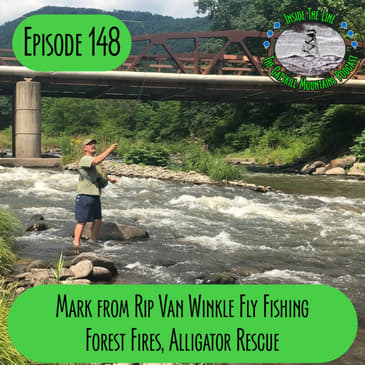
Welcome to episode 148! Tonight, Tad and I chat with Mark from Rip Van Winkle fly fishing! He chats about his business and his passion for fly fishing in the Catskills. We also chat about the forest fires, the crazy drought, an alligator catch in NY and a lot of recent hikes. If you need a sticker, email me or go to Camp Catskill! Subscribe on any platform! Share! Donate! Do whatever you want! I'm just glad you're listening! And remember... VOLUNTEER!!!!!!
Links for the Podcast: https://linktr.ee/ISLCatskillsPodcast, Donate a coffee to support the show! https://www.buymeacoffee.com/ITLCatskills, Like to be a sponsor or monthly supporter of the show? Go here! - https://www.buymeacoffee.com/ITLCatskills/membership
Thanks to the sponsors of the show!
Outdoor chronicles photography - https://www.outdoorchroniclesphotography.com/, Trailbound Project - https://www.trailboundproject.com/, Camp Catskill - https://campcatskill.co/, Scenic Route Guiding - https://adventurewiththescenicroute.com/, Another Summit - https://www.guardianrevival.org/programs/another-summit
Links:
Rip Van Winkle Fly Fishing, Jennings Creek Fire, Alligator Capture, Mt Whitney Rescue, Drought Halts Aqueduct Plans
Volunteer Opportunities:
Trailhead stewards for 3500 Club - https://www.catskill3500club.com/adopt-a-trailhead?fbclid=IwAR31Mb5VkefBQglzgr
fm-hGfooL49yYz3twuSAkr8rrKEnzg8ZSl97XbwUw, Catskills Trail Crew - https://www.nynjtc.org/trailcrew/catskills-trail-crew, NYNJTC Volunteering - https://www.nynjtc.org/catskills, Catskill Center - https://catskillcenter.org/, Catskill Mountain Club - https://catskillmountainclub.org/about-us/, Catskill Mountainkeeper - https://www.catskillmountainkeeper.org/, Bramley Mountain Fire Tower - https://bramleymountainfiretower.org/
Post Hike Brews and Bites - Colonial Inn
#flyfishing #catskillsflyfishing #flyfishingcatskills #ripvanwinkle #forestfires #jenningscreek #husdonvalley #hikingNY #kaaterskill #bluehole #catskillhiking #visitcatskills #catskillstrails #catskillmountains #catskillspodcast #catskills #catskillpark #podcast #catskillshiker #volunteers #catskillmountainsnewyork #catskillspodcast #catskillshiker #catskillshiking #hiking #catskill3500club #insidethelinecatskillmountainspodcast #volunteercatskills #catskill3500 #hikethecatskills
[00:00:30] The bushwhacks were some of the worst days I've ever had in the mountains, or life really.
[00:00:37] Whereas Pansom Mountain is totally opposite, it's a mountain on top of a crater.
[00:00:42] I think the weather challenges on this incident were particularly difficult.
[00:00:48] It is really the development of New York State. Catskills are responsive.
[00:01:09] So as I was saying, the last time I was at Snyder's with Davis, this guy who was sitting at the bar comes over and asks us if we want some venison.
[00:01:23] And sure enough, he is a local guy and he's got this spread that he put out on a table in the main area of Snyder's with potatoes and vegetables and some venison.
[00:01:37] I didn't try it, but Danny did. I guess it's good.
[00:01:40] I mean, he, you know,
[00:01:41] Already made?
[00:01:42] Yeah, it was all, it was like, oh, he had a little buffet spread set up.
[00:01:45] Jesus. Why?
[00:01:47] Why isn't Snyder's the greatest place in the Catskills known right now?
[00:01:51] Well, it is. That's incredible.
[00:01:52] And part of the reason it's so great is because nobody knows there, knows of it, and those who do don't go other than, you know, the hardy, hardcore ones.
[00:02:01] So at any rate, you're going to start recording?
[00:02:04] What?
[00:02:05] Oh yeah, yeah, yeah, yeah, yeah.
[00:02:07] 148.
[00:02:08] Let's get going.
[00:02:08] Let's get going.
[00:02:09] I don't have all night for this.
[00:02:11] So 148.
[00:02:12] Mark from Winkle Fly Fishing is going to talk with us tonight about his fly fishing in the Catskills, how he's been up here almost all of his life,
[00:02:20] how it became a dream.
[00:02:21] And now he is doing it as a career.
[00:02:24] So it's going to be a phenomenal night.
[00:02:26] Sounds good.
[00:02:27] So, you know, tonight we have a lot of kind of stuff to talk about pregame.
[00:02:33] I would say we have historic lack of rainfall in the watershed area, the New York lower part of New York's state.
[00:02:44] And the mayor's office commissioner has elevated New York City's drought level to a warning now.
[00:02:51] And the New York DC is also to carry a drought warning for New York City in 10 counties in the watershed area.
[00:02:58] The Delaware aqueduct repair project will pause out of caution.
[00:03:03] And they urge all New Yorkers to save water whenever possible.
[00:03:08] You know, I'm pretty sure this is like the most of the people upstate will see this, but nobody downstate will see this or care.
[00:03:15] So we're trying everything we can for you people down in New York City area.
[00:03:20] So, but what, what do they exactly do when they run out of water?
[00:03:25] Cause you, I don't think that's ever happened.
[00:03:27] I know, but you were in the reservoir.
[00:03:28] You took those photos of, you could have walked from one side to the other.
[00:03:34] What do they do?
[00:03:35] What do they do when they run out of water?
[00:03:37] It was, you know, it looked in those, in those pictures and in that video, it looked like it was right across the street, but it wasn't, it was probably like 200 yards away that I could walk across.
[00:03:48] Uh, I'd had to walk across the water.
[00:03:51] I'd have to be Jesus, but I'd have to say, you know, looking at where I was, it was probably, probably 20 feet lower than what it should be.
[00:04:03] And then there's another probably 20 to 30, maybe 40 feet going down to the bottom of that valley area.
[00:04:10] And, and the ground you were on was rock hard.
[00:04:13] Oh yeah.
[00:04:14] There was soft spot.
[00:04:16] There was really soft spots that I thought I was going to sink.
[00:04:19] I was just like, this is not safe.
[00:04:20] But then there was a, I mean, we'll, we'll talk about it later.
[00:04:24] Of course.
[00:04:25] I mean, let's not give it that.
[00:04:26] That was, that was my highlight of the week.
[00:04:28] So.
[00:04:29] All right.
[00:04:30] Of course there's a drought warning, but of course we're recording Tuesday.
[00:04:33] So there's rain and snow on the way.
[00:04:35] And we'll be talking about that later with the forecast, but we have rain and snow on the way.
[00:04:39] Lower elevations got a pretty good amount of rain coming in one to two inches.
[00:04:44] I've heard in, in two days, Thursday to Friday, and then snow up high.
[00:04:50] I've heard possibly up high above 3,200 thirties of the 4,100 feet and slide 4 to 12 inches.
[00:05:00] That's a bitty, pretty big.
[00:05:02] Yeah.
[00:05:03] Sweet.
[00:05:03] But it's, it's, it's that, it's that heavy snow.
[00:05:07] So.
[00:05:07] That's this time of year.
[00:05:08] That's the best snow packs down.
[00:05:10] Nice.
[00:05:10] It does.
[00:05:11] It does.
[00:05:12] But breaking trail by yourself is horrible in that shit.
[00:05:15] But it's, you know, at the higher elevations.
[00:05:17] So it's going to vary between 32 and 36, 4,000.
[00:05:23] And it doesn't drift that much.
[00:05:24] If it's heavy snow.
[00:05:26] True.
[00:05:27] It, you know, it's beginning of the season.
[00:05:29] It'll be fun.
[00:05:30] Get out there, bring your snowshoes.
[00:05:33] Have a good time.
[00:05:35] Yeah.
[00:05:36] Yeah.
[00:05:36] Now it's, I mean, I've, I, it sounds really weird, but I packed my spikes in my pack for
[00:05:42] about a month now.
[00:05:43] I haven't yet.
[00:05:45] Yeah.
[00:05:45] I've said they've stayed there to pack two pairs.
[00:05:48] That's why my pack is so goddamn heavy.
[00:05:50] Not mine.
[00:05:52] Yeah.
[00:05:52] And I, not your 30 liter, 30 gallon pack or whatever the hell it is.
[00:05:57] I'm at, I'm at 19 pounds without traction gear, 19 pounds with water, no traction gear.
[00:06:05] Yeah.
[00:06:06] And I'm, and I'm well equipped at 19 pounds.
[00:06:08] It's not like I'm cutting corners.
[00:06:10] How many of the essentials do you have?
[00:06:12] How many of the essentials?
[00:06:14] Oh, I mean, you can admit.
[00:06:16] Yeah.
[00:06:16] I have all the essentials.
[00:06:19] Um, nice.
[00:06:21] Yeah.
[00:06:21] I, I can't think of anything that's an essential.
[00:06:24] I even have like a battery charger in there now.
[00:06:27] Oh, that, that, that's a significant weight.
[00:06:29] I gotta admit those things.
[00:06:31] Yours is mine's mine.
[00:06:33] Mine's only like 5,000, whatever.
[00:06:36] Compared to my 30,000.
[00:06:38] Yeah.
[00:06:38] Yeah.
[00:06:38] You could power a city.
[00:06:40] I could just get enough charge on my cell phone and GPS to send a signal.
[00:06:46] If I had to, that's all I need.
[00:06:48] Yeah.
[00:06:49] I mean, it's not like I'm, it's not like I'm out in the middle of death valley and I need
[00:06:53] three, four days of charge.
[00:06:55] All I need is enough, enough to send out a signal that I'm alive.
[00:07:00] Send beer.
[00:07:01] Yeah, exactly.
[00:07:03] Um, and then, you know, we're talking about the, the drought area that that's happening.
[00:07:11] And the Jennings Creek fire that we've, we've had the peak of moose, the peak of moose fire,
[00:07:16] which was called the, what's that fire called?
[00:07:18] Uh, white house.
[00:07:20] The white house fire.
[00:07:21] That's apparently that have started from a local burning.
[00:07:24] That's somebody was burning stuff.
[00:07:27] Exactly.
[00:07:27] I saw that earlier that they said that a local burning was, was causing that.
[00:07:32] So, um, that is all contained.
[00:07:35] It is being patrolled right now.
[00:07:37] Uh, the hot areas that once were that they thought would kind of spark up as being patrolled.
[00:07:41] So that's good.
[00:07:43] Most of the fires and New York state are being patrolled right now.
[00:07:47] And just being kind of contained as a blow a one to two person to fire for flight fighter,
[00:07:52] uh, ranger ratio.
[00:07:54] But the Jennings Creek fire is now 90% contained.
[00:07:59] And this is as of today, which is Tuesday, but they are still claiming that it's still on
[00:08:08] the rain.
[00:08:08] Like it's, it's not controllable yet, but they think they're going to be controlling
[00:08:13] it within the next couple of days due to the rain that is coming.
[00:08:17] The Hudson Valley is supposed to get some significant amounts of rain.
[00:08:20] So what's interesting about that Jennings Creek fire is unlike the white house fire.
[00:08:24] Jennings Creek is right on Greenwood Lake.
[00:08:27] They didn't have to go far to get water, you know, and the, the helicopters, whereas up at
[00:08:33] white house, the, uh, city wasn't allowing them to take water out of the reservoir.
[00:08:40] So, so, so down in Jennings Creek, they had a ready supply of water and it's a pretty well-developed
[00:08:48] area with some rather expensive homes.
[00:08:51] So they had a lot to do to maintain that.
[00:08:54] And, you know, with that, uh, you know, the area was the terrain is actually where it was located.
[00:09:02] Coming down into the houses was actually very difficult terrain.
[00:09:05] You only had one access point and that was a road.
[00:09:08] And that was high elevation, not highly elevation area, but just a steep elevation to get, you know, rescue
[00:09:15] vehicles up there to get UTVs, ATVs, to get the hoses up there.
[00:09:20] It was difficult.
[00:09:20] So they kinda, the good thing is this is, this was an underbrush.
[00:09:26] Mostly all of it was underbrush.
[00:09:28] It caught quick.
[00:09:29] And as it died down, it just died down.
[00:09:32] It wasn't the trees.
[00:09:33] We, we saw this happen, of course, over, you know, in the Western areas where just everything
[00:09:39] catches fire.
[00:09:40] It's not just the underbrush is the trees and everything.
[00:09:42] And it just sparks an insane 5,200 acres so far is pretty significant in New York state.
[00:09:51] Do you know who used to own a house on Greenwood Lake?
[00:09:57] Derek Jeter.
[00:09:58] No way.
[00:09:59] No way.
[00:09:59] Derek Jeter.
[00:10:00] Yeah.
[00:10:01] He, he had a house.
[00:10:02] Um, they called it a castle, no surprise.
[00:10:05] And it was sold, it was sold this past, uh, summer for $5.1 million.
[00:10:12] He had been trying to sell it for a while.
[00:10:14] I don't know where it is in relationship to that fire.
[00:10:18] I can find that out, but yeah, yeah, we can stock them.
[00:10:21] Derek Jeter.
[00:10:22] Yeah.
[00:10:22] Just over the New Jersey state line, Greenwood Lake.
[00:10:26] Oh, wow.
[00:10:27] Yeah.
[00:10:27] So, I mean, they're, they're still, they're still containing it.
[00:10:30] They're doing, uh, pretty phenomenal.
[00:10:33] They've done a phenomenal job with the volunteer firefighters, the DEC, the DEP, the New York
[00:10:38] state troopers, the Rangers.
[00:10:40] They've all come together and battled this thing, uh, like a beast.
[00:10:45] And it just, it's just been such a great coordination between all organizations.
[00:10:50] And, uh, we, we thank you greatly for what you've done.
[00:10:53] You know, I, I talked to slate about the P who moves fire and he said, you know, like,
[00:10:57] luckily it's contained, everything is open.
[00:10:59] All the roads are open and such like that.
[00:11:01] And, uh, as a, he said, uh, I'm going from the peak of Moose fire down to the Sterling
[00:11:07] fire, which was, uh, wasn't it later named?
[00:11:10] And of course the Jenning Creek fire, but, uh, just, just amazing to hear that from him.
[00:11:15] And, and to, to have that communication once again, with the Catskills Rangers and stuff
[00:11:20] like that is phenomenal.
[00:11:21] And I kind of feel privileged just to, to, to have that coordination with them, to, to let
[00:11:27] you guys know, to let the listeners know, the hikers know what's going on here in the
[00:11:33] Catskills and here in the other areas.
[00:11:35] So awesome job by everybody to contain that fire, to not let it burn.
[00:11:40] As if we see in the pictures, not let it have any, or like, uh, structures for get fire to
[00:11:46] how close it was.
[00:11:47] I, those pictures were just absolutely insane to be like, from the pictures that looked like,
[00:11:53] you know, 200 feet and to 200 feet, I'd be freaking the fuck out.
[00:11:57] Yeah.
[00:11:58] Yeah.
[00:11:59] That's a, that's a hard thing to deal with, man.
[00:12:02] Imagining your, your house going up in flames.
[00:12:05] I mean, you got a lot of memories, a lot of, you know, heirloom, uh, belongings in your
[00:12:10] house and yeah, to be forced to evacuate quickly, not a, not a pleasant situation
[00:12:17] to be in.
[00:12:18] So we're thankful for our firefighters and Rangers.
[00:12:21] Yeah.
[00:12:22] They've been doing awesome jobs and mostly those, those have all been volunteer.
[00:12:28] Like for those firefighters have been volunteer.
[00:12:30] So it's, it's been absolutely incredible.
[00:12:33] So thank you once again, great update on the fire that has been crazy in, in New York state.
[00:12:39] So we talk about the fire.
[00:12:41] We talk about the drought.
[00:12:43] Now, uh, I heard there could be a derail.
[00:12:47] I mean, we've talked about it earlier on the $2 billion New York city project that goes
[00:12:52] with the Catskill aqueduct under the Hudson river.
[00:12:55] Now that has to do with a course, uh, my, my little weekend excursion that happened over
[00:13:00] here at the captain.
[00:13:03] And you know, for some reason I can't access that Tad, uh, because I don't have a times
[00:13:10] union account.
[00:13:11] I used to, but apparently they derailed that.
[00:13:13] They probably found that I was bad mouthing them all the time and they kicked me out of
[00:13:17] there.
[00:13:18] So, so yeah.
[00:13:19] So the Catskill aqueduct is being repaired.
[00:13:22] This is going on by my memory is being repaired.
[00:13:25] There's a couple areas below the Hudson river.
[00:13:27] Of course that is being repaired.
[00:13:29] And if you ever know about the Caxill aqueduct that goes a thousand beat below the river to
[00:13:36] access between the river, uh, and like bear mountain, right?
[00:13:41] Yeah.
[00:13:42] Um, actually while bear mountain is on the Western side of the river, the, uh, Catskill
[00:13:48] aqueduct goes under the Hudson river in or around, uh, Newberg and comes up on the other
[00:13:56] side.
[00:13:56] But the reason that this is an issue is they were planning on taking the Catskill aqueduct
[00:14:02] offline and using the Delaware system to supply the city.
[00:14:06] But the problem is there's not enough water in the Delaware system to just draw on it with,
[00:14:15] without it being fully charged up.
[00:14:18] So they need to have both systems continuing online.
[00:14:22] And I think this is the third time in the past three years that they've not been able to go
[00:14:27] forward with their plans.
[00:14:29] Yeah.
[00:14:29] I mean, it's, it's 80 years old.
[00:14:31] I mean, it's been sustained for over 80 years, like around, around 80 years.
[00:14:36] And I gotta admit one of the most greatest creations of, I wouldn't say American history, but you
[00:14:44] know, the world that we, we do not have an aqueduct that is this amazing, that the supplies
[00:14:49] this much, this long down to, to any area than here.
[00:14:55] So we have the awesome, uh, privilege to say that we have the Catskill aqueduct built
[00:15:01] under us and they are repairing leaks and such like that.
[00:15:03] So it's, you gotta admit the coordination between the five reservoirs that we have up here.
[00:15:10] We got the Ashokan, the Pakape, oh, excuse me, Skahari, Roundout and the NeverSink that goes
[00:15:16] into this all-catchville aqueduct.
[00:15:18] And it feeds into down into the, the New York city area.
[00:15:22] I mean, you have got a lot of coordination to do that and it's gonna cost a lot.
[00:15:29] And it's, it's gonna take a lot of repairs.
[00:15:33] And especially when, once again, when you built this 80 years ago, you know, 1955 was
[00:15:40] when the Pakaptin was last flooded and then it had, you know, the water flowing and to,
[00:15:45] to, to be substantial for this long.
[00:15:49] I mean, I know you said there's been repairs for this last three couple of years and they've
[00:15:53] been thwarted.
[00:15:54] Do you think, I know, I know, I don't wanna go into these, these negative areas, but I
[00:15:59] mean, everybody has their opinions about climate change, but is it, do you think this climate
[00:16:05] change or it's just, it, anybody has it.
[00:16:08] Well, yeah, you know, you, you do have variations and rainfall over a long cycle like this.
[00:16:14] I mean, it's been a long time since we've had a drought of this magnitude in, in this area.
[00:16:21] And is this a sign of things to come or not?
[00:16:24] I mean, you know, you just don't know, but it, it doesn't mean that you should scale back
[00:16:31] on your efforts to reduce your carbon footprint.
[00:16:36] Yeah.
[00:16:37] Reduce the amount of waste that you put into landfills and you should in general, just be
[00:16:43] more conscientious about conserving resources and not wasting things.
[00:16:48] Reduce?
[00:16:49] Yeah.
[00:16:50] Whether or not it impacts on repairing the aqueduct or not.
[00:16:53] Yeah.
[00:16:54] Reduce, reuse, recycle.
[00:16:55] Yeah.
[00:16:56] That's what we say here.
[00:16:57] Jessica, my, my wife is very firm on that.
[00:17:01] I'll be screamed at if I do, if I don't re reduce or recycle something that we can.
[00:17:08] Yeah.
[00:17:08] Some, some communities and some countries are very, very conscientious on reducing the amount
[00:17:15] of waste that they put into landfills.
[00:17:17] And I don't think in the Hudson Valley or in the Catskill area, it's not as much of a concern
[00:17:25] as it should be.
[00:17:26] It definitely should.
[00:17:28] And we talked about that with the incinerator, like, you know, what, what would people think
[00:17:35] if they were going to build an incinerator?
[00:17:38] Yeah.
[00:17:41] One of the things that I saw this week and maybe I'll shoot you some news articles on
[00:17:45] it is the County of Ulster is looking into building a landfill in Weawarsing.
[00:17:53] So Weawarsing is just on the Eastern edge of the Catskills.
[00:17:59] Lower, lower, Southern part of Ellenville, right?
[00:18:02] Like below Ellenville?
[00:18:03] It's just North of Ellenville.
[00:18:04] Oh, North.
[00:18:05] Sorry.
[00:18:07] That's a little, it's never going to fucking happen.
[00:18:09] Sorry.
[00:18:10] Yeah.
[00:18:10] You say that, but if you, if you live in Ulster County, I think the political forces in the
[00:18:16] County would favor something going in that area because that's not densely populated.
[00:18:24] It's how many, you said there was like how many incinerators in America?
[00:18:29] Like what?
[00:18:29] I don't know how many, but yeah, I don't know any that are working.
[00:18:35] Yeah, exactly.
[00:18:37] I think this would happen in New York state.
[00:18:39] No.
[00:18:40] Yeah.
[00:18:41] Yeah.
[00:18:41] I know we've had an incinerator company here in Orange County.
[00:18:44] That's been, been trying to get off the ground for, I don't know how long.
[00:18:48] And as far as I know it, it's still not as operational.
[00:18:51] I, I, they might've even given up on it.
[00:18:54] Yeah.
[00:18:54] We just gotta, we just gotta all come together and influence each other on how to reduce,
[00:18:59] reduce the cycle.
[00:18:59] It's not that difficult.
[00:19:00] Yeah.
[00:19:01] As we see recently with the white house road and Jennings Creek.
[00:19:05] Yeah.
[00:19:05] Burning things is not a good way to solve your problems.
[00:19:08] Especially when it's, when it's goddamn desert conditions out here.
[00:19:12] So, all right, move on better, bigger and better things.
[00:19:16] Uh, 23 year old becomes the youngest to summit the 14 highest peaks in the world.
[00:19:21] So Adriana Brownlee became the youngest woman to scale the world's first or the 14 summit
[00:19:28] peaks, which are more than 8,000 meters high, 26,000 feet.
[00:19:33] Uh, she's from London, 64th person to do this, the world officially.
[00:19:37] Um, but she is the first, uh, to do it at this age and, and this quickly.
[00:19:43] And, uh, she says she hopes to inspire people around the world that, uh, there is no path
[00:19:48] in life and that you can do whatever you want.
[00:19:50] Uh, she reached a summit of, uh, you know, I'm going to try to say this, but it's, it's
[00:19:57] shis shiske pagama.
[00:19:59] Yeah, that's pretty good.
[00:20:01] What was that stosh?
[00:20:01] Shiske pagama.
[00:20:02] You're breaking up on a stosh.
[00:20:04] Shiske pagama in Tibet.
[00:20:06] Just, just move along.
[00:20:08] Was challenging, emotional, and she started to cry to you reaching the top.
[00:20:11] So that was her last summit.
[00:20:12] Uh, and she definitely is an inspiration.
[00:20:17] Of course, 23 years old.
[00:20:20] Uh, 23 years old.
[00:20:21] I wasn't even starting to hike yet.
[00:20:24] So what is the most remarkable thing about that story?
[00:20:29] Uh, what, what's Dan, what stands out to me in the year 2024, when we have all of this
[00:20:37] technology available to us and everything is so widely publicized, she's only the 64th
[00:20:45] person to have done this.
[00:20:47] Good point.
[00:20:48] Right.
[00:20:48] Well, I mean, you would think that people that are into this type of adventure, you know,
[00:20:55] there would be hundreds of people that would have this on their list to do all of these
[00:21:01] 14 highest peaks.
[00:21:02] I mean, there's people that set out just to climb the high point in every state in this
[00:21:08] country, which means like, you know, high point, New Jersey, you can drive your car to
[00:21:13] the top, right?
[00:21:14] That's on somebody who's bucket list.
[00:21:16] And here you have this list of these, these, the tallest mountains in the world.
[00:21:22] And only 64 people have done it.
[00:21:26] I think that's amazing.
[00:21:27] Regardless of her age.
[00:21:28] I think that's incredible that only 64 people have done it.
[00:21:31] And she's one of them.
[00:21:33] That's just some tough peaks though.
[00:21:35] Yeah.
[00:21:36] But where do you go from there?
[00:21:37] You're 23, you've climbed the 14 highest peaks in the world.
[00:21:43] And you know, it, it's not just about Everest.
[00:21:46] I mean, Everest, it's almost like taking an escalator ride up.
[00:21:49] There's so much traffic and so much support and technology available there.
[00:21:55] But these, there's a lot of other ones that are harder to get to the top that she summited.
[00:22:01] Where do you go from there?
[00:22:02] Yeah.
[00:22:03] What's next?
[00:22:03] What's her next challenge?
[00:22:06] Catskill 30.
[00:22:07] Yes, definitely.
[00:22:08] Right.
[00:22:08] Just shout it out when you know the answers.
[00:22:10] I'll tag her in this and make sure she gets a like Catskill 3,500 is an extra adventure.
[00:22:16] Yeah.
[00:22:16] And tell her that when she finishes, when she cries summiting Balsam Lake is her final ascent.
[00:22:25] We'll get her on the show.
[00:22:27] We'll get her on the show.
[00:22:28] We'll do it live.
[00:22:29] That'll be the prize.
[00:22:29] Yeah.
[00:22:30] That'll be live broadcasting live from Balsam Lake mountain without a, without a ranger's
[00:22:36] cabin, but with the podcast at the summer.
[00:22:40] Podcast and fricking woman who's summited.
[00:22:43] Oh, I'll have to send a message to her.
[00:22:47] So upon that, you know, we talk about summiting the highest peaks in the world.
[00:22:54] We, we talk about two people who tried to summit Mount Whitney with 150 pounds on their pack.
[00:23:04] 150 pounds.
[00:23:05] You know, I thought my pack was a little heavy, but it was actually more than 150 pounds because they don't include in the 150 pounds.
[00:23:12] The five gallons of water that they were carrying.
[00:23:16] That's, that's a known for me though.
[00:23:18] Yeah.
[00:23:19] So that's, that brings it up to like 180 some pounds.
[00:23:24] Wow.
[00:23:25] 90 pounds per person.
[00:23:26] Yeah.
[00:23:27] Five gallons of water weighs just under 42.
[00:23:29] Yeah.
[00:23:29] I don't know how much you weigh, but I couldn't imagine strapping a 90 pound pack on my back and then climbing into L trying to climb into altitude.
[00:23:40] Yeah.
[00:23:42] Mount Whitney tallest mountain in the continental United States, the continental United States, a 22 mile hike.
[00:23:50] Uh, one of them have packed three liters of water, breakfast, lunch, and snacks.
[00:23:54] The other had packed five liters of water.
[00:23:57] First aid kit, a water filter, a couple more pieces of gear, a total weight for the day.
[00:24:02] Uh, they said for the day, 19 pounds, but then they added everything else between them was 150 pounds.
[00:24:10] Each of them weighing roughly around 96 pounds of weight on their backpacks.
[00:24:20] You know, I picked up mine and it was like 22 pounds at the most.
[00:24:24] And I'm like, what the, what, what type of packs are these that can carry that kind of weight?
[00:24:30] Yeah.
[00:24:32] Um, that's, they didn't say that.
[00:24:36] So of course they didn't make it far.
[00:24:38] They started their truck at the six.
[00:24:41] You know, sometimes I don't read these until now so I can get my full reaction.
[00:24:46] Yeah.
[00:24:47] 6 PM Friday, November 1st, 6.
[00:24:51] PM.
[00:24:52] Um, yeah.
[00:24:53] So they were going to hike in late in the day, set up camp and then leave from camp in the morning.
[00:24:59] That's kind of typical for Whitney.
[00:25:01] I was going to do it with my daughter.
[00:25:02] We tried to get permits one year, but we couldn't.
[00:25:05] So 6 PM though on November.
[00:25:08] Yeah.
[00:25:09] Yeah.
[00:25:09] That's like fricking like, like there's snow up there.
[00:25:12] Number one.
[00:25:12] And number two, the sun goes down at 4 30.
[00:25:15] Keep reading.
[00:25:16] It gets better.
[00:25:17] Um, so they hiked 2.7 miles in and became too exhausted and stopped around 3 AM.
[00:25:22] So that, so 6, 7, 8, 9, 10, 11, 12, 1, 2, 3.
[00:25:28] So 2.7 miles, it took them eight hours.
[00:25:32] Yeah.
[00:25:33] Right.
[00:25:34] They're not doing too well.
[00:25:35] This was going to be like a two week thing.
[00:25:37] That's why they needed all that gear.
[00:25:38] We make fun of them for having like 96 pounds of gear.
[00:25:41] But at that rate, it was going to take them a lifetime to make it to the top.
[00:25:46] I hate to make fun of them, but God, yeah.
[00:25:49] Yeah.
[00:25:50] 8 hours for 2.7 miles.
[00:25:53] Keep reading.
[00:25:54] Keep reading.
[00:25:54] It gets better.
[00:25:55] The best part yet.
[00:25:57] Yeah.
[00:25:57] These in your search and rescue people have always been there.
[00:26:00] They're always up on Mount Whitney, so they're ready to go.
[00:26:03] They woke up to Paris still shower that has filled their snoot shoes.
[00:26:07] So lucky they had reached their limit and called for help via iPhone on the SOS sit in.
[00:26:12] So that new setting is, is kind of working by 10 AM Saturday.
[00:26:16] The search and rescue team was on the move.
[00:26:18] They reach them by 1 40 PM.
[00:26:20] So that shows you how long it could take for a search and rescue team.
[00:26:24] That's like three hours.
[00:26:25] Uh, escorting the mountain down by 3 15 PM.
[00:26:30] They were new to the trails.
[00:26:31] They had to buy all their year for this hike and the sheer amount they brought with the would
[00:26:36] give the hikers their strongest pause among the 450 pounds of gear.
[00:26:41] They didn't bring a map, a bear canister or water filter.
[00:26:45] Kind of like the most that the map and the, on the water filter are the most important things.
[00:26:50] The last item that was helpful was the trail that they were willing to climb up.
[00:26:57] So they didn't even bring a map of the trail that they were in the climb up.
[00:27:02] There's definitely a lot of resources up there.
[00:27:04] I mean, they have snow, they have lakes.
[00:27:07] Um, definitely be in the mall tallest mountain, the lower 48.
[00:27:10] Mount windy is definitely.
[00:27:13] One of the coolest.
[00:27:14] I mean, Ted said he was going to go up.
[00:27:15] So it gotta be cool.
[00:27:16] It's gotta be cool.
[00:27:17] Instagram coast, especially when you get to the top.
[00:27:20] That's, that's the only reason I was going to do it.
[00:27:22] I mean, not, not because I was going to do it with my daughter.
[00:27:24] It was just all about the Instagram posting opportunity that it presented.
[00:27:29] So exactly.
[00:27:30] I'll keep working on that.
[00:27:32] And, you know, of course we've always heard from Mount Whitney and, and stuff like that.
[00:27:37] It's, it's happened many cases, actually there's two or three people that have died from there.
[00:27:43] I've probably more than that in the past couple in the past year.
[00:27:47] Sure.
[00:27:48] You know, there was a famous actor, right?
[00:27:49] There was a famous actor and there was an Instagram, uh, uh, inspiration girl that, that died from up there.
[00:27:57] So, yeah.
[00:27:59] So, but what, what I see is that they apparently bought all of this gear for this particular hike that this was like, you know, let's go to REI, grab a couple hundred pounds of gear and then set off to Mount Whitney.
[00:28:17] Right.
[00:28:18] With our brand new gear.
[00:28:20] And we left our shoes out or boots out.
[00:28:24] So they got snow in them.
[00:28:26] So we were going to start off hiking again with super cold feet.
[00:28:30] There was just a lot of mistakes going on here.
[00:28:33] Definitely.
[00:28:34] And yeah.
[00:28:35] So you know what they forgot to do?
[00:28:36] You know what the most important thing that these two should have done that they didn't do.
[00:28:41] Take a selfie, uh, where they were rescued.
[00:28:44] No, no, no, no, no.
[00:28:46] They needed to listen to episode one 46 winter hiking gear revisited.
[00:28:52] Nice.
[00:28:53] Yeah.
[00:28:54] Had they listened to episode one 46, they would have, they wouldn't have made all these gear mistakes.
[00:29:01] Okay.
[00:29:01] I'm just pointing that out.
[00:29:03] I mean, that's a fact.
[00:29:04] It is a fact that, you know, we, we went over a lot of great stuff with, with that episode.
[00:29:10] And we, we kind of scoured the lines, you know, if you, if once again, uh, if you need to reach out and ask any questions, Ted and I have our list of stuff that we could be able to reach out to you about that we've bought and stuff like that, that could help you out.
[00:29:25] Let me know.
[00:29:25] Uh, and you know, the morals of this story is they say, don't pack too much.
[00:29:32] Uh, make sure you have the essential gear, but also make sure you are physically prepared to take on a challenging height.
[00:29:39] Cause you'd never know.
[00:29:41] Like, I mean, Mount Whitney is absolutely insane.
[00:29:45] And, uh, and if I mean, 150, like 96 pounds per person.
[00:29:52] Uh, it's a little tough.
[00:29:54] It's unmanageable, right?
[00:29:55] Unmanageable.
[00:29:56] That's like Appalachian trail kind of stuff back in the sixties.
[00:30:01] Yeah.
[00:30:02] Back, back in the seventies, I, I had a heavy pack, but it wasn't even half that.
[00:30:07] I mean, but did you find alligators back then?
[00:30:11] Uh, no, I, I actually, back in the seventies, we weren't finding alligators in Hudson Valley Creek.
[00:30:19] Why don't you tell us about that stosh?
[00:30:21] It sounds interesting.
[00:30:22] So first you gotta tell me where the Hudson Valley Creek is.
[00:30:26] Do you know?
[00:30:27] Um, I don't know, but while you start off, I'm gonna, I'm gonna cut and paste that into.
[00:30:32] I was gonna say, I would do that as well.
[00:30:35] Our research assistance window.
[00:30:37] And I'm gonna get, uh, our research assistant, uh, sunny days looking at that.
[00:30:43] Uh, so recently the DEC rescued an alligator that was captured, uh, in a great deal of interest
[00:30:52] with the community.
[00:30:52] So the herpetology, uh, expert from the Bronx Sioux came by and took a look at their friend
[00:30:59] that was in the Hudson Valley Creek and he is in pretty good shape.
[00:31:03] So there's a boy, uh, they have two names for him, Felipe or AIE Gator, AIE Gator.
[00:31:11] Interesting.
[00:31:12] And they found him up in the Hudson Valley Creek.
[00:31:15] Uh, the DEC help, uh, was assisting him in placement, which is pretty tough in New York
[00:31:23] State because there are really no alligator kind of specific areas.
[00:31:27] So hopefully they'll bring them back down south, but big, very, uh, big question mark was how
[00:31:33] do you get paired?
[00:31:33] Uh, this wasn't the first alligator.
[00:31:35] I know there's one that was found all the way up kinda above near me.
[00:31:39] And, uh, Oh, what was it?
[00:31:42] Uh, up near Biggumton area, Whitney point, which is pretty far up.
[00:31:48] So, uh, just to find an alligator up here, I don't wanna go swimming anymore.
[00:31:54] Uh, where's the Hudson, where's the Hudson Valley Creek.
[00:31:57] Did you find out?
[00:31:57] Uh, yeah, it's in, uh, have a straw, which is on the Western side of the Hudson near Stony
[00:32:06] Point, new city area.
[00:32:10] Yeah.
[00:32:11] I have no clue where that is.
[00:32:12] So at least I'm glad that's not near us.
[00:32:15] Yeah.
[00:32:15] Lower Hudson Valley getting closer to, to New York city.
[00:32:19] Very, very populated area.
[00:32:22] All right.
[00:32:23] All right.
[00:32:23] So I'm glad that, uh, that that's with gators apparently, apparently.
[00:32:30] So, uh, the DEC once again, thank you for getting this alligator.
[00:32:36] I don't, it doesn't say how they were spot, how they spotted that alligator.
[00:32:39] That must've been up on the Creek side or something like that.
[00:32:42] Yeah.
[00:32:42] All's I know is this somehow strangely reminds me of what the DEC should be doing and what
[00:32:48] they shouldn't be doing and that is they should be capturing alligators and not pet squirrels.
[00:32:57] Ah, God, man.
[00:32:59] You had to bring it up.
[00:33:00] I had to talk that up today with my friend.
[00:33:02] Yeah.
[00:33:03] So we, maybe on a, uh, another episode, we'll get into the lawsuit, which apparently has now
[00:33:09] been filed or will be filed against the DEC.
[00:33:13] Yeah.
[00:33:13] You fought, you sent me that today.
[00:33:14] Didn't you?
[00:33:15] Yeah.
[00:33:16] Yeah.
[00:33:16] Our friend peanut the squirrel.
[00:33:19] So if you were related, we'll have to get him on the, on the show.
[00:33:24] Definitely.
[00:33:24] I'll have to send a message to him.
[00:33:26] We'll get a whole thing going.
[00:33:29] All right.
[00:33:30] So that's all it for the news.
[00:33:32] So thank you to the monthly supporters, Darren white.
[00:33:34] Thank you for Mike.
[00:33:36] So Tosky, Tom, who is Jim C.
[00:33:38] Betsy, a Denise Vanessa, Joseph, Jim and Michael.
[00:33:43] Love you guys.
[00:33:43] Thank you very much for supporting the show.
[00:33:45] Really appreciate it.
[00:33:46] Also caps.
[00:33:47] Your love story against breathtaking backdrops with outdoor Chronicles photography.
[00:33:52] Molly from outdoor Chronicles photography specializes in adventure, a boatman and adventure
[00:33:57] couple of photography, and she'll immortalize your moments.
[00:34:00] And that's the stunning landscapes of the Catskills, Adirondacks and white mountains.
[00:34:05] She'll craft timeless images that reflect unique bond and nature's grandeur and mark on an unforgettable
[00:34:10] photographic journey with outdoor Chronicles photography.
[00:34:14] Don't hesitate to get ahold of Molly on all platforms.
[00:34:17] Also discover the wilderness with Cheryl bomb project.
[00:34:20] Our expert led hiking and backpacking education programs offer unparalleled outdoor experiences.
[00:34:26] Whether you're a beginner or seasoned adventure, join us to learn essential skills, explore stunning
[00:34:32] trails and connect with nature.
[00:34:34] Start your journey today with trailbound project and unlock the wonders of the great outdoors.
[00:34:40] So coffees, if you want to, well, hard ciders mentions.
[00:34:45] If you want to donate hard ciders that could help support your approach to put the show, go ahead.
[00:34:50] I have a link in the show notes or you can ask me and you can just donate some hard ciders through buy me a coffee
[00:34:56] slash hard cider and mentions.
[00:34:59] We got a lot this week.
[00:35:01] Holy crap.
[00:35:02] Yeah, that's great to see.
[00:35:03] That's great to see.
[00:35:04] We have some, we have some repeat offenders here too.
[00:35:06] We do.
[00:35:07] We definitely do.
[00:35:09] So scion 72, Sean, I knew she did equip Luke hike and checked out some old abandoned mines located
[00:35:16] in a popular Hudson Valley park.
[00:35:18] The trails were clean, no blow downs.
[00:35:21] And I didn't see anyone not like the cat skills that I took earlier this week where he was up on
[00:35:27] Thomas Cole and Campbell's hump where he totally shamed me for not doing my trail work, which I later found out was a lie.
[00:35:37] So thanks, Sean.
[00:35:38] Todd also, Todd bold went to the Ashokan reservoir and checked out the low levels, took some amazing pictures.
[00:35:45] So check him out on his photos were just absolutely insane on the Shokan reservoir.
[00:35:52] So that's at Todd bold.
[00:35:54] Yes.
[00:35:55] To see his photos.
[00:35:56] Yeah.
[00:35:57] Instagram.
[00:35:58] So pink pony, 818.
[00:36:00] She has been like you said, Ted, a repeat offender.
[00:36:04] Not really, but she had a beautiful day on the Appalachian trail in Kent, Connecticut, 8.6 miles from 341 south to Bulls
[00:36:12] bridge.
[00:36:12] Great views and sunshine out the way.
[00:36:15] They saw one hiker and only one hunter hiker.
[00:36:19] He was head to cone camel, but you can't hike on the AT.
[00:36:24] You probably tricking the trail back.
[00:36:25] So snake was too scared to crap the crowd up out of her.
[00:36:30] And it was mid November.
[00:36:33] And she had a post hike try on 45 on main.
[00:36:39] So post hike tries.
[00:36:41] Once again, you said that expensive, right?
[00:36:44] Well, I don't know.
[00:36:45] I don't know.
[00:36:45] I mean, she, she reports that no, they're not.
[00:36:48] They're the, the drink of the common person.
[00:36:52] So I'm checking out 45 on main right now.
[00:36:54] So setting Connecticut.
[00:36:56] Yeah.
[00:36:57] It looks that way.
[00:36:58] So, so local coffee, ice cream, chocolates, candy, and more 45 North main street, Kent, Connecticut open Monday through Thursday, Friday,
[00:37:08] Saturday, Sunday.
[00:37:09] Got some nice photos here.
[00:37:11] Reader's choice awards.
[00:37:13] So it sounds like a good place to go.
[00:37:15] Sounds pretty popular.
[00:37:16] Yeah.
[00:37:17] So next time I'm in Kent, uh, I do have a funny Kent story.
[00:37:21] I won't tell, but yeah, next time I'm Kent, I'll check it out.
[00:37:24] All right.
[00:37:25] Same here.
[00:37:26] So Rachel Jean, the gypsy queen, uh, had post hike, hike bruising bites at Westkill.
[00:37:32] So I, she didn't say what she did before.
[00:37:36] So I, I hope in there that Rachel, the gypsy queen is a woman.
[00:37:41] I wasn't mistaken last time.
[00:37:43] Uh, so, uh, she didn't say what she did before, but Westkill is an awesome place for post hike, bruising bites.
[00:37:50] Yeah.
[00:37:50] Well again, check out her Insta and you can see what Rachel queen, Rachel Jean, the gypsy queen was up to before she went to Westkill.
[00:38:00] Of course, who's outdoors Tom from our two episodes.
[00:38:04] Went to hemlock spruce and big Indian and fur down on the brisket, Brooke parking area.
[00:38:11] That's a nice, fantastic hike, especially in the, uh, uh, the all times of when you can enjoy the views and stuff like that.
[00:38:22] Now, uh, I really am glad that he got to do that and he got to do that in a kind of peaceful way because kind of sucks in the summer when your little saplings are killing you.
[00:38:32] Yeah.
[00:38:32] Have you ever done that hike?
[00:38:34] I have, I have done, well, I've done hemlock to spruce to a fur and then come back down.
[00:38:40] Mm-hmm.
[00:38:40] Not the big Indian.
[00:38:42] Yeah.
[00:38:42] I don't know why.
[00:38:43] I've actually done it from when a suck all the way over to the big Indian.
[00:38:50] And he did it at the right time of the year.
[00:38:52] He had a perfect day to do it, uh, leaf off conditions.
[00:38:55] I think it makes it for a more interesting hike.
[00:38:57] Yeah.
[00:38:58] Then, you know, middle of the summer.
[00:39:00] Yeah.
[00:39:01] And you can see the terrain ahead of you.
[00:39:03] Yeah.
[00:39:04] You, you know, it's easier to bushwhack this time of year cause you have better visibility, but also I think the highlight of that hike is the rocks that are located on the top of hemlock and spruce.
[00:39:18] Also, he didn't get to Winnesook.
[00:39:20] I think Winnesook, part of Winnesook is owned by the Winnesook association, but the other half of the summit isn't.
[00:39:28] I think it's very interesting up there.
[00:39:29] That whole ridge line hike is splendid.
[00:39:33] Mm-hmm.
[00:39:34] Glad to see he did it.
[00:39:36] Yeah.
[00:39:36] He ripped it up.
[00:39:37] Yeah.
[00:39:38] Danny Davis and I have a hike planned maybe in December to, uh, hike up, uh, hanging birds nest and then do that ridge line.
[00:39:47] There's ice.
[00:39:48] You guys won't be able to do that.
[00:39:50] Yeah, we will.
[00:39:51] We have, we're going to listen to episode 146 again.
[00:39:54] Nice.
[00:39:55] We'll know what track, we'll know what traction equipment to bring along.
[00:39:57] I heard that whatever that guy is, Tad, I think his name is.
[00:40:01] Yeah.
[00:40:01] I think he's, I think he's dialed in with the winner gear.
[00:40:04] Definitely.
[00:40:05] So Tom, is that, is that, is that his picture that you posted?
[00:40:08] That looks like somebody would be called Tad.
[00:40:11] Yeah.
[00:40:11] It's definitely him.
[00:40:12] I didn't post something.
[00:40:13] What?
[00:40:14] Yeah.
[00:40:15] For the episode.
[00:40:17] Oh yeah.
[00:40:17] Yeah.
[00:40:17] That's you with the, the, the, the, the, Ike's axis and every.
[00:40:21] Yeah.
[00:40:21] That's my 19 pounds of gear in my new, my new 30 liter pack.
[00:40:26] On your chest.
[00:40:27] Yeah.
[00:40:27] So goggles, the goggles do it.
[00:40:30] Okay.
[00:40:30] Moving along.
[00:40:31] Tom.
[00:40:32] Glad you enjoyed that, that hike.
[00:40:34] It's actually a very splendid hike.
[00:40:35] I got to admit.
[00:40:37] Uh, so Dr.
[00:40:38] Storm two 17 enjoyed a sunset at overlook mountain.
[00:40:42] That's a first for Dr.
[00:40:44] Storm two 17.
[00:40:45] So check them out on Instagram.
[00:40:46] Uh, I got to admit the sunset on overlook mountain is probably, you cannot beat that.
[00:40:54] I got to admit sunset sunrise.
[00:40:56] I don't overlook.
[00:40:57] Definitely.
[00:40:58] There's usually nobody up there for, for sunset, especially at this time of year and even sunrise.
[00:41:04] Nobody is up there.
[00:41:04] So whenever there's nobody up at overlook, you're awesome.
[00:41:09] I'm checking out his post right now.
[00:41:11] Dude.
[00:41:12] It's got a shadow.
[00:41:14] Yeah.
[00:41:15] Awesome cast over on the mountains.
[00:41:17] I gotta admit, I've, I've been up there two times for the sunset and I've never been disappointed.
[00:41:23] And it was just phenomenal.
[00:41:24] Do you know how many times I've been up on overlook?
[00:41:27] None, none at all.
[00:41:29] None.
[00:41:30] But I'm going to, I'm going to finish up.
[00:41:31] I think either my all trails there or something else there.
[00:41:34] I'll do that with you.
[00:41:35] So, so if you can rate the show, uh, it doesn't matter what platform do anything, rate the show.
[00:41:42] I don't know if it does anything, share the show.
[00:41:45] But if you do rate the show, rate us high.
[00:41:48] Yeah.
[00:41:48] If you're going to rate us low, then don't bother rating us.
[00:41:51] But if you do, our people are going to find you.
[00:41:54] Yeah.
[00:41:55] No, I'll figure it out.
[00:41:56] Give us five stars or more.
[00:41:58] Yes, please.
[00:41:59] Please.
[00:42:00] So what are you drinking, Ted?
[00:42:02] Uh, so I had another one of these Lagunitas wheat IPAs, incredibly smooth, but not that dynamic, but that's what it says.
[00:42:12] It says smooth and silky wheat IPA.
[00:42:16] So it's, it's just as described.
[00:42:19] Smooth and silky wheat.
[00:42:21] And then I also on my, that's in my left hand.
[00:42:24] And then in my right hand, I have, I have a cup of coffee.
[00:42:28] So I'm two fisting it tonight.
[00:42:30] I'm like an Irishman.
[00:42:31] Jesus.
[00:42:32] Do you know what they call it?
[00:42:33] That's what they call Irish handcuffs, right?
[00:42:36] A drink in each hand.
[00:42:38] I would, I would prefer.
[00:42:40] I mean, yes, that's actually a good idea.
[00:42:42] I, uh, I've had some rum and Coke tonight.
[00:42:45] Uh, but I have water right now.
[00:42:47] I'm just drinking water.
[00:42:49] Cause I gotta go to bed soon.
[00:42:51] Of course.
[00:42:51] Cause you have to drive home.
[00:42:53] No, not at all.
[00:42:54] Not yet.
[00:42:55] Not yet.
[00:42:57] So previous hikes, Tad, I know you're busy, but.
[00:43:01] Yeah.
[00:43:01] Well, I'm, I don't know.
[00:43:02] I'm kind of like embarrassed to say what my hike was knowing what you're going to pull
[00:43:07] out of left field here.
[00:43:08] So.
[00:43:08] Oh yeah.
[00:43:09] At any rate, uh, Saturday, I set out to, uh, do the quick lake loop, the big rock trail
[00:43:18] and the loggers loop in the far, far, far west Catskills, the wheel willow.
[00:43:24] We mock wild forest.
[00:43:27] Uh, the morning started off really, really brisk, really, really windy.
[00:43:31] And then it, uh, the sun came out, the temperatures went up.
[00:43:35] It was just a blue sky, beautiful day.
[00:43:37] The 16.4 mile hike was characterized by really, really wide logging roads, which means it would
[00:43:45] make a great social hike with your group with people.
[00:43:48] You can go side by side to two abreast, three abreast for abreast, maybe even six.
[00:43:54] I mean, these were wide roads, not trails.
[00:43:58] 16.4 miles, 1850 vertical feet of gain over 16 miles, which means it was about as flat of a hike
[00:44:08] as you can get.
[00:44:09] Yeah.
[00:44:09] Like Jesus, that's a hundred feet, almost like less than 150 feet per mile.
[00:44:13] Yeah.
[00:44:14] I mean, it was, there was, there was a couple segments where you did gain or lose elevation
[00:44:21] in a quarter of a mile or so, or a 10th of a mile, but it was just relatively flat ho-hum terrain.
[00:44:30] Other than the fact that it was a, just a glorious, uh, late fall day leaf off conditions.
[00:44:38] The one notable thing, the entire day was characterized by gunshots.
[00:44:45] I was hearing them to my left, to my right, behind me, in front of me.
[00:44:50] One shot would go off, then maybe a couple shots.
[00:44:54] Sometimes you'd hear three shots.
[00:44:55] In fact, quite often I'd hear three shots, which to me meant these guys weren't good
[00:45:00] shots or they were just shooting at anything.
[00:45:03] Right?
[00:45:03] So I was, I was glad to have my trusty bright orange, uh, hat on, which is a good thing to
[00:45:10] be wearing this time of year is some, uh, bright colors to be seen.
[00:45:15] And then at one point when I got out to quick lake, uh, which was, you know, the turnaround
[00:45:20] point for this hike, I'm, I'm at the lean to out there, which is a very nice lean to has
[00:45:25] no view, but it's very, very, very well kept.
[00:45:28] I'm hanging out in this lean to, and apparently I wasn't paying attention all that well, because
[00:45:34] next thing I know I'm surrounded by nine hunters, right?
[00:45:39] Guys in camo gear.
[00:45:40] Yeah.
[00:45:41] Guys in camo gear, guys with guns, right?
[00:45:45] These, these guys, there were nine of them.
[00:45:48] And the weirdest thing was only one of them spoke to me.
[00:45:55] The other eight guys said enough.
[00:45:57] Yeah.
[00:45:58] I mean, it was strange.
[00:45:59] Stosh is like, give me that.
[00:46:00] What the fuck look.
[00:46:02] And here I am, I'm like halfway into this hike and I got these nine hunters, you know,
[00:46:06] with they like everything they're wearing is camouflage, their boots, their socks, their
[00:46:12] pants, their shirts.
[00:46:14] And also they have is like a bright orange hat on.
[00:46:17] Right.
[00:46:17] And then there's the alpha male hunter in the group.
[00:46:20] The only one who interrogated me.
[00:46:25] And did I feel uncomfortable?
[00:46:27] I don't know if I felt uncomfortable or not uncomfortable, but as they left, I thought
[00:46:31] to myself, if I was Clint Eastwood, I could probably take them out.
[00:46:36] Right.
[00:46:37] Yeah.
[00:46:37] Yeah.
[00:46:38] All right.
[00:46:39] So, so now tell us what you tell us what, no, no, no, hold on.
[00:46:43] Hold on.
[00:46:43] All right.
[00:46:44] So where did you start your hike?
[00:46:46] Like this is, I gotta admit, this is a more complicated.
[00:46:49] This is more of an all trails challenge.
[00:46:51] This is more complicated to figure out where, where to go and such.
[00:46:56] Like I'm trying to start figure out like if I'm going to have to use two cars, a bike,
[00:47:01] a car, stuff like that.
[00:47:02] You had to, this was difficult.
[00:47:03] Well, it was a lot of miles and not everything I hiked in this loop was part of the all trails
[00:47:09] challenge, but I just didn't want to do this as an out and back.
[00:47:12] And so through this willow, we mock forest area, it's been heavily, heavily logged.
[00:47:19] There are a ton of roads.
[00:47:22] Not all of them are going to show up on your GPS mapping app.
[00:47:27] But, um, what I did is I hiked out of the, uh, Frick pond parking area, which is also the
[00:47:37] area that I did the, uh, trail maintenance with the Catskill trail crew earlier this year.
[00:47:44] And, uh, but I hiked out there.
[00:47:46] I hiked out to quick lake.
[00:47:49] As I said, um, there were some segments where I did have to repeat, but I just basically was
[00:47:56] like figure eight, these loops to get out there.
[00:48:00] Uh, primarily my, my focus on the route I took on the way out was to avoid having the sun in my eyes, going
[00:48:07] out and go coming back.
[00:48:09] That's what really dictated the way I, I did this hike, but yeah, I mean, you want to do the
[00:48:14] Catskill all trails challenge.
[00:48:16] You're going to have days like this.
[00:48:18] Um, I, I thought it was interesting.
[00:48:20] I didn't check it out afterwards too well, but I, when I got out to quick lake, there is a gate across
[00:48:26] this road that's posted by a hunting club.
[00:48:30] And that may or may not be accurate that it's private land.
[00:48:35] Sometimes these hunting clubs and others will post over an easement or DEC right of way that you're
[00:48:44] entering private land and they actually don't have the right to do that.
[00:48:48] So, um, sometimes you need to check those things out.
[00:48:51] I know of a few other areas in the Catskills where that has been done, but yeah.
[00:48:57] And I'm also going to admit, embarrass, embarrassing myself is I never thought this was part of the
[00:49:03] Catskill challenge until I, until I started to fill out the ledger because on the map, all of this stuff
[00:49:10] shows up as roads for most of it shows up as roads.
[00:49:15] So who would think that it's part of the Catskill all trails challenge when it's really logging roads?
[00:49:21] So is it, uh, like the snowmobile trails?
[00:49:24] Are they some of them?
[00:49:26] Well, there's a lot.
[00:49:26] Yeah.
[00:49:26] There's a lot of snowmobile trails that are inter dispersed in this area.
[00:49:31] And like I said, because I just didn't want to do the trail hike or what is on the all trails challenges and out and back.
[00:49:39] I did on the way out and on the way back, I, some segments I would head over on the snowmobile trail, but I did cover all that, which whether it was on the way out or back, that's part of the all trails challenge.
[00:49:51] But if you look at my tracks that day, I had basically four loops on the way over there.
[00:50:00] Yeah.
[00:50:00] It's a complicated area.
[00:50:02] Yeah.
[00:50:03] Well, I did a little spur to Hodgepond just to check off that trail.
[00:50:07] Um, and that whole area of that hike, the north Western area by Hodgepond Hill over to Hodgepond.
[00:50:17] I thought that in terms of forestry and geology was the most interesting of all that area.
[00:50:23] Nice.
[00:50:24] Yeah.
[00:50:24] My understanding is that area previously, uh, and this is based on Mike Kudish's book.
[00:50:31] That area was previously part of a acid producing factory and that the trees were harvested to make alcohol or, um, acid.
[00:50:46] For tanning, right?
[00:50:47] Uh, I don't think it was for tanning.
[00:50:49] I think it was just for industrial purposes.
[00:50:51] Oh, wow.
[00:50:52] Yeah.
[00:50:52] Interesting.
[00:50:52] And so, but when you walk through there, you see no evidence of old growth, uh, first growth.
[00:51:00] These are all, you look at like the last picture I posted.
[00:51:03] It's, these are all young and straight trees.
[00:51:07] Not very, nothing really, really big throughout there.
[00:51:12] If it was a, a mid summer day, it would have been a really ho-hum hike, especially in those, uh, logging roads.
[00:51:20] It's just, they would have been just covered with waist high ferns.
[00:51:23] Yeah.
[00:51:24] A whole day in ferns like that on a hot, humid day with bugs, snakes.
[00:51:29] Not my idea of fun.
[00:51:31] So I got the perfect day, even though I was surrounded at one point by nine hunters.
[00:51:36] I think I lost count of like 13 hunters for the day, including those nine.
[00:51:41] I mean, you'd just be hiking along and you'd see some guys sitting on a rock next to the road, right?
[00:51:47] With his gun, with his gun, this young, young 20 some year old guy sitting on this rock.
[00:51:52] Doesn't even hear me coming.
[00:51:54] He's sitting on this rock.
[00:51:55] He's got his, his gun like on his left leg, you know, holding the stock.
[00:52:01] And then he's got his phone in his other hand as if he's got like a deer spotting app or something.
[00:52:06] I don't think he was too into the hunting.
[00:52:08] But I was, I was literally right behind him when I said hello.
[00:52:11] I think it scared the shit out of him.
[00:52:14] So, wow.
[00:52:15] But, but then, yeah, but even still was seeing all those hunters and hearing all those shots.
[00:52:19] I saw the most deer that day on a hike.
[00:52:24] Yeah.
[00:52:25] And so whatever, whatever I saw any hunters, I wouldn't include them in where I saw the deer.
[00:52:29] Um, but interesting.
[00:52:32] Yeah.
[00:52:32] Unless they're, unless, unless they're killing the, the deer and, and dressing them and then putting it out at the buffet at Snyder's.
[00:52:39] Um, I'm not going to let them know where the deer are.
[00:52:42] Yeah.
[00:52:42] So it's my new rule.
[00:52:44] So if you want to like chat with Tad, get ahold of him on Instagram about that, that area, because I got to admit, it's a complicated area over by the Monga pond and, and Frick pond and stuff like it's a tough area to navigate what you want to do, because there is, there's this very little out of back to, to parking cars and stuff.
[00:53:06] It's, it's a tough area too.
[00:53:07] Yeah.
[00:53:08] So I'll, I'll say this.
[00:53:09] Um, I do a lot of these, uh, bike and hikes where I'll drop the Jeep ride my bike to a start point and then hike back to the Jeep.
[00:53:17] But Zach of Zach and action fame, I see he now has a, an electric, uh, scooter that he'll take with him.
[00:53:28] Oh yeah.
[00:53:29] Yeah.
[00:53:29] So, yeah.
[00:53:29] So he'll drop his vehicle, you know, at the end point and then he hops on this scooter and he rides his scooter to where he starts the hike.
[00:53:37] So if you see some young, young guy, you know, buzzing around the Catskills or even up in the Adirondacks on a scooter could be Zach and action out doing some fun stuff.
[00:53:48] So there's, there's a shout out to Zach.
[00:53:51] Yeah.
[00:53:51] So meeting all these, uh, hunters, what are you wearing?
[00:53:55] Hopefully orange and bright colors, right?
[00:53:58] Yeah.
[00:53:58] I just, I have a bright orange hat that I wear and I do have a, I'm not going to say it's a bright orange windbreaker, which I had on most of the day.
[00:54:09] I had it on in the morning when it was super, super windy, but it's, it's that light windbreaker I described in episode one 46.
[00:54:16] Um, and then underneath that later in the day, I, when I took the breaker off, I do have like an El Cheapo ultra bright orange shirt.
[00:54:26] Yeah.
[00:54:26] But I, I, like I said, most of the hunters I saw, the only orange that they had on was their hat.
[00:54:33] Was it the rest?
[00:54:34] Yeah.
[00:54:34] The rest of them completely in camo.
[00:54:37] Now that's no reason to, to trust them on the one hand, but on the other hand, that's what they, they think they can get by with.
[00:54:44] So kudos to them.
[00:54:45] Yeah.
[00:54:46] Whatever.
[00:54:48] So last Friday I've, I've had a pretty crazy weekend.
[00:54:54] Uh, of course, uh, a week slash weekend last Friday, I went up to Thomas cold and did my trail maintenance.
[00:55:01] I got.
[00:55:03] Before somebody lost an eye.
[00:55:05] Yeah.
[00:55:06] Just saying.
[00:55:07] Queen of the cat skills and, and Sean, Julian, Sean bamboozled me and think that it made me think that I need to do trail maintenance.
[00:55:15] But apparently they are great stewards of the catskills and kind of did it for me and, uh, kind of staged it.
[00:55:24] I guess.
[00:55:25] Oh, I flew up there.
[00:55:28] Freaking rip roar and thinking that I had to do anything.
[00:55:31] And I, I, I had to cut like a pinky of a trail limb off of there and that's about it.
[00:55:39] And so I hold my ass up to Thomas colon back.
[00:55:43] It was a good day.
[00:55:45] I got to admit it was a very beautiful day.
[00:55:47] Uh, from 5.8 miles of rip roaring up in the trail.
[00:55:51] I got to admit that trail is one of my favorite.
[00:55:53] You could fly.
[00:55:54] You got that awesome.
[00:55:56] Ridge.
[00:55:57] Well, like the Ridge walk between Campbell's home and Claude's Hill.
[00:56:01] That is just solid, pristine stuff.
[00:56:04] And you know, the, the views in the, in the winter or the, when the leaves are off the trees
[00:56:10] are very nice compared to the summer where they're growing in quite substantially, especially
[00:56:15] on Campbell's hump where you can't really see a Thomas colon anymore from Campbell's hump.
[00:56:19] And then you can see a little bit of Wyndham high peak.
[00:56:22] And then there's that area going up Campbell's hump where you used to be able to see over
[00:56:26] into devil's path and stuff, but you it's barely visible in the summer, but you can see it now.
[00:56:32] So you gotta admit if you're going up to Thomas colon, you want to enjoy a secluded, beautiful
[00:56:39] hike, and it's a nice switchbacky, uh, like good elevation gains.
[00:56:45] So what kind of hike go up through there and just enjoy your, your life because it's beautiful
[00:56:51] because it's just an awesome hike up there.
[00:56:54] I just love that hike.
[00:56:55] That's why I maintain that trail.
[00:56:56] It's two miles to get up to Campbell's hump.
[00:56:59] And then I do a mile of trail maintenance, but that's what I do.
[00:57:04] It's it's, it's worth it.
[00:57:06] So that was what I did Friday.
[00:57:08] I actually, I took the day off because Jessica and I were supposed to go see a band up in Saratoga Springs,
[00:57:13] a reggae band called tropidelec, but she, she couldn't with do like a meeting.
[00:57:19] So we had to cancel it.
[00:57:20] So I was like, I'll fricking go and hike.
[00:57:22] I don't care.
[00:57:23] Yeah.
[00:57:23] What was that at the college up there?
[00:57:25] Skidmore or was it going to be elsewhere?
[00:57:27] It's, it's a place called, uh, I forgot what it was called a small venue, very small venue.
[00:57:33] I was, I, I, I, I guarantee we would enjoyed it, but we don't know much songs from, we love our reggae stuff.
[00:57:38] We wouldn't, uh, we, we know their songs, but we don't know them that much that we wouldn't enjoy the two hour ride.
[00:57:46] I would say, I think you guys would have had fun anyway, but you made the best of it.
[00:57:50] You went out and did some biking.
[00:57:51] So I did some trail maintenance.
[00:57:53] Yeah.
[00:57:53] I got my, my winter trail man.
[00:57:54] It's that I wore bright orange.
[00:57:56] My fricking shirt was goddamn bright orange.
[00:57:59] I didn't want to get shot.
[00:58:00] I heard a lot of shots.
[00:58:01] You're right.
[00:58:01] I heard a lot of shots on the way down later towards the day.
[00:58:04] And I was just like, eh, so were they, were those shots towards Burnham road or were those shots further down in the valley towards the lake or elsewhere?
[00:58:14] Burnham road.
[00:58:14] I would say more towards the Maplecrest area.
[00:58:18] Okay.
[00:58:19] You're kind of going towards the big hollow area.
[00:58:21] Yeah.
[00:58:22] I'll say when I'm in the higher mountain areas in the Catskills, I don't come across hunters or see hunters, especially on the trail hikes.
[00:58:31] I mean, I, I, the most hunters I've seen in the, the 3,500 mountains had been around double topping Graham back in the old days.
[00:58:40] Yeah.
[00:58:41] Right.
[00:58:41] They, they, it's, it's all the city people don't want to travel too far to hunt.
[00:58:45] Uh, I I'll say this, I'll, I'll give kudos to the guys I've run into around double top.
[00:58:50] Uh, when I ran into this one guy who hunts up there.
[00:58:51] Uh, they were mainly folks who had second homes in the area.
[00:58:55] Uh, they seem to be relatively affluent people.
[00:58:59] They had some pretty impressive hunting gear and apparel, but they were also just, you know, really astute, really knowledgeable, uh, very polite and courteous to talk to.
[00:59:11] So I learned a lot about the, uh, road network around double top, uh, when I ran into this one guy who hunts up there and he lives over, you know, just one ridge over from there is a, is a second home.
[00:59:25] So, but otherwise, you know, otherwise, you know, around slide mountain, Wittenberg, you ever run into a hunter in there?
[00:59:34] I mean, if you were hunting, you're going to go up, uh, I'm not going to say Woodland Valley, but certainly you're not going to go up in the moon, moon hall area to go hunting.
[00:59:43] Unless you're Ralph.
[00:59:45] Yeah.
[00:59:45] Yeah.
[00:59:46] There's a picture of Ralph and a bear in Snyder's.
[00:59:50] So he's like, he's like famous in multi circles, you know, he's like the cat.
[00:59:55] That's Gil's most favorite son.
[00:59:57] He is great.
[00:59:58] He's we talked about him, uh, today and we'll, you know, and we're, we're like a little bit hunting.
[01:00:04] So Sunday, I also got time to go out and I, you know, we talk about the all trails towns.
[01:00:09] I crossed out all of Kelly hollow off of the list.
[01:00:13] That's an awesome, beautiful, interesting hike, especially in the fall by yourself when you did that.
[01:00:19] Yeah.
[01:00:20] I parked in the, so there's two parking areas.
[01:00:22] There's one kind of to the west and into the east, more towards Millbrook.
[01:00:27] I parked in the east.
[01:00:27] I didn't, there was no cars parked there.
[01:00:29] I met zero people throughout the whole hike.
[01:00:33] Uh, I went there repairing the bridge that does the small loop.
[01:00:38] So it's pretty cool, which is pretty, pretty crazy that they would repair that bridge and not make a bridge over the never sink.
[01:00:45] But Hey, don't get me started.
[01:00:47] Uh, and that in the kiosk, they fixed the kiosk though.
[01:00:50] Let's just say that it fixed the kiosk apparently.
[01:00:52] So yeah, they repaired it.
[01:00:54] So good for them.
[01:00:55] Awesome.
[01:00:56] Thank you, DEC, DEP or, uh, whoever repaired it.
[01:00:59] I heard it was some boy scouts.
[01:01:01] So I'm glad they repaired it, but they're doing a bridge over that, uh, the small loop.
[01:01:06] So I, I went, I did it counterclockwise.
[01:01:11] I went over the small loop and then I went back and then I did it counterclockwise and then went back over the small loop again, just to get all the whole.
[01:01:19] I got to admit the amphitheater is absolutely awesome going into the pond and seeing that big amphitheater.
[01:01:27] It reminds me just of like the Huckleberry area, the amphitheater, how big it is.
[01:01:33] It's just one massive amphitheater that you're just like, wow.
[01:01:36] Especially with the leaves off of the trees and then walking over from there into the plantations was absolutely phenomenal.
[01:01:45] Yeah.
[01:01:46] And, and then when I went back to the area, back down towards the parking area, I saw six trucks and two cars and I'm guessing they were all hunters.
[01:01:56] Cause I didn't see them on the trail.
[01:01:58] Yeah.
[01:01:59] Wonder where they were hunting.
[01:02:01] Exactly.
[01:02:01] You know, I'm curious.
[01:02:02] I didn't see them at that, that crazy cemetery that's down there.
[01:02:05] Yeah.
[01:02:06] Yeah.
[01:02:06] It's a pretty condensed area for, for people to go hunting on public land over there, you know, with the trail.
[01:02:14] Yeah.
[01:02:15] What'd you think he, uh, of Kelly hollow?
[01:02:17] It's very, very nice and mellow.
[01:02:19] It's beautiful.
[01:02:20] Uh, I, I have images of going with some back country skis out and doing Kelly hollow.
[01:02:28] I think it would be fabulous for that.
[01:02:31] I know the first time I did Kelly hollow and I wasn't thinking of the all trails challenge.
[01:02:36] Uh, it was just a perfect winter day.
[01:02:39] And I did this impromptu bushwhack up to mill brook ridge from Kelly hollow.
[01:02:46] Oh, nice.
[01:02:47] Yeah.
[01:02:47] Yeah.
[01:02:48] Which was, it was fairly close, fairly strenuous.
[01:02:50] Cause there was a lot of snow on the ground, but it's the Kelly hollow loop is, is one of
[01:02:56] these places.
[01:02:57] I mean, it's far out there, which is nice.
[01:02:59] Cause you don't get a lot of people there, but if you want to take somebody who is, you know, new to hiking and can't do the intensity of, you know, say getting up to Wittenberg, Cornell, um, you know, the blacks or the, uh, Indian head twin circle, things like that.
[01:03:21] But if you want to get them out and to do some catskill hiking, the Kelly hollow loop is very appealing.
[01:03:29] I mean, there's, there's a couple of hikes like that, that are short, not a lot of vertical, very scenic Kelly hollow is one of them.
[01:03:38] And then I had a great time.
[01:03:39] Yeah.
[01:03:39] And then afterwards you can hang out neat and Margaret Phil.
[01:03:42] Yeah.
[01:03:43] I mean, I couldn't, I went through Andy's, so I had to go in the back.
[01:03:47] And then, you know, then they say that I went down right after that Kelly hollow.
[01:03:52] I decided to go and check out the captain reservoir.
[01:03:56] And that's where I had my, my find of the day of the, you don't have to admit any of this.
[01:04:02] Okay.
[01:04:03] So any, any listeners that hear this.
[01:04:06] So lawyers listening to it.
[01:04:08] Yeah.
[01:04:09] You just, you know, don't rat out stosh.
[01:04:12] So of course we've had unusually be low levels, uh, at the reservoir, especially the captain and the cannonsville reservoir has been drained for the catskill aqueduct, the Delaware aqueduct to be repaired.
[01:04:25] So I went down there and to check it out.
[01:04:27] And of course I found old homesteads of the arena place, the arena homestead of where, uh, 300 residents lived.
[01:04:37] And I found old foundations.
[01:04:39] Uh, I, I w I would say they're old foundations roadways, stuff like that.
[01:04:44] It was just, I mean, I love the Kelly hollow, but this was the highlight of the day of just walking around and finding place after place of just where they used to live.
[01:04:54] Uh, I did this theory.
[01:04:56] Was that kind of an eerie weird?
[01:04:58] It was stuff.
[01:04:59] You know, but was it like, we're sure it was stosh.
[01:05:03] Yeah.
[01:05:04] That was very legal.
[01:05:04] I had a permit with them the entire time, but was it, was that weird to come across these old homesteads where people, you know, I mean, this is where people called home.
[01:05:13] It's where children grew up and now it's not that they're just abandoned.
[01:05:17] It's been for like decades have been covered with water.
[01:05:21] And now for the first time, you know, again, in decades they're exposed to the sun.
[01:05:26] Was that a weird thing to walk upon these places?
[01:05:29] It was, you know, the crazy thing is I, I don't know what I expected at first.
[01:05:35] I knew there was kind of like old roadways that lived like kind of around the area, but I saw.
[01:05:42] Uh, like kind of like a little uprising in the area.
[01:05:46] And I was like, that looks weird because that looks like, like old limestone, like old kind of blocks.
[01:05:53] So I walked over towards there and I'm just like, Oh, this is, this is a whole different area.
[01:05:59] And then I see, I start seeing old foundations and I'm just like, this is very distinct.
[01:06:05] This is not like, this is not a mistake.
[01:06:07] Like these are old homes.
[01:06:09] And then I didn't, of course I was like seriously in the middle of the, the, the reservoir and I had no service and stuff.
[01:06:17] So I'm like, you know, I, I took my screenshot of where I was.
[01:06:21] I took pictures, I took videos and I was just like curious of where I was and stuff.
[01:06:28] And just these old, like I saw steps, like a staircase of maybe like three or four steps.
[01:06:33] So I'm guessing that must've led up to like an old church or something like that.
[01:06:37] There was no, there was all foundations.
[01:06:41] It was all concrete stuff.
[01:06:43] There was roads, there was paved roads leading to like, there was an intersection.
[01:06:47] Uh, there was a big, huge structure that looked like it kind of was a chimney, but I don't think it was.
[01:06:52] It was too big to be a chimney.
[01:06:54] Like, did you see that picture?
[01:06:56] Yeah, I saw that.
[01:06:58] It almost looked like could have been something industrial.
[01:07:00] So what I want to know, what I really, really, really want to know on this abandoned community.
[01:07:07] Did you find a Chucky doll?
[01:07:09] No, no, no, no.
[01:07:11] I found, I found some beer cans.
[01:07:13] Really?
[01:07:14] That was, I mean, I got it.
[01:07:16] Were they old beer cans from, you know, a hundred years ago?
[01:07:20] They were newer from like a fishermen you think or?
[01:07:23] Milwaukee's best.
[01:07:24] Oh, good stuff.
[01:07:26] Good stuff.
[01:07:27] Yeah.
[01:07:27] I can't, I can't afford that.
[01:07:29] And I wish I could get a six or a Milwaukee's best.
[01:07:32] Oh, so like, like when I was at this one place, I, I counted, I, um, this was, this was, I'm like the highest I can count was like 10 foundations.
[01:07:43] The highest you can count as 10?
[01:07:45] That's what I'm hearing.
[01:07:46] That's what I'm hearing.
[01:07:46] Okay.
[01:07:47] So there was 10 foundations within this area and I couldn't, I couldn't find any more kind of behind me or stuff.
[01:07:54] So I found the intersection of where kind of like it could have been.
[01:07:58] And, and looking at old photos, I couldn't, I couldn't distinguish it.
[01:08:02] Cause there was, you know, with the looking at old photos, there's a lot of, there's trees all over the place.
[01:08:07] Cause this was once a valley, a farmstead, a town and such.
[01:08:10] You can't distinguish where the intersection was.
[01:08:14] There was supposedly train tracks there, but I didn't see them.
[01:08:17] I'm guessing they went further north into the valley area.
[01:08:22] So where the water was and that, that that's what I was kind of looking for is the, the Ulster Delaware railroad came through there and once led up through the union Grove.
[01:08:33] There was three towns.
[01:08:34] There was arena union Grove, uh, Shaker 10.
[01:08:40] Uh, I think that was, and the last one, I forgot what the last one was, but they were all.
[01:08:50] And once flooded for the, the captain reservoir, which holds the most water for New York city.
[01:08:56] It's the biggest reservoir for New York city.
[01:08:58] Is it really?
[01:08:59] Huh?
[01:09:00] Yeah.
[01:09:00] You would think the Ashokan's bigger than that.
[01:09:02] Oh no, no.
[01:09:03] The captain is longer is, is actually a lot longer wines a little bit more and a little bit wider.
[01:09:10] And it holds 140.
[01:09:12] I thought it was billion gallons.
[01:09:16] So at this time I could walk, I would say, like you said, I could walk.
[01:09:21] It was probably 150 yards from the water to the other side of the water, which is pretty insane because it's like usually like three quarters of a mile, maybe a mile between the, the roads of route 30 and route.
[01:09:38] 10, I think it is route 30 is on one side route 10.
[01:09:41] Mm-hmm .
[01:09:42] But that, that was the crazy, like I was, I was, my, my instinct was just like, go, go check
[01:09:47] it out.
[01:09:48] And I, I walked down there and I found an old town, which was, it just blew my fricking mind.
[01:09:56] And just, and I, I, like I told you, I was just like going down a fricking rabbit hole.
[01:10:00] I did, I went down a rabbit hole of the town of arena.
[01:10:03] I couldn't find much.
[01:10:04] It's tough.
[01:10:05] Yeah.
[01:10:07] That's, did you, so did you find like any evidence of an old cemetery?
[01:10:11] Nope.
[01:10:12] No old cemetery.
[01:10:13] Oh, it was, I, I, the, the old cemetery that I saw was up in the Beaver Kill, Kelly Hollow area where it was like 1880.
[01:10:23] Yeah.
[01:10:24] So where'd you park?
[01:10:26] For the, the boat launch.
[01:10:29] Okay.
[01:10:29] The boat, so the boat launch and you just walk right.
[01:10:31] By Kelly Hollow.
[01:10:32] So you walk just right down the boat launch ramp.
[01:10:34] No, no.
[01:10:35] I ran up the river and then ran away from the bald eagles that were trying to catch me saying that like, you couldn't do here because this is America.
[01:10:42] Okay.
[01:10:44] I can tell you where I'm going with this fricking, I'm going to get shot.
[01:10:47] I get it now.
[01:10:48] So this really wasn't you.
[01:10:49] This is all make believe.
[01:10:51] This is like an Orson Welles end of, end of times story in the Papakton.
[01:10:57] So if you were, if you were to walk into the Papakton when the water levels were exceptionally low, where did you walk in and how far down did you descend to where you were?
[01:11:10] Oh God.
[01:11:10] 20 feet, 50 feet.
[01:11:13] I couldn't tell you.
[01:11:14] It was probably like 50.
[01:11:16] 50 feet.
[01:11:17] So you, if, if you did this and if there was water, if the reservoir was full, you would have, you would have been 50 feet underwater.
[01:11:25] Yeah.
[01:11:26] That's crazy.
[01:11:27] And that's just a ton of water.
[01:11:28] That is, but it's been so dry.
[01:11:32] Yes.
[01:11:32] It's, you know, it's kind of, it's surprising and it's just, you know, you know, so in today's world of not only supercomputing, but we have AI computing.
[01:11:42] The, uh, city of New York must have like all sorts of, uh, data projections, uh, scenarios, statistics and whatever.
[01:11:54] I wonder what they forecast in terms of how long it will take to recharge, refill these reservoirs, how much rain, you know, in an ordinary winter between now and say the end of March, if it is an ordinary winter with a typical amount of rain and or snowfall, how recharge will these rough reservoirs get?
[01:12:16] Is it possible with the normal amount of rainfall or precipitation to recharge them in a year?
[01:12:24] Yeah.
[01:12:25] Or not.
[01:12:26] It's crazy.
[01:12:27] Who knows?
[01:12:27] I mean, but also I know is I'm glad I don't live in New York city.
[01:12:29] I'm glad I have my own well.
[01:12:31] Right.
[01:12:32] I have my own water and I don't have to rely on.
[01:12:35] So these reservoirs.
[01:12:37] Okay.
[01:12:37] So Stosh, before we move on, I have one question for you.
[01:12:40] Okay.
[01:12:40] You're ready to answer this question.
[01:12:42] What'd I do today?
[01:12:43] No, I'm, we're still, I'm still on the Papakton reservoir.
[01:12:47] Did you, when you were on the, the bottom of the Papakton reservoir, did you dig a cat hole?
[01:12:57] I didn't need to.
[01:12:59] Okay.
[01:12:59] All right.
[01:13:00] No, no, no.
[01:13:01] I ain't going to admit that.
[01:13:02] Yeah.
[01:13:02] All right.
[01:13:02] So what, what'd I do today, Tad?
[01:13:04] Did you see my pictures?
[01:13:05] What do you think I did today?
[01:13:07] Uh, you, today you went to target shopping for 95 pounds of hiking gear.
[01:13:15] Cause you're going to do my fishing gear.
[01:13:16] Fishing gear and hiking gear.
[01:13:18] Cause you're going to fish your way to the summit of Mount Whitney.
[01:13:23] I don't know.
[01:13:24] I barely, I barely look at your stuff.
[01:13:26] I don't find it.
[01:13:27] You don't care.
[01:13:27] No, I don't.
[01:13:28] We're like, we're like a married couple.
[01:13:30] You can talk all you want.
[01:13:31] I'm not listening.
[01:13:33] Yeah.
[01:13:33] So I did balsam lake from the South from, uh, what's it called?
[01:13:39] The beaver kill.
[01:13:39] Yeah.
[01:13:40] Yeah.
[01:13:41] So I did, we, I, I, I had times have you done it from that side?
[01:13:47] Can I say zero today was your first.
[01:13:50] That's my first.
[01:13:51] Okay.
[01:13:51] So tell me how you, I've done it many times from that way and others, but.
[01:13:55] So we didn't park at the upper area.
[01:13:57] We, we parked at the lower area and we did the never sink Hardenberg road walk all the
[01:14:04] way up to the parking lot.
[01:14:06] And then did the blue trail going around, uh, balsam lake and then did the.
[01:14:14] Is it, is it yellow, the yellow or yeah.
[01:14:18] Yellow trail up to balsam lake.
[01:14:19] And then we did a lollipop.
[01:14:21] So in the lollipop, were you going clockwise or counterclockwise counterclockwise?
[01:14:27] Okay.
[01:14:28] It was, it was absolutely phenomenal.
[01:14:30] It was very enjoyable because it, the elevation gain is, I wouldn't say minimal, but it's very,
[01:14:36] very gradual.
[01:14:37] Well, but on your descent, when you go by the lean to that's pretty steep.
[01:14:42] It's nice.
[01:14:43] It was nice.
[01:14:44] Yeah.
[01:14:44] I thought it was great.
[01:14:45] Yeah.
[01:14:46] I've done that so many times.
[01:14:47] And there was the spring was actually, I wouldn't say flowing, but it had water, which was crazy.
[01:14:53] And the lean to was absolutely fantastic.
[01:14:55] I'm, I'm, I'm thinking of going there again and maybe like spending the night there just to.
[01:15:00] Yeah.
[01:15:01] Yeah.
[01:15:01] No, I was actually, I was actually planning on doing that a variation of that.
[01:15:06] Um, from Alder Lake over to balsam lake mountain this weekend with Danny Davis.
[01:15:12] But just before the show tonight, we, we went to plan B, but I will, I will say that if you
[01:15:19] really, really ever, if you just want a splendid hike park where you parked or park at the parking
[01:15:26] area by balsam lake and start off on the trail.
[01:15:31] And when you get to a point where you can head west on public land, go west and go through that valley.
[01:15:44] And go up.
[01:15:44] Bushwack.
[01:15:45] Yeah.
[01:15:45] Yeah.
[01:15:46] Of course.
[01:15:47] Bushwack.
[01:15:47] Right.
[01:15:47] That's the best hikes are via Bushwack.
[01:15:51] And then you go through that valley, get to the valley and go up the valley to the call between
[01:15:56] balsam lake and the it's woodpecker ridge.
[01:16:02] Oh yeah.
[01:16:02] Yeah.
[01:16:03] Okay.
[01:16:03] It's very doable, but I think that's one of the most scenic places in all of the Catskills
[01:16:09] going through there.
[01:16:09] And if you do that, there's a surprise.
[01:16:13] You'll come across to surprise.
[01:16:15] I'm looking at my tracks now from that hike.
[01:16:16] And I spent a lot of time in this one area.
[01:16:19] Cause you're going to come across something very unusual over there.
[01:16:22] Hmm.
[01:16:24] It's like a, it's a water plant.
[01:16:26] Oh.
[01:16:27] Where they have spring houses in the side of the ridge that they pump or pipe water out
[01:16:33] of.
[01:16:34] Interesting.
[01:16:35] Yeah.
[01:16:35] It's crazy to be hiking through there and next thing you know, you're like surrounded
[01:16:38] by pipe.
[01:16:39] Hmm.
[01:16:40] Interesting.
[01:16:41] So that's like, you heard it on inside the line.
[01:16:44] This hike was phenomenal.
[01:16:45] I got to admit, I enjoyed it.
[01:16:47] Even the road walk.
[01:16:48] We also went down to the, uh, with who are you with my buddy, John.
[01:16:53] Okay.
[01:16:53] He was previously, he's been on the show a couple of times.
[01:16:56] Uh, he, we, if we needed this to work up, we're still, we're going to continue on our
[01:17:02] all trails challenge.
[01:17:03] So this was what we needed on the all trails and it was beautiful day, beautiful sunny day.
[01:17:09] It's chilly up at the top at the top, at the bottom, it was like 48 degrees.
[01:17:14] And at the top, it was like 30.
[01:17:17] So in the, in the, without the sunshine.
[01:17:19] So at the top of the wind, it was probably lower than that, but it was phenomenal day.
[01:17:24] Uh, there, the spring is flowing a little bit, uh, good enough to, it'll take a couple
[01:17:29] minutes to get you some water.
[01:17:32] But we heard very minimal shots.
[01:17:34] The funny thing is, is when we were getting ready, a guy drives by and he's just like,
[01:17:39] you know, it's hunting season.
[01:17:40] Right.
[01:17:41] And I like show him the big bright orange shirt that I have on.
[01:17:44] And I'm like, yeah.
[01:17:45] And then my friend has a big, bright yellow backpack.
[01:17:50] He's like, okay.
[01:17:51] And then he drives off and he takes the house that's right next to the trail.
[01:17:55] But we also went down and checked out the amazing suspension bridge that they have down there going,
[01:18:01] uh, to the Widdowemack.
[01:18:03] And I love, that was just, it's just crazy to, you don't get any suspension bridges here
[01:18:08] in New York state and it's phenomenal to go across the suspension bridge with like 20,000
[01:18:13] posted signs on either side of it.
[01:18:15] Yep.
[01:18:16] Right.
[01:18:16] And then it has a dam down there that says like something's damn where they fly fish.
[01:18:21] So you went up, you went up the beaver kill road, which is like 12 to 15 miles of dead end.
[01:18:33] Yeah.
[01:18:33] Yeah.
[01:18:34] It's always, it's every, every three miles is say it's a dead end.
[01:18:37] Well, and every, every three miles, it says road narrows to eventually, to eventually you get to the point where it's just one lane.
[01:18:45] Yep.
[01:18:46] You know, the last, the last three miles.
[01:18:48] I actually, I've hitchhiked on that road, uh, quite a few times.
[01:18:52] And my favorite, one of my favorite hitchhiking experiences on that road is when I literally just stepped in front of the car.
[01:18:59] Cause I said to myself, there's no way I'm going to let another car go by without getting picked up.
[01:19:04] So.
[01:19:04] Nice.
[01:19:33] Nice.
[01:19:34] Yeah.
[01:19:35] So we, we, we rode rock.
[01:19:36] It was, it was absolutely fun.
[01:19:38] Fantastic hike.
[01:19:38] So while we're talking about road closures, Platte Cove.
[01:19:42] Yes.
[01:19:43] Closing on Wednesday, the 20th, which is tomorrow for us.
[01:19:48] But when you listen to this two days ago, yeah, we'll already be closed.
[01:19:52] Yeah.
[01:19:53] So don't make that mistake.
[01:19:55] Yeah.
[01:19:55] So good hikes, good hikes.
[01:19:57] So volunteer once again, 3,500 club Catskill trail crew, Catskill mountains club, visitor center,
[01:20:02] Charlie rovers trail crew building me out in fire tower, uh, volunteer wherever you can.
[01:20:07] They need some help.
[01:20:08] I do New York to Jersey tour conferences asking for some help on some trails.
[01:20:11] Check them out.
[01:20:12] We can all help.
[01:20:13] We can all do a great job together.
[01:20:16] Uh, stickers, need some stickers.
[01:20:17] Let me know free stickers, free stickers from me, uh, or the Catskill, uh, camp Catskill.
[01:20:25] Definitely check them out.
[01:20:26] Uh, camp Catskill.
[01:20:28] So big message from Charlie Gallo, uh, who is the trail crew.
[01:20:32] Got volunteer.
[01:20:33] He says, Hey, everyone is weather gets colder and winter sets in up at the Catskills on behalf
[01:20:37] of all the volunteer leaders.
[01:20:39] I want to thank you for all your tremendous efforts in 2024.
[01:20:42] We accomplished so much together, keeping all the trails clear, repairing and maintaining
[01:20:47] the shelters and repairing and rehabilitating old trails, especially the Western Catskills
[01:20:52] and area that had not seen much maintenance for years.
[01:20:55] Thank you so much and grab a great holiday season.
[01:20:57] That is Charlie Gallo.
[01:20:59] He is from the New York to Jersey trail conference, and he is one of the big leaders
[01:21:02] of the conference in the Catskill.
[01:21:04] So thank you, Charlie, for all that you do.
[01:21:06] And thank you, Matt Smith.
[01:21:07] Matt Smith is going to be on our next episode to talk about Sawyer and the Catskills.
[01:21:12] Very cool.
[01:21:13] I'm looking forward to that.
[01:21:15] Yes.
[01:21:15] So weather in the Catskills looks like we have some, uh, some fun on the forecast.
[01:21:23] Yeah, exactly.
[01:21:25] Uh, you know, like what do you, I mean, Tad, I know we all have, we all have mixed kind of
[01:21:33] weather's going on.
[01:21:34] You have rain.
[01:21:35] I have rain, but up in the Catskills, we have some significant snow amounts that are going
[01:21:41] to happen.
[01:21:42] Let me find this really quick.
[01:21:46] Oh, that's a Shokin high point.
[01:21:47] Doesn't say much, but let's check out slide mountain.
[01:21:50] Let's see a Shokin high point says on Thursday, you're going to get 0.02, but let's see what
[01:21:54] slide mountain says on mountain weather forecast.
[01:21:58] It's going to be a whole different story.
[01:21:59] So slide mountain says, uh, Thursday, Friday, and Saturday, there's going to be snow showers
[01:22:05] with a total accumulation with Wednesday, four, six, eight, 10, 12, 14 inches, maybe 15
[01:22:13] inches on slide mountain from Wednesdays, a Saturday.
[01:22:17] And then on a Sunday, it looks like it's going to be nice and sunny, some clouds, but the, the
[01:22:24] weather, the wind is going to be whipping.
[01:22:25] So it looks like all in these days, it's going to be light snow all day long to moderate
[01:22:31] snow with a high of a 32 and a low of negative three with wind chill.
[01:22:40] So yeah.
[01:22:41] Pack your snowshoes.
[01:22:43] Yeah.
[01:22:43] Well, yeah, you might need your snowshoes or it just might get blown off.
[01:22:48] So is that where you would head this weekend?
[01:22:50] Is that your advice?
[01:22:51] Head over to slide mountain, get your dose.
[01:22:53] I don't know whatever you want to do, but just make sure you're packing the right.
[01:22:58] Mm-hmm.
[01:23:00] 96, 96 pounds of shit.
[01:23:02] That's what you need to pack.
[01:23:04] So enjoy it.
[01:23:05] I mean, uh, have fun, make sure you're got your spikes on you.
[01:23:10] At least, at least snowshoes, throw them on top spikes.
[01:23:15] Please start throwing in your pack.
[01:23:16] You need them.
[01:23:16] Now it's starting to get that time.
[01:23:19] So at least we're getting rain.
[01:23:20] At least we're getting water, stuff like that.
[01:23:23] So how about our last sponsors?
[01:23:25] Then we'll head on to the guests of the night.
[01:23:27] How about it?
[01:23:28] Sounds good.
[01:23:29] All right.
[01:23:30] So discover camp Catskill in Tannersville, your ultimate hiking store.
[01:23:34] Find top quality gear, apparel and accessories for all your outdoor adventures.
[01:23:38] Our expert staff is to hear up every hyper from beginner to seasoned pros.
[01:23:44] We also carry a variety of unique Catskill souvenirs and gifts.
[01:23:48] Visit us online at campcatskill.co or in the store to gear up for your next journey.
[01:23:53] Adventure starts at Camp Catskill.
[01:23:56] Also discover beauty in the Adirondacks, Whites and Hudson Valley with Scenic Route Guiding.
[01:24:02] Our expert guides to ensure a safe, unforgettable hike experience tailored to your skill level.
[01:24:07] From death taking vistas to hidden gems or if you're peak bagging to just simple day hikes.
[01:24:12] We'll lead you to the best spots and back.
[01:24:14] Book your adventure today and explore nature's wonders with Scenic Route Guiding.
[01:24:19] Check them on all social media platforms.
[01:24:22] Also, if you mention the podcast, you can get 10% off.
[01:24:25] Use the amazing code word, Mountain Lion.
[01:24:30] So if also, if you want to embark on a transformative journey with another summit.
[01:24:34] Another summit is dedicated to serving veterans and first responders with free outdoor activities.
[01:24:40] Activities like walks in nature, paddling, hiking and even backpacking.
[01:24:44] Join our supportive community to rejuvenate in nature's embrace.
[01:24:48] Experience camaraderie, adventure and healing at no cost.
[01:24:51] Take your next step with another summit and ascend to new heights of resilience and joy.
[01:24:57] Apply today on another summit dot org.
[01:25:03] Thank you to all the sponsors for supporting the show.
[01:25:05] Really appreciate it.
[01:25:09] All right.
[01:25:10] So tonight we are going to welcome our guests of the night.
[01:25:12] Mark from whip Van Winkle fly fishing.
[01:25:15] So Mark, welcome to the show, sir.
[01:25:18] Well, thank you for having me.
[01:25:19] It's an absolute honor to be here right now.
[01:25:24] So, so we know, we know that Mark has never listened to the podcast before with that.
[01:25:31] At least he's honest.
[01:25:32] At least he's honest.
[01:25:34] So, so Mark, you're a fly fisher.
[01:25:37] How about, uh, you give a quick background about yourself?
[01:25:39] Uh, it go, you can tie it in with your early younger life into fly fishing and stuff like that.
[01:25:45] Okay.
[01:25:46] Well, um, I grew up in the village of Irvington, New York, which is right next to Terry town.
[01:25:52] It's, uh, it's about, uh, 15 miles north of the city of the Bronx.
[01:25:58] Um, and it's named after a famous author named Washington Irving, who wrote the story about Rip Van Winkle.
[01:26:07] Um, basically what he did is he, um, I'm sorry, I got a six year old running around here.
[01:26:15] No problem.
[01:26:16] And he's not, and he's not mine.
[01:26:19] So the tenant.
[01:26:21] So basically, um, I grew up in Irvington and we have that famous, uh, author, um, Washington Irving, who wrote about Rip Van Winkle, went up into the mountains and, uh, met some Dutch people playing nine pin, which was bowling.
[01:26:38] And he had some grog and fell asleep in the mountain.
[01:26:42] He woke up 20 years later and the world has changed.
[01:26:45] And that's why I'm called Rip Van Winkle fly fishing because it took place in the Catskills.
[01:26:52] Um, and it's a little village I went to.
[01:26:54] I had a friend that had a summer house up here in Phoenicia and I always liked it.
[01:27:00] And I was in the insurance business and I retired from that.
[01:27:04] And I said, what am I going to do with myself?
[01:27:05] And I always loved fishing.
[01:27:07] So this is a dream come true, you know, being a fly fishing guy.
[01:27:11] I get to go with people and I get to be in an activity that I truly love.
[01:27:17] This is something I really love to be with.
[01:27:20] Uh, really love to do.
[01:27:22] I love to be with the people and I meet all kinds of people from, uh, high executives in, um, uh, in like, uh, the NFL.
[01:27:33] I mean, I meet, uh, uh, professional baseball players, actors, politicians, all kinds of people.
[01:27:40] It's a great way to meet these people and learn a lot of things.
[01:27:43] And when you're out on that water, uh, it's like a big chill moment.
[01:27:48] You know, everything comes out and you really find out about people and, and how the world works.
[01:27:55] And it's combined with a wonderful experience that people love.
[01:28:01] And it's a, it's a great art and skilled and fly fishing, just not the way it's done.
[01:28:08] Um, but in the way people handle the rod and there's a lot of eye hand coordination that comes with it.
[01:28:19] And when you throw the fly rod out, there's a, there's a, uh, timing with the line and a delayed reaction.
[01:28:28] And you have to wait, follow through, and then you see how the fish hit and respond and you have to be on top of your toes.
[01:28:37] Um, and I really compare, uh, fly fishing to, um, you know, when you go regular fishing, it's like, uh, drinking a beer.
[01:28:49] After, uh, uh, cutting the lawn.
[01:28:52] Um, I was in Cabo's Mexico.
[01:28:56] My friend has a place down there and I caught a seven foot blue stripe Marlin and jumped in the air.
[01:29:03] It took me about an hour to get in.
[01:29:04] I'm a reasonably fit, uh, 62 year old.
[01:29:09] It's pretty strong.
[01:29:10] I go to the gym every day and it took me about 90 minutes to pull it in.
[01:29:15] And then you're out in the seat and you know, things going back and forth and you're sort of pulling it in and it's, it's out there dancing on the water.
[01:29:22] It's exciting.
[01:29:24] But when you're fly fishing and you're waiting, and we mainly do waiting up here in Phoenicia, the Northern Catskills.
[01:29:32] But when you're doing waiting, uh, you have to hunt the fish.
[01:29:38] You have to do a, a soft presentation.
[01:29:41] You can't beat the water because you'll scare them.
[01:29:45] You have to work in, in a certain way.
[01:29:47] You have the elements, the sun, the wind, the current, um, and, and you're on your feet.
[01:29:56] The rocks are slippery.
[01:29:57] Um, so it takes a lot more skill than traditional fishing.
[01:30:03] And, um, you know, I've done the big stuff, the medium and, uh, catching these, uh, Catskill trout.
[01:30:12] And I'll tell you, it's the most difficult, skilled, sporting fishing you can ever do.
[01:30:23] I meet people from all over the world.
[01:30:26] Sometimes in the morning, I have somebody from Australia and the afternoon.
[01:30:30] I have people from New Zealand taking out people from Japan, France.
[01:30:36] And, uh, it's really surprising though, but the birthplace of, um, the birthplace of modern day fly fishing is, is Northern England, Scotland area.
[01:30:51] Mm-hmm .
[01:30:53] And, uh, believe it or not, I'm finding that not the best fishermen come from that area.
[01:31:00] Um, some of them come from places like France.
[01:31:04] Um, it's, it's, it's unbelievable.
[01:31:06] The Japanese are very good too.
[01:31:08] I had two Japanese guys show up.
[01:31:10] They were using the Takara rods.
[01:31:13] I might not be saying it right.
[01:31:14] It's a telescopic rod.
[01:31:16] They're usually, you know, 10, 12, 15 feet long.
[01:31:21] They have a line tied at the end of it and they just throw it out.
[01:31:25] No real.
[01:31:26] A lot of times in the mountains of Japan, they're, they're very, uh, fine trout up there.
[01:31:32] And they do it.
[01:31:33] These two guys came in with matching outfits.
[01:31:36] I, I thought they were a bobsled team, but, um, they were, uh, they were very into this and
[01:31:42] very excited.
[01:31:43] And they like the Japanese are really, they're, they're known for being good fishermen too.
[01:31:48] What kind of got you into fly fishing in the later part of your life?
[01:31:52] Like, did you do this as a kid and such?
[01:31:56] I did a little bit as a, as a, as a child.
[01:31:59] A matter of fact, I remember I was, my father took me out opening day.
[01:32:03] Um, I grew up in a country, uh, family of, uh, country club people and my father, my mother,
[01:32:10] they were both club champions when it came to golf.
[01:32:14] And I'd really didn't like it.
[01:32:15] I wanted to be, I wanted to be at the pond on the, on the golf course and go fishing.
[01:32:21] And, um, as I got, as I got older, um, the, the, the, um, fly tying kit my father got me
[01:32:30] when I was six years old, I started using it more and I ran into some other people and
[01:32:36] I found out how to use some, uh, fancy, make some fancier patterns.
[01:32:41] And I started to use them.
[01:32:43] Um, and when I, um, got bored of bass fishing and I did a lot of striped bass fishing too.
[01:32:52] I, in the, in the Hudson, I said, geez, it's a, I could just go up there by myself and, and
[01:32:59] do things.
[01:33:00] And I, I, I forced myself into doing, it wasn't easy.
[01:33:05] And I did a lot of it myself in the beginning, but it really wasn't until I started talking
[01:33:11] to some of the older guys that gave me techniques, taught, taught, taught me how to fish, uh, what
[01:33:20] were reacting.
[01:33:22] And I got more interactive with people that I really got much better at fishing.
[01:33:27] So, and it was, uh, it was a long process, uh, for me to really do it on my own.
[01:33:35] And, uh, one of the, one of the benefits I believe I do myself, I do for, for people is I know exactly
[01:33:44] what needs to be done, how the fish are going to react.
[01:33:47] And, um, when I take people out from England or certain other areas, these people, they
[01:33:56] just practice casting in a certain way.
[01:33:59] And that's nice and all, but, um, there's a practicality to doing certain things.
[01:34:07] And a lot of it up here is flip casting.
[01:34:11] And the big secret when it comes to fly fishing is having the direct contact between the fly
[01:34:20] and the rod.
[01:34:21] So when they grab it, you're going to hook them right away because if you don't, they
[01:34:27] spit it out immediately and you got to be on top of your toes.
[01:34:31] That's really the key to it.
[01:34:33] And when you, when you hit the water, I mean, everybody's seen, have you guys seen the river
[01:34:38] runs through with Brad Pitt?
[01:34:40] Yes.
[01:34:42] Yeah.
[01:34:42] Okay.
[01:34:42] Everybody's seen that.
[01:34:43] Remember when he's, when he's, uh, on top of the rock and going back and forth with
[01:34:49] the, um, with a fly rod and they're like, Oh, he's doing the figure eight.
[01:34:54] Isn't that wonderful?
[01:34:56] And, uh, that is so sacrilege.
[01:34:59] Um, that is, it's really making a mockery of the sport because the trout are very timid,
[01:35:08] fish and they spook easily.
[01:35:10] And if you're going to throw the rod back and forth a lot, you're going to scare them.
[01:35:15] Um, so when it comes to being realistic, uh, that movie, that part of that movie was
[01:35:23] the, it was very false.
[01:35:25] It was a very false premise what they did.
[01:35:28] Um, so when it comes to casting, you don't have to go far.
[01:35:32] You hit different areas.
[01:35:34] And then when you're done with it, you walk a foot or two and you do it.
[01:35:37] Now we're in the, uh, northern, we're in the, uh, northern, uh, Catskills up here in
[01:35:43] Phoenicia, which are the highest peaks of the Catskills.
[01:35:48] And, um, we have more white water here.
[01:35:51] So we're going to do wading and you can get away with shorter leaders.
[01:35:55] The fish don't see you as well here compared to the southern, uh, Catskills, uh, the old
[01:36:03] Borscht Belt, northern Catskills where the, where the Germans and Irish were.
[01:36:07] And the southern Catskills where, where the big hotels were films like dirty dancing supposedly
[01:36:14] took place there.
[01:36:16] And you have long gin clear pools, you know, long pools are gin clear and you have to use
[01:36:23] like a 12 foot leader.
[01:36:24] And they say, if you could see the fly, it's too big.
[01:36:27] So generally they use smaller flies down there.
[01:36:30] Hmm.
[01:36:31] So, um, those are the two different things.
[01:36:33] Yeah.
[01:36:34] So that, that made it into like your career, you're kind of like passion that you retired
[01:36:39] and then you went into like a fly fishing business in the Catskills.
[01:36:45] Yes.
[01:36:45] Yes.
[01:36:45] And it's, it's, it's been absolutely rewarding and wonderful.
[01:36:50] And, uh, I would say 99% of the people I take out, uh, are, are just, uh, you know, um,
[01:36:59] they just can't believe the success they have when they go out fishing with me.
[01:37:05] Um, you know, the techniques and, and, and, uh, and, and, uh, you know, how to use the rod,
[01:37:14] how the fish, uh, react and also a lot of the wildlife they see too.
[01:37:19] So Mark, tell, tell us about those, the first time customers.
[01:37:24] Is there a, what is the present time?
[01:37:27] What is your typical first time customer?
[01:37:30] Like where do they come from?
[01:37:32] How old are they?
[01:37:33] Sir, any, anything you can tell us about the typical first timer.
[01:37:40] Yeah.
[01:37:41] A lot of the first time customers, uh, that I see, most of them are some kind of executive,
[01:37:51] mid to upper executive.
[01:37:54] Uh, they've done a lot of things, had a lot of experience in their life and they say,
[01:37:58] I want to take up fly fishing.
[01:38:00] Remember the first person I took out, my first real customer, he had a, he was out of, uh,
[01:38:07] Northern New Jersey and an engineering degree, graduated from Columbia university, had a basketball
[01:38:12] scholarship.
[01:38:13] And last time he was coaching or helping coach the basketball team there.
[01:38:18] And, um, he wanted to learn how to fly fish.
[01:38:23] And I took him out and we threw the, threw the rod around, went to different areas.
[01:38:30] And I was telling him to pull, pull.
[01:38:32] And I go, you can't see that these, uh, you know, your lines going out.
[01:38:38] And he said, no.
[01:38:40] And, uh, he goes, you try it.
[01:38:42] Boom.
[01:38:43] I hooked one.
[01:38:43] I, I let him reel it in.
[01:38:46] He wouldn't let me take a picture of him with it because he said he didn't hook it.
[01:38:50] But, uh, and then from there, that's when we were just, I was just using a, you have
[01:38:56] the fly line and then you have the leader and the leader is seven to nine feet.
[01:39:02] I usually use around here and I could see it with my eyes.
[01:39:06] And that's when I was in my, uh, my fifties.
[01:39:09] Now I'm, now I'm in my early sixties and I use what's known as strike indicators.
[01:39:14] And it's either like a little sort of bobber or a piece of yarn.
[01:39:20] And you can see the hit more before I wasn't doing that.
[01:39:23] So it, it helps everybody.
[01:39:24] I call it using training wheels and it's all different, uh, all different, uh, ages and,
[01:39:35] uh, male as well as females too.
[01:39:37] And I'm really surprised to see how a lot of the females, their, their eye hand coordination
[01:39:45] is pretty fast.
[01:39:48] I'm surprised how they, uh, you know, they, they, they can catch on and they, they're,
[01:39:54] they're very good at hooking the fish and, and doing that.
[01:39:59] Uh, the men tend to be a little bit bigger and stronger and they, they, they horse them
[01:40:05] in a lot.
[01:40:06] We have less patience, I would say.
[01:40:08] Right.
[01:40:10] Um, yeah.
[01:40:11] Yeah.
[01:40:12] Right.
[01:40:12] Admit it.
[01:40:13] Admit it.
[01:40:13] We have less patience.
[01:40:15] I would say, I would say we, we, we were more, yeah, we're, we're more aggressive.
[01:40:23] Yes.
[01:40:23] I guess that would be less patient.
[01:40:25] We were more aggressive and we walk around a lot more and you know, we'll, we'll, we'll,
[01:40:32] we'll pull on it.
[01:40:34] There was a guy, he was there with his girlfriend and he was an iron worker.
[01:40:40] And if you know anything about iron workers, they tend to be tough guys.
[01:40:44] And those are the guys that climb on top of, you know, what are they called?
[01:40:49] They climb on top of, uh, the scaffolding, the iron marks scaffolding.
[01:40:54] Yeah.
[01:40:54] On like skyscrapers.
[01:40:56] Yeah.
[01:40:57] And you know, I mean, they do heavy equipment.
[01:40:59] They, they, they, they, they handle these big wrenches and, and nuts and bolts and, you
[01:41:06] know, do concrete work.
[01:41:07] And, uh, his girlfriend landed three and he wasn't landing any.
[01:41:13] So I put my hand on his hand.
[01:41:15] I put my hand on his shoulder and we were trying to do it together.
[01:41:19] And we were doing, we're like now and boom, we kept on breaking the line and, and going
[01:41:23] while she was very elegant and graceful.
[01:41:27] So, and she kept on hitting them.
[01:41:31] I can see that.
[01:41:32] Um, so it was, it was, it was, it was pretty wild.
[01:41:36] I mean, this was, this was a guy from New York city.
[01:41:39] He was an iron worker.
[01:41:40] It was very interesting.
[01:41:40] And he, and he was very coordinated too.
[01:41:43] But once again, there's an elegance to this, you know, it's the, you know, the other stuff
[01:41:48] is drinking a beer after mowing the lawn.
[01:41:50] This is like having a fine glass of champagne after playing tennis.
[01:41:55] So, so Mark, let me ask you, uh, let's suppose that Stosh and I, uh, make a, an appointment
[01:42:03] with you.
[01:42:04] We're first timers.
[01:42:05] We want you to take us out fly fishing.
[01:42:08] Why don't you walk us through, uh, a morning of fly fishing with you?
[01:42:15] So usually most of the time we go for, uh, either one o'clock and one, um, I'm sorry,
[01:42:22] eight o'clock to 12 o'clock in the morning, or we go from one to five.
[01:42:29] And I know a lot of times I take people out.
[01:42:32] And if you go more than that, their, their eye hand coordination slows down.
[01:42:36] So usually we go for about four hours.
[01:42:39] We'll meet in the village.
[01:42:40] Uh, right now we meet at patinas, which is 49 main street.
[01:42:45] And, uh, from there you told me the size of, uh, you know, your foot size and your waders.
[01:42:54] So, and I tell people to bring a hat and sunglasses, preferably, um, uh, I forgot the name of the
[01:43:03] sunglasses that see through the water or those polarized, polarized sunglasses.
[01:43:09] And a hat, I think a hat is more important than the sunglasses because the glare is, is, is, is a big challenge out there.
[01:43:18] And a lot of this is eye hand coordination.
[01:43:21] So depending on what the conditions are, we usually go to the esopus and depending on the skill of the person and how big they are.
[01:43:30] There's some places that you have older people or, or, or young children.
[01:43:35] I might go to one place and I really don't like taking anybody out younger than, you know, nine or 10 years old.
[01:43:44] So we go to different places depending on what their skill is or, or how big they are or what the flow of the water is.
[01:43:53] And we'll go out there and we'll start doing lip casting.
[01:43:58] Now, usually I take the rod.
[01:44:01] It's nine feet long, put out nine feet of fly line and you have a leader that's not, that's about nine feet.
[01:44:09] We start off with nymphs, usually a pheasant tail, prince, maybe a hare's ear.
[01:44:16] Um, and we put the strike indicator, usually depending on how deep the water is.
[01:44:21] We usually go maybe, maybe three feet down and we'll cast.
[01:44:27] We'll sit in an area, cast upstream.
[01:44:30] As it goes down, you pull the rod up and then it, and if it goes down, you follow it through and then it swings around.
[01:44:38] When it swings, you wait until the end of the swing because 30% of the hits are in the swing.
[01:44:45] Now, if you pull up too fast, um, if it's a small fish, you'll astronaut it.
[01:44:50] If it's a big one, um, you'll break, you'll pull it out of their mouth.
[01:44:55] You'll, you'll break the line.
[01:44:57] So you don't want to do that.
[01:44:58] We usually do, um, five to 10 and then we walk a foot or two, uh, five to 10 and then we walk a foot or two.
[01:45:06] When we're done, we walk back and then go down the stream or up the stream, depending on the kind of stream that we're fishing in.
[01:45:14] Um, if you're fishing in a small stream, usually walk upstream.
[01:45:18] The big stream, it doesn't matter as much.
[01:45:21] And you don't want to walk into an area where you're about to fish.
[01:45:25] You want to, you want to approach that area.
[01:45:28] You don't want to walk through it and then fish in it.
[01:45:30] You want to fish towards that area and then go to a different area.
[01:45:35] Um, a lot of times the fish gets spooked.
[01:45:37] So we start off with that.
[01:45:39] And, and then from there, we usually go to a wet fly or soft tackle that you throw it out and let it swing up.
[01:45:47] It represents a, a nymph turning into a fly or fly hatching.
[01:45:53] Um, those tend to be very effective when you look at some of the old men and ask them what they're using.
[01:45:59] I don't know.
[01:46:00] What kind of fly is it?
[01:46:02] I don't know.
[01:46:03] Can I take a look at it?
[01:46:04] Get out of here.
[01:46:05] Usually wet flies.
[01:46:09] You got to experience it.
[01:46:10] It's hilarious.
[01:46:11] Yeah.
[01:46:11] So, so Stash and I, other than, other than bringing a hat and some polarized sunglasses, we, we don't have to show up with anything.
[01:46:20] Uh, we're out for about four hours.
[01:46:23] Do you, do you show us how to gut and dress and cook a trout when we're out with you?
[01:46:29] Yeah.
[01:46:30] Well, getting back to the results, um, most people catch between two and six fish.
[01:46:37] They land and, uh, they lose between 20 and 30 fish.
[01:46:41] Oh, wow.
[01:46:41] They catch.
[01:46:43] Most people throw the fish back.
[01:46:45] Um, I've kept some myself and unless I'm going to eat it that night, I don't do it.
[01:46:52] If people want to keep them, which sometimes they do, I got the fish and I'll teach them how to do it.
[01:46:58] Trout have very small scales.
[01:47:00] So you don't have to gut the, uh, you don't have to, you, all you have to do is gut the trout.
[01:47:06] You don't, you don't, you don't have to scale them.
[01:47:12] Gutting it basically is, um, where the sort of anus is.
[01:47:18] You, you, you pull it up there, you go through the stomach and then you just pull out everything out of it, clean them off.
[01:47:26] And, and that's pretty much it.
[01:47:28] A lot of people do fancy things, cooking the fish.
[01:47:32] Um, more of a traditionalist, little bit of garlic, onions, some butter or olive oil.
[01:47:40] Um, they're very good to eat up here.
[01:47:44] Um, there's brook trout and they're usually in the smaller streams and you have to hunt them down.
[01:47:50] They, they spook like crazy.
[01:47:52] Some of them are in the esopus.
[01:47:54] Um, they're very hard to catch.
[01:47:56] Um, we have rainbow trout here.
[01:47:59] This place is polluted with little rainbow trout.
[01:48:02] Um, a lot of them tend to be in the, uh, aerated rapid water.
[01:48:07] And then you also have the brown trout too.
[01:48:10] Indigenous to this area are the, uh, brook trout.
[01:48:15] And the rainbows were imported from California and the brown trout are from Germany.
[01:48:21] The brown trout tend to be, yeah, the brown trout tend to be the hardiest and they can handle the, the hotter waters.
[01:48:30] Um, you know, trout like cold aerated water.
[01:48:35] And that's why they're in the mountains in these conditions.
[01:48:38] It's the, and there's exceptional beauty up here.
[01:48:41] I mean, I see so many things we were, I was fishing with a guy.
[01:48:47] Uh, he was, uh, God, I can't remember who he was from.
[01:48:53] It was an interesting person though.
[01:48:55] And he goes, I fished a couple of times.
[01:48:58] So let's try in the more advanced water.
[01:49:01] So we were doing it and he goes, I caught a little bit and I sort of had straightened him out.
[01:49:06] I said, look, you can't let the line so loose.
[01:49:08] You can't pull it tight.
[01:49:09] You got to go down with it.
[01:49:10] That's it.
[01:49:11] The guy caught on unbelievable.
[01:49:14] And then when we were walking downstream and there was a calm area, I saw this duck flapping around.
[01:49:21] So God, that's an injured duck.
[01:49:24] And as I did, it was going towards the shore away from us.
[01:49:27] And I see this big black thing.
[01:49:30] And I said, oh my God, it looks like a beaver.
[01:49:32] And as it pulled it up, it actually killed it.
[01:49:36] And it was black with a thin tail.
[01:49:38] I took pictures of it and then I brought it to Steve that owns the Colonial Inn.
[01:49:44] It's another interesting story.
[01:49:46] But Steve is the Oracle at Delphi when it comes to trout and wildlife up here.
[01:49:53] And he goes, he goes, that's a mink.
[01:49:56] He goes, they're killers.
[01:49:58] They're freaking insane.
[01:50:00] I never knew that.
[01:50:02] You know, and, you know, I'm really a fisherman.
[01:50:07] I really love fishing.
[01:50:09] I've had my hunting license.
[01:50:11] I really haven't done much with it.
[01:50:13] I like shooting a bow.
[01:50:15] But for me, it's, I love fishing.
[01:50:18] And I don't know as much as I should about, you know, the other game and stuff like that.
[01:50:24] But, you know, once again, up here, I learned by talking to other people.
[01:50:30] And some of the people have been up here.
[01:50:32] Steve has been up here since he's been three years old.
[01:50:35] He's originally from Queens.
[01:50:37] His grandmother owned a boarding house up here.
[01:50:39] So he used to come up here all the time.
[01:50:42] And he told me when I think in the, I don't know, it was the 40s or 50s, he would sell worms to local fishermen and make more money doing that than what most grown men would make in a summer.
[01:50:56] It was just wild.
[01:50:58] But I'd had him, I go, look, what's happening with the stream?
[01:51:01] Ah, it's too much here.
[01:51:02] This, he goes, go to this other place, go to Delaware County.
[01:51:05] And there's this place with a post office and you got this little stream here.
[01:51:10] And, you know, hide behind the rocks and throw it in this area.
[01:51:14] And boom, guy's always right.
[01:51:16] Yeah.
[01:51:17] Guy's always right.
[01:51:18] You know, and, and, you know, he says, ah, it's too hot here, but they're looking for the cold water.
[01:51:23] Go over there.
[01:51:23] So, so Mark, you, you, you were talking about, um, like the, the, the times you trap, like you get as a fish per day.
[01:51:33] What would you say a successful day when you're out in the streams are like fish, like catching fish?
[01:51:39] How many fish?
[01:51:41] Well, my, my, um, my personal record, um, is 44 in the hand.
[01:51:48] I probably lost like another a hundred, a hundred and fifty.
[01:51:52] Wow.
[01:51:52] But, um, that's, that's a really good day trout fishing.
[01:51:56] And you got to remember the Esopus river now they stopped, they stopped stocking it.
[01:52:02] Yeah.
[01:52:02] They haven't put rainbows in there in years.
[01:52:05] And, and I think in the past five years, they haven't put any brown trout in it.
[01:52:09] And the fish are sharp here.
[01:52:11] You know, when you go in and you go to a place where, where you catch stockies, you know, they'll bite at anything.
[01:52:18] You come to the Esopus and, and you catch these natives.
[01:52:23] It's a, it's a different game.
[01:52:25] So it's all about skill more, right?
[01:52:29] It's, it's a lot of skill.
[01:52:31] Okay.
[01:52:32] There's a lot of skill involved with this.
[01:52:36] Um, and I mentioned nymphs, soft tackles and dries.
[01:52:40] There's another thing which is called streamers.
[01:52:44] And streamers look like, couldn't look like a minnow or a leech, something like that.
[01:52:51] And basically you sort of throw it out and let it go down and jerk it a little bit and then pull it up and throw it out.
[01:52:56] It rely, uh, it, it, it, it has the least amount of skill involved with it.
[01:53:03] Streamers.
[01:53:03] It's almost like using a regular fishing rod in a way.
[01:53:07] And that's the one I, that I, I think you need the least amount of skill with, but, um, trout fishing for these natives.
[01:53:17] It's, it's, I would say it's probably between 80 and 90% skill.
[01:53:23] No.
[01:53:23] Very important.
[01:53:25] So we, we had a recent guest on the episode one 40, Tony Bonifest.
[01:53:30] He's, uh, uh, I w I would say an expert fly fisher.
[01:53:34] And also he was very, very well addressed with the reservoirs and stuff like that.
[01:53:40] Now he had a, an opinion and he said the reservoir trout tastes better than the rivers and brooks trout.
[01:53:46] Can you, do you have any input on that?
[01:53:50] Um, you know, it's, uh, it's interesting because the trout do change when they come upstream.
[01:53:59] Um, some of the spots on the brown trout, you can see if you go up to the bigger, uh, waterways, like, uh, where the salmon,
[01:54:09] are, and what's known as steelhead, big rainbow trout.
[01:54:13] And then they turn into what's known as steelhead.
[01:54:15] Uh, they definitely change a little bit.
[01:54:19] I would disagree with him about that.
[01:54:22] Now, a lot of fish, depending on what they eat, that determines how they taste.
[01:54:28] I think in the reservoirs, you get older fish.
[01:54:32] I think in the streams, you get younger fish.
[01:54:36] And the bigger fish that you get, you get during the spawning times, you, you have the rainbows in the spring and the, and the browns in the brooks or in the fall.
[01:54:47] I would think they taste better in the, in the streams.
[01:54:51] Just they're more active and stuff like that.
[01:54:54] Um, and it, and, and sometimes it's also a preference to lazier fish tend to put more fat on them.
[01:55:02] Um, and if you look at a brown trout, the meat's darker generally.
[01:55:08] Um, it has more fat on it compared to a rainbow trout.
[01:55:11] Now, rainbow trout tend to be in, in, in the, in the rougher water.
[01:55:17] So I think they have to work harder.
[01:55:19] Um, and you know, it's really wild in the spring.
[01:55:22] You'll be on top of some mountain or, you know, in the woodland valley stream or some other place.
[01:55:30] And, and, you know, you'll be in a small stream and you'll see huge rainbow trout and the rainbow trout just take off.
[01:55:37] You know, they're not lazy at all.
[01:55:39] The brown trout tend to be lazy.
[01:55:41] They'll go into a stream.
[01:55:43] Some of them won't go as far up as, uh, the brown trout don't go up as far as the rainbow trout, but, and they're, they're, sometimes they just go and they do their business in the bottom part of the mouth of a, of a stream and then go back again.
[01:55:58] So, so, and that, that gives it more fat.
[01:56:01] Speaking of these different streams, which, which water course or stream river in the Catskills is your favorite to fish and why?
[01:56:13] Uh, by far it's gotta be the Esopus.
[01:56:16] And why is that?
[01:56:17] Um, the Esopus, you can walk through the whole place.
[01:56:22] The terrain changes so much in a small area.
[01:56:26] Yeah.
[01:56:27] It's connected with the, the Ashokan reservoir, which 40% of the drinking water from New York City comes from that reservoir.
[01:56:35] The rocks, the rocks with it, how it changes and turns and, and it has a lot of access.
[01:56:43] And there's just so much, I mean, I've several times I've seen eagles come in and grab trout out of it.
[01:56:50] And, you know, you see bear and, you know, you could do a lot and there's nice little towns and little restaurants and bars to go to.
[01:57:00] You know, you got the, the, the Woodstock brewery there or, or you can go to the sportsman in the center of town and then go out fishing or go, go in the back of the sportsman.
[01:57:12] And I've been back there with people and I'm walking and then, you know, I'm like, Oh my God, I hear something.
[01:57:17] I look up, my dog's barking and there's a bear climbing up the tree about 10 feet away from me in the center of town.
[01:57:24] I mean, there's so much in a little area.
[01:57:27] What about the willow, we mock the beaver till the East branch?
[01:57:32] Um, I thought excellent.
[01:57:34] Yeah.
[01:57:34] I thought the beaver kill was considered to be.
[01:57:37] Pristine.
[01:57:38] Yeah.
[01:57:38] The, the best of the best, but we're not hearing that from you, Mark.
[01:57:43] What's up?
[01:57:44] Yeah.
[01:57:44] It's, it's, you know, it's, uh, you know, there's a reason why Babe Ruth, Roy Rogers, Mark Twain, Ted Williams,
[01:57:53] all fished here in Phoenicia.
[01:57:56] You know, the way this stream is, you know, with, with, with the rapids and the holes.
[01:58:03] I mean, it's, it's, it's, it's, it's a very interesting place.
[01:58:07] Now those other streams are very good.
[01:58:09] And, uh, you've got, um, Lee Wolf's wife.
[01:58:14] She's still around.
[01:58:15] She's like in the nineties, mid to late nineties.
[01:58:18] Bill teaches fly fishing.
[01:58:20] Unbelievable woman.
[01:58:21] Um, I had son with her lunch.
[01:58:24] I had dinner with her son, uh, this past, uh, winter we were in Kingston.
[01:58:30] Uh, very nice people, unbelievable history, but the fish here are just, you know, they're
[01:58:36] very acrobatic.
[01:58:37] They run around.
[01:58:38] It is true though.
[01:58:39] You have those three streams coming together right there.
[01:58:44] And, uh, the Delaware there is an unbelievable river.
[01:58:48] I mean, there's, there's a lot of huge fish there.
[01:58:50] I think there's more, more fish here.
[01:58:54] Um, and there's big fish here too.
[01:58:56] Biggest I've ever seen pulled out of this.
[01:58:59] The esopus was, uh, 32 inches.
[01:59:04] Biggest I've ever pulled out was like a 30 inch brown.
[01:59:07] Um, so there's some big fish here, but there's, there's huge monsters over there.
[01:59:13] I know people that fish there.
[01:59:15] Um, and they catch a lot of fish now, unfortunately, uh, this past year, it's very upsetting to me,
[01:59:24] but we lost our best overall fishermen, Kevin Frazier.
[01:59:30] This guy did everything.
[01:59:32] He, you know, he could, he, he could fish with a fly rod.
[01:59:35] He preferred a spinning rod.
[01:59:37] Absolute gentlemen.
[01:59:38] I used to call him up every morning, cried like a baby when he died, but, and he was 60
[01:59:44] years old.
[01:59:44] He had a heart condition.
[01:59:47] He helped anybody.
[01:59:48] He was a character, but an absolute gentleman.
[01:59:52] And he would say, you try that hole.
[01:59:56] And I would try that hole.
[01:59:58] And my kids wanted to, he would do it and he would pull out big fish.
[02:00:02] Um, a matter of fact, if you go to my site, Rip Van Winkle fly fishing on Facebook, I have
[02:00:07] a picture of him with two big brown trout, you know, probably between, you know, 26 to 30
[02:00:15] inches in the store, the old hardware store.
[02:00:19] Um, I worked out of the building was just bought, but, uh, I took that picture.
[02:00:24] I'm very proud of it.
[02:00:26] And I'm very proud to know him.
[02:00:27] And he's one of these guys that would just, just tell you, you know, what it is and how
[02:00:33] to do it.
[02:00:34] And he was so jovial and he loved it.
[02:00:38] Guy loved fishing.
[02:00:39] He loved life.
[02:00:40] He loved people.
[02:00:42] And he was one of those traditional characters that grew up here in the Catskills.
[02:00:51] I mean, you know, him and Steve that owns the, uh, Colonial Inn in Pine Hill, very interesting
[02:00:58] place to go to.
[02:00:59] He's got fish mounted on the wall and all these antiques all over the place.
[02:01:04] Uh, the Colonial Inn was started in 1790 by Aaron Adams, John Adams, cousins.
[02:01:11] And it's just the prep, I'm forgetting the word, preflah.
[02:01:15] I can't, I can't, you know, I forget these college, I haven't been in college in over 40
[02:01:20] years.
[02:01:21] It's a huge amount of information.
[02:01:23] What a great experience.
[02:01:24] And you're stepping back in time.
[02:01:27] And then when you talk to people like Steve, who's in his eighties and he shared this love
[02:01:35] of fishing and the outdoors, and he reached a level of sportsmanship.
[02:01:45] And that is, you know, very few people reach that level of being able to fish that way.
[02:01:54] I mean, this, these, these, these people are legends.
[02:01:59] Um, more so I think than people like Babe Ruth, Roy Rogers, Mark Twain, Ted Williams,
[02:02:06] this guy, um, Kevin Frazier that passed away.
[02:02:12] Unbelievable.
[02:02:13] Unbelievable.
[02:02:14] And when you would see him, he just a really nice guy, you know, from, uh, like Mayberry
[02:02:21] from the Andy Griffith show, you know, just a really nice guy, carpenter handyman, grew
[02:02:27] up in Phoenicia, lived in Phoenicia.
[02:02:29] Everybody loved them.
[02:02:31] Um, you know, he was, he was good to, to children and animals and, uh, you know, he
[02:02:37] had a problem.
[02:02:38] He helped you out.
[02:02:39] He knew how to fix everything.
[02:02:41] And he was just such a personality, you know, just a wonderful people.
[02:02:45] And Steve at the colonial is the same way.
[02:02:49] Um, and you know, you really got to get to know these people.
[02:02:52] So Mark, before I get onto my next question, you, you talk about Phoenicia quite a bit so
[02:02:59] far.
[02:02:59] Why is it then that Roscoe, Roscoe, New York claims to be trout town USA when it sounds like
[02:03:11] you consider Phoenicia the hub of Catskill fishing?
[02:03:16] Well, you know, having coming from Irving to New York where Washington Irving fell asleep
[02:03:21] under a tree for 20 years, cover up conspiracy.
[02:03:26] Um, it's a fictional thing with Roscoe.
[02:03:30] It's a conspiracy.
[02:03:31] Phoenicia is better, but I, I do have, I do have to say, you know, there are a lot of
[02:03:38] fish in, in Roscoe and you've got those three great rivers running through it.
[02:03:44] I mean, just have three phenomenal rivers, you know, in, in, in Phoenicia, you, you have
[02:03:50] the usopus.
[02:03:51] Now you go over, over 28, you go west, ask Pine Hill, Bel Air ski area.
[02:03:57] And then you go into the Delaware watershed area and you've got the East branch of the
[02:04:02] Delaware, um, the, the, the bash, bash kill, I think it's called through Fleischman's.
[02:04:08] And there's really good fishing there too.
[02:04:11] But in that area, you really have a, a very high concentration of fish and those, and those
[02:04:19] streams are, are bigger than the usopus.
[02:04:23] Would you agree that the, um, the Shandakin portal plays a role in the quality of the
[02:04:30] fishing of the usopus?
[02:04:32] Hmm.
[02:04:32] Good question.
[02:04:34] It's a, it's a very good question.
[02:04:37] And I debate this all the time.
[02:04:41] Um, especially with the old timers.
[02:04:44] I'm not a, I have worked on farms.
[02:04:47] I worked on a kibbutz, but I'm, I'm not really an agricultural person.
[02:04:52] Now, when I talked to some of these other people like Steve from the colonial in, uh, he
[02:05:00] blames a lot of the problems.
[02:05:04] And he remembers when he was young, you would go there and you shag darts and catch your
[02:05:11] limit of three huge trout, um, within like an hour.
[02:05:16] He said the fishing was that good back then.
[02:05:19] Now that fishing is not that good in the, in the, in the, in, in any other area now, but
[02:05:24] it used to be really good.
[02:05:25] And he blames it on the portal.
[02:05:27] Now the portal carries water from another reservoir by the Belboa Belboa reservoir system, about
[02:05:37] 19 miles.
[02:05:38] And then it goes into the usopus about three miles north of town, 10 miles north of the, uh,
[02:05:46] Shokin reservoir.
[02:05:50] And if you go in the portals really going out, it's, it's throwing brown water there.
[02:05:55] And the way that fish hunt, trout hunt, they have big eyes.
[02:06:00] They hunt with their eyes vision.
[02:06:01] And when it's cloudy, it's tougher to catch them.
[02:06:04] A lot of times I go farther downstream.
[02:06:07] Once again, when I take people out, it depends on what the conditions are.
[02:06:11] That's one thing.
[02:06:12] Another thing is, uh, people like Steve and certain other people are very angry because
[02:06:19] they, they think it affects the insect life.
[02:06:22] And when I go fishing every summer in the usopus, I see a lot of, uh, nymph shells cause they
[02:06:33] climb up and then they come out of their shell and they turn into a fly and the shells are
[02:06:38] there.
[02:06:38] I've seen stone flies, I sneakias, um, other ones there.
[02:06:45] But, you know, I wasn't a big fisherman, you know, back in the, in the sixties, you
[02:06:51] know, I was, I was born in 62.
[02:06:53] But when I talked to people like Steve, he blames it on that.
[02:06:57] Now there could be some other, uh, factors too.
[02:07:01] For instance, there aren't as many houses close to these sopuses as there used to be because
[02:07:06] of the floods and then they get condemned and the city takes over the property.
[02:07:10] So that could affect it.
[02:07:12] Maybe there aren't as many dairy farms around.
[02:07:15] I really don't know.
[02:07:17] I couldn't tell you.
[02:07:19] I remember, I remember hearing that, uh, the water from the upper reservoirs of Skaheri
[02:07:24] and the Golboa reservoir brings in warmer water to the usopus.
[02:07:28] And that kind of scares off the trout because it's warmer and the world doesn't scare it
[02:07:34] off.
[02:07:34] They can't really do their thing because they don't want more warm water.
[02:07:39] Well, fish are cold blooded animals and their metabolism is based on body temperature.
[02:07:46] So if it gets too warm, they slow down.
[02:07:51] They could even die.
[02:07:52] And if it gets, um, when it gets really cold, they slow down and their metabolism slows down.
[02:08:00] I find that the water is colder.
[02:08:02] Now you got 19 miles of underground water.
[02:08:08] And when you go underground, it gets cold.
[02:08:11] So I think it gets colder.
[02:08:12] But the problem is it throws out brown water sometimes, a lot of times.
[02:08:18] And I don't know if there's a leak or there's a break in the pipe.
[02:08:23] Cause I think a lot of these things were done in the twenties or thirties.
[02:08:28] Um, a lot of these, you know, our infrastructure was done, done back then.
[02:08:33] And a lot of it is aging.
[02:08:34] You have 18 or 19, uh, big reservoirs that were, most of them were manmade and they're
[02:08:41] all gravity fed feed New York city.
[02:08:45] Um, so I'm sure there's some problems with it.
[02:08:48] And I think the, um, I don't think it's the water temperature.
[02:08:52] I think it's, there's a hole in it and it needs to be fixed.
[02:08:57] Um, some people tell me the intake pipe is too low or too high and it's, and it's sucking
[02:09:03] things in.
[02:09:04] I know there've been lawsuits that trout unlimited put on it.
[02:09:09] So, and I've, I've talked to engineers too, that tell me things like, um, that, you know,
[02:09:20] they're worried about just getting the water down to the city and forget about the fish.
[02:09:24] We got to make sure we get the water.
[02:09:26] So we're not going to worry about that.
[02:09:27] Well, if you go to the Delaware, it's, uh, they, they don't, they treat it a little bit
[02:09:32] differently.
[02:09:33] So, but what the real story is, I couldn't tell you.
[02:09:38] It's, it, it, it, it, it baffles the mind.
[02:09:42] Just, just what really, uh, happened to Rip Van Winkle.
[02:09:45] Same thing.
[02:09:46] Still trying to figure that out.
[02:09:47] I fall asleep under a tree for 20 years.
[02:09:50] I tell you.
[02:09:51] Yeah.
[02:09:54] Yeah.
[02:09:54] Yeah.
[02:09:55] It's, uh, so, uh, Mark, I, I think that kind of wraps it up.
[02:09:59] I'm, I'm thank you.
[02:09:59] I, I glad you could join us on, on the show.
[02:10:01] I really appreciate you taking your time and enjoy it and just on the show.
[02:10:05] So, uh, what about, we have a thing called post hike bruising bites.
[02:10:10] Now, after doing your local fishing, like, uh, your fly fishing, uh, expedition that you
[02:10:14] have, where do you like to go afterwards?
[02:10:16] What would you suggest in the Catskills?
[02:10:18] What's that?
[02:10:19] Is that your favorite?
[02:10:21] Favorite place to eat, drink, walk around.
[02:10:26] I mean, a lot of times I, I enjoy the, uh, the Woodstock breweries, a nice place.
[02:10:34] Uh, there's another place.
[02:10:36] It's like an English in it's at two 12 and plank road.
[02:10:41] And, uh, that's a beautiful place called Oliver's.
[02:10:45] That's a great place to go to.
[02:10:46] Uh, there's a bunch of other little places to go to, um, on the off the beaten path.
[02:10:53] But one of my favorite places to go to is called the colonial.
[02:10:57] And I mentioned it before and Steve's there.
[02:10:59] There's antiques everywhere, mounted fish.
[02:11:03] They even have like a map of Manhattan from 1776.
[02:11:09] And on it, it shows where the brook trout are, the mountain lion, the bobcat.
[02:11:17] Nice.
[02:11:18] Mountain lion.
[02:11:18] Nice.
[02:11:19] Really?
[02:11:20] It just, it's just such an interesting place.
[02:11:23] And there's not too many places like that anymore.
[02:11:26] And I hope that place stays forever the way it is.
[02:11:31] Um, they have some rooms up there too.
[02:11:35] And Steve is Steve's daughter, Heather are just so obliging.
[02:11:41] So nice to people.
[02:11:42] You know, the, the, the, the, uh, jukebox is free.
[02:11:46] The pool table is free.
[02:11:47] Jukebox.
[02:11:48] Nice.
[02:11:48] The drinks, the drinks are very reasonable.
[02:11:52] Okay.
[02:11:53] And I'll throw that in there.
[02:11:55] And you meet people.
[02:11:56] Yeah.
[02:11:56] You meet, you meet people from everywhere there.
[02:11:59] Um, I wasn't there, but one time, uh, the sky is talking and he has these beautiful women
[02:12:06] with him that are obviously show girls.
[02:12:09] Turned out it was Jimmy Buffett.
[02:12:11] No, nice.
[02:12:12] Uh, he went, he went there a couple of times and very interesting place.
[02:12:18] I used to go skiing a lot at like Bel Air, which I like.
[02:12:22] And there's, there's so many little towns to go to and little different places to, to,
[02:12:29] to visit.
[02:12:30] Um, the, the show can in is, uh, is pretty nice.
[02:12:35] It's high end.
[02:12:37] Um, Raphael is the innkeeper there.
[02:12:41] Just a stellar individual.
[02:12:43] Really, really wonderful guy.
[02:12:46] Tell him I sent you.
[02:12:47] Yeah.
[02:12:47] Raphael is a lovely guy.
[02:12:49] I, I, I keep on saying, come out fishing with me.
[02:12:52] Yeah.
[02:12:52] Okay.
[02:12:52] He's always busy.
[02:12:53] You know, he's probably, he's probably in his mid thirties, maybe early thirties.
[02:12:59] Awesome.
[02:13:00] Awesome.
[02:13:01] Yeah.
[02:13:01] Yeah.
[02:13:01] We'll throw the colonial in there.
[02:13:03] Uh, we haven't heard that yet.
[02:13:04] So that'll be a good addition to our, uh, post hike bruising bites.
[02:13:09] So, yeah.
[02:13:10] Yeah.
[02:13:11] All right.
[02:13:11] So that kind of wraps up the show, Mark.
[02:13:15] I really appreciate you joining us.
[02:13:16] Uh, I, I taking your time out and, uh, telling us about the, the great fly fishing in the Catskills.
[02:13:22] I really appreciate it.
[02:13:23] Yeah.
[02:13:24] It's really, uh, once again, I mean, I, people from all over the globe I've taken out.
[02:13:29] Matter of fact, last year I took out a guy from South Africa.
[02:13:33] Very interesting guy.
[02:13:35] Yeah.
[02:13:35] I think it was a psychologist, psychiatrist, psychologist.
[02:13:38] Um, I took out another Dutch guy too.
[02:13:41] I could, I took out a guy from Holland.
[02:13:43] He was interesting.
[02:13:44] We went Dutch.
[02:13:45] I gave him the, the, the fly rod and he caught the fish.
[02:13:49] So, um, very interesting guy.
[02:13:52] Nice, nice, nice.
[02:13:54] Hey, really appreciate it.
[02:13:56] Uh, thanks for joining us and, uh, have a great night and, uh, let's keep in touch.
[02:14:01] Yeah.
[02:14:02] And if you ever want to come up, I'll take you guys out fishing for free.
[02:14:05] Let's do it.
[02:14:06] Let's do it.
[02:14:07] Let's do it.
[02:14:07] Yeah.
[02:14:08] I'm up for that.
[02:14:09] I'm definitely up for that.
[02:14:11] I'm going to bring a harpoon.
[02:14:13] I got, I got a cabin up there too.
[02:14:15] If you guys want to stay, I got a three bedroom.
[02:14:17] So, um, you say, I want to stay overnight to be my, be my guest.
[02:14:22] I mean, it's, uh, I'm at the top of Woodland Valley.
[02:14:25] So.
[02:14:25] Nice.
[02:14:27] Very interesting area.
[02:14:28] Yeah.
[02:14:29] All right.
[02:14:29] All right.
[02:14:30] Well, have a good night, Mark.
[02:14:31] Thanks again.
[02:14:32] Bye.
[02:14:35] Hi everyone.
[02:14:36] I just want to thank you for listening to the show.
[02:14:39] If you enjoyed the show, subscribe and throw down a smooth review on Spotify, Apple podcasts,
[02:14:46] or any podcast platform that you use.
[02:14:50] You can also check daily updates of the podcast, hikes, hiking news, and local news on Facebook,
[02:14:58] Instagram, Twitter, and the official website of the show.
[02:15:02] Remember this, you gotta just keep on living in the Catskills man.
[02:15:09] L I V I N.
[02:15:12] Wicked, wicked, wicked, wicked.