
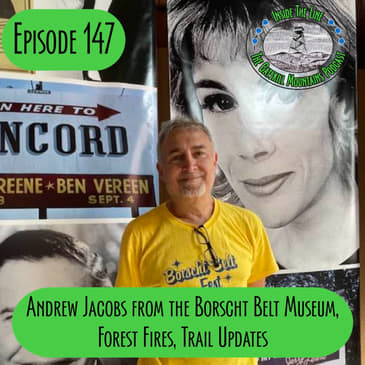
Welcome to episode 147! Tonight, Tad and I chat with president Andrew Jacobs of the Borscht Belt Museum. We also chat about the forest fires in the Catskills, the sale of the ski resort in Tupper Lake and the reroute on Blackhead Mountain. If you need a sticker, email me or go to Camp Catskill! Subscribe on any platform! Share! Donate! Do whatever you want! I'm just glad you're listening! And remember... VOLUNTEER!!!!!!
Links for the Podcast: https://linktr.ee/ISLCatskillsPodcast, Donate a coffee to support the show! https://www.buymeacoffee.com/ITLCatskills, Like to be a sponsor or monthly supporter of the show? Go here! - https://www.buymeacoffee.com/ITLCatskills/membership
Thanks to the sponsors of the show!
Outdoor chronicles photography - https://www.outdoorchroniclesphotography.com/, Trailbound Project - https://www.trailboundproject.com/, Camp Catskill - https://campcatskill.co/, Scenic Route Guiding - https://adventurewiththescenicroute.com/, Another Summit - https://www.guardianrevival.org/programs/another-summit
Links:
Jennings Creek Fire, Whitehouse Fire, Tupper Lake Sale, Borscht Belt Museum, Andrew Jacobs, Four SeasonsLodge Moive, Borscht Belt Film Festival, Borscht Belt Fest
Volunteer Opportunities:
Trailhead stewards for 3500 Club - https://www.catskill3500club.com/adopt-a-trailhead?fbclid=IwAR31Mb5VkefBQglzgr
fm-hGfooL49yYz3twuSAkr8rrKEnzg8ZSl97XbwUw, Catskills Trail Crew - https://www.nynjtc.org/trailcrew/catskills-trail-crew, NYNJTC Volunteering - https://www.nynjtc.org/catskills, Catskill Center - https://catskillcenter.org/, Catskill Mountain Club - https://catskillmountainclub.org/about-us/, Catskill Mountainkeeper - https://www.catskillmountainkeeper.org/, Bramley Mountain Fire Tower - https://bramleymountainfiretower.org/
Post Hike Brews and Bites - Cohens Bakery, Common Bakery
#forestfires #jenningscreek #whitehouse #melgibson #jerrysienfeld #muhammidali #billycrystal #woodyallen #borschtbelt #borschtbeltmuseum #jewishcatskills #husdonvalley #hikingNY #kaaterskill #bluehole #catskillhiking #visitcatskills #catskillstrails #catskillmountains #catskillspodcast #catskills #catskillpark #podcast #catskillshiker #volunteers #catskillmountainsnewyork #catskillspodcast #catskillshiker #catskillshiking #hiking #catskill3500club #insidethelinecatskillmountainspodcast #volunteercatskills #catskill3500 #hikethecatskills
[00:00:30] The bushwhacks were some of the worst days I've ever had in the mountains, or life, really.
[00:00:38] Whereas Panser Mountain is totally opposite. It's a mountain on top of a crater.
[00:00:43] I think the weather challenges on this incident were particularly difficult.
[00:00:49] It is really the development of New York State. Catskills are responsive.
[00:00:54] You're listening to Inside The Line, the Catskill Mountains Podcast.
[00:01:06] All right, so episode 147 tonight, Andrew Jacobs from the Borscht Belt Museum will be joining us a little bit later on.
[00:01:18] But we have a lot to go through. A lot. And it's going to mostly be about one topic.
[00:01:23] Like three hours worth.
[00:01:25] It's going to feel like that, isn't it?
[00:01:27] We're going to set a new record tonight. Three hours.
[00:01:30] It feels like it. Because of what's going on, because of the craziness that we've had in the Catskills,
[00:01:36] and then like the southern part of the Catskills and such, it definitely will feel like that.
[00:01:42] So one thing I want to do, Tad, though, is two apologies.
[00:01:45] I'd like to apologize to the DEC.
[00:01:48] A big thing is not the DEC's fault that things are getting done around the Catskills and around areas.
[00:01:57] It's the state's fault because of passing through so many hoops to get through this done.
[00:02:03] It's not a gun.
[00:02:03] And so I'm not blaming them. We're not bashing the DEC all this time. It's the state.
[00:02:09] The state is really messing things up.
[00:02:11] But the DEC, thank you for all that you do.
[00:02:14] But, you know, I've had people reach out to me about, you know, the kiosk on Giant Ledge and what's going to happen and stuff.
[00:02:23] So I decided to do an email to 20 different people at the DEC, New York, New Jersey Trail Conference and stuff like that,
[00:02:33] and reach out to see if we could do something, donate some money, get that thing done that's 200 yards away from the trailhead.
[00:02:39] Either that or we can just go up there and rip that stuff out and stop making it look like such a horrible mess and just do that during the nighttime.
[00:02:47] What do you think?
[00:02:51] Uh, yeah, I, you know, look, I'm ready to move on from the kiosk at Panther.
[00:02:59] I, I haven't been through there in quite a while.
[00:03:02] I feel bad that it's down, but the DEC is certainly do what was up until recently had been doing a lot of work in proving our trails and other things in the Catskills.
[00:03:10] And then along comes the fire or fires, and that certainly is rearrange their priorities.
[00:03:22] So, of course, of course, definitely.
[00:03:24] They're entitled to a little slack.
[00:03:26] I can, I'm sure that, you know, if they ask for a hundred thousand, the state probably gives them 50.
[00:03:32] So they, they're in a constant battle of economic triage in terms of fixing what they can with the money they have.
[00:03:43] And I'll also say, while we're talking about what the DEC has money for and doesn't have, I'm very eager to get over to Lockwood Gap and hike the blacks and check out that trail rerouting.
[00:03:54] Yeah. Yeah, definitely. We'll, we'll talk about that later. That's, that's definitely on the list.
[00:03:58] Uh, but that looks, that looks fantastic.
[00:04:01] So, so once again, DEC, thank you for all that you do.
[00:04:04] Uh, it's a state of course, that's like, uh, making jumping through hoops and stuff.
[00:04:10] They get stuff done, but you know what?
[00:04:12] Reach out to people about the kiosk and we can, we can maybe get something going about that and, and certain other things.
[00:04:18] Uh, maybe we can get like a power force code, but also I want to apologize to Lisa.
[00:04:24] AKA chaotic chaotic is apparently, uh, I misaddressed her, uh, tagging in us the last week on Instagram.
[00:04:34] And I kept saying he, and I feel like a dick.
[00:04:39] I'm so sorry, Lisa.
[00:04:40] Damn man.
[00:04:41] That's awful.
[00:04:42] That's awful.
[00:04:42] I didn't do my research.
[00:04:44] Yeah.
[00:04:44] Well, we'll have to fire a few of our research assistants.
[00:04:48] It seems like they've been dropping the ball recently.
[00:04:50] So if you want to apply to be one of our research assistants, it's a high, a high paying position.
[00:04:57] You need to have a great research skills and be able to work on a moment's notice to make us look and sound good.
[00:05:05] Yeah.
[00:05:06] So once again, apologies to Lisa.
[00:05:10] Uh, thank you for tagging us in the podcast.
[00:05:13] Uh, congratulations.
[00:05:14] It was your devil in the day.
[00:05:15] I haven't done that yet.
[00:05:17] I really look forward to doing that sometime when my knees aren't dead, which is never.
[00:05:22] I'm freaking I'll die.
[00:05:23] I'll die, man.
[00:05:24] Do you think I could do it?
[00:05:26] Yes, absolutely.
[00:05:27] I think that you are anywhere from six months to a year away from doing the devil in a day.
[00:05:35] If you put your heart and mind to it and you train and you do that, that which is necessary to get you in shape to do it.
[00:05:43] I don't think you have to be in tremendous shape to do the devil in the day, but you have to be in really, really good shape.
[00:05:48] And if you need a lift from one end to the other to make it happen, you can count on me because I'd really, really like to be there to pick you up at the end of the devil in a day to bust your chomps while I suck down an ice cold cider and watch you suffer.
[00:06:07] You'd be like, sorry, I'm drunk.
[00:06:09] You got to drive home.
[00:06:09] Yeah, I'll start like pulling away slowly in the car and make you run after it as I drive away slurping a cider or two.
[00:06:20] Oh, hey, we'll see.
[00:06:22] We'll see.
[00:06:22] Not that I would drink and drive.
[00:06:24] That's true.
[00:06:25] That's true.
[00:06:25] Yeah.
[00:06:25] Don't drink and drive.
[00:06:27] Just joking around here.
[00:06:28] All right.
[00:06:29] So let's get on to the basically, I wouldn't say the guest tonight, but the hot topic of the night forest fires.
[00:06:37] What the hell is going on?
[00:06:39] We have two big forest fires going on.
[00:06:42] As of now, the Whitehouse fire down the sundown, sundown area near Peacamoose is getting contained 95% contained.
[00:06:50] But the Jennings Creek fire down at Greenwood Lake in the southern part of the Catskills is now growing, still growing.
[00:06:56] Largest fire in New York in 16 years.
[00:06:59] National Guard has been deployed.
[00:07:02] Forest rangers, volunteer firefighters.
[00:07:04] As of this recording, which is Tuesday, November 12th, only 20% has been contained.
[00:07:11] And it doesn't seem like it's letting up.
[00:07:15] An 18 year old State Parks employee died in the fire.
[00:07:19] So sorry about that.
[00:07:21] Rest in peace.
[00:07:21] There's just so much stuff going on around with this forest fires and when the craziness of, I don't know if to call it not to trigger people, but climate change.
[00:07:34] What's what's happening?
[00:07:35] You know, this.
[00:07:36] I haven't in my 40 years of living in upstate New York, you know, I can't remember hearing about forest fires and at this big of size, I would say.
[00:07:46] And I have, you know, reached out to people that have been hiking in the Catskills for since the 1960s, 70s.
[00:07:52] And they said they haven't seen something like this or heard of something like this.
[00:07:56] And one of the guys I talked to, he is a listener of the show.
[00:08:01] I think I met him through the 3500 Club, Tony Versandi.
[00:08:04] I met him on slide and he sees me around Oneonta once in a while.
[00:08:08] And I asked him, like, listen, you've been you've been hiking in the in this stuff since the 70s and stuff.
[00:08:13] Do you ever remember something like this?
[00:08:14] He's like, not at all.
[00:08:15] He goes, I can't say that, you know, we we didn't have the people would say social media is is to cause, you know, all the the knowledge and stuff like that.
[00:08:26] But, you know, we were a tight community of small people when he lived down in like Phoenicia and Shandakin.
[00:08:34] And he goes, I don't remember hearing something of this larger scale happening.
[00:08:38] It would be a small brush fire that would be, you know, 10, 20, 30 acres that would be put out in a matter of, you know, like.
[00:08:46] Eight hours and with 20 volunteer firefighters, not 200 volunteer firefighters and such.
[00:08:52] So just craziness.
[00:08:54] Yes. The good thing is, Tad, I would say that most of this forest fire is just the forest floor and not the trees.
[00:09:03] I don't know if a lot of people notice that with the pictures.
[00:09:07] This is not like out west where everything is lighting up and igniting.
[00:09:11] But it's mostly, I would say, 98 percent of the forest floor.
[00:09:15] Would you agree?
[00:09:16] You know, I haven't studied the photos that closely and I'm not sure that the photos I have seen are a representative sample of the area impacted.
[00:09:27] But hiking up in the Cats the past three weekends, it almost seemed inevitable.
[00:09:35] I've never hiked along in the Catskills where the leaves were all dried and curled up the way they've been.
[00:09:44] Normally they've been rained on quite a few times in the fall and they just get saturated and matted down and flat.
[00:09:52] And it would seem harder for the air to get underneath them and get a fire going.
[00:09:59] But this year, man, they've been, you know, just dry, curled up and flying around with the wind.
[00:10:09] And who knows what caused this fire?
[00:10:13] Hopefully it wasn't one of our own up there doing something that ignited it.
[00:10:18] But it's a sad state of affairs on the one hand.
[00:10:21] But on the other hand, forest fires are kind of the natural progression or evolution of a forested area.
[00:10:31] Gets rid of some of the other undergrowth and, you know, cleans out the forest area.
[00:10:37] So we'll see what it looks like afterwards.
[00:10:40] I'm kind of excited to hike over there, whether it be later this year or in the spring.
[00:10:46] Yeah.
[00:10:47] So the White House fire over in the sundown area is burned near 600 acres, three structures, but not homes.
[00:10:55] A lot of people did that like false information.
[00:10:58] Of course, there was three structures that were burnt down.
[00:11:01] They weren't homes.
[00:11:02] They were old, like homesteads, barns, stuff like that.
[00:11:05] Nothing that really had any people in it.
[00:11:07] Over 200 firefighters, aviation assistance from the DEP and the state troopers.
[00:11:15] And as of tonight, as of this recording, 95% has been contained.
[00:11:19] And this has been the largest wildfire in the Catskill watershed since the records began in 1976.
[00:11:27] Just a lot of crazy stuff.
[00:11:29] If you don't know where this is, if you don't, if you know where the Bengal Hill long path goes through right across from the long path of the Peekamuth area, that is the mountain that it's somewhat been burning on.
[00:11:42] I do not know.
[00:11:43] I'm pretty sure I heard that the Bengal Hill trail, the long path trail kind of was like a fire line for it.
[00:11:48] And it kind of stopped the jump going over to there, but I could be wrong.
[00:11:53] I don't know the exact spots of where it was, but I do know it was in that general area of Bengal Ridge or Bengal Hill and stuff like that.
[00:12:02] Do you want me to go over the stats or do you want to do this that you put up?
[00:12:05] You put up all this work.
[00:12:06] Well, I don't know how much work it was.
[00:12:09] Just a couple flicks and clicks on Google.
[00:12:12] So it, as you pointed out, it's 95% contained as of this afternoon.
[00:12:19] The DEC was in charge of coordinating the response.
[00:12:23] 20 different fire companies were involved.
[00:12:25] The equipment used include fire engines, brush trucks, tankers, bulldozers, and UTVs.
[00:12:36] The New York state DEP or New York city DEP aviation and New York state police aviation provided support bucket drops using helicopters.
[00:12:49] I know what Danny Davis and I, when we were out Saturday morning, early before nine o'clock, a helicopter flew overhead where we were in the plateau area.
[00:13:01] And it was headed south towards the Bengal Hill, Peacamoose area.
[00:13:08] So, uh, one of the interesting stats as you note here, Stosh is that from 2007 to 2023, the New York, New York state had an average of 117 wild fires per year with an average of 1400 acres burned per year.
[00:13:28] The wild fire in the Jennings Creek, Sterling forest area by Greenwood Lake, uh, supersedes the amount of acreage burned in wild fires in 14 of the 17 years of this data.
[00:13:44] In 2008, the overlooked fire in the town of Rochester, Ulster County burnt a total of 2855 acres.
[00:13:57] And this, uh, fire in Greenwood Lake is how many acres against Dosh?
[00:14:03] Do you remember that stat?
[00:14:04] 2,500 in New York and 2,500 in New Jersey.
[00:14:08] So a total of 5,000.
[00:14:10] Yeah.
[00:14:10] 5,000 acres.
[00:14:12] So that's like twice the size of the most recent largest fire of 2800 acres.
[00:14:18] However, the largest, uh, brush fire to occur in the state of New York was the Adirondack fire of 1903, which lasted for.
[00:14:29] 4,000 acres.
[00:14:30] A whopping six weeks.
[00:14:33] Yeah.
[00:14:34] And burned a total area of 600,000 acres.
[00:14:41] Damn.
[00:14:42] That's huge.
[00:14:43] That's huge.
[00:14:44] That is 600,000.
[00:14:46] That is half of the acreage of the Adirondack park.
[00:14:49] Yeah.
[00:14:49] I'm sure it left a, a lasting impression on the forestry in the park, but that's amazing.
[00:14:59] Absolutely.
[00:15:00] Yeah.
[00:15:01] But back then, you know, they didn't have the instruments available to fight forest fires like they have today.
[00:15:05] I doubt they had many bulldozers available to them.
[00:15:08] They certainly did.
[00:15:08] Yeah.
[00:15:09] They certainly didn't have helicopters available to haul in water and, uh, UTVs were not even a figment of somebody's imagination at the time.
[00:15:20] Forest fire towers weren't even up then.
[00:15:25] Yeah.
[00:15:26] Yeah.
[00:15:26] That was back when, you know, even communication, what were they using?
[00:15:30] Telegraphs back then.
[00:15:32] Yeah.
[00:15:32] Exactly.
[00:15:33] They've come a long way and certainly it's, it's not something that we seem to deal with, uh, every year in the Catskills.
[00:15:39] I don't remember the last time there was a sizable forest fire in the Catskills.
[00:15:46] So what's happening now is, uh, certainly unusual.
[00:15:51] Yeah.
[00:15:52] And, you know, luckily if you, if you look at the pictures, uh, I said before that it's mostly the undergrowth, the leaves and stuff like that is burning and not the trees.
[00:16:01] So if you compare this to like out west, out west is, is absolutely crazy insane.
[00:16:08] They, they usually have like a, a minimal of like 4,000 acres that get burned just because of the trees catch on fire and the undergrowth.
[00:16:16] And it's just the, the winds are a steady 30 miles per hour.
[00:16:20] Everything gets blown and destroyed.
[00:16:22] We're here.
[00:16:24] It's just mostly the undergrowth.
[00:16:26] We have somewhat healthy trees in these areas.
[00:16:29] Uh, the sundown area I know suffers from the, the woolly algid and stuff like that, but it's not a lot of those ash trees out there that are being burned.
[00:16:37] It's, it's all the undergrowth that I see being burned and who knows what this brings to, to our forests and stuff like that.
[00:16:45] Like will those trees survive?
[00:16:47] I would say yes, because they, they did a great job.
[00:16:49] It burned quickly.
[00:16:51] It burned fast and they did a great job of putting it out, um, with the sterling area.
[00:16:56] I'm not sure of how that's going to be handled.
[00:17:00] I know they're attacking that pretty aggressively and it's tough and they're having a tough time.
[00:17:05] Of course, I mean, it's, it's a lot of work with the, the fire we had up in the Peekamoose area.
[00:17:11] It kind of just, uh, it happened and it grew and they, they attacked it.
[00:17:17] We got a good rain a couple of nights ago.
[00:17:20] That was really good and helped out over there.
[00:17:22] And they have done, I've seen a lot of pictures.
[00:17:24] If you just search white house fire, uh, up on your, your face, the Facebook, uh, if you have a Facebook, they'll show a lot of pictures from local people who work there.
[00:17:33] And they've done a great with those fire lines.
[00:17:36] And like you said, you know, there were Ted, you said there was a bulldozers and such.
[00:17:40] I'm guessing they also took like ATVs and dragged plows to build up fire lines and stuff.
[00:17:46] If you ever seen, uh, what they do for this, it's, it's pretty aggressive and pretty cool to see what they do because they do all that they can to stop.
[00:17:55] Uh, it's not just water.
[00:17:57] It's, it's a lot of hard work.
[00:17:59] Yeah.
[00:18:00] Last, uh, significant fire we had over here in the gunks was in 2022.
[00:18:08] As I recall, and Danny Davis and I, uh, about six months, four months or six months after that fire, we actually hiked along the fire line that the, uh, the firefighters had put in using a couple bulldozers.
[00:18:29] And you talk about a path of destruction that they did putting in that fire line, they just literally just plow over everything and push it to one side to, to create, create a gap for the fire to not jump over.
[00:18:45] And it's going to take quite a while for that area to re vegetate and re forest again.
[00:18:51] So it'll be interesting to see what they did with these bulldozers on Bengal Hill.
[00:18:55] Yeah.
[00:18:56] Um, what do you, you say when you, you saw that, did you, were you disturbed by it?
[00:19:02] Were you like, okay with it because of what they did, or you should have just let it like, let it do its thing?
[00:19:07] Well, you it's the lesser of two evils.
[00:19:11] Yeah.
[00:19:11] You know, you, you go, you walk through there and it is quite disturbing to see how much destruction that they do with these bulldozers.
[00:19:18] Just literally just plowing, you know, a 15 to 20 foot wide road for lack of a term, uh, along the side of the mountain.
[00:19:29] And, you know, they just push all the trees, the stump, the ground cover over to one side.
[00:19:36] It's, you know, it's very erosive.
[00:19:39] There's, you know, no water bars or anything like that are put in when they're doing this.
[00:19:43] They're just going in on an emergent basis.
[00:19:46] But you realize if they don't take some measure like that, then the fire is just going to continue to spread.
[00:19:52] And it's going to burn up a greater area.
[00:19:55] I forget how long it took them to put that fire out, but it was, it was a sizable fire.
[00:20:01] And there was a lot of activity over there for quite a few days.
[00:20:04] Do you mind me asking where that was?
[00:20:08] I don't remember.
[00:20:09] Yeah, sure.
[00:20:10] It was, uh, just right off of, um, Berm road heading, uh, west to the east going up the, I'm going to call it the backside or the Western slope of the gunks in that part of the gunks.
[00:20:27] Oh yeah.
[00:20:28] The rock is lifted up with the, the lower point of the, the rock in the west.
[00:20:35] And then the, the plates or slabs of rock are angled upward to the east in that area.
[00:20:43] And that's what they just ran the bulldozers up with along that run.
[00:20:48] So, yeah, so it's just, it's just crazy to think, you know, like you, you said with your stats that you pointed out that this, uh, from 2020, 2007 to 2023, 117 fall files per year, an average of 1400 acres burn year.
[00:21:07] Uh, now, you know, if you just take the New York thing within the last three days, we've burned over 3000 acres, 2,500 plus the 600.
[00:21:16] It's over three 30, 100 acres.
[00:21:18] So that, that surpasses that in the past, like you said, 14 of the 17 years, it's just, it's just crazy to think.
[00:21:25] And it's, you know, once again, this is a controversial topic of, is this climate change?
[00:21:30] Is this just a normal thing that happens once in a great while?
[00:21:33] Who the hell knows?
[00:21:35] It's there's so many different variables that you can.
[00:21:37] Yeah.
[00:21:38] Well, so just two things to note here.
[00:21:40] If you have, uh, an, uh, an average of 117 fires per year, burning 1400 acres of acres per fire.
[00:21:51] Hmm.
[00:21:52] So the, those fires aren't all that big here.
[00:21:55] We have a fire, um, in the, um, Greenwood Lake area, you know, 3000 acres plus the acreage in Jersey.
[00:22:06] You're up to 5,000.
[00:22:08] So that's, that puts it in perspective.
[00:22:10] But the, the other thing we haven't mentioned so far that goes hand in hand with the conditions that brought about the fire is we haven't had a lot of rain for quite a while, uh, going back to August.
[00:22:24] And so when you drive past the Ashokan reservoir, when you drive back past the round out reservoir, they're low, they're very low.
[00:22:36] And those are the two collection reservoirs for the Catskill watershed system and for the Delaware watershed system.
[00:22:47] So you wouldn't expect them to be so low.
[00:22:49] So the city of New York is, uh, put out a notice for water conservation measures because of these drought conditions.
[00:22:59] I've noticed it the last three weeks.
[00:23:01] Um, actually I'm going to say the last four weeks, three of those weeks, I've basically hiked up, dried up, uh, stream or river beds in the Catskills.
[00:23:12] I mean, almost bone dry in many instances, there's just some small pools of water here and there, but otherwise there's no flowing water in these streams.
[00:23:23] Wow.
[00:23:24] Nothing, nothing inflowing to the reservoirs.
[00:23:26] So not only for the sake of, uh, diminishing the likelihood of a forest fire, but for the sake of filling up the reservoirs with drinking water, we need some rain.
[00:23:37] Yeah.
[00:23:38] And you know, one thing.
[00:23:39] Maybe we'll get it in the form of snow, get some snow, get some early snowshoeing in.
[00:23:44] I got, I got snow here today in Oneonta, by the way, I got some snow showers.
[00:23:48] It's very little, but, uh, it was pretty cool to say, did you, did you also know that the, with these, with the, the, the, the Pika moves, the white house fire that they could not take water from the reservoir.
[00:24:01] It doesn't, it doesn't surprise me cause the reservoir is low.
[00:24:04] Yeah.
[00:24:05] And everything upstream in the system is low as well.
[00:24:08] I mean, they're, they, they are concerned about the water levels in these reservoirs.
[00:24:17] And I'm sure that the DEP and the other people involved for the city of New York have a lot of data and run a lot of calculations and do, you know, have their probabilities down and all of that.
[00:24:31] But I was, when I drove over the Ashokan Saturday morning, I I've never seen it that low.
[00:24:39] I mean, you see, you see, you know, dirt islands out in the reservoir now, which means it's close to the bottom.
[00:24:48] Wow.
[00:24:49] Just thinking about that.
[00:24:50] Yeah.
[00:24:50] We, we drove by the, uh, the Cannonsville reservoir and I was like showing Jessica, I'm just like, look at that.
[00:24:57] I'm like, you can see, I mean, it just like, looks like 40, 50 feet off of the banks of where it should be, where the trees are.
[00:25:05] And you're just like, that is not fricking like Jessica said, uh, that's disgusting.
[00:25:10] Like she's like, this is that's scary.
[00:25:12] And I'm just like, exactly.
[00:25:13] It's just really, it's really odd.
[00:25:15] And then, you know, things, little tiny things like that, who knows what started these two hikes?
[00:25:19] That's the big thing is we don't know what started these two hikes or hikes fires, started these fires.
[00:25:25] And, and like, it's, it's crazy to think that some sort of little Amber could float and then.
[00:25:33] Yeah.
[00:25:34] I mean, whether it was somebody that was burning something in their backyard, or it was somebody who had a wood stove going inside or a camper.
[00:25:43] I mean, there's a lot of potential causes for it, but do you think cigarettes could start this crazy fire?
[00:25:49] I don't know.
[00:25:50] I mean, you would, on the one hand you would say, yeah, sure.
[00:25:53] It seems so.
[00:25:54] On the other hand, I just scientifically, I don't know what, where the other, all's I know is, all's I know is the, the, the leaves have been so dry in the Catskills.
[00:26:04] All the, everything that's fallen this year is just, you know, loose on the forest floor blowing around.
[00:26:13] Nothing's packed down.
[00:26:14] So, um, yeah, very dry conditions up there.
[00:26:19] Yeah.
[00:26:20] Don't be going up and starting your jet boil to make a hot cup of tea.
[00:26:27] You know, when you're out hiking this weekend, because it's knocked over.
[00:26:31] Yeah.
[00:26:32] Who knows what's going to happen.
[00:26:34] Yeah.
[00:26:34] And we have a bunch, we have a red flag warning, uh, which started today at 6 PM, uh, Hudson Valley, New York city, Long Island.
[00:26:43] And I heard it extends all the way up almost to the Adirondacks red flag means, uh, warm temperatures, very low humidities and stronger winds.
[00:26:51] We've had some winds that just, I wouldn't say that are just very strong, but it come like just constant, constant 10 mile per hour winds.
[00:26:59] And that's not good.
[00:27:00] It just keeps blowing and blowing, uh, increased risk with fire danger.
[00:27:04] So something that'll catch, it won't just, you know, stay in your area.
[00:27:07] You can put it out with your feet.
[00:27:08] It'll just keep going and going.
[00:27:10] Now there is also a statewide burn band in effect until November 30th.
[00:27:15] Uh, today is November 12th.
[00:27:17] So that's fricking 18 days away to, to, to, to say in fricking November that we have a burn band.
[00:27:25] It's just absolutely insane to say that in November, uh, significant snowfall, like not significant, but somewhat hasn't happened.
[00:27:35] It's just absolutely insane.
[00:27:37] Like it's just weird.
[00:27:38] Well, this is maybe the new normal.
[00:27:42] I know our forecast down here is no, no rain in the forecast for the next 10 days in the valley.
[00:27:51] Uh, I'm looking at the forecast for Denning the same, no rain in the forecast through next Thursday.
[00:27:59] And in Tannersville, it is the same.
[00:28:04] We have, you know, high daytime temperatures are going to be in the mid forties up to three degrees on Sunday, but no rain inside for the next 10 days or longer.
[00:28:19] That's scary.
[00:28:21] That's scary.
[00:28:34] Like, right?
[00:28:35] Yeah.
[00:28:36] Um, you spend a lot of time picking your way across the stream back and forth as you go up the mountain because you, you know, you have to do a ton of water crossings.
[00:28:45] Not now.
[00:28:46] They're, they're dried out.
[00:28:47] Look at my photos on Instagram.
[00:28:49] There's very little water, maybe some pool, some pools of water here and there, uh, which is cool.
[00:28:57] Cause you can actually see the brook trout in them.
[00:29:00] Um, but flowing water, not really trying to get some, uh, Instagram followers.
[00:29:08] I see.
[00:29:08] Yeah.
[00:29:09] Yeah.
[00:29:09] That's it.
[00:29:09] Instagram followers for me.
[00:29:11] It's the only reason I do this.
[00:29:14] Two plus hours.
[00:29:15] Yeah.
[00:29:16] On Instagram.
[00:29:18] Follow me often.
[00:29:21] So.
[00:29:22] All right.
[00:29:23] So once again, crazy times have been happening.
[00:29:25] Uh, 25,000 acre forest fire down in Serling.
[00:29:29] And forest down in, uh, New Jersey, New York area.
[00:29:32] And then the 650 acre forest fire up in the peak of Moose area.
[00:29:36] So stay away from those areas for now.
[00:29:38] Let the professionals deal with this.
[00:29:41] Uh, keep checking out on, on Facebook, your, your social media areas for, for updates, because it's, it's, it's good to follow.
[00:29:50] The volunteers are doing all that they can.
[00:29:52] I will try to reach out to the volunteers, see what they need, uh, especially, and we'll see what we can do.
[00:29:58] Um, but so that remember, we talked about the big Tupper ski resort.
[00:30:04] Do you remember that?
[00:30:06] I sure do.
[00:30:07] Sure do.
[00:30:08] I got my, I got my bid in.
[00:30:10] Uh, what did you put it?
[00:30:11] Uh, I bid $650,000.
[00:30:17] So you got it.
[00:30:18] Yes, I did.
[00:30:19] I put all my, I put all my cider money in there.
[00:30:23] Well, hell yeah.
[00:30:24] I mean, you're a hell of a drinker.
[00:30:26] Yeah.
[00:30:26] Isn't that nuts though?
[00:30:27] Somebody bought this ski area for $650,000.
[00:30:32] $650,000.
[00:30:33] Uh, and that's not to say that they're going to run it.
[00:30:36] It is a ski area.
[00:30:39] Well, you know, I read that, uh, that they are big lovers of the Adirondacks and they bought
[00:30:45] the area and they envisioned to reopen the area for a downhill facility for recreation.
[00:30:51] Now they're looking to partner with, uh, I'm pretty sure it was the AMR and the Adirondack
[00:30:57] mountain reserve and the Adirondack park to make this a more accessible area for people
[00:31:05] and stuff like that.
[00:31:06] Uh, 5,800 acres.
[00:31:08] It looks like the, uh, uh, what else?
[00:31:14] Uh, fourth parcel is a bunch of different parcels.
[00:31:19] Uh, Tupper Lake is 625.
[00:31:22] Cranberry Palm was 45 and the former arena on Tupper Lake was 170.
[00:31:27] So it wasn't the 650.
[00:31:29] So they came up with all this and it was close to like $800,000.
[00:31:34] And they did this anonymously, but they, then they came out of course, later on, they were
[00:31:39] like, yeah, we want to be known about this.
[00:31:41] Of course, they, they hope that it becomes a part of private public land that leads to
[00:31:45] renovation to reopening the skis.
[00:31:48] Uh, facility.
[00:31:49] Now the mayor said that, uh, hopefully the community has been, uh, with this cause there's
[00:31:56] so much nostalgia in the area and that, uh, they hope to, that this goes in the positive.
[00:32:02] Way.
[00:32:03] Uh, of course, cause this has been banded for over five years and, uh, it's definitely got
[00:32:07] an awesome cross country ski and the golf course.
[00:32:10] It's all going to hopefully go to good, good faith.
[00:32:13] And, uh, we will see, you know, I, I wanted to give an update on that just to see what
[00:32:18] was, what was going on.
[00:32:20] $650,000.
[00:32:21] You being a ski expert, Ted, uh, up in the Tupper Lake area.
[00:32:26] What do you think?
[00:32:27] Do you know, do you know about that area?
[00:32:29] Oh yeah.
[00:32:30] I, I actually way back in the seventies and eighties, I skied there.
[00:32:34] Um, back when natural snow is an abundance and resorts didn't have to rely so heavily on manmade
[00:32:43] snow when there wasn't a lot of the freeze thaw cycles throughout winter.
[00:32:49] But you know, it's, it's a great ski area.
[00:32:51] It's not a super big ski area, but for New York state, it's sizable.
[00:32:56] And I wish these folks all the best.
[00:32:58] It could be a great, if they revitalize the ski area, it could be a great place to go with
[00:33:03] a family or, you know, some pals to get away from the, the bigger ski areas.
[00:33:08] But what would you say?
[00:33:12] Like the, the drop and stuff of that is, is it a vertical drop?
[00:33:16] Yeah.
[00:33:17] Uh, I don't remember offhand, but it's, you know, maybe in the 1500 foot range, something
[00:33:22] like that.
[00:33:23] I mean, it's certainly bigger than anything we have around here in the Catskills, uh, or
[00:33:31] elsewhere.
[00:33:32] Problem is you get up in the big Tupper area.
[00:33:36] You're just a stone's throw away from white face and white faces.
[00:33:40] A big mountain has a lot of vertical, has a lot of really, really steep pitch, a lot of
[00:33:45] challenging terrain.
[00:33:46] It's a great place to ski.
[00:33:49] And, and because white faces state owned and operated, they've got all of the money of
[00:33:57] the state of New York behind it.
[00:33:58] So they can afford to make snow in a bad snow year and pull it off.
[00:34:04] But if you're a private ski area operator, that's really tough.
[00:34:08] You know, when a bad year blowing snow and trying to compete with a place like white face,
[00:34:12] gore mountain, or, you know, as we are going to talk about later on how cheap airfare, uh,
[00:34:20] ended the Boerish belt.
[00:34:21] Hey days.
[00:34:22] Same thing with, uh, skiing.
[00:34:24] You know, why would you take a week off to ski in the Northeast when the skiing conditions
[00:34:29] can be marginal?
[00:34:30] When you can hop on a plane, fly out to the Rockies, ski, bigger ski areas, more natural
[00:34:37] snow, better skiing, almost guaranteed.
[00:34:41] Wow.
[00:34:42] Yeah.
[00:34:42] So sometimes you don't think about that sometimes.
[00:34:45] Yeah.
[00:34:46] And that's, you know, that we'll, we'll talk about that tonight.
[00:34:48] You know, how that is a huge thought of what, like how the Boer's belt died is that, you
[00:34:55] know, Hey, let's see, let's go over to Sweden.
[00:34:57] You know, we have the, what they, what they call this again, the Catskill Alps.
[00:35:01] And then you actually, we can go over the Swedish Alps or just the same.
[00:35:05] Yeah.
[00:35:05] Or you can go to the South Beach.
[00:35:07] You can go to Cancun or Ruba.
[00:35:10] You know, there's a whole bunch of other places you can go by just hopping on the plane
[00:35:16] and you're arguably going to get better weather, certainly in the winter months.
[00:35:20] Not that the, the Borscht belt was, uh, as popular in the winter months, fall and spring
[00:35:29] as it was in the summer season, but still, once people were able to fly places cheaply,
[00:35:37] more options were open to them and there was less and less demand in the Catskills.
[00:35:44] Yeah.
[00:35:45] Yeah.
[00:35:45] Crazy times.
[00:35:46] Great time.
[00:35:46] Can't wait to talk about it.
[00:35:48] So you think, um, once again, you should go more local.
[00:35:52] If you could go more local, I mean, uh, Tupper Lake is, is not as crazy as local to the
[00:35:58] out, uh, the Catskills and the Adirondacks, but you know, if you could go local, go ahead
[00:36:02] and please do it because that would support.
[00:36:04] Of course.
[00:36:05] Now this area, uh, you talk about the Tupper Lake area.
[00:36:09] Did this have in the time you were skiing, what it had to pull you up the mountain?
[00:36:13] Do you have tow ropes?
[00:36:14] Oh no back.
[00:36:15] Well, I don't know.
[00:36:16] Maybe on like the beginners Hills and stuff like that they did, but they had chairlifts.
[00:36:20] Oh, they did.
[00:36:20] Okay.
[00:36:20] I'm sorry.
[00:36:21] I'm sorry.
[00:36:21] I don't mean to.
[00:36:23] Yeah.
[00:36:24] You know, it wasn't in the 1930s, you know, I started skiing in 1942, you know?
[00:36:32] Yeah.
[00:36:32] Right.
[00:36:33] So Jesus, I'm sorry.
[00:36:34] I'm sorry.
[00:36:35] I don't, you know, all I know is about bear petting and they had tow ropes.
[00:36:38] Yeah.
[00:36:39] I don't know.
[00:36:40] Well, that was, that was in the fifties and chairlifts.
[00:36:43] I don't know when chairlifts started to be made.
[00:36:46] Um, but it, it took them a few years and somebody could set up a rope tow pretty easily.
[00:36:52] Often you'd see, uh, like they did a bear pen.
[00:36:57] You just get a couple of tractors and you put, uh, bull wheels on them, big round wheels
[00:37:03] to run the rope around.
[00:37:05] Pretty simple thing.
[00:37:06] Yeah.
[00:37:07] And that's what they, that's what they had at bear pen and many other places.
[00:37:09] And then over time they would upgrade the T bars, J bars, Pomas, all surface lifts.
[00:37:16] And eventually chairlifts came around.
[00:37:18] Pat, you are so knowledgeable in the skiing.
[00:37:21] We got, we gotta do a whole skiing.
[00:37:24] Second.
[00:37:25] Yeah.
[00:37:25] Yeah.
[00:37:25] Well, I'm proud to say my daughter's, uh, got a job at a mammoth mountain color or California
[00:37:31] for the ski season as a ski instructor.
[00:37:33] I'm so happy for her.
[00:37:35] Well, let's get you two on that.
[00:37:36] And we'll talk about skiing.
[00:37:37] She's a frequent skier, the Catskills.
[00:37:40] Oh, you know, back, back when she was growing up.
[00:37:42] Yeah.
[00:37:43] We'd go to Belair and, uh, platykill Wyndham.
[00:37:46] We were repeat offenders at Wyndham.
[00:37:50] However, I'm proud to say she's never skied at Hunter mountain.
[00:37:57] Proud.
[00:37:57] Why?
[00:37:57] Why is that?
[00:37:58] Oh, cause it's, I just, I don't like Hunter for skiing.
[00:38:02] Interesting.
[00:38:02] Cool.
[00:38:03] All right.
[00:38:03] All right.
[00:38:03] No, uh, no judging at all.
[00:38:07] So yeah.
[00:38:08] I think, I think Wyndham's got better terrain, um, especially off the, uh, Eastern.
[00:38:13] I forget what they call it, but there's an Eastern side of it.
[00:38:17] That's got a quad lift and it's really good skiing over there.
[00:38:21] And then Bella areas is okay.
[00:38:25] I mean, they have a longer season, typically a Beller, but the best skiing hands down in the Catskills is plot.
[00:38:30] Well, yeah.
[00:38:32] And you want to know why that is?
[00:38:34] Cause they're locally owned.
[00:38:36] Well, in part, but the, the two reasons why platykill has the best skiing and the Catskills when they have snow is number one, they don't make a lot of snow.
[00:38:48] Right.
[00:38:48] And number two, they do not have detachable lifts, which means they can't get a lot of skiers up the hill in an hour.
[00:38:59] Oh, nice.
[00:39:00] Like Hunter.
[00:39:01] Right?
[00:39:01] Yeah.
[00:39:02] So yeah.
[00:39:02] Hunter can get, you know, almost 2000 up the hill and on just that one lift in an hour and platykill is probably hard pressed to do a few hundred in an hour.
[00:39:11] So there's less skier traffic.
[00:39:14] Nice.
[00:39:14] And that's what makes it in part.
[00:39:16] It's just great terrain.
[00:39:17] It's a great ski area.
[00:39:18] You going to teach me how to ski this year?
[00:39:20] Yeah.
[00:39:21] If you want to, I'll take you out and I'll teach you.
[00:39:23] Please.
[00:39:23] My daughter, I taught my daughter.
[00:39:25] She's got a job as a ski instructor now.
[00:39:27] French fry and pizza.
[00:39:28] That's all I know.
[00:39:30] Well, we'll, we'll, we'll move beyond that.
[00:39:32] Even somebody as uncoordinated as you.
[00:39:36] Yeah.
[00:39:36] We'll teach you how to ski.
[00:39:38] I fall down the mountain a lot.
[00:39:39] If you like hockey or you're, if you can play hockey or not far behind.
[00:39:43] Oh, nice.
[00:39:44] Well, good, good.
[00:39:45] I'm a good, I'm a good skater.
[00:39:46] So that's cool.
[00:39:47] All right.
[00:39:47] All right.
[00:39:48] So, uh, we've had this in, in the updates kind of the past couple of weeks.
[00:39:54] So blackhead mountain reroute.
[00:39:55] I've Ted, you got a video from the ed and I've gotten a couple of pictures and videos from people about this, this reroute.
[00:40:03] And, uh, I gotta admit it looks pretty good.
[00:40:05] I wanted to, I look kind of deep into the UMP to see, and they kind of give a detailed, uh, description on what's going on.
[00:40:12] So I'm going to read that out loud and we're going to talk about this.
[00:40:14] So this outlines a relocation of approximately 460 feet of existing trail to a new sustainable design trail, approximately 1500 feet in length.
[00:40:26] So it's going to be nearly triple, quadruple the, the area.
[00:40:30] Uh, the existing section of the trail is steep and fall line, which has resulted in, of course, trail riding and rodent and incision.
[00:40:38] Uh, the stone steps now have been installed along some of the steepest portions of trail, which I've seen.
[00:40:43] It's beautiful.
[00:40:44] And, uh, they have failed before.
[00:40:48] Uh, but now they are leaving, uh, a good surface and soil part, which, uh, we know, uh, the earlier part was the rebar part that we see.
[00:40:57] If, uh, if you look closely, when you go up to the blackheads, uh, the blackhead area, you can see some rebar in there and you're kind of curious.
[00:41:04] And that was where they previously tried to, uh, install stone and they failed miserably.
[00:41:10] Now, uh, it is much more desirable.
[00:41:13] Safety is, uh, a big concern and they have done a fantastic job.
[00:41:19] Uh, Tad has seen videos.
[00:41:20] I've seen pictures.
[00:41:21] I've, I'm sure he's seen pictures as well.
[00:41:24] I would say, say this is a fantastic reroute and it's going to be very, very pretty, especially right now where you got, you know, views off to the east, uh, or the south that you're going to be looking at the devil's path and such.
[00:41:37] Yeah.
[00:41:37] Well, yeah, you're not a trail guy.
[00:41:40] Well, you know, not a trail guy, number one and number two.
[00:41:43] So they, they do it on blackhead and now what's next.
[00:41:48] Right.
[00:41:48] Because any, anywhere along the devil's path, this is what you have.
[00:41:52] You have these up and down the fall line, just vertical madness, straight up, straight down.
[00:41:58] And it has the same problem, trail widening, erosion, incision in each of those areas.
[00:42:06] So now if they pull it off on blackhead and they're patting themselves out on their, the back because they did it on blackhead.
[00:42:14] What's next?
[00:42:15] Yeah.
[00:42:16] Black dome, twin, sugar loaf.
[00:42:19] Why not?
[00:42:20] I mean, I mean, and when, and when do they stop?
[00:42:23] Are they going to go in like, cause when you go to the gunks and you hike in the gunks, a lot of these trails were made, you know, over a hundred years ago.
[00:42:29] And one of the things the smiley brothers did when they made the trails is they would bring in drills, rock drills and blasting and they would blast the rock away.
[00:42:40] You look closely, you can see where they did it.
[00:42:43] Um, so they would have switchbacks going up these steep areas.
[00:42:46] So is that what they're going to do in the cats skills?
[00:42:49] Maybe they won't do the blasting, but maybe they'll do some rock moving, boulder moving and make these trails.
[00:42:59] Not steep.
[00:43:00] Well, what's the word they use?
[00:43:01] Sustainably designed trail, right?
[00:43:03] Yes.
[00:43:03] We're going to have these sustainably designed trails.
[00:43:06] That sounds great, but it's going to take away a lot of the fun.
[00:43:10] So where's the balance?
[00:43:12] I don't know.
[00:43:13] I'm like, when you're talking about like sugar loaf and the devil's path, I don't see that many as trail widening.
[00:43:18] As I did on, on blackhead because you know, more of that as, as come on, you don't see it.
[00:43:24] You don't see it.
[00:43:25] Oh, that, that whole Western face of sugar loaf.
[00:43:30] It's like a mile wide in spots.
[00:43:33] Really?
[00:43:34] Yeah.
[00:43:35] Oh, it's crazy.
[00:43:36] I mean, I, I, I see that as super steep, but I don't see it as, as wide.
[00:43:41] It's because of the rock faces and not because of the erosion.
[00:43:43] Yeah.
[00:43:44] And, but what happens is so people will go to the left, to the right, to get some vegetation to grab onto.
[00:43:49] It's tree roots or small branches or small trees.
[00:43:54] And, you know, if one person did it a day, that's great.
[00:43:58] And, and it would be arguably sustainable.
[00:44:00] But when it's a dozen to two dozen to three people, three dozen people, you know, Saturday and Sunday, and then throughout the week, dozens of people, how many other people are going up and down, especially when the soil soft and those tree roots, those young trees start getting pulled out.
[00:44:19] And then you get the trail widening and then to some administrator with the DEC, they say, well, okay, it's time to reroute the trail, make it more sustainable.
[00:44:32] And frankly, they probably spend less money over 10, 15, 20 years when they reroute the trail than they do with annual or semi-annual maintenance programs, whatever.
[00:44:46] So is this, is this like they're taking an inch and they'll end up getting a mile, right?
[00:44:52] They're, they're starting off with eliminating 460 feet of fall line trail, replacing it with 1590 feet of sustainable trail, which has got to be that whole lift in that one section, right?
[00:45:10] Where the rebar was, that's all now arguably been redone.
[00:45:15] So that's changing your experience going up blackhead.
[00:45:19] They're going to do it on the other side where Sherman's lookout is.
[00:45:24] I mean, I've been up the other, I've bushwhacked the other side.
[00:45:28] There's ways to get up it that aren't as vertical as it is on the east side.
[00:45:33] I'm talking about Indian head Sherman's lookout.
[00:45:37] I'm talking about, oh yeah, excuse me.
[00:45:40] Yeah.
[00:45:41] So, but they're all like that.
[00:45:42] I mean, there's all, all of them have an easier way up than where the trail is.
[00:45:46] Sure.
[00:45:47] So is that what they're going to do now?
[00:45:49] Is there, they're going to reroute all of these.
[00:45:51] And so they're easier to get up.
[00:45:53] There's pros and cons.
[00:45:54] I mean, maybe it makes it easier, more accessible for some people, but for other people or hardcore hiking listeners.
[00:46:03] Takes away some of the fun.
[00:46:05] Eventually it'll be like hiking up slide up the Jeep trail.
[00:46:08] I mean, that's a, I hate that.
[00:46:09] It's horrible.
[00:46:10] Right.
[00:46:11] You and your buddy, you both could be side, side by side, you know, with your ear pods in or whatever they are, you know, or speakers going maybe some beach towels over your shoulder and flip flops on as you're going to go sun yourself at the top of the mountain.
[00:46:26] But, you know, maybe this trail is more for like the, the, the, ever, the kind of the, the water and stuff like that will flow off of it easier instead of widen the trail.
[00:46:38] And then people won't try to skip over these, these areas.
[00:46:41] You know, it's, we gotta, we gotta see it in person first.
[00:46:44] Do not.
[00:46:46] I am.
[00:46:46] I am.
[00:46:47] I'm already against it.
[00:46:49] I know you're gonna change.
[00:46:50] You're never gonna change my mind.
[00:46:51] I'm not, I'm not, I'm never hiking on a trail in the Catskills again.
[00:46:56] Bushwhack forever.
[00:46:57] Bushwhack or die.
[00:46:59] Bushwhack or die.
[00:47:01] I hear you.
[00:47:02] I hear you.
[00:47:03] Uh, I do.
[00:47:04] I do understand.
[00:47:05] I do understand, but Hey, we'll see.
[00:47:08] I'll have to go up there and see.
[00:47:09] I know I'm, I'm gonna try to get to, to my area this weekend.
[00:47:12] Maybe, uh, yeah, it's from what I've seen from recent posts on Instagram.
[00:47:17] Yeah.
[00:47:18] Screw Sean.
[00:47:19] You know what?
[00:47:20] We'll talk about that in a second.
[00:47:22] It looks like the, it looks like the queen of the Catskills almost lost an eye from what I could tell.
[00:47:27] Yeah.
[00:47:27] From that massive.
[00:47:28] Blow down.
[00:47:30] All right.
[00:47:31] So thank you to the monthly supporters, Darren White.
[00:47:33] And thank you for our Mike Sautosky, Jim, who's Jim's John C. Betsy, A. Denise.
[00:47:39] Vanessa, Joseph, Jim scene.
[00:47:41] Michael, thank you guys very much for supporting show.
[00:47:43] Really appreciate it.
[00:47:44] Also.
[00:47:45] Thank you to our awesome sponsors of the show.
[00:47:47] Outdoor Chronicles photography.
[00:47:49] Molly from outdoor Chronicles photography specializes in adventure, a loping and adventure couple photography in the Catskills, Adirondack and the white mountains.
[00:47:58] She is an officiant for getting married.
[00:48:00] A license guide was most important.
[00:48:02] She is a story maker.
[00:48:03] Molly won't give you photos.
[00:48:05] She'll give you memories that last forever.
[00:48:07] Don't hesitate to get a hold of Molly on all platforms.
[00:48:11] Have you ever wanted to learn more about hiking or backpacking, or even just brush up onto your old skills in the back country?
[00:48:17] Check out Trailbound Project, a hiking and backpacking school.
[00:48:20] So, Scott and Joe from the New Jersey search and rescue team have amazing background in Wilderness First Aid, Wilderness First Responder, and the Mountain Rescue Association.
[00:48:28] And they are here to help you learn all the new skills of hiking and backpacking.
[00:48:33] They teach anything for first aid, map and compass, and many other skills that can help you and others while on the trail.
[00:48:39] Check them out on their website and all social media platforms.
[00:48:44] So, mentions in the podcast, coffees.
[00:48:46] Let's say Betsy Anderson, thank you very much for the five-siders.
[00:48:50] Appreciate it.
[00:48:51] She said she had a great time listening to the winter episode and looks forward to getting some more of our winter recommendations for gear.
[00:48:58] That's good.
[00:48:59] I got to admit, we go with top-notch shit.
[00:49:01] Right, Todd?
[00:49:03] Well, you said you get all your stuff from Walmart.
[00:49:05] Yeah, that's a moisture-working shirt.
[00:49:07] That's about it.
[00:49:08] Well, you know, honestly, the more money you save on gear, arguably, the more time you have to go hiking.
[00:49:15] You don't have to work as much.
[00:49:17] True.
[00:49:18] Buying stuff cheap is good.
[00:49:20] I honestly, I get a lot of my stuff at the Annex and New Paltz, which sells used gear.
[00:49:27] And I have actually bought quite a bunch of stuff on eBay used.
[00:49:32] Nothing wrong with that.
[00:49:33] Yeah.
[00:49:33] A lot of people like have, you know, that problem of purchasing stuff and it doesn't fit them right and it doesn't feel right.
[00:49:40] Or, you know, they're not comfortable in the first couple of uses and they forget about it.
[00:49:44] And then all of a sudden they got to sell it on eBay, you know, after the warranty.
[00:49:48] Yeah.
[00:49:48] Or they return it.
[00:49:51] Right?
[00:49:51] Yeah.
[00:49:52] So there was that woman who was recently barred from shopping at REI or barred from returning at REI because she has an unusual number of returns.
[00:50:04] I mean, you know, I got to admit, I do not like REI because Jessica had a puppy jacket and it started to leak some of the down.
[00:50:14] And then that was like, she bought it a week before their, their little policy was like lifetime.
[00:50:21] And then it changed over to, I forgot what it was.
[00:50:24] And there, they, they said they couldn't do the lifetime warranty or something like that.
[00:50:28] And she was just like, like when free, she didn't, she didn't do much where I, you know, I, if I was there, I would have been like, screw this.
[00:50:35] You guys are repaying us $350.
[00:50:37] Also, I'm hearing his stashes walking around in his Walmart hiking gear and the puppy is walking around in a posh REI down jacket.
[00:50:46] That's what I'm hearing when you say that.
[00:50:48] 100%.
[00:50:49] 100%.
[00:50:50] In the minute, in the minute, like a little feather of down popped out of the jacket.
[00:50:57] The posh, the posh dog had to get another one.
[00:50:59] It's an REI jacket.
[00:51:01] You gotta like there's down shouldn't be coming out of that.
[00:51:03] This is, this is where we now know that Stosh and his name is trying to keep up with the Joneses.
[00:51:09] She does not bushwhack.
[00:51:13] Like, like, like we do.
[00:51:14] I have my LL bean bushwhack jacket and like I've bushwhacked through fricking the dink in Cornell and stuff like that.
[00:51:22] And mine is not leaking down, but hers is after like a week of use.
[00:51:27] Yeah.
[00:51:28] So screw REI.
[00:51:29] So mentions though, uh, I got bashed today or a couple of days ago.
[00:51:36] So scion 72, which is Sean bacon.
[00:51:39] Tell us about that.
[00:51:40] What happened?
[00:51:41] He said the best thing about having a morning job in the Catskills is able to do a hike afterwards.
[00:51:46] He had to join.
[00:51:48] He got the able to enjoy the Royal Highness, Julie queen of the Catskills to join a saunter up Thomas Cole from Barnum Road.
[00:51:55] He's always heard that it was nice.
[00:51:57] And until after camel's hump blow down trash.
[00:52:00] What the F dinner, uh, food was at Wyndham and Julie got strangers, uh, into a stranger's truck afterwards.
[00:52:09] And it was the good day.
[00:52:10] So apparently I have to, uh, go check out my area up on Campbell's home to Thomas Cole.
[00:52:15] So I got some blow down and some trash, but you know what?
[00:52:19] I want to say one thing, Sean, if you are a true steward of the Catskills, why did you not pick up that trash?
[00:52:28] Well, I, you can pick up the trash and I encourage everyone to do that.
[00:52:31] But are you allowed to pick up blow down?
[00:52:36] No, no.
[00:52:36] I was, he said there was trash in the thing.
[00:52:38] I don't care about the blood.
[00:52:39] I'll take care of that.
[00:52:40] He didn't pick up the trash.
[00:52:42] So you're, so you're trashing him about the trash.
[00:52:46] Correct.
[00:52:47] This is a retrash.
[00:52:49] It's a double trash.
[00:52:51] Yeah.
[00:52:51] A double down trash.
[00:52:53] Yeah.
[00:52:54] It's trash talk.
[00:52:55] Yeah.
[00:52:56] Yeah.
[00:52:57] So screw Sean, uh, queen of the Catskills.
[00:53:00] Uh, yeah.
[00:53:02] Thank you guys for alerting me.
[00:53:04] I will be up there before November 30th, which is my trail report.
[00:53:07] I will be up there and I will maintain that.
[00:53:10] It'll be best trails in the Catskills.
[00:53:11] Once again, silence.
[00:53:14] He doesn't.
[00:53:15] Yeah.
[00:53:15] I, you know, I, I have nothing good to say.
[00:53:17] I mean, what's the last time you've been up there, Ted?
[00:53:20] Uh, the last time I have been on that side of Thomas Cole is, has been a while.
[00:53:28] Um, it's been at least a year now that I'm not grading anymore.
[00:53:31] I don't get around like I used to, and I do love that hike and it's on my short list to
[00:53:39] do really, really soon, but I don't know if I'll get over to camel's hump.
[00:53:43] I usually bushwhack up and down Thomas Cole.
[00:53:46] Nice.
[00:53:47] Yeah.
[00:53:47] So to eliminate road walkers cycling, I just make it one big loop, like Wyndham, Thomas
[00:53:53] Cole, start and stop at the same spot.
[00:53:56] You figure it out.
[00:53:58] Yeah.
[00:53:59] Yeah.
[00:53:59] Figure it out.
[00:54:00] So I've had a lot of fricking people reach out to me about your, your cat skills loop.
[00:54:04] How about you get that shit going?
[00:54:06] I will.
[00:54:06] I got to get that shit going.
[00:54:08] And when I get it going, I'm going to go to the DEC and get on their podcast.
[00:54:13] And I think that's, I think, look, I think it's a great idea.
[00:54:16] I think it's good for everyone.
[00:54:17] I think it's better than, uh, eliminating our fun vertical fall line up and down mountain
[00:54:27] climbing on the, on the steep terrain.
[00:54:30] But that's just one person's view.
[00:54:31] Where was it started again?
[00:54:33] I'm I might do this for you.
[00:54:35] I could do this really quickly.
[00:54:36] Cause I, I gotta admit, I'm good at this Richmond mountain, right?
[00:54:41] Yeah.
[00:54:41] Well, you just, you make a big loop.
[00:54:43] You're going to make me pull up my, uh, dude, people I've had like four or five people
[00:54:48] ask about this.
[00:54:49] That's pretty significant.
[00:54:50] Okay.
[00:54:51] I'll get, I'll get to it.
[00:54:52] Um, that's more than all of our listeners.
[00:54:55] Yeah.
[00:54:55] You, I'm pretty sure you said Richmond mountain all the way around and then back again, the
[00:55:00] bear pen and stuff like that.
[00:55:02] Yeah.
[00:55:03] Yeah.
[00:55:03] I just have to look at the task tax maps to see what is DEP property that doesn't show
[00:55:08] up on my, um, mapping program to try to route it through as much DEP or other state property
[00:55:18] as I can to eliminate road walking.
[00:55:22] Um, but yeah, you can, you can get a big loop in with not so much road walking and that most
[00:55:29] of that road walking is going to be along the Western edge of the park or just outside
[00:55:35] of the park.
[00:55:35] But I think it's a great idea and I'm going to put it together and we're going to do this.
[00:55:43] We're going to go out.
[00:55:44] Yeah.
[00:55:44] We're going to, we're going to do this.
[00:55:46] I'm going to fricking do this.
[00:55:47] We're going to declare our, um, the sovereignty and we're going to start eminent domain proceedings
[00:55:55] to take people's land and get easements over it.
[00:55:58] So I think part of now that I'm on this rant, I think part of the eminent domain is going
[00:56:03] to entail.
[00:56:04] We're going to go right through the middle of the gold property, right over double top
[00:56:09] and Graham.
[00:56:13] And we, like, he said, yeah.
[00:56:19] I'm going to go right back to the, I'm going to change the audio profile on my, my zoom
[00:56:23] again.
[00:56:23] So that was pretty, pretty hardcore.
[00:56:26] we're gonna call this tads loop that was the uh explicit profile i'm gonna go i'm gonna go back
[00:56:33] to the pg-13 all right back to the pg-13 all right so were you drinking anything tonight what was
[00:56:39] you drinking oh hold on hold on wait wait for it it's a did it come through no it didn't like
[00:56:50] the last time that was yeah that's because you had me put on the wrong audio setting i'm going
[00:56:53] to blame it on you so i'm just having some san pellegrino uh flavored seltzer or sparkling
[00:57:00] water is what they call it it's good it's non-alcoholic because sometimes i feel bad
[00:57:06] uh sitting here drinking an alcoholic beverage when there's others out there who don't so
[00:57:13] i don't want them to feel that they're left out so very nice all right i'm having a down east
[00:57:22] cider donut nice very fall festival and stuff like that it's very nice so uh i'll put that in
[00:57:29] the show notes uh so previous hikes tad i have not done anything since slide mountain uh i've had to
[00:57:38] work i know two two people that are thinking yeah when you say you haven't done anything that includes
[00:57:43] trail maintenance that's correct actually i will not deny that you know but if you want to do that
[00:57:50] on the weekend give me a shout out i'll go over and help you out i'll show you how to get rid of
[00:57:55] this friday friday maybe i don't know i'm having a light week okay so you want to hear what i did
[00:58:00] i've i'm definitely interested yeah so you know warner creek right phenomenal area yeah so uh saturday
[00:58:11] morning november 9th i hooked up with uh the danny davis we met up at uh bread alone in boysville
[00:58:19] and uh it's a good meeting spot because if somebody gets there early uh they can go inside get a hot
[00:58:25] cup of joe uh a bakery product and kill some time and when i showed up danny and i went over parked his
[00:58:34] car at the catskill center which is a great place to park a vehicle and carpool in to the cats so we
[00:58:42] drove over uh silver hollow road to the bitter bitter end of silver howler hollow road one of the many
[00:58:50] great things about hiking with danny davis is he has a lot of uh property owners who have given him
[00:58:58] permission to cross their property right to get to stream so we we took advantage of that and we hiked
[00:59:06] up warner creek to its headwaters at about uh it was just over 3 500 feet which i was impressed with
[00:59:13] that you wow that's awesome yeah you had a defined riverbed going up that high it was about 1400 feet
[00:59:20] to gain the river stream uh creek whatever you want to call it was there was no flowing water to speak
[00:59:31] of there were uh many many deep pools of water that were left over you could see uh brown trout swimming
[00:59:41] in them some as large as we estimated six or seven inches wow there's um one and i'm going to post
[00:59:48] pictures of this i haven't gotten to it yet but there was one segment at about 2300 feet on our way
[00:59:53] up where there was an exposed layer of mudstone along the stream bank which is really cool i don't know if
[01:00:03] you've run across a mudstone and you're hiking but the mudstone is so soft you can literally pull it out
[01:00:11] of the mountain it's like yeah i wouldn't say it's like clay but it's it's sort of yeah it's on the
[01:00:17] stone side of clay yeah so it's it's pretty cool and then danny will point out the the different fossils
[01:00:24] that are in it uh predominantly tree roots or other vegetation uh but the most of the way up what i found
[01:00:33] interesting was there was very very few bedrock outcroppings it was mainly glacial till a lot of
[01:00:39] landslides on either side of the stream going up some older and others more recent in terms of more
[01:00:48] recent i mean some were still active uh but nonetheless we we made it up to the uh boreal forest at the top
[01:00:57] of the plateau whacked through it we hit the trail we spent a whopping i don't know 25 30 yards on the trail
[01:01:05] and then we had headed um south to older bark down some ledges to get to that ridge that runs over to
[01:01:16] older bark it's a relatively narrow ridge if you've never been on it it is very very similar in its uh
[01:01:26] topography and feel including the forestry to what you run into between loan and table
[01:01:33] uh but i'm going to say it's narrower than that it's longer than that and there's a dog
[01:01:40] leg uh turn in it um which is pretty cool and when you hit that dog leg is when you step into
[01:01:48] um the um the the spruce the hemlock that's awesome first yeah i mean it's just the the floor
[01:01:56] the forest just completely changes there now so we made our way over um older bark and have you ever
[01:02:03] been on older bark i have have you ever so when you came up older bark which way did you come up to it
[01:02:11] uh uh uh no we went up the the beaver kill area it was not the beaver kill uh yeah it was from a
[01:02:19] private property up on the beaver kill area so short approach to the older bark instead of a longer
[01:02:25] approach yeah steep yeah oh yeah it was yeah rocky slippery as heck yeah and did you go over to
[01:02:34] little rocky from older bark i don't think we did no yeah well that's that's what you need to do
[01:02:41] because i think one of the most interesting areas in the catskills is going through the coal
[01:02:48] from older bark to little rocky because you get everything you get a hemlock forest you get a
[01:02:53] huge boulder field it's almost like a boulder maze you get a peat bog then you get rock ledges heading up
[01:03:02] to rocky little rocky and then the quote unquote summit of little rocky is um a grassy area yeah we did so
[01:03:14] we we approached that from the mink hollow road but we parked on sky road drive up on a private property
[01:03:20] and they let us uh approach it from there but we totally missed a little rocky wound straight up to
[01:03:26] older bark uh that's that's sad yeah and i look i'm the summit of older bark really doesn't have much
[01:03:36] notable to it i mean the the the balsam firs are taller than what you see elsewhere it's not like a friday
[01:03:45] or rocky summit um but it's untrailed and um like i said we made our way over to
[01:03:56] little rocky but one of the things i did is we went through this bog on our way over to little rocky
[01:04:01] and so afterwards i sent out a an email to our friend mike kudish who has been to that bog and he wrote back to me that bog it's he's got it numbered as bog number three six
[01:04:14] and so i think that bog is going to be a big part of the bog in the middle of the bog in the middle of the bog
[01:04:16] and the bog in the middle of the bog in the middle of the bog was sampled in may 2002 it's 90 79 centimeters to till
[01:04:23] the deeper peat sample dated to uh 6 270 years ago the upper peat sample dated to 3 000 3 630 years ago
[01:04:36] the fossils found in the peat were hemlock red spruce balsam fir and yellow birch indicating that the
[01:04:44] forest had not changed in the past 6 270 years and probably for a lot longer than that uh which is
[01:04:56] interesting that that area through there notwithstanding that that area was logged uh we know by the fenwick
[01:05:04] lumber company nearby i don't know if they got up that high but that area has been logged and according to
[01:05:11] kudish it's really the the same species continue there to the present time but it's it was a it was
[01:05:19] a great hike and the final thing i have on my my notes is it was my first day with my new ortovox
[01:05:28] traverse pack and the best part about doing that hike with that pack is it doesn't smell brand new
[01:05:36] anymore because it was spent the whole day getting brushed up against this brushed up against that
[01:05:42] sticks twigs and branches in it you know thrown down on the moss you name it it now smells like a
[01:05:49] real backpack should so good good glad you had a good time i gotta say that fantastic that hike uh going
[01:05:56] up older bark to plateau is is something else is you know if you're true brushwacker that'll be your
[01:06:02] i wouldn't say your high point your high time but it's definitely one of those times of where you're
[01:06:07] just like you're you're out there and yeah you know it's look we we hiked and what was my data here i
[01:06:15] think we did um eight miles with 22 2300 feet of gain so it's not like it was a long hike and it's not
[01:06:25] like there was a lot of climbing but all of it was off trail other than a few yards uh on the devil's path on
[01:06:33] plateau but of the uh non-trailed summits or mountains i've been on in the catskills that are on that 100
[01:06:43] highest list these two are i'm gonna say better than most of the others a lot of a lot a lot of them are just
[01:06:53] kind of ho-hum a lot of them have a lot of uh low-lying brush like hobble brush and prickers and
[01:07:00] other things that are just a pain in the butt to get through um but these these are very hikeable
[01:07:07] they're very enjoyable and like i said the the one thing that is really great is that boulder field
[01:07:16] in the coal between older bark and little rocky and then from there so jealous yeah well danny was
[01:07:23] blown away by it and there's you know few places in the catskills that he hasn't been to and this
[01:07:27] happened to be one of them so wow it was it was neat getting him there and then and then we got the the
[01:07:33] report afterwards from doc kudish nice sweet sweet yeah it's i'm getting you know blown away by your
[01:07:41] your uh trail reports and stuff like that so i might as well i'm signing off and it's just a tad
[01:07:46] show yeah well you should yeah okay all right folks let's rock and roll stash is signing off let's
[01:07:52] get down and dirty catskill hiking at its finest he's leaving the he's left the room turn the lights off
[01:07:59] and i don't know how i don't know how to do any of this i gotta i gotta bring him back in
[01:08:03] i gotta find a different day off to hike so i don't i have a limited amount of time to hike
[01:08:08] yeah well right now uh danny's days off are saturdays and that's my typical hiking day nice
[01:08:16] you if you can switch man come on out with us it's a lot of fun and i'll say you know on the one hand
[01:08:21] it's it's really sad and unfortunate that it hasn't been raining but on the other hand we've had these
[01:08:26] these really spectacular blue line hikes uh the past four weeks we've done three of them and yeah
[01:08:36] they've all been really cool so listeners if you don't know what blue line is it's basically you're
[01:08:40] following kind of like uh the part of the stream all the way to the source and it's it's just
[01:08:46] it's a magical time especially like you know i know i hate to say it tad with you like uh there's
[01:08:51] been this drought but you know it makes it easier it makes it cooler to see of course the the levels
[01:08:58] of uh of uh erosion and stuff like that from the streams that have caused it's just it's just a more
[01:09:05] phenomenal time than trying to rock hop from this side to that side just imagine how long your hikes
[01:09:11] would be if if these areas were flowing with water they would be so much longer yeah they would be
[01:09:16] longer slower uh more tedious and you know when a lot of times you'd have to leave the the water course
[01:09:24] and get on one bank or the other to make it further uphill uh this way we've been just all these hikes
[01:09:31] with very very few instances we've been able to stay in the the stream bed and make our our way uphill
[01:09:39] and you can really see um the geology that makes up these mountainsides and it's it's pretty cool to
[01:09:47] to see all of the uh erosion activities that occur as recently as at the present time you see these active
[01:09:55] slides and bank erosion and then you see areas that it might have been 25 30 50 75 years ago that that
[01:10:04] area was a basically a landslide but now it's been revegetated but you can see just how the the side of
[01:10:13] the stream cut has changed from that erosion yeah magical magical it's pretty awesome hopefully i'll be
[01:10:24] getting out actually a lot this within the next week i have i have a lot planned hopefully planned
[01:10:30] let's see let's see but i'll get out i'll get out so catskill news uh volunteer 3500 club uh lead some
[01:10:39] hikes stuff like that uh volunteer for their uh trail cleanup and their trail are the roadside cleanup
[01:10:45] uh catskills trail crew matt smith is going to be on our trail on our uh episode soon uh about some
[01:10:53] stuff with the castle trail crew catskill mountain club visitors center jolly rovers trail crew bramley
[01:10:58] out in fire tower uh volunteer as much as you can and uh we can see where we can get the catskills make
[01:11:04] it a better place also if you need stickers let me know free stickers free free stickers from me or the
[01:11:11] catskills uh camp catskill check them out uh weather forecast for this friday saturday and sunday
[01:11:22] let's check it out what we got going on so friday once again it was tuesday so something might change
[01:11:29] but it doesn't look too bad so uh all right so we're gonna do a weather forecast for let's say
[01:11:38] westkill does it sound good or uh wittenberg let's check out wittenberg uh so friday the 15th
[01:11:47] looking at a low of 28 at night of the pm but a high of 43 wind chills looking down to maybe uh
[01:11:56] maybe the 30s high 20s uh some clouds mostly clear so that's pretty sweet saturday looks like
[01:12:04] mostly clear but a high wind of 40 so the wind chills would be going down to 30 a high of 43
[01:12:11] with a low of 28 with the wind chill sunday looks pretty decent some clouds in the am a little bit
[01:12:18] cloudy in the pm a high of 48 with a low of 27 at night with the wind chill so once again this is
[01:12:27] layer time pack your layers doesn't matter how much it weighs just do it it's worth it you know
[01:12:35] you get your tolerance you know you might carry something like like me 50 liter backpack uh unlike
[01:12:42] tad who carries like a five liter backpack hey well the new one's 30 and and frankly when i
[01:12:51] pulled it out of the box i was like jeez how am i going to stuff all my stuff in in this but
[01:12:57] this weekend was the shakedown hike i don't think i had it i definitely didn't have all the stuff i
[01:13:02] carry with me during the winter in it but there's yeah there's plenty of rum in a 30 liter pack to
[01:13:08] carry all the stuff i bring around with me in the winter that i never ever use when i'm hiking sure it's
[01:13:17] like it's like having an rei store on my back but it's never open yeah it's just never just there
[01:13:24] yeah you're never doing it you know it's so i was uh cognizant uh you know this weekend one of the
[01:13:31] things is we were coming down a little rocky it was late in the day and we just had a few hours to
[01:13:38] uh sundown and that's when you know if something bad happens and you're delayed for an hour um now
[01:13:44] you're in you're in headlight territory and you know you need those things because it gets cold fast
[01:13:51] i mean that's the one thing is you're out there hiking during the day and it's not so bad and then
[01:13:55] once that sun goes down you know as you just called out i mean you're going to have a 15 to
[01:14:01] greater greater temperature drop and it's dropping down into the 20s so yeah yeah right you're going
[01:14:08] to get chilly fast chilly fast so good good all right so let's uh wrap up the sponsors and then we'll
[01:14:16] go uh into the the guests of the night how about that sounds good all right so is it time for some
[01:14:22] new gear for hiking in the catskills say no more camp catskill tannersville has all your hiking needs
[01:14:28] footwear socks moisture wicking shirts freeze dried meals casual merchandise and more they have all the
[01:14:35] essentials for your hiking needs located tannersville and online check out camp catsville if you want free
[01:14:41] stickers stop here also if you're ready to hit the trails make sure you take the scenic route our guides
[01:14:48] here to help you with your goals big or small like anything from marcy of slide to loan or the sewers
[01:14:54] check out scenic route guiding and gear rentals on instagram or facebook for more information also if
[01:15:01] you mention the podcast you can get 10 off use the code word mountain lion also embark on a transformative
[01:15:09] journey with another summit another summit is dedicated to serving veterans and first responders with free
[01:15:15] outdoor activities activities like walks in nature paddling hiking or even backpacking join our
[01:15:21] supportive community to rejuvenate in nature's embrace experience camaraderie adventure and healing
[01:15:27] at no cost take your next step with another summit and a sense new heights of resilience and joy
[01:15:32] apply all right so let's welcome the guest of the night
[01:15:38] tonight andrew jacobs from the borscht belt museum president from the borscht belt museum is joining us
[01:15:43] tonight and to talk about the borscht belt times and the amazing borscht belt museum they just had
[01:15:48] a recent event down there uh in ellenville that we're going to talk about tonight so we have a lot
[01:15:52] to talk about andrew this is going to be this is going to be a good time well thanks for having me
[01:15:57] i really appreciate the opportunity to come on and talk to your your people yeah yeah this is i mean
[01:16:02] borscht belt was a huge time in in catskill's history let alone american culture history so uh we're happy to
[01:16:11] we're grateful to talk about this as many times as we can so and and our people our listeners are the
[01:16:18] best so yes we're happy we're happy to bring this high quality content to them uh uh all right well
[01:16:26] i'm thrilled to be the best deliverer of the information so yes what kind of what do you want
[01:16:31] to know about the borscht belt museum well first we want to know about you well can you give us a brief
[01:16:35] background about yourself uh you can anywhere you want to go you can go with it okay uh so i i i'm
[01:16:42] my full-time gig is i'm a reporter the new york times or about health related things and uh my side gig
[01:16:49] is um this little project called the warsman museum which has been in existence for about a year and a
[01:16:54] half now the idea for it has been around for decades but uh and what else can i tell you i live up in
[01:17:00] uh napanoc which is a part of a warsing uh which includes ellenville and uh i also spend a bit of
[01:17:07] time in the city where i'm speaking to you from on the eighth avenue in 24th street all right i'm not
[01:17:14] familiar with new york city but that's probably a town that's actually down lower manhattan right yeah
[01:17:20] okay so maybe i am familiar with new york city damn all right all right how is it how's the weather down
[01:17:26] there by the way it's uh 47 degrees uh according to my car thermometer nice um yeah and um so that's
[01:17:37] you know and so um uh that's the the the quick uh bio um and um yeah do you want me to tell you how
[01:17:46] this sort of all came about or what do you uh yeah so with your with uh being with the borscht belt museum
[01:17:51] and stuff how did this tie you into the borscht belt and and its history and stuff well oddly i didn't
[01:17:57] i never had any i didn't have any real borscht belt background i went to uh the concord ones and then
[01:18:03] i believe once my family when i was a kid grew up in jersey uh but uh it was only late more recently i
[01:18:10] that i i kind of got connected to the region when i bought a house well i actually used to rent a house
[01:18:15] for for many years and for you know 30 years and i've been gardener and then got this house in
[01:18:20] napa knock and uh and then at some point i did a bunch of stories about summer life in the caskills
[01:18:26] for the times and one of the stories was about a bungalow colony up in ellenville uh called four
[01:18:31] seasons lodge which uh was a bungalow colony of holocaust survivors and i did a little tiny little
[01:18:38] story about them and then they told me they were going to sell the place and that was their like
[01:18:41] you know next year was their last year and i found these people very compelling they you know
[01:18:47] were you know obviously been through hell but they were really kind of a fun loving bunch of people
[01:18:52] uh love to party dance dress up just have a really good time and despite all the trauma and so i
[01:18:58] decided to make a movie about them the following year and became obsessed and made a documentary
[01:19:04] called four seasons lodge about their kind of final years together so that's how i got sort of the bug
[01:19:09] the the borscht belt bug i guess uh and then years later uh i was asked to join the board of this effort
[01:19:15] to create a museum an institution dedicated to this this you know period in history uh that's you know
[01:19:22] largely forgotten or largely not really known by certain younger people um i think those of us who
[01:19:28] are older and who are from the northeast kind of you know have an idea we are what our family went or
[01:19:33] whatever but uh mostly the the history is you know not really acknowledged i thought that was a shame because
[01:19:39] it's a super cool uh time in american history uh and uh the impacts on our culture like our
[01:19:47] popular culture are so vast and really interesting and i thought that was worth highlighting and uh
[01:19:53] and also connecting that back to the region where we could use a little bit of uh you know cultural
[01:19:58] and economic uh you know development and promotion and so i thought this would be you know let's let's
[01:20:06] do a brick and mortar thing uh and so we did well there's a board it's not just me but there's a whole
[01:20:11] board of other people volunteers and that's what we did so we go back in time let's just go back and
[01:20:18] quick in time and kind of relive what the borscht belt was i mean i i've read so much about this i i've
[01:20:25] interviewed a lot of people about this do you know like a quick recap of of the borscht belt now we we
[01:20:31] we know it's called what were what were we called again it was called the the jewish alps up here
[01:20:36] the jewish alps uh solomon uh and there's all kinds of funny names but the one that stopped was borscht
[01:20:42] belt and uh that's sort of a playful riff on uh the bible belt uh it was i think it was a 30s
[01:20:50] public relations kind of a gambit where they came up with a funny name for the region which was starting
[01:20:57] to boom then and borscht belt stuck and and why borscht borscht is uh beet soup for those who don't
[01:21:02] know uh they're eastern european uh beet soup uh jews there's uh particularly jews love it and of all
[01:21:09] all eastern europeans ukrainians russians beat soup's a big thing that are uh borscht that is and so
[01:21:14] uh that's where the name came about and then just going back so why what the why why this why this
[01:21:19] place uh you know obviously beautiful the caskills have been recognized for the beauty for for you know
[01:21:26] more than uh um the other 200 years you know you had the customer to paint or not anyway lots of
[01:21:32] people from the city would come up here uh to escape the pestilence of the of new york city
[01:21:37] the disease tuberculosis uh yellow fever you know you came up to the country for your health but but uh
[01:21:44] starting in 1890s uh 1889 a lot of jews a lot of jews immigration the u.s and a lot of jews tried to go up
[01:21:53] there but the doors were closed in their face the a lot of hotels would have signs you know said no
[01:21:59] no hebrews uh chantiles only so uh what do they do the jews decide to create their own vacation land
[01:22:07] and they basically uh you know converted old farms there was a lot of dairy farms still uh are some but
[01:22:14] there were many many dairy farms in in sullivan ulster uh orange delaware county and uh they
[01:22:21] were you know a lot of more reproductive uh and it paid more to take in borders so they started taking
[01:22:26] in these borders from the city jewish borders and uh from there grew an entire resort industry so
[01:22:32] that's the short version and and i should add it's not just jews of course there were all kinds of
[01:22:38] uh groups uh really marginalized you know at the time italian americans irish americans african americans
[01:22:44] uh latinos all had their own sort of vacation worlds up here in the caskills and that's what
[01:22:51] the museum is dedicated to sort of telling that story and also uh it's kind of lasting impacts
[01:22:57] on our culture now was that was a bit it's a big part in american history and american culture like you
[01:23:03] said that we it just exploded from there yeah and then i i left out of course the the punchline which is
[01:23:09] comedy you know just jumping ahead you know what what people do these hotels right there was you
[01:23:14] know they will stop by the pool they relax but they want to be entertained and so there was entertainment
[01:23:20] and what was the cheapest form of entertainment these unemployed vaudeville uh writers and performers
[01:23:26] from the city who uh were hired to do comedy uh you know and so they this this was the birth of
[01:23:32] cassano comedy because you could have comedians one guy it was inexpensive you know he paid him whatever
[01:23:38] a few bucks and he would do an act at your hotel and then he would go on to another hotel and do
[01:23:42] another act and he could make a living that way uh during the season uh and uh that was the birth of
[01:23:48] kind of comedy stand-up comedy in america and so you had this whole proving ground uh you know we're
[01:23:54] talking about a thousand hotels and bungalow colonies at its peak in the 50s and 60s so you had a whole
[01:24:01] ecosystem uh sort of proving that for comedy so a big part of uh what we're about is sort of uh
[01:24:07] telling that story the sort of birth evolution of stand-up comedy uh here in the catskills so andrew
[01:24:14] how is it you you segued from your brief exposure to the borscht belt and uh staying at the nevoli and
[01:24:24] the concord to wanting to kick start the museum and kind of preserve that history via the museum
[01:24:35] um well the short answer uh is i'm not good at saying no so um i think um
[01:24:44] yeah i i probably shouldn't have because i have a full-time job but whatever i i i ended up joining
[01:24:51] this effort um like i said i've been around in time for maybe 15 years and it hadn't worked and uh so i
[01:24:59] kind of saw a way to do it that was very different than what we what we have been doing uh which was
[01:25:06] originally build a new building a sort of a brand new um very expensive building uh and i said let's
[01:25:12] just maybe we should just buy an old you know a semi-dare look building and just sort of uh uh
[01:25:18] fix it up uh historic building would make sense anyway so that's what we did we found this old bank
[01:25:22] in ellenville uh used to be called the home national bank and then the ellenville national bank and then uh
[01:25:28] yeah i bought that building and that's that's kind of so yeah so why why i don't know i i couldn't say
[01:25:34] no and it seemed like it was a worthy thing and uh and then it got in my head and here here we are
[01:25:40] um running between work my job and my my other job but yeah so that's uh that's the short answer
[01:25:48] so like uh what can you i mean you talk about you you've actually been experienced at the concord and
[01:25:54] neville uh what were your experience there do you remember uh how old were you when you went there
[01:25:59] the concord's when i was like eight or or you know seven or eight and that was fun there's
[01:26:04] there's you know it was winter uh skiing is ice skating very pleasant lovely uh but the more recent
[01:26:11] one was the neville i think it's 2005 thanksgiving in fact my family stayed there because our the house
[01:26:17] we bought was not habitable for them so they stayed there and that was a kind of a sad memory because it
[01:26:21] was kind of at the end tail end and it was like a kind of a shell of its former self and uh sort of
[01:26:28] a little moldy you know moldy odor and yeah it's just sad so that those are my like my two experiences
[01:26:36] i mean with the the the massive decline that happened so quickly the rise and the decline of it happened so
[01:26:43] quickly i think that's what i find most phenomenal about it is just that it happened so quick it was
[01:26:50] so huge and then all of a sudden boom it was done yeah i i still almost every day i still had that kind
[01:26:58] of moment i'm like how what how did this all it was such a vast kind of world i mean we're not talking
[01:27:06] like 20 30 hotels we're talking you know up to a thousand places where people could stay and how
[01:27:13] does it come to be in in 40 years i mean let's say i mean yeah 40 years really since well so i guess it
[01:27:22] was the in the 80s there was not many left but there was still a bunch left but you know how did it all
[01:27:26] just vanish and that's a really interesting uh it says a lot about tate american tastes um and our
[01:27:33] fickleness and um but there's other deeper reasons for you know and then uh you know kind of the easing
[01:27:40] of anti-semitism and assimilation uh you know cheap airfare uh let people go anywhere they wanted in the
[01:27:46] world for vacation um you know air conditioning the air conditioning made it so you didn't have to leave
[01:27:52] your apartment in the city you could stay in the city and or or your house in long island then it could
[01:27:56] be a pool in the back or in the backyard why do you need to go to the gas school so all these things
[01:28:00] kind of played a role so so andrew we we have these theories about uh the role of cheap airfare air
[01:28:09] conditioning automobile we can even say penicillin in medical science that reduce the need of for
[01:28:17] people to get out of the city but where is it folks would go today to replicate this borscht belt
[01:28:25] stand-up comedy resort experience that existed in america in the 40s 50s and 60s does it exist anywhere
[01:28:36] i'm really thinking hard in this country right no no no it's really good question i wouldn't even las
[01:28:44] vegas i i mean i wouldn't even yeah i mean yeah there's comedy there are hotels but you go to a place
[01:28:52] like vegas it's so impersonal right these these places in the catskills as i understand it they
[01:28:59] they were home brewed they were started by moms and pops families you know they they they couldn't make
[01:29:05] a living uh working the farm and they made more money in the early years easier by taking in borders
[01:29:12] i mean you didn't have to milk and tend to your borders like you do a herd of cows and over the course
[01:29:19] of time it just morphed into uh this very rich and intense area the borscht belt and there was all
[01:29:27] these other industries that supported it such as food supply laundry uh cleaning services and all of
[01:29:34] that and then it just vanishes um and what what if anything was it that touched you about the what you
[01:29:44] knew of the borscht belt that got you uh motivated to say yes and get involved in supporting the museum
[01:29:54] uh well you know i think um i i uh i think there are a lot of i think there are a lot of valuable lessons
[01:30:04] um from that era that i think younger you know younger generations that they should know about
[01:30:13] um hold on in charge take your time andrew if you want to go and settle down i can edit this all out
[01:30:21] yeah i'm good okay and andrew's walking into his apartment right now so he's he's multitasking he is
[01:30:30] crazy multitasking i i can i can do this stuff i don't know how much longer i can
[01:30:38] but that's another podcast yeah um the um so yeah i mean i think um you know this was a place you
[01:30:48] know this was a an era really born out of um bigotry right like you know these are people who
[01:30:54] weren't allowed into their own into into to gentile owned hotels they had to kind of create this this
[01:31:00] their own place um and and and that was a kind of a triumph and it had really positive impact i think
[01:31:06] that kind of lesson especially like in the moment we're in now so much polarization and kind of
[01:31:14] intolerance and um i feel like um these are valuable lessons and uh i um you know and then just the the sort of
[01:31:25] the creative that you know the sort of there's you know there's mid-century modern design there's food
[01:31:30] there's a whole world of culinary kind of evolution it's super interesting that can be traced um through
[01:31:37] that era in fact that's our exhibit at the moment uh at the museum i haven't really done it put in a
[01:31:41] big plug good plug yet for the museum but um uh we are currently exhibited is called in and such small
[01:31:50] portions and it's all about food and comedy in the borscht bar door here um but but basically um going
[01:31:58] back to your question i think that there are a lot of um really important uh things to remember about
[01:32:04] the time one of them you you bring up is the fact of the bigotry that was a motivating factor and in the
[01:32:13] the rise of the borscht belt and uh giving folks of jewish jewish heritage and belief a place where they
[01:32:22] felt you know where they belonged and were welcomed to do you try to convey that at the museum do you
[01:32:28] try to teach that aspect of the history and if so how do you how do you address that well we kind of
[01:32:36] address it front and center it's uh we've had two of them so far uh and for both of them it was kind of
[01:32:43] the first thing you learn you know when you step inside because it helped it helps to understand
[01:32:48] you know the origin story um so uh we we yeah but we haven't we don't get that into it because i have
[01:32:55] to say we really focus on the the joy uh and the the positivity not not to say we we it's like a censoring
[01:33:04] but it's more like the focus of the museum is very much the the joy of that era and so um yeah but i but
[01:33:12] i think there are there is more to be done and you know i want to give a shout out for like um
[01:33:16] places like peg like baits country club with i don't know if you guys have heard of that but
[01:33:21] you've heard of pick like baits who was a uh african record a one-legged tap dancer uh who was a huge
[01:33:27] cultural phenomena and you know starting in the um 20s 30s 40s and he had a resort or a hotel up here
[01:33:34] for hongson uh there was some other uh african-american resorts and you know up here as well and that's another
[01:33:40] story that hasn't been pulled um but yeah so like i remember you talking about the the borscht belt
[01:33:47] being big with comedy and and you know stuff like that uh is that something you you highlight at the
[01:33:54] museum of course because we we know i i know what the big names muhammad ali was down there um
[01:34:00] seinfeld was down there jerry seinfeld who else was down there mel brooks there was like everyone mel
[01:34:07] brooks uh milton burl uh jerry lewis um danny k uh you know um joan rivers uh you know you name it um
[01:34:19] even adam sandler got a star at the casco hotel so like uh you know in the waiting days but i you know
[01:34:24] every every major comedian of the 20th century um kind of has uh ties to the borscht belt and that's
[01:34:32] really cool yeah so on on that note i on my list i also have billy crystal yeah yeah right woody woody
[01:34:40] allen woody allen right so let me this is jumping ahead in my notes but now that you bring up these
[01:34:46] you know uh widely known big names in the comedy world have any of them stepped up to the plate
[01:34:53] and made contributions right yeah i'm sorry we're sorry to bring that a little bit like that's a little
[01:35:01] dark but not not really i'm curious no no it's good i'm glad you asked no i and that they have not we
[01:35:06] have an artistic advisory board with some celebrities who've allowed us to use their name which is great
[01:35:12] but i i can't say we've got any contributions yet wow so if you're listening jerry seinfeld yeah well i know
[01:35:18] mel brooke's all in there yeah they're all frequent listeners of this podcast um and they are substantial
[01:35:25] current contributors to the show yeah so what because where i grew up andrew uh in jamestown just
[01:35:33] i grew up outside of jamestown yes jamestown national comedy center yeah precisely and i i bring up the
[01:35:39] fact that there are these famous people that you know cut their teeth in the borscht belt and not lucy
[01:35:47] though i don't think lucy i don't know she no no she didn't but she's the only one that came out of
[01:35:52] southwestern new york and why is it that southwestern new york has the national comedy center right but
[01:35:59] but you attribute the origin of stand-up to the borscht belt but that's not where the location of
[01:36:05] the national comedy center is what went wrong there what went wrong there i would say you had very
[01:36:09] industrious local leaders i don't know the backstory but i do know that it started out as lucille bald's
[01:36:16] childhood home and that was a museum and someone had the foresight to say you know what let's put
[01:36:22] this flag in the ground and say this is going to be the home of the national comedy and they raised
[01:36:27] a few million dollars and they did it and it's um i'm actually i'm going up there um in a few weeks um
[01:36:33] and uh it's i've heard amazing things and that's kind of what we aspire to be in terms of its stature
[01:36:40] um and and it's um um what it does in terms of like really covers the whole landscape um you know
[01:36:47] ours obviously a little bit narrower in focus um but you know in some ways it's sort of a satellite uh
[01:36:54] i mean not not a satellite branch but you know it's just sort of a version of that i guess you could say
[01:36:59] yeah i i certainly think there's a parallel or connection between the two and i'm surprised
[01:37:05] that these famous and very wealthy uh comedians who got their start in the borscht belt you know
[01:37:14] aren't stepping up to the plate and uh you know helping you guys get further down the road with this
[01:37:21] project so yeah here's to you freaking mel brooks and and i'm gonna have to tag them in this i'm
[01:37:28] gonna try to tag them would you please i mean bel brooks knows about us we we were hoping to have an
[01:37:33] interview with him for our archives um during the pandemic but didn't happen but he's you know we're
[01:37:38] we haven't given up he's 97 yeah oh wow 97 no i know um so you know and you know hopefully as our our
[01:37:49] profile uh rises as we become more visible people like that will hear about us and it'll pave the way
[01:37:57] because we do have a very ambitious plan um because like i said we have the building we have
[01:38:03] is very very uh let's just say it's very raw at the moment we we don't have much in terms of
[01:38:08] facilities uh we don't want heat or air conditioning uh so we're trying to raise some money for that
[01:38:14] because going to all time to the back back in the days huh yeah go straight up to present that
[01:38:19] authentic you know that authentic free uh yeah experience but now um yeah uh it we need heat
[01:38:27] we desperately and you know i'm hoping the raise of this winter by i'm gonna i'm gonna spend two weeks
[01:38:33] in the museum with a camera on me shivering and if people don't pay i'm gonna just uh get pneumonia and
[01:38:39] die no um well andrew if you listen to our last episode uh when we talk about winter gear you can
[01:38:46] get the proper winter gear to survive that we can combine we'll do a whole episode let's do an episode
[01:38:52] live from me um yeah teeth chattering so and andrew i'll give you a pointer though on that when it
[01:38:58] comes to winter gear and trying to get things done inside of the um the borscht belt museum don't wear
[01:39:06] micro spikes inside okay yeah i just want to make sure you're aware of that but if stash and i were to
[01:39:14] come over to the museum on a day that it was opened uh what type of exhibits or attractions
[01:39:23] do you folks have there for your visitors so what you would see um first of all it's a grand
[01:39:31] uh 1928 uh sort of neo georgian building so you walk in and it's a soaring double height
[01:39:38] bank you know bank gallery uh so you would see our uh you'd see our exhibit that's up now um about
[01:39:46] comedy and food and it's a lot of um very splashy graphics um you have just like blown up photos um
[01:39:54] uh stretched across canvas uh and then uh a narrative a story um with uh artifacts or we call them ephemera
[01:40:05] uh you know items from hotels uh stuff to tell the story of the rise um you know from the farm
[01:40:10] to the hotel that kind of thing um um i wish i'm not doing a good job but a semi um
[01:40:18] you also have a bank the old bank vault uh in the center of the building is there and it's a it's a
[01:40:25] really imposing giant steel vault as you can imagine and it's sort of a small town bank we've turned that
[01:40:32] into a miniature a replica of a 1977 hotel room of a cutcher's uh which was a big hotel back in the day
[01:40:41] a very green shades of green i would say if you can picture this late 70s um shag carpet on the wall
[01:40:49] uh they're swirling shades of green on the bed spread and so we've reproduced that uh and it's a fun thing
[01:40:56] uh and you go into the back of the museum um we have a 1940s the bungalow interior um that's sort of
[01:41:05] all the elements you would find uh from you know refrigerator washing machine furniture and all that
[01:41:11] um so that's you'd find that am i going too fast here am i am i no no no you're not no um and um yeah
[01:41:19] and and then we have a the back room is a little movie uh a short film about uh the era and the
[01:41:26] museum uh you know like a four minute film uh and that's that's your that's your quick uh
[01:41:32] judge oh i forgot the giant bowl of beat uh borscht we have a a very large bowl of borscht in the center
[01:41:39] of the museum uh that an artist robert schwartz made for us um including a giant silver spoon sticking
[01:41:45] out of it uh and people uh semi-interactive it's not supposed to be people pick up the spoon and
[01:41:51] take pictures and all that so that's um and the confelte fish there are three large pieces of
[01:41:56] the fish on the wall also by robin schwartzman um and i don't leave those out so yeah that's that's a
[01:42:03] quick tour and if you go on our website or shop museum.org um there are some pictures and also follow
[01:42:08] us on social media instagram facebook and uh you can step right into the meeting yeah now would the
[01:42:18] the day alanville kind of was like i would say the almost kind of like the entry point into the borscht
[01:42:24] belt um so what other what other like like i know the neville was there um and as a further you go
[01:42:33] up of course we had the concord and other places like that so what can we is there anything else we
[01:42:39] can do in ellenville uh so ellenville yeah ellenville ellenville ellenville addition to neville had had the
[01:42:48] falls view um and had um about 200 other small hotels tamarack was in ellenville um what to do
[01:42:57] today you can tour uh the ruins of the neville you didn't hear from me but um you can you know
[01:43:04] get in there and walk around it's pretty um jaw-dropping um if you know it's a it's a whole
[01:43:11] little town basically an abandoned town um i think you know at the peak it had a thousand rooms um
[01:43:18] and uh enormous dining room and indoor outdoor pools skating like so you can do that you can um
[01:43:26] come to downtown ellenville which itself uh is a reviving i would say sort of reviving uh casco
[01:43:34] town had a few tough years but we've uh in addition to the museum we've got a theater shadowland stages
[01:43:40] which is legit you know a proper theater and um we have about eight or nine restaurants it's a little um
[01:43:47] well cultural the sort of magnet for the surrounding area so those are a few things uh and then of course
[01:43:55] the hiking is i don't have to tell your people right the hiking the gunks are right there i mean you can
[01:44:00] hike from downtown ellenville to uh the trail that takes you up to um mohawk and minnewaska and all
[01:44:08] that and sam's point and all yeah so it's it's really that's a that that's a new thing that ellenville's
[01:44:15] really pushing i don't know if you've had people on your show talking about that but you know there are
[01:44:19] not that many sort of large-ish towns where you can just hike you know have all this amazing hiking
[01:44:24] out your door so uh ellenville's done a good job at sort of promoting that and i hope to see more in the
[01:44:29] future yeah a lot i'm just i'm just glad a lot of this is being brought back to life and and such like
[01:44:37] that because we've read about this in the past you know five to ten years for me the borscht belt was
[01:44:43] absolutely one of those times of where i i will dig myself into this in this rabbit hole and then i'll
[01:44:49] come out and then i'll be like i want a little bit more of that and it just so much keeps resurfacing
[01:44:55] which is awesome and it's great and hopefully you know the borscht belt museum can bring back history
[01:45:01] piece by piece and make it a massive huge exhibit because i gotta admit there's so much there
[01:45:06] yeah i know and and that's um that's what um we're trying to do you know we're we kind of see it as
[01:45:15] a not just a museum about that period and then and nostalgia but also kind of a cultural center so
[01:45:21] there'll be you know contemporary uh art and events happening um you know movies uh so it's all kinds of
[01:45:29] you know educational stuff for kids school kids so we kind of we we had this very um big vision
[01:45:35] what we want to see um you know when you come down today you'll see you'll just sort of see a a just a
[01:45:42] little tip of that um you know it's almost like our proven concept but we had it we wanted to build
[01:45:47] something to show people what was possible uh even though we don't have heat and you know the
[01:45:52] sensible thing to do is buy a building raise some money renovate and then open a museum but we kind of
[01:45:56] went ass backwards and um built the building uh put the put a new roof on because when we bought it
[01:46:02] there was like quisk cheese raining inside and then we just opened the exhibit we just like you know
[01:46:08] we have a bathroom um very you know um basic bathroom that's fine that's what that's needed i
[01:46:16] think every place needs a bathroom that's my favorite thing i'm sorry we can all we have that
[01:46:21] on the records dosh yeah yeah sure you know me i would like you know i would like you know proper
[01:46:27] bathrooms one day uh men and women's or just you know anyway we won't we won't talk too much about
[01:46:32] so let's let's let's shift gears here andrew and let's talk about uh what is the vision for this coming
[01:46:40] season when you don't have to worry about heat um you know the coming summer 2025 and you know the next
[01:46:49] three four five years after that where do you want to see the growth of the museum
[01:46:54] um so we just just quickly i'll tell everyone we just had a film festival uh two weeks ago called
[01:47:01] the board felt our first attempt uh film festival it was a wonderful smashing success so uh so yeah
[01:47:08] now we're facing uh because we don't have heat we're gonna have to close at some point soon we're
[01:47:12] trying to avoid as long as i can because we get good uh we get you know good numbers people coming in
[01:47:18] um when we're open and uh they pay they pay for those tickets and that helps our bottom line that
[01:47:24] pays for a lot of uh things so we need to stay open so i the immediate focus is going to be raising
[01:47:31] the money for heating system and some insulation and maybe some new windows and that the goal is to do
[01:47:36] that over the next uh three four months and then uh reopen in the spring uh with our current exhibit but
[01:47:45] a few little additions um but mostly then we focus on our summer festival which um is uh not sparsely
[01:47:52] called the borscht belt fest uh borscht belt fest is a street fair slash comedy festival slash uh
[01:48:01] kind of food and culture event we started two years ago and that is in the last beginning july and super
[01:48:09] fun we had about three dozen comedians um two days of street fair in ellenville and uh music uh theater
[01:48:19] musical theater it was a lot it's a lot it's a lot and and really great and so that's where that's kind
[01:48:25] of what we're going to be focusing on i guess after we close um you know for the depths of the winter
[01:48:31] um we're looking at you're going to have this film festival again next fall and we'll have the film
[01:48:37] festival again next fall um around the same time which was the first weekend in november and so um
[01:48:43] yeah so you know while we're building this museum we're also trying to uh create you know a whole
[01:48:50] kind of range of cultural uh events uh to kind of engage people and uh you know promote uh the culture
[01:48:58] of the museum ellenville you name it we're that's what we're about so let's let's go over the numbers uh
[01:49:06] how many visitors in the first full year um we had 12 000 last year impressive impressive yeah i don't
[01:49:16] know about this year uh i have met many many more i would say um we're open we were open six days a week
[01:49:23] until uh yesterday we just we just went down to four days a week um just because you know the you know
[01:49:31] things do winter yeah as much as i hate to admit it there are fewer people who appear in the winter
[01:49:39] um still there are there are plenty of people playing full live here full time as you all might
[01:49:43] happen to know and but also people come and visit a lot of people who come and visit and there's not
[01:49:47] that much to do uh besides beautiful you know outdoorsy things like skiing and hiking but you know
[01:49:53] culturally speaking not a time to do and that's why we want to be um you know year-round and so what does
[01:49:59] a ticket cost somebody to get into 15 bucks unless you're from uh local and then it's five okay nice
[01:50:07] and if you're 18 or under it's free so besides we got a dad there yeah and so during the the summer
[01:50:14] months what are the the typical hours of operation 12 to 5 12 to 5. yeah we're just closed on mondays
[01:50:22] um though probably going to expand next year maybe a little earlier turns out some people want to go to
[01:50:27] museums in the morning not me but apparently it's a thing i mean nine o'clock would be pretty cool i
[01:50:33] mean that's the way i would see it and then go hiking or something you know what it's probably a
[01:50:38] really good day you know i think in the beginning we were you know we're we so we were initially all
[01:50:43] volunteer run so getting scraping together volunteers to keep it open for five hours a day was enough
[01:50:49] of an effort um but but this year we've had some paid help and i think if we opened you're right if
[01:50:56] we opened up like eight hours maybe we'd get more people and more money um so yeah that's a good idea
[01:51:03] yeah but it's tough with the volunteers and stuff like that to understand but you know sharing this
[01:51:09] of course is is a big part of catskill history at catskill uh you know tourism and stuff like that
[01:51:16] i i think it's it's one of the greatest times that the catskills has been alive they just exploded and
[01:51:22] stuff and just the history uh you know let's let's hope you know some people you know like
[01:51:28] like i said mel gibson and jerry seinfeld and stuff like that to hear this and they're just like
[01:51:35] oh damn maybe we should check out this place that grew us and and made us into who we are today
[01:51:41] instead of neglecting it is that how that's how i say i don't want to sound like a dick to that but you
[01:51:47] know listen you know we're we'll get there i mean we'll get there i think we'll get to those people
[01:51:53] um it just takes time yeah so andrew just a little off topic um they brought the casino in to the
[01:52:02] monticello area in in hopes of generating some economic activity uh that would spill over into other areas
[01:52:10] that were you know devastated when the borscht belt industry uh and so what if any positive impact is
[01:52:21] the casino had that as far as you're aware in the old borscht belt area since it opened i think um
[01:52:31] i haven't seen any statistics from research world but i don't think it's um i think i would say it's
[01:52:38] probably been a disappointment for many people um yeah i don't think it's you know it's obviously
[01:52:44] still a going concern because it's open but i don't know if it's very successful i think we know
[01:52:50] for the reasons we all understand there's you know it came too late there's just um just gambling
[01:52:56] everywhere and yeah people just don't need to drive two hours you can get you're gambling closer than
[01:53:03] going over the gas schools you know in the city yeah do you folks on the board of the museum have
[01:53:09] any uh desire to move closer to the casino that's a good question figuratively figuratively or what do
[01:53:20] you mean keep it away from there yeah physically i mean you you can get some spillover you know visitors
[01:53:28] from the uh casino what would you know i would love that for that too that's you know it that's
[01:53:35] actually a good idea i i don't you know what i'm writing that down because there's no reason we can't
[01:53:40] offer you know resorts world uh visitors good point yeah a coupon or something you know advertise
[01:53:47] something that is a really good idea i my my part of my my cynical side says most people coming to gamble
[01:53:55] are probably not interested in the history museum but that's maybe not true i should never assume
[01:53:59] anything um so i'm writing that down resorts world some not not everyone who goes to resort world is
[01:54:08] there for the gambling sometimes it's their partner that's into the gambling and they're just going to be
[01:54:13] good company and that's a really good point yeah well we won't we won't charge you for that andrew all
[01:54:22] all right thank you yeah all of our good ideas are free so within the last year and a half that
[01:54:29] you've you've had this going on besides the the heating and air conditioning and stuff any like
[01:54:35] awesome successes you know that you want to talk about besides you know hopefully getting heat in
[01:54:41] there soon and stuff will happen this year round yeah i mean i would i mean the initial success is just
[01:54:48] having a building having a home um and having so many supporters you know we've had like you know
[01:54:53] probably five six hundred people have made donated money to the museum um and that's really kind of
[01:55:00] cool and heartening um film festival i would just say was a success for we had the the director uh ang lee
[01:55:07] some of you might know um who said oscar winning you know uh director and uh judd hirsch
[01:55:14] there from taxi he was there and some other you know sort of celebrities and that made the thermal
[01:55:19] very special for a total town like ellenville um and i would just say um oral history we have an oral
[01:55:26] history project started we have a booth in the museum where folk can tell their stories um about their time
[01:55:33] in the catskills whether they worked there or they were a guest uh and now we also have a remote
[01:55:38] option you can do an oral history with us one of our um volunteers um through a platform called their
[01:55:45] story you can do it on your phone or your computer and that's really cool um we have about 100 oral
[01:55:50] histories we've collected so far um we just got a grant that collaborative grant with at bethel woods
[01:55:57] you know the museum the woodstock museum to do some um more oral histories and that's a cool success
[01:56:04] there's a federal grant oh and we got a state grant to um for capital construction 600 600 000 which we
[01:56:13] have to match so even though it's in there theoretically the bank we can't spend it until we
[01:56:17] raise it but so that's it those are my quick my quick triumph list now um with the i'm surprised
[01:56:28] that the state put that little into it with considering how much you know the borscht belt has done for
[01:56:34] the state you know no i think i think we should be eligible for more in the future i think it's
[01:56:39] good you know we came we came out of nowhere you know and and we don't really sure record but i can
[01:56:46] see that but i'm with you listen hey kathy uh or state governor hochel if you're listening to this
[01:56:54] please christmas is coming yes i mean you're right but christmas is not a jewish holiday we're not
[01:57:02] oh but we're not a jewish museum oh yeah i don't want to give the impression we are you know we we do um
[01:57:10] like i said our focus is brought i mean yes of course there is an undeniable jewishness to the story
[01:57:16] but um but yeah point taken okay yeah i mean hopefully you guys are gonna
[01:57:24] just keep going on and on and build this of course because you know it is like a major piece in catskill
[01:57:29] history anybody have read catskill books and stuff like that that the borscht belt was just the
[01:57:34] massive rise besides the the railroads and the reservoirs i'd have to say borscht belt top of the
[01:57:40] list by far with not not only with people visited with money with growth with expansion and stuff like
[01:57:48] that and it's just it's just crazy to see that and then of course horribly the decline of it you know
[01:57:56] we don't see many of those hotels up today if any you know we just i heard about uh the recently the
[01:58:02] pine was that the pine bush the pines yeah the pines just just went down with with a fire and you
[01:58:09] know hopefully this isn't just stupid people breaking in and doing stupid stuff oh that's that's what it is
[01:58:14] that's what it is i'm sure i guarantee and you know we have the the neville which i find one of the most
[01:58:21] beautiful resorts i mean it was cool as heck yeah so um yeah anything else to to add to this jacobs or
[01:58:30] andrew before we we close out ah that i mean i i just thank you for for you know giving me this
[01:58:38] opportunity to to talk about the museum and and our sort of larger project um you know and i hope anyone
[01:58:45] listen is get on down to ellenville it will be open definitely uh through the end of november uh if
[01:58:52] the weather holds will stay open longer uh or if you want to come with your winter coat on and maybe
[01:58:57] we'll stay open all winter i mean that's an option right for the really oh yeah come at your own peril
[01:59:02] but um yeah that's an idea too but yeah so thank you so much and um yeah of course you've seen
[01:59:15] post-hike bruising bites now when you go up to ellenville and you go to the borscht belt museum
[01:59:21] you visit a local place that you want to go after you've had a good time what is your suggestion
[01:59:27] oh that's a tough call can i can i go to go right now okay um the the stand the old standby the classic
[01:59:34] in elmville is cohen's bakery uh and cohen's bakery is um um actually more of a diner it has a bakery but
[01:59:42] it's uh been around since the 20s and it's um you know got great food and even a cooler story uh
[01:59:51] the cone family cone family no longer owns it but a mexican um proprietor bought it and sort of learned
[01:59:57] all the recipes from the original cones and keeps them alive um and uh it's a really kind of cross-cultural
[02:00:04] meeting place uh and then my second uh other top two would be the common good which is a books a
[02:00:12] brand new bookstore um coffee place slash bar in ellenville that just uh that's on a catty corner
[02:00:22] from the museum and uh that would be my place to kind of chill get coffee meet locals and hang out
[02:00:27] um so there you have it what's that place called uh the common good the common good awesome yeah and i
[02:00:35] can i can vouch for cohen bakery i've been there many times yes it's not that far of a run from the house
[02:00:42] and i used to go over there to get my hungarian mother-in-law oh wow some of their um they made this
[02:00:52] bread with poppy seeds yeah she liked so yeah i would go over there and get it for her
[02:00:59] and get me out of the dog house really yeah well i wouldn't be really in the dog house but it was a
[02:01:06] fun thing to do sure you could somehow so tad you got a question for me no what do you mean i have a
[02:01:15] question for you what is it what is a tumbler what what does that mean oh oh yeah yeah yeah i did
[02:01:19] write that down so yeah what is a tumbler i have not that i'm bringing back stump stosh but
[02:01:26] i uh i know what a tumbler is how about you andrew you know what a tumbler is well sure do tell us
[02:01:34] a tumbler is uh basically the larger hotels uh had a person on their staff called a tumbler
[02:01:42] who was really like the hotel jester and he ran around the hotel telling jokes practical jokes
[02:01:48] uh physical you know jumping in the pool with his clothes on playing you know ping-pong with a frying pan
[02:01:54] uh you know just running around causing chaos and people loved it and that was what a tumbler was
[02:02:00] jerry lewis started as a tumbler namel brooks started as a tumbler because you were sort of a comedian
[02:02:05] but like just running you know unscripted running around the hotel wow i should be the tumbler on this
[02:02:13] show all right yeah tad the tumbler you already are all right the tumble yeah i'll take that as a
[02:02:19] compliment yeah all right so thank you andrew for joining us tonight i really appreciate you taking
[02:02:27] time uh especially when you're on the run and stuff and and being so focused and such like that we hope
[02:02:32] great success for the borscht belt museum because uh like i said i've always said it's it's a great part
[02:02:38] of catskill mountain history and it's a big part of catskill mountain history so thank you once again
[02:02:44] for joining us and uh we hope you have a great night and uh likewise take care yeah have a good
[02:02:50] night man thanks a lot bye bye bye bye hi everyone i just want to thank you for listening to the show
[02:03:01] if you enjoyed the show subscribe and throw down a smooth review on spotify apple podcasts or any
[02:03:09] podcast platform that you use you can also check daily updates of the podcast hikes hiking news and
[02:03:18] local news on facebook instagram twitter and the official website of the show remember this
[02:03:26] you gotta just keep on living in the cat skills man i the i am wicked wicked wicked