
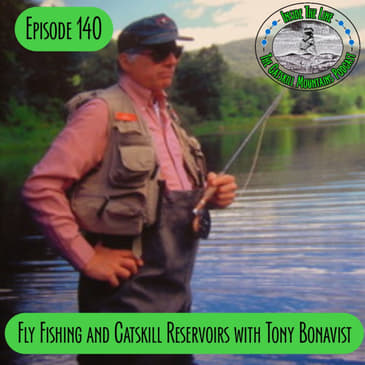
Welcome to episode 140! Tonight, Tony Bonavist, who is a writer from the River Reporter, joins us to chat about fly fishing and the reservoirs in the Catskills. If you need a sticker, email me or go to Camp Catskill! Subscribe on any platform! Share! Donate! Do whatever you want! I'm just glad you're listening! And remember... VOLUNTEER!!!!!!
Links for the Podcast: https://linktr.ee/ISLCatskillsPodcast, Donate a coffee to support the show! https://www.buymeacoffee.com/ITLCatskills, Like to be a sponsor or monthly supporter of the show? Go here! - https://www.buymeacoffee.com/ITLCatskills/membership
Thanks to the sponsors of the show!
Outdoor chronicles photography - https://www.outdoorchroniclesphotography.com/, Trailbound Project - https://www.trailboundproject.com/, Camp Catskill - https://campcatskill.co/, Scenic Route Guiding - https://adventurewiththescenicroute.com/, Another Summit - https://www.guardianrevival.org/programs/another-summit
Links:
Tony’s Writings, Tony’s Book - What’s Wrong With My Fly, River Reporter, OGC-9, NYS Fishing Regulations, Charm Circle
Volunteer Opportunities:
Trailhead stewards for 3500 Club - https://www.catskill3500club.com/adopt-a-trailhead?fbclid=IwAR31Mb5VkefBQglzgr
fm-hGfooL49yYz3twuSAkr8rrKEnzg8ZSl97XbwUw, Catskills Trail Crew - https://www.nynjtc.org/trailcrew/catskills-trail-crew, NYNJTC Volunteering - https://www.nynjtc.org/catskills, Catskill Center - https://catskillcenter.org/, Catskill Mountain Club - https://catskillmountainclub.org/about-us/, Catskill Mountainkeeper - https://www.catskillmountainkeeper.org/, Bramley Mountain Fire Tower - https://bramleymountainfiretower.org/
Post Hike Brews and Bites - Schoolhouse Restaurant
#flyfishing #flyfishingcatskills #mayflies #esopus #tonybonavist #riverreporter #reserviors #catskillreserviors #visitcatskills #catskillstrails #catskillmountains #catskillspodcast #catskills #catskillpark #podcast #catskillshiker #volunteers #catskillmountainsnewyork #catskillspodcast #catskillshiker #catskillshiking #hiking #insidethelinecatskillmountainspodcast #volunteercatskills #catskill3500 #hikethecatskills
[00:00:00] [SPEAKER_02]: As far as a trout fishery depends on the release of that water from Miss Gahari.
[00:00:06] [SPEAKER_02]: And when this last hurricane Debbie hit up here, the Scahari Reservoir got completely browned.
[00:00:13] [SPEAKER_02]: And that water is pumped down into the the shoken through the tunnel into the sopus.
[00:00:19] [SPEAKER_02]: So the asopus a lot of times when there's a lot of rain around runs brown, dirty and it stays that way for days or sometimes weeks.
[00:00:28] [SPEAKER_02]: So from a fishing standpoint, it's not fun to go fishing the Mississippi.
[00:00:35] [SPEAKER_02]: It's fly fishing anyway.
[00:00:37] [SPEAKER_02]: Yeah, feed pure cold water, not muddy water.
[00:00:41] [SPEAKER_02]: But without that release even though it's muddy, it's still cold so it does support the trout fishery.
[00:00:48] [SPEAKER_02]: So that's the enigma part of it.
[00:00:50] [SPEAKER_02]: Without the release from Miss Gahari, the asopus would be just another dry, warm, free stone seasonal trout stream.
[00:00:59] [SPEAKER_04]: Now it's been the bushwax where some of the worst days I've ever had in the mountains or life really.
[00:01:19] [SPEAKER_02]: Whereas pants and mugs are totally opposite to some of them.
[00:01:22] [SPEAKER_02]: I'm talking with a crazy person.
[00:01:24] [SPEAKER_01]: I think of other challenges on this incident where particular difficult.
[00:01:30] [SPEAKER_01]: It is really the development of the extinct cascades we've been for sponsor.
[00:01:36] [SPEAKER_06]: Yeah, yeah.
[00:01:41] [SPEAKER_00]: Oh, you're listening to inside the mountain.
[00:01:44] [SPEAKER_00]: Catch you, ma'am.
[00:01:46] [SPEAKER_05]: You're just going to pop it over right now.
[00:01:53] [SPEAKER_05]: We're not ready.
[00:01:55] [SPEAKER_05]: Ready?
[00:01:55] [SPEAKER_05]: One, two, three.
[00:01:58] [SPEAKER_05]: I don't know if it sounded as good.
[00:02:02] [SPEAKER_05]: Whatever, mine was more authentic.
[00:02:05] [SPEAKER_05]: It was really good stuff.
[00:02:07] [SPEAKER_05]: What's that?
[00:02:08] [SPEAKER_05]: So, Ted, yes, of course.
[00:02:11] [SPEAKER_05]: So guess the starting weight of my pack without any water or food.
[00:02:17] [SPEAKER_05]: For today's hike?
[00:02:19] [SPEAKER_05]: I mean, it's for any hike.
[00:02:21] [SPEAKER_05]: I keep the same thing.
[00:02:23] [SPEAKER_04]: So we're going to say for three seasons, not for winter conditions.
[00:02:27] [SPEAKER_04]: Yeah, yeah.
[00:02:27] [SPEAKER_04]: Okay.
[00:02:29] [SPEAKER_04]: So your dry weight, I'm going to guess is to want to jog it with a response or a serious response.
[00:02:40] [SPEAKER_04]: Serious.
[00:02:41] [SPEAKER_04]: 22.8 pounds.
[00:02:43] [SPEAKER_05]: Wow, wow, that's a little, it's like a session.
[00:02:46] [SPEAKER_05]: I mean, for me, damn.
[00:02:47] [SPEAKER_04]: I mean, you know, I guess yours is probably around 8.
[00:02:53] [SPEAKER_04]: I have no idea.
[00:02:55] [SPEAKER_04]: I'm not weight conscious when it comes to my pack, especially for day hikes.
[00:02:58] [SPEAKER_04]: I think people place too much emphasis on it.
[00:03:01] [SPEAKER_04]: My attitude is whether it's 10 pounds, 20 pounds or 30 pounds.
[00:03:07] [SPEAKER_04]: Is it really that much weight to carry around for a day?
[00:03:10] [SPEAKER_05]: Yeah, correct.
[00:03:11] [SPEAKER_05]: So mine's 14 pounds.
[00:03:13] [SPEAKER_05]: I wanted to, I felt that it was a little bit heavy.
[00:03:16] [SPEAKER_05]: And you know, I was just like, yeah, I will check it out and, you know,
[00:03:21] [SPEAKER_05]: tads going to pick it up.
[00:03:23] [SPEAKER_05]: What do you hold on?
[00:03:26] [SPEAKER_05]: Hold on, what does it feel like?
[00:03:29] [SPEAKER_04]: You said yours is how much again?
[00:03:32] [SPEAKER_04]: 14 14 minds 14.3.
[00:03:37] [SPEAKER_05]: You don't even have a negative there.
[00:03:39] [SPEAKER_05]: I got a full on make hit search and rescue.
[00:03:42] [SPEAKER_04]: So yeah, but you have to see the size of the camera.
[00:03:45] [SPEAKER_04]: I carry.
[00:03:46] [SPEAKER_04]: Who carries the med kit?
[00:03:47] [SPEAKER_04]: It's all about the photos you take.
[00:03:50] [SPEAKER_05]: You know, my pixel takes better photos than whatever you have.
[00:03:54] [SPEAKER_05]: So that's so hurtful.
[00:03:56] [SPEAKER_05]: It is.
[00:03:57] [SPEAKER_04]: It is really that's like going low.
[00:03:59] [SPEAKER_04]: That's very we're early into the show and you have set a new standard for how low
[00:04:05] [SPEAKER_04]: you can go.
[00:04:07] [SPEAKER_04]: I don't know.
[00:04:08] [SPEAKER_05]: I don't know.
[00:04:09] [SPEAKER_05]: It takes great pictures.
[00:04:10] [SPEAKER_05]: I got to admit.
[00:04:11] [SPEAKER_05]: Yeah, I was I was very curious of people's like
[00:04:14] [SPEAKER_05]: starting weight because I know a lot of my friends of course are
[00:04:18] [SPEAKER_05]: such a rescue type and they carry a lot of stuff.
[00:04:21] [SPEAKER_05]: So I'm just I'm I'm carried out.
[00:04:23] [SPEAKER_04]: So you kind of have to live by that code if you're out hiking in your part of
[00:04:27] [SPEAKER_04]: saw or shame on you if you're caught without like a more of a full
[00:04:34] [SPEAKER_04]: fledged med kit than myself, you know, mine's pretty bare bones.
[00:04:40] [SPEAKER_04]: But the the whole thing is is when you especially for winter hiking.
[00:04:45] [SPEAKER_04]: I put stuff in my pack for winter hiking that I've never ever used ever
[00:04:51] [SPEAKER_04]: you're read.
[00:04:53] [SPEAKER_04]: But just in that that rare event if it ever happens,
[00:04:57] [SPEAKER_04]: I like to think that I'm prepared maybe I would be maybe I won't be.
[00:05:01] [SPEAKER_04]: I don't know, but it's just you know, I carry a certain minimum in the winter
[00:05:05] [SPEAKER_04]: that's not in the pack the rest of the year.
[00:05:08] Right.
[00:05:09] [SPEAKER_05]: Yeah, and I do the same.
[00:05:10] [SPEAKER_05]: You know, I have learned not for I wouldn't say from the past from previous
[00:05:14] [SPEAKER_05]: experiences because I haven't had any crazy bad previous experiences,
[00:05:18] [SPEAKER_05]: but I've learned from the internet and from, you know, just hearing stories and
[00:05:24] [SPEAKER_05]: stuff that I do not want to be caught in that situation where I'd have to find out
[00:05:30] [SPEAKER_05]: a place to make a snowy glue or something like that to save myself.
[00:05:35] [SPEAKER_04]: Yeah, you know, well, so then the question becomes not going out on a day like that.
[00:05:42] [SPEAKER_04]: Right.
[00:05:42] [SPEAKER_04]: Right.
[00:05:43] [SPEAKER_04]: You know, this is this is all recreational day hiking and you should definitely the night
[00:05:51] [SPEAKER_04]: before in the morning of your hike.
[00:05:54] [SPEAKER_04]: Double and triple check to prevailing weather conditions.
[00:05:58] [SPEAKER_04]: What's forecast?
[00:06:00] [SPEAKER_04]: I like to look on color radar to see what storms if any are out there and how they're
[00:06:05] [SPEAKER_04]: moving because
[00:06:08] [SPEAKER_04]: I don't know what percentage of
[00:06:11] [SPEAKER_04]: situations arise that are weather related versus a pure accident,
[00:06:16] [SPEAKER_04]: but if you can eliminate or minimize the weather related incidents,
[00:06:20] [SPEAKER_04]: you've gone a long way to promoting your safety.
[00:06:24] Yeah.
[00:06:25] [SPEAKER_05]: And the mountains will be there another fricking day.
[00:06:27] [SPEAKER_05]: That's that's the whole thing that I think is that, you know,
[00:06:31] [SPEAKER_05]: if it's going to be a bad experience,
[00:06:33] [SPEAKER_05]: if you feel like, you know, there's 100% chance of rain that.
[00:06:36] [SPEAKER_05]: I mean, that's that's, you know, rain all day.
[00:06:38] [SPEAKER_05]: It could be a great experience, you know, in the summer times when it's a warmer weather
[00:06:42] [SPEAKER_05]: and you can kind of feel that rain.
[00:06:46] [SPEAKER_05]: But, you know, when you're sitting at that spring temperatures, though, the winter fall
[00:06:51] [SPEAKER_05]: temperatures, when it's rain.
[00:06:53] [SPEAKER_05]: And then as you get higher up, it could be sweet and snow.
[00:06:57] [SPEAKER_05]: That gets to be the kind of uncomfortable time of when you're just like
[00:07:01] [SPEAKER_05]: damn I really regret planning this.
[00:07:04] [SPEAKER_05]: But I got to get the summit.
[00:07:06] [SPEAKER_05]: I just got to do it, you know, yeah.
[00:07:07] [SPEAKER_04]: Well, you know, it's need versus desire and days like that.
[00:07:14] [SPEAKER_04]: It's more desire than really needing to get there.
[00:07:17] [SPEAKER_04]: And fortunately for you and I, we both look so close to the cast skills that
[00:07:22] [SPEAKER_04]: if you don't hike at this weekend, you can hike at next weekend.
[00:07:26] [SPEAKER_04]: Right, correct.
[00:07:28] [SPEAKER_05]: And, you know, yeah.
[00:07:30] [SPEAKER_05]: So welcome to episode 140 of Inside the Line that Catskill Mountains,
[00:07:35] [SPEAKER_05]: podcasts tonight.
[00:07:36] [SPEAKER_05]: We have Tony Bonavis here to talk about Catskill fly fishing and the somewhat of the Catskill
[00:07:41] [SPEAKER_05]: reservoirs more about fly fishing in the Catskills.
[00:07:43] [SPEAKER_05]: You know, he's a Catskill man who's been live fishing since the 1950s.
[00:07:51] [SPEAKER_05]: And, you know, we can't wait to hear about that.
[00:07:53] [SPEAKER_05]: And, you know, are you doing some like what are you doing with your costs as
[00:07:58] [SPEAKER_05]: man?
[00:07:59] [SPEAKER_05]: I'm cleaning off the lenses.
[00:08:00] [SPEAKER_05]: I'm sorry.
[00:08:01] [SPEAKER_04]: It looked like he were looking at that spider.
[00:08:04] [SPEAKER_04]: Yeah, now I'm getting some glare from this green and then with you in the
[00:08:08] [SPEAKER_04]: background it kind of freaks me out.
[00:08:10] [SPEAKER_04]: So I'm just saying, I'm going to have to minimize your image.
[00:08:15] [SPEAKER_04]: Thank you.
[00:08:16] [SPEAKER_05]: I appreciate it.
[00:08:17] [SPEAKER_05]: I appreciate it.
[00:08:18] [SPEAKER_05]: As we're talking right now,
[00:08:20] [SPEAKER_05]: fall foliage, we're not at peak, but we're getting there.
[00:08:24] [SPEAKER_04]: I'd say so.
[00:08:25] [SPEAKER_04]: I mean, if you don't like this coming weekend or next weekend,
[00:08:28] [SPEAKER_04]: I think you're missing out.
[00:08:30] [SPEAKER_04]: I think this coming weekend, we're going to see some good colors.
[00:08:33] [SPEAKER_04]: Obviously, I think the following weekend would be even better.
[00:08:37] [SPEAKER_04]: But at the higher elevations, it's happening.
[00:08:40] [SPEAKER_04]: Fall is up there.
[00:08:43] [SPEAKER_05]: And, you know, I was out today up in the high peaks and I will talk about that later.
[00:08:47] [SPEAKER_05]: But, you know, we're going to chat about our favorite short hikes.
[00:08:52] [SPEAKER_05]: I would say to get that fall foil foil, fall foliage at kind of like a reasonable
[00:09:00] [SPEAKER_05]: time where you have enough time to get that moment of New York state, the fantastic
[00:09:06] [SPEAKER_05]: New England foliage that nobody else, you know, I drive around and I gasped and I say,
[00:09:15] [SPEAKER_05]: God damn, people don't know what awesomeness we have up here.
[00:09:20] [SPEAKER_04]: What beautiful stunning stuff we have up here.
[00:09:22] [SPEAKER_04]: Oh, yeah.
[00:09:23] [SPEAKER_04]: I mean, you've spent more time hiking in the southwest than I have.
[00:09:27] [SPEAKER_04]: But out there is it's just rocks, rocks and rocks and maybe a few plants,
[00:09:33] [SPEAKER_04]: some cacti, whatever.
[00:09:35] [SPEAKER_04]: But up here, it's like you're in a tall, shaggy carpet walking around.
[00:09:41] [SPEAKER_04]: That's all green, you know, throughout the summer in early September.
[00:09:46] [SPEAKER_04]: And then that that shag carpet starts to change color.
[00:09:51] [SPEAKER_04]: I suppose I should ask, do you even know what shag carpet is?
[00:09:54] [SPEAKER_04]: I do.
[00:09:55] [SPEAKER_04]: You do you?
[00:09:56] [SPEAKER_04]: All right, you don't have to admit that if you don't want to.
[00:09:58] [SPEAKER_05]: Yeah, I was in the 80s and 90s man.
[00:10:00] [SPEAKER_05]: I know what those orange green carpets were event.
[00:10:04] [SPEAKER_04]: Yeah, well, shag had a short run in the 70s.
[00:10:08] [SPEAKER_04]: So it's okay.
[00:10:09] [SPEAKER_04]: And I don't think it will ever come back to style.
[00:10:12] [SPEAKER_04]: But that's what it's like being up there.
[00:10:13] [SPEAKER_04]: I mean, I was up this past weekend.
[00:10:15] [SPEAKER_04]: It's just gorgeous.
[00:10:16] [SPEAKER_04]: So you want to talk about some some wiki's that you can do in the cacti skills.
[00:10:20] [SPEAKER_04]: If you just want to get out for a few hours in the woods.
[00:10:24] [SPEAKER_04]: Yeah, dude.
[00:10:25] [SPEAKER_05]: So one of my, you know, one of my favorite areas.
[00:10:28] [SPEAKER_05]: I know it's a little bit packed towards these times,
[00:10:31] [SPEAKER_05]: but it's still definitely worth an acropoint for knob over anywhere on there
[00:10:37] [SPEAKER_05]: that overlooks the blackheads.
[00:10:39] [SPEAKER_05]: I mean, you can even do when I'm high peak,
[00:10:41] [SPEAKER_05]: it's a little bit longer.
[00:10:43] [SPEAKER_05]: But it just gives you that awesome view of the blackheads,
[00:10:46] [SPEAKER_05]: the foliage going up to the peaks of the area of what is this called
[00:10:50] [SPEAKER_05]: the blackheads because they have the, the awesome forest of pop.
[00:10:54] [SPEAKER_04]: Yeah, I'd have to agree with that.
[00:10:56] [SPEAKER_04]: And sometimes the misconception is that the best view is from the higher
[00:11:01] [SPEAKER_04]: mountain looking down when Erka and Burton obthellus,
[00:11:06] [SPEAKER_04]: that the better view is from the lower elevation looking up.
[00:11:12] [SPEAKER_05]: And it's definitely, you know, still acro important knob,
[00:11:16] [SPEAKER_05]: Burton obthack a punch.
[00:11:18] [SPEAKER_05]: They do.
[00:11:18] [SPEAKER_05]: It's like 900 feet again in one, one, two miles.
[00:11:22] [SPEAKER_05]: It's still packs a punch.
[00:11:23] [SPEAKER_05]: You know, I remember taking Jessica up the Burton obtherate sunset
[00:11:27] [SPEAKER_05]: like, and she wasn't happy with me because she thought it was,
[00:11:31] [SPEAKER_05]: you know, 1.2 miles in, you know, like like 300 feet again
[00:11:35] [SPEAKER_05]: and it was not.
[00:11:37] [SPEAKER_05]: So, but she was still blown away.
[00:11:39] [SPEAKER_05]: We got you don't get the sunset, but you get that sunset projection
[00:11:44] [SPEAKER_05]: onto the blackheads and to acro point because, uh,
[00:11:49] [SPEAKER_05]: Burton obthellus, the summit is blocking, of course,
[00:11:52] [SPEAKER_05]: the sun, what it gets going into the valley up into the valley.
[00:11:58] [SPEAKER_05]: And it's just absolutely stunning.
[00:12:00] [SPEAKER_05]: And you know, I mean, short hikes, the escarbman anywhere on the escarbman
[00:12:04] [SPEAKER_05]: sunset ledge, new men's ledge, stuff like that.
[00:12:07] [SPEAKER_05]: You can overlook the Hudson, you can overlook, you know,
[00:12:10] [SPEAKER_05]: part of the valley going up to Catascale High Peak and such like that.
[00:12:15] [SPEAKER_05]: And, you know, there's a bunch of others, like,
[00:12:18] [SPEAKER_05]: I mean, if we go a little bit further, like,
[00:12:22] [SPEAKER_05]: peacorn-notch going into the Indian head and twin,
[00:12:25] [SPEAKER_05]: that alphars of fantastic view of just the valley of Hudson Valley
[00:12:30] [SPEAKER_05]: and then going into the Burroughs range.
[00:12:32] [SPEAKER_05]: And then, of course, you can do anything else with a viewpoint like,
[00:12:36] [SPEAKER_05]: I, I, one of my favorites is every,
[00:12:40] [SPEAKER_05]: not a lot of people like this because it's so popular, but it's flat bound.
[00:12:44] [SPEAKER_05]: It feels like you are on top of the world.
[00:12:46] [SPEAKER_05]: And you can see so much, I don't know.
[00:12:49] [SPEAKER_05]: I don't know why slide gets me every time.
[00:12:51] [SPEAKER_04]: Yeah, I mean, it's hard to argue with the hike-up slide,
[00:12:55] [SPEAKER_04]: whether you go up to Jeep trail or the Curtis Orm's be either way,
[00:13:01] [SPEAKER_04]: it's fun and easy and surely in the fall.
[00:13:05] [SPEAKER_04]: It's a good hike.
[00:13:07] [SPEAKER_04]: But when you talk about a short hike in the fall,
[00:13:10] [SPEAKER_04]: you know, a shoken high point comes to mind for me.
[00:13:14] [SPEAKER_04]: Why is it short? Where are you approaching this from?
[00:13:17] [SPEAKER_04]: Well, it's, I think of a shoken high point as a hike.
[00:13:20] [SPEAKER_04]: You can take somebody on that you don't know what their ability is.
[00:13:23] [SPEAKER_04]: And you can just hike as far as you want to
[00:13:27] [SPEAKER_04]: and turn around.
[00:13:29] [SPEAKER_04]: If they're not into the whole valley pop loop.
[00:13:35] [SPEAKER_04]: So, just, I mean, just getting up to where the beaver dams are,
[00:13:39] [SPEAKER_04]: is a good hike or just sometimes just crossing that bridge
[00:13:42] [SPEAKER_04]: and going up the little stream, you know, going down there and exploring.
[00:13:49] [SPEAKER_05]: What is the stream that is?
[00:13:51] [SPEAKER_05]: Isn't it the canopy brook?
[00:13:53] [SPEAKER_05]: Yes, the canopy brook. What an awesome spot.
[00:13:56] [SPEAKER_05]: You're right.
[00:13:57] [SPEAKER_05]: Yeah.
[00:13:57] [SPEAKER_05]: Fall foliage right up there is pristine area because it's a bit wider trail.
[00:14:03] [SPEAKER_04]: Yeah, it's actually an old, like,
[00:14:06] [SPEAKER_04]: rock, shroeder through road that goes through to the other side,
[00:14:10] [SPEAKER_04]: towards wagon wheel.
[00:14:13] [SPEAKER_05]: And then they're trying to make it,
[00:14:15] [SPEAKER_05]: they have, they bought land on the other side of the Shoken High Point correct?
[00:14:21] [SPEAKER_05]: Well, I think let's talk about that.
[00:14:23] [SPEAKER_05]: We don't want to talk about that.
[00:14:24] [SPEAKER_04]: It's not open to public access and maybe it will never be.
[00:14:30] [SPEAKER_05]: That's, we'll go to a ton of lies.
[00:14:32] [SPEAKER_05]: But I agree.
[00:14:33] [SPEAKER_05]: Shoken High Point offers some phenomenal views and they recently cut the top of that.
[00:14:38] [SPEAKER_05]: Like to the view point going.
[00:14:40] [SPEAKER_04]: Yeah, so yeah, I haven't been up there outside of the winter months,
[00:14:46] [SPEAKER_04]: but every time I've been up there in the winter,
[00:14:48] [SPEAKER_04]: it's just a great hike.
[00:14:49] [SPEAKER_04]: So I have to go there.
[00:14:51] [SPEAKER_04]: Let's, let's, okay.
[00:14:53] [SPEAKER_05]: Maybe this will think about this in the summer.
[00:14:54] [SPEAKER_04]: Yeah.
[00:14:55] [SPEAKER_04]: Also, I put on my list anything on the dry brook ridge,
[00:14:58] [SPEAKER_04]: the Hkelberry Loop,
[00:15:00] [SPEAKER_04]: Caterstil, Caterstil, Cove.
[00:15:03] [SPEAKER_04]: Oh, yeah.
[00:15:04] [SPEAKER_04]: You know, there's just a lot of hiking opportunities.
[00:15:07] [SPEAKER_04]: Along all of that.
[00:15:09] [SPEAKER_05]: There's not just hiking opportunities.
[00:15:11] [SPEAKER_05]: There's driving opportunities.
[00:15:13] [SPEAKER_05]: You can get all this stuff.
[00:15:15] [SPEAKER_05]: And you are fair for familiar,
[00:15:17] [SPEAKER_05]: of course, with that lower area of the globe and stuff like that.
[00:15:20] [SPEAKER_05]: You get to go along 23A.
[00:15:23] [SPEAKER_05]: That has like, I know there's that one view point right before.
[00:15:26] [SPEAKER_05]: I think it's like a gas station that has two trees.
[00:15:30] [SPEAKER_05]: And it has like a pathway and then it opens up into Caterstil,
[00:15:33] [SPEAKER_05]: high peak in North South Lake Mountain and stuff like that.
[00:15:38] [SPEAKER_05]: I'm trying to think of the gas station that it is,
[00:15:40] [SPEAKER_05]: but I think it's on 23A.
[00:15:43] [SPEAKER_05]: And it's private property and every human being stops there
[00:15:47] [SPEAKER_05]: to take a picture of the cat skills from that area.
[00:15:49] [SPEAKER_04]: Oh, oh, oh, yeah.
[00:15:51] [SPEAKER_04]: You're, I know where you're talking of it.
[00:15:52] [SPEAKER_04]: And it's right across all its not 23A.
[00:15:55] [SPEAKER_04]: In W. Yeah. Well, this is an online W.
[00:15:58] [SPEAKER_04]: It's on 32.
[00:16:02] [SPEAKER_04]: Right.
[00:16:02] [SPEAKER_04]: Heading North towards Platte Cove and, or is it now?
[00:16:07] [SPEAKER_04]: Yeah, Platte Cove.
[00:16:08] [SPEAKER_04]: And if you're heading north on the right hand side of the road,
[00:16:11] [SPEAKER_04]: there's a hoarder's house with stuff all around the house.
[00:16:16] [SPEAKER_04]: I think all that stuff now is like the structural support
[00:16:20] [SPEAKER_04]: itself for the house because the house is in bed shape.
[00:16:23] [SPEAKER_04]: And then on the opposite side of the road is an epic view
[00:16:29] [SPEAKER_04]: of the cat skills, the apartment.
[00:16:32] [SPEAKER_04]: You really get the full flavor of the cat skills from base elevation.
[00:16:38] [SPEAKER_05]: Yeah.
[00:16:39] [SPEAKER_05]: And you know, you go along that 9 W up to is that 23.
[00:16:45] [SPEAKER_05]: Route 23 going up to wind them and stuff like that.
[00:16:47] [SPEAKER_04]: Yeah, you keep saying 9 W.
[00:16:49] [SPEAKER_04]: Like, I'm that's more along the Hudson for 9.
[00:16:53] [SPEAKER_04]: Really?
[00:16:54] [SPEAKER_05]: Yeah.
[00:16:55] [SPEAKER_05]: And in my mind 32 you're right 32.
[00:16:58] [SPEAKER_05]: Oh my god.
[00:16:59] [SPEAKER_05]: I'm an idiot.
[00:17:01] [SPEAKER_05]: Yeah, I haven't been around there in a while.
[00:17:03] [SPEAKER_05]: So it's been a long time.
[00:17:04] [SPEAKER_05]: So yes, you're right 32 goes all the way up into 23 and then you can get up
[00:17:10] [SPEAKER_05]: along 23 and go up to wind them and have those phenomenal views.
[00:17:14] [SPEAKER_05]: They don't get to a occasional times when you can just get that glimpse.
[00:17:17] [SPEAKER_04]: And you go through Durham and the the Irish mountains of the Catskills.
[00:17:24] [SPEAKER_04]: And I guess together with talking about these epic fall drives and the Catskills,
[00:17:29] [SPEAKER_04]: one of the things that gets me stoked up to go hiking in the Catskills is just the drive over
[00:17:33] [SPEAKER_04]: because I'm fortunate enough to be able to enter the Catskills by going through
[00:17:39] [SPEAKER_04]: any one of these scenic corridors that just kind of like set the stage or the vibe
[00:17:45] [SPEAKER_04]: for the day or may.
[00:17:48] [SPEAKER_05]: Man, I hate to say this.
[00:17:49] [SPEAKER_05]: I hate this where but anytime I go through there, I'm like,
[00:17:52] [SPEAKER_05]: fuck yes.
[00:17:54] [SPEAKER_05]: I'm like, like today, you know, when I drove down to Sugarloaf,
[00:17:57] [SPEAKER_05]: you're looking at those bridges going up a rush and they are all different colors.
[00:18:02] [SPEAKER_05]: And you're like, yeah, damn, this is fantastic.
[00:18:05] [SPEAKER_05]: This is beautiful.
[00:18:07] [SPEAKER_05]: Like even, you know, seen parts of Hunter Mountain,
[00:18:11] [SPEAKER_05]: even with the disc eras or you still see like the ridges and you're just like,
[00:18:16] [SPEAKER_05]: wow, what an awesome sight.
[00:18:20] [SPEAKER_05]: And like, you know, you have a bunch of drives that you know to do.
[00:18:25] [SPEAKER_05]: I know to do going out towards where to go more towards the West around any reservoir
[00:18:30] [SPEAKER_05]: is absolutely fantastic.
[00:18:32] [SPEAKER_04]: Yeah, I think the, um,
[00:18:35] [SPEAKER_04]: the Ashoken reservoir, particularly on the backside along Route 28 A is a nice drive.
[00:18:41] [SPEAKER_04]: But the, um, the Papakten and the round out are just marvelous to drive around.
[00:18:48] [SPEAKER_04]: You get more of an more intimate and less developed feel driving around those two
[00:18:54] [SPEAKER_04]: than you do the Ashoken.
[00:18:57] [SPEAKER_05]: And you know, you go, you go those areas.
[00:18:59] [SPEAKER_05]: You go even more further, can it'sville?
[00:19:01] [SPEAKER_05]: You know, once again, you're talking about undeveloped.
[00:19:04] [SPEAKER_05]: There's no houses out there whatsoever.
[00:19:07] [SPEAKER_05]: It's just all roads going alongside of the in and out weaving in and out of the, you know,
[00:19:14] [SPEAKER_05]: the reservoir territory range big.
[00:19:17] [SPEAKER_05]: There's not big mountains, but they feel superior when you're on the base level of the,
[00:19:21] [SPEAKER_05]: the reservoirs.
[00:19:22] [SPEAKER_04]: Yeah, I mean, the amount of prominences, you know,
[00:19:26] [SPEAKER_04]: will give you that feeling of being an amount in this area.
[00:19:28] [SPEAKER_04]: The other note where the drive is going up the beaver kill out of living livingston manner.
[00:19:35] [SPEAKER_04]: Well, I think that's yeah, I think that's just one of the classic, uh,
[00:19:40] [SPEAKER_04]: at skill roads to drive and I forget how many, but there's at least three or four,
[00:19:47] [SPEAKER_04]: maybe five signs.
[00:19:49] [SPEAKER_04]: There should drive along that road.
[00:19:52] [SPEAKER_04]: And each one of these signs calls out that the road is narrowing.
[00:19:58] [SPEAKER_04]: Right.
[00:19:59] [SPEAKER_04]: And it starts out in an normal state standard, you know,
[00:20:03] [SPEAKER_04]: two lane road width and there's you keep going out further and further and further.
[00:20:09] [SPEAKER_04]: It keeps downsizing, you know, to a smaller two lane width and then small or
[00:20:14] [SPEAKER_04]: and you get the looped beach and it gets smaller and eventually you get out where
[00:20:18] [SPEAKER_04]: it's more of a hard pack gravel road and it's just one lane.
[00:20:22] [SPEAKER_04]: Mm-hmm.
[00:20:24] [SPEAKER_04]: One lane.
[00:20:25] [SPEAKER_05]: That's where you go deep in the cat skills and you are one with the cat skills.
[00:20:30] [SPEAKER_04]: You're out by ball some lake when you're out there.
[00:20:33] [SPEAKER_05]: I'm actually thinking about that this Sunday.
[00:20:35] [SPEAKER_05]: You said you're available?
[00:20:37] [SPEAKER_04]: Yeah, yeah, we can go hike.
[00:20:38] [SPEAKER_04]: I'm not sure if I be a awesome lake.
[00:20:41] [SPEAKER_04]: Uh, we got to represent that the podcast come on.
[00:20:45] [SPEAKER_04]: Yeah.
[00:20:45] [SPEAKER_04]: I think the great hike for this weekend would be Warner Creek down to Mount Trimber.
[00:20:52] [SPEAKER_04]: We park up.
[00:20:53] [SPEAKER_04]: We park a car at one end, we go point to point.
[00:20:56] [SPEAKER_05]: Even Warner Creek off the plateau is absolutely phenomenal.
[00:21:01] [SPEAKER_05]: Have you been up that yet?
[00:21:02] [SPEAKER_05]: You have.
[00:21:03] [SPEAKER_05]: Oh yeah, many times.
[00:21:04] [SPEAKER_05]: Of course, of course.
[00:21:05] [SPEAKER_04]: Yeah, forget about it.
[00:21:06] [SPEAKER_05]: If I've been up that, if I've been up that, yeah, right.
[00:21:09] [SPEAKER_05]: Good point.
[00:21:10] [SPEAKER_05]: Good point.
[00:21:10] [SPEAKER_05]: All right.
[00:21:11] [SPEAKER_05]: So once again, you get out there and enjoy the the fall foliage because it is happening.
[00:21:17] [SPEAKER_05]: It's it's starting to.
[00:21:20] [SPEAKER_05]: I wouldn't say peak, but it's a dry season, but it's going to happen fast and it's going
[00:21:24] [SPEAKER_05]: up and quick and who knows if we have a rainstorm and those fleas will fall.
[00:21:29] [SPEAKER_05]: Pretty quickly.
[00:21:30] [SPEAKER_05]: So you know, one thing we talked about last week was about the Baltimore Bayer Tower
[00:21:36] [SPEAKER_05]: cabin that is right below the fire tower and you know, I got an important update from
[00:21:42] [SPEAKER_05]: Lori and Lori kind of posted this online as well that there was another area
[00:21:47] [SPEAKER_05]: that had kind of a similar incident that they took negligence to the observers cabin.
[00:21:53] [SPEAKER_05]: And it is just deteriorated down into it and an unfortunate.
[00:21:58] [SPEAKER_05]: They're just going to leave it to decay forever.
[00:22:02] [SPEAKER_05]: And you know, I'm not trying to be kind of forgetful, but I forgot what
[00:22:08] [SPEAKER_05]: cabin it was with it like stark weather.
[00:22:12] [SPEAKER_05]: You know, I don't remember off hand.
[00:22:13] [SPEAKER_05]: I will, I will look it up really quickly.
[00:22:18] [SPEAKER_04]: But so the thing is is that the DEC can spend so many dollars to fix up the existing
[00:22:24] [SPEAKER_04]: cabin and you know, preserve and maintain it or eventually when it falls into such a
[00:22:31] [SPEAKER_04]: state of this repair, it becomes a new sense for for young people, a fire hazard, you
[00:22:36] [SPEAKER_04]: know, more likely for somebody to set it on fire.
[00:22:40] [SPEAKER_04]: So that they would have to tear it down, you know, and and haul off the demolition debris.
[00:22:47] [SPEAKER_04]: So the issue would seem to be which is the economically the better alternative and then
[00:22:55] [SPEAKER_04]: from a historical preservation standpoint.
[00:22:58] [SPEAKER_04]: I think it really the scales lean and favor of spending some money now and maintaining
[00:23:04] [SPEAKER_04]: the structure.
[00:23:05] Yeah.
[00:23:06] [SPEAKER_04]: Doesn't seem that hard.
[00:23:08] [SPEAKER_05]: Exactly.
[00:23:09] [SPEAKER_05]: And you know, I looked it up and Lori Mita an awesome post on the FFLA on New York
[00:23:15] [SPEAKER_05]: State Chapter of the fire towers association.
[00:23:18] [SPEAKER_05]: And I will post the link in the show notes.
[00:23:21] [SPEAKER_05]: Please join it because it's awesome site of great information.
[00:23:26] [SPEAKER_05]: And this was the Jessup River wild forest fire tower to breeze.
[00:23:30] [SPEAKER_05]: Pillsbury Mountain Fire Tower of service.
[00:23:32] [SPEAKER_05]: Kevin had one walls collapsed to breeze from the walls of falling in the trail lead
[00:23:36] [SPEAKER_05]: down the fire tower.
[00:23:38] [SPEAKER_05]: Hikers come into visit the tower should be cautious of nails and broken remnants of
[00:23:43] [SPEAKER_05]: the wall and to walk on the boards that have been placed down to east half of work
[00:23:47] [SPEAKER_05]: to clean up their breathe.
[00:23:49] [SPEAKER_05]: So that was left today.
[00:23:52] [SPEAKER_05]: It's set.
[00:23:53] [SPEAKER_05]: It's set because this is historical area.
[00:23:56] [SPEAKER_05]: This is an area once people went up to the tower and were up there, you know,
[00:24:02] [SPEAKER_05]: I don't know how many hours per day just observing for fires and saving our forest.
[00:24:08] [SPEAKER_05]: And they would go down to stay in the cabin for certain amount of time.
[00:24:13] [SPEAKER_05]: And now these cabins of historical place where we can learn so much,
[00:24:16] [SPEAKER_05]: we can put so much up and people can be influenced to go into our mountains
[00:24:21] [SPEAKER_05]: and stuff, you know, get, you know, fall them up with the mountains have left to be decay.
[00:24:26] [SPEAKER_04]: And yeah, and you know, in the irony is this what government often does is they'll let
[00:24:34] [SPEAKER_04]: this cabin fall into a state of disrepair, spend money to demolish it in a car
[00:24:40] [SPEAKER_04]: way that debris.
[00:24:43] [SPEAKER_04]: But then 25, 30, 40, 50 years from now that they'll sell it to build a cabin up there
[00:24:49] [SPEAKER_04]: to, you know, create some historical looking feature
[00:24:54] [SPEAKER_04]: that to show people what it was like, you know, way back in the day when they could have just
[00:24:58] [SPEAKER_04]: maintained what was there.
[00:25:01] [SPEAKER_04]: We'd now would seem like the better alternative.
[00:25:04] [SPEAKER_04]: So hopefully the DEC will make the resources available to preserve that historic structure.
[00:25:10] [SPEAKER_05]: Yeah. And you know, we talk about that kind of structure that you talk about
[00:25:16] [SPEAKER_05]: and you know, the public with the brand new mountain fire tower has benefited
[00:25:21] [SPEAKER_05]: and gotten together to create a fire tower up on the brand new mountain.
[00:25:25] [SPEAKER_05]: Now this is not in the Catskill force preserve area, the Catskill mountain park and stuff like that.
[00:25:30] [SPEAKER_05]: But you know, what can we do as a local community to get this, you know,
[00:25:38] [SPEAKER_05]: to lead to slather and stuff like that to people to view to get this going and, you know,
[00:25:43] [SPEAKER_05]: you know, Ted was the one that brought this up and I don't know if Lori heard the podcast
[00:25:49] [SPEAKER_05]: and she was like, God damn, that's a great idea. Let's get it going.
[00:25:52] [SPEAKER_05]: She made up a report or a little letter that we can send to our local legislations to get this going.
[00:26:00] [SPEAKER_05]: Who knows what it can do? You know, it's a little thing that you can copy and paste,
[00:26:04] [SPEAKER_05]: send mail via email, whatever.
[00:26:07] [SPEAKER_05]: It could make an impact. It could not, but you know, it's, it's a simple one, two, three thing that you can do.
[00:26:13] [SPEAKER_04]: Yeah. So, um, make the link available and let's talk it up so we can get some people to send this in.
[00:26:21] [SPEAKER_05]: Yeah. It's it's said, you know, we can, the community can do a lot.
[00:26:27] [SPEAKER_05]: But unfortunately, the DC can make do gondolas for a ski resort, up in Bel Air or in Core Mountain.
[00:26:33] [SPEAKER_05]: But they can't put a bridge over slide, they're never saying going over to slide.
[00:26:38] [SPEAKER_04]: That's right. I am.
[00:26:39] [SPEAKER_04]: You are so sure about that. Right. Yeah.
[00:26:42] [SPEAKER_04]: But you want to hear something crazy? I understand that the city of Kingston just received a grant to hire a full time for aster for a city.
[00:26:57] [SPEAKER_04]: For aster.
[00:26:58] [SPEAKER_04]: Okay. I mean, there's just something that just doesn't fit there, right? So, so there's money available to hire a full time for aster for the city of Kingston.
[00:27:06] [SPEAKER_04]: I'm not sure why, but yes, they're getting money for that and it's presumably a good thing.
[00:27:12] [SPEAKER_04]: But why is it? They can't make a few thousand dollars available to fix an existing cabin on Balsam Lake Mountain.
[00:27:22] [SPEAKER_04]: Right. Right.
[00:27:23] [SPEAKER_04]: You know, and every year and I'm not shaming the forester, but every year you need to pay the salary of the forester.
[00:27:30] [SPEAKER_04]: Right. So, it's reoccurring expense.
[00:27:33] [SPEAKER_04]: Whereas you go in, you fix this cabin.
[00:27:36] [SPEAKER_04]: It's going to be good if you do it right. It's going to be good for what? 10, 15, 20 years.
[00:27:43] [SPEAKER_04]: Or it's probably been 50 years. Yeah. I mean, it's going to be a long time, a long long time.
[00:27:48] [SPEAKER_04]: But again, the state has the money to hire a full time for aster for the city of Kingston.
[00:27:54] [SPEAKER_04]: I don't exactly get that. Right.
[00:27:58] [SPEAKER_04]: Why it's a full time position? And hopefully they pay a for aster a decent amount of money because the person should make a decent living on the one hand.
[00:28:08] [SPEAKER_04]: But again, on the other hand, what's the point at just funding that job for one year?
[00:28:13] [SPEAKER_04]: Right. You should do it for multiple years. And now you're talking, you know, let's say at 75,000 a year
[00:28:20] [SPEAKER_04]: for multiple years going forward. That's a lot of money.
[00:28:24] [SPEAKER_04]: Right. And for what? For five, 10,000 dollars. I don't know what it is. You can fix this cabin on
[00:28:29] [SPEAKER_04]: balsam lake mountain and be done with it for a decade or two.
[00:28:34] [SPEAKER_05]: Simple to me. Or you could put out a mass invite to all these volunteers that are willing to do it
[00:28:42] [SPEAKER_05]: and cut that expense in half. Yeah. Because, you know, I would really be the one up there and freaking have fun.
[00:28:49] [SPEAKER_05]: You know, see helicopter drop up, supplies or something like that. And then freaking get this out on one day.
[00:28:56] [SPEAKER_04]: Well, if you're up there, stush, we don't want the building coming out crooked, you know, full leaks.
[00:29:02] [SPEAKER_05]: So I know which buildings are. I'm not a photographer, man. Okay. Stick to trail maintenance.
[00:29:07] [SPEAKER_05]: It's all it's all worry and time. They all forget to go all out and stuff like that.
[00:29:12] [SPEAKER_05]: So speaking of all out, amazing accomplishment recently that just happened within the last few days.
[00:29:18] [SPEAKER_05]: Ultra run at Tara, Candy Mama, Dauer, shaved 13 hours off. Carousel, please.
[00:29:26] [SPEAKER_05]: previous record for hiking the Appalachian Trail. So she completed the Southern through hike.
[00:29:32] [SPEAKER_05]: So south, the north of the south of the iconic trail crossing 14 states, 2,197 miles
[00:29:41] [SPEAKER_05]: in 40 days, 18 hours and 5 minutes. That's the same time for hiking the iconic trail in any
[00:29:50] [SPEAKER_05]: direction, any direction and you know, not to knock the soft, but it was freaking done by a female
[00:29:57] [SPEAKER_05]: who kicked ass. I am just like, I'm so excited about this. Like, south to north. Well, sorry, north of
[00:30:09] [SPEAKER_05]: south was just absolutely phenomenal and she destroyed the people say 13 hours is not a lot,
[00:30:17] [SPEAKER_04]: but that is a lot of freaking time hiking. Well, it's a lot of miles. Right. Yeah,
[00:30:23] [SPEAKER_05]: doing the doing 40 days. I mean, that's had you know how long it takes for a normal person to hike
[00:30:29] [SPEAKER_05]: the Appalachian Trail? Take a guess. Three months, five months really. Five months is a usual
[00:30:38] [SPEAKER_04]: time by the six months if you're going casually. So she, she averaged like 55 miles a day.
[00:30:47] [SPEAKER_04]: Jesus Christ. Right. Right. Like I've blown away. Yeah. So she's averaging 55 miles a day, which is
[00:30:57] [SPEAKER_04]: insane, but what I want to know and maybe you can find this out for us. Where's the name candy
[00:31:05] [SPEAKER_04]: mama come from? Okay. I mean, is it she like operating at such a high intensity that that's all she
[00:31:12] [SPEAKER_04]: does as he can do? Right. While she's, you know, doing 55 miles a day. So if she is doing 55 miles
[00:31:22] [SPEAKER_04]: a day and the only way to maintain her feeling for that is just to eat nonstop candy. What's
[00:31:30] [SPEAKER_04]: the next thing I want to know? Right. I want to know how much money she spends on dental bills.
[00:31:38] [SPEAKER_04]: What's got it in there? You've got to have bad teeth if you eat all that candy. True, but also
[00:31:43] [SPEAKER_05]: you don't want to know about like, open and pee in. Like is it, is it like the next like, oh shit?
[00:31:50] [SPEAKER_05]: I can't take a shit for another six miles. I got her right. I just think you go when you have to go.
[00:31:57] [SPEAKER_04]: I don't, I don't think that's, I don't think that's the big deal. I mean, but, but obviously, if you're
[00:32:02] [SPEAKER_04]: trying to make time, you don't want to be constipated. Okay. True. So I'm sure, I'm sure, you know,
[00:32:09] [SPEAKER_04]: that's part of getting the business done is getting your business done, but that's 40 days,
[00:32:14] [SPEAKER_05]: 50 some miles a day. I can't even comprehend. Right? Like just, just the fly along to do that many
[00:32:25] [SPEAKER_04]: miles per day is to set, how do you feel? How many times do you stub your toes during the day?
[00:32:32] [SPEAKER_04]: How many times do you change your shoes? Yeah. It's she has like all of her toes are like black
[00:32:37] [SPEAKER_05]: from like toe jam all day long. What is it about? You know, watching her finish. Of course,
[00:32:44] [SPEAKER_05]: this record was set in 2018. So it hasn't been like beaten for six years. So that's pretty crazy.
[00:32:51] [SPEAKER_05]: I got to admit there are always people going after fastest known times. We've seen it in the
[00:32:56] [SPEAKER_05]: cat skills, you know, with Steven and Josh, like they gone back and forth. It's insane to have
[00:33:03] [SPEAKER_05]: both of them on the podcast. I am a static that they've been on here, but to see this happened like
[00:33:12] [SPEAKER_05]: just as absolutely insane and seeing, you know, pictures of the times of when she like stopped
[00:33:19] [SPEAKER_04]: and got like aid, she looks miserable. You know, well, deservedly so 50 some miles a day. I wonder
[00:33:28] [SPEAKER_04]: what her pack weight was. Right? You know, and today you know, like today we did, you know,
[00:33:33] [SPEAKER_05]: me and my friend did sugar loaf and I was going to his pace and it took us to consider a
[00:33:39] [SPEAKER_05]: role a lot of time to do seven hours. You know, he's not in the greatest shape at all. My buddy,
[00:33:44] [SPEAKER_05]: John, but, you know, we did it his pace. We enjoyed it. It was phenomenal, but like to do 50
[00:33:51] [SPEAKER_04]: five fucking miles on a day, good Lord. Day after day for 40 days, you know,
[00:33:57] [SPEAKER_04]: right? Obviously in days. Yeah, you know, it would be interesting to know if she took
[00:34:01] [SPEAKER_04]: any zero days or a light days to just do that day and day out for that long. I can't even
[00:34:09] [SPEAKER_05]: comprehend that experience. Yeah. So Kudos to her, just of course, what her resume is just
[00:34:17] [SPEAKER_05]: absolutely insane for ultra marathon victories and 2021 plus of course record of the devil dog
[00:34:23] [SPEAKER_05]: 100 mile on 2020. I don't know what that is, but it's just she said a new record for the
[00:34:29] [SPEAKER_05]: 300 mile bent in the K trail, uh, often seen as a miniature Appalachian trail and then that year
[00:34:36] [SPEAKER_05]: she also shattered a long standing women's benchmark of the 567 mile Colorado trail. That was
[00:34:42] [SPEAKER_05]: her kind of like inspiration to go into the Appalachian trail and do this. So God damn, isn't that
[00:34:52] [SPEAKER_05]: her? You got to wonder what's next on her list. Exactly. Like list, like, you know, what are
[00:34:58] [SPEAKER_05]: you 55 miles per day and it was like 10,000 feet per day? I could have gained. I forgot the total
[00:35:07] [SPEAKER_05]: stats, but that's a brute force to do that. Kudos to her. You know, I would never even think about
[00:35:16] [SPEAKER_05]: you know, sometimes I run down the trail. But then I stop after like 25 feet and I'm like,
[00:35:22] [SPEAKER_04]: fuck, this kills me. I'm not doing this. Yeah, I think I think a good hiking goal for me would be 55
[00:35:29] [SPEAKER_04]: miles in a week. In a week, that's that's pretty tough man. You freaking weak? Do you complete
[00:35:37] [SPEAKER_05]: the long path and then how many like 55 miles in a week? That's that's four weeks and more than that.
[00:35:44] [SPEAKER_05]: That's pretty good, man. Kudos to her. Awesome. Once again, you know,
[00:35:51] [SPEAKER_05]: Appalachian trail, I don't know, it goes across this. But we talked about this a while back.
[00:35:56] [SPEAKER_05]: I forgot what episode I talked about this in the via Farada and the Catskills. It brings people
[00:36:03] [SPEAKER_05]: to a new kind of destination and the Catskills that new kind of experience in the Catskills.
[00:36:08] [SPEAKER_05]: I don't remember what I talked about this in, but Ted, you know, you're a little bit
[00:36:15] [SPEAKER_05]: or a sea area. Are you looking forward to this? Are you going to do this? No.
[00:36:20] [SPEAKER_04]: Well, first of all at the present time, you got to be an overnight guest,
[00:36:26] [SPEAKER_04]: paying guest. Oh God. Long yeah, the Mohawk Mountain House, which I would like to do that. That
[00:36:32] [SPEAKER_04]: would be fun to stay on that bed old hotel. But I want to do it for the purpose of doing that trail
[00:36:41] [SPEAKER_04]: and, you know, that type of climbing. It's just not my cup of tea. But Kudos to the Mohawk Mountain House
[00:36:49] [SPEAKER_04]: for, you know, developing this type of activity and, you know, doing something to attract more
[00:36:55] [SPEAKER_04]: business for itself as it has to do. But no, I don't see myself doing it. I do want to point out
[00:37:06] [SPEAKER_04]: that Mohawk Mountain House is not in the Catskills. Thank you. Yeah. I'm just going to say that
[00:37:15] [SPEAKER_04]: I'm on the bed. This guy writes this nice article talks it up really, really well. Let's
[00:37:20] [SPEAKER_04]: wrap it. He's got these great pictures. But if you did a word search, you'll see that he mentions
[00:37:28] [SPEAKER_04]: countless times that this is countless. Yeah. And the Catskills, he starts off with that. Right.
[00:37:36] [SPEAKER_04]: He says always the same way with the Catskills. The latest offering from a classic
[00:37:42] [SPEAKER_04]: Catskills destination. No, it's not a Catskills destination. It's not in the Catskills. It's a
[00:37:48] [SPEAKER_04]: completely different geological formation. It's the Shwankamaya. Yeah. So, I'm just going to comment
[00:37:57] [SPEAKER_05]: on this. I can't. Yeah. Oh, no, they can. Okay. I will. So it's, I, I met God. It's pretty neat.
[00:38:04] [SPEAKER_05]: You don't see much stuff like this in a lesson like I know there's one in Virginia. Of course,
[00:38:09] [SPEAKER_05]: there's, they're all over, you know, Switzerland and European stuff like that. But, you know,
[00:38:17] [SPEAKER_05]: I'm not saying only the rich can enjoy this, but a lot of the rich can enjoy this because
[00:38:23] [SPEAKER_05]: I know the Monk area is a lot of rich people. So and once again, you said, you said he
[00:38:30] [SPEAKER_05]: fucking mentions the Catskills. I don't know five and six times within the first paragraph.
[00:38:36] [SPEAKER_04]: You can just pick any, any paragraph like here's one that says, 155 year old, Mohawk Mountain House
[00:38:43] [SPEAKER_04]: in the heart of the Catskills. No, he's not even in one of the appendages of the Catskills.
[00:38:53] [SPEAKER_04]: Okay. You're not in the heart of the Catskills pal. So, but yeah, I mean, you know, he's got these photos
[00:38:59] [SPEAKER_04]: here, you know, with this helmet on, you know, is rock climbing gloves, his harness, clipped in,
[00:39:07] [SPEAKER_04]: doing his thing rock rock scrambleing and going on and on and on. This GoPro 360 GoPro.
[00:39:16] [SPEAKER_04]: Yeah, but it's not, you're not doing this in the heart of the Catskills pal.
[00:39:20] [SPEAKER_05]: You know, I want to thank Darren, of course, to bring him this to my attention again and it's
[00:39:25] [SPEAKER_05]: it's funny to talk about because, you know, once again, this guy talks about, of course,
[00:39:32] [SPEAKER_05]: what is he talk about sex in the city? What the hell?
[00:39:36] [SPEAKER_05]: If Mohawk Mountain, that's probably okay. Of course, once again, rich people, that's in the city.
[00:39:42] [SPEAKER_05]: It's all I think of. You know, it's cool to have, but only the wealthy people can enjoy this.
[00:39:50] [SPEAKER_04]: I would say, you know, yeah, there's a certain barrier to entry, particularly if you're
[00:39:55] [SPEAKER_04]: going to do it with the family of four or more to spend a weekend up there is not cheap.
[00:40:02] [SPEAKER_04]: But again, you know, if you want to go stay at a nice place with some great hiking trails,
[00:40:10] [SPEAKER_04]: you know, great scenery, lots of things to do. You know, it's a nice venue to do that in,
[00:40:17] [SPEAKER_04]: but don't plug into your GPS system the heart of the Catskills because it's not going to
[00:40:22] [SPEAKER_04]: get you there. I'm getting nowhere. Slide mountain is the heart of the Catskills. I would say,
[00:40:28] [SPEAKER_04]: right? Yeah. We see this all the time, we see it all the time. People people call
[00:40:34] [SPEAKER_04]: the the gunks, the Catskills. Nope. Nope. I'd like to, you know, what, Ted,
[00:40:41] [SPEAKER_05]: I appreciate you kind of green with me and other people on that because you are a
[00:40:46] [SPEAKER_05]: kind of guy you live down there and you know, I'm glad that you agree with me.
[00:40:52] [SPEAKER_04]: Yeah, well, it's just, it's just a fact. I mean, you can stand in either place
[00:40:58] [SPEAKER_04]: and see the other. And, you know, you've got a big valley in between the two.
[00:41:06] [SPEAKER_04]: And it's kind of interesting. I mean, if you, you'll, closely as you go from the gunks,
[00:41:12] [SPEAKER_04]: through the pasture kill heading west and then start climbing elevation again on Route 17,
[00:41:19] [SPEAKER_04]: going towards Monticello. You'll see the transition in the rock and the rock cuts that they did
[00:41:26] [SPEAKER_04]: for the highway were one overrides the other and how the gunks were pushed up through
[00:41:32] [SPEAKER_04]: tectonic forces, you know, when they were forced, you know, up from the, the crust millions of
[00:41:40] [SPEAKER_05]: years ago. But they're completely different. Yeah. And then you see the layers of, of stone with
[00:41:47] [SPEAKER_05]: the Catskills that were done by a road in and such like that. Yeah. Well, I mean, the giveaways,
[00:41:51] [SPEAKER_04]: all the Catskills rock, the bedrock is flat. It's mainly level flat layers, or is onally,
[00:41:59] [SPEAKER_04]: with some crossbedding, you know, was a shout out to Danny Davis with point that out. But in the
[00:42:05] [SPEAKER_04]: main, it's all horizontal, whereas the, the gunks, some of those rock layers have been shifted,
[00:42:14] [SPEAKER_04]: you know, by 70, 75 degrees in places. I mean, a huge uplift. Jagged edges. Yeah. Even I know that,
[00:42:23] [SPEAKER_05]: I didn't have to be involved Danny Davis, that's enough. Come on. Oh, silence. No, I mean,
[00:42:32] [SPEAKER_05]: what can I say? I mean, Danny knows his stuff and, you know, I got to get it freaking hike with him
[00:42:39] [SPEAKER_04]: because God damn that would be insane. Yeah. He's a good time. He's up at Alaska right now
[00:42:45] [SPEAKER_04]: and tell us, yeah. He's doing some big stuff up there. Wild country. Where he's the second.
[00:42:53] [SPEAKER_04]: Where he'll be out on the beach with the tide going out in the morning, you know, and then a few
[00:43:00] [SPEAKER_04]: thousand feet up on a mountainside in the afternoon with a, currently bears. Yeah, I'll talk about,
[00:43:08] [SPEAKER_04]: how many feet above sea level, right? Sea level for him changes with the tide out there.
[00:43:16] [SPEAKER_05]: Pretty cool. Yeah. So thank you to the monthly supporters, Darren White,
[00:43:21] [SPEAKER_05]: thank you for Mike Sohtowski, John C. Betsy Anderson Denise, Vanessa Joseph, Jim C and Michael.
[00:43:28] [SPEAKER_05]: Thank you guys very much for supporting the show. Really appreciate it. Also, thank you to our sponsors.
[00:43:33] [SPEAKER_05]: Wow. I'm tired. Outdoor Chronicles photography. Capture your love story against Beth
[00:43:40] [SPEAKER_05]: taking draft drops with outdoor chronicles photography. Molly specializes in an adventure,
[00:43:46] [SPEAKER_05]: couple photography and show a more-realized your moments of miss studying land case
[00:43:50] [SPEAKER_05]: escapes of the Catskills, Adorondex and White Mountains. Socrap timeless images that reflect
[00:43:56] [SPEAKER_05]: unique bond in nature's grand tour and bark on your unforgettable photographic journey with
[00:44:01] [SPEAKER_05]: outdoor chronicles photography. Don't hesitate to get a hold of Molly on all platforms. Also,
[00:44:07] [SPEAKER_05]: discover the wilderness through trailbomb project. Our expert led hiking and backpacking
[00:44:12] [SPEAKER_05]: education programs offer unheilout outdoor experiences. Whether you're beginner around season adventure,
[00:44:19] [SPEAKER_05]: join us for essential skills, exploring stunning trails and connect with nature. Start with your
[00:44:24] [SPEAKER_05]: journey today with trailbomb project and unlock the wonders of the great outdoors. So if you mentioned
[00:44:31] [SPEAKER_05]: podcasts through your hikes or social media, we'll chat about it on the show. Also, if you want
[00:44:35] [SPEAKER_05]: to support the show, buy us a coffee of buymeacoffee.com. I had the link in the show notes and stuff
[00:44:42] [SPEAKER_05]: like that. You'll support the podcast and you'll also support the Catskills. Whatever cost
[00:44:47] [SPEAKER_05]: don't go to, kind of offset the podcast. We'll go out to our organization that benefits the Catskills.
[00:44:56] [SPEAKER_05]: So, Ted, we opened up in the beginning. What is your anybody?
[00:45:01] [SPEAKER_04]: So, I cracked open a Sierra Nevada pale ale, which is not some esoteric craft beer,
[00:45:13] [SPEAKER_04]: widely available but it's consistently delicious and hits the spot. So that's what I'm drinking.
[00:45:20] [SPEAKER_04]: See, I remember that as this very nice. That's not going to complain.
[00:45:25] [SPEAKER_05]: Better than the Budweiser. Yeah, right? So I cracked open a stocider.
[00:45:32] [SPEAKER_05]: Of course, I got a whole crap load of setters. Mountain glove, ginger hard cider. Absolutely fantastic.
[00:45:40] [SPEAKER_04]: Very delicious. So is that on the fruity side, the dry side or somewhere else on the spectrum?
[00:45:46] [SPEAKER_05]: It stosh takes a big, like, slug of it. And it's more on the fruity side, fruity? Not like,
[00:45:56] [SPEAKER_05]: like, it's not a 75% fruity side. Okay. It's not dry. It kills me. I hate dry. It's not overly fruity
[00:46:07] [SPEAKER_04]: but it's not like weaving your mouth dry at the end of a gulp. I kind of like my cider dry though.
[00:46:15] [SPEAKER_04]: I go for that. I'm past me piece. Yeah, maybe up for next week, maybe I'll sort something that's a dry
[00:46:21] [SPEAKER_04]: cider and will compare and contrast local local only go local. So what do you get? What do you
[00:46:29] [SPEAKER_04]: do last week? Oh, for hiking? Yeah. So I for a while it's been bugging me
[00:46:37] [SPEAKER_04]: that I haven't been over the North Dome in Cheryl. So I'm starting to compile my notes for
[00:46:45] [SPEAKER_04]: another grid and see what I've done and all that I haven't done. And the last time I
[00:46:53] [SPEAKER_04]: typed North Dome and Cheryl seems to be in 2023. So I add out and on Saturday, I did
[00:47:08] [SPEAKER_04]: wish to act Westkill when over trail to North Dome. The traditional route up North Dome
[00:47:16] [SPEAKER_04]: continued on the social path over to Cheryl and then I veered off
[00:47:22] [SPEAKER_04]: to the north, kind of the northwest and picked up Balsam Mountain over there. You familiar with
[00:47:31] [SPEAKER_04]: the shorter Balsam not the full grown Balsam. I can get back all the stuff this stuff.
[00:47:39] [SPEAKER_04]: Have you ever thought about it? Yeah. So it was I'll say it was thick going
[00:47:46] [SPEAKER_04]: you know, a lot of low cover under the canopy. The surface was good. I remember going through
[00:47:54] [SPEAKER_04]: there one time in the winter where you couldn't see the rocks but there was like cover is snow
[00:47:59] [SPEAKER_04]: that made it a little more slow going but this time without any snow on the ground to obscure
[00:48:06] [SPEAKER_04]: what you were stepping on. It was easier and faster going so I got over to Balsam and then
[00:48:12] [SPEAKER_04]: back down to Spruce St. Road and I'll say this, everything that day the one thing I wasn't expecting
[00:48:19] [SPEAKER_04]: is I got closer to Spruce St. Road on my way down Balsam. I ran into this Grove. It's like probably
[00:48:28] [SPEAKER_04]: the last thriving Grove of Nettles in the Catskills for this as a okay and they were
[00:48:36] [SPEAKER_04]: they wanted to put up a fight. I mean these things were like information and marching towards me
[00:48:41] [SPEAKER_04]: just angrius hell that was the end of the season and they knew their death was shortly awaiting
[00:48:47] [SPEAKER_04]: them. So I went around them for the most part and then my lack of reconnaissance beforehand
[00:48:56] [SPEAKER_04]: I ended up my map showed that like the last quarter of a mile was going to be on a road walking
[00:49:02] [SPEAKER_04]: out of the woods and there might have been a road there at one time but it was now a field
[00:49:10] [SPEAKER_04]: and as you're driving down Spruce St. the next time you're driving down Spruce St.
[00:49:14] [SPEAKER_04]: like before the end of the growing season when stuff is still tall and standing and when you're
[00:49:19] [SPEAKER_04]: just like past the community center I don't know if you know where that is on Spruce St. Road
[00:49:25] [SPEAKER_04]: and over that is right? Just before. Yeah just past well that's where I park so just past the
[00:49:31] [SPEAKER_04]: community center on the south side of Spruce St. Road are these big ass fields you know what I'm
[00:49:39] [SPEAKER_04]: talking about and they have golden rod you know what golden rod is of course right of
[00:49:46] [SPEAKER_04]: old like flower yeah and it's particularly beautiful this time of year when it's so tall
[00:49:53] [SPEAKER_04]: and so dense it's like right in your face as you're trying to walk through it where this road
[00:49:58] [SPEAKER_04]: was supposed to be but instead it's like this epically thick golden rod that I'm trying to go through
[00:50:05] [SPEAKER_04]: it was so bad I had to trespass so yeah just I just cut the edge of it and I'm thinking
[00:50:14] [SPEAKER_04]: anybody was around the house but it was just I could not make forward headway going through
[00:50:21] [SPEAKER_04]: this stuff so but otherwise it was a fun hike sometimes you gotta do it you gotta do it yeah
[00:50:27] [SPEAKER_05]: yeah and so I mean when I last time I was up the balsam that area I submitted balsam that I went
[00:50:34] [SPEAKER_05]: to Cheryl North Home and then I went down to the northern part of the drainage where it was like
[00:50:43] [SPEAKER_05]: there was uh there's a little park in area along the creek yeah I went the landscapeer yeah on it's a
[00:50:52] [SPEAKER_04]: timber not timber weed but timber something road timber lake or something like that yeah I know the
[00:50:59] [SPEAKER_05]: yeah it's like a storm drain into or something like that you know it's a cool place the
[00:51:06] [SPEAKER_05]: park it's an awesome hike down from North Home that you want to take at least sometime in your
[00:51:12] [SPEAKER_05]: life because it's phenomenal but today my buddy John and I did we did the loop the shirk a little
[00:51:18] [SPEAKER_05]: flu from more info it was I got admit it was one of the most phenomenal days everything was dry
[00:51:27] [SPEAKER_05]: you know at the beginning we could the peaks were a little bit covered with clouds but it opened
[00:51:35] [SPEAKER_05]: up and it just was one of those phenomenal fall days where the leaves weren't covering the trail that
[00:51:41] [SPEAKER_05]: you would like crazy slip it all in time but those sections I forgot how awesome those sections
[00:51:47] [SPEAKER_05]: going up shirk a loaf and down shirk a loaf the devil's path was just awesome scrambling
[00:51:53] [SPEAKER_04]: should we go and clockwise your counterclockwise clockwise okay well no I don't counterclockwise sorry
[00:52:00] [SPEAKER_04]: wait Jesus oh boy yeah clockwise clockwise it's amazing you made it home okay so you
[00:52:09] [SPEAKER_04]: did you walk right I'm behind you yeah from your photos it does it does look like you went to
[00:52:14] [SPEAKER_04]: clockwise going up and you got an early start from the reference say cloud cover nine o'clock
[00:52:20] [SPEAKER_05]: okay that's not early but there's only we've only we saw one guy going on to the trail and then we
[00:52:27] [SPEAKER_05]: met two people going up and that's it freaking three people throughout the whole day and it was just
[00:52:34] [SPEAKER_05]: we sat at the viewpoint for like a half an hour eating chatting you know watching the clouds open
[00:52:41] [SPEAKER_05]: up over to the burrows range you know like I said I forgot how awesome the devil's path is
[00:52:48] [SPEAKER_05]: you know just just the amount of like like stop when you stop and see that said next section
[00:52:57] [SPEAKER_05]: you're like wow this looks fun and then you do it you know like and that was freaking fantastic it was so
[00:53:03] [SPEAKER_05]: you know interesting and you know innovative that you just like oh my god that was so cool
[00:53:09] [SPEAKER_04]: yeah it's some that's just a great mountain anyone of those mountains is fun to do on
[00:53:16] [SPEAKER_04]: in and of itself or in a group of two or three or four yeah and you know put that that one you
[00:53:24] [SPEAKER_05]: know I kind of I told my friend John because you know he is not in the shape of that I am
[00:53:31] [SPEAKER_05]: and I was like you know you could go down to Ming Hollow just wait there for me I will fly down
[00:53:36] [SPEAKER_05]: the trail I will come back and pick you up he was just like you know I don't want to I don't want
[00:53:40] [SPEAKER_05]: to see out you know I'm going to do this I'm like you sure it's three freaking miles from this
[00:53:46] [SPEAKER_05]: junction to the trailhead it's not the greatest trail you know and it's not like just straight down
[00:53:55] [SPEAKER_04]: it's it's up and down and up and down and then down he did it yeah yeah yeah that's that is a nice hike
[00:54:03] [SPEAKER_04]: out um I've done it many times and often when I do do that hike out we're hiking from that
[00:54:10] [SPEAKER_04]: direction I think it's a shame you know because some people will just do the four in a row
[00:54:16] [SPEAKER_04]: and they don't do any of those side trails to get in and out of that area and
[00:54:22] [SPEAKER_04]: there's you know there's some neat things there's a view point along that way
[00:54:26] [SPEAKER_04]: there's some interesting rock features along that way a lot actually yeah yeah so I enjoy it
[00:54:33] [SPEAKER_04]: and my fun memories of hiking through there one time with my daughter I remember going through
[00:54:37] [SPEAKER_04]: there and then I remember you know like one time going through there in the early morning
[00:54:44] [SPEAKER_04]: somebody was ahead of me and snow shoes I finally caught up with them and they were like
[00:54:49] [SPEAKER_04]: way out of their league and gave them some pointers and met up with them later in the day
[00:54:55] [SPEAKER_04]: they they never made it to the top I met up with them on their way out and they they had been
[00:55:01] [SPEAKER_04]: off more than they can chew but it's just really nice over there so glad you guys had a great hike
[00:55:08] [SPEAKER_05]: and you know I I grew with you I didn't want to opt out I could have taken you know we could have
[00:55:15] [SPEAKER_05]: done make hollow my john went up there previously and never got views so I wanted to take them
[00:55:21] [SPEAKER_05]: up there and get views because that's I think one of the few mountains he'd gotten without views
[00:55:28] [SPEAKER_05]: so you know I was just like let's go up you know there's a bunch of views of going across
[00:55:32] [SPEAKER_05]: the east side and west side it's awesome innovative you know hiking you can you can do a lot of
[00:55:39] [SPEAKER_05]: scrably and there's a lot of awesome multiple sections that you can you know have a bunch of fun
[00:55:44] [SPEAKER_05]: in and you know he had a great time we were just a you know going slow we're going to his
[00:55:50] [SPEAKER_05]: pace and that's what I do when I hike with other people like they're they're hike and you know
[00:55:55] [SPEAKER_05]: I keep track of them I make sure they're doing well and stuff like that but you know some of the
[00:56:00] [SPEAKER_05]: times he was the psych looking back he's like wow that section was fantastic he's like I don't
[00:56:05] [SPEAKER_05]: remember that because the last time he did it it was porn-rained and I'm just like I can I can't
[00:56:10] [SPEAKER_05]: bad them doing this in the rain because it's just slippers hacking you know like you said
[00:56:16] [SPEAKER_05]: going that one section from before mink hollow I don't even know they don't have a section it's
[00:56:23] [SPEAKER_04]: like a yellow trail right there's a blue trail yeah it's not I don't think the DEC wants to promote
[00:56:29] [SPEAKER_04]: the usage of that little stub trail I think there's an issue with the what's that Elka Park
[00:56:37] [SPEAKER_04]: yeah actually go through yeah and I don't I think and I'm just assuming but I think the folks at Elka
[00:56:44] [SPEAKER_04]: Park are not that welcoming we're inviting of the Catsco hiking crowd so that's not really
[00:56:53] [SPEAKER_04]: promoted all that much although if you if you want to do a quick hike up plateau and sugar level
[00:57:00] [SPEAKER_05]: that's the place to start from or any collo yeah yeah but I got to admit the Roinkel area
[00:57:06] [SPEAKER_05]: from the junction down to the Roinkel is is a special section oh yeah yeah not like that
[00:57:14] [SPEAKER_04]: areas yeah I like that that whole that whole loop sugar loaf is a great mountain I get
[00:57:25] [SPEAKER_04]: hike up sugar loaf so I do remember one time on sugar loaf you ever been out in the
[00:57:31] [SPEAKER_04]: Catskills in the winter after an ice storm where the the ice is accumulated on the the
[00:57:37] [SPEAKER_04]: tree branches and then it starts to fall off the branches like a big cubes of ice like cylinder
[00:57:46] [SPEAKER_04]: ice your hell it's yeah but they're big I mean they're like bigger than your thumb you know
[00:57:51] [SPEAKER_04]: just long have you ever been there when it's like that I was up on Friday when I did that yeah
[00:57:57] [SPEAKER_04]: I was on sugar loaf one time and it was like that and so coming down was a real treat because
[00:58:04] [SPEAKER_04]: your foot would not hit solid ice when your foot hit the surface it would just you would be stepping
[00:58:11] [SPEAKER_04]: into inches of these ice cubes so you had to just develop this confidence that after your foot
[00:58:19] [SPEAKER_04]: lit enough on the ice cubes you would actually hit firm ice underneath and stop
[00:58:26] [SPEAKER_05]: it was almost like like glass yeah it was interesting I enjoyed oh yeah for now a little
[00:58:34] [SPEAKER_05]: times once again awesome you know good times that we had I love talking about previous I
[00:58:41] [SPEAKER_04]: don't know why yeah well next week maybe we'll be talking about our first hike together
[00:58:48] [SPEAKER_04]: ice pretty weird yeah we could make this happen this is my folks this is my 25th episode with
[00:58:55] [SPEAKER_04]: stash he hasn't brought that up it's our silver anniversary so maybe we'll go out this weekend and do
[00:59:03] [SPEAKER_04]: a hike I'm not gonna call it a special hike because that just sounds too corny it's too red hell yeah
[00:59:08] [SPEAKER_05]: that's good enough that's good enough for me yeah all right so Catskilled News once again volunteer
[00:59:14] [SPEAKER_05]: 3 500 called Catskilled Truc crew which had volunteered a week ago too
[00:59:21] [SPEAKER_05]: Catskilled Mountains Club I'll be going to their dinner I'll report on that next week so
[00:59:27] [SPEAKER_05]: visitor to send our jolly rovers Truclu brand new out in fire tower which they are
[00:59:32] [SPEAKER_05]: building the fire tower as we speak which I'm so excited about phenomenal stickers send me a message
[00:59:41] [SPEAKER_05]: I have a kind of message in a while so send me a message through Instagram Facebook about stickers
[00:59:46] [SPEAKER_05]: you get a free sticker I will send it to you of no cost or you know I gotta get actually some
[00:59:52] [SPEAKER_05]: two uh cat's go yikes all right so weather forecast this weekend looks like an absolute phenomenal
[01:00:03] [SPEAKER_05]: weekend to get out and get about in the Catskilled's so Saturday well we'll go Friday clear
[01:00:10] [SPEAKER_05]: high of 57 a low 48 and that's in the morning of a low 48 clear skies absolutely nothing
[01:00:19] [SPEAKER_05]: going on throughout the whole freaking day get out there beautiful Saturday some clouds in the
[01:00:25] [SPEAKER_05]: morning but going out to clear during the day a high of 57 a low of 52 wow beautiful weather
[01:00:33] [SPEAKER_05]: and then Sunday some clouds throughout the whole day a high of 54 a low of 48 in the night time
[01:00:41] [SPEAKER_05]: so we're looking at absolute amazing peak weather to hike where you won't be killed by bugs
[01:00:49] [SPEAKER_05]: and you won't be sweating fucely say the silence just the silence of right there is just like
[01:00:57] [SPEAKER_04]: wow get out there and freaking do some shit yeah I'm looking forward to what weekend weekends
[01:01:03] [SPEAKER_05]: like this or a few in far between that's why we gotta get to an amazing viewpoint we got to pick
[01:01:12] [SPEAKER_05]: up in the night so discover camp catskilled and Tanner's value your ultimate hiking store buying
[01:01:18] [SPEAKER_05]: top quality gear a peril and accessories for all your outdoor adventures our experts that
[01:01:24] [SPEAKER_05]: is to hear help every hiker from be kidding to season pros we also carry a variety of unique
[01:01:30] [SPEAKER_05]: Catskilled superdears and gifts visit us on mydacampcatskilled.co or on the story gear up for your
[01:01:37] [SPEAKER_05]: adventure starts here at camp catskilled also discovered the beauty of the Catskilled's
[01:01:43] [SPEAKER_05]: adorondex and huts and value with scenic route guiding our expert guys ensure a safe
[01:01:48] [SPEAKER_05]: unforgettable hike and experience tailored to your scale though or from breathtaking vistas to
[01:01:53] [SPEAKER_05]: hen and jams or if you peek back into just simple day hikes we'll eat you the best spots in back
[01:01:59] [SPEAKER_05]: look here adventure today and explore natures wonders with scenic route guiding check them out
[01:02:05] [SPEAKER_05]: sports media platforms also if you mentioned the podcast you can get 10% off use the code
[01:02:12] [SPEAKER_05]: mountain line also embark on a transformative journey with another summit another summit is
[01:02:19] [SPEAKER_05]: dedicated to serving veterans and first responders with free outdoor activities
[01:02:23] [SPEAKER_05]: activities like walks in nature paddling hiking are an even backpacking
[01:02:28] [SPEAKER_05]: journous for our presortive community to rejuvenate and nature embrace experience commottery adventure
[01:02:35] [SPEAKER_05]: and healing at no cost take your next step with another summit at extent to new heights of resilience
[01:02:41] [SPEAKER_05]: enjoy apply today on another summit dot org alright so let's welcome to the guest of the night
[01:02:50] [SPEAKER_05]: only bottomest catskilled reservoir we're going to do a deep dive with a catskilled reservoirs
[01:02:55] [SPEAKER_05]: also Tony is apparently a live fisher that writes all sorts of stuff about fly fishing and you know
[01:03:02] [SPEAKER_05]: talks about the catskilled reservoirs so we're going to have a modern tonight and we're going to have
[01:03:05] [SPEAKER_05]: a great time talking about the reservoirs and it's live fishing some of the two biggest
[01:03:11] [SPEAKER_05]: things that you can do in the catskilled's besides hiking so welcome to show Tony thanks guys
[01:03:17] [SPEAKER_05]: happy to be on board yeah looking forward to talking about this you know I've read a lot of your
[01:03:22] [SPEAKER_05]: stuff on the river reporter and such and you read some amazing stuff that gives you a lot of
[01:03:29] [SPEAKER_02]: good attention about the catskilled's thanks for that I'm a neophyte writer to tell you the truth
[01:03:35] [SPEAKER_02]: but I enjoy doing it and I think that I've written some stuff that's helped people both from a
[01:03:42] [SPEAKER_02]: fly fishing and fishing standpoint and also some of the other less known things that have
[01:03:48] [SPEAKER_02]: going on in the catskilled like some of the water releases stuff on the reservoirs and some
[01:03:53] [SPEAKER_02]: of the issues with aquatic insects so there's a fairly broad paint brush of stuff I've worked on
[01:04:00] [SPEAKER_05]: definitely and I've read some of that stuff and I'm very curious about the you know what
[01:04:05] [SPEAKER_05]: they'll get to once again the aquatic releases of all the reservoirs and how it you know
[01:04:10] [SPEAKER_05]: pertains to the catskilled's and how it affects different parts of the reservoirs and stuff so
[01:04:15] [SPEAKER_05]: how about we start off about you're kind of like your background you know you know where you
[01:04:20] [SPEAKER_05]: involved in the catskilled's a kid or something like that she get into hiking fly fishing stuff like that
[01:04:26] [SPEAKER_02]: yeah I grew up in Westchester County and I was fortunate enough at a fairly young age to meet
[01:04:32] [SPEAKER_02]: through a school pal a dad that took us all over the place even when we were teenagers we started out
[01:04:40] [SPEAKER_02]: fishing the actually the streams that come out of the reservoirs and New York City reservoirs
[01:04:46] [SPEAKER_02]: in Westchester and Putnam which are cold water and we'll have pretty good trout populations
[01:04:52] [SPEAKER_02]: and as we got a little older he took us to the isopus that was our first trip to the catskilled's
[01:04:58] [SPEAKER_02]: for trout fishing that was all bait fishing at the time and then it was onto the beaver kill
[01:05:04] [SPEAKER_02]: in the willowimoc and ultimately the Delaware River so as a kid I was fortunate enough to have
[01:05:11] [SPEAKER_02]: a pretty good mentor and a person that was on selfish and took us all over the place not a lot of
[01:05:18] [SPEAKER_02]: people did that and we also fished the reservoirs quite a bit for bass and another fish
[01:05:23] [SPEAKER_05]: so as you developed litter on your years as a kid did you still explore the catskilled's area
[01:05:30] [SPEAKER_02]: yes whenever we could I mean whenever we would I didn't have a driver's license at the time I was still
[01:05:36] [SPEAKER_02]: under 18 so I was fortunate again to have other people that took us to the catskilled's
[01:05:43] [SPEAKER_05]: what happened after your your your your trial deers and stuff like that did you move on with your
[01:05:48] [SPEAKER_02]: I'd see that you went to the University of Montana correct? It's open I had a friend come home from
[01:05:55] [SPEAKER_02]: for Christmas break a guy I fished with a little bit and ran across country with and he just happened
[01:06:02] [SPEAKER_02]: to stop in to visit me at Christmas and said you know I'm in school in Montana you had to come out
[01:06:07] [SPEAKER_02]: there because the fishin is really good so that's probably not a real good reason to go to college but
[01:06:13] [SPEAKER_02]: that's the reason I went and I was able to get through four years and have a degree in
[01:06:19] [SPEAKER_02]: aquatic biology and that led to a career with the Department of Environmental Conservation
[01:06:25] [SPEAKER_02]: as a fisheries biologist where I worked in both new polls and in the old manoeu office for about 25
[01:06:31] [SPEAKER_04]: years. Awesome so Tony if we could just step back a little bit what years were you
[01:06:38] [SPEAKER_04]: starting off fishing up in the catskilled's just so we can kind of get that and pretty good that's the question
[01:06:43] [SPEAKER_04]: rate the mid to late 1950s wow no way so it was was the through way built down.
[01:06:54] [SPEAKER_02]: While we got to the catskilled's from West Boatford we have nine to pickipsy across the pickipsy bridge
[01:07:01] [SPEAKER_02]: went up root 32 into Kingston on to 28 and then up into the Assopus Valley and when we went to
[01:07:10] [SPEAKER_02]: the other side of the catskilled's the beaver kill and that we went the same way but we took root six
[01:07:16] [SPEAKER_02]: over bare mountain bridge on to root 17 and then up to Roscoe to get off there to fish the beaver kill
[01:07:22] [SPEAKER_04]: in the willowen lock. Yeah and when you say root 17 back then was just one lane in each direction
[01:07:30] [SPEAKER_02]: there was old 17 which we had. Yeah I think mostly we were on the old road I don't think
[01:07:38] [SPEAKER_04]: the lane was really just so our listeners get the gist of this I mean this is really back and
[01:07:45] [SPEAKER_04]: in the day that inner states and highways weren't as established as they are now so you guys were
[01:07:53] [SPEAKER_04]: really pioneers driving up here and was it like a station wagon or a big sedan that you would do.
[01:07:59] [SPEAKER_02]: I think that first had a 49 mercury and then later he got a 56 mercury which is a very nice car
[01:08:08] [SPEAKER_02]: and it took us about three hours to get to fishing so we would leave at five o'clock in the
[01:08:15] [SPEAKER_02]: morning get to fishing maybe 839 o'clock fish till 3 or 4 and head back so we didn't stay overnight
[01:08:23] [SPEAKER_04]: or do any of that with these are one day trips. Wow yeah and so this is back when there was no cassette
[01:08:31] [SPEAKER_04]: tapes or even eight track tapes in the car it was AM radio. Very much yes. Well that's very good
[01:08:38] [SPEAKER_05]: this was also during the prime of the bushbalk correct. Absolutely. Wow awesome so you went through
[01:08:46] [SPEAKER_05]: all these areas seeing everybody going up to the kind of eastern cascals area. Yes at that time
[01:08:54] [SPEAKER_04]: old famous resorts were an operation. Wow and it is a young boy to jubbers spend a summer up in the
[01:09:02] [SPEAKER_02]: school's working. I never did when I was really young I was probably 14 I went to the New York
[01:09:09] [SPEAKER_02]: State Conservation Department's de Brux conservation camp twice. They were long sessions and those
[01:09:17] [SPEAKER_02]: are the only two you know I guess you could call them vacations that have actually had. Do
[01:09:31] [SPEAKER_02]: this was something I really wanted to do it was sponsored by local sportsman's groups.
[01:09:39] [SPEAKER_02]: Really excellent because we got an overview of a lot of different aspects of conservation at that time
[01:09:44] [SPEAKER_02]: from fishing and hunting to management of fisheries and management of deer herds and all
[01:09:50] [SPEAKER_02]: of that stuff. It was really an exceptional experience. So we now get to the point where you're
[01:09:55] [SPEAKER_04]: heading off to college in Montana and what was the fishing like in Montana? What it was cracked
[01:10:02] [SPEAKER_02]: up to be by your pal. Absolutely. At the time Montana was not discovered like it was after
[01:10:13] [SPEAKER_02]: a river runs through it came out that started there. Brad Pitt once that movie hit Montana
[01:10:22] [SPEAKER_02]: changed as far as population was concerned people started moving in there from California and
[01:10:28] [SPEAKER_02]: Washington State and even New York and buying large parcels and building huge homes
[01:10:35] [SPEAKER_02]: and real estate prices went through the roof but that was and I think that movie came out around
[01:10:40] [SPEAKER_02]: 1993 or something like that. But when I was in Montana, Montana was still the wild west. There
[01:10:47] [SPEAKER_02]: are people in the state and nobody was fishing. I mean comparatively speaking as today, you know,
[01:10:53] [SPEAKER_02]: today there's guide boats and it's promoted all over the place and it's difficult out there now
[01:10:59] [SPEAKER_02]: because they've got not only too many fishermen but they've also got some water temperature
[01:11:04] [SPEAKER_02]: and flow issues because the snow pack has been not so good in the mountains in the last several
[01:11:09] [SPEAKER_02]: years. So there's environmental issues and there's fisheries issues and they're fighting an access
[01:11:15] [SPEAKER_02]: law that they passed which allows people to fish in any river in the state provided they can get
[01:11:21] [SPEAKER_02]: access through a public area like a bridge or a fisherman's parking lot. New York State just as
[01:11:28] [SPEAKER_02]: aside amended OGC9 which is New York State Office of General Service Nile which is a policy statement
[01:11:36] [SPEAKER_02]: that they modified and you're guys are the first people to hear any I guess not press coverage
[01:11:45] [SPEAKER_02]: but any release of information about this from a public standpoint because the state hasn't
[01:11:51] [SPEAKER_02]: done it yet. But what they did is they said if a river is navigable in fact, if people can get on that
[01:11:58] [SPEAKER_02]: river same thing, a bridge or a fisherman parking lot, they have a right to wait and fish.
[01:12:06] [SPEAKER_02]: And New York State in this region there's only three rivers that qualify as navigable for this
[01:12:13] [SPEAKER_02]: policy change and that's the main stem Delaware and the two branches of the Delaware. So that was a major
[01:12:20] [SPEAKER_02]: league, age in the policy and it provides a lot more access because a lot of these rivers are
[01:12:27] [SPEAKER_02]: not accessible because the river may be accessible but the land is private on both banks. So now we can
[01:12:33] [SPEAKER_02]: get into water and we can wait wherever you know where we want to go on those three rivers.
[01:12:39] [SPEAKER_05]: Do you find that like a benefit towards like fly fishing and then towards the professional fly fishing?
[01:12:48] [SPEAKER_02]: Well it's a benefit to all fishermen because there was a whole big to do about who owned the river
[01:12:53] [SPEAKER_02]: bottom. We looked at a lot of the, a lot of landowners property beads said they owned to the
[01:13:00] [SPEAKER_02]: mean low watermark and nobody really I never could figure out what that meant but the landowners
[01:13:07] [SPEAKER_02]: claimed they owned to the middle of the river. So what this, this change in policy with OGC 9 did
[01:13:14] [SPEAKER_02]: is it took that all away? So regardless of who claims owned to the bottom, people can still wait
[01:13:20] [SPEAKER_02]: to fish and you know wait around to do other things. You could always canoe on these rivers or
[01:13:24] [SPEAKER_02]: flow there was no problem. That's that but because people said they owned the bottom
[01:13:30] [SPEAKER_02]: that prevented a lot of people from fishing because they didn't want to get into conflict with landowners.
[01:13:36] [SPEAKER_05]: Well that's good. I mean at least people are following the rules.
[01:13:40] [SPEAKER_05]: Somewhat, you know at least respectful let's us say that.
[01:13:45] [SPEAKER_02]: Yeah I don't think there's a lot of trouble with fishermen in general as far as fly fishing is
[01:13:51] [SPEAKER_02]: concerned most fly fishers are are pretty respectful of people's property and they don't want
[01:13:57] [SPEAKER_02]: to get into hassles with landowners especially when you're out here to enjoy a day in the
[01:14:02] [SPEAKER_04]: middle of the river. So Tony, if the fly fishing was so good in Montana when you're in college
[01:14:10] [SPEAKER_02]: watch it come back to New York. That's a question that I've asked myself
[01:14:15] [SPEAKER_02]: that a lot of friends there and I could have got work there and the last day I stayed one
[01:14:21] [SPEAKER_02]: summer the last summer I had to finish a course and there's a thing called the oval up on the
[01:14:27] [SPEAKER_02]: campus and I walked around that oval about 15 times asking myself why I was leaving this beautiful
[01:14:34] [SPEAKER_02]: state and it was really because of my family was back in Westchester so that's the reason
[01:14:40] [SPEAKER_04]: yeah and I imagine in around the time that you graduated from college,
[01:14:45] [SPEAKER_04]: communicating with your family and your friends long distance was a lot different than it is today.
[01:14:52] [SPEAKER_04]: Well, certainly we just had to land lines. Yeah and you know back then a long distance call for
[01:14:57] [SPEAKER_04]: just a few minutes would rack up a bill pretty fast wouldn't it? We didn't have a problem with that
[01:15:04] [SPEAKER_02]: I mean, we broke home every week and we wrote letters back and forth to a degree. I mean not a lot
[01:15:12] [SPEAKER_02]: but certainly not like today with the internet and email and all the other things that are going on
[01:15:17] [SPEAKER_05]: with social media and that kind of so Tony when when you were fishing in the Catskills and
[01:15:24] [SPEAKER_05]: you were fishing in Montana were you say that these places were at its prime and fly fishing?
[01:15:33] [SPEAKER_02]: I would say in Montana it was at its prime. In New York state it's been fairly stable
[01:15:41] [SPEAKER_02]: for the last 50 years or so and one of the things. One of the reasons I'm saying that is
[01:15:47] [SPEAKER_02]: because in no fool 76, several of us that worked in the DEC helped get some legislation passed
[01:15:57] [SPEAKER_02]: which caused New York City to release a lot more water from its Catskills reservoirs.
[01:16:03] [SPEAKER_02]: But the East and West branch of the Delaware when they built those when they negotiated the releases
[01:16:08] [SPEAKER_02]: they were pitiful. They were like 15 or 20 CFS from those things probably a little more
[01:16:15] [SPEAKER_02]: but when that water release legislation was passed the East branch release was increased to 70 CFS
[01:16:22] [SPEAKER_02]: and I think the West branch went up to 360 CFS and over time that's been modified by
[01:16:32] [SPEAKER_02]: some people that worked for Columbia University they did a lot of research and they did engineering
[01:16:37] [SPEAKER_02]: studies and now there's some release on the East branch is 140 CFS and on the West branch it's
[01:16:44] [SPEAKER_02]: 500 CFS and it never sank. It's 100 CFS and the asopuses which is under another
[01:16:51] [SPEAKER_02]: section of law has got a minimum release at cold broke I think of around 250 CFS so that legislation
[01:17:00] [SPEAKER_02]: provided a lot more cold water to these rivers and it extended the trout fisheries downstream many
[01:17:09] [SPEAKER_02]: so those those rivers now are all world-class trout fisheries there is good as any rivers in the
[01:17:15] [SPEAKER_04]: United States. Tony I I infer that CFS CFS refers to cubic feet per second and I guess the
[01:17:26] [SPEAKER_04]: problem that folks have in Montana these days is they don't have a large metropolitan area like
[01:17:33] [SPEAKER_04]: New York City that needs these massive reservoirs to impound water so they're just relying on the
[01:17:40] [SPEAKER_02]: free flow of water out there. Well that's true except there's a couple of different situations
[01:17:47] [SPEAKER_02]: where there is bottom release one is on the Big Horn River that comes from a very large lake over
[01:17:54] [SPEAKER_02]: in eastern Montana and then the Missouri River the Lower Missouri comes is another one that has
[01:18:00] [SPEAKER_02]: cold water influence coming from another very large they're not reservoirs for drinking
[01:18:05] [SPEAKER_02]: their proper hydro projects on those I'm guessing but those are two their tail waters tail
[01:18:12] [SPEAKER_02]: waters mean their waters below dams were cold water influences the fishery and both of those are
[01:18:18] [SPEAKER_02]: extremely good trout fisheries on a year-round basis they're not they're not in trouble with low
[01:18:25] [SPEAKER_02]: flows and water temperatures like when I say free stone rivers I mean rivers that depend on rainfall
[01:18:32] [SPEAKER_05]: and run off for their flows. So Tony what does CFS have to do with you know cubic flow
[01:18:41] [SPEAKER_05]: I has to do with like trout fishing and stuff like that cubic feet per second means the amount of
[01:18:46] [SPEAKER_02]: the stream over a period of time and every river the more CFS you have CFS that we have up to
[01:18:57] [SPEAKER_02]: a point is beneficial for example the beaver kill which is the famous trout fishing river in the
[01:19:04] [SPEAKER_02]: Catskills it's called Mecca by a lot of fly fishermen that flow up there now is under a 100 CFS
[01:19:12] [SPEAKER_02]: and the temperatures go up into the 80 degree mark in the summertime those temperatures are
[01:19:18] [SPEAKER_02]: lethal to trout so trout have to find places to hide or to survive at broke mouths and spring holes.
[01:19:26] [SPEAKER_02]: So the flow on the beaver kill a good flow on the beaver kill is three to 500 CFS and now it's
[01:19:33] [SPEAKER_02]: 100. Wow that's the differential and the east branch before the water releases the summer release was
[01:19:41] [SPEAKER_02]: and even with run off from the tributaries was a maximum of 50 CFS and a river that size normally
[01:19:50] [SPEAKER_02]: would have a flow in the spring of a few hundred CFS if not more and now we have this cold water
[01:19:57] [SPEAKER_02]: release of 140 CFS which is a good cold water flow that protects the fishery and also provides a
[01:20:04] [SPEAKER_02]: decent flow for fishing so cubic feet per second is an important measurement about the amount of
[01:20:11] [SPEAKER_02]: water in a river and you want average flows for the river you don't want them too high or too low
[01:20:18] [SPEAKER_02]: because if they're too high people can't wait and fish if they're too low they become a problem
[01:20:23] [SPEAKER_05]: for the fish. So now with all this you're in knowledge about CFS and stuff to this bring you to a
[01:20:31] [SPEAKER_05]: easy job. You sound like you know and then say no matter this. No what brought me to the easy job was
[01:20:40] [SPEAKER_02]: a job in fisheries management and yes we've got to learn about all these different things because
[01:20:46] [SPEAKER_02]: we did biological surveys on lakes and rivers all over the seven county region that we've managed
[01:20:52] [SPEAKER_02]: in New York state and they were westchester putnam duchess ulcer Sullivan and orange county those
[01:21:00] [SPEAKER_05]: seven counties. Which all have to do basically with the the reservoir system going flowing
[01:21:06] [SPEAKER_02]: out into New York City. Well all of that we surveyed the reservoirs and the rivers.
[01:21:12] [SPEAKER_05]: So 26 years with the fisheries biologists correct? Yeah I was a field biologist for several years
[01:21:18] [SPEAKER_02]: and then I was a regional supervisor of fishing wildlife and new poles for three years.
[01:21:23] [SPEAKER_02]: And then I got transferred up to the Albany office where I ran the federal aid project.
[01:21:28] [SPEAKER_02]: That's a project where the states got money through a program called Bengal Johnson that
[01:21:35] [SPEAKER_02]: funding came from the sales tax on fishing tackle and motorboat fuels and the money was
[01:21:40] [SPEAKER_02]: a portion back to the states to manage different fishery resources.
[01:21:46] [SPEAKER_04]: Is that is that where you went to your career with the DEC? Yeah Albany yes. Okay.
[01:21:53] [SPEAKER_04]: And I suppose one of the big things that the DEC has involved in and the cat skills and
[01:22:01] [SPEAKER_04]: trout fishing is stalking these streams and rivers without is that correct? Well they are
[01:22:09] [SPEAKER_02]: in certain rivers what happened the few years old. They changed a lot of the policies
[01:22:16] [SPEAKER_02]: with regard to different rivers and they base the stocking policies on the quality of the rivers.
[01:22:23] [SPEAKER_02]: For example, the East Branch of the Delaware because it has a good and actually reproduction
[01:22:28] [SPEAKER_02]: population of brown trout is now a it's called a wild premier river. So there's no more stocking
[01:22:36] [SPEAKER_02]: that river. Other rivers are evaluated to decide whether they should be stocked or not.
[01:22:44] [SPEAKER_02]: And a lot of that has to do with water temperature flow and the quality of the environment
[01:22:48] [SPEAKER_02]: and whether there's natural reproduction. So yeah, stocking is still a big part of it,
[01:22:54] [SPEAKER_02]: especially in streams that are like seasonal where you can stock in the spring when the water
[01:22:58] [SPEAKER_02]: temperatures cool and the flow is good enough with by the summertime maybe they get low in warm
[01:23:05] [SPEAKER_02]: by then most of the fish either move or are caught. But a lot of stocking goes on in these
[01:23:10] [SPEAKER_02]: reservoirs also compact and round out never sink and a choke and all receive plants of brown trout
[01:23:17] [SPEAKER_02]: every year. And there is natural reproduction in those lakes too because there's a full run of
[01:23:23] [SPEAKER_02]: brown trout into the tributary streams where they spawn in the babies return as fingerlings to the
[01:23:29] [SPEAKER_04]: reservoirs in about a year. So can you give us a guesstimate or maybe you know the exact number
[01:23:38] [SPEAKER_04]: of fish trout that the DEC on an annual basis stocks the rivers and streams and the cat skills with?
[01:23:48] [SPEAKER_02]: I don't know the answer to that but anybody that's interested can go to the county
[01:23:54] [SPEAKER_02]: that they're interested in and put in DEC stocking and there's a list by county of every
[01:24:00] [SPEAKER_02]: water and the number of fish that go in there. I know it's many thousands because New York's
[01:24:05] [SPEAKER_02]: State has, I don't know how many hatcheries probably eight or ten or something like that.
[01:24:11] [SPEAKER_02]: In the when I was working in federal aid we built a big salmon hatchery up at Altamore
[01:24:17] [SPEAKER_02]: which is way up near Rome, New York and that hatchery gets salmon from the great lakes that have
[01:24:24] [SPEAKER_02]: been stocked and they take eggs and they raise them and they hatch them and then they release the
[01:24:30] [SPEAKER_02]: salmon back into the into the Lake Ontario primarily. So there is that program and in our hatcheries
[01:24:38] [SPEAKER_02]: here there's one in cat skills called the Bruce hatchery that pretty much raises brown trout
[01:24:44] [SPEAKER_02]: and other ones raised rainbow trout and some raised brook trout but most most of the hatcheries
[01:24:51] [SPEAKER_02]: or most of the hatchery fish that go into the cat skill system are brown trout.
[01:24:57] [SPEAKER_04]: So I actually pulled those lists today and to me it I didn't tell him up because it went
[01:25:05] [SPEAKER_04]: county by county stream by stream section of stream by stream and to me it seemed when you say
[01:25:13] [SPEAKER_04]: tens of thousands I mean it could be more than a hundred thousand fish in the cat skills
[01:25:18] [SPEAKER_04]: am I wrong about that? Oh, I want one about that. Yeah and so I looked over the list and
[01:25:24] [SPEAKER_04]: it I saw that they stock with brown trout a few rainbow but no brook trout. Why is it that they don't
[01:25:32] [SPEAKER_02]: stock with brook trout? Oh brook trout that's a funny question. I'm not 100% sure why they stop
[01:25:39] [SPEAKER_02]: one of the reasons is that most of the hatcheries are geared toward brown trout production. Brook trout
[01:25:45] [SPEAKER_02]: for the eastern part of this area, Westchester and Putnam and Duchess County, they were
[01:25:53] [SPEAKER_02]: stopped from a hatchery down in cold spring harbored low in Ireland and they raised brook trout down
[01:25:59] [SPEAKER_02]: there and they stocked they stocked those streams and those three counties with brook trout early
[01:26:05] [SPEAKER_02]: in the year and then the second stocking would be brown trout but one of the things we found out
[01:26:10] [SPEAKER_02]: is that on some of these rivers like in Putnam County on the east branch of the crotten people
[01:26:15] [SPEAKER_02]: would go fishing on opening day and they wouldn't catch any brook trout and we found out that the
[01:26:20] [SPEAKER_02]: fish were actually dropping out of the river into the lake. They weren't sticking around so people
[01:26:25] [SPEAKER_02]: weren't catching them so they stopped stocking brook trout down here because that hatchery was turned
[01:26:31] [SPEAKER_02]: over to the town of cold spring harbored. It's now run privately it's no longer a state facility.
[01:26:38] [SPEAKER_04]: Okay, but is there any difference if I'm out fishing fly fishing? Is there any difference
[01:26:45] [SPEAKER_04]: and how I would go about catching a native fish versus one that was stocked in the stream?
[01:26:55] [SPEAKER_02]: No, the point thing that's different is that wild fish seem to be a little more difficult to catch
[01:27:01] [SPEAKER_02]: and hatchery fish because hatchery fish are used to feeding in raceways and they have these machines that
[01:27:08] [SPEAKER_02]: every so many hours or minutes, spray pellets out on the surface and so hatchery fish became
[01:27:17] [SPEAKER_02]: become tuned to feeding at the surface. I think you're more likely to catch them easily
[01:27:23] [SPEAKER_02]: you're on a floating dry fly then you might catch a wild fish because they start feeding as
[01:27:29] [SPEAKER_02]: as babies and fingerlings on the bottom or on the sides of the stream on aquatic insects near
[01:27:36] [SPEAKER_02]: the river bottom and as they go up they start to feed near their surface but a lot of the feeding
[01:27:41] [SPEAKER_02]: of wild trout about 80 to 90 percent is subsurface. We're hatchery fish always feed at the surface
[01:27:49] [SPEAKER_02]: gotcha. I've made some analogies with some friends of mine I said do you think that
[01:27:56] [SPEAKER_02]: hatchery fish are better dry fly fish than wild fish and he agreed with me because they're raised.
[01:28:02] [SPEAKER_02]: It's kind of like pavillas dogs. Yeah I think you're right yeah. Yeah. Yeah.
[01:28:07] [SPEAKER_04]: The stimuli that is around there. Gotcha so I know the staunch has got some questions here.
[01:28:13] [SPEAKER_05]: I do so I know there's hatcheries. There's hatcheries along the beaver colon such like that. Is there
[01:28:20] [SPEAKER_05]: hatcheries like multiple hatcheries on every river basin that you know of so far?
[01:28:26] [SPEAKER_02]: On the rivers they're in places where they find good water sources. The cat skill hatchery is up
[01:28:33] [SPEAKER_02]: way up. Oh I don't even know the name of the road it's way up towards it's outside the living
[01:28:39] [SPEAKER_02]: standard manner up into the cat skills along Munga Creek and not there's not hatcheries
[01:28:48] [SPEAKER_02]: on major rivers mostly there wherever they've got good cold spring water that have constant
[01:28:54] [SPEAKER_02]: temperatures because they don't want temperatures that are changing a great deal in a summer time
[01:28:59] [SPEAKER_02]: because water temperatures as significant has a significant impact on trout growth. Good
[01:29:06] [SPEAKER_02]: temperatures around 55 to 65 degrees and if it's lower than that the fish don't feed as well because
[01:29:15] [SPEAKER_02]: they're cold blooded and they react to colder temperatures and if it gets too warm then you
[01:29:20] [SPEAKER_02]: get into problems with parasites and if it gets even warmer than that you can get into
[01:29:25] [SPEAKER_02]: mortality issues plus warmer water oxygen doesn't stay in warmer water as well as in cold
[01:29:33] [SPEAKER_02]: water. So the colder the water the better the oxygen supply so those are all factors that these
[01:29:40] [SPEAKER_02]: hatchery managers look at to make sure that they've got the right locations and New York's
[01:29:45] [SPEAKER_05]: had trout hatcheries for 100 years or more. Yeah and so the more up kind of further up to the
[01:29:54] [SPEAKER_05]: like the spring area of the rivers is where you'll see the hatcheries. Yeah wherever it may not be
[01:30:01] [SPEAKER_02]: a spring but it's got to be a good cold water source in a while. Yeah I know that there's
[01:30:06] [SPEAKER_05]: up to be for colors one way far up there up on the road. That's a private hatchery that's
[01:30:13] [SPEAKER_05]: the beaver kills trout hatchery. Yeah I've gotten a hold of that lady she hasn't gotten a hold
[01:30:17] [SPEAKER_05]: like me back she said yeah I'll do something with you but nothing further so I'm curious if you
[01:30:23] [SPEAKER_02]: have any connections let me know. I don't with them I don't I somebody this is a side somebody
[01:30:30] [SPEAKER_02]: sent me an email about it I don't know six weeks ago they said they quote a tiger trout.
[01:30:37] [SPEAKER_02]: A tiger trout is forced between a brook trout and a brown trout and I found one in the wild once
[01:30:44] [SPEAKER_02]: in a river down in Putnam County and it was a real hybrid cross between that then I found out
[01:30:51] [SPEAKER_02]: that all of a sudden the beaver kills trout hatcheries produce in these things and the beaver kill
[01:30:56] [SPEAKER_02]: in is stalking them in the beaver kill up on its property and our people are catching them it's
[01:31:01] [SPEAKER_02]: you know it's a it's a promotional thing that we've got tiger trout out the beaver kill so it's
[01:31:07] [SPEAKER_05]: it's what it is. Wow that's really is that now is that regulated by the DEC do you know
[01:31:14] [SPEAKER_02]: you mean as far as the crossing no they they have to have a permit to run a trout hatchery
[01:31:19] [SPEAKER_02]: and people that want to stalk streams in New York state need to permit to stalk from the
[01:31:25] [SPEAKER_04]: DEC also even private waters so what what limitation of any is there on genetically modified
[01:31:35] [SPEAKER_02]: trout. They're not genetically modified you know they don't fool around with the genes
[01:31:41] [SPEAKER_02]: to do stuff they take eggs what what started out with wild fish that they collected at the beginning
[01:31:48] [SPEAKER_02]: of the hatchery programs they take eggs from wild fish and eventually those fish become more
[01:31:55] [SPEAKER_02]: and more domesticated I guess you could say but they don't they don't monkey with the genes what
[01:32:02] [SPEAKER_02]: they do do is they find out which parents produce the fastest growing healthiest fish
[01:32:11] [SPEAKER_02]: from the survivors from the hatch but I don't know that they fool around genetically too much with
[01:32:17] [SPEAKER_02]: they may do some of that but I don't think they I mean some of these hatchery brood stocks
[01:32:23] [SPEAKER_02]: they're the big mom is in poppies they've they've been using some of those fish for several
[01:32:29] [SPEAKER_02]: years I mean I didn't realize myself even though I'm a biologist trout can live brown trout can
[01:32:35] [SPEAKER_02]: live like 10 or 11 years I thought they would live like five or six in a while but I
[01:32:41] [SPEAKER_02]: thought people collect fish that have been tagged that are much older than that. Now and not
[01:32:47] [SPEAKER_05]: familiar with of course the the fly fish and the aspects or the aspects of the hatchals now
[01:32:54] [SPEAKER_05]: what is the the rules in regulation of catching nizet catching release you catch so many
[01:33:00] [SPEAKER_02]: it's looks like that what's the rules? Well there's regulations on every river okay
[01:33:05] [SPEAKER_02]: and they're all new the DEC your fisheries modified the trout stream management plan I think it
[01:33:14] [SPEAKER_02]: went into effect in the fall of either 2019 or 2020 and there's five or six different
[01:33:21] [SPEAKER_02]: classes of rivers now that are based on the quality of the environment and as I said the East
[01:33:27] [SPEAKER_02]: branch is a wild premiere river it's the only wild premiere river in Delaware County or in the
[01:33:34] [SPEAKER_02]: half skills other than the Delaware and the West branch of the Delaware all the other ones are
[01:33:40] [SPEAKER_02]: our managed based on flow temperature and ability to produce wild trout so I can't tell you
[01:33:48] [SPEAKER_02]: which river is which I know that the beaver kill and the willowimock are they're not wild
[01:33:55] [SPEAKER_02]: premiere but they're the next one down and if you go to the fishing guide there's a list of the
[01:34:01] [SPEAKER_02]: different the different regulations the the wild premiere river has a one fish limit any size per day
[01:34:09] [SPEAKER_02]: the statewide regulation on normal rivers that were not wild premiere or some other
[01:34:17] [SPEAKER_02]: high quality river is five trout a day any size but there's there's a lot of there's a lot of
[01:34:24] [SPEAKER_02]: different regulations on different rivers so people are urged when they're going fishing because
[01:34:30] [SPEAKER_02]: they don't generally post signs on the rivers except on certain rivers that are no killed
[01:34:36] [SPEAKER_02]: they'll put signs up there like the beaver kill has a section there's no kill at soil catcher release
[01:34:41] [SPEAKER_02]: but other rivers just don't have a lot of signs around so people have to become familiar
[01:34:46] [SPEAKER_02]: with the regulations by looking in the guide and when they get a fishing license they get a copy
[01:34:51] [SPEAKER_02]: of the guide and they have to go and then check everything out to make sure that they comply with
[01:34:57] [SPEAKER_05]: those regulations so I mean that's good that you know most of the guides around the
[01:35:03] [SPEAKER_05]: catscales and you know of course the people get that kind of brochure to familiarize themselves
[01:35:08] [SPEAKER_05]: with the different waters that they're they're fishing in of course and we all I mean most of
[01:35:14] [SPEAKER_05]: us know that the premier spots are the the beaver kill and the willowimock those are just
[01:35:20] [SPEAKER_05]: secluded areas of the catscales that are just absolutely gorgeous yes absolutely
[01:35:28] [SPEAKER_04]: so Tony if you were to compare and contrast your fishing experience when you're in college in Montana
[01:35:35] [SPEAKER_04]: with what is your fishing experience presently in the catscales how are these similar and how
[01:35:42] [SPEAKER_02]: are they different well when I was in Montana as I said before there was really very little fishing
[01:35:50] [SPEAKER_02]: I fished a river called the bitter root river which is let's see I'm trying to figure
[01:35:57] [SPEAKER_02]: south west of Mazul of the on towards Idaho I saw one fisherman there all summer where I fished
[01:36:07] [SPEAKER_02]: if you were there today there would be guide boats on that river early in the season when the
[01:36:12] [SPEAKER_02]: flows were up every day now as far as the quality of the fishing the trout out there were mostly wild
[01:36:20] [SPEAKER_02]: and they were really easy to catch really easy comparatively I mean you could go out and catch
[01:36:26] [SPEAKER_02]: a limit in an hour and these were wild fish and they were decent fish they weren't nine inches
[01:36:32] [SPEAKER_02]: a lot of them were 16, 18 inch trout and at least there's plenty of big fish they're not as easy
[01:36:39] [SPEAKER_02]: to catch they're just not and I think I don't like to give trout credit as becoming sophisticated
[01:36:48] [SPEAKER_02]: and they see this kind of fly so they learn to know flies and stuff but they do seem to
[01:36:54] [SPEAKER_02]: evolve to become harder to catch I don't know whether it's because they get cast over by so many
[01:37:01] [SPEAKER_02]: more fishermen but even in Montana I was out there a couple times in 2001 and 2002 and the fish
[01:37:10] [SPEAKER_02]: out there are still easier than here and I'm guessing if you go certain places that are off the
[01:37:18] [SPEAKER_02]: a lot of fish quite easily but that is in river and the bitter root and the Clark fork and
[01:37:25] [SPEAKER_02]: the other rivers it's not easy to catch fish anymore like it used to be I mean it was like
[01:37:30] [SPEAKER_04]: catching bluegills when I was there so if I was a fly fisherman somewhere in the southern U.S.
[01:37:41] [SPEAKER_04]: I was thinking of heading north to Montana or to the cat skills where would you direct me?
[01:37:49] [SPEAKER_02]: It depends on the season if it was early in the season late April preferably May and June
[01:37:59] [SPEAKER_02]: May and the middle of June are the best six weeks in the cat skills because after that
[01:38:04] [SPEAKER_02]: the free stone river started dropping flow and the temperature started going up in the fly hatches
[01:38:10] [SPEAKER_02]: in the west run off ends about the fourth of July so people would want to start fishing there
[01:38:16] [SPEAKER_02]: around the middle of July so it depends on the season and how much money you want to spend
[01:38:23] [SPEAKER_02]: and all that kind of stuff but that's it it depends on the season I believe I would come east
[01:38:30] [SPEAKER_02]: in May and June and I would go west in the middle of July in August and then
[01:38:36] [SPEAKER_02]: it's like that's their main season when the fly hatches occur out west and our fly hatch
[01:38:41] [SPEAKER_02]: season is run from about the end of April till about the end of June so you can go I think some
[01:38:49] [SPEAKER_02]: people do it they fish here in east and then they go west and fish out there when the fishing is better
[01:38:55] [SPEAKER_02]: rivers are crowded now and a lot of people go to west shallow stone which is just outside of
[01:39:01] [SPEAKER_02]: shows a Yellowstone Park and the rivers out there you can't get a room out there in trout season
[01:39:07] [SPEAKER_05]: to the right horse you can't get a room out here in the Catskills either from one
[01:39:13] [SPEAKER_02]: early in the season I'm your probably right in May that's guilty it's probably very difficult to find a place to say
[01:39:21] [SPEAKER_05]: I mean all year round it's crazy to find a place to stay anywhere now it's it's gone absolutely bonkers
[01:39:28] [SPEAKER_05]: so you know I know you you write a lot of stuff but you know one of the last questions I wanted to
[01:39:32] [SPEAKER_05]: sort of ask about why fishing is you write a lot about May flies what does May flies have to do with
[01:39:39] [SPEAKER_05]: cats like like fishing in the Catskills fly fishing and stuff I'm very new to this stuff
[01:39:45] [SPEAKER_02]: all right what what you have to understand first and you guys are new at this May flies
[01:39:52] [SPEAKER_02]: are not flies that come out in May only they're there are order of aquatic insects that
[01:40:00] [SPEAKER_02]: includes several different species and in the eastern United States well let me talk you about
[01:40:05] [SPEAKER_02]: the life cycle because that's the most important part May flies have a larval stage that we call
[01:40:13] [SPEAKER_02]: NIMS those NIMS live on the river bottom for about a year and at the end of a year depending on
[01:40:20] [SPEAKER_02]: species they migrate through the water column swimming and floating up and on the way up
[01:40:27] [SPEAKER_02]: the NIMP case cracks in an adult fly pops out that fly has to write on a surface
[01:40:35] [SPEAKER_02]: for a little while so the wings can dry so that means that they're vulnerable to feeding
[01:40:41] [SPEAKER_02]: trout those May flies are called dunes there's another there's another phase to this the dunes fly
[01:40:49] [SPEAKER_02]: off into the vegetation the ones that escape the birds and the feeding trout and they undergo another
[01:40:54] [SPEAKER_02]: milk where they become what is called a spinner that's the reproductive phase and the whole
[01:41:01] [SPEAKER_02]: key about May flies is that when God created them he was thinking of trout fishermen because the
[01:41:08] [SPEAKER_02]: dunes float on the surface depending on the temperature if it's a cold wet day they may float
[01:41:14] [SPEAKER_02]: minutes or who knows how long so they sit there and the fish pick them up so May flies that's what
[01:41:22] [SPEAKER_02]: it means in England there are other flies they call May flies I think some people call those
[01:41:27] [SPEAKER_02]: biting flies that bite in April and May and June black flies they call them May flies too but they're
[01:41:33] [SPEAKER_02]: not so May flies is a complete order of aquatic insects called FMRO after a and in that order
[01:41:41] [SPEAKER_02]: there's hundreds of different species of those things they're different in different parts of the
[01:41:46] [SPEAKER_02]: world different species in Montana than in New York and in England England it was the birthplace
[01:41:52] [SPEAKER_02]: of dry fly fishing going way back into probably at least the late 17 hundreds and all
[01:42:01] [SPEAKER_02]: all fishing fly fishing evolved from that there was a man named Theodore Gordon that lived up on
[01:42:08] [SPEAKER_02]: Neverseink and he wrote to a man named Frederick Halford over in England and they exchange
[01:42:15] [SPEAKER_02]: different fly patterns and our dry fly fishing evolved along the Neverseink so the Catskill
[01:42:22] [SPEAKER_02]: Mountains are considered the birthplace of dry fly fishing in America. Wow yeah as we hopefully we all
[01:42:30] [SPEAKER_05]: know because you got to admit that the fly fishing is just absolutely amazing here and that's just
[01:42:37] [SPEAKER_05]: it's blown up into crazy proportions now with of course social media and stuff like that so
[01:42:45] [SPEAKER_05]: yeah so now you know we I chatted a little bit about your writing stuff so why don't we get into
[01:42:52] [SPEAKER_05]: your writing about you know your fly fishing and then you get all and sudden into these the
[01:42:58] [SPEAKER_05]: reservoirs and such like that with your writing so why don't we chat about your writings
[01:43:02] [SPEAKER_05]: about the Catskill and fly fishing and the reservoirs and stuff what do you do this stuff?
[01:43:08] [SPEAKER_02]: What do I do the writing? Yeah. I do it right on my little MacBook Air.
[01:43:15] [SPEAKER_02]: Okay like who do you do for? I do it for the Riverite Porter and what I've got a book out that I wrote
[01:43:22] [SPEAKER_02]: I think it came out in 2019 it's kind of a cynical book it's called What's Room with My Fly
[01:43:30] [SPEAKER_02]: and it's a book not a very big book but it's got a lot of different information and it that most
[01:43:36] [SPEAKER_02]: people that write fly fishing books don't and one of the things behind it is that when people are
[01:43:43] [SPEAKER_02]: dry fly fishing and they cast their fly out maybe six or seven times and a fish doesn't take it
[01:43:49] [SPEAKER_02]: they change their fly because they think it's the fly and a lot of times it can be
[01:43:54] [SPEAKER_02]: but a lot of time there's other reasons a trout doesn't take it for example trout's have a very
[01:43:59] [SPEAKER_02]: small window of vision it's called a cone of vision and they can't see a lot and the deeper they
[01:44:06] [SPEAKER_02]: are in the river the wider the cone is if you can see a trout stay that's a foot under the water
[01:44:15] [SPEAKER_02]: and he's looking to the left and toward the surface the cone is wider as he has he's deeper
[01:44:21] [SPEAKER_02]: the closer he gets to the surface the smaller the cone is so if you don't have a fly within that
[01:44:27] [SPEAKER_02]: cone of vision he's not taking it because he's not seeing it and I had a perfect example of that one time
[01:44:34] [SPEAKER_02]: years ago I had a trout rising under a tree and I couldn't catch him and then I cast on the other side
[01:44:42] [SPEAKER_02]: of him and he took it on the first cast when I landed him he was blind and worn out because he didn't see
[01:44:47] [SPEAKER_02]: fly when it came by the other side so that's what I've written about I've written about some
[01:44:52] [SPEAKER_02]: obscure things that I've learned in trout fishing over my life that a lot of people don't know about
[01:45:00] [SPEAKER_02]: because they don't have a biology background and they haven't fished as much as I have
[01:45:05] [SPEAKER_02]: and all of that kind of stuff. In tradition fly fishing is based on England American fly fishing is
[01:45:11] [SPEAKER_02]: based on historically on England its traditions and butterfly patterns so fly patterns are a huge
[01:45:20] [SPEAKER_02]: part of this and there's thousands of different fly patterns that people try because they're always
[01:45:26] [SPEAKER_02]: modifying and searching for the fly that's going to work all the time and none of them ever do
[01:45:31] [SPEAKER_02]: but if you go out on opening day or not opening but let's say when the first fly hatches
[01:45:36] [SPEAKER_02]: run like around the end of April if you talk to 10 fly fishermen and they all quote fish you'd
[01:45:45] [SPEAKER_02]: probably find that they quote fish on a lot of different kinds of flies even know the fly that hatches
[01:45:50] [SPEAKER_02]: is one particular species so the the whole mistake about fly patterns is crazy and people put
[01:45:59] [SPEAKER_02]: so much faith in the fly that they don't worry about if they can cast accurately if they're
[01:46:05] [SPEAKER_02]: getting dragged if the fish are actually taking flies off the surface because a lot of times
[01:46:11] [SPEAKER_02]: it looks like trout are rising and taking flies but they're actually taking the nymph just before
[01:46:16] [SPEAKER_02]: they emerge to an adult and you have to be able to pick that up because you can be casting
[01:46:22] [SPEAKER_02]: to fish that are not feeding at the surface and be fooled by it so there's all these little nuances
[01:46:27] [SPEAKER_02]: that you have to learn about to make sure you're on the right track and that's what I tried to
[01:46:32] [SPEAKER_02]: point out in that little book they never sold anything because nobody knows about it and you know
[01:46:37] [SPEAKER_02]: nope who I am so it's what it is I'm going to take my stories from the river reporter and I'm
[01:46:43] [SPEAKER_02]: going to consolidate them into a Kindle book if I ever get it done and it's going to be called
[01:46:49] [SPEAKER_02]: rambling of a Catskill fly fisher and that one might do a little better because I've got a little
[01:46:54] [SPEAKER_05]: sounds good in order to get to the river reporter. I like that now with your stuff with the river
[01:47:02] [SPEAKER_05]: reporter this brought you into a little bit more knowledge about the reservoir system correct?
[01:47:07] [SPEAKER_02]: Well no I've worked on the reservoirs for years. Oh okay. The biologists so I surveyed a lot of
[01:47:15] [SPEAKER_02]: the New York City reservoirs not here in the Catskills but because I wasn't assigned to them
[01:47:21] [SPEAKER_02]: but in Westchester and Putton there's 22 New York City reservoirs of all different sizes and depths
[01:47:27] [SPEAKER_02]: most of them have trout populations also most all of them have bass and other warm water
[01:47:35] [SPEAKER_02]: fishes like sunnys and perch and trapeze and stuff like that so they're what we call
[01:47:41] [SPEAKER_02]: two story reservoirs where the warm water fish live in a warm water zone and the trout live
[01:47:48] [SPEAKER_02]: in the colder zones and probably 25 years ago fishermen that were bait fishing these reservoirs
[01:47:58] [SPEAKER_02]: started using a little minnow, well not a minnow but a little fish called an al-wive harring
[01:48:04] [SPEAKER_02]: that's actually a saltwater fish that can live in freshwater and they started buying them for bait
[01:48:11] [SPEAKER_02]: and releasing them into the reservoirs when they were done. Now there are main food item for the trout
[01:48:17] [SPEAKER_02]: and these reservoirs and the bass and other fish and now Catskill reservoirs produce huge brown trout.
[01:48:25] [SPEAKER_02]: I mean there's I don't think anybody's quite a 20 pounder but 10 pounders are not on common
[01:48:30] [SPEAKER_02]: and they all every reservoir in the Catskills has a good population of brown trout that's
[01:48:36] [SPEAKER_02]: patakten, browned out, never sink and a shoken or bark world class trout fisheries for big brown
[01:48:45] [SPEAKER_02]: and in the summer time you got to go a little deeper so a lot of the best fishing is early in
[01:48:51] [SPEAKER_02]: the season may particular when the trout are closer to the surface but those lakes also have
[01:48:58] [SPEAKER_02]: absolute tremendous small mouth-based populations and very few people fish them because
[01:49:04] [SPEAKER_02]: the near-city reservoirs are beautiful, they're pristine, they're well maintained but access is limited.
[01:49:10] [SPEAKER_02]: There's no boat launch sites, you can use motors, you've got a row, uh,
[01:49:15] [SPEAKER_02]: pepactin is steep side and it's hard to get down to the lake. I drive by there usually once a week
[01:49:21] [SPEAKER_02]: it's 5,000 acres, 10 miles long or no more than 10 miles long, it's almost 20 miles long.
[01:49:28] [SPEAKER_02]: If you see three boats on that thing where people are rolling it's rare so you've got all this
[01:49:35] [SPEAKER_02]: ponded waters in the Catskill, all the reservoirs I just mentioned to you guys
[01:49:39] [SPEAKER_02]: that are hardly ever used, you know, because of access and near-art city is actually
[01:49:48] [SPEAKER_02]: become a little more liberal on some reservoirs. Now you can you can use kayaks and canoes
[01:49:53] [SPEAKER_02]: and if you leave them at a boat rack on the reservoir you don't have to get them steam clean but
[01:50:00] [SPEAKER_02]: if you're going to be moving around you got to get them steam clean because they don't want
[01:50:04] [SPEAKER_02]: different types of parasites that may stick to the bottom of the boats and
[01:50:07] [SPEAKER_02]: start to spread out we've got a whole bunch of different, not in the New York City reservoirs
[01:50:13] [SPEAKER_02]: but in a great lake the freighters that came up in there from different parts of the world
[01:50:18] [SPEAKER_02]: would clean out their billages and you got zebra muscles and so they got all these unwanted
[01:50:25] [SPEAKER_02]: things that come in from other places in these reservoirs that can create problems for
[01:50:30] [SPEAKER_02]: profession for everything else. On our rivers getting back to them for just a second we've
[01:50:36] [SPEAKER_02]: got this vegetation called Japanese not weed is horrible. I mean it's really terrible you can't
[01:50:44] [SPEAKER_05]: get through it it's like a wall. It's a freaking worst stuff that I have seen along any drives
[01:50:52] [SPEAKER_05]: that in the cat skills it's people are like it's so beautiful but I'm like it's like the worst
[01:50:57] [SPEAKER_05]: stuff that you cannot get rid of it but it takes years upon years.
[01:51:03] [SPEAKER_02]: Yeah I think you got to get the big the roots out or something I don't know how you how you can do it.
[01:51:09] [SPEAKER_02]: So the reservoirs are wonderful beautiful places to be there's serene,
[01:51:15] [SPEAKER_02]: there's no competition on them like the trout streams there is competition and it can get
[01:51:20] [SPEAKER_02]: it can get a little nasty because people people in my era when we were younger if we saw
[01:51:27] [SPEAKER_02]: somebody fishing a pool we wouldn't go over there but now because fly fishing is so
[01:51:32] [SPEAKER_02]: popular and so competitive there's conflicts sometimes for example on the West Branch there's
[01:51:38] [SPEAKER_02]: guide boats because it's big enough and it's got enough water where guys are waiting and fishing
[01:51:43] [SPEAKER_02]: and then these guide boats will come in park in front of them and it starts you know conflict
[01:51:47] [SPEAKER_02]: between fishermen and the last thing you want to do on your day off when your trout fishing is
[01:51:52] [SPEAKER_02]: getting to a hassle with a guide boat or vice versa. So I recommend people go to these reservoirs
[01:51:58] [SPEAKER_02]: because they're very peaceful you can fish from shore and you can catch beautiful small mouth
[01:52:04] [SPEAKER_02]: bass quite easily and in the spring of the year and again in the fall you can catch brown trout
[01:52:10] [SPEAKER_02]: from shore using a bobber and a live bait or you can cast with different kinds of lures
[01:52:17] [SPEAKER_02]: and if you have a boat you can actually catch these fish on a fly you can fly fish
[01:52:22] [SPEAKER_02]: reservoir trout particularly in the spring because they're near the surface and they're chasing
[01:52:26] [SPEAKER_02]: bait fish and you can cast to them when they're doing that is not easy but it can be done.
[01:52:32] [SPEAKER_04]: Yeah so a trout fish that you catch in a reservoir versus one that you catch in a streamer
[01:52:39] [SPEAKER_04]: upriver from the reservoir does it taste the same or they taste different? Oh they're not they don't
[01:52:45] [SPEAKER_02]: taste the same. I don't actually care for river trout. The bigger what was that Tony you're
[01:52:54] [SPEAKER_04]: like this trout fishing expert extraordinaire and you don't like the taste of the trout fish.
[01:53:00] [SPEAKER_02]: Did I hear that right? They can river trout are a little strong.
[01:53:04] [SPEAKER_02]: Whether what that's all about for example and I will tell you this from experience from years
[01:53:09] [SPEAKER_02]: ago the trout in the Delaware River the main stem river rainbow trout you can't eat.
[01:53:16] [SPEAKER_02]: Really? Wow. I think it has to do with the water quality from
[01:53:21] [SPEAKER_02]: cannonsville reservoir. I mean it's like they're just a kind of a grassy you can smoke them.
[01:53:28] [SPEAKER_02]: I guess that works but I've even tried I tried pickle it in a couple times and cooking them.
[01:53:34] [SPEAKER_02]: The smaller stream trout the brown trout are actually pretty good nine or ten inches but
[01:53:40] [SPEAKER_02]: the bigger ones I don't care for. The reservoir fish on the other hand are excellent. If you get a
[01:53:45] [SPEAKER_02]: five pounder you can bake it or you can fill it and drill it or broil it. It's like buying salmon
[01:53:53] [SPEAKER_02]: because their meat is pink or orange and they're excellent. There's a whole different
[01:53:59] [SPEAKER_02]: taste profile with them as compared to stream trout. Now small stream brook trout in a headwater
[01:54:05] [SPEAKER_02]: trout stream like eight or nine inches pan fried with a little corn meal and butter lemon juice
[01:54:11] [SPEAKER_02]: those are excellent too but I've eaten a fair number of East branch of the Delaware trout bigger ones
[01:54:18] [SPEAKER_02]: not many maybe half a dozen I don't care for them. Most of us don't kill that many trout.
[01:54:29] [SPEAKER_02]: I'd rather have a flounder to tell you the truth or so yeah and then stashed you know how I like my trout
[01:54:35] [SPEAKER_04]: I don't know. I don't know. I don't know. I don't know. I don't know. I don't know.
[01:54:40] [SPEAKER_04]: I don't know. Come on El Dante it's like you know just pizza in. Yeah.
[01:54:45] [SPEAKER_04]: Host of style so maybe that maybe there was a bad joke we'll edit that out Tony.
[01:54:50] [SPEAKER_04]: Oh, okay, we'll keep it. We'll keep it. Yeah, oh, I'll get her. This is a free for all.
[01:54:56] [SPEAKER_04]: Pac-Assa. So Tony tell us about the legislation
[01:54:59] [SPEAKER_04]: that saved almost 200 miles of the Delaware water shed.
[01:55:04] [SPEAKER_02]: Yes. I'm going to be precise here because I was deeply involved in this.
[01:55:11] [SPEAKER_02]: I'm July 26, 1972 my friend Ed van Putt who he may know the name he's a well-known
[01:55:21] [SPEAKER_02]: fly fisherman and author that lives between Roscoe and Livingston Matter
[01:55:27] [SPEAKER_02]: was fishing the Delaware even way back then when the water temperatures were crazy.
[01:55:33] [SPEAKER_02]: He called me on that day and he said there's
[01:55:36] [SPEAKER_02]: thousands of fish walked them out of a boochowbrook which is downstream from Lordville. So I went
[01:55:44] [SPEAKER_02]: over there with my camera with a polaroid lens and I photoed all these things
[01:55:49] [SPEAKER_02]: and we took water temperatures and the water temperature in the river at that time was 86 degrees.
[01:55:55] [SPEAKER_02]: Wow. He asked New York City through the DEC when I got in the office on Monday
[01:56:01] [SPEAKER_02]: if they would release some water to help get the temperature down and they declined.
[01:56:07] [SPEAKER_02]: So I made a slide series that I went around the different sportsman organizations
[01:56:12] [SPEAKER_02]: and explained to them what was going on because at that time the release is from Canan'sville
[01:56:18] [SPEAKER_02]: and the packed in because of the original agreements were so pitiful
[01:56:25] [SPEAKER_02]: that there was no really essentially there was no water coming out of these two reservoirs
[01:56:30] [SPEAKER_02]: unless the river master called for water because there was a formula established by the Supreme
[01:56:35] [SPEAKER_02]: Court that in order for the city to build these two reservoirs, Canan'sville and Pappaktin,
[01:56:41] [SPEAKER_02]: if the natural flow was not high enough in the summertime they had to release enough water
[01:56:47] [SPEAKER_02]: to meet a flow target of 1,750 cubic feet per second and monogues. So sometimes they would release
[01:56:55] [SPEAKER_02]: water to meet that but if there was no call from the river master to Delaware just flowed
[01:57:00] [SPEAKER_02]: over what merely along with high temperatures and no essentially not a lot of water.
[01:57:08] [SPEAKER_02]: So this we went around and we talked as I said sportsman organizations,
[01:57:12] [SPEAKER_02]: we got a lot of people involved outside of the DEC, my friend Frank Melee who was an author from Woodstock
[01:57:21] [SPEAKER_02]: started an outfit called Catskill Waters. We met every month in Roscoe and over a five-year period
[01:57:28] [SPEAKER_02]: they're built up a lot of support for this process of getting New York City to change the way
[01:57:36] [SPEAKER_02]: managed to release a water and there was a guy you may may know the name I don't know he's
[01:57:42] [SPEAKER_02]: dead now by the name of Phil Chase who wrote a column for the Times Harald record out of
[01:57:50] [SPEAKER_02]: poor jurors or somewhere down river I don't know exactly where they were headquartered
[01:57:54] [SPEAKER_02]: but he had a column there every week and we fed him information so there was a lot of support
[01:57:59] [SPEAKER_02]: we got politicians involved we got private citizens involved that had cloud with the DEC's executive
[01:58:08] [SPEAKER_02]: staff and in 1975 or 76 there was legislation introduced in the state assembly by Maurice Henshee
[01:58:19] [SPEAKER_02]: who was a assemblyman here for the conservation committee that legislation was passed and signed
[01:58:26] [SPEAKER_02]: by the governor in 1976 and it required New York City to release a lot more water the original
[01:58:32] [SPEAKER_02]: release from the pact and was increased from I think around 30 up to 70 and cannons or I think
[01:58:39] [SPEAKER_02]: I mentioned this before that release was increased from probably around 35 or 40 up to 350.
[01:58:48] [SPEAKER_02]: Years later a man named Peter Colesar who was a professor at Columbia
[01:58:54] [SPEAKER_02]: worked with friends of the upper Delaware and they re-engineered these releases
[01:59:00] [SPEAKER_02]: and now they have a program called a flexible flow management plan which provides for
[01:59:06] [SPEAKER_02]: releases to be based on rainfall and the amount of storage in the reservoirs and this is primarily
[01:59:12] [SPEAKER_02]: summer stuff although there are releases in the winter too but in the summer it's packed in
[01:59:17] [SPEAKER_02]: now 140 the never sink used to be 50 it's 100 and cannons used to be 350 and it's 500 so that
[01:59:26] [SPEAKER_02]: legislation in conjunction with the flexible flow management plan has changed the ecology and the
[01:59:33] [SPEAKER_02]: environment of the of the Catskill Delaware reservoirs forever can make them world class
[01:59:39] [SPEAKER_04]: trout fisheries now. Jim and idea of how much money trout fishing in the Catskills pumps into the
[01:59:47] [SPEAKER_04]: Catskill economy billions. It's been worthwhile for the state and the city to promote
[01:59:55] [SPEAKER_02]: trout fishing in the Catskills. I mean those communities over there like Downsville and
[02:00:03] [SPEAKER_02]: you know Roscoe and Stilesville were there on the West branch. There their economy is tourist base
[02:00:11] [SPEAKER_02]: because there's you know you don't work for New York City in Downsville or some of those
[02:00:16] [SPEAKER_02]: other small Catskill towns. There's not a lot of work around there I mean you're not going to
[02:00:21] [SPEAKER_02]: stay if you get up around Del High maybe or Oniana but in the heart of the Catskills and
[02:00:27] [SPEAKER_02]: in the circle there's a guy named Cecil Hikauk said wrote a book called The Charms Circle
[02:00:32] [SPEAKER_02]: and that's Roscoe, Cold Chester East Branch and maybe even Hancock those are the key
[02:00:40] [SPEAKER_02]: trout fishing areas in the Catskills maybe Stilesville. Those economies are tourist economies and
[02:00:46] [SPEAKER_02]: a lot of it's fishing fishing to fall over there it's a port of the guides and the guide boats
[02:00:53] [SPEAKER_02]: and you know all of that and a fly shop that's all fishing related stuff yeah so so speaking of
[02:01:01] [SPEAKER_04]: the Catskills fishing tourism industry is it true that Baybruth once went fly fishing and the
[02:01:12] [SPEAKER_05]: Catskills? Yeah he wasn't that kind of a baseball player by the way yeah there was a die on the
[02:01:19] [SPEAKER_02]: assault list I'm trying to think of his name he was a famous fly tire up there race myth he tied flies
[02:01:28] [SPEAKER_02]: and he also guided on the isopus and Baybruth was one of his guys that he guided there and that
[02:01:35] [SPEAKER_02]: goes probably back in the I don't know maybe the 40s or 30s or something like that and the
[02:01:42] [SPEAKER_02]: isopus is in a magma I don't know if you want to get into that game but yeah we'll tell us about
[02:01:48] [SPEAKER_04]: how the isopus is in a magma and maybe the five archers bridge. Yeah what happened in the
[02:01:55] [SPEAKER_02]: office the isopus was a free stone river without any augmentation by anything as far as man-made
[02:02:04] [SPEAKER_02]: flow introduction then New York City going back into the early 1900s decided to build the
[02:02:13] [SPEAKER_02]: Ashokan reservoir when they built it they made it with two basins an upper base and an lower base
[02:02:20] [SPEAKER_02]: and I think that reservoir maybe the biggest of all I'm not sure the acreage was really pretty big
[02:02:27] [SPEAKER_02]: so as part of that they also build a reservoir up in green county called Skaheri reservoir
[02:02:34] [SPEAKER_02]: I think because the the drainage area of the isopus is not that big compared to some of the other
[02:02:43] [SPEAKER_02]: reservoirs so they built Skaheri and they hooks Skaheri up to the isopus creek
[02:02:48] [SPEAKER_02]: via a tunnel called the Shandake in tunnel so the Skaheri receives water from its water shed
[02:02:55] [SPEAKER_02]: it fills up and in the summertime or when they need water in the Ashokan they open the portal
[02:03:01] [SPEAKER_02]: the Shandake in tunnel that water goes down the isopus into the Ashokan reservoir problem
[02:03:06] [SPEAKER_02]: the Skaheri water shed is full of this collodial red clay
[02:03:14] [SPEAKER_02]: big storms the banks are exposed and that clay goes into the Skaheri reservoir
[02:03:20] [SPEAKER_02]: and then it goes down the tunnel and it goes into the Ashokan so the Ashokan reservoirs upper
[02:03:26] [SPEAKER_02]: basin is essentially a settling basin it was designed that way because when the engineers
[02:03:33] [SPEAKER_02]: designed the Ashokan reservoir they realized that this siltation problem in the Skaheri
[02:03:39] [SPEAKER_02]: was done being issued so the isopus as far as a trout fishery depends on the release of
[02:03:47] [SPEAKER_02]: that water from the Skaheri and when this last hurricane Debbie hit up here the Skaheri reservoir
[02:03:55] [SPEAKER_02]: got completely brown and that water is pumped down into the the Ashokan through the tunnel
[02:04:01] [SPEAKER_02]: into the sopus so the asopus a lot of times when there's a lot of rain around runs brown
[02:04:07] [SPEAKER_02]: dirty and it stays that way for days or sometimes weeks so from a fishing standpoint
[02:04:15] [SPEAKER_02]: it's not fun to go fishing the Mississippi five fishers in the way yeah
[02:04:22] [SPEAKER_02]: mean pure cold water not muddy water but without that release even though it's muddy it's still
[02:04:29] [SPEAKER_02]: cold so it does does support the trout fishery so that's the enigma part of it without the
[02:04:36] [SPEAKER_02]: without the release from the Skaheri the asopus would be just another dry warm free stone
[02:04:42] [SPEAKER_02]: seasonal trout stream now it's been they stopped stocking it because it's got a wild population
[02:04:49] [SPEAKER_02]: of excellent rainbow trout and brown trout so it's no longer stock they used to receive up to
[02:04:56] [SPEAKER_02]: about 30,000 trout a year so now it's a wild fishery it's not wild premier it's the next one down
[02:05:01] [SPEAKER_02]: wild whatever I don't know the actual name so that's the enigma the asopus and it's
[02:05:07] [SPEAKER_02]: got a famous history because years ago and there is still some of it going on the rainbow
[02:05:12] [SPEAKER_02]: trout also live in the upper basin of the reservoir and they migrate up into the asopus and
[02:05:18] [SPEAKER_02]: the spring unlike browns which spawn in the fall and spawned up there and there's some pretty
[02:05:23] [SPEAKER_02]: sizable ones I had some pictures of guys sent me this last I think may of some five and six
[02:05:30] [SPEAKER_02]: pound rainbows that they were catching up in the asopus that had migrated up into the
[02:05:35] [SPEAKER_02]: into the river from the reservoir to spawn so that is still going on but the asopus because
[02:05:40] [SPEAKER_02]: of its dirty water periodically does not get the same amount of pressure that the other
[02:05:46] [SPEAKER_02]: Catskill rivers do which is unfortunate because it's a beautiful river it's got beautiful pools
[02:05:51] [SPEAKER_02]: and it's got a stable flow now throughout the summer it's just the dirty water that puts
[02:05:57] [SPEAKER_02]: people off there are people that fish in any way and they catch fish but the dry fly fishing
[02:06:03] [SPEAKER_02]: is not as good as the other rivers because the hatches are not as good because of the muddy water
[02:06:09] [SPEAKER_02]: of the some of the May-Fly populations on other aquatic insects are impacted by that dirty water
[02:06:16] [SPEAKER_05]: does that the the scoherial kind of the shandake and tunnel stuff does that have to do with
[02:06:21] [SPEAKER_05]: the blendheim gubble like hump storage power project? No it's separate. Oh it is so what's that?
[02:06:29] [SPEAKER_02]: That's that that's what me and made. Oh that's run by the New York power authority and speak
[02:06:36] [SPEAKER_02]: to that in 1972 or 1971 the power authority wanted to put another pump storage on scahari
[02:06:47] [SPEAKER_02]: reservoir and use that as its base to pump water up during the day when there was a lot of
[02:06:55] [SPEAKER_02]: wait night they would when the electric demand went down at night they would use these
[02:07:01] [SPEAKER_02]: turbines as pumps and pump water up to the top reservoir and then during the day when the
[02:07:09] [SPEAKER_02]: when the need went up they dumped it and they those pumps would act as turbines. We oppose that
[02:07:15] [SPEAKER_02]: because we figured that the silk deposit and scahari reservoir if that pump storage went into
[02:07:21] [SPEAKER_02]: into an operation it would keep that reservoir turbid forever because it would just be pulling water
[02:07:26] [SPEAKER_02]: off the bottom and all over and it would constantly moving up and down and in and out and it was
[02:07:32] [SPEAKER_02]: defeated they did not the DEC the initial water quality permit and that killed it so that was a good
[02:07:41] [SPEAKER_02]: thing but you know the other ones not not hooked up to that at all the glutton bill bowl with
[02:07:47] [SPEAKER_05]: things that's a separate operation. Okay what can you say about the glutton bill bowl operation?
[02:07:55] [SPEAKER_02]: Nothing it's a complete man-made system it's not I don't think it's a natural lake I think they
[02:08:01] [SPEAKER_02]: made a bottom lake in an upper lake I don't know where the water comes from. I don't know I don't
[02:08:06] [SPEAKER_02]: think I don't know for sure but I'm not sure they allow fishing over there any of that stuff
[02:08:12] [SPEAKER_04]: because of the power of this. Yeah so I take it from what you're saying Tony then that that's a
[02:08:17] [SPEAKER_04]: closed system that water doesn't flow into a river stream. I know it doesn't.
[02:08:24] [SPEAKER_05]: Huh interesting yeah I've been up to the scahari reservoir and the upper scare reservoir the
[02:08:31] [SPEAKER_05]: upper scare heroes are reservoir office phenomenal views of the cat's goes but it's just it's crazy
[02:08:37] [SPEAKER_05]: how high it is and what it offers and how much people don't know they just walk around it and have
[02:08:43] [SPEAKER_05]: no clue about what it does for our reservoir systems. Yeah it's a pretty good fishing lake there's
[02:08:49] [SPEAKER_02]: a there's a pretty good wall-eyed pipe population in there and cloud and bass and all that and again you
[02:08:57] [SPEAKER_02]: know access is an issue you can leave a boat there but again people this generation or the last
[02:09:04] [SPEAKER_02]: several generations when we were kids we all have road boats on the on the New York City reservoirs
[02:09:09] [SPEAKER_02]: we rode around to go bass fishing and all that. I don't think people like to roll that much anymore at
[02:09:16] [SPEAKER_02]: least robots maybe they do kayaks and canoes and that but wooden robots are pass A.
[02:09:23] [SPEAKER_05]: Yeah and especially you know around the reservoirs and of course since 9-11 happened and
[02:09:29] [SPEAKER_05]: stuff like that there's been restrictions of course on the reservoirs that we had and it kind of
[02:09:34] [SPEAKER_02]: stings but you know understand. Yeah it's understandable because you don't know what the
[02:09:40] [SPEAKER_05]: praises are going to try to do. Yeah and you know with all the reservoir systems there are still
[02:09:48] [SPEAKER_05]: you know places you can get out and get about and you get permit you can you can go out and
[02:09:53] [SPEAKER_05]: have a good time and you can go fishing you can get some quality time with the family you know.
[02:09:57] [SPEAKER_02]: Oh yes yes I said the packed in is my favorite it's an absolutely stunning reservoir especially
[02:10:04] [SPEAKER_02]: at this time of the year when the colors are changing and all that to drive along there it's just
[02:10:10] [SPEAKER_02]: it's just a beautiful beautiful lake and you know I'm driving along 30 from where it takes
[02:10:15] [SPEAKER_02]: off through 28 out of outside a margarbill hit and I drive along this thing and you can see a lot
[02:10:21] [SPEAKER_02]: of the reservoir from the road and there's not a boat out there. It's really quite amazing. Yeah I'll
[02:10:29] [SPEAKER_04]: go those comments. So Tony this is the last question of the night and it's a big one.
[02:10:41] [SPEAKER_04]: See you've been out trout fishing or you just want to go out for a dinner where is it in the
[02:10:48] [SPEAKER_04]: cat skills? You recommend somebody go if they want to trout dinner. Well the problem is is if you get a
[02:10:58] [SPEAKER_02]: out dinner it's going to be a hatchery trout. A hatchery probably a hatchery rainbow trout that
[02:11:06] [SPEAKER_02]: comes from frozen from some hatchery because you can't sell wild trout in the earth state.
[02:11:14] [SPEAKER_02]: You can't go out like there's no commercial commercial fishing around here for trout. Now in
[02:11:21] [SPEAKER_02]: the great lakes they have commercial fisheries for perch and stuff like that where people net them
[02:11:26] [SPEAKER_02]: sell them. But we need a trout in New York state. I don't care if you go to a four seasons in
[02:11:32] [SPEAKER_02]: New York City and you order trout you're going to be getting a rainbow trout probably from a hatchery
[02:11:37] [SPEAKER_04]: and Idaho. Wow. I did not know that. Did you know that? Gosh. Not at all. I don't drink fish though.
[02:11:46] [SPEAKER_04]: All right. I don't drink fish. I don't eat fish. That's interesting. So Tony then if you can't
[02:11:52] [SPEAKER_04]: go out and get a decent trout dinner in the cat skills then we used a wild trout dinner.
[02:11:59] [SPEAKER_04]: What what? One of you tell us what your favorite place to head to for a post fishing
[02:12:06] [SPEAKER_02]: brew and bite. Well when we're in Downsville we go to the schoolhouse restaurant.
[02:12:12] [SPEAKER_02]: And why is that? I'm 206 going towards Walden and it's an old schoolhouse and they've made it into
[02:12:19] [SPEAKER_02]: really pretty nice restaurant. They have the proprietors raised these Lauren Horn cattle down here.
[02:12:26] [SPEAKER_02]: They're on the side of the mountain and they slaughter those and use those steers or whatever to make
[02:12:32] [SPEAKER_02]: their own burgers and stuff. So it's not gourmet but it's excellent bar kind of food. You know
[02:12:38] [SPEAKER_02]: good French fries, good burgers. They have beans on the weekend. They got a big dining room.
[02:12:44] [SPEAKER_02]: So it's not a lot of restaurants in that area around Downsville. There's a diner and there's that
[02:12:52] [SPEAKER_02]: and a couple of gas stations. I don't know much about Roscoes got a couple of places. I don't know much about
[02:13:00] [SPEAKER_02]: but that would be my place where we usually close. We have a camp on the East Branch outside of
[02:13:07] [SPEAKER_02]: Downsville and old Pat's skill mountain campground that's closed and we're allowed to stay in
[02:13:12] [SPEAKER_02]: here. We have an old RV that we use kind of a place to get out of the rain and stuff that
[02:13:18] [SPEAKER_02]: gets nasty when we're fishing. So at the end of the year we'll either have a closing
[02:13:23] [SPEAKER_02]: get together with my buddies down there or we'll go up to the schoolhouse and have lunch and
[02:13:28] [SPEAKER_02]: close there. So yeah I'm sorry about the trout dinner. You're going to get a rainbow, you know,
[02:13:37] [SPEAKER_02]: quote, whether they try to all blue and switch your lid with a plunge of in vinegar and then
[02:13:43] [SPEAKER_02]: cook them or something like that. But you're going to get at your rainbow most likely. That's what
[02:13:47] [SPEAKER_02]: I've seen in stores. They're not bad. I'm not saying they don't taste good but they're what they are.
[02:13:53] [SPEAKER_04]: Yeah. I'm so fortunate. So it's the schoolhouse restaurant for a
[02:14:04] [SPEAKER_05]: tap beer's there also. Awesome. I live in O'Neill and so I go over that way quite often.
[02:14:12] [SPEAKER_02]: Check it out when you go by. I think they're not open on Monday but they're open the rest of the week.
[02:14:19] [SPEAKER_05]: Perfect. Perfect. All right. Tony, that kind of wraps it up. Really appreciate you coming out
[02:14:25] [SPEAKER_05]: and joining us tonight. Hope you had a good time. I had an excellent time. It was nice meeting
[02:14:30] [SPEAKER_02]: and talked to you. And you took my evening here, which I would be hanging out with my boxer and
[02:14:36] [SPEAKER_02]: reading or watching some dopey TV show like a light below zero. And now I had a good chance to
[02:14:44] [SPEAKER_02]: talk to you and maybe give you a little bit of knowledge about some stuff you didn't know a hell
[02:14:47] [SPEAKER_05]: of a lot about. Yeah. Definitely. Once again, check out Tony's stuff on the river reporter
[02:14:53] [SPEAKER_05]: and I will post all of your links for your book and the river reporter as well in the show
[02:15:00] [SPEAKER_05]: and stuff like that. So I can't wait to hopefully people get a lot about your knowledge of
[02:15:05] [SPEAKER_05]: the Catskills fly fishing and the reservoirs because you put a lot of heart and soul into that
[02:15:11] [SPEAKER_02]: and it's awesome stuff. Well, thanks guys. I really enjoyed dealing with you guys tonight.
[02:15:17] [SPEAKER_02]: And if you get a chance, I don't know if you fish. Go to the reservoirs, leave the stream
[02:15:22] [SPEAKER_02]: to the guys that are jumping all around out there competing with one another. You'll have
[02:15:27] [SPEAKER_02]: more peaceful experience. Yeah. This small mouth bass, if you're fulla in skin and are
[02:15:34] [SPEAKER_05]: excellent to eat. Interesting. I'll try that sometime out to try fishing sometime.
[02:15:40] [SPEAKER_05]: All right. Well, thanks Tony. All right. Thanks again. All right. Have a good night, Tony.
[02:15:47] [SPEAKER_05]: And, uh, we'll talk to you later. Okay. I'm here. All right. Bye.
[02:15:56] [SPEAKER_00]: Bye everyone. I just want to thank you for listening to the show. If you enjoyed the show,
[02:16:02] [SPEAKER_00]: subscribe and throw down a smooth review on Spotify, Apple Podcasts or any podcast platform
[02:16:09] [SPEAKER_00]: review. You can also check daily updates of the podcast, Highlights, Immense
[02:16:16] [SPEAKER_00]: and local news on Facebook, Instagram, Twitter and the official website of the show.
[02:16:23] [SPEAKER_00]: Remember this. You gotta just keep on living in the cat-skills man. And I'll be I.