
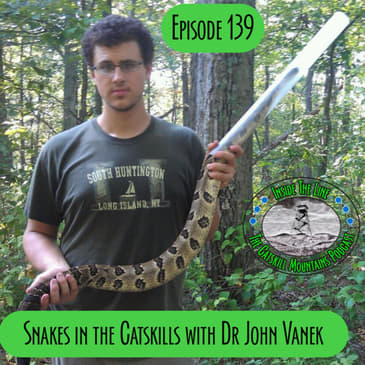
Welcome to episode 139! Tonight, Dr John Vanek from the New York State Natural State Heritage Program joins us and talks with us about snakes in the Catskills! This includes timber rattlesnakes, copper rattlesnakes and many others! If you need a sticker, email me or go to Camp Catskill! Subscribe on any platform! Share! Donate! Do whatever you want! I'm just glad you're listening! And remember... VOLUNTEER!!!!!!
Links for the Podcast: https://linktr.ee/ISLCatskillsPodcast, Donate a coffee to support the show! https://www.buymeacoffee.com/ITLCatskills, Like to be a sponsor or monthly supporter of the show? Go here! - https://www.buymeacoffee.com/ITLCatskills/membership
Thanks to the sponsors of the show!
Outdoor chronicles photography - https://www.outdoorchroniclesphotography.com/, Trailbound Project - https://www.trailboundproject.com/, Camp Catskill - https://campcatskill.co/, Scenic Route Guiding - https://adventurewiththescenicroute.com/, Another Summit - https://www.guardianrevival.org/programs/another-summit
Links:
John Vanek, New York State Natural Heritage Program, Inaturalist, Snakes: The Evolution of Mystery in Nature Book
Volunteer Opportunities:
Trailhead stewards for 3500 Club - https://www.catskill3500club.com/adopt-a-trailhead?fbclid=IwAR31Mb5VkefBQglzgr
fm-hGfooL49yYz3twuSAkr8rrKEnzg8ZSl97XbwUw, Catskills Trail Crew - https://www.nynjtc.org/trailcrew/catskills-trail-crew, NYNJTC Volunteering - https://www.nynjtc.org/catskills, Catskill Center - https://catskillcenter.org/, Catskill Mountain Club - https://catskillmountainclub.org/about-us/, Catskill Mountainkeeper - https://www.catskillmountainkeeper.org/, Bramley Mountain Fire Tower - https://bramleymountainfiretower.org/
Post Hike Brews and Bites -
#snakes #catskillsnakes #timberrattlesnake #copperhead #timber #rattlesnake #visitcatskills #catskillstrails #catskillmountains #catskillspodcast #catskills #catskillpark #podcast #catskillshiker #volunteers #catskillmountainsnewyork #catskillspodcast #catskillshiker #catskillshiking #hiking #insidethelinecatskillmountainspodcast #volunteercatskills #catskill3500 #hikethecatskills
[00:00:00] Yeah, so temperatists and species that we are responsible for tracking at the New York National Heritage Program.
[00:00:05] It's one of its rare species that is rare enough where we go out and we do regular surveys for our copperheads or kind of in this ambiguous space where they're declining
[00:00:15] And we're not quite sure how rare they are, but we don't have funding to track them regularly.
[00:00:20] And by track I mean we keep those specific GPS locations.
[00:00:24] So like if the DEC, if a Ranger or a biologist for a Mino-Wasks State Park C is one, they'll email us and then we can kind of update our database.
[00:00:34] But what we do is so this year for example, we went out to some of the state parks in New York in the Hudson region
[00:00:40] And we go to these known-den locations and we go out and we record data like what is the weather?
[00:00:45] What is the emergency? What is the leaf emergency status?
[00:00:48] You know, and then we see how long were we there and how many snakes did we see?
[00:00:54] And so we were really fortunate to see a wee real bit and see, you know, I think like Kenner or 11 snakes at one of these dents.
[00:01:08] The bushwax were some of the worst days I've ever had in the mountains or life really.
[00:01:15] Whereas pants and mums are totally opposite to some of them. I'm talking with a crazy person.
[00:01:21] I think that weather challenges on this incident where a protect girl is definitely full.
[00:01:26] It is really a bit of a bell amen if we are extinct.
[00:01:30] Cats go through with her response.
[00:01:37] Oh, you're listening to inside the mountain. Catskill, mountains, pockets.
[00:01:48] Welcome everyone to episode 139 of the inside the land the Catskill Mountains podcast.
[00:01:53] Now you're going to see that things are a little bit different this week because last week
[00:01:56] I had posted of Ted and I just shoot in the shit and this week it's going to be the interview with Dr. John Benek who is a snake expert
[00:02:03] and he's also works with the New York State Heritage Program and he does studies of endocuments snakes around the Catskills,
[00:02:10] Hudson Valley and surrounding areas. Now we decided to split it into two parts because
[00:02:15] one it was too long has around three hours long and two we later realized that
[00:02:20] because I was going to be in Vermont that it would be really cool to have you know it's split into two pieces
[00:02:25] so you can have at least straight weeks of a listen and to us chat and listen or no invoices.
[00:02:32] So hopefully you enjoy this episode and glad we made this decision to split it up into two pieces
[00:02:37] so we didn't have an empty week. So enjoy the interview with Dr. John Benek.
[00:02:45] So John Benek is here talk about snakes in the Catskills. So snakes everybody has questions about
[00:02:53] these especially up on overlook, trumpets and stuff like that but he is going to be here to talk
[00:02:58] about snakes anywhere and everywhere and also all about other stuff's the allergies that you're involved
[00:03:05] into. Should I say Dr. John? No please please don't.
[00:03:11] What? Well you know my uncle one time told me, you know I'm never going to call you Dr.
[00:03:20] when I was in grad school not even for my PhD but for my master's like I'm never going
[00:03:25] to call you Dr. just so you know that. I think he was just just kind of making fun of me a little bit.
[00:03:33] I don't really I don't really come from a family of science people so
[00:03:38] I'm no as far as I know the only scientist in my family and most of my family's not even
[00:03:43] very outdoorsy. So yeah I mean I'm breaking the train, eh? A little bit yeah.
[00:03:51] Nice. Originally from Long Island so I have a lot of blue collar people in my family
[00:03:57] and then some like HR management people. None of them really outdoorsy it all.
[00:04:04] It's funny to talk about that because my brother is a doctor and it's like the complete opposite
[00:04:08] we always call we call him Dr and we're just so we're just nothing to compare to him it's
[00:04:14] a little actually hilarious so so welcome to the show John how you feel tonight feeling good?
[00:04:20] Pretty good yeah. I'm going to busy day school starts this week. I have a
[00:04:25] six and a half year old she's starting first grade on Thursday and then my four year old just
[00:04:30] started preschool today but my wife yeah my wife already went back to work so the six and a half
[00:04:36] year old was at at home with me today so we were trying to manage doing some work in meetings
[00:04:41] and entertaining her. And then join the couple last day of the summer you guys have right?
[00:04:47] Yeah. Beautiful day though. Yeah it was really nice we did some gardening we bought some
[00:04:53] half dead hospice to plant in the backyard so they'd come back next year.
[00:04:58] Hopes cross your fingers for hopes man. Yeah yeah yeah so why don't you give a little
[00:05:03] background about yourself? It doesn't matter when hiking you know your background and PhD
[00:05:07] and stuff like that. Sure so I'm from Long Island and my dad used to take his camp like
[00:05:15] car camping in Vermont every year and I just I was enamored by that was my favorite part of the year
[00:05:23] and I would just go off in the woods by myself and find things, salamanders, flip logs,
[00:05:31] catch snakes and that was just something that always stuck with me. I remember the first
[00:05:35] you know reptile or amphibian ever found was a little red-edged so you know those little orange
[00:05:40] roots that you see crossing the forest after a heavy rain. That's still one of my favorite species
[00:05:45] but I saw one of those and no one of my family knew what it was because we're from Long Island not
[00:05:49] Vermont and I remember just I was probably five or six and I was just we had an encyclopedia
[00:05:55] home and I was leafing through the encyclopedia and then I saw a picture and it was just
[00:06:01] serendipitous that there was a picture of the thing I saw because I wasn't really reading at that
[00:06:05] age and so that was just like I knew what it was and then learned everything about it and I just
[00:06:11] that started in that situation with reptiles and amphibians the natural world and from when I was
[00:06:17] little I always knew I loved animals and then as I got older I learned I love science so becoming a
[00:06:22] wildlife biologists was just kind of the perfect pathway using science to study animals and nature out
[00:06:30] and wild and I want to soon eat ESF which is in Syracuse it's the SUNY College of Environmental
[00:06:36] Science and Forestry so it's a specialized SUNY where all of the majors are environmental focused
[00:06:44] my major was wildlife science and what I think is funny about SUNY ESF so if you spell out
[00:06:50] SUNY or you say the acronym of SUNY State University of New York College of Environmental
[00:06:56] Science and Forestry at Syracuse is the full name that's the longest name of any university in
[00:07:01] the United States. It's a mouthful. Stayed University of New York College of Environmental
[00:07:10] Science and Forestry at Syracuse. Wow that is a that it is a mouthful I got on. Yeah so that's why
[00:07:17] we just say SUNY ESF but it's a really cool school it's small there's like 3,400 people every
[00:07:23] year graduate from it undergrads. It's where a lot of New York's biologists come from it's where a
[00:07:29] lot of our farsters come from we have really good forestry program a lot of our Rangers went to
[00:07:34] the Ranger School where I guess the you know the farsters go to the Ranger School which is a
[00:07:38] want to Kina up in the Adirondacks and that was really fun you just get to go and hang out with other
[00:07:44] nature nerds and what I thought was kind of fun when I got there's a lot of people from Long Island
[00:07:49] in New York City just because that's where most of the people in New York live so if you're interested
[00:07:53] in nature you kind of have to leave the islander you know migrate north but so the main groups
[00:07:58] of college kids there are like the hippies the science nerds and like the country kids who
[00:08:04] like actually grew up with in rural areas and so it's like weird venn diagrams of mixtures of
[00:08:10] people you have like the hippie rural people and the science nerds and then there were the landscape
[00:08:17] architects which were like the cool kids and that was you know that was a weird mix of people
[00:08:23] I think about it's a great school and so where I started taking formal classes in this sort of
[00:08:29] stuff herpitalogy which is the study of reptiles and amphidians worn offology, study of birds
[00:08:35] dengerology, the study of trees so it's one of the few remaining schools at least in New York where
[00:08:42] you can really get in touch with nature from professors who have not just the academic background but
[00:08:49] they're also naturalists in their own right and so they might have rather textbook but they've
[00:08:55] also gone out and seen these creatures in the wild and they know where to find them and what impacts
[00:08:59] them and I just thought that was super valuable because it wasn't just classroom learning we went
[00:09:05] out into the woods all the time to get hands on experience with these amazing parts of
[00:09:12] of nature in New York and I just love that school and I think it's praises what brought you to
[00:09:21] the newer heritage natural heritage program. Yeah so wildlife biology is kind of interesting
[00:09:28] there's not many jobs if you might guess and it's really a game of perseverance and luck
[00:09:36] so how do you say luck what do you mean yeah luck meaning there's very few job openings in a given year
[00:09:43] in a geographic location you're interested in and that applies through your seasonal so the way
[00:09:50] works is usually you'll you'll go to school and you'll get a little bit of experience but
[00:09:56] you still need more hands-on experience because your these are esoteric topics and they're kind of
[00:10:01] abstract so usually what you do is you get you take seasonal positions where you're working as a
[00:10:07] technician a biological technician or a wildlife technician for say the US Geological Survey
[00:10:12] or another university who's doing research or a graduate student or a local municipality
[00:10:20] and basically you're the grunt you're you're going out there and you're collecting the data but
[00:10:24] you're not designing the study so you kind of travel around wherever you can picking up these positions
[00:10:30] at last anywhere from 3 to 6 to 9 maybe 12 months so I took a position my first job was looking
[00:10:37] for salamanders in New York have you heard of health-enders salamanders? I have heard of them but I've
[00:10:43] never spotted one. Yeah so they're incredibly rare in New York there's salamanders that are
[00:10:48] trimmer by camera as you know they're 18 to 20 inches long they're they're big they're the third
[00:10:55] largest species of salamanders in the world the other two living Japan and China the Japanese
[00:11:02] giant salamander and the Chinese giant salamander and then third is what we have the hellbender
[00:11:06] and these are these they're flat and brown and they live under big huge rocks that are in
[00:11:12] the river mostly in the Allegheny drainage but also in the sussquaana and so it was really unclear
[00:11:21] if there were any hellbenders left in the sussquaana so my first field job as a I was in
[00:11:26] under there was the summer of my undergrad when I was an undergrad our job was for minimum wage
[00:11:33] or something like that $7 an hour was to go out and go into rivers and flip these giant rocks
[00:11:40] and swim under and look to see if there's a giant salamander under it and it's there is we have to
[00:11:44] catch it and pick it up and bring it to the surface and not let it go. And do you guys create
[00:11:50] your YouTube channels of this Jesus? Yeah I mean people this was you know before that but there
[00:11:55] are people who do this now there's tons of really cool videos on YouTube you should totally look it up
[00:12:00] but so what you'll do is so I'm a big dude I'm 6-3 and so my job was to lift up the rocks
[00:12:06] and my buddy my partner he's like he was like 5-6 and so his job was to snorkel down and see if
[00:12:13] there was a giant salamander under the rock and I had to make sure I didn't drop it and crush it on him
[00:12:18] and you know kill Eric basically and we did that every day checking different stretches of the river
[00:12:26] and we found two that summer which was kind of how working with where your species goes you
[00:12:31] often don't find your target species but what was cool is one was a grab and female
[00:12:36] so it's a female that has eggs so that means that there was at least another male somewhere
[00:12:40] that was able to fertile out you know well not necessarily fertilize because they actually have
[00:12:44] external fertilization which is a completely different thing but she was full of eggs they hadn't been
[00:12:49] fertilized yet and but that was an area where no one had ever seen a hellbender before so that was a
[00:12:54] new location and one of them was a historic location so in a whole summer we found two of these
[00:13:06] so the fact that we confirmed they were still there was amazing and then just two years later
[00:13:11] they did a reintroduction program two years ago they did a reintroduction program they released
[00:13:16] like 150 of these hellbenders back into the suss-guahanna which is amazing now is a collaboration
[00:13:21] through the Bronx Zoo and Sunni Gia set and the Wetland Trust which is a nonprofit organization
[00:13:26] and so you do these kind of seasonal jobs until you can either land a permanent position
[00:13:31] as a wildlife biologist working for say like the New York State DEC where the federal government
[00:13:36] the US Fish Wildlife Service or you go to graduate school so you can kind of get a higher level
[00:13:41] position that pays a little more you have a little more autonomy but so that works really well if
[00:13:45] you don't have roots or if you don't really care where you want to go right so so John I don't mean
[00:13:52] to the budget but yeah where along the suss-guahanna did you spot these hellbenders because I live
[00:13:57] a quarter of mile from suss-guahanna up and up in more of the upstate New York New York Cooper
[00:14:03] town only onto area okay so yeah they're not quite there although there's there's people
[00:14:07] come out at only onto often study the species just because of proximity one of them I'm pretty
[00:14:13] sure we're in Chidango County so that's not far away that's not very good then yeah and
[00:14:20] one it was a private property probably closest to the town in Norwich who is where where I think
[00:14:26] we were most successful but you know they kind of they kind of traverse all around the
[00:14:32] all the streams and the issue with them is siltation so with our farming practices in historic
[00:14:37] past de-far station there's just a lot more silt that flows into the water
[00:14:42] with through the ocean and what it does is it fills those spaces under the rocks and then the
[00:14:46] salamanders can't hang out under there anymore you suss-guahanna river is disgusting
[00:14:53] it's pretty it's pretty unfortunate it gets nicer you know it gets nicer down its Pennsylvania
[00:14:58] and Pennsylvania is kind of like the stronghold of the species in the Northeast
[00:15:05] and so that that's kind of nice but yeah we kind of have this this little disjunk population
[00:15:09] in the suss-guahanna and most people never see them right and pretty much the only people
[00:15:15] because they don't come on land they're purely aquatic the people who do see them
[00:15:19] used to be trout fishermen so health enters like cold clean water so trout fishermen
[00:15:24] would trout anglers would you know occasionally catch them if they're warm one under a log
[00:15:30] by mistake or so not fly fishermen right but people are using worms and they'd hook one
[00:15:36] and a lot of times they would they would kill them and that's one of the reasons that they
[00:15:40] declined in a lot of the reasons in addition to habitat destruction because you know there
[00:15:44] if you're not expecting to see one of these things it comes out of the water on your hook
[00:15:48] 18 inches long kind of like writhing around it has legs you're not expecting something
[00:15:53] down the rock to have legs and their mouth is huge and they kind of you know they're snapping
[00:15:58] their mouth and if they do know what it's called do they have teeth?
[00:16:03] you know I don't certainly nothing that you would think like you wouldn't visibly see teeth
[00:16:07] I'd have to select frogs don't have teeth I'd have to think if if hellbenders
[00:16:11] salamanders have little tiny teeth but not all species I'd have to say yeah they probably have
[00:16:15] but not for we're really just for grit right so they can grab onto the they're not stabbing
[00:16:20] they don't have things yeah okay yeah uh there wild another common aim for them is
[00:16:26] not otter is what people call them? it's not otter how do you get the name hellbender
[00:16:33] yeah right I mean where do these names come from? I thought you'd be throwing out some like fancy
[00:16:38] latin name that's stash and I couldn't put something this sounds like you're just pre-stop
[00:16:43] yeah yeah stash and I are pretty good with the hellbenders yeah we got that but where does that
[00:16:49] name come from? I don't know what the etymology of that common in the scientific name is crypto
[00:16:53] brank is alugianiancissus yeah no I'm familiar with them yeah crypto brank is hellbender
[00:16:59] around it which is first so they don't have external gills most aquatic salamanders have external
[00:17:04] gills but they don't so they're they they they they get a lot of their oxygen right
[00:17:11] from the water grows right into their skin cutaneous respiration oh I think Lance Armstrong
[00:17:16] had cutaneous exploration yeah well so so they kind of you know they have um increased these
[00:17:25] little skin folds to maximize their service areas so they get more blood flow so they can increase
[00:17:29] the amount of so Lance Armstrong could have done that right instead of taking drugs he could have
[00:17:34] like increased the amount of skin he had and then rank wrinkle skin yeah yeah okay that's crazy
[00:17:40] so what what is some stash has down that you have a background in zoology?
[00:17:47] yeah so zoology is the is just really the study of science of setting animals and so my
[00:17:56] position at the New York Natural Heritage Program is zoologist and so what the New York Natural
[00:18:01] Heritage Program is is an organization that we facilitate the conservation of New York's biodiversity
[00:18:09] and so we're not we're not a state I'm not a state employee I don't work for the DEC but our
[00:18:16] office is in the DEC building and we share tubacles with intersting DEC staff so I don't get a pension
[00:18:22] you guys getting fights oh yeah all the time yes all right and that's when John pulls up the
[00:18:36] rotation they have like big fangs on it so yeah so we work we work really close to within
[00:18:41] their colleagues we have they they provide a lot of our funding but we don't work for them
[00:18:47] we're almost kind of like we're like a nonprofit consulting organization so we're actually
[00:18:53] a program of SUNY ESF over in Syracuse but we don't our offices are not over there and we're
[00:19:01] not state employees so we're employees of the SUNY research foundation which is the organization
[00:19:06] so that kind of controls all the different SUNY's throughout New York it's I don't really
[00:19:12] understand how the finances and everything works but basically we get a lot of soft money every
[00:19:17] year to support regular projects well what we'll do by facilitating your the conservation
[00:19:22] of your biodiversity basically what we do is we go out and we maintain the database of where all
[00:19:28] rare species are so you know Walmart wants to build something on top of a timber rattlesnake
[00:19:34] dead the DEC would come to us and say hey they're going to build a they want to build a Walmart
[00:19:40] or whatever is there any any rare species in that area so like when you hear that about that in
[00:19:46] the news or your friends are complaining or talking about that right so that's kind of we control
[00:19:51] that database we have that data and then we provide the same thing we'll provide that data to the
[00:19:58] so why is bio diversity important yeah so there's there's probably a lot of
[00:20:06] it depends on your values I would say right so i think a classic thing that I was remember
[00:20:11] fondly is my aunt who I love she gave me a really nice wedding present unsolicited
[00:20:18] unsolicited one Thanksgiving she said Johnny no offense but I don't give a shit about turtles
[00:20:23] just like add a nowhere wow and she she loves me I love for she's very nice but you know I'm
[00:20:30] sure that was after a couple glasses of red wine but so so that kind of that always makes me think
[00:20:35] you know I love nature I love the environment and I assume a lot of the people who listen
[00:20:40] your podcast do because if you're hiking through the cat skills you're not going to hike through
[00:20:44] the cat skills if there's no trees if there's no wildflowers if there's no amazing geologic
[00:20:48] formations otherwise you just go for a walk down near street or something like that or you get
[00:20:53] on the stairmaster so there's kind of that intrinsic value that many people feel and a lot of
[00:21:00] scientists and psychologists would say is probably inherent in in part of being human which comes from
[00:21:07] our evolution as part of nature so if you feel that biodiversity which is just all the little living
[00:21:15] things all the different trees all the different flowers all the insects all the genetic diversity
[00:21:21] that exists out there you might feel that it's important and you can't really articulate why
[00:21:27] it makes you feel good it you know when you think about falacters you go out and you just you need
[00:21:32] that that green space there's that reason and so but that doesn't really convince everybody
[00:21:41] there are people who have who have they don't care about nature and for them I say biodiversity
[00:21:48] is also important because of the ecosystem services that it provides and so when I say ecosystem
[00:21:53] services I think of tangible things that nature provides to humans whether that's our reservoirs
[00:22:02] that feed the clean drinking water in New York City I don't I don't subscribe to the notion
[00:22:07] that that water is what makes our bagels and pizza very good I think that's technique and down to
[00:22:14] the generations of talent and practice and passing down but people think that you know maybe
[00:22:19] that's part of it but you know if we didn't protect these giant reservoirs and the and the
[00:22:25] forests around them we wouldn't have that clean drinking water imagine what your water bill
[00:22:30] would be if you had to desalignate the long island sound to support New York City or on long
[00:22:36] island it's our aquifers if we didn't have the pine barrens out east the same thing we would
[00:22:41] have be desalignating water and how much more expensive would our aquifer our water bills be
[00:22:47] yeah they expensive yep they expensive you know I think of other things like for people who like
[00:22:53] to kill a to kill comes from a govay right and and there are some types of a govay plants that
[00:23:00] only fertilize by bats at night and if those bats were gone and bats are part of biodiversity
[00:23:07] then you'd have to pay someone to pollinate all these agave plants and then you could
[00:23:12] kill a prices would go up or they wouldn't exist because it wouldn't be profitable that's not
[00:23:17] all the types of to kill it's certainly you know for your to kill my attention but the same thing so
[00:23:24] there are insects they're these beetles that eat corn and there's been really cool experiments
[00:23:31] where people put nets over corn fields at night to exclude the bats and what they find is greatly
[00:23:38] reduced corn yields because these beetles come in and they're able to eat all the corn or at least
[00:23:42] you know not eat it all but I'm exaggerating a little bit but they're you know they're
[00:23:45] degrading the corn yield you're getting fewer bushels per acre and so again these bats are
[00:23:50] providing free ecosystem services by eating those insects the alternative would be to spray even
[00:23:56] more pesticides on the corn fields and people are obviously not super supportive of that
[00:24:03] and I guess a final thing for ecosystem services an example that always give that kind of ties
[00:24:08] into what we might talk about later is that you know a lot of the medicines that we that we use these
[00:24:15] are derived from nature and you know there's like you know I'm not someone who particularly
[00:24:23] believes in you know the nature kind of heals all right so you don't need medicine but I think
[00:24:30] a lot of our effective medicines have their roots in nature aspirin is originally developed from
[00:24:37] you know chemicals that come from willow trees and there's so many other pharmaceuticals
[00:24:42] that we depend on these days that have that are literally just now synthetic compounds that
[00:24:47] we wouldn't know existed if we didn't originally find them in plants in the rain forest or something
[00:24:50] like that and similarly so people have taken the venom of rattlesnakes and copperheads
[00:24:57] and use it to make all sorts of medicines that help protect against heart attacks and I want to say
[00:25:04] possibly even cancer drugs and it's just based on these compounds that nature has spent millions
[00:25:11] and millions of years perfecting and then we can use our computers and smart people and hospitals
[00:25:17] and doctors and researchers and turn those into life-saving medicines that we wouldn't necessarily have
[00:25:22] if we didn't have nature as inspiration the inspiration for Velcro came from Gecko feet
[00:25:28] they have these little hooks on their toes and they kind of are able to latch onto the wall
[00:25:33] people think that the earth has our feet toes Velcro came from Gecko's is that what I just heard you say
[00:25:40] inspire and you can see that yeah you could fact check me on that I could I could be in
[00:25:45] other species but I'm pretty sure the inspiration for Velcro came from the really cool
[00:25:51] feet of Gecko lizards yeah yeah that's very cool so I asked you about zoology what what other
[00:26:01] degrees or areas of expertise do you have?
[00:26:07] so I like to consider myself a generalist but so my undergrad is wildlife science which is kind of the
[00:26:13] the study of kind of balancing the needs of humans and nature so there's kind of the more
[00:26:21] classic conservation biology which is actually more what I do now where is you're trying to think
[00:26:26] how do we conserve nature and then wildlife science is kind of wildlife science is kind of a subset
[00:26:31] of that where you're also taking into account the sociological effects or impacts and what's
[00:26:39] almost more what you can do on the ground right so I might have this lofty ideal that we want to
[00:26:44] preserve 90% of you know New York but realistically we have cities already we're not going to
[00:26:50] destroy those cities we're not going to let those cities kind of go back to nature so
[00:26:56] and you're certainly people live out in the country you're not going to it's impractical and probably
[00:27:02] maybe even unethical to tell people what they can do on their private property we're not going
[00:27:07] backwards and you know saying we're going to eminent domain someone's land not that I'm even in
[00:27:12] the position to make that decision but I kind of think of having a wildlife biology or wildlife
[00:27:17] science background and that we're at least taking those things into consideration what's practical
[00:27:21] and how do we balance the needs of humans and nature and none of my masters my masters is more
[00:27:28] master's degree is more kind of pure science so I studied Eastern Hognostakes up in Startogga
[00:27:35] County in download Island and that was really just learning about the species what is their
[00:27:39] biology where do they go what are the where do they move when do they reproduce
[00:27:44] um so just more studying that animal which is more classic zoology and then for my PhD in
[00:27:53] Illinois I studied really urban ecology which is the how our animals are nature
[00:28:01] kind of surviving in these ecosystems that are human dominated so I was studying wildlife in
[00:28:07] their suburbs of Chicago and so the suburbs of Chicago are actually really the people who created
[00:28:14] them had a lot of foresight and so each county the collar counties of Chicago it's like
[00:28:18] cook county to page county lake county which is where I focused they have tons and tons of far
[00:28:25] spresirs that are not that probably 100 years ago or something someone said all right let's just
[00:28:30] make this a nice area because I don't want it to be cornfield and I don't want it to be someone's
[00:28:34] backyard or a house and so you kind of have these sub the suburban sprawl that abuts the cornfields
[00:28:42] but then scattered among them are these really beautiful gems of farce preserves and so for my
[00:28:46] PhD I was looking at all sorts of things so I look at salamanders and how they persist in these urban
[00:28:54] preserves where do we see invasive species like domestic cats how far were they penetrating into the
[00:28:59] preserves and where do we see coyotes what time did the coyotes come out do they do they change
[00:29:05] their timing did they come out at day or did they come out at night and then we were looking at things like
[00:29:11] how do we manage these urban preserves to maximize biodiversity and they do a lot of really cool
[00:29:19] restoration they love to do prescribed burns in the Midwest so they're just burning everything all
[00:29:22] the time which is really great for nature right so in New York we don't really have a history
[00:29:27] of that but the pine barons should certainly burn on a regular basis and probably like minowasca
[00:29:32] and this what uh trwong on those should probably burn on a somewhat regular basis based on
[00:29:37] the tree species that they have they're the pitch pine but in the Midwest everything everything
[00:29:43] is flammable basically and and reproduces like a pitch pine tree the pine cones don't open unless
[00:29:48] they get to a certain temperature so they like really need fire to maximize their reproduction
[00:29:51] wow and I know about that and there are a lot of species that need they can't survive in a
[00:29:57] closed canopy so if you have all the trees just grow up all the time then that excludes a lot of species
[00:30:03] okay-creafarist should be burned somewhat regularly for maximize their potential but so
[00:30:10] so that urban ecology is kind of just focusing your zoology and your wildlife biology in these urban
[00:30:15] ecosystems and the people out there love love their preserves they spend a lot of money in time
[00:30:21] in those preserves and and their tax money goes into making them really world-class you're
[00:30:26] you know they don't have the caskills in illiterate in northern Illinois southern Illinois has
[00:30:31] the equivalent right they have amazing topography but northern Illinois it's either corn fields
[00:30:35] or these little preserves so that's the more evidence that people love nature and and they
[00:30:40] have built out intrinsic value yeah so what about brought you back over to near estate
[00:30:46] yeah so I went from Sunni set and I bounced around the country doing these seasonal jobs
[00:30:51] working with rattlesnakes one point in Indiana we were radio tracking them every day for
[00:30:56] when they come out of their dens and April and then until they go back in their dens and October
[00:31:01] they're just every day my buddy and I were using equipment to find where they are and record
[00:31:05] what they're doing and exactly where they are and then how far they were from where we initially
[00:31:10] found them so that was one of my seasonal jobs which made me get interested in snakes
[00:31:15] professionally but then so I bounced around and then I did my masters back down on Long Island at Hofstra
[00:31:20] University and then I worked at Jamaica Jamaica Bay the what did you call it? John F. Kennedy Airport
[00:31:30] Jamaica airport and what you they have basically shooting seagulls so they don't get sucked into
[00:31:36] plane engines that I know what you did you were shooting seagulls? He's only like what the rifle
[00:31:42] with a shotgun yeah yeah so that's one of the things I saw you being serious I swear to God
[00:31:52] I trusted some big issue with with the jet sucking in seagulls like that but so you
[00:31:57] out every day and that's what you and your buddies your co-workers would do is take your lunch
[00:32:02] pales and walk out to end the runway 81 yeah you could ever hit a plane? No so it was the most stressful
[00:32:11] job it was the most stressful job in the world and I left that to start my PhD in Illinois in Illinois
[00:32:17] what makes shooting seagulls at the airport is stressful John? Well so it's the planes
[00:32:22] well of course one is the firearms right so basically the rules are if you do anything to
[00:32:28] cause a pilot to change his course you're like the FAA gets involved and you're just like your
[00:32:34] course you're screwed you're screwed even if the pilot is in the wrong but you make them feel
[00:32:39] for whatever reason that they need to do something differently it's your fault so it's all about
[00:32:44] situation you learn it and your your responsible for being you you have to think about what
[00:32:50] your perceptions and how they impact the pilots so I'm just I don't know if I'm ever going to fly
[00:32:55] out of JFK again because I'm thinking that's just a bunch of guys like you on the ground with
[00:33:00] shotguns no that's right you you want them there because you don't want those seagulls or what it's
[00:33:05] the candidate he said that the big issue you don't want to do this yeah isn't that what caused
[00:33:09] that one plane you know decades ago to go in the Hudson River yeah with with the companies then
[00:33:15] made the movie about it yeah I was incredible I'm pretty sure that was that incident the real
[00:33:21] incident you were not there no no I think you were I'm gonna Google you don't mention shop that
[00:33:28] day that's what happened yeah I'm pretty sure that that incident is what inspired the increase in
[00:33:34] hires of people to work there well and that was but it was a fun job not that you I didn't like
[00:33:41] killing animals that's not fun but of course psych there's a psychological hitting your target
[00:33:46] a psychologically rewarding even if you don't enjoy the active killing but the way you kind of
[00:33:51] think about it is well if if a goose does get sucked into the plane engine that has a more negative
[00:33:57] impact obviously for the people but for the wildlife population because then everyone's gonna hate them
[00:34:03] right and so and and and shooting them legally is the least is the last resort lethal removal
[00:34:09] it's always the last resort right so there's there's a focus on how do we reduce wildlife from
[00:34:14] coming to the earfield in the first place how do you and then can you hate species so they stay
[00:34:19] away and so lethal removal is always the last resort and then there's rare species that they never
[00:34:25] you don't lethally remove unless it's an emergency but basically what they do is they hire biologists
[00:34:30] that don't have a history of shooting so they can and then they have world class firearms instructors come
[00:34:36] and teach you how to be sick they don't want they don't want you learning how to shoot from
[00:34:39] your you know your uncle when you were that you know the top that didn't you know and so they
[00:34:45] they like to hire these people that know their birds but don't really have a great
[00:34:49] shooting history and then they they teach you how to be really safe around a fire arm you have to
[00:34:53] pass tests so you basically hire like brain firearms from freaking like holy crap John you have
[00:35:02] everything and everything also and I like that because I don't come from a hunting I come from
[00:35:08] Long Island and not Eastern Long Island but if I can go then talk to a landowner now and say hey there's
[00:35:13] this rare turtle on your property you know let's let's talk about how we can serve this let's talk
[00:35:18] about conservation easements and then then I can kind of fall back to like all right and I'm not
[00:35:24] just a city kid you know like I shot more seagulls than you have you know and I feel like it just
[00:35:30] if I if I want to be really into the conservation of non-game species that we're just protecting I think
[00:35:35] it's important to know how other people interact with wildlife and that was a really valuable experience
[00:35:40] even if I I found it too stressful and quick to do my PhD it was super about and almost all
[00:35:46] all airports have wildlife removal programs and but it depends on so the ones upstate like steward
[00:35:53] air force base or steward airport closer to the cat skills and what is that orange county that's more
[00:35:59] of a deer focus program how ensure that deer don't get on the airport and I had a
[00:36:04] I had a buddy who worked in Alaska at an airport in his job as how do we make sure elk don't get
[00:36:09] on the runway because if a little plane hits an elk everyone's dead right all digels yeah well
[00:36:17] and so species like that pose a particular challenge do you can't shoot an eagle an eagle is federally
[00:36:21] protected so how do you make sure that eagles don't come on the airfield especially in places like
[00:36:27] Alaska is a large part of what airport biologists do they're thinking about ways that they can
[00:36:32] minimize conflict and prevent having to do any sort of what can I do to make sure I don't have
[00:36:38] to haze the species and then if hazing doesn't work what can I do to make sure we don't have
[00:36:41] the lead clear remove that species so basically everybody who's listening to the podcast thank
[00:36:47] you're biologist for doing this absolutely insane stuff as shooting seagulls so you don't crash
[00:36:54] yeah well and I know now I still have friends at work in JFK so all like and there I'll text them
[00:37:00] like are you working today because I'm flying in and I'm gonna make sure that you know it's not
[00:37:03] think the newbie that's uh that's sitting in the shots and hitting the plane yeah yeah
[00:37:11] yeah so so I did my peachy and Illinois and then I took a position in Hobart Williams Smith College
[00:37:20] which is in the finger lakes region because my wife's family is all from Long Island has his
[00:37:26] mind and so we wanted to come closer and then there was an opening at the heritage program for
[00:37:31] zoologist and I applied for it and I was very fortunate to get it and it's a great job. I originally
[00:37:36] wanted to be a professor at a university I really like teaching and I like doing research but
[00:37:42] I found that this this position lets me do fieldwork so I get to hike you know all the time
[00:37:48] I get to be outside and I get to see all these rare species in New York that I wouldn't have
[00:37:54] a chance to do and it and it put me within you know three hours drive of my wife's family which is
[00:38:01] important so you can see family and my kids can see their cousins and stuff like that.
[00:38:06] I joke with her if it was up to me we'd be living in a cabin in Alaska or you know unlike Australia
[00:38:11] and so that's where the luck comes in because you know there's only I don't know there's maybe
[00:38:18] five let's see maybe five like zoologists at my level at the heritage program and there was one opening
[00:38:24] and people don't quit this job for regular basis so I was unfortunate there was this one opening
[00:38:30] that was within a reasonable driving distance to where I wanted to go and that I was competitive
[00:38:34] and I ultimately you know got the position and so that's where the luck comes in because there's just
[00:38:39] so few positions like our professional organization which is the wildlife society which represents
[00:38:45] wildlife professionals has like I think like 12,000 members across the United States and Canada.
[00:38:50] So it's a very small small profession and so there's only so many jobs and so you just have to
[00:38:57] have luck in perseverance if you want to work in a particular geographic area with a particular
[00:39:01] species some people do a very important jobs of working making short permits or filled out
[00:39:08] every day and they use their expertise as a biologist to make sure that you know someone's not
[00:39:12] trying to pull one over on the permit application but I'm just very fortunate that I don't really
[00:39:17] have to do that and I get to go outside on a regular basis. So how did this bring you into
[00:39:23] studying snakes and the cat's goes in New York state? Yeah so one of the species that we keep
[00:39:29] track of at the New York National Heritage program is the timber rattlesnake and that's a threatened
[00:39:35] species in New York and so I we have access to kind of like where all the timber rattlesnakes are
[00:39:43] and I was invited to give a talk on the snakes of the cat skills by the carry institute
[00:39:48] which is down in Millbrook and so it's like hey this is a great excuse to kind of dig into the data
[00:39:54] and so I started pulling together historic records of all the different species of snakes
[00:40:01] that occur in the cat's skills and then what we can find today. So back in the 90s the DEC funded
[00:40:07] this program called the reptile and amphibian Atlas and so they basically said hey people you know
[00:40:14] wherever you see a garter snake or a box turtle or a toad tell us where that was and if you can
[00:40:20] provide some evidence that you know what you're talking about maybe a picture and then they kind of
[00:40:31] but that was 99 and then it never really had permanent funding and so since then there's been nothing
[00:40:37] that keeps track of where all these different species are in New York so a lot of people will use
[00:40:41] e-bird these days say like oh I saw these are the birds I saw when I was hiking and
[00:40:48] and people do that all the time and so we now have a really good idea of where the birds are
[00:40:53] but there's not something really similar to that for the reptiles and amphibians on a regular basis
[00:40:57] there are programs like I know and you guys heard of iNaturalist which is kind of like this
[00:41:02] citizen science thing where so you can download their app and then if you see a toad or a
[00:41:07] orchid or a maple tree you take a picture of it uploaded and then it goes into this
[00:41:12] global database and you can go on their website and you can see where everyone saw that species or
[00:41:16] whatever. So my thought was what if we compare the herp Atlas data the herp is herpatology reptile amphibian
[00:41:26] so what if we compare that 1990 to 1999 herp Atlas data with what we know from iNaturalist today
[00:41:34] and see if we can see where snakes have been declining or increasing or where do we see snakes in the
[00:41:39] cat skills and it let this some really interesting conclusions most species are probably declining a
[00:41:48] little bit even though many many many more people are reporting you know every so many people
[00:41:52] see something take a picture uploaded to the internet but for some species we're just not getting
[00:41:57] that data and it seems like they're declining and we're not really quite sure why
[00:42:01] and it also gives a snapshot of where people see things because there weren't that many records
[00:42:06] from the cat skills in the first place probably because most people just go to the eastern
[00:42:10] the eastern edge of the cat skills and do the popular hikes and so we don't really have the
[00:42:14] much data for the more rugged wilderness areas of the cat skills but that's kind of how I came
[00:42:19] to researching this is I needed to give a talk at the carians institute and it was a great excuse
[00:42:24] to play around with some data so download the nai natural as to everybody yeah and you have
[00:42:31] poor ear sightings yeah it helps there's yeah it's it's an amazing database and it's really
[00:42:37] simple and you can even download there one of their apps is called seek even if you don't want
[00:42:42] to really you know I think I don't think you need to count for that it's just in half where you take
[00:42:46] picture of something in nature and it uses AI to tell you what it is that's pretty it's pretty fun
[00:42:52] especially for wildflowers and plants and ferns and stuff like that it's not always accurate
[00:42:56] but it's it's pretty good these days very cool so where is it in the cat skills we're going to run
[00:43:02] into the rattlesnakes oh yeah let's get in the question big question on that yeah so
[00:43:09] I will say that rattlesnakes are one of the species where we keep specific locality data
[00:43:15] confidential because there's a massive history of exploitation for this species one of the reasons
[00:43:22] so the temperattlesnakes used to probably occur throughout most of New York outside of you know
[00:43:29] the eastern at the western at around X and maybe the the high peaks of the cat skills just because
[00:43:35] it's too chilly but you certainly can't find temperattlesnakes across New York today
[00:43:41] and it's estimated that we've probably lost about 50 to 60 percent of our populations of that species
[00:43:46] mostly because well one a lot of habitat destruction and humans have been living in New York
[00:43:52] and probably killing rattlesnakes for hundreds if not thousands of years so they're up until the
[00:43:58] 70s they were down keys and a lot of new nissipalities you could say would say all right
[00:44:02] there's too many fricking rattlesnakes in our town if you every tail you bring will give you five
[00:44:08] dollars or something like that and that went on through the 50s and 60s until this I think it's
[00:44:14] 1971 New York made that illegal that obviously still happened and people then just kept killing them
[00:44:20] even without the bounty and people would collect them there were these famous rattlesnakes
[00:44:25] hunters that would actually collect hundreds if not thousands of rattlesnakes every year and sell them
[00:44:31] across the country to you know scientific supply companies to roadside zoos to
[00:44:37] private collectors overseas to have them sold so their skins could be made into leather
[00:44:44] one of those ones is oh this I mean people still post on today but this probably went on until the
[00:44:50] until the early 90s but probably probably peaked in the 70s 60s 70s until populations really
[00:44:56] started declining so given that though where we have rattlesnakes today they're probably mostly
[00:45:02] around the eastern edges and the eastern and southern edges of the cat skills and then there's
[00:45:08] probably some populations along the western edge but it's a little unclear in the western
[00:45:13] portion of the range where they still are we we know kind of somewhat where they are but it
[00:45:19] it's still kind of challenging because these things can can range like five miles from their den so
[00:45:24] they'll kind of they'll have this den where they go in the winter and what if I identify mean
[00:45:29] as an area where a whole bunch of rattlesnakes have found like the perfect spot where they can get
[00:45:34] into the mountain below the frostline and there's only so many of those spots where they can actually
[00:45:39] get in and overwinter so what they'll do is they'll get down below the frostline and they'll just
[00:45:45] hang out at like 30 degrees all winter not moving and even then a lot of them die every year because
[00:45:51] they get stucold or gets too dry so there's only so many of these places and and these snakes
[00:45:56] go back year after a year and a timber rattlesnake can live over 50 years wow and they don't
[00:46:02] reach sexual maturity until there's seven, ten, eleven years old and then most of them certainly
[00:46:07] don't reach 50 years old most of them only get to reproduce once or twice females will only
[00:46:15] reproduce every three or four years just because it takes so much so many so much energy and time
[00:46:23] to build up fat reserves to have a litter but what the baby snakes do is they follow the
[00:46:28] pharma and trails of the adults so what happens is if too many adults are killed the babies
[00:46:33] don't know where to go and it's hard for them to start to re-colonize areas where they've been gone
[00:46:38] but what's also kind of wild is that the way people use to kill these snakes so at these
[00:46:43] dens they kind of congregate because like I said there's only so many areas that are perfect
[00:46:48] and they would literally just blow them up with dynamite did like holy fithers and tons of things over there
[00:46:53] let's move aside to the mountain with dynamite how long was this like we talking we're talking about before
[00:47:00] like good times right yeah so probably 50 60's before okay okay yeah Jesus Christ that's very
[00:47:07] humanitarian yeah we don't do that anymore and then and then mining so like mining I think it's like
[00:47:12] blue marble or something that they would quarry in the cat's gills or like the Hudson Highlands
[00:47:18] that kind of destroys these rock out cropping where the species likes to hang out but so I guess
[00:47:25] if we're the one place that everyone knows where you can see rattlesnakes and it's not a secret anymore
[00:47:29] is right overlook mountain right so everyone can kind of everyone is tried to see rattlesnake in
[00:47:34] the at the old hotel or something like that you know you can kind of think that that kind
[00:47:40] of stretch is where you're most likely to see them so eastern southern or easternly or
[00:47:49] eastern and southern exposed slopes because south western would be ideal but most of them are
[00:47:54] not there anymore whether they've been extropeded or not is unclear. You'll also never really find
[00:48:00] them in northern exposed slopes just because it gets too cold you have all the hamlock and the moss
[00:48:06] and it's just a cooler micro climate but the sun really heats up those south southernly exposed
[00:48:13] slopes and so they get nice and warm and then they can they can do their eating and traveling
[00:48:19] and mating and stuff like that. Wow so they'll be kind of hiding out of the frost area and
[00:48:26] sort of in the toxin the rocks kind of like bear dents almost like all right yeah but uh pretty much
[00:48:33] same principle yeah but they get really far down in these rock crevices snake they like to squeeze
[00:48:37] and so they like to have things touching them so they just go these little tiny holes
[00:48:42] and they probably open up into these fishers and they can be really really far down
[00:48:46] you know dozens of feet into the into the ground basically just to get away from that frost.
[00:48:52] Where is it? What about the copper heads or they pump your order in the cast girls?
[00:48:58] Yeah so that's that's a species where it's really hard to track where they are
[00:49:02] people always say they see copper heads but people think every snake they see is a copper head
[00:49:08] which makes it really challenging for scientists to track where they are. Copperheads
[00:49:13] certainly do probably the same area the south eastern extent of the cac skills that's pretty
[00:49:16] much the northern extent of their range in New York. There's anecdotal reports around Kingston
[00:49:22] but I've never really seen a picture from up there I'm sure maybe everyone's in a while we'll get
[00:49:26] that far north. He burp him because you had beer. Yes all right what do you have?
[00:49:37] Alligash white. All right all right that's a good style wheat beer.
[00:49:41] You're white. Yeah I like it. Yeah it's good stuff one of my daughters likes that.
[00:49:46] Thank you John for participating we usually do you know before this is a little bit later so we did
[00:49:54] a little bit pre game but awesome so I have cash white I would be I saw you burping
[00:49:59] I was just like okay let's get on with this to some copper heads. Yeah so copper heads probably
[00:50:06] the same area so the thing is that there are some species that I naturalist obscure the data
[00:50:13] and so what what I mean by that is they'll okay so someone sees a copper head on the trail
[00:50:17] they take a picture of it they upload it to this citizen science database where anyone can contribute
[00:50:22] their observations and then I natural says okay well this is a rare species so we don't want to pinpoint
[00:50:30] exactly where it is because then poachers will go and kill it or collect it and sell it
[00:50:38] or too many people will just flock to the area to see it and we want to minimize that harm
[00:50:43] and those are absolute legitimate reasons to obscure that locality so what you'll get is it you'll
[00:50:49] kind of this I think it's like a 15 kilometer buffer around so it's it's a fuzzy so you generally
[00:50:56] know where they are but it's not you know 15 15 kilometers is pretty far and so we have a general
[00:51:05] idea of where copper heads are but we're not able to get at that exact specific location where they
[00:51:11] are and the same with timber rattlesnick so we actually can't when someone uploads a picture of a timber
[00:51:16] rattlesnick to i naturalists we don't know exactly where it is unless we message that person
[00:51:20] and they tell us and there's a little bit of social engineering there you have to be like hey this is my
[00:51:25] name here's my website I'm not this is going to be weird message but can you tell me exactly where you
[00:51:31] found this thing that is not supposed to be publicly available please please trust me here's my
[00:51:36] contact information so so do you actually go out looking for timber rattlesnick copper heads these days
[00:51:42] yeah so timber rattlesnick's are species that we are responsible for tracking at the
[00:51:47] New York National Heritage Program is one of his rare species that is rare enough where
[00:51:51] we go out and we do regular surveys for copper heads or kind of in this ambiguous space where
[00:51:57] they're declining and we're not quite sure how rare they are but we don't have funding to
[00:52:01] track them regularly and by track I mean we keep we keep those specific GPS locations so like if the
[00:52:11] Nahuasca State Park sees one they'll email us and then we can kind of update our database but what
[00:52:17] we do is so this year for example we went out to some of the state parks in New York in the in the
[00:52:21] Hudson region and we go to these known den locations and we go out and we record data like what is
[00:52:26] the weather what is the emergent what is the leaf emergence status you know and then we see
[00:52:33] how long were we there and how many snakes did we see and so we were really fortunate this year we
[00:52:38] were able to see you know I think like 10 or 11 snakes at one of these den's and then what we
[00:52:44] can do is over time look at look at the numbers say all right are the number snakes we see
[00:52:49] and it given amount of time every year increasing decreasing or staying the same and unfortunately
[00:52:54] for a lot of these den's we're finding that the number snakes we see every year are going down
[00:52:59] and it's really not quite clear why is it because the snakes are we're scaring them right and
[00:53:06] every freaking year someone is coming into disturbing us right as we come out from hibernation
[00:53:11] we're skinny we're hungry and and now they're these big scary predators looking at us
[00:53:20] maybe we don't need to be here anymore and they kind of disperse that's one of the hypotheses
[00:53:23] that humans are scaring them away so do the tempers like rattlesnakes and the copperheads kind
[00:53:31] like battling each other for like area and there's this not a no so what's really interesting
[00:53:38] is they'll they'll go to they'll use the same den's in the areas where they can cover yeah
[00:53:44] a lot of people like black rat snakes and black racers which are the other black snakes
[00:53:49] they'll all kind of go into the same den and in some of the best kind of most picture-esque
[00:53:54] natural geographic locations you'll find like a copperhead's coiled up on top of a coiled up
[00:53:59] a baratlesnake because that's where the sun is right and so they're like so neither
[00:54:06] copperheads will eat little snakes so they might eat a baby timber rattlesnake but timber
[00:54:10] rattlesnakes don't eat other snakes so they don't they're not really competing and and their
[00:54:15] their metabolism's are low enough where it's not really a case where their food limited
[00:54:21] except in in years when there's not a lot of mice which follow the years where there's not a lot
[00:54:27] and that's related to how many spongy moths are out there will be used to call gypsy moths
[00:54:33] there's a whole cycle between the moths and the acorns in the mice because the mice eat the
[00:54:40] caterpillars and the cocoons of the spongy moths yeah also I know as I want our listeners
[00:54:46] to know as John's telling us this is like smiling with gulny as he goes over the cycle between
[00:54:51] the moths and the mice and yeah this is something interesting to you isn't it John
[00:54:57] yeah and so you know but then when you think as well timber rattlesnakes mostly eat mice in the
[00:55:03] woods and so our good acorniers related to good snake years possibly but maybe there's some lag
[00:55:11] and so that's something that people with and anything so the mice are full of ticks and the
[00:55:17] ticks are what those are the ticks that carry line disease and so you start thinking is there
[00:55:23] relationship between if we had more timber rattlesnakes in a landscape would they modulate
[00:55:28] the number of mice which would reduce the number of ticks which might reduce the number of
[00:55:33] the prevalence of line disease Jesus this is all like a huge insane cycle yeah this is crazy
[00:55:40] so John let me let me ask you have you ever been bitten by a timber no no poison as snake bites
[00:55:49] no really is that is that because they have like some respect because you're a scientist yeah
[00:55:54] so they stay away from you yeah so when I worked my first job working with rattlesnakes in in Indiana
[00:56:02] my boss told us that if we got bit by a rattlesnake that we were studying we were fired after
[00:56:07] got into the hospital because that means we were not following safety protocols and we were
[00:56:13] being stupid and that looks bad for the program and it gives a bad name to the snake
[00:56:19] and and so timber rattlesnakes their fangs are very fragile they're like hydrodermic needles
[00:56:25] and they break very easily and they use those fangs primarily to to kill their prey
[00:56:33] second defense is secondary so what they do is they coil up next to a log where they know
[00:56:40] a mouse or squirrel is going to be running back and forth because they smell it they smell the
[00:56:44] central and they sit there they might sit there for two three four weeks waiting for the perfect
[00:56:50] opportunity and then they'll strike and then the mouse will die pretty quickly but not immediately
[00:56:56] right it doesn't just and so then what they do is they wait you know a couple minutes
[00:57:01] and then they use their fork tongue and they follow the central of the dead mouse that has now
[00:57:06] all these smells from their venom and then they consume it but they're not a snake they're not a
[00:57:12] constrictor so they can't like fight and overpower their prey they're actually pretty they're
[00:57:18] muscular but they're like they're pretty fragile and so if those fangs break they can't eat
[00:57:24] until they regrow those fangs and their fangs regrow throughout their whole lives they're
[00:57:28] shedding their fangs and growing new ones but the snake never wants to bite you because if it
[00:57:34] bites you and breaks it fangs it's that means it might not get to reproduce that year if it's a
[00:57:38] female you know a single squirrel could be enough energy for the whole year for a timber adult snake
[00:57:47] and if it breaks it spangs on your fricking hiking boots and then doesn't get a squirrel
[00:57:53] evolutionarily that's that's a terrible trade-off and so that's one of the reasons
[00:57:58] they rattle they they're rattling to tell you that they're there and they see you it's a signal
[00:58:02] and it says I see you hopefully you hear me so back off I don't make me bite you because
[00:58:11] that's bad for everybody so is this why we shouldn't hike with like our your pods in
[00:58:17] I mean that's that's probably good reason yeah right everybody does that I'm freaking over
[00:58:22] mountain Jesus yeah so I read I read somewhere and you maybe can tell me if this is true we're not true
[00:58:29] that with all the hunting and poaching of rattlesnakes to get their rattlers that
[00:58:37] somehow that changed the evolutionary course and now there's fewer timber rattlers with loud
[00:58:45] rattlers out there anyway yeah so versions of that story have been around for many different
[00:58:54] populations of rattlesnakes across the country for a long time and as far as I'm aware no one
[00:59:01] is it ever has ever been able to kind of confirm that scientifically I don't think it's it's impossible
[00:59:07] but I don't I don't think it's likely yeah well they probably died trying to confirm it right
[00:59:12] so the scientists have done some really cool tests where they'll say like okay well how often
[00:59:19] does a snake bite and so what they'll do is they'll kind of mess with snakes using fake hands
[00:59:24] and see how often they strike and that's a whole lot of job yeah right and the answer is that
[00:59:31] snakes are are reluctant to bite most of the time now that's that's not to say you should go
[00:59:36] mess with a timber rattlesnake you absolutely shouldn't because it can and will bite you and you'll
[00:59:40] have to go to the hospital but the fact is that we probably step by more snakes that don't
[00:59:46] rattle and therefore you never see then you'd be aware anyone who has hiked along the eastern edge
[00:59:52] of the cat skills has probably walked somewhere near a timber rattlesnake at some point
[00:59:57] one of my experiences last year and I didn't know what a snake ball was until I stepped in one
[01:00:05] and then like googled it later on and I was like are you fucking kidding me this is this is
[01:00:11] what happened but yeah I'm walking through these ferns that are like shoulder high and thick
[01:00:17] really thick and you have to like spread them apart as you're walking through them and when my foot
[01:00:22] hit the ground it didn't feel like the ground so I looked down and I was like holy shit there was
[01:00:27] like it seemed like a dozen snakes like all in one big massive ball you know on the ground there
[01:00:33] so it was for me it was a freaky experience you would have taken quick stock of you know the
[01:00:39] different species I bet that those were probably eastern or common garter snakes yeah so
[01:00:44] yeah they're fine female with a whole bunch of males surrounding them and you know during the
[01:00:48] breeding season they'll feel congregate around any female they can find congregate is at the
[01:00:53] scientific term for that activity in my feet no right so is there any other like snakes in the
[01:01:02] where not aware of in the cat's skills besides everybody always associates with the
[01:01:07] tember rattlesnake because of course they're men and mess yeah and there are connect there meet I mean
[01:01:13] it some people probably don't want to see a tember rattlesnake but if you see a tember
[01:01:17] rattlesnake in your hike that is a fucking awesome hike right like that is right the hike of the year
[01:01:21] yeah yeah I find them in the gunks I know here but a few years ago I was on one hike and we
[01:01:28] encountered and two separate spots two different timber rattlesnake one of them was under a rock I mean
[01:01:36] legit you know a slab rock on on the side of the trail and you heard it as you approached
[01:01:43] it's kind of an interesting experience the other one was in this ravine that we were walking through
[01:01:49] yeah so you're probably more likely to see them in the gunks than you are in the caxcows
[01:01:53] and now probably 150 years ago you probably would be more likely to see them in the cat's skills
[01:01:59] but you know there's probably more recreation going on I mean the cat's skills are the cat's skills right
[01:02:04] and so from the resort towns to everything to all the iconic hikes they've probably just been
[01:02:10] persecuted more there and it's also I guess the gunks that topography is a little different it's
[01:02:17] probably a little more suitable for snakes but that's also where you're more likely to see
[01:02:21] overheads as well I just I just saw a copper head dead on the side of the road by Mohung preserve last week
[01:02:29] it sucks yeah I mean we talk about their venomists but also they kind of a rare species up here
[01:02:37] the cat's skills the eastern area state yeah I mean both species are into climb and
[01:02:45] I'd say copperheads are pretty rare in the cat's skills much more much more common in the gunks
[01:02:51] where they can be relatively abundant in some areas so when I'm what I'm hiking in the
[01:02:56] cat's skills and I see something with my untrained eye that I think is a copperhead what am I
[01:03:03] more likely to be seeing it certainly could be a copperhead but the species that people often
[01:03:09] mistake for copperheads are milk snakes and water snakes and so they both kind of have
[01:03:16] everyone likes to talk about triangular heads but realistically almost all snakes have a triangular
[01:03:20] head and if they don't they can make it triangular because that's their defensive
[01:03:24] display they same way like when you see a barrier supposed to pick your arms up and look bigger
[01:03:29] snakes are always trying to look bigger when they see a predator so they flatten their head out
[01:03:33] and they flatten their body out and then milk snakes can be brown kind of the same very
[01:03:41] same color as milk snakes as copperheads and water snakes have that kind of superficially
[01:03:49] similar appearance to a copperhead as well kind of the same thick-stap body. I would say those are
[01:03:55] the two species that most people are going to associate with a copperhead but literally any species
[01:04:01] of snake has been called a copperhead by tons of people, people called guardersnakes,
[01:04:06] copperheads they call little brown snakes which some people see in their gardens,
[01:04:11] copperheads or any little snake is called a baby copperhead by most people
[01:04:17] and derailities they're just not that common once you get north of the gongson and past the south
[01:04:23] eastern extent of the cat skills. They're certainly around and they could be so if you ever see
[01:04:29] snake feel free to shoot me a picture and I'll tell you what it is. I'll cut your email in there.
[01:04:34] Do you want like as eye naturalists like a really good resource to do this from?
[01:04:39] It's a great resource and I would encourage people to submit the records you can also send them
[01:04:44] directly to me and if people want to email me pictures of snakes and I'd be happy to
[01:04:50] I'll send an email back and tell you what it is. Awesome. There's only 13 species snakes in the cat
[01:04:56] skills. What's wrong with you? What's wrong with you? Yeah, yeah, can you go through them?
[01:05:02] Yeah, at least half of them. I might miss some. So the most common is certainly the common guarders
[01:05:07] snake and that's the species right black yellow stripe sometimes can be checkered. Each everything lives
[01:05:12] everywhere. People caught that as a kid. So there's that there's the northern water snake which
[01:05:18] is the species. It's kind of brown dark colored and lives near water. This is the species that
[01:05:24] people will see swimming across water or it's by the dock or it tries to grab your blue
[01:05:29] gill when you're reeling it in. And this is what people call a cotton mouth or a water moccasin but
[01:05:35] that species is limited to southern Virginia and south. But people will say it's a waterhead
[01:05:43] of they saw a copper cotton mouth or a water moccasin what they mean as they saw a northern
[01:05:48] water snake. And right they might be rightfully calling it what they were told it was but
[01:05:54] it's just that's just not what it is. There's the brown snake which is this little little snake
[01:05:58] that eats slugs and snails and worms. That's actually pretty uncommon in the cat skills. It's
[01:06:03] more common on the other side of the river you'll see them in like backyards and pick kipsy.
[01:06:07] There's the red belly snake which is another snake that only gets about a foot long
[01:06:10] that only eats slugs and snails. And so that's like the best snake you can have in your garden
[01:06:17] if you want like yours or Keenies. You love to see a red belly snake because it's eating all
[01:06:22] the slugs that are eating yours or Keenie plants. John you have good zucchini? No I don't. I have no
[01:06:29] my house and I can't grow any vegetables. All right number five. There's the ring neck snake
[01:06:36] which is this little slate, slate, gray snake with a yellow collar around its neck. That's pretty
[01:06:41] much can be found anywhere in the cat skills and you'll find them under slate. So like if you see
[01:06:46] the side of a cliff or a slope especially if it's moist and there's like those slate
[01:06:52] it's just falling off the mountain. You can kind of pick those up and there might be
[01:06:55] little ring neck snake. They like to eat other snakes and worms and salamanders. There's the
[01:07:01] smooth green snake which is almost completely gone from the cat skills. People used to see this
[01:07:05] all the time in like little meadows but this is the only bright green snake we have in New York
[01:07:10] and it only gets 15 to 18 inches and that eats insects and it's been declining throughout the
[01:07:16] northeast and the Midwest and people think because it's primarily eating insects that is probably
[01:07:25] finding everywhere. I mean think how many insects? How often you used to have to use your
[01:07:30] windshield wipers to drive through the mountains just for those cries horrible. Aside from you
[01:07:35] know obviously we still blackflies and mosquitoes but like moths caterpillars, grasshoppers all
[01:07:42] those things are in dramatic decline and so the ideas that smooth green snakes which eat those
[01:07:46] are probably probably declined as well. There's the Eastern Hognos snake which is my favorite
[01:07:52] species. It has an upturn nose like a pig that's where it gets the name Hognos snake but it's
[01:07:59] really like the possum snake because if you mess with it it flips over on its back and plays dead.
[01:08:04] Those used to be found on the the edges of the cat skills in the 90s and I don't think anyone
[01:08:11] is found in the cat skills since then. People love to kill them because before they play dead
[01:08:17] they hiss and they open their mouth and they lunge but they never bite and but people don't know
[01:08:22] that and they don't get that far and they get their head cut off by a shovel or a walking stick.
[01:08:27] Jesus. But that's a really cool species you should if you're listening to this and you've never
[01:08:31] seen when you should you should you too Hognos snake playing dead and they just you can flip them
[01:08:37] over and they go they roll right back over on their back like they're not good at actually
[01:08:42] pretending to be dead they have this idea of what being dead looks like but you can't put them back
[01:08:49] they'll just keep flipping back over and they stick their tongue out and open their mouth like
[01:08:53] it's it's really dramatic it's it's amazing you seem you seem very excited about this
[01:08:58] uh it's it's the best yeah everyone needs to look them up on YouTube if they haven't seen them.
[01:09:06] So are you like doing research about that? Uh that's what I that's a species I study for my master
[01:09:12] so I I caught hundreds of them and I put little radio transmitters in them and followed them around
[01:09:17] saw where they go and a snake radio transmitters how yeah how do you manage that?
[01:09:23] Yeah so if you think like a a wolf and yellow stone or a lion right they have those big colors on
[01:09:28] their neck uh you can't do that with a snake because it doesn't have shoulders right and it
[01:09:33] which is all right off. So what you actually have to do is you catch this snake you bring it to a
[01:09:37] veteran area and then they put a little nose cone on it and you knock it out with isoplorein
[01:09:44] like your dog is getting his teeth cleaned at the vet and
[01:09:49] and then they cut a little hole on its side and they put this little radio transmitter in there
[01:09:54] and they sew it up and they you give it antibiotics and pain killers and you keep it warm
[01:09:59] for a couple days and then the scab heals over and you let it go and then you can track it wherever it goes.
[01:10:06] So how about John how about John what in the actual fuck like this is insane
[01:10:13] awesome that's an awesome how many how many Eastern hognobin nose snakes did you do this horrible
[01:10:20] thing to? I'm the 30 probably about 30. Well that's I think that's awesome you know you
[01:10:25] track and then yeah and you wonder why there's none left right in the sand skills they all got
[01:10:31] the memo and got out of here man. Yeah screw this John Bennett guy. Yeah so that's actually kind of like
[01:10:37] a little bit of controversy between different sex of people who are interested in reptiles
[01:10:46] in amphibians or the same way you know there's like professional biologists who study birds
[01:10:51] and I'm a professional biologist who studies reptiles in amphibians among other things
[01:10:56] and you know there are people who just go bird watching and they could be not just go bird
[01:11:00] watching but they're not professionals they're not paid it's not their job but they can be phenomenal
[01:11:04] birdwatchers there are people who go out and find reptiles in amphibians for fun and that's what I
[01:11:11] used to do before it was a professional and there's kind of this little debate among among the
[01:11:18] the exact time with this John. But you know John I'll defend you because you know the bird people
[01:11:26] are absolutely insane it's so easy to spot a plujae and the spot a cardinal but it's not easy
[01:11:33] to spot a freaking eastern hog nose steak. Oh we just heard that they're the ones with the
[01:11:38] funny shape nose that turn upside down and pretend. But still where the hell would you find that
[01:11:42] in the middle of a tree? And John wants to put radio transmitters in them and robotically control
[01:11:48] them or someone. Oh man yeah so what did you learn by implanting 30 of these hog nose snakes
[01:11:55] with radio transmitters? Well you can see so they go pretty far so they'll their home range is one
[01:12:01] of the things you find out so that's 50 hectares is about average which is pretty big for a
[01:12:08] snakes that they move more than almost any other snake and they're eating how many of them
[01:12:12] that's American terms how many hamburgers is that? Yeah I'm trying to think how big a hector
[01:12:18] is like I think like 2.5 miles right? Yes okay so it says 50 hectares is 120 acres so how big
[01:12:25] is 120 acres? Yeah it's a fair one like a lot of hamburgers yeah we're Americans here.
[01:12:36] So okay so that's like 100 football fields or 100 and 150 football fields okay so they go pretty far
[01:12:45] and most snakes except for timber rattlesnakes don't go that far timber rattlesnakes you have a
[01:12:55] white it's kind of interesting and why they can kind of show up almost anywhere even though
[01:13:00] we kind of know where they are along the eastern edge you know if so if they have a den somewhere
[01:13:05] near overlook mountain they could be anywhere within five miles of that area they could go down the valley
[01:13:10] they could go along the riches they could go into the forest and and so that's kind of cool is they're
[01:13:17] just moving and moving and moving and the females don't move as much the males are just roaming
[01:13:20] these big circles looking for females in eating and then they make their way back to the same den
[01:13:27] where they over winter was the females kind of hang out in these rocky open areas so they can
[01:13:32] get warm enough so they can give birth to their young so they don't lay eggs they get birth to
[01:13:37] live young like 10 babies and the baby hot timber rattlesnakes are like a foot long and they follow
[01:13:44] the mom and the mom stays with them and protects them it's kind of amazing they're actually
[01:13:47] good mothers so John not to interrupt you but when does this usually happen during the
[01:13:53] hour now so all the late late August early September the females are dropping their
[01:14:00] letters and then she'll probably she'll like protect protect them until they shed their skin
[01:14:08] so for a couple of weeks and then then they disperse but this is kind of recent people have started
[01:14:13] realizing that there's parental care and they're protecting their offspring people don't think
[01:14:18] of snakes as something that is a good mother but they're giving birth to live young
[01:14:25] and they're protecting them at least for a little bit and then the the babies are following
[01:14:31] that central of the parents to know where to go and I mean snakes are essentially lizards
[01:14:38] they just don't have islands and so people look at them and they don't think of them as
[01:14:42] animal worthy of empathy or that they can feel pain or that they can think but snakes can learn
[01:14:49] they can feel pain they can form associations and I mean timber rattlesnakes aren't exactly the
[01:14:55] smartest snake they're very instinctual they're driven by instinct but other snakes are very
[01:14:59] intelligent but and there's been some cool research that shows that when you if you're doing like an
[01:15:05] education with people with a program with people and you explain that their good mothers and that
[01:15:10] take care they're offspring people are more likely to not hate them as much so it's like kind of
[01:15:18] this avenue for environmental education is to kind of show people that they're not just worms you
[01:15:25] know they're there they're things that feel not that they have like emotions like mammals or humans but
[01:15:33] they're they're more complicated and they have internal lives they're not just
[01:15:38] things that can't feel pain and crawl around and bite people. So do you have any like suggestions of
[01:15:46] work people go for like reading information stuff about snakes in the cat skills surrounding areas because
[01:15:54] I know we have a kind of a broad variety of people that go in the Hudson Valley and then over to
[01:16:05] specific reference which is unfortunate but there's a couple the DEC has some good information on
[01:16:12] their website Sunni ESF has a good information like generally on snakes there's a book
[01:16:18] about the reptiles and amphibians of New York written by James Gibbs who's a professor at Sunni ESF
[01:16:25] and co-authors are people in the DEC I can send you guys the link to that book but it's
[01:16:31] so that the amphibians of reptiles in New York by James Gibbs at all and others and that's basically
[01:16:39] has a species account for every species of reptile and amphibian in New York and it has maps
[01:16:44] and pictures and it has interesting tidbits about them and the history of them and it has a section
[01:16:49] on the folklore and the the background of reptiles and amphibians in New York. It's a phenomenal book
[01:16:57] and then more generally the the book I love to recommend to people is called snakes the
[01:17:03] evolution of mystery in nature and that's written by a retired professor from Cornell Harry Green
[01:17:12] and he this is a guy he has a way with words has a crazy life history was an ambulance driver
[01:17:20] was in the military and it's just this beautiful beautiful book that discusses
[01:17:27] everything about the biology of snakes but it's not written like a textbook it's written just in
[01:17:32] story form and beautiful words like you're reading the best national geographic articles
[01:17:37] so the and Dr. Green wrote this book he was where from Cornell Cornell University
[01:17:44] interesting life story ambulance driver and all that stuff oh yeah I think even he might
[01:17:49] drive in a morgue did you ever go to JFK with the shotgun and shoot
[01:17:56] sorry what's what's we're now John we're gonna get down the meat ready we're gonna roll our sleeves
[01:18:03] here and a few weeks ago stash and I were commenting on a story about what was alleged to be a
[01:18:13] 14 foot boa constrictor pulled out of a water main break that the DEC captured and removed it
[01:18:23] are you familiar with that story I'm I'm not familiar with that well then you're one of
[01:18:27] you're one of the leading snake authorities in the state of New Yorkers
[01:18:33] I don't know if you were excited by side with the DEC and we have this news are too much
[01:18:38] yeah but it's like they say here that was pulled out of the tavoli water main over the week
[01:18:44] and the DEC captured and removed it and so do you have on the screen stash that's right
[01:18:50] you say can you see it John this picture what they call it is that a boa constrictor is that a piece
[01:18:55] of black pipe I can't tell from that you can't tell you can't tell and you're an expert
[01:19:02] and you don't know whether it's a black pipe yeah if I'm looking for a boa constrictor I'd be
[01:19:09] looking for I mean if this is a boa constrictor it's in a state of decay right so but I'd normally
[01:19:17] be looking for like a mahogany or burgundy color with dark blotches and some lighter edging
[01:19:23] and I don't see any blotches I just see it looks like a piece of pipe but the size of it
[01:19:29] is pretty significant yeah it's significant because it's a black piece of pipe stash I mean
[01:19:35] all right John they say they say the DEC captured it would you agree with me if this thing was a
[01:19:41] snake and it's dead you're not capturing it right that's what it would you would use if it
[01:19:47] was dead it wouldn't have been captured okay okay I think the verdict is this was a fake news report
[01:19:55] there wasn't there wasn't a 14 foot boa constrictor in the Tavoli water main yada yada yada okay John
[01:20:03] I can I can find out I know people so I can try to find out please so please don't
[01:20:09] if you can find out this is my next question okay now that we're getting down to fact checking
[01:20:16] all of these internet stories what I want to know from you John you have a background in bats as
[01:20:22] you've studied bats you know about bats right little okay do you know enough to tell us with your
[01:20:29] expert opinion did the covid virus I'll do don't know bring this shit up come come from a bat
[01:20:38] or did it come out of some laboratory in China which is it I don't know if there's conclusive evidence
[01:20:45] oh that's it I'm cutting you on to not on this podcast anymore from now on so we all want
[01:20:52] to know the truth I mean we all have to do a lot of hiking in 2020 from from that but here here's
[01:20:58] what I'll say when we do when we catch bats and we do catch bats to do research and nowhere they are
[01:21:04] we wear masks so so we don't give the bats covid by accident oh okay that's why there's
[01:21:15] a lot of people in the right that's mask bats are that's really phenomenal so they they like
[01:21:22] they have incredible immune systems where they like they get these illnesses but they don't get sick
[01:21:26] and so bats actually are a big cause of zoonotic illnesses in a lot of places around the world
[01:21:33] but i always that's make me think of the j guess or watch the simsons back in the day
[01:21:39] number of it never heard of it that episode where Montgomery burns he's like
[01:21:45] he's on a boat and the doctors like you have every illness and they're trying to squeeze through
[01:21:51] the door and so i'm invincible right because but that's almost how bats are because they
[01:22:01] they get these illnesses and they just don't get sick from them and then the illnesses
[01:22:04] the virus is kind of unable to mutate and then it's that's that's that's that's can carry illnesses
[01:22:11] not that's not so much a thing in the United States but
[01:22:15] tats why don't we don't ask that's we don't eat bats that's why it's not a sign I'm so sorry about
[01:22:22] tats i'm not apologizing stash this is this is absolute american stuff right here this is going
[01:22:29] to go get a mask though we don't talk about a guy who freaking gets a snake bite and gets his arm
[01:22:34] two times the size of the sports baby we'll talk about bats and yeah got all right john so
[01:22:41] when you're out in the caskills my this is my last question what do you go and get for
[01:22:48] post-ide bruises bites you know when you go out and check out these the like timber rattlesnakes
[01:22:53] and stuff like that where do you go to take it something good to eat and get we're pretty bad
[01:22:58] so we do a lot of travel we do a lot of fieldwork firm in my position and so like
[01:23:04] but my colleagues and I we all have little kids so we're always feeling guilty doing fieldwork
[01:23:09] leaving our spouses with these terrorists at home and so basically we're just like
[01:23:16] speeding that home and so we just stop at the terrible rest stops on the throughway
[01:23:22] and we we never really stop and get anything delicious after a nice hike because most of
[01:23:28] the hikes now are not recreational therefore work and so I it's a terrible answer but I think
[01:23:33] until our kids are a little older we're just going to be like rushing homes so we don't get guilty
[01:23:38] that we have this fun job we're out hiking and our spouses are stuck with the screaming kids at home
[01:23:45] well john when you're stuck on these these hikes please include us because I would love to hear
[01:23:51] your research and stuff like that and hear your expertise on this we our organization is a lot of
[01:23:56] cool stuff in the cat skills like uh looking at old growth forest and um we do a lot of cool stuff
[01:24:03] so definitely we could we could try to go out sometime just me and dad me and dad nobody else
[01:24:09] I would say too though just generally for a snake safety out like I said timber rattlesnakes
[01:24:15] like to sit and wait for prey to cross logs so the number one thing you can do is one
[01:24:22] where where boots and shoot and pants if you're going to be walking off trail but number but if you
[01:24:29] just regardless what we're trying to do is snake researchers when we're working in areas with venom
[01:24:35] snakes as you never walk over a log or a rock you you step onto it and then look down to make
[01:24:41] sure there's not a snake on the other side resting with its head up and and that's going to prevent
[01:24:47] a lot of bites because most of the time if a snake is going to bite you it's because you're
[01:24:52] fucking with it or you didn't see it and you stepped on it by accident. I said you avoid stepping
[01:24:58] on them by not stepping over logs but looking where you're putting your foot or you know if you're
[01:25:06] coming down a steep slope make sure you're peering over the rock ledge before you slide down
[01:25:12] and that's going to go a really long way so just look where you're going and don't step over logs
[01:25:18] and rocks just step on them first and then look down and then step and that's that's a huge thing
[01:25:23] that's number one where where boots and it's not fun but and especially when it's hot but if you're
[01:25:30] going to go off trail where you know leather boots and or something like that but and then if you
[01:25:41] the common folk suggestions work right so don't slice the wound and let it bleed out don't
[01:25:48] try to suck the venom out and the snake the snake bite kits you can buy at the
[01:25:53] outdoor store don't work. The only thing you do is you lie down and die or you get to or you
[01:26:02] get to a hospital and so your cell phone is the best thing you can do is make sure you have
[01:26:07] in reach or a spot or something like that and know what the different snakes are because if uh
[01:26:13] if you I think there was something like a 400 snake bites from 2000 maybe from 2000 to 2010
[01:26:20] in New York only 60 of those were venomous snakes so the vast majority were just people getting
[01:26:26] bit by garter snakes in the hospital and the doctor having to say yeah that was a garter snake
[01:26:32] and so that's I mean that you know that's just wasting your deductible at that point right
[01:26:37] uh so know what the snakes are and but then if you if you are bitten by venomous snake you
[01:26:43] need to go to the hospital and that's right there's there's no intervention at home that will
[01:26:49] do anything you just need either either they'll treat the symptoms or they will give you
[01:26:54] antivand on if it's bad enough. So you're you're telling me with all these excursions
[01:26:59] that you go on studying snakes we're studying other things you don't carry any special equipment
[01:27:06] personate bug if it can't put Jesus Christ no there there's no first aid for a snake bite
[01:27:12] snake I mean other staying calm and and being able to get out safely keeping calm as
[01:27:19] huge because the faster your heart rate goes the the faster the venom is going to spread
[01:27:25] but I will sometimes what we'll do is we'll carry we'll bring snake gators
[01:27:29] which are basically just like thick fabric maybe there's cavalar in there or something
[01:27:35] but you wrap around your legs so you if you accident because because we're going into these
[01:27:41] snakey areas and we're gonna go air known areas with snakes at high concentrations so we don't
[01:27:47] accidentally get struck on the leg but we're not doing anything to we're not wearing gloves because
[01:27:51] we're not putting our hands where we expect to get bit it's safety is paramount. If I got bit by
[01:27:57] venomous snake I'd feel like an asshole because I'm I'm doing damage perception wise to
[01:28:03] snakes and I want the opposite of that. Great. So good I mean you guys are going to do a
[01:28:10] research so it makes sense. I mean to not become but awesome thanks uh yeah thanks for tips and
[01:28:18] advice really appreciate it so just want to before we close out thank you to the monsters
[01:28:24] portal's monthly sponsors really appreciate you guys donating to the show once again this all
[01:28:30] mostly back towards the cat's goals once after you know we we get out to expenses. Thank you
[01:28:36] to the people who have continued to listen to the show after 130th episode we have John here
[01:28:44] talking about snakes and the cat skills which is take at a hundred and thirty eight episodes to
[01:28:49] get to so it's absolutely phenomenal John I had a fantastic time listening about your
[01:28:55] knowledge and uh experience with with snakes and the cat skills and in other areas because it's just
[01:29:02] it's just that astronomical it's crazy. Thanks thanks for having me this was really fun.
[01:29:07] I tell you other people that because a lot of people are like you know this is this is too
[01:29:13] professional for me now this is fun. Yeah no this is fun and please feel free to
[01:29:18] anyone if you see a snake I will tell you what it is feel free to email me. I will push your email
[01:29:25] and this show knocks definitely. So have a good night John and tap thank you once again John for joining
[01:29:32] us for really appreciate it. Thanks for having me. Hey everyone I just want to thank you for listening
[01:29:40] into the show. If you enjoyed the show subscribe and throw down a smooth review on Spotify,
[01:29:46] Apple podcasts or any podcast platform review you can also check daily updates of the podcast,
[01:29:56] hikes, hiking meals and local news on Facebook, Instagram, Twitter and the official website of the show.
[01:30:05] Remember this you got to just keep on living in the cat skills man and I'd be I
[01:30:13] Wicked wicked wicked wicked