
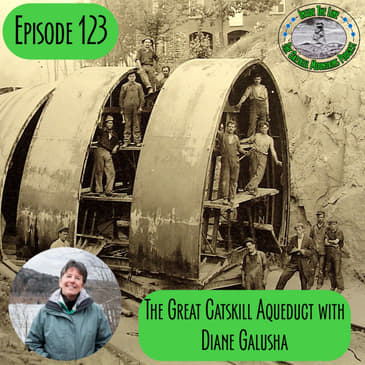
Welcome to episode 123 of Inside The Line: The Catskill Mountains Podcast! Tonight, author Diane Galusha joins us and chats about her knowledge of the great Catskills Aqueduct. If you need a sticker, email me or go to Camp Catskill! Subscribe on any platform! Share! Donate! Do whatever you want! I'm just glad you're listening! And remember... VOLUNTEER!!!!!!
Links for the Podcast: https://linktr.ee/ISLCatskillsPodcast, Donate a coffee to support the show! https://www.buymeacoffee.com/ITLCatskills, Like to be a sponsor or monthly supporter of the show? Go here! - https://www.buymeacoffee.com/ITLCatskills/membership
Thanks to the sponsors of the show!
Outdoor chronicles photography - https://www.outdoorchroniclesphotography.com/, Trailbound Project - https://www.trailboundproject.com/, Camp Catskill - https://campcatskill.co/, Scenic Route Guiding - https://adventurewiththescenicroute.com/, Another Summit - https://www.guardianrevival.org/programs/another-summit
Links:
Diane’s Writings, Howells Storm Book, Hudson Fjords Project, Ulster County Nature Bus, Coalition of Watershed Towns
Volunteer Opportunities:
Trailhead stewards for 3500 Club - https://www.catskill3500club.com/adopt-a-trailhead?fbclid=IwAR31Mb5VkefBQglzgr
fm-hGfooL49yYz3twuSAkr8rrKEnzg8ZSl97XbwUw, Catskills Trail Crew - https://www.nynjtc.org/trailcrew/catskills-trail-crew, NYNJTC Volunteering - https://www.nynjtc.org/catskills, Catskill Center - https://catskillcenter.org/, Catskill Mountain Club - https://catskillmountainclub.org/about-us/, Catskill Mountainkeeper - https://www.catskillmountainkeeper.org/, Bramley Mountain Fire Tower - https://bramleymountainfiretower.org/
Post Hike Brews and Bites -
#catskillaqueduct #ashokanreservior #catskillwater #catskillsreserviors #visitcatskills #catskillstrails #catskillmountains #catskillspodcast #catskills #catskillpark #podcast #catskillshiker #volunteers #catskillmountainsnewyork #catskillspodcast #catskillshiker #catskillshiking #hiking #insidethelinecatskillmountainspodcast #volunteercatskills #catskill3500 #hikethecatskills
[00:00:00] The Catskill Mountains Podcast
[00:00:30] The Catskill Mountains Podcast
[00:01:14] Since then, we're particularly difficult.
[00:01:18] It is really the development of New York State.
[00:01:21] Catskills are responsible.
[00:01:24] Yeah!
[00:01:26] Now you're listening to Inside The Line, The Catskill Mountains Podcast.
[00:01:39] I felt like I was hogging the mic for that one.
[00:01:41] No! No.
[00:01:43] Alright, so Ted, what was the last live concert you've been to?
[00:01:46] The last live, okay. I have an answer for this.
[00:01:51] The elder of the two of us, my last concert was Madison Square Garden, 2016 with my daughter.
[00:02:05] We saw The Cure.
[00:02:08] Alright, alright, alright. Nice!
[00:02:11] Yeah, it was a fabulous show.
[00:02:12] It was a fabulous show.
[00:02:14] Now before that, well I won't go into the one before that, but yeah it was a fabulous show.
[00:02:18] I hadn't seen The Cure since you know 30 some 40 some years.
[00:02:23] Show me, show me, show me. Oh God, that's so nice.
[00:02:28] Great stuff.
[00:02:30] I could imagine that.
[00:02:32] Tomorrow, Jessica and I will be seeing some 41.
[00:02:36] So I don't know if you...
[00:02:38] I have no idea who they are.
[00:02:40] Oh my God.
[00:02:42] Are they the new kids on the bands? Is that what you're into?
[00:02:45] Definitely. New kids on the lock type, you know.
[00:02:48] Excellent.
[00:02:50] This is how we do it. Don't show out what it's named, but they're punk, they're punk rock.
[00:02:54] Some 41 was like the blink 182, but a little bit on the harder edge.
[00:02:59] And they're doing their last tour, last tour I say that with quotations because everybody says that and then they can do like eight more.
[00:03:07] But we're going to see that so we're like all preparing for that and everything.
[00:03:12] So tomorrow when you're at the big event, are you going to try to get backstage by telling everybody that you have a podcast and you want to interview the band?
[00:03:22] They already know.
[00:03:24] They already invited me. They invited me to play on stage.
[00:03:28] Oh nice, sweet.
[00:03:31] I'm the introducer. I'm just like hey everyone.
[00:03:33] You're like the guest. What do you play? The guitar? Are you a guitarist?
[00:03:37] I'm electric guitar actually.
[00:03:39] So you're going to show up with your guitar. You're going to hop on stage.
[00:03:41] You ever see those YouTube videos where like some random person from the audience gets on stage with the band and just rips away?
[00:03:51] Yes, I'm so jealous.
[00:03:53] There's some great YouTube videos of guys, one of them that I saw was a woman getting up on stage and just really just lighting it up.
[00:04:02] I'm jealous as heck.
[00:04:04] This year has been like the past couple years, I don't know if I talked about this with you or with someone else before you came on, but it was like I've noticed a lot of musicians passing away.
[00:04:17] And whether it's from unfortunately suicide, they have the burden of live concerts. They have to be on the road all the time.
[00:04:28] Or whether substance abuse or just a crazy problem of a heart attack.
[00:04:34] But my favorite musicians, I see them for the last time and then they're on tour and then all of a sudden the tour gets canceled because someone passed away.
[00:04:43] And then I'm like, oh, I never got to see them again. So I'm kind of like in that stage of like, I need to see these bands before something bad happens.
[00:04:51] Is that bad? Is that bad to think?
[00:04:54] Well, to a certain extent you should live life that way. You should try to do now or in the near term that which you consider worthwhile and that you want to see, do or hear experience during your lifetime.
[00:05:06] Because eventually you're going to wake up, you're going to be an old guy like me. And you're going to say, what did I do the last three years of my life?
[00:05:13] This is where if you want to have the discussion on the podcast, we can talk about how I tried to convince you to quit your job, sell everything and take a year or two or three off and just travel.
[00:05:24] I'm 40 years old. I can't do that crap right now because I'm not 20.
[00:05:28] Doesn't matter. My daughter, my daughter this Sunday is leaving for a cross country car packing rock climbing excursion that's going to last months, not just week, month.
[00:05:42] Wow. Go ahead, go ahead. What details? Like what is she doing?
[00:05:45] Oh, who knows? It's a lot of like ad libbing and just freestyle. She's got some plans. The most important thing is she doesn't have to have an end date or return date.
[00:05:57] She just is going to travel as long as she feels the need to travel and have a good time. And that's part of the fun of being in your 20s, having no debt, little to no responsibility.
[00:06:08] Get out there. You see the world. I encourage it. And we can talk. I mean, I can talk to anybody about that.
[00:06:16] I think that it's great that if you were able to, and we should just make it a whole thing in our society where we take time off for Thanksgiving.
[00:06:26] We take time off for Christmas. There's this fuzzy retirement age of 65, but why don't we say that when you turn 40, we get to take two years off, take two years off all of your mortgage payments or other debt.
[00:06:44] All of that is frozen. You get to park your life for a year or two and just travel, enjoy life, enjoy the world.
[00:06:52] And then you come back to it when you're 42, 43 years old.
[00:06:55] Right. That sounds absolutely phenomenal.
[00:06:58] So we're going to rewrite the whole social order tonight on tonight's podcast. I'm getting out a blank sheet of paper, a pen.
[00:07:07] I'm going to start down the new rules age 40.
[00:07:11] Yeah, right.
[00:07:12] Quit job. Okay. I know you want to move the ball down the field.
[00:07:16] No, not at all. So like is she doing the van life and stuff like that?
[00:07:20] Well, you know, she's got a Subaru. Her father built a sleep platform in it for her on Sunday. So she has room to store stuff underneath.
[00:07:29] She's got a car carrier on top. It's probably has a design capacity of carrying, you know, the whole vehicle came out of the factory able to carry like 10 cubic feet of gear.
[00:07:41] And we've doubled that capacity. But I'll say this is not her first time going cross country in this car. She's she's done many, many trips.
[00:07:50] She's probably seen more national parks by the age of 24 than you or I have put together.
[00:07:57] So she doing this solo?
[00:07:59] Yes and no. She's got plans to hook up with people, but she is in the main going to be solo hanging out, having a good time.
[00:08:08] Does she have a GPS like that you can?
[00:08:12] No, nobody in our family uses GPS. We just have this innate sense of direction, you know, true north. I don't even use a compass when I hike. She doesn't use any GPS in the car.
[00:08:26] Oh wow.
[00:08:28] I'm just bullshitting Stash.
[00:08:30] Okay. I was like wait a minute.
[00:08:31] Of course she has GPS. Her dad wouldn't let her leave home without it.
[00:08:35] This is like she's a hardcore rock climber. That's this little.
[00:08:39] Yeah.
[00:08:40] Good for her. Tell her if she ever listens to the show, tell her you know what I congratulate her on doing this and hopefully she's successful and having fun.
[00:08:50] I appreciate that. So just two notes before we move on. Number one, I'm trying to convince her to put a sticker on her cargo carrier from the podcast.
[00:09:02] Why not?
[00:09:03] Yeah. So we know that already.
[00:09:05] I know I should get the shame, you know, drum out for this. And then the second thing is if we ever have a free night in the coming months, we'll try to arrange to get a run. She can give us like a roadside update on where she is.
[00:09:20] Absolutely.
[00:09:22] How many flat tires she's had and whether or not she's having fun or not.
[00:09:27] How many, you know, people she's encountered and stuff. I'm curious of seeing her route. Did she do a pre-planned route and stuff?
[00:09:35] There's no weather conditions and rendezvousing with people at different times.
[00:09:42] Yeah.
[00:09:43] Unbelievable that you can have that sort of thought like thinking about that right now. I'm just like what I need to have A, B, C, D, E, F, G. And if it's not planned, nope.
[00:09:55] Yeah. Also, I know it's crazy is that when did you love to be 24 years old and setting off for the next 12 to 14 weeks backpacking, car camping, rock climbing? And then she's looking this winter, she's looking to get a job in some ski town out west as a ski instructor.
[00:10:14] So all the best. All the best to her.
[00:10:18] Yeah, definitely. So you know, you're talking about being a ski instructor out west and they have still had winter. They still have winter going on. And in the Inyo County Search and Rescue team that I follow a lot because of course they're always doing stuff in the high Sierra Nevadas.
[00:10:36] They had at May 2nd had a winter storm warning and it's the first series of storms that is going to happen from May 4th to May 5th. 35 to 45 mile per hour summit winds in the high Sierra Nevadas and also a snowfall of 8 to 16 inches daily.
[00:10:55] So yeah, and this is of course in the high Sierra Nevadas, of course includes Mount Whitney. Mount Whitney is the highest mountain in the contiguous United States area.
[00:11:07] So once again, people think that we're hitting 70, 80 degrees today here, but not over there in the high Sierra Nevadas where it's hitting negative 9 and 35 mile per hour winds and 5 to 6 inches of snow every freaking six hours. So crazy stuff. It's not over yet.
[00:11:27] So could you imagine that if you sometime a few days ago sat out in your car and an airplane to travel out there, let's say you were planning on climbing Mount Whitney and you were expecting daytime temperatures in the 50s.
[00:11:41] So you didn't bring gear to go out in really cold weather. Then you get out there and you realize that this is like full on winter conditions. Quite a bummer.
[00:11:50] Yeah. And then, you know, and you wonder if you bail. By the way, that's a nice pen you got there. Okay. I thought you had yours to move. I'm sorry. Distracted. Once again, there it goes. Yeah. Yeah. Do we have a tobacco free thing?
[00:12:07] Yeah, just now. Just so but also the listeners now Stash and I are like, you know, engaged in pen envy right now. So while you're driving down the road, what the F is going on? He's he's holding up his pen. I'm holding up mine. Maybe he'll just edit all of this out.
[00:12:22] I'm so I'm so sorry. Once again, back and forth. So yeah, so my cool thing is we'll talk about this later. But I've had a guy who on dry brick rich day which I had no thought of anybody visiting pack attack in the area.
[00:12:37] I met a guy that summited Mount Whitney and he wants to do it in the wintertime. And this guy had no absolute clue how to do the winter. I'm going to edit that out because he so he's going to listen to this.
[00:12:52] So I had a chat with a guy that summited Mount Whitney. That is a photographer and stuff like that. So it was pretty cool to talk with him about it. So hopefully he's ready for the winter out there because it is a whole nother story, especially a Mount Whitney, especially with I'm sorry to say the deaths that they had this year. So it's pretty crazy.
[00:13:11] So Ted, a question that I have been brought to my attention. And so, you know, we had of course the recent storms, you know, have you heard about the the Panther Mountain Trailhead Register got like totally crushed by a fallen tree?
[00:13:28] I saw that. So a lot of people are wondering about digital like trailhead registers, you know, maybe tap in your Bluetooth sign in. I mean, you would need signal maybe maybe not. But you would need battery, you'd need power. But you know, they could probably tap in at the exact time you entered the trailhead entered that that time and then you know, kind of determine your route as of when they you know you needed something.
[00:13:57] You know, you need a rescue or something like that. But, you know, that would be a little difficult, of course, you know, with what we have the technology is improving. But today, you know, sometimes I find trailhead registers are absolutely full and you can't write in anything anyway. And I found this at Panther, you know, the popular areas.
[00:14:17] You don't see it at Dry Book Ridge though, when you sign in there.
[00:14:22] Not at all. Actually, there's like three pages left, but there's only five pages total.
[00:14:26] Yeah, but that's yeah, yeah. And that book is like for the past five years.
[00:14:30] I actually looked at the last.
[00:14:33] Rip Van Winkle signed into that book.
[00:14:36] No, no, John Burroughs did.
[00:14:39] Well, that's the two were hiking together that day. So they were.
[00:14:42] What do you think about that? That's actually that's pretty.
[00:14:45] It's it's completely unnecessary for the Catskills. I mean, a place that's more populated, that data would have more meaning. Maybe it's useful. But if you if the DEC had that kind of money to spend on digital registers, there's so many other projects that they could spend that money on.
[00:15:05] Like it's becoming my new pet peeve, a bridge over the West Branch of the NeverSync.
[00:15:12] I think that's the if I've done this podcast seven or eight times now, I've mentioned it on at least 20 episodes. That's how strongly I feel about that.
[00:15:23] I agree you have mentioned that a lot.
[00:15:26] You can't afford that simple West Branch. Come on.
[00:15:31] Sometimes you can. Most times you can. But I just some places have bridges and why they don't have one there, particularly when it's such a popular spot with people who are new to the Catskill hiking scene, who may not be as well equipped or experienced doing something like that.
[00:15:50] They deserve a bridge there.
[00:15:54] Doesn't have to be a fancy bridge, but I think it's a good spot for a bridge.
[00:15:59] That's all I have to say about a bridge on the West Branch today.
[00:16:04] And one of those bridges too in that area wouldn't require like a high height because it's the start of the river so the flooding doesn't go too high.
[00:16:13] So you're right. It's a very easy one. It's I would say more of like the one where it's crossing over the NeverSync over down towards Table and Peek-a-moose.
[00:16:22] Like it would be a one lane one that's lifted a little.
[00:16:26] And the Rangers just would back up with their pickup trucks with the wood in it and they'd have to carry it. What, 50 feet?
[00:16:35] It's not like these other places where they've got to go in a quarter of a mile, a mile, right?
[00:16:41] That's like 25 feet. That's nothing. Have you ever been a steward there? No, you haven't.
[00:16:46] I offered though to sign up with you if you want to. I'm down for it. Just let you know in advance.
[00:16:52] I'm showing up at the Sharpie signing autographs, working on my signature.
[00:16:59] Nice. Yeah, we'll have to do that. Definitely. We'll talk about that later. 3500 Club has their trail of steward things up.
[00:17:05] So moving on Hudson Valley Fjords project. Ted, you want to talk about this one? This is your area, right?
[00:17:13] Okay. Yeah. So you pointed this out. I think I actually found this at or about the same time.
[00:17:20] It's a seven and a half mile improved walkway from along the Hudson River from Beacon to Cold Spring.
[00:17:29] That's on the eastern side of the Hudson River. And it just sounds like a neat project.
[00:17:36] They haven't yet completed the full seven and a half miles.
[00:17:41] The expected completion date is the year 2031. So you have a few years before it's done,
[00:17:49] hopefully with global warming and the increase of the water heights that won't be underwater by the time it's completed.
[00:17:58] But when it is completed, you'll either be able to hike it with your hiking shoes or your water boots. One or the other.
[00:18:06] 20 years in the making. So let's say that it's taken 20 years to think about this.
[00:18:13] And if you don't know what a fjord is, it is a former spot of a glacier that has carved its path through the area.
[00:18:23] So the Hudson Valley, we all know was once a glacier, massive glacier, the Blorrentide.
[00:18:28] I don't know if we all know that, but I do because Dr. Titus, awesome guy, brings it in.
[00:18:34] But he said once again, Cold Spring to Beacon, 7.5 miles.
[00:18:40] The images that goes along with it is pretty neat. It brings it through a bunch of different areas,
[00:18:44] going along the Hudson River, going in through a bunch of swampy areas around there.
[00:18:50] It looks promising, but it looks very expensive.
[00:18:56] Did you happen to see who would be doing this? Is this the DEC or is this a whole other...
[00:19:03] Yeah, I don't know who's on the point in terms of the planning and construction.
[00:19:09] I'm sure it's one of these things that you have a whole bunch of agencies, both local, state, county,
[00:19:18] that are planning, designing it, funding it. But it seems like a worthwhile project, expensive as it may be.
[00:19:27] It's also in an area of the state that's relatively highly populated.
[00:19:31] There's not a lot of... Well, there are a lot of recreational opportunities for people down there.
[00:19:37] Some of them are probably more rugged than your average person in that area would want to experience.
[00:19:45] This frankly goes right past Breakneck Ridge, which is a pretty hardy hiking spot.
[00:19:52] But it's well needed and one of the things I like about it from the renderings that I've seen
[00:19:59] is it will be handicap accessible, which I think is important to provide accessible opportunities for everyone to enjoy.
[00:20:13] Agreed. You chat about that and recently my mom just turned 70 years old
[00:20:22] and I'm thinking about, you know, I want to take her to the places that I've seen lately.
[00:20:27] And I'm thinking, how the hell do I do that? Wheelchair?
[00:20:31] I can't push a wheelchair up six and a half miles to Balsam Lake or something like that.
[00:20:36] Yeah, it's an easy trail, but that's one hell of a haul.
[00:20:40] Stuff like that. But take her down here to maybe the Fords area where you have five 700 foot tall mountains,
[00:20:49] like Breakneck Ridge and stuff peeking over you. She'll find that fascinating.
[00:20:53] Yeah, and there is already some places along the Hudson River, some town and county parks
[00:21:00] that you can literally drive right up to the edge of the water and you get some very majestic viewpoints
[00:21:08] either to watch the sunrise or just to be on the water, watch the boats go by.
[00:21:14] There's a lot of barge traffic on the Hudson River if you didn't know that.
[00:21:19] So if you like tugboats and barges, you'll see quite a few during the day.
[00:21:23] Your mother would also be able to do the walkway over the Hudson. Have you ever done that?
[00:21:28] I have not.
[00:21:29] Yeah, that's definitely worthwhile. It's not your wilderness outdoor experience, but it's still very cool.
[00:21:36] I will just tell you that on a hot summer day, the deck of the walkway over the Hudson,
[00:21:43] you could fry an egg on it. So it doesn't seem like a long walk across, but bring something to hydrate with.
[00:21:53] Did you see the AI images of this Hudson Valley fjord?
[00:22:00] Yeah.
[00:22:01] That was pretty outrageous out there. This is Switzerland type stuff.
[00:22:06] All the people were so well dressed.
[00:22:08] Right.
[00:22:09] Yeah, right. You're right actually.
[00:22:10] It's like country club hiking.
[00:22:12] So you got to pay to get in, by the way. No, I'm just kidding.
[00:22:17] So cool. It's a cool project. Let's see.
[00:22:19] Once again, the big question is who's funding that because let's get this stuff up here fixed.
[00:22:25] That's been 60 years out of me.
[00:22:27] Speaking of that, I'll talk about that later today about going up to the Drybrook Ridge.
[00:22:34] There was a trailhead, like a sign, a junction sign that basically looked like a bunch of peels of yellow on it.
[00:22:41] And I was just like, well, thank God I got digital maps so I don't need to try to read this and figure out where I'm going because it has absolutely no signage on it whatsoever.
[00:22:53] It's just a bunch of peels looking like...
[00:22:55] There's one along the way that's splitting too. Was that the one?
[00:22:59] No, no. This was the German Hollow area. German Hollow and stuff it showed.
[00:23:06] The mileage was around like 0.8 to go all the way over to Balsam Lake Mountains.
[00:23:13] So I'm guessing it's missing a five or six on there.
[00:23:18] So anybody going along Drybrook Ridge, please use your digital maps and not...
[00:23:24] Or your printed maps or your digital map. Don't go by the signage on there because there's nothing on there.
[00:23:30] So yeah. So the Nature Bus, Ulster County Nature Bus. I heard about this. Diane actually brought this up.
[00:23:37] That's why I wanted... I thought she was going to join us in this because she brought this up to me too.
[00:23:42] So pretty cool little addition to Ulster County area.
[00:23:49] So the Nature Bus free ticket to explore Ulster County natural wonders.
[00:23:54] So it's a program that has started April 27th. So it started about 10 days ago.
[00:24:00] Community members visit and explore the county's natural treasures and destination favorites like Sand Point, Shulkin Rail Trail,
[00:24:08] Quayover the Hudson and definitely Mother Adder's.
[00:24:13] So what's... Do you have any... What do you think about this, Ted? It's pretty neat.
[00:24:18] Yeah, again it's something that provides accessibility to the outdoors for people.
[00:24:25] And I'm a proponent of that.
[00:24:30] I did go to the website and it raised a couple of questions for me because one of the things it said was that this program is entirely free,
[00:24:43] both for transportation and admission to the sites. Well, I know that's not true.
[00:24:51] I know if I pulled up in my car, I'd have to pay to get into these places.
[00:24:55] So if you're riding on the bus, maybe you do get in for free.
[00:25:00] But then the next question for me is it said here that one of the stops is the Sand Point Preserve just down the road from my house.
[00:25:09] And Sam's Point is by reservation only and you need to make your reservations early because it's booked on the weekends.
[00:25:19] So if you're riding it on the bus, does that mean you don't need a reservation?
[00:25:24] It'd be kind of a bummer to get there, get off the bus, walk over to the ranger station and they ask for your reservation and you're like, huh?
[00:25:33] And then you got to wait two hours or whatever it is for the bus to come back.
[00:25:37] You know, and you spent all day sitting in the parking lot thinking it was free and not knowing you needed a reservation.
[00:25:45] So I was interested in knowing whether that was actually accurately stated on the website or is it misinformation?
[00:25:55] Well, maybe they like this certain purchase a certain amount of permits per day.
[00:26:02] Yeah, or maybe the whole idea behind it is they're just factoring into the reservation system that these people have access.
[00:26:12] And maybe part of it is because these people are coming in on a bus, they're not driving in a car and parking is limited there.
[00:26:18] And maybe it's the parking that's really the thing that's controlling the amount of people they let in versus the head count.
[00:26:25] So, yeah, Minnewaska that has a permit as well, not a permit, but a part or paid parking, right?
[00:26:33] Yes, Minnewaska. It's part of the Empire Pass program.
[00:26:36] So if you have an Empire Pass, you can get in or better than that, if you're one of the locals like me, you know where to park and just walk in and you don't need a pass.
[00:26:48] Hell yeah.
[00:26:49] You don't need to deal with the crowds either. You just walk right in the middle of the park.
[00:26:54] Yeah, this looks pretty neat.
[00:26:57] I mean, most of the people probably here wouldn't participate in this because they listen to the show, usually have their own means of transportation and want to get away from these places.
[00:27:07] You say that but one of the things that this bus would provide is you can now go point to point if you're a solo hiker.
[00:27:16] You just drop your car off someplace, take the bus to the starting point and hike back to your car.
[00:27:22] Damn.
[00:27:24] Thinking right there, that's thoughts, right?
[00:27:27] Yeah, and when you spend enough time hiking by yourself, you come up with good ways to make it a through hike as opposed to an out and back.
[00:27:36] Yeah. So you say there's three routes, a river route, a ridge route and a mountain route.
[00:27:41] So it looks like the river route has Kingston Point Beach, so Jordan or Truth State Park.
[00:27:49] I don't know how to spell that.
[00:27:51] Shawpeck Ridge?
[00:27:53] Oh, Shawwann Gunk?
[00:27:55] No, no, Shawpannock.
[00:27:57] Oh, I don't know.
[00:27:58] H-A-U-P-N-E-C.
[00:28:00] Walkway of the Hudson, Black Creek, Aesopic Meadows Preserve.
[00:28:04] Those are the river routes.
[00:28:06] And then the ridge route is Sam's Point, Lipman Park and Minnewaska State Park.
[00:28:12] And then the mountain routes are the Shulkin Rail Trail and the Catskill Visitor Center.
[00:28:17] And a bunch of different weird dates with everything at different points.
[00:28:22] So pretty cool, but it's also kind of scary at the same time because of how much flow we're getting up here.
[00:28:31] But it's like weird. It's adapting.
[00:28:36] Yeah, well, it's the wave of the future.
[00:28:38] You can see they've already done this in the Catskills with that trolley system.
[00:28:43] They run out of Tannersville to reduce the traffic, reduce the demands on parking.
[00:28:51] Facilitate access. I think it's a good program.
[00:28:55] I plan on using it this summer to do some thru-hiking in that area.
[00:28:59] Nice. Let me know when you're doing it, probably on a Saturday, which I can't do it.
[00:29:04] Yeah, or I'm going to strategically plan my day to do it on a Sunday, rip off a guy's Tesla, drive it to one spot and hike through.
[00:29:15] It'll drive you to one spot, so I'll just let you know.
[00:29:18] Just to let you know.
[00:29:20] All right. So thank you to the monthly supporters, Darren, Vicki, John, Betsy, Didice, Vanessa, Joseph, Jim C, Michael, David, Chris and Vanessa.
[00:29:29] Thank you guys very much for donating the show.
[00:29:31] Just want to let you know, guys, now for the people who have donated like monthly and of course, hard siters once in a while, your donations go towards the show.
[00:29:41] And then it goes to much more.
[00:29:42] For this week, we donated the podcast, donated $250 towards the Catskill Trail Crew.
[00:29:50] So I am not taking this into my pockets. This is going back and towards the Catskills.
[00:29:56] It's benefiting towards the show that pay for expenses of the show.
[00:30:01] And then everything else is going back and towards the Catskills.
[00:30:04] So $250 has been donated to the Catskill Mountain Trail Crew.
[00:30:08] So check them out.
[00:30:10] Doing a lot of stuff over there over the next few months within the Catskills.
[00:30:14] So once again, guys, thank you for donating monthly to the show.
[00:30:18] Also, thank you, Molly from Outdoors Chronicles Photography.
[00:30:21] Molly from Outdoors Chronicles Photography, specialized in adventure loping and adventure couple photography in the Catskills, Adirondacks and the White Mountains.
[00:30:28] She's an officiant for getting married, a licensed guide, and she is also a story maker.
[00:30:33] Molly just won't give you photos.
[00:30:34] She'll give you memories that will last forever.
[00:30:36] Don't hesitate to get a hold of Molly on all platforms.
[00:30:39] Also, have you ever wanted to learn more about hiking or backpacking or even just brush up on some of your old skills in the backcountry?
[00:30:46] Check out Trailbound Project, a hiking and backpacking school located in New Jersey.
[00:30:50] Scott and Joe from the New Jersey Search and Rescue Team has amazing backgrounds in Wilderness First Aid, Wilderness First Responder and the Mountain Rescue Association.
[00:30:58] And they're there to teach you all the new skills about hiking and backpacking.
[00:31:04] They teach anything from first aid, map and compass, and many other skills that could help you and others while at the trail.
[00:31:09] Check them out on their social media website and all platforms.
[00:31:13] So anybody, nobody mentioned the podcast.
[00:31:16] Come on.
[00:31:18] Shame on them. I think it's because you undersold our intentions last week.
[00:31:23] So I'm giving you kudos for making the donation of the money that was donated to the podcast.
[00:31:30] And you went ahead and benevolently regifted that money, if you will, to good causes.
[00:31:37] But last weekend we announced that.
[00:31:42] Tag us on your Instagram posts.
[00:31:44] We're going to check out your posts and talk them up on the show and maybe even invite a few of our fellow hikers on to chat up Hiking in the Catskills, what they have planned for this summer and what is they think that is fun and groovy about hiking in the cats.
[00:32:03] So tag the podcast and we'll check you out.
[00:32:09] Yeah. And check out your, you know, I had a, I tried it with a guy that did.
[00:32:14] I don't know if you're on social media like Facebook and stuff like that.
[00:32:17] Have you heard of the guy Brian Hikes all day?
[00:32:20] Yes.
[00:32:21] So he, did you see that he recently went up slide slide?
[00:32:25] No, I didn't see that.
[00:32:27] So this guy, this guy went up slide slide.
[00:32:30] I'm guessing his name is Brian because it's Brian Hikes all day.
[00:32:33] So we had a good chat about that because you and I have both been up that area.
[00:32:37] Correct.
[00:32:38] So you met up with him on the trail or just on social media?
[00:32:42] On social media through Instagram because he was, he was chatting me about it.
[00:32:46] And I was telling him my thoughts because I saw his Instagram posts and then I was just like, oh, you know, your route and stuff like that.
[00:32:56] So I was just like, well, I did that, you know, at least I've done.
[00:33:00] I think I've done that twice.
[00:33:01] And then I went around the rim.
[00:33:03] I told them I run around the rim looking for a plane crash.
[00:33:05] Rumor has it.
[00:33:06] Rumor has it you went up slide slide during the actual slide itself.
[00:33:10] Is that true?
[00:33:11] With John Burroughs?
[00:33:12] Yes, you were the slide.
[00:33:14] I was.
[00:33:15] I slid down it.
[00:33:17] It was, it was crazy.
[00:33:19] So he chatted with me about that.
[00:33:22] And then I talked about with him about looking because we went around that area looking for a potential plane crash and he was super excited.
[00:33:30] He was just like, hey, let's get together for a plane crash and stuff like that.
[00:33:34] And the one question he's he asked me, which I was like, I paused for like at least 20 minutes pondering why.
[00:33:42] But he goes, how many bodies have you found?
[00:33:45] And I'm like.
[00:33:48] The silence. I was like, what do you mean bodies?
[00:33:50] Like, like, like actual bodies in there.
[00:33:52] He's like, yeah, I'm like none.
[00:33:55] I'm like they've been documented.
[00:33:56] That's why we've we've kind of like resurfaced these.
[00:33:59] I'm like, how many bodies do you think people have found in the past, like 60 years with the technology we have?
[00:34:06] And he's like, oh, you know, I'm like, do you think that like this is unsolved mysteries kind of stuff?
[00:34:11] Like, like, like no, like no.
[00:34:14] But but but isn't there some truth to the fact that not all bodies were recovered in these plane wrecks?
[00:34:21] I know the the military plane that went down in the drainage between Balsam Cap and Friday, one of the fellows wasn't found.
[00:34:30] That is a question, of course.
[00:34:34] Oh, he might not have been on the plane or we we have looked into that once again.
[00:34:40] And I think the wording in the the report is kind of wrong.
[00:34:47] It is misinterpreted because that's you know, that's that's the one thing that I said to my friend Joe.
[00:34:52] I was just like, hey, wait a minute.
[00:34:54] In this report, it sounds like they are missing one body.
[00:34:58] But the wording is wrong.
[00:35:01] But I hear what you're saying. Yeah.
[00:35:03] He but he thinks we're going to find skeletons in there like along with this.
[00:35:08] And I'm like, but when you do double double top and the plane wreck there, there's the shoe.
[00:35:14] There's the shoe. That's kind of weird, isn't it?
[00:35:16] You're like walking around or checking out the wreckage.
[00:35:19] And then there's this shoe there. Leather shoe.
[00:35:23] Yeah. Of all the things for the the search and rescue people to leave behind a shoe.
[00:35:31] Right. That's a that's a rough place.
[00:35:33] So I mean, yeah, it's a rough place.
[00:35:35] But still, that's I mean, was it part of his luggage?
[00:35:39] I don't think he was carrying any luggage with him.
[00:35:41] It was a day trip. Right.
[00:35:43] No, no, no.
[00:35:44] The other thing is, you know, I recently went up to the wreck on Westkill
[00:35:49] and that was the family of four that was flying up to Vermont to go skiing.
[00:35:54] And I don't even think they knew that the plane had gone down for a few days.
[00:36:00] But what is strikingly sad is the ski gear is still there.
[00:36:06] It's kind of like a reminder that you had this family of four, two young children in the plane,
[00:36:11] probably all excited about flying up to Vermont from, I think, Virginia,
[00:36:15] where they were coming to go skiing.
[00:36:18] And, you know, the ski gear is still there at the site of the wreck.
[00:36:22] So you search out these plane wrecks and it's, you know, it's kind of like a bittersweet experience.
[00:36:29] You know, there's the joy of finding it after all that time you spend searching for it.
[00:36:33] But then on the other hand, you know, people lost their life there.
[00:36:36] And it's just, you know, epically tragic.
[00:36:39] Yeah. And that's, you know, and that's what I think.
[00:36:43] I give my respect every time I visit these sites and, you know, I've visited very, very many of these sites.
[00:36:49] And it's one of those times of when you're just like, damn, like a lot of this all happened before the like the 19, mid 1980s.
[00:37:01] So a lot of these people were misinformed.
[00:37:04] And, you know, I mean, we have to get we got to go deep dive in more on the crash with Joe again.
[00:37:11] Yeah. Well, I understand one of the technological problems was is back then their altimeters were run off of barometric pressure.
[00:37:19] And when these storm systems rolled in and dropped the barometric pressure, the altimeters weren't self-correcting.
[00:37:27] So that the altimeter reading was showing an elevation higher than the plane actually was.
[00:37:35] Yeah. And that's what it was.
[00:37:37] Yeah. And then, of course, you have a number of these folks who were just plainly off course and they didn't know they were over mountains.
[00:37:43] Nice. And, you know, 95 percent of the time, you know, Joe and I calculated that basically these people just didn't know that the Catskills existed.
[00:37:52] Correct.
[00:37:53] They were like they were like, oh, the Adirondacks and the whites.
[00:37:56] But then there's a wall of Manitou that fricking rises up 2000 feet straight up from the Hudson Valley.
[00:38:02] And I'm just going to follow along the Hudson River. What do I need navigation for?
[00:38:06] Yeah. And you're two miles off of the Hudson River and let's boom, you're hitting the fricking mountains.
[00:38:11] So I thought it was I thought they said it was a valley.
[00:38:16] Yeah. And then, Catterskill High Peak. Yeah.
[00:38:19] Catterskill High Peak and then there's Stopple Point and then there's Jesus. So many crazy stuff.
[00:38:24] So yeah, that was a very interesting conversation.
[00:38:27] So he wanted to hike with me and then he declined of hiking with me unless I found bodies in there.
[00:38:34] But before we move on, I know you want to move on.
[00:38:37] So you're arranging to hike with Brian Hikes All Day, but you've blown me off every time I tried to hook up with you to hike.
[00:38:46] Not at all.
[00:38:47] No, you have. I'm just absolutely I'm signing off now. That's it. I'm done.
[00:38:52] I'm clicking the button now. I'm out of here. You're on your own, Stas.
[00:38:57] I've never agreed to hike with this guy, this Brian Hikes All Day guy.
[00:39:03] So I've just told them that, you know, I'm going to subpoena from Facebook your messaging, whatever.
[00:39:09] And we're going to get to the truth of this. I'm doing a full investigation.
[00:39:13] It's fine with me. You'll find nothing. Nothing.
[00:39:17] All right. So what are you having to drink, Dad?
[00:39:21] I was actually going to go get a brew, but I'm still I'm still putting down the home roasted, home ground, home brewed coffee.
[00:39:34] Nice. It's good stuff.
[00:39:36] And the same old Yeti cup, which I know annoys you because you think it's like this bougie pompous thing to drink coffee out of a Yeti cup.
[00:39:43] Hipster. That's hipster.
[00:39:45] It is hipster, but it is recyclable or reusable.
[00:39:49] It is. So 100% kudos to you. So I'm having some water right now. I was having a rum and coke.
[00:39:55] But I got to sober up for tomorrow so we can meet up with some 41 and have some fun with them.
[00:40:02] All right.
[00:40:03] Previous hikes, what have you been up to?
[00:40:05] Notice the long silence. It's deafening.
[00:40:10] I didn't hike this weekend.
[00:40:12] Oh.
[00:40:13] Yeah. Saturday, I did like an epic list of things around the house. Sunday, as I somewhat indicated earlier, I built this sleep platform in the back of my daughter's SuperRoo.
[00:40:29] So I was like family guy this weekend.
[00:40:32] Nice. Nice.
[00:40:34] Well, I mean, Sunday was a pretty crappy day in general.
[00:40:37] Yeah, yeah it was. But it was fun watching my daughter sit on her chair occasionally helped me as I'm sawing up pieces of wood and you know, trying not to curse as I'm putting this thing together in the back of her car and hoping she has a fantastic time.
[00:40:51] And then she doesn't judge you. It's like, Dad, this says this doesn't work out.
[00:40:55] Like, like, she's thinking good thing dad has a day job.
[00:40:59] Yeah, right.
[00:41:00] And then you're just like, well, they go look at it online because there's probably some crap online for us.
[00:41:05] I'm out of here.
[00:41:06] The sad thing is that the supports, I thought to get a good base on them that I would actually screw them into the sidewalls of her tires.
[00:41:15] But that proved to be a bad idea. Why are you making that face? Why was that stupid? You would have done otherwise.
[00:41:22] I thought it would work out well with the shock absorbers and everything.
[00:41:27] It would.
[00:41:28] That was dumb on my part. I might be part Polish. I don't know.
[00:41:33] Self filling tires right there.
[00:41:36] Yeah, I have to do one of those. One of those the DNA test of why 23 and whatever.
[00:41:42] Okay, I guess so. Are you sure you're not?
[00:41:45] Tell us about. I know you hiked. Tell us about the hike.
[00:41:48] You sure you don't live in Suffolk County?
[00:41:50] Yeah, I just drink. I drink the water.
[00:41:54] Which we're going to talk about tonight.
[00:41:57] So today, which once again it is the 7th of May, I went up Dry Book Ridge through Margaretville, the Pakatakan area.
[00:42:08] So you kind of tried to educate me on how to say Pakatakan.
[00:42:14] I've already learned how to say this man.
[00:42:16] Kudos to you buddy.
[00:42:18] Dr. Kudish, man. He's definitely a nail biter on what you say.
[00:42:23] He'll correct you instantly. It's hilarious.
[00:42:27] You're just like, oh, sorry. Sorry about that buddy.
[00:42:30] But I was just like, my original plan was to go back or hollow to Hunter and to just a short quick hike, push myself to the extreme max.
[00:42:43] But I was just like, you know what? I'm going to go back to Pakatakan and check that out because I haven't been back there in years.
[00:42:51] And what a geological masterpiece going up from Margaretville is.
[00:42:57] Just the ledges upon ledges. There's like three sets of ledges that you go past.
[00:43:03] Of course, they made it a really cool switchback area where you kind of don't have to go through those ledges.
[00:43:08] But you kind of want to if you're like you and me, you're just like I want to explore these areas.
[00:43:14] So beautiful spot. I went all the way up to like the kind of like the intersection of German Hollow.
[00:43:20] And the Pakatakan lean tube. Beautiful Pakatakan lean tube is absolutely phenomenal shape.
[00:43:27] And last time I was there, it was overgrown.
[00:43:31] I mean, it was really oh yeah, it was it was Pricker bushes, Pricker bushes and more Pricker bushes right in front of the lean to where the view is from the lean to.
[00:43:44] Leading up to the lean to is you know, you were under the trees, the canopy.
[00:43:50] There wasn't a lot of undergrowth. It was very nice going up to the lean tube.
[00:43:54] But once you got there, just you could not walk around the fire pit that was so overgrown.
[00:44:01] Yeah, it looks like it's going to be that way though.
[00:44:04] That's what I I took a picture from it and I could see the the Prickers are.
[00:44:10] Oh yeah, yeah. As you approach it, you're developing this expectation of like, wow, this is going to be really good.
[00:44:16] You see the clearing in front of the lean to and you're thinking this is especially when you walk through the forest leading up to it.
[00:44:23] You have this expectation that this is a great spot and it is a great spot.
[00:44:28] But you just can't get up in the middle of the night and like think that you're going to want past the fire pit to relieve yourself.
[00:44:37] Because that would really hurt.
[00:44:40] It looked it looked I got to admit and then this is spring.
[00:44:43] So we were talking early spring and I could see the Pricker.
[00:44:46] So you're right. Somebody's going to have to go in there.
[00:44:48] I didn't have my machete with me at the time I should have.
[00:44:51] But I had my saw, though I did had to I had to clean this up with some blow down down.
[00:44:55] But I suggest anybody and everybody that wants to have an awesome connection with nature to go up from Markerville, the Pack Attack an area to check out this day.
[00:45:11] You know, it's a pretty good game going all the way up to German Hollow cross section.
[00:45:14] It's like 1400 feet.
[00:45:16] Yeah. Yeah. That whole trail going right up to the Balsam Lake Fire Tower is a great hike.
[00:45:22] There's one section that kind of gets a little ho hum as you go next to private property.
[00:45:29] That's a fantastic section. It's so funny.
[00:45:31] Yeah, it's like one side you're like, oh, oh, you're like private property about that.
[00:45:36] Yeah. Yeah. I'm sure if you walked across the line, these people would shoot you or have you arrested.
[00:45:42] They seem to be very protective.
[00:45:44] I guess you should understand. But, um, no, I've liked that several times and I've enjoyed it each time.
[00:45:52] It's part of the what is that the Huckleberry Loop out there?
[00:45:56] Once once you get up to like the German Hollow area and you get past the lean to it starts to be part of the Huckleberry Loop.
[00:46:03] You're not you're not quite a part of the Huckleberry Loop when you start from the Pack Attack an area.
[00:46:08] Correct. Yeah. But but there's some great along that.
[00:46:13] Yeah, it's there's a nice viewpoint overlooking the Pack Acton Reservoir.
[00:46:19] Not not insane, incredible. But, you know, I was just looking to get out and having a good time.
[00:46:26] And like I said, going up from there, there's just the geological awesome areas of where you see the ledges
[00:46:36] separated from the other part of the ledges by like, you know, 30, 40 feet.
[00:46:40] And you're just like, you know, you're questioning what is this?
[00:46:44] I actually like when I went up to the top, I came back down.
[00:46:47] I'm like, I'm Bushwhack in this area so I can check out more of this this geological stuff and seeing these layers and of course the sandstone and stuff.
[00:46:55] So I dissected part of the trail to check that out.
[00:46:59] And it was really, really cool. I met I actually met a person on there.
[00:47:02] I met a guy who a photographer and, you know, I was like this like there's a human being on this trail.
[00:47:09] And he's like, no way. He's like, well, I lived I lived down across the street.
[00:47:12] I'm like, OK, that makes sense.
[00:47:14] I'm just like, I didn't think I'd ever see anybody out on the trail on that side.
[00:47:17] I've liked that several times.
[00:47:19] And I think the last time I hiked that trail, I don't think I saw a soul.
[00:47:28] Yeah, it was crazy.
[00:47:31] But it's a great hike to do in the fall because you get those viewpoints to the West and it's different.
[00:47:41] It's one of those areas of the Catskills that's not overused.
[00:47:44] The trail is in really good shape.
[00:47:47] Highly recommended.
[00:47:49] Yeah, great.
[00:47:50] And, you know, a lot of a lot of people talk about pack attack it like, you know,
[00:47:56] a lot of people wonder about pack attack and where to come from and stuff like that.
[00:48:00] Of course, pack attack and sounds Indian.
[00:48:02] It is Native American.
[00:48:04] And, you know, Ted, you sent me these these articles a little bit earlier before when I told you I did it was an Indian village situated a short distance above the present village of Margaretville.
[00:48:15] The name pack attack and has been used a great deal locally.
[00:48:20] The highest mountain area village, of course, is pack attacking in market.
[00:48:24] There was a boarding house above marketville in Arkville that was named the pack attack and lodge.
[00:48:29] The artist Jay Francis Murphy and late other Clifford Murphy and his wife also had a home in that area.
[00:48:37] Golf course was named Pack Attack and Golf Course.
[00:48:40] House near the bridge was named the Pack Attack and Country Club.
[00:48:44] So so many people use the pack attack and and a lot of people pack attack and bowling alley pack attack and lodge pack attack and hose company.
[00:48:53] It's just it's all over the place with that.
[00:48:55] And a lot of people look at that and wonder, you know, for the longest time of when I was new here, I was I said, I forgot what I said.
[00:49:04] Pack pack tacking or something like that.
[00:49:06] George tacky or something like that.
[00:49:09] And, you know, I was I was mispronouncing it.
[00:49:12] And then, of course, I met Dr. Kudish who like looked me dead in the eyes and gave me this there.
[00:49:17] It's a pack attack. And I'm like, whoa, my bad.
[00:49:20] Yeah, my bad.
[00:49:22] That's his backyard drybrook ridge.
[00:49:24] It is. Yeah, that's pretty cool.
[00:49:26] It's pretty cool. Like he could from his backyard, he could hike right up to the to the summit of drybrook ridge.
[00:49:33] I'm pretty sure he's right there.
[00:49:35] Yeah. So he when I when I met him, he described where his house was not by the street address, but by the elevation on the road.
[00:49:46] He said he's at 1450.
[00:49:49] So he's just right. That's what only he would do.
[00:49:53] So he's he's just past German Hollow.
[00:49:56] Yeah. Not far from the trailhead there.
[00:49:59] Actually, you're right. I probably could have followed one of them streams and gotten down from there to his house.
[00:50:05] I've been to his house. It's very amazing.
[00:50:08] It's it's very it's very incredible.
[00:50:11] The only only reason I'm participating in this podcast is to interview Dr. Kudish with you.
[00:50:19] We need we need to do another another episode with him or two or three or four.
[00:50:26] Well, we're going to have to go to his house because he doesn't do Zoom.
[00:50:29] Not not a problem. I'll do OK.
[00:50:32] Right. So news Catskill News.
[00:50:35] So 3500 Club has their trailhead towards a schedule out.
[00:50:41] So check them out. You can sign up for any weekend that they have.
[00:50:45] And I know that Wittenberg you can sign up and then you can also camp there overnight for free so you don't have to pay.
[00:50:51] So check that out. Catskill Trail Crew.
[00:50:54] They have a new schedule out there going to be out this weekend.
[00:50:57] I know that for the Huckleberry Loop.
[00:51:00] I believe they're doing the Huckleberry Loop with the Kelly Hallow lean to as well.
[00:51:04] Charlie sent me out something about that.
[00:51:06] Catskill Mountain Club Visitors Center.
[00:51:09] Jolly Rovers Trail Crew has their their calendar out.
[00:51:12] Bradley Mountain Fire Tower definitely has our calendar out as well so you can book up stuff to volunteer.
[00:51:18] I suggest anything and everything to volunteer.
[00:51:21] Ted and I are going to do that sometime.
[00:51:23] I'm definitely going to volunteer for my 3500 Club Stewards and Bradley Mountain.
[00:51:27] Definitely going to do that.
[00:51:29] And Ted, you know, the Catskill Outdoor Expo.
[00:51:34] I think we might be there.
[00:51:36] Are you willing to participate?
[00:51:38] Yeah, I'm going to get my Fender amp and guitar out.
[00:51:41] And you and I are going to put on a little rock concert under our do we have like an official awning or pop up for the podcast?
[00:51:50] I think it's just a table.
[00:51:52] Just a table. So we're going to stand on the table and make fools out of ourselves because I don't know how to play the guitar.
[00:51:58] It'll attract the most amount of people.
[00:52:01] Harry Oakey.
[00:52:02] I'm all about the attention.
[00:52:03] Oh, dude, that's a great idea actually.
[00:52:05] Yeah.
[00:52:06] They didn't say what we can't do.
[00:52:08] Yeah, if it wasn't in the fine print, then we're going to get away with it.
[00:52:11] All right.
[00:52:12] So Catskill Outdoor Expo.
[00:52:14] We probably will probably be there June 8th down at the Catskill Visitors Center.
[00:52:20] So stop in if you're going to be there.
[00:52:23] I believe it's free of charge.
[00:52:24] So stop in.
[00:52:26] Check us out.
[00:52:27] We might be doing a live show.
[00:52:28] We might not. That might be awkward.
[00:52:29] We might be just talking to each other really weird about previous hikes.
[00:52:33] So I'm not sure how that all goes.
[00:52:35] It was really odd at the 100th episode.
[00:52:37] I did have people lined up.
[00:52:38] So this, this I don't.
[00:52:40] Yeah.
[00:52:41] I'm not sure if the open mic is a good idea or not, but you know, we can,
[00:52:46] we can hook up with some equipment and we'll just play it by ear and sound
[00:52:50] really stupid.
[00:52:52] Yeah, exactly.
[00:52:54] Which isn't hard for me.
[00:52:55] Which isn't hard for me either.
[00:52:57] According to my wife, I just have to open my mouth.
[00:52:59] Exactly.
[00:53:00] What are you dumb?
[00:53:01] Yes.
[00:53:02] Yes.
[00:53:03] That's the way it always is.
[00:53:04] She has a different word for me.
[00:53:06] That's the ball.
[00:53:07] That's involved swear words, I'm guessing.
[00:53:09] Same here.
[00:53:10] No, no.
[00:53:11] It's more, more humbling, but you're lucky.
[00:53:13] You're a lucky guy.
[00:53:14] Move on.
[00:53:15] Well, time to move on stash.
[00:53:17] Yes.
[00:53:18] Weather forecast.
[00:53:19] So this weekend, come up Friday.
[00:53:22] So when this is released, moderate to light rain all day on Friday,
[00:53:27] high temperatures and the low forties may be high thirties with the
[00:53:32] wind chill dipping down into the lower thirties.
[00:53:35] So Saturday cloudy with a little bit of light rain highs of mid thirties.
[00:53:41] This is from Balsam Lake, by the way, forgot to add that this from
[00:53:44] Balsam Lake.
[00:53:45] I always try to do different area.
[00:53:47] So Balsam Lake has a little bit more wind than everybody else as well.
[00:53:50] Saturday, light rain, cloudy Sunday, moderate rain all day long,
[00:53:56] basically with not even maybe like like a half an inch of rain
[00:54:01] falling.
[00:54:02] But once again, the temperatures are in the mid thirties to low thirties.
[00:54:07] So once again, that area of precipitation and temperature has the
[00:54:15] exposure thoughts.
[00:54:17] So need to bring your rain coats.
[00:54:19] You need to bring extra layers.
[00:54:20] You need to bring layers to maybe change out of if you're wet,
[00:54:23] because that is the time of the year, even though it's spring and
[00:54:28] not going into fall winter that hypothermia still is a possibility.
[00:54:34] And that's my biggest fear.
[00:54:36] I do not want to deal with hypothermia because it screws with you
[00:54:40] a lot.
[00:54:41] So, so definitely once again, this weekend, a little jumpy,
[00:54:46] a little weird.
[00:54:47] Just don't forget to check the weather forecast that day when
[00:54:50] you're setting out, cause it's subject to change.
[00:54:53] Exactly.
[00:54:54] Yeah.
[00:54:55] New York state fricking subject to change might go lower,
[00:54:58] might go fricking 20 degrees higher.
[00:55:00] Who knows?
[00:55:01] And so the real question is if for example,
[00:55:05] the New York City water authority was going to engage in a cloud
[00:55:10] seeding event, would they tell you in advance or would they just
[00:55:15] go out, would they just go out and seed the clouds to cause a
[00:55:18] rainstorm without giving any advance warning?
[00:55:22] I don't care about us upstate.
[00:55:24] Yeah.
[00:55:25] Cause as we're going to hear later tonight, they do that in the
[00:55:28] Catskills.
[00:55:29] They plant rain seeds in the clouds.
[00:55:33] It's the truth.
[00:55:34] Stay tuned.
[00:55:35] It's the truth.
[00:55:36] Stay tuned.
[00:55:37] Definitely.
[00:55:38] So set a last set of sponsors.
[00:55:40] So is it time for some new gear?
[00:55:42] Hiking the Catskills say no more.
[00:55:44] Camp Catskill in Tarrantville has all your hiking needs.
[00:55:47] Footwear, socks, moisture wicking shirts, freeze dried meals,
[00:55:50] Catskill merchandise and more.
[00:55:51] They have all the essentials for your hiking needs located in
[00:55:54] Tarrantville and online.
[00:55:55] Check out Camp Catskill.
[00:55:56] If you want free stickers, stop here.
[00:55:59] Also, if you're ready to hit the trails,
[00:56:00] make sure you take the scenic route.
[00:56:02] Scenic route guiding are here to help with your goals,
[00:56:04] big or small like marks to your slide, loan their sewers.
[00:56:07] Check out scenic route guiding or gear rentals and Instagram
[00:56:11] and Facebook for more information.
[00:56:13] Also, if you mentioned the podcast, you can get 10% off.
[00:56:16] Use the code mountainline.
[00:56:18] Also check out another summit,
[00:56:20] a nonprofit program that leads outdoor adventures,
[00:56:23] activities for veterans and first responders for free.
[00:56:26] Activities like walking, the hiking,
[00:56:28] or even backpacking and paddling ship.
[00:56:30] Check out another summit.org for more information and future dates for events.
[00:56:35] All right.
[00:56:36] So let's get onto the guests of the night.
[00:56:39] So tonight, Diane Galusha joins us on the show and she is going to chat with us about the Catskill Aqueduct,
[00:56:47] something that I've been talking about probably ever since the beginning.
[00:56:51] I started this podcast because I'm fascinated with the reservoir system and the Aqueduct.
[00:56:56] The reservoir system is a huge project that New York City and New York State and the Catskills had
[00:57:04] that probably overturned everything in the Catskills and made it an even crazier place in this day.
[00:57:09] So welcome to the show, Diane.
[00:57:11] Thanks so much. Appreciate it.
[00:57:13] Yeah, it's good to have you here.
[00:57:15] Like I said before, I've gone through a lot of contacts to get you here.
[00:57:20] So I'm just like, yes, about time. Yes.
[00:57:23] So Diane, how about a little background about yourself before we start?
[00:57:27] Okay. Well, I come from Windsor, which is in Broome County,
[00:57:33] just the next county over from Delaware and the next county to the west.
[00:57:38] My interest in the New York City reservoir system began when I kind of didn't really appreciate that it was the beginning.
[00:57:48] But my dad had a business that was impacted by the construction of the Cannesville Reservoir,
[00:57:55] which was the last reservoir constructed by New York City and their Delaware water system.
[00:58:04] So, you know, I remember him being really intimidated, I guess was the word, with his appear.
[00:58:17] He had to be up here in court to claim damages for his business by the construction of the reservoir and the loss of customers.
[00:58:28] He and his brother had a dry cleaning business, which at the time was kind of like the milk business.
[00:58:35] You know, you picked up dry cleaning and you delivered it the next week after it was cleaned.
[00:58:41] It's kind of like, you know, the milk business where they would,
[00:58:46] where milkmen would come and deliver your milk and your cream and such to your doorstep.
[00:58:53] Kind of you wouldn't, it's sort of hard to imagine today.
[00:58:57] But in that time, in the 1960s, it was pretty common.
[00:59:03] So anyway, you know, fast forward, I graduated from Windsor Central School and I went to journalism school at SUNY Morrisville.
[00:59:14] And then I became a reporter, photographer, editor.
[00:59:20] And in nineteen, my gosh, when was it?
[00:59:24] Eighty nine. I became the editor of the Catskill Mountain News based in Margaretville in Delaware County.
[00:59:31] And soon after this, this was kind of the epicenter for a kind of a major confrontation,
[00:59:43] shall we say, between New York City and the upstate communities that supplied the water to New York City
[00:59:50] and the Department of Environmental Protection, which protected that water.
[00:59:56] And so, you know, as the editor of the Catskill Mountain News, I was intimately involved with reporting on that issue.
[01:00:07] And and so in the course of that discovered that there was very little local reliable local history,
[01:00:17] the building of the reservoirs that preceded this 1990s episode.
[01:00:24] And so I decided to investigate it because that history was resonating.
[01:00:32] It was this was it was what was informing the negotiations between the city,
[01:00:42] the federal government, the state government, the local governments and tried to protect this water.
[01:00:50] So, you know, I kind of harkened back to my childhood and remembered the pain that was caused by the development of the Cannonsville Reservoir,
[01:01:03] which was really the sixth in a series of reservoirs in the Catskill region.
[01:01:12] And and and that pain was multiplied by six or beyond.
[01:01:20] So, you know, you couldn't very well talk about a report on what was, you know,
[01:01:31] what the what was what was going on in the 1990s without knowing what had happened in the previous 90 years.
[01:01:43] So I don't know if I answered your question, but I'm kind of rambled.
[01:01:47] I tend to do that anyway.
[01:01:50] That's that's kind of how I got to write the book, which is called Liquid Assets, New York, A History of New York City's Water System.
[01:01:59] And, you know, I had started that project on a very small scale.
[01:02:06] I thought, gosh, I need to know about the Perpactin Reservoir, which the tailwaters kind of is like two miles from Margaretville.
[01:02:13] And I thought, you know, what happened in the Perpactin Reservoir?
[01:02:17] Not being from here, I didn't know.
[01:02:20] And anyway, that I started with the idea that I would just interview people who had lived in the communities in the Perpactin Reservoir basin
[01:02:31] who were required to move and and other people, people who had helped build the reservoir,
[01:02:37] people who were with the New York City DEP and others who could explain this kind of amazing phenomenon.
[01:02:49] And so I but I quickly learned that the Perpactin was just one of like 26 reservoirs and it was just one of many.
[01:03:00] So one thing led to another and I ended up writing this book.
[01:03:04] And, you know, it's been a revelation to me and to many other people.
[01:03:12] I've learned many things since writing the book.
[01:03:14] And I'm grateful that I have the opportunity to meet so many people and talk to so many people who are now gone,
[01:03:22] who were able to share their family stories, the trauma of being displaced,
[01:03:34] the joy, I guess, and the pride of being a part those people who had been a part of building it because it is truly a wonderful and a wondrous project.
[01:03:50] I mean, yeah, definitely.
[01:03:52] You know, we are if you if you look a lot like it, like you said, a lot of the stuff about the reservoirs is as I wouldn't say like faded, but it sort of is like it's tough to find a lot of information about it.
[01:04:06] It's tough to go.
[01:04:07] It's tough to go.
[01:04:08] You got to connect a lot of dots to find out a certain certain information about it.
[01:04:14] And that's what I've done is, you know, I've read a bunch of books, you know, watched a bunch of videos online and, you know, your book really explains the hardship of the building of the reservoirs,
[01:04:27] the importance of building the reservoirs like the balance.
[01:04:30] Is there a balance?
[01:04:31] Is there a balance?
[01:04:32] And that's that's kind of the big question.
[01:04:35] Is is there a balance to this like is near, of course, New York City is winning because they're getting the water.
[01:04:42] Are the Catskills winning as well?
[01:04:44] Is is it both an importance to both places?
[01:04:48] Would you say that's an interesting question depends on what your perspective is.
[01:04:54] I was just talking to somebody today, actually, about how we were looking at an aerial photograph of Margaretville looking towards Ulster County and the you know,
[01:05:09] the community of Margaretville is this intact, you know, lots of buildings and this obvious, obvious village and surrounding it is just endless forests and and a river that runs through it.
[01:05:28] And and, you know, we all kind of looked at it and said, we are so lucky to live here.
[01:05:36] And I think that, I mean, beyond the heartache of being displaced, those those many communities that were lost to these reservoirs, they have in fact contributed to the quality of life that we now enjoy.
[01:05:57] I mean, those the reservoirs, the surrounding New York City lands, the New York state lands that that preceded the reservoirs and then built on those city lands.
[01:06:14] And they are protecting us, if you will, from overdevelopment and from I don't know, I guess, you know, that I'm lucky to be here.
[01:06:30] I came after so I probably have no standing really to say that this is a good thing.
[01:06:38] But I will say that, that there are many people, the people who live here now are benefiting from the fact that this is all protected land and will not be developed and overdeveloped and industrialized and polluted in any way.
[01:06:58] There is that, I guess.
[01:07:01] That's, that's, I mean, both once again, New York City is getting the cleanest water in the world, the greatest water in the world.
[01:07:07] And the Catskills, of course, are benefiting from like what you said, you know, people know overdeveloping, no overuse, you know, misuse stuff like that.
[01:07:17] I mean, we have misuse sometimes on the trails, but not as much as that should be with how close we are to New York City.
[01:07:24] But, you know, like, like you said, there are definitely grounds in place to keep this area protected.
[01:07:32] The DEC and the DEP are buying new lands every day to make this, this area protected, make this water protective.
[01:07:40] And it's a, it's a big, it's a big project.
[01:07:43] It's a big project. And, you know, anybody who's read about the reservoirs and, you know, the aqueduct and stuff like that knows that it is a, it's very important to New York State, let alone New York City.
[01:07:56] So what, I mean, you kind of skimmed over what made you go after the book to write about the book.
[01:08:03] What, like what made you really go into to write in this book?
[01:08:06] Like you said the hardships and stuff like that. Was that like the deep spot that kind of hit you?
[01:08:13] Well, you know, I mean, I started, I really got interested in the book because there was no, I had no source
[01:08:25] That would explain the history of the hostility and the resentment that was, was obvious in the 1990s when this agreement between New York City and the upstate communities was being hashed out.
[01:08:41] You know, for the benefit of those who don't, who don't know about that, the federal government was driving this train in which it basically said all surface water supplies needed to be filtered.
[01:08:56] And the city said, well, hold on, you know, we have more than a billion gallons of water a day from the Delaware system alone.
[01:09:08] And, you know, we can't afford to build a filtration plant to handle that.
[01:09:14] And it would be an unfair burden on our ratepayers in the city. So they, you know, they're so thus began this big negotiation between the federal government and the city and the state and the local governments to determine what was, you know, what was the, what was the fair middle ground that would allow the city to have clean,
[01:09:43] palatable water and safe water at a reasonable price while not bankrupting the communities where that water began.
[01:09:52] So the idea was to protect the water at the source without burdening the people who live here in the watershed with the source of the water with, you know,
[01:10:03] I mean, not requiring the people who live at the water source to pay, you know, to make the water clean for people 120 miles away.
[01:10:17] So this was a huge thing that went on for several years in the 1990s and I just needed some kind of historical background.
[01:10:26] I'm a, I'm an avocational historian. I'm not a trained or historian with any kind of history degree or anything, but I'm very much, I've always been very interested in history and how it has colored our present and our future.
[01:10:41] So I just felt like you can't really write this story without knowing what came before. So that's, that's kind of why I wrote the book. Yeah.
[01:10:51] So, like as you started reading and stuff like that, you started to develop an interest to write the book and be like, wow, this has some crazy facts that a lot of people don't know about.
[01:11:02] And then, yeah, sure. And, and, you know, because I lived in Margaretville and the Pepactin was my kind of immediate resource.
[01:11:11] And, and I knew people who had lived in Arena and Shavertown and Pepactin and Union Grove, those communities that had been removed for the Pepactin reservoir.
[01:11:23] I, you know, it didn't take long for me to realize that there were many other towns, hamlets that had suffered the same fate over 150 years.
[01:11:35] So basically I kind of went, went backwards and, and, you know, to the first New York City water system was the Proton system, which was developed along the river, the Proton River and its tributaries in Westchester and Pletton County.
[01:11:50] And then it went to the Catskill system, which was across the river, across the Hudson River and involved the Ashokan Reservoir and the Schoharie Reservoir.
[01:12:02] And they also built the Kensico Reservoir as the receiving reservoir for those two upstate reservoirs.
[01:12:09] And that was in Westchester County. And, and then, you know, they went on to the Delaware system, which was four more reservoirs in the Catskills.
[01:12:19] And they included the, the Rondout, the Never Sink, the Pepactin and the Cannonsville.
[01:12:26] And so the, the, the, between the Catskill and the Delaware system reservoirs, that was like, they spanned the era from like 1905 to 1965.
[01:12:40] So for 60 years, there were New York City reservoirs being built in the Catskills.
[01:12:46] It was traumatic for many, many communities.
[01:12:50] It was also a boon to many communities who were not taken but benefited from the influx of workers and money and all of that that you can imagine would, you know, happen with a huge public works projects like these.
[01:13:08] So, you know, a lot of people were employed and, you know, a lot of, a lot of communities were destroyed and moved.
[01:13:20] And I mean, it's just a huge story that has resonance today, for sure.
[01:13:27] Yeah.
[01:13:28] And Diane, if I may, just hitting the reverse button and going back to this agreement in the 1990s, what I think is referred to as the memorandum of understanding.
[01:13:42] Well, it was the memorandum of understanding until it was agreed upon.
[01:13:47] It was kind of crammed down on the locals because they didn't have the legal wherewithal to push back.
[01:13:55] Called MOA now, yeah.
[01:13:57] Yes. And is one of the concerns or one of the gripes that the locals and the local communities have relative to this agreement, is that when the city of New York was essentially mandated by the EPA to go around and buy up land in the Catskills to protect the watershed,
[01:14:19] to protect the water, to minimize the need for filtration or eliminate the need for filtration.
[01:14:25] That when the city was buying up this land, it was basically either taking the land off the tax roll or preventing that land from ever being developed with the type of development that would generate a tax rateable that would reduce the tax burden on the local community.
[01:14:43] Do you understand that?
[01:14:45] Not a long question.
[01:14:47] Yeah.
[01:14:48] I'm not sure what the question was actually.
[01:14:50] Am I correct?
[01:14:52] Am I correct that one of the concerns, a year in, year out concern of the local communities and the Catskills is the city of New York is currently going around and buying up lots and lots of land.
[01:15:07] And that land will never be developed.
[01:15:09] Therefore, that land won't have its tax value increased.
[01:15:15] So the tax burden is going to remain on the locals going forward and not so much on the city of New York.
[01:15:21] Yeah, that's been a long standing issue.
[01:15:25] And I'm not sure how much land the city is currently buying.
[01:15:30] I think that was pulled back.
[01:15:32] I think they are not doing that so much.
[01:15:36] They got a lot of pushback in recent years from local communities and from the Coalition of Watershed Towns about that, you know, about, you know, why are you buying so much land that's not necessarily critical to water quality?
[01:15:51] That was a big concern.
[01:15:53] That was a big concern.
[01:15:55] Initially, you know, 20 years ago or how many ever long years ago it was, you know, the city was buying priority lands, lands that were fed into or were located within a 60 day travel time for the water to get to the city.
[01:16:18] And that was very early on.
[01:16:20] And then they gradually, you know, those that priority area basically expanded over time.
[01:16:26] And so, you know, the standards for what kind of property they could buy shifted somewhat.
[01:16:37] It went from 10 acres.
[01:16:39] You know, they had to be at least 10 acres.
[01:16:42] And then I think it was shrunk over time.
[01:16:44] I don't know.
[01:16:45] I've been away from that for a bit now.
[01:16:47] But that's always been an issue.
[01:16:50] The city does pay taxes on its land.
[01:16:54] It is the largest taxpayer in many communities.
[01:16:58] But you're right in that it buys vacant lands for the most part and restricts.
[01:17:10] And so those lands will not be developed, you know, with houses or businesses or whatever.
[01:17:19] So it pays taxes on the undeveloped value of these lands.
[01:17:24] You're absolutely right about that.
[01:17:26] Which is if you're a homeowner up in the Catskills, that over time just continues to increase your tax burden.
[01:17:34] I think what also increases the tax burden is the fact that the city and the states
[01:17:45] And other municipal and nonprofit entities owning lots of land in the Catskills makes the available land,
[01:17:57] you know, limits the amount of available land to people who want to buy land.
[01:18:03] So therefore that limited land is more valuable.
[01:18:08] And so people who can afford it then buy this land.
[01:18:13] And it is so there's less and less, you know, land.
[01:18:18] So basically that land is more valuable, which means that people other people in the Catskills,
[01:18:28] you know, I mean, they're you know, the tax burden is higher because they are,
[01:18:38] you know, they they are living next to people who have million dollar properties as opposed to their,
[01:18:46] you know, hundred thousand dollar property.
[01:18:48] So, I mean, you know, it increases the value of their land, which makes their taxes go up.
[01:18:56] Yeah. Now, do you have like we have some facts about the aqueduct.
[01:19:01] Let's let's get back into the aqueduct a little bit.
[01:19:04] Do you have any like facts that you know about the aqueduct that you can tell to the listeners?
[01:19:11] Like it's 92 miles long. We know that right. Probably longer than that now. Right.
[01:19:16] 92 miles long.
[01:19:19] Let's see. What else is there?
[01:19:23] Sixty seven shafts of steel siphon, I guess.
[01:19:28] Sixty seven shafts of sunk for various purposes.
[01:19:32] Do you know, did you find with all this research, did you find anything like crazy,
[01:19:37] like the lesser known stuff that people wouldn't find out about usually?
[01:19:43] Well, I mean, it's all fascinating to me that the Catskill Aqueduct,
[01:19:49] just to back up a little bit and explain what it is, unless you already did this.
[01:19:53] No, go right ahead.
[01:19:55] So so when the city decided, I mean, you know, New York City was population
[01:20:04] was expanding by leaps and bounds.
[01:20:06] And then in 1898, it was, you know, the city of Brooklyn was consolidated
[01:20:13] and many other outlying areas were consolidated.
[01:20:15] So the so New York City was, you know, suddenly had a lot of people on its hands,
[01:20:21] millions more people on its hands that it was required to supply basic services,
[01:20:26] including clean water.
[01:20:28] And so the Croton system, which had been developed from eight from the 1830s,
[01:20:35] really through the 1890s, was no longer really adequate to serve all these
[01:20:41] millions of people.
[01:20:42] So they looked to various other sources and and finally settled on the
[01:20:50] Catskills, which was, as you know, well out of the jurisdiction of New
[01:20:55] York City politically and geographically and to the west of the Hudson River.
[01:21:00] But they were able to get the blessing of the New York State Water Commission
[01:21:08] and other entities.
[01:21:10] And so they so the city, I say they but a lot of very smart people
[01:21:17] and engineers and such decided or came up with a plan to tap various water
[01:21:27] systems in the Catskills, which were clean and copious sources of water.
[01:21:37] And but in order to get the water from there, from the Catskill Mountains,
[01:21:42] 120 miles away to New York City, I mean, that was like, OK, how do we do this?
[01:21:49] Well, they decided they figured out that they would they could build an
[01:21:55] underground tunnel if they if they dammed the Asopas Creek in Ulster County
[01:22:01] and created this 12 mile long reservoir called the Ashokan Reservoir.
[01:22:07] How would they get that water to to the city?
[01:22:11] They built the Catskill Aqueduct, which starts at the Ashokan Reservoir
[01:22:16] and it goes southeast and it crosses beneath the Hudson River
[01:22:23] at around West Point and 1100 feet beneath the bottom of the Hudson River
[01:22:32] and then continues on to a reservoir that was constructed to receive this water,
[01:22:39] the Kensico Reservoir.
[01:22:41] Actually, the Kensico was part of the Croton originally,
[01:22:43] and they enlarged it to allow the Catskill Water to come there.
[01:22:49] And then it went to a reservoir called Hillview,
[01:22:52] which was built in concert with the Catskill system that's in Yonkers.
[01:22:57] That was a kind of a balancing reservoir.
[01:23:00] So, you know, it would be the amount of water that went to the city
[01:23:06] was kind of calculated there.
[01:23:09] And so that's so that's the Catskill Aqueduct, which is a series of
[01:23:18] I mean, it wasn't just one underground tunnel.
[01:23:21] It was a series of siphons of hard rock tunnels under the reservoir,
[01:23:29] under the river.
[01:23:31] You know, it went through mountains that went underneath streams.
[01:23:35] But the key was that it was all the water that went through to the Catskill
[01:23:41] through the Catskill Aqueduct to the city was conveyed by gravity.
[01:23:47] It did not require pumping.
[01:23:49] It was a really amazing engineering feat,
[01:23:55] which was really compared at that time to another amazing engineering feat,
[01:24:05] which was the Panama Canal,
[01:24:07] the construction of the Panama Canal, which was being built about the same time.
[01:24:11] So the Catskill Aqueduct was really kind of the umbilicus for,
[01:24:19] you know, between the mother Catskills and this child in the city,
[01:24:25] all these millions of children who had no clue where their water was coming from.
[01:24:32] They just took it for granted that it would be there when they opened the tap.
[01:24:36] So Diane, the aqueduct itself is 92 miles long.
[01:24:42] Correct.
[01:24:43] Do you have any idea how long it takes water to travel that distance of 92 miles?
[01:24:50] Well, because it settles for a time in a couple of different locations,
[01:25:01] it actually can go to the West Branch Reservoir,
[01:25:04] which is part of the Delaware system now, but in Putnam County.
[01:25:09] And then it goes to the Kensico and then it goes to Hillview.
[01:25:14] I believe the time that they basically calculate that a drop of water that drops,
[01:25:20] you know, that come, the rain that falls on the Ashokan Reservoir
[01:25:24] or maybe the Skoharie Reservoir,
[01:25:26] which is now, which is connecting to the Ashokan to the time it takes to get to through the tap.
[01:25:35] I think it's two months.
[01:25:37] I mean, you know, it'd be hard to kind of know.
[01:25:40] But, but the, you know, the Catskill system is just very complicated
[01:25:48] because it's not just the Catskill Aqueduct, the Catskill Aqueduct,
[01:25:52] the Catskill Aqueduct, just the conveyance, you know, that the Ashokan Reservoir is this huge.
[01:25:59] It's about between the Ashokan and the Skoharie Reservoir that they are connected.
[01:26:10] I think they provide about 40 percent of New York City's water.
[01:26:15] And the Delaware system, which is four additional reservoirs and the Delaware Aqueduct,
[01:26:23] is about 60 percent, maybe 50 to 60 percent of New York City's water.
[01:26:30] 10 percent is supplied by the Croton system.
[01:26:33] So the Skoharie Reservoir, which was, so the Ashokan Reservoir was finished in around 1915 to 17.
[01:26:43] And then the immediately the Skoharie Reservoir just to the north was constructed.
[01:26:53] And it was finished around 1925.
[01:26:57] And it is connected to the Ashokan by the Shandacon Tunnel, which sends the Skoharie.
[01:27:09] Basically, the Skoharie Reservoir was created by damming the Skoharie Creek, which is a north-flowing creek.
[01:27:15] It's born and hunter in the Green County Catskills.
[01:27:19] And it flows north to the it's basically a tributary of the Mohawk River.
[01:27:26] So the city basically kind of changed the whole geographic dynamic by damming the Skoharie Creek
[01:27:35] and then creating this reservoir and then sending that impounded water through a nine mile tunnel.
[01:27:45] I was going to say it's a little bit more than nine. It's got to be 18 mile.
[01:27:51] I'm sorry. So that tunnel goes, carries water from the Skoharie Reservoir under the mountains in a hard rock tunnel.
[01:28:02] You know, it's basically through bedrock and it exits into the Esopas Creek in the town of Shandacon and Ulster County.
[01:28:12] And then the Ashokan, the Esopas Creek carries that water to the Ashokan Reservoir.
[01:28:20] So so there's this Shandacon Tunnel, the Esopas Creek, the two reservoirs.
[01:28:26] Those are considered the Catskill system.
[01:28:31] And then that those conjoined waters go down the Catskill aqueduct
[01:28:39] that begins at the Ashokan Reservoir and goes down through a couple of counties and under the Hudson River, as I mentioned,
[01:28:49] and into New York City, into actually into the Kensico and then Hillview Reservoir.
[01:28:54] So that is it's a very complicated system.
[01:28:57] And I'm not sure where I was going with that.
[01:29:02] Oh, no, no. It's you know, Ted just asked about how long it takes.
[01:29:08] But then you it's a tough question because you have the Ashokan, you have the Skoharie, then you have the roundout.
[01:29:14] So it's it's a varying question.
[01:29:17] But I would say the roundout is not part of the Catskill system.
[01:29:20] So it was so it's it's so the quest continues for, you know, as the immigration continued,
[01:29:28] the city grew and grew and grew and they continue to need more and more water.
[01:29:34] And they they the city then after the completion of the Skoharie Reservoir,
[01:29:41] which was the completion of the Catskill system,
[01:29:45] they wanted to tap the Delaware River and its and its branches and tributaries to construct more reservoirs.
[01:29:56] So in order to do that, because the Delaware River,
[01:30:01] you know, to the west of the Esophis and the Skoharie Creek,
[01:30:07] the Delaware River, the east and west branches of the Delaware River and its main stem are an intrastate waterway.
[01:30:16] So you can't you know, they couldn't just decide to dam any one of the branches and then and call it good.
[01:30:25] They they were the city was had to answer the question.
[01:30:34] Had to answer to New Jersey and Pennsylvania and Delaware, which also depend on Delaware River water.
[01:30:43] So the issue came, went actually to the state, New York State.
[01:30:50] I'm sorry. The U.S. Supreme Court, which determined in 1931 that the city could have the intrastate water,
[01:31:01] the Delaware River, as long as it maintained the flow in the main stem of the Delaware River at a particular level.
[01:31:10] You know, it couldn't just dam it up and say, you know, oh, we're having a drought.
[01:31:15] We can't let any of this water go.
[01:31:16] They had to maintain the water level in the Delaware River at Montague, New Jersey, at a certain level.
[01:31:23] And so and then and then that.
[01:31:27] Ruling by the Supreme Court was modified again in the 1950s to allow the city to build yet another reservoir in Cannonsville,
[01:31:40] which was the last they built.
[01:31:43] So ultimately, the city built a reservoir in on the Rondout Creek, which is not part of the Delaware River.
[01:31:55] It is part of the Hudson River watershed.
[01:31:58] The Rondout is a tributary of the Hudson, but it built the Rondout Reservoir as a receiving reservoir for the other three Delaware Reservoirs,
[01:32:09] which is the Papactin on the East Branch of the Delaware River and the Never Sink on the Never Sink River,
[01:32:16] which is a tributary of the main stem of the Delaware and the Papactin, which is.
[01:32:25] Wait, well, no, I'm in Cannonsville, which is on the West Branch of the Delaware River.
[01:32:29] So those three reservoirs all have tunnels that feed to the Rondout.
[01:32:35] And then the Delaware aqueduct begins at the Rondout Reservoir and is a deep rock tunnel that the longest continuous tunnel in the world
[01:32:48] that takes the water, the conjoined Delaware River, the Delaware system waters to the West Branch Reservoir in Putnam County and then on down to the city.
[01:33:06] It's very complicated. If you look at maps, it's absolutely like you're just like, holy, holy crap.
[01:33:11] How does this how did this happen in the 1900s?
[01:33:14] Let's just say that now, how does the Catskill aqueduct compared to like similar water system supplies around the world?
[01:33:21] Can you compare it?
[01:33:23] I don't have any idea.
[01:33:26] Let's get to the chase there.
[01:33:28] I don't really know.
[01:33:29] I would say that it's not anything like it.
[01:33:34] Well, you know, I've read other other.
[01:33:39] You know, water systems around the world are so are very different.
[01:33:44] And, you know, the if you there's a really interesting documentary as well as a book about the what's it called?
[01:33:57] What's it called?
[01:34:00] The the water system for.
[01:34:05] What is it called Cadillac Desert?
[01:34:09] I'm drawing a blank here, but, you know, water for for California, for instance, is drawn from hundreds of miles away.
[01:34:18] So in fact, New York City had.
[01:34:23] You know, it was a good thing that that the Catskills existed so close to New York City that that even though we look at it as as this, you know, amazing feat, if you look at how they deliver water to, you know, San Francisco and Los Angeles, it's, you know, it's kind of a
[01:34:41] They have all pumps and stuff like that.
[01:34:44] Ours is gravity fed.
[01:34:45] That's amazing.
[01:34:46] Well, that's me.
[01:34:47] Yeah.
[01:34:48] I mean, really, I think, I think, yeah, there's a lot of amazing things about the New York City water system.
[01:34:53] Not the least of which is the engineering of it, obviously.
[01:34:57] But, you know, but they did look at many, many other ways to get water.
[01:35:04] And they looked at going to the Adirondacks.
[01:35:07] They looked at going to the Great Lakes.
[01:35:09] They looked at tapping other New England, you know, neighboring New England water sources.
[01:35:16] And, you know, there were various Hudson River.
[01:35:21] They wanted to tap about the river was insanely polluted even then.
[01:35:26] So, you know, the Catskills is really the lifeline for millions of people, whether they know it or not.
[01:35:34] And grateful for sure.
[01:35:37] And so, Diane, one of the things I wonder you you mentioned that the span of the construction starting with the construction of the river,
[01:35:46] And so, Diane, one of the things I wonder you you mentioned that the span of the construction starting with the Ashokan and ending with the the roundout was approximately 60, 65 years, more or less.
[01:36:05] And I'm wondering what if any mistakes the engineers and designers realized that they made in the early construction, the early design, the early plans for this water system?
[01:36:21] And what changes were made when they constructed the later the latter components of the system?
[01:36:28] Are you aware of any?
[01:36:30] You know, I can't answer that question.
[01:36:32] I'm not an engineer, so I can't say I don't I can't identify mistakes.
[01:36:38] I will say that they are now, you know, the Delaware system.
[01:36:45] There were some errors in the construction of the Delaware aqueduct in that it traversed an act apparently an active fault geological faults.
[01:36:58] And so there has been a major leak in the Delaware aqueduct where it because the Delaware aqueduct also crosses beneath the Hudson River.
[01:37:08] And so there's an active fault.
[01:37:13] There has been an active fault, which is which is believed to have created a crack in the concrete.
[01:37:22] That's in Rostin.
[01:37:23] Yes.
[01:37:24] And so, so for many years now, the city has been figuring out and trying to correct that issue, which, you know, has what.
[01:37:34] So what they have done is they have constructed a bypass tunnel under the Hudson River to get the water out of the water system.
[01:37:47] And so they've built a bypass tunnel under the Hudson River to avoid the leaking portion of the Delaware aqueduct.
[01:37:59] And so there I don't know, I think there's been some kind of a there's been a bit of a delay.
[01:38:10] I'm not exactly sure why, but that was supposed to have been connected this year.
[01:38:17] And I think it's gone.
[01:38:19] It's going for another year.
[01:38:22] And but in preparation.
[01:38:25] So so they have to shut down the cats, the Delaware aqueduct while they make the actual connection.
[01:38:35] You know, they built this, you know, they have to they're they're avoiding the crack that the leaking portion, but they have to reconnect it on both sides of the river.
[01:38:47] So in order to do that, they're going to have to shut down the Delaware aqueduct for like six months, which means the Delaware the Catskill aqueduct is going to have to take up the slack and the Croton system.
[01:39:01] So this has been a whole like many years worth of calculating how are we going to make those other systems, how are we going to adapt them to be able to carry this additional load?
[01:39:13] And the so the Catskill aqueduct has been cleaned.
[01:39:18] There has been this biofilm over the many decades that has formed on the interior of the of the aqueduct of this concrete span,
[01:39:28] which they've now they've cleaned so that there so that it doesn't provide the same.
[01:39:36] It doesn't have the same resistance to the water flow.
[01:39:40] And so more flow, more water can flow through it and and it's it's more efficient.
[01:39:47] And they and they reduce the number of leaks in the Catskill aqueduct, et cetera, et cetera.
[01:39:52] They've done a number of other things, which I can't because I'm not part of that.
[01:39:57] You know, the DEP. I can't I can't explain those details.
[01:40:01] But so you asked about mistakes.
[01:40:05] I think that that might have been a big mistake that that, you know, maybe they knew about it earlier and they just figured, well, what the hell?
[01:40:16] You know, what's what's a few hundred thousand gallons of leaking water a day?
[01:40:24] The water I have read that the number that the amount of water that's leaking that has been leaking from the Delaware Aqueduct is really enough to furnish the city of Rochester every day.
[01:40:38] Yeah, I've heard it's on the order of tens of millions of gallons a day.
[01:40:43] A lot of water. Yeah.
[01:40:46] Yeah.
[01:40:47] And not to be sorry to tag, but and the Delaware is the most recent one.
[01:40:52] So we that's the most the newest technology you think we'd be over that stuff already.
[01:40:57] Yeah, but it's a you know, it was an additional no no I don't think it was rushed.
[01:41:05] I think it was an additional challenge in that it went through heart.
[01:41:08] It went through bedrock the entire length.
[01:41:10] I mean, it wasn't like the Catskill Aqueduct, which is which surfaces from time to time.
[01:41:15] I mean, the Catskill Aqueduct is 92 miles, but it was many different sorts of water conveyances.
[01:41:22] It wasn't just all underground for 92 miles through bedrock, which is our.
[01:41:27] And so I think there were additional challenges there.
[01:41:31] But, but I don't know, I wasn't there.
[01:41:35] I didn't. I can't, I can't say what happened there.
[01:41:39] Are you at all familiar with what's going on in Warsing?
[01:41:43] With what's going on? You mean you're talking about the.
[01:41:46] The Delaware aqueduct is has been leaking for.
[01:41:50] Well that's what I was just saying. That's what I'm talking about. It's the same thing.
[01:41:54] Yeah. And apparently that remediation program is yet to even been started.
[01:42:01] The construction work and.
[01:42:02] No, no. Actually the Delaware aqueduct is almost it's almost I mean it's that project that leaking that leak repair is virtually finished except for connecting the I mean the the underground tunnel.
[01:42:20] I mean the connecting the Delaware aqueduct around the the leaking portion.
[01:42:31] Yeah, no. I mean it's not like it's not like they haven't done anything there. They've been working for years.
[01:42:37] There's but there's I don't know exactly what the nature of the delay is which I would suggest you talk to the DEP about that.
[01:42:44] That you know why because it was supposed to have been.
[01:42:49] Last year they came around to all the Delaware municipalities and said you know and explained what they were doing and that you know because a number of.
[01:43:03] Municipalities and institutions get their water from these two major primary New York City aqueducts the DeKatzco and the Delaware aqueducts.
[01:43:17] You know they if you're if the if the aqueducts pass through your town you can tap into it by law.
[01:43:28] And I mean not an individual of course but you know a water district or an institution like a hospital or whatever can can tap into it and pay for the water.
[01:43:42] It's not free.
[01:43:45] So the city was required to tell all those people along the Delaware aqueduct that.
[01:43:53] You know we were going to have to shut down the aqueduct for a period of time so a number of municipalities had to search for alternative sources.
[01:44:01] So but but there's there's I have to say that I'm not privy to the current.
[01:44:09] Status of of that right now.
[01:44:14] So what can you tell us about the topic of cloud seeding and droughts in the Catskills.
[01:44:23] Well that that happened I mean to my knowledge that happened once in 1950.
[01:44:32] And there was a drought if you will or a what's another word for it in 1940 1949 and 50 which was pretty worrisome and.
[01:44:50] So the city was doing things like.
[01:44:54] There were people who are collecting water on their roofs you know and.
[01:45:01] And there were I mean Ebbets field they were drilling a well in Ebbets field the Dodgers baseball.
[01:45:09] You know to come up with water it was it was worrisome and they.
[01:45:18] So the city hired a Harvard Rainmaker Harvard professor who had this scheme to.
[01:45:29] To spread not sodium chloride but some I forget what what's what was it dry ice.
[01:45:38] Yeah but it's it's for something I'm trying to think of the scientific term or the chemical.
[01:45:43] No chloride of some sort I should.
[01:45:48] I have a great book written about it actually.
[01:45:53] Mr Howell's storm I think it's called.
[01:45:57] But anyway so so there was an effort to seed the clouds over the Catskills to get it to rain to fill the reservoirs which.
[01:46:07] At that time included the the the Ashoka and the Schoharie and the first two Delaware reservoirs which were well they weren't even really finished yet but they're never sinking the round out.
[01:46:22] The the the Pacton didn't get started until 19 I didn't didn't wasn't finished till 1954 and.
[01:46:32] Cannonsville from 1965 so this was 1950 and they were you know trying to they were doing everything they were tearing their hair out trying to figure out how to do this and so they they did it but.
[01:46:47] Whether or not the cloud seeding that the jury is still out on whether that actually resulted in the flood that ensued in 1950 but there was a huge flood in the Catskills in 1950.
[01:47:01] Which did a lot of damage and subsequently resulted in many lawsuits by private homeowners and businesses against the city and there were many many damage claims and I think not that many were successful.
[01:47:21] Because it's kind of hard to prove that you know your damage was caused by you know off plane you know sending dry ice into the clouds.
[01:47:31] Okay so that's that's what cloud seeding is I'm not familiar with cloud seeding.
[01:47:35] Yeah.
[01:47:36] Okay so it's like you're you're sending particles into the air to make rain basically.
[01:47:42] Well you're sending you know I wish that I wish I knew you were going to ask me that I would have looked for.
[01:47:49] That was that was Tad's that was Tad's out of nowhere thing man that was good.
[01:47:54] Here's the book you should read Howl's Storm.
[01:47:58] Howl's Storm.
[01:47:59] Howl's Storm in which Dr. Wallace Howell.
[01:48:06] Let's see what did he do here over the next year.
[01:48:09] I wrote that down.
[01:48:10] And his job has to replenish the city's upstate reservoirs and the caskets captured New York's cloud seeding and rain making efforts would remain the stuff of legend and controversy for decades.
[01:48:22] Oh my god Tad we have it looks like Diane do you know this guy.
[01:48:27] Do I know him.
[01:48:29] Yeah can you get him on the show this is like a whole conspiracy thing this is this is massive.
[01:48:33] This guy's long gone by now.
[01:48:36] He is no longer with us.
[01:48:39] But let's just let's just point out that Mr. Howell or potentially Dr. Howell was paid money by the city of New York to hop in an airplane fly over the Catskills throw chemicals out of the plane to create drinking water for the city of New York.
[01:48:54] Okay.
[01:48:57] Wow.
[01:48:58] Great idea.
[01:48:59] No clue of that.
[01:49:00] This is this opens up with a whole nother book in my chapter.
[01:49:05] Wow.
[01:49:06] Amazing Tad thank you for bringing that up and Diane thank you.
[01:49:09] That's that's interesting.
[01:49:12] Once again this is this once conspiracy theorists are going to be all over this and be like oh my god chemtrails and stuff like that and that's why we have so much water down there and
[01:49:26] I just wish they would do that in the winter so we could do more snowshoeing.
[01:49:31] Right.
[01:49:32] That's the time when we need it.
[01:49:33] That's when needs to melt and get into the reservoirs.
[01:49:36] Come on.
[01:49:37] I think we need to get a grant program going together some Harvard scientists an airplane and do some snow seeding in the Catskills this December and January.
[01:49:47] The skiers aren't going to turn us down.
[01:49:49] They'll support us.
[01:49:50] Support us.
[01:49:52] Well good luck with that.
[01:49:54] I think I think we will be successful.
[01:49:57] All right.
[01:49:58] So Diane that kind of like concludes everything so far.
[01:50:03] So Tad's got a little thing at the end called some stash.
[01:50:08] We're going to see how closely Stashe has been listening Diane and it's almost like who wants to be a millionaire wasn't that a show where you can reach out for help and things like that but we don't let Stashe reach out for help.
[01:50:21] We'll just have Diane chime in if Stashe is stumped and she knows the answer.
[01:50:28] Okay we have three questions.
[01:50:30] The last question is in two parts or has two components.
[01:50:34] Okay question number one.
[01:50:37] What is the water pressure inside the Catskill aqueduct tunnel?
[01:50:44] Oh you've got to be kidding me.
[01:50:48] Diane do you know?
[01:50:49] You might remember that I did not mention that and so it's understood that Stashe will not know.
[01:50:55] Okay all right but if you know it I just want him to sweat it out.
[01:50:58] He's sitting there he knows you know the answer.
[01:51:02] I don't know the answer.
[01:51:03] I'm sorry Chuck could answer that question but I don't know.
[01:51:07] I can't do it by metrics like what is it by?
[01:51:11] Well I'll give you what I'll Google.
[01:51:13] Dr. Google who's my research assistant tells us that the pressure in the 14 foot circular tunnel reaches about 15 tons per square foot.
[01:51:27] Wow.
[01:51:28] 15 tons per square foot.
[01:51:30] Square foot.
[01:51:31] Yeah that's like six or seven cars per square foot.
[01:51:35] Isn't that crazy?
[01:51:36] That's exactly why it reaches to the sixth floor of all those buildings in New York City.
[01:51:43] Crazy.
[01:51:44] I will say that it was designed at a time when most buildings were six stories tall.
[01:51:51] And Diane you're somewhat stealing my thunder because the very next question in this week's segment of Stump Stash is
[01:52:04] the question is, is water from the Catskill system distributed to residents in New York City by more than 5,000 water towers holding 10,000 gallons of water or more?
[01:52:20] Basically Stash are there water towers as part of the distribution system?
[01:52:26] There is.
[01:52:27] And do you know what they're for?
[01:52:30] They're for the high rises and stuff like that because that's where the water goes in the distribution from the top.
[01:52:35] So I don't get it wrong let's have Diane explain the role of water towers.
[01:52:40] Oh gosh you know you guys.
[01:52:43] We're trying to make it fun.
[01:52:45] Well, I don't understand the answer to that question.
[01:52:54] Okay well so as you said Diane, as you said that there's enough pressure in the water distribution system to deliver the water to the sixth floor but not higher of buildings in Manhattan and elsewhere in New York City.
[01:53:09] So it's a long standing practice to the current day in New York City to have wooden water towers or water tanks on the top of these buildings, modern buildings in the city have these old fashioned, if you will, towers that are made out of wood.
[01:53:28] Many of them hold up to 10,000 gallons and the water is pumped up into the tower from the street level or below and the water sits in the tower until it's needed.
[01:53:39] The water tank works like a bathroom toilet with a float in it and as the water goes down the float goes down triggers the release of water, more water going into its very interesting thing.
[01:53:53] Okay.
[01:53:54] Now it's awesome.
[01:53:55] It's awesome.
[01:53:56] Yes, very interesting but not the topic of another podcast.
[01:54:01] The next question, probably the most important question that I've ever asked on this podcast is why do bagels and pizza made with water from the Catskill in Delaware system taste better?
[01:54:19] I can't answer that question because I don't, I'm from upstate so.
[01:54:23] You've never had a bagel or slice of pizza from New York City?
[01:54:27] I have but I had slices of pizza from upstate that's way better than New York City.
[01:54:31] Oh, oh please.
[01:54:32] Diane and I are leaving this show right now.
[01:54:35] Well I have to say that, I mean the standard answer to that is oh it's all those wonderful minerals in the Catskill's water and the purity of Catskill's water but I have to say there's a lot of mythology involved with that.
[01:54:51] That's just my own thinking so that's why Slash says you know pizza tastes better here than in the city.
[01:54:57] Well, you know I don't know maybe bagels just taste better in New York because you're in New York when you're eating them.
[01:55:03] There's some debate whether they actually taste better or not and whether it's because of the water or not because of the water but some people believe and are proponents of the theory that all of the minerals in the water and its transportation
[01:55:21] through this tunnel mechanism exposing it to more minerals actually impacts on how the gluten reacts with the water is the bread is proofing or the bagels are proofing.
[01:55:34] Interesting.
[01:55:35] But it is true, it is true.
[01:55:37] There's no debate over the fact that a New York City bagel and a slice of pizza from the city some of the best if not the best in the world and it's certainly better than where is it again Slash you live?
[01:55:50] Oneonta.
[01:55:51] Oneonta does, they probably don't have any bagels within 10 miles of where you live.
[01:55:56] We don't we have a good pizza though we got Sal's Pizzeria.
[01:55:59] Alright we're going to go to Sal's we're going to check out his pie and see if it's up to Arthur Avenue standards.
[01:56:08] That's not casted for oneonta.
[01:56:10] The next show is coming live from Sal's and Oneonta.
[01:56:15] It could be pizza and beers with with with Stash and Ted.
[01:56:19] And then yeah so you have to ask Sal where his water comes from.
[01:56:23] Exactly.
[01:56:24] Obviously a wooden water tank at the top of his building.
[01:56:28] We don't have six stories here up in Oneonta.
[01:56:31] No way.
[01:56:32] It's like a bunch of trailers and a tractor.
[01:56:35] No, no way we have a city we're cities, we have a city here we I think we do have an eight story building here.
[01:56:42] Rumor is there's one fellow up there that has a Tesla.
[01:56:46] Just one man of class and character in the whole community.
[01:56:50] I got to agree there's probably like a few up here.
[01:56:52] Anyway so Diane thank you for joining us tonight really appreciate it.
[01:56:57] Ted thank you for the stomp Stash you really did stomp me.
[01:56:59] This is getting out of control.
[01:57:01] It's not hard.
[01:57:02] So Diane when you're visiting throughout the Catskills and stuff like that do you have any place that you like to stop and like have something to eat or
[01:57:10] have to you know take a good something to drink or something like that you want to suggest.
[01:57:14] Business or you're talking about a place to just enjoy the view.
[01:57:18] Either or I would say a business basically is what we it's called a post hike bruising bites.
[01:57:23] I say so you're looking to promote actually to tell you the truth I don't eat out a lot but I would say
[01:57:32] I.
[01:57:38] You're a person of Margaretville right.
[01:57:40] I live in Margaretville there's a number of cool places to eat and new places to eat actually in Margaretville and and in just over the hill in Pine Hill and in
[01:57:52] I'm not going to name any because I have to say I'm not really much of an out eater.
[01:58:00] But anyway this is a beautiful place to live in Margaretville right on the edge of the Catskill Park and I hope you'll all come to spend some time in Margaretville.
[01:58:13] It's a beautiful town.
[01:58:15] Definitely.
[01:58:16] So Diane once again thank you for joining us tonight.
[01:58:18] Once again check out Diane's writing liquid assets.
[01:58:21] Another day another dollar both about the Catskill Reservoir system.
[01:58:25] Definitely check her out anywhere you can.
[01:58:29] It took a long time for me to get a hold of her but if you need me to get a hold of her I'll get a I got her email now so she can I can get a hold of her so check out her writings.
[01:58:38] Diane once again thank you for joining us tonight and have a good night.
[01:58:42] You're welcome.
[01:58:43] Thank you so much.
[01:58:44] Thanks Diane.
[01:58:46] Thank you.
[01:58:47] Bye.
[01:58:48] Have a good night.
[01:58:49] Good night.
[01:58:51] Hey everyone.
[01:58:52] I just want to thank you for listening to the show.
[01:58:55] If you enjoyed the show subscribe and throw down a smooth review on Spotify, Apple Podcasts or any podcast platform that you use.
[01:59:06] You can also check daily updates of the podcast, hikes, hiking memes and local news on Facebook, Instagram, Twitter and the official website of the show.
[01:59:19] Remember this, you gotta just keep on living in the Catskills man.
[01:59:25] L-I-V-I-N.
[01:59:28] Wicked. Wicked. Wicked. Wicked.