
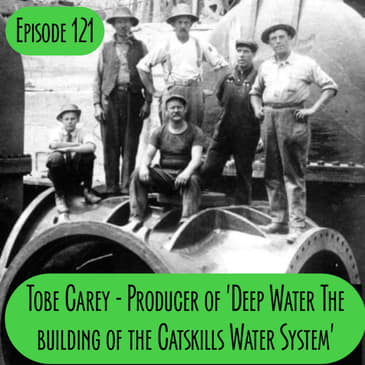
Welcome to episode 121 of Inside The Line: The Catskill Mountains Podcast! Tonight, film producer Tobe Carey joins us and chats about his film productions called ‘Deep Water: The building of the Catskill Water System’ and ‘The Catskill Mountain House and The World Around.’ If you need a sticker, email me or go to Camp Catskill! Subscribe on any platform! Share! Donate! Do whatever you want! I'm just glad you're listening! And remember... VOLUNTEER!!!!!!
Links for the Podcast: https://linktr.ee/ISLCatskillsPodcast, Donate a coffee to support the show! https://www.buymeacoffee.com/ITLCatskills, Like to be a sponsor or monthly supporter of the show? Go here! - https://www.buymeacoffee.com/ITLCatskills/membership
Thanks to the sponsors of the show!
Outdoor chronicles photography - https://www.outdoorchroniclesphotography.com/, Trailbound Project - https://www.trailboundproject.com/, Camp Catskill - https://campcatskill.co/, Scenic Route Guiding - https://adventurewiththescenicroute.com/, Another Summit - https://www.guardianrevival.org/programs/another-summit
Links:
Deep Water Film, The Catskill Mountain House Film, Mountain River Esopus Creek Film, Rails to Trails film, Willow Mixed Media,
Volunteer Opportunities:
Trailhead stewards for 3500 Club - https://www.catskill3500club.com/adopt-a-trailhead?fbclid=IwAR31Mb5VkefBQglzgrfm-hGfooL49yYz3twuSAkr8rrKEnzg8ZSl97XbwUw, Catskills Trail Crew - https://www.nynjtc.org/trailcrew/catskills-trail-crew, NYNJTC Volunteering - https://www.nynjtc.org/catskills, Catskill Center - https://catskillcenter.org/, Catskill Mountain Club - https://catskillmountainclub.org/about-us/, Catskill Mountainkeeper - https://www.catskillmountainkeeper.org/, Bramley Mountain Fire Tower - https://bramleymountainfiretower.org/
Post Hike Brews and Bites - Downtown Cafe, Brickmen Kitchen
#Ashokanreservior #catskillsmovies #ashokan #catskillsreserviors #visitcatskills #catskillstrails #catskillmountains #catskillspodcast #catskills #catskillpark #podcast #catskillshiker #volunteers #catskillmountainsnewyork #catskillmountainsnewyork #catskillspodcast #catskillshiker #catskillshiking #hiking #insidethelinecatskillmountainspodcast #volunteercatskills #catskill3500 #catskillmountains #catskillhiking #hikethecatskills
[00:00:00] Well, it was fascinating to really learn the technology that they use. A lot of it was handmade.
[00:00:06] It was sometimes called the last of the handmade dams because there's a lot of hand work. They're
[00:00:11] grubbing out the old trees and the foundations and stuff where the water was going to be
[00:00:20] captured. But they used steam engines and they used steam loaders and
[00:00:28] crushers with big engines and people were scalded from the steam. The latest diamond drills,
[00:00:36] latest technology of the time, so to speak. At the same time, there was still a lot of hand work and
[00:00:42] there were mule drivers with wagons loading up, you know, bluestone and stuff that was dug out
[00:00:50] from where the main dam was going to be. So there was this kind of period where it was
[00:00:55] a changeover from a lot of hand work to much more mechanized, kind of deep industrial revolution
[00:01:04] kind of stuff that was going on. So that was fascinating to kind of learn about and to find
[00:01:10] out about. It's again, there are photographs. The bushwax were some of the worst days I've
[00:01:32] ever had in the mountains or life really. Whereas Pansom Mountain is totally opposite to
[00:01:38] Samelton on top of a crater. I think the weather challenges on this incident were particularly
[00:01:45] difficult. It is really the development of New York State. Catskills are responsible.
[00:01:52] Now you're listening to Inside the Line, Catskill Mountains Park Gas.
[00:02:09] So episode 121 producer Toby Carey is here to chat about his productions of the Catskill
[00:02:18] Mountain House and the deep water building of the water system from upstate New York here
[00:02:23] in the Catskills down to New York City, which I am very fond of. And I'm looking forward to this.
[00:02:28] Good to meet you Toby. I hope you're having a great day today.
[00:02:32] Yeah, thanks. It was really beautiful. I've got to do some garden work, which is always my
[00:02:37] saving thing. Put my fingers in the dirt. We like that.
[00:02:42] Definitely, definitely. It was a beautiful day all around everywhere.
[00:02:45] The Ted will talk about that later with the He Hikes. So once again,
[00:02:50] AMR, Adirondack Mountain Reserve is starting their reservations in the ADK up in the Adirondacks.
[00:02:58] So is this a preview of what we're going to see here in the Catskills? That's a big question
[00:03:04] because we have, of course, these overused areas in the Catskills. We talk about
[00:03:11] Catterskill Falls, Panther, Slide Mountain. Will we see this here in the Catskills?
[00:03:18] Toby, with your experience being up in the Catskills, what do you think? Will we see this
[00:03:23] eventually? Well, I guess there have been a lot more people who've come up since the 2020 pandemic
[00:03:30] started. And so I think more and more people are familiar with the area and they might want to
[00:03:35] continue coming. It's very possible. My wife is a 46er, so she's had her time in the Adirondacks.
[00:03:42] I'm not so lucky to have done as many Heikes as she has, but we do go out here. I don't know. It's
[00:03:49] probably a good system to think about if not implement right away so they can be ready. And
[00:03:55] maybe this is a trial run for the state to do it in the Adirondacks.
[00:04:01] Yeah. It's definitely a big topic. Ted, what do you think, buddy?
[00:04:05] I think it's inevitable. I think it's a question at time and resources, but it's
[00:04:13] going to start just being phased in in the Adirondacks, the Catskills, and elsewhere. It's
[00:04:20] inevitable. Yeah. So looking at the previous stats of the reservation system, they said from 2022 to
[00:04:30] 2023, there was 52,000 people who registered in 2023. 16,900 reservations and only of those 16,900
[00:04:44] reservations, only 9,800 showed up. And then 2,600 cancellations. So there in between that, so there
[00:04:52] was around, let's say maybe 12,000. So 4,900 people did not even show up. So that once again,
[00:05:01] opportunity for 4,500 people to go to the Atom Round Uckbound Reserve and reserve that spot
[00:05:09] didn't happen. So Toby, I don't know if you're on board with this idea or not, but you seem
[00:05:15] like an enterprising fellow. What do you say we set up an app like StubHub or Ticketmaster
[00:05:22] and we start hoarding reservations and selling them at a substantial profit? What do you think?
[00:05:28] You go for it.
[00:05:32] Pat, I don't know. I don't think you're that technologically advanced to do that.
[00:05:36] Those, look Stosh, those are fighting words after the podcast, you and I in the parking lot,
[00:05:41] okay? I'm taking you down buddy.
[00:05:44] So yeah, well this, you know, a lot of controversy of course is happening with this, of course.
[00:05:50] You know, I'm on those Facebook pages where they talk about this a lot and a lot of people had
[00:05:56] like missed opportunities because it said it was booked on the weekend. They couldn't get a reservation
[00:06:01] but then you know they drove by and the parking lot was half full. So just, it's, I guess, you know,
[00:06:08] like you said, it's like a pilot still because it's only been happening for two years
[00:06:13] and we have this, you know, VUM coming up soon with the Catterskill Falls area that's going to be,
[00:06:19] the spring is when it's going to be released. All their information is going to be released. So
[00:06:26] it's a big question Mark. So that's a big topic.
[00:06:30] So Stosh, do you know what they do when they're sold out but they have no shows? Do they let
[00:06:36] people in at say 10 o'clock, 9 o'clock, 11 o'clock or is it just shut down for the day
[00:06:41] because they're sold out and they won't let more people in? I've heard they shut it down.
[00:06:46] That people tried to show up on their way to maybe another area and they saw that the parking
[00:06:51] lot was full and they wouldn't let them in. It's only for reservations only. So it's crazy.
[00:06:59] Toby, you're going to say something, buddy? Well, I was going to ask the same question
[00:07:03] actually. I wondered if someone just showed up whether they could get in. Yeah. So it seems
[00:07:07] to me with the technology that exists, they should be able to know that there's some slots open.
[00:07:16] Of course, that means having a person on site, which I guess they have anyway, right? Otherwise,
[00:07:20] how do they keep people out? True. The DEC is on site with someone from the Adirondack Mountain
[00:07:26] Reserve. So yeah, maybe there's not good stealth service or other tech availabilities where
[00:07:34] they are. I don't know. Well, Toby, we put a person on the moon in the 60s. I'm sure we can tackle this
[00:07:40] problem. Yeah, I would think. Yeah, it's something once again to think about because we, like Toby
[00:07:49] said, ever since the pandemic, hiking has blossomed, hiking has grown. And I do appreciate that.
[00:07:56] It's brought a lot of hikers to the area, brought a lot of businesses, businesses that
[00:08:02] have grown. And that we have more volunteers, people, more volunteer system has come about.
[00:08:08] And it's a big plus. But it's also once again for these parking areas like Panther Mountain,
[00:08:16] just there's no parking available or like I went to the Barnum Road today and there's,
[00:08:22] you can't park in the snow plow turnaround. So there's three parking spots available on
[00:08:26] Barnum Road going up to Thomas Cole. So what do we do? We got to,
[00:08:30] you know, and that brings my next question. Tag, go ahead. What are you going to say? Sure.
[00:08:35] Well, the obvious solution for you, Stash, is if you drove a Jeep Wrangler,
[00:08:42] you would just make your own parking spot. So little inside tip from a Wrangler driver here.
[00:08:48] The Tesla can handle it, trust me. I will challenge you on anything. No,
[00:08:52] I'm just getting bottom out every time. So my question with this,
[00:08:57] I was thinking about this today as I was hiking, should the DEC open up more viewing point like
[00:09:04] viewpoints along different routes to get people attracted to different areas?
[00:09:11] What do you think, Toby? You think he's picking a flight here?
[00:09:15] Maybe. Yeah, because they're going to say, what, you want to cut down trees?
[00:09:20] You know, so that's the first flight I guess you'll run into right away.
[00:09:25] And are there that many viewpoints to be added? I don't know. I'm not that much of a hiker to tell
[00:09:33] you that if I went up X Mountain, that if only if they took down four trees,
[00:09:40] there'd be a great few of the valley. I don't know. So I'm not the right one to really
[00:09:44] comment other than I'm a tree hugger. But you know,
[00:09:48] yeah, it's it's a big decision. Hugging trees is good. But I think in a lot of areas of the
[00:09:54] Catskill certainly in the Adirondacks where it's designated forever wild, there's constitutional
[00:10:03] New York State constitutional restrictions on tree cutting in the forever wild areas
[00:10:10] of those two parks. Yeah, it's one of those thoughts though, you know, like when going up,
[00:10:16] you know, I maintain Thomas Cole and there's that one viewpoint just below like the call of
[00:10:23] Thomas Cole and Camels Hump. That was once a fantastic viewpoint. I can remember seven,
[00:10:27] eight years ago and now it's over a corona in that time. And you know, do we get that opened
[00:10:35] up more again for people to travel from bottom row? But we don't have to park in
[00:10:39] a bottom row. So it's a yeah, you know, viewpoints are attractions. People are going to seek them out.
[00:10:47] But we should get people to, you know, refocus themselves and it really isn't about the viewpoint.
[00:10:55] It's more about the journey to the viewpoint that experience either who you're with or how
[00:11:01] you're absorbing your moments of solitude along the trail. I'm not a big fan of
[00:11:07] hanging out at viewpoints and taking in the view. I just like to stay under the canopy and check out
[00:11:12] everything that happens under that canopy. Outrageous. I'm a viewpoint kind of guy.
[00:11:19] We're like the odd couple face it. You're electric, I'm gas. You're in the viewpoints.
[00:11:26] I'm into under the canopy. Do you actually hike together? What's that? Do you actually
[00:11:33] hike together? No, we've never I've only met Stash one time and it didn't go over very well. He
[00:11:38] knocked me down. I got hypothermia. Sarr had to come and rescue me. It went something like that.
[00:11:43] Am I wrong Stash? Deny it. Am I wrong? Not entirely wrong. Your friend got hypothermia.
[00:11:50] Well, I did suffer from it at times. That episodic hypothermia.
[00:11:56] Fantastic. So once again, big, big topics to come up with with the rise of hiking and
[00:12:02] Catskills and the Aderonics to the East Coast anywhere. Do we do this and that to help out this
[00:12:08] and that, but it will cause this and that. It's just all over the place. Everything's all over the
[00:12:12] place. So speaking of a couple news around in or around more of the Catskills is more outside
[00:12:20] the Catskills. So mother, I've actually been to this place. Mother falls 140 feet to death
[00:12:25] while hiking with family in Sedona, Arizona. So hiking is a Sedona called Bear Mountain.
[00:12:30] It's actually the highest peak in Sedona. A 40 year old mother fell 140 feet off the cliff and
[00:12:39] fortunately passed away. And the woman and her husband are a one year old child
[00:12:45] with visiting from California and rented to Airbnb in Sedona. And I've been to Sedona at least two
[00:12:51] or three times. I think I can't remember. I was young, but Bear Mountains, the highest peak
[00:12:56] there called 911. They had to get rescue squads and stuff like that up there. It's not the easiest
[00:13:02] hike. I will tell you that, especially being the tallest peak in Sedona, which is probably around
[00:13:07] 8,900 feet. Sedona starts off plateauing probably around 6,000. So 2,000 feet of elevation gain
[00:13:16] is just crazy. And just to think of that once again, around this time it's just difficult.
[00:13:26] And their interview and hikers as they were coming off the mountain and said the sheriff's
[00:13:31] office is looking into the events that led to the 40 year old mother's death. So crazy stuff.
[00:13:40] So Toby, who do you think did it? If you were following along a family of three with the one
[00:13:45] year old child or hiking and up the highest peak in Sedona, mom falls off the cliff, dies.
[00:13:54] If you were investigating this, who are you looking at, Toby?
[00:13:56] Toby Daly, Oh boy, you've got me. You don't have a library to put the butler in
[00:14:02] so it makes it difficult. You know, that's a bunch as far as I can go.
[00:14:07] Well, that's good creative insight. I wouldn't have thought of going to the butler,
[00:14:11] but he wasn't on the hike this time. As I know, it's really unfortunate situation for the father
[00:14:18] as well as the child, you know, to be, to lose your wife, the mother of your child and
[00:14:23] presumably be a suspect at the same time. Yeah. Yeah. And like I said, Bear Mountain is
[00:14:30] definitely not the easiest hike in Sedona. I thought about doing that, but I was just like,
[00:14:37] eh, no way. It's the highest peak in Sedona in the area. So, um, so, Tat's got some a little bit
[00:14:45] information for us. So the travel magazine listed Devil's Path as a seventh steepest hike in the
[00:14:51] USA. Why the seventh? Why not number like three or four? Yeah, that's, that's, I found
[00:14:57] that to be interesting. You pointed out you must have done the calculations or actually read
[00:15:01] the article, which I didn't do. Um, right? It's, uh, apparently based upon elevation gain per mile
[00:15:09] and the Devil's Path is a long, the entire hike is 25 miles more or less,
[00:15:16] 8100 feet, but they were, they were ranking in the, the, you know, upper five of that list
[00:15:23] short hike. Some hikes that were under three miles and I'd really, I'd rather do a three mile
[00:15:30] hike with 1500 or 2000 feet of vertical gain as steep as that is, as opposed to doing
[00:15:37] the Devil's Path 25 miles up and down, up and down, up and down. And then as we all know,
[00:15:45] when you get to the end and you finish on West, West kill, what's next?
[00:15:51] West kill, Brian. That's right. Well, no, no, no, it's, it's what, what the fuck?
[00:15:57] St. Ann's, right? St. Ann's Peak, what the fuck? Yeah, you're all, you've got one more.
[00:16:00] Sorry Toby, if you don't mind the, yeah, it was in the disclaimer, Toby. This is an explicit
[00:16:06] show. You might have to go say some, um, you know, uh, hail. I'm not nervous. I'm not nervous.
[00:16:11] It's all right. You're hanging with the young crowd tonight. Hey, I started it, you know.
[00:16:18] So, you know, dad, do you bring up like once again a great point. They had some
[00:16:25] hikes on there, four mile hike over in your 70 up Devils or not Devils Path.
[00:16:31] What's that called? Half Dome, right? Half Dome. Like how do you compare,
[00:16:38] you know, a 25 mile hike to a four mile hike? Like,
[00:16:41] yeah, I do half dome it any day every day. Yeah, right? The full Devils Path.
[00:16:47] I to be honest, I've never done the full Devils Path. I know I can't do it. I can't do 25 miles
[00:16:52] physically my body. I have too many broken parts to do the 25. So that's how hard the Devils Path is.
[00:17:01] Toby, have you ever done any hike on the Devils Path kind of area?
[00:17:05] No, I'm not. As I said, I'm not really someone who's experienced in serious hiking.
[00:17:13] You know, I've been up to a few viewpoints. I've been to overlook more than once and I've been to,
[00:17:20] you know, stuff like that. But I've not been lucky enough to learn how to do that or to
[00:17:25] experience it all. Certainly not nothing like 25 miles. That's not even in my consciousness.
[00:17:31] You know, so. Correct. Correct. It's a tough hike. I gotta say something like half dome
[00:17:41] comparing it to 25 mile hike up and down, up and down, up and down. It's just absolutely insane.
[00:17:47] Yeah. I like things like Huckleberry Point. You know, that's good. Nice hike. Oh yeah.
[00:17:51] Great spot to be in the fall, which we were a couple years ago. So like that,
[00:17:57] that's about my speed. As I say, my wife in the old back in the day did all of the four,
[00:18:03] it was a 46er, but she goes along with kind of what I'm looking for these days as well. We spend
[00:18:11] you know, maybe more time along the Shokan Rail Trail than we do hiking up these days. So.
[00:18:18] At Rail Trail. It's got some great views. Yeah. Well, there's a whole history there that
[00:18:25] I won't get into the politics of that, that thing. But why not later on? Well, you know,
[00:18:32] it relates to one of my films actually Rails to the Catskills has a section about
[00:18:38] the railroad heritage railroad operation that's still ongoing the Catskill Mountain Railroad
[00:18:45] and how the rail trail purists wanted the tracks where they're running.
[00:18:53] And that became a big battle. It just kind of erupted as I was doing this nice, sweet historical
[00:19:00] piece about railroading and the history of it in the Catskills. So I had to fold it in. So it's
[00:19:07] yeah, I'm aware of it. Interesting. It would be great to hear about the rails of the Shraftkills
[00:19:13] Catskills like different, you know, I've talked about that different times, but to hear
[00:19:18] different kind of like sections of the Catskills with their rail trails are
[00:19:24] the railroads are actually amazing. Phenomenal.
[00:19:27] There's an ongoing thing wherever there are disused tracks, the rail,
[00:19:35] the trail people have their eye on it. Some of it makes a lot of sense to me.
[00:19:40] Some of it I would like to see re-established as heritage tracks because it has,
[00:19:46] because I'm a history buff. So I have these two pulls within me.
[00:19:51] Yeah, I see that both ways. Exactly. You know, what side more of you are
[00:19:57] leaning to making it kind of like a history trail or just like some, I guess I don't understand
[00:20:05] what the difference is from making it for people that can hike and then making it kind of like
[00:20:10] offsite for people to check out or something? Well, you know, there exist, for instance,
[00:20:16] there's a, the Castamount Railroad runs now out of Kingston up to about two miles shy of where the
[00:20:26] Shokan Rail Trail begins, which goes around the Shokan Reservoir or at least on the north side
[00:20:31] of it. And that is right now just the railroad track and the train runs on its schedule and they
[00:20:40] have about 50,000 tourists that take it every year. So it's a reasonable operation. And of course,
[00:20:48] the trail folks would like that to become a trail as well because their plan is connectivity of trails
[00:20:55] all the way from New York City to Buffalo. And you know, this is a piece of it, it could be a piece
[00:21:01] of it all the way up. So they have their eye on that and the railroad for its part says, well,
[00:21:08] and this is something that exists quite a few places, let's do a rail with trail. So there's
[00:21:15] a walking trail beside the existing track that's that could be put in. And that's kind of the,
[00:21:22] to my mind, the highest use of that stretch of the territory rather than just pull out the
[00:21:30] successful railroad operation and only have a trail. So
[00:21:35] And I'm with you on that Toby. I think you can have the two coinciding with each other.
[00:21:41] If you're riding a bike or walking, you don't have to be on the old rail bed. There's nothing
[00:21:46] intrinsically valuable or unique about walking on the old trail bed itself.
[00:21:52] And the hike, the walkers, the bikers, the hikers can be alongside the existing tracks or the
[00:21:58] reestablished tracks and frankly, it'd be kind of neat to either walk, walk up and then take
[00:22:03] the train back or vice versa. That's part of what what the railroads plan is that
[00:22:10] keep a few cars from going up route 28 to the show can and they go on the train on the train,
[00:22:17] take your bike, get off at the, you know, at a rest stop basically along the track
[00:22:24] right near the rail trail. And then you've got 11 miles of rail trail around the reservoir if
[00:22:29] you want it. So. Absolutely phenomenal idea. Yeah. So we'll see what happens. It's in the
[00:22:36] it's in the mix right now. It's been talked about. The politicians know about it. They're
[00:22:42] starting to discuss it. We'll see what happens. There's always some pushback on both sides. So
[00:22:51] stay tuned. We'll stay tuned. So Toby, you're going to be on this show again.
[00:22:56] Well, maybe who knows? Hell yeah. I definitely will hook that up. So with that,
[00:23:04] did that have to do anything with the Catsco Mountain Railroad be awarded the four million
[00:23:09] dollars? Does that have anything to do? Yeah, yeah. It has a lot to do with it. In fact,
[00:23:14] the trail purists say how dare they get this grant. They didn't go through the county
[00:23:20] and they did it, you know, on their own and, you know, trying to get it kind of squash.
[00:23:27] But that's that grant money will be used by the railroad to do a bunch of things,
[00:23:33] you know, and they have a piece of land right near the trailhead that they want to develop.
[00:23:40] There are no, you know, this is an interesting thing that I just learned that there are no
[00:23:46] signs on the throughway talking about the Ashokan Rail Trail because there are no
[00:23:51] bathrooms on the rail trail. Evidently you can't have any signage pointing to a tourist
[00:23:58] destination unless there are restroom areas available. So one of the things the railroad
[00:24:04] wants to do with this property that they've leased is to establish some restrooms and,
[00:24:11] you know, a little gift shop or historical museum kind of spot. And then it becomes even more of
[00:24:19] a tourist destination. 100% agree with that because the lack of bathrooms in the Catskills
[00:24:26] is one of my hot topics that I always talk about. Yeah, yeah. Let's not even go there.
[00:24:32] Okay. Talk about shooting the shit, Stosh. My God, it's so crazy. Like, I mean,
[00:24:40] it's that and the Adirondacks and stuff. It's just, you know, it's just, it's uncomfortable,
[00:24:46] I guess. Is that how you say it? Poor Stosh. No wonder why you don't go on the long hikes,
[00:24:52] buddy. You know, and we talk about that, you know, speaking of bathrooms, I love to work shops
[00:24:58] because it has that lock that you turn on and it says like occupied unoccupied, right?
[00:25:05] So Toby's with me on this one. Are you recording still Stosh? I'm hitting the mute button on you,
[00:25:12] buddy. No. When my wife and I travel to New Hampshire, which we do every couple of months
[00:25:20] or shortly during the summer, we take the back route and Stewart shops are a must stop place,
[00:25:27] you know. So I'm with you. Yeah. Thank you. Like they have the locked unlocked thing and you can
[00:25:33] tell when somebody is in there. So it's not that awkward jerking of the handle where somebody's
[00:25:39] like uncomfortable inside. So every time I go into a Stewart's, I'm going to go over to the,
[00:25:45] especially if I see your car outside Stosh, I'm going over to the bathroom. And if it says
[00:25:50] occupied, it's I'm going to throw stuff at the door on you. I'm just going to start heaving things
[00:25:56] and that'll be the last time that's the last time you'll relieve yourself in a Stewart's.
[00:26:00] It'll be so fun. I didn't know this was going to be such an exciting show, but I'm really glad
[00:26:05] that I'm part of it. See, this is why like I like to, this is called shooting the shit.
[00:26:12] It's fun. It gets everybody loosened up for the interview and a lot of people don't understand.
[00:26:20] Sometimes it's too professional. This podcast is not this. This podcast is 100% fun. That's what
[00:26:26] I do it for. And that's what I, hopefully that's what Ted does it for. I don't know if he does it
[00:26:30] for to be popular or something. I'm not doing it to put it on my resume. Okay.
[00:26:35] That would be sad. I just want to say one thing because it relates to my history. There's a
[00:26:41] field to this show that is like much like early access television programming.
[00:26:49] Now, Toby, I don't know if that's insulting or not.
[00:26:53] That's a compliment. That's a compliment because I was very involved in the beginnings of
[00:26:58] access television and Woodstock and then it had a 10 year off the air kind of time. And
[00:27:06] then it came back again and I was involved with the bringing it back. So I appreciate the good humor,
[00:27:14] the unafraid nature of the presentations because it just great. We got a lot of trouble because
[00:27:23] people tried to do that and was coming into people's homes unbidden so to speak. This is
[00:27:28] a little different because you've got to sign up for the podcast. So you kind of know what
[00:27:32] you're getting into or you might know what you're getting into. And this is where Toby announces
[00:27:38] his candidacy for the 2024 election on our show. You heard it first on Inside the Line,
[00:27:45] Toby Carey or President. Dave May please. I know right. All right. So let's better move it on.
[00:27:54] Stop politics. No politics. All right. So thank you to the monthly supporters,
[00:27:58] Chris, Darren, Vicki, John, Betsy, Denise, Vanessa, Joseph, Jim, Michael, David.
[00:28:05] Thank you guys so much for supporting the show. Really appreciate it. Also check out sponsors
[00:28:09] for the show, Outdoor Chronicles Photography. Molly from Outdoor Chronicles Photography specializes
[00:28:15] in adventure elopement and adventure couple photography and the Catskills, Adirondacks
[00:28:20] and the White Mountains. She's an officiator for getting married, a license guide,
[00:28:23] and she is also a story maker. Molly won't just give you photos, she'll give you memories that will
[00:28:28] last forever. Don't hesitate to get ahold of Molly and all five books. Also, have you ever
[00:28:33] wanted to learn more about hiking or backpacking or even just brush up on some of your old skills
[00:28:37] in the back country? Check out Trailbound Project, a hiking and backpacking school. Scott and Joe
[00:28:43] from the New Jersey search and rescue team have amazing backgrounds at Wilderness First Aid,
[00:28:47] Wilderness First Responder and Mountain Rescue Association. They're here to teach you
[00:28:52] all the new skills of hiking and backpacking. They teach anything for First Aid, map and compass,
[00:28:57] many other skills that could help you with others while on the show. Check them out on all platforms.
[00:29:03] Let's move on. Let's see. So you guys having anything to drink tonight? Besides, I guess
[00:29:09] I'm the only one probably. Not me. Water. Hey, that's good. I'm going to have water in a second.
[00:29:16] So this is where I normally say that I'm having a cup of coffee, but I ran across a little
[00:29:22] interesting news tidbit this week that I thought I would throw in in lieu of
[00:29:27] telling everybody that I'm drinking another cup of coffee. So I saw on the news this week this
[00:29:32] fellow, Vincent Dransfield, 110 years old, which is known as a super centurion,
[00:29:40] is living. They report that he's living independently in New Jersey at 110 years old.
[00:29:45] He still drives his car every day, getting coffee at the convenience store and buying lunch.
[00:29:53] So everyone would want to know what Vincent attributes his longevity to. And this ties it
[00:30:01] into what am I drinking tonight? Let's look at the answer given for Vincent. What does
[00:30:07] Vincent dread credit his longevity to according to his granddaughter, milk? Milk still plays a role
[00:30:14] in his life. The super centurion credits drinking oval team, a milk flavoring and nutrition supplement
[00:30:23] every day after breakfast for his longevity. He's been so outspoken about it that when he
[00:30:29] turned 100, everyone drank all voltine at his birthday party. So this is where we turn
[00:30:36] it to Stosh. Toby, you can't chime in because I know you know the answer to this. Stosh,
[00:30:42] what's all voltine? It's a supplement, isn't it? Well, it's a supplement, but what type of supplement?
[00:30:49] I mean, tell us more than just the obvious. What's all voltine? Toby is like leaning forward.
[00:30:56] He's ready to dive into this because he wants the five points for answering this question.
[00:31:01] I know I sell it where I work, but it's about it. So Toby, what is oval team?
[00:31:10] Well, I can't tell you specifically except I remember it as having a malted kind of flavor.
[00:31:15] And maybe it's made from malt, but that's my memory as a kid. I did drink it
[00:31:22] once in a while as a youngster. I don't know if it was something that was
[00:31:27] mandated or was a treat. I don't quite remember that, probably a treat, but it was always a little
[00:31:33] unusual because it was malted. Yeah. So it's like a powder that you add to your glass of milk. It has
[00:31:41] malt flavorings amongst other flavorings, whey protein, vitamin supplements, etc. But apparently
[00:31:47] this is what Vincent says is made him reach the ripe young age of 110 years old. So I thought
[00:31:55] that I'm going to start drinking oval team from now on for these shows.
[00:32:00] I like it. And that way, Stosch, I can go all night. We can throw to the boards the two hour
[00:32:06] limit and we can go for like an eight hour podcast session. I don't know if I have time for that.
[00:32:16] You know, and the funny thing is you bring that up. I remember watching a documentary on people
[00:32:21] from Italy who base their longevity on wine and starch, basically, from their bread and stuff
[00:32:32] that they have in gardening. I think I saw that as well. It was special. They went around and did
[00:32:39] a dozen or so of these areas with a high concentration of centarians. And one of the
[00:32:45] things that was common to most of these areas were the old folks spent a few hours a day
[00:32:51] out gardening. Well, this, you know, it's funny that this documentary that I watched with my wife,
[00:32:57] it was trying to think of the guy's name is very popular. He was in like a music team thing.
[00:33:04] And he just went about the world checking out the world and he found, you know, Italy to have
[00:33:10] the oldest people, oldest residents there. And they interviewed one guy and every morning
[00:33:16] at 10 a.m., he goes to a bar, has a sip of wine, talks with his bartender for two hours,
[00:33:23] goes out, has some bread or some any form of starch of their original bread 100%. And he is
[00:33:32] a hundred and like 13 years old and he's walking. He's going up these hills and I'm just like,
[00:33:37] my God, my knees are giving out on the way down. And I'm just like somebody rescue me. But
[00:33:43] this guy's killing it. Well, let me jump in just for a second. I recently had my annual checkup
[00:33:51] with my doctor and we're talking about these kind of sort of these kind of things. He said to me,
[00:33:55] well, there was a study done where they decided to look at people and centenarians perhaps.
[00:34:03] And they were all very religious. They all went to church. And he said, oh, is there
[00:34:08] a connection there? And what they discovered was all the churches were up on a hill.
[00:34:15] So they all had to climb hill to go to church. So it was the hill climbing that was the good,
[00:34:20] the good thing for them not necessarily kneeling in prayer. So there you go.
[00:34:26] Wow. Yeah. So exercise, exercise. A lot of studies.
[00:34:31] Exercise and wine. That's what it seems like. So, yeah, so cool. Excellent. Yeah,
[00:34:37] I'm just having a good old rum and zivia. Once again, a nice way to bring out, get out the soda
[00:34:46] and the sugar and stuff like that in my life and kind of get balanced. So is that embarrassing?
[00:34:52] That's Toby's laughing. I'm laughing because I'm at the point where I'm trying to cut out sugar
[00:34:58] and I just think the balance idea of them bringing the sugar and sounds good to me.
[00:35:03] I know, right? Like, like I had a sip of Coca-Cola the other day. I'm like, oh my God, this is so good.
[00:35:10] And I have my windows open. Can you hear that? Can you guys hear that annoying truck that just went by?
[00:35:18] No. Okay. Good. Good. Because it's just louder. I have my windows open because it's 60 degrees
[00:35:24] outside and the wind's blowing. It's absolutely phenomenal. But so yeah. So Toby, why don't you
[00:35:30] go with previous hikes or something that you would like to chat about that you've done recently
[00:35:34] of just enjoying nature? Enjoying nature. Well, you know, I've got a great property here. We do
[00:35:42] a lot of gardening, both flowers and veggie gardens kind of my spot. So we have a small stream
[00:35:48] behind the house that gets roaring when we have these big gas-filled rainstorms. So it's always
[00:35:55] something different and changing. So I'm about as happy in my backyard as I am anywhere in the
[00:36:02] Catskills, frankly. And some of my good friends don't quite understand it. And my wife doesn't
[00:36:10] quite understand why I don't want to go to Italy anymore and, you know, get on an airplane ever
[00:36:17] again. And I'm feeling pretty grounded here. And in fact, again, relating to my work, if you will,
[00:36:27] in video, I have a whole probably a dozen what I call landscape projects that I did, many of which
[00:36:35] are here. Some are in New Hampshire but really paying attention to the landscape and kind of
[00:36:42] some time studies going in with that. So it's something that keeps me off the street, so to speak.
[00:36:51] So that's my other adventures lately. I've been picking up leaves from around bushes. There you go.
[00:37:00] Nothing wrong with that. As long as you're outdoors, breathe into that open air.
[00:37:04] Yeah.
[00:37:05] Replenishes us all. Ted, how about you, sir? Oh, I went out on Sunday with Danny and some friends of
[00:37:12] his and we did some geological exploration. One of the fun twists of hiking with Danny
[00:37:22] is he likes to educate you about the terrain and how it came about to be shaped
[00:37:29] the way you find it when you're out hiking. So before the hike, he handed out some
[00:37:36] legit reading materials, deglation of the Hudson Valley between Hyde Park and Albany, New York,
[00:37:45] and some other materials are very interesting to read. And then we spent about six miles hiking
[00:37:50] around an area of lower elevation in the Catskills that's privately owned. So I cannot say where
[00:37:57] it is. And I'm not posting any pictures of the scenic views, but I'm telling you it was jaw dropping.
[00:38:05] Just jaw dropping and to have explained what shaped and contoured it. My Danny was
[00:38:14] really a treat, but I'm looking forward to getting out and crushing some mega this weekend.
[00:38:21] Nice. Nice. So Danny, person you speak of, is he a geologist for New York State?
[00:38:29] Yes. He actually mentioned that you interviewed him for one of your videos or your movies.
[00:38:36] Yeah, when you were talking about geology, I said, oh, it's going to be our Danny who's in our
[00:38:40] Mountain River film, which is about the Osoapus Creek. And we go back to the early geology
[00:38:46] of it with him. And he takes us out on the creek with some of the students he's been working with.
[00:38:51] He's a great interview. Of course, his knowledge is astounding.
[00:38:57] Exactly. And a lot of fun. So yeah, great. Good. Dave McGinnis, say hello.
[00:39:03] Yeah, I will. And I get the pleasure of hiking with him more and more often. And it's
[00:39:08] both enjoyable and educational. I know Stash was out today doing some trail maintenance.
[00:39:17] Wanted to tell us how that went, Stash. I just want to say that I'm jealous that
[00:39:22] you get these Saturdays off and get to go with Danny and talk about the geological features.
[00:39:29] Whenever you're ready. We actually were out Sunday this time.
[00:39:32] Yeah, I got to work on Sundays. I'm a slave to the United States.
[00:39:37] So to the to the hourly wage. Yes. So today I did my annual, well not my annual. I usually you do
[00:39:46] twice a year, you do trail maintenance at your spot. Unfortunately where I have trail maintenance,
[00:39:52] I at least do it five times a year because the overgrowth of my area that has, you know,
[00:39:59] prickers and burns and stuff like that, it gets pretty harsh once in a while. So
[00:40:04] I went up and I did my trail maintenance and I have a trail from
[00:40:09] Hamelsump up to Thomas Cole. To me, this is the probably most beautiful section in the cat skills
[00:40:16] just because of that area between Tamelsump and then starting up Thomas Cole has got to be
[00:40:24] one of the, I don't know, just the connections with the forest, the flat areas switching
[00:40:31] from the old birches to balsams back to birches. It's just, you know, ferns all over here,
[00:40:39] flat areas, you know, mud over there. It's just absolutely phenomenal. But I went up there,
[00:40:45] you know, you got to haul your gear up two miles, you know, 1300 feet of elevation gain for two
[00:40:51] miles. I got to admit, you know, I'm pushing myself pretty hard. I crushed it. I did it in
[00:40:56] an hour and 15 minutes getting up there. And that stops viewpoints and then observing other
[00:41:03] areas on my way up, but my areas from Camelsump up to Thomas Cole went through there,
[00:41:10] trimmed back some, some pricker bushes that I thought would be a problem in the future,
[00:41:14] because it always is. I'd never have to go up there twice a year. It's always four or five
[00:41:18] times a year. But there was actually a significant amount of blowdown in the area. I
[00:41:23] had at least to cut at least three or four, like good four inch trees to get out of the way.
[00:41:30] So people wouldn't go around them. And luckily, you know, some of the times I saw that people did
[00:41:35] push those branches and trees out of the way. So I thank people for doing that. But it was
[00:41:42] actually one of the more tougher days that I've had to do trail maintenance. And, you know,
[00:41:47] the one thing that I am extremely positive about, I had to clean up absolutely zero trash,
[00:41:55] none whatsoever. Absolutely phenomenal. And to have that after, you know, the pandemic and after
[00:42:01] it's explosive and hikers, I am 100% glad that I do this stuff and then that these people,
[00:42:11] you know, hopefully are learning about leave no trace and keeping these trails
[00:42:15] the way they are. And I only have to do the maintenance that I have to do.
[00:42:19] But absolutely beautiful day, sunny 65 degrees, war shorts. God, wind was blowing just,
[00:42:27] I've been the only one on the trail. I couldn't ask for a better day and my arms hurt.
[00:42:34] So I had two questions for you. First one, any ticks?
[00:42:40] No ticks? Yeah, because we were all getting ticks on Sunday, but we were also,
[00:42:46] you know, we started off under a thousand feet. Second question may be more important,
[00:42:54] did you finish your work for the day or do you still have to go back and do more?
[00:42:58] Absolutely. I'd never leave there without finishing that.
[00:43:01] Yeah. So you got it all cleared out and trimmed back.
[00:43:05] You know, I hate to brag, but I also cleared out the trail going from Camel's hump
[00:43:11] all the way down to Bottom Road. There was actually three or four more blowdowns and
[00:43:16] actually one of them was pretty significant size was probably like, I would say like four
[00:43:24] or five branches of like four inch, five inch and width and did it all by hand.
[00:43:29] No mechanical, you know, no gas powered stuff or anything.
[00:43:34] That's that stretch from the road up to there's like a set of rocks that are a viewpoint as
[00:43:40] you're hiking in, you know, where I'm talking about? Oh hell yeah, awesome spot.
[00:43:44] I have not been there on a warm and sunny day that I haven't seen snakes.
[00:43:48] I haven't seen any snakes there either. Well, I see them all the time there.
[00:43:52] That's like one of the places I know that I'm going to run into snakes in the cats.
[00:43:55] Is that spot? Interesting. Yeah. Maybe they have respect for you when they just get out of the way
[00:44:00] because they know you have like, you know, shears and clippers and a saw and they're just not
[00:44:04] going to mess with you. Me, they're just like around my feet and I kind of get a little freaked
[00:44:09] out and pick up the pace and get out of there. Yeah. It was a beautiful day though. I had,
[00:44:14] you know, very minimal mud and I got to admit that trail from Bottom Road
[00:44:19] up to Camel's hump is one of the most fantastic trails in the Catskills
[00:44:24] just because of well built switchbacks back and forth here and there. They've been
[00:44:29] beginning to mark a lot of private property now for some reason. I think someone that has
[00:44:34] property down below the area right after the trailhead register is starting to make a
[00:44:41] private trail up because I saw private trail markers like not DEC mark, but something else.
[00:44:47] So we'll see what happens, but you'll see if you ever go from Barnum Road to Camel's
[00:44:52] hump, you'll see a lot of red and teal paint from property assessors of the DEC
[00:45:00] mark in their area to kind of separate that from the private property. So it's very,
[00:45:04] it was very interesting on that part, but other than that beautiful day, got a couple viewpoints,
[00:45:12] hauled my ass up and down so I can get back to make this awesome interview with Tad and Toby.
[00:45:17] So I'm excited, probably got more sunburn than I should have. I put sunscreen on and then you
[00:45:24] wipe it off with that sweat. It never works. It never works. So awesome. So Catskill News,
[00:45:33] Volunteer 3500 Club, Catskill Trail Crew, Catskill Trail Crew 427, 428. So this is this weekend.
[00:45:42] We'll meet at 9am at the entrance of the North South Lake campground and hike down to the
[00:45:45] campground to Mary's Glen Trailhead to do some more trail maintenance on the area. That area is
[00:45:51] a little swampy and messy, so they're going to touch up that area a little bit more. They've
[00:45:54] done a great job to there. So if you want to meet up with the Catskill Trail Crew,
[00:45:59] meet up with them 427, 428, 9am at the entrance North South Lake. Catskill Mountain Club has
[00:46:05] a volunteering, so does Visitor's Center, Jallerovitch Trail Crew have set out their
[00:46:11] calendar Bradley Mountain Fire Tower? Also, if you want stickers, go to Camp Catskill
[00:46:17] in Tannersville and get some free stickers there, free or message me. Let me know. So
[00:46:22] weather forecast real quick guys this weekend. It looks to be an absolutely phenomenal weekend
[00:46:30] somewhat like today it said it was supposed to be a little rain but Friday 34 degrees to a low
[00:46:36] of 32 degrees with a very little wind chill at all sunny skies all day. Saturday in the AM
[00:46:44] 43 degrees, a high of 43, a low of 32 with a little bit of wind chill and then later on in the
[00:46:51] evening maybe more towards six o'clock rain will come in. Sunday looks a little bit sketchy
[00:46:56] but it's higher temperatures 55 degrees going low to 45 degrees with a little bit of rain,
[00:47:01] not too much, not even just a sprinkle here and there. So get out there have some fun in the
[00:47:09] Catskills if you need to. All right so we're going to do these last sponsors and Toby will
[00:47:16] get into the interview is that okay? Sounds good. All right so is it time for some new gear
[00:47:23] hiking in the Catskills? Say no more Camp Catskill in Tannersville has all your hiking
[00:47:27] needs. Footwear socks moisture wicking shirts freeze dried meals Catskill merchandise and more
[00:47:31] they have every all the essentials for your hiking needs located in Tannersville and they
[00:47:35] have an online store check out Camp Catskill also if you want free stickers stop here.
[00:47:40] Also if you're ready hit the trails make sure you take the scenic route our guides are here
[00:47:44] to help you with your goals big or small like Marcia Slider lowing their swords check out
[00:47:49] scenic route guiding gear rentals on Instagram and Facebook for more information also if you
[00:47:54] mentioned the podcast you can get 10% off use the great code word mountain lion also check out
[00:48:01] another summit a nonprofit program that leads outdoor and venture activities for veterans and
[00:48:06] first responders for free on other summits epic adventure applications are open this year's epic
[00:48:12] adventures include a nine-day canoe trip in the north main woods and a through hike of the
[00:48:16] north pole Placid trail the Etterondex epic adventures are a step up program where you
[00:48:21] see classroom instruction wilderness first aid trading and a custom three-day trading trip
[00:48:26] all leading up to adventure never forget of course this is all 100% free for veterans and first
[00:48:31] responders applications are open till May 1st for the Allagash River Strip and May 15th for
[00:48:37] the north pole Placid trail apply today at another summit org. All right so let's get on to the
[00:48:44] guests of the night so producer Toby Carey is here to talk about his productions with
[00:48:52] his movies called deep water the building of the water system and the Catskills and the Catskill
[00:48:57] mountain house and the world around now he's done a bunch of other ones and I can't wait to hear
[00:49:02] about those those two uh the rails to the cat rails to the Catskills I'm looking forward to
[00:49:06] I'm actually gonna look into that Toby so welcome to the show buddy thank you very much it's a
[00:49:12] pleasure to be with you I enjoyed the first hour so hopefully you can enjoy what I have to say a
[00:49:17] little bit so we'll see I'm sure we will I'm sure we will I've been looking forward to this you
[00:49:23] know I am my uh my thought or my my I'm trying to think of the words about the the reservoirs
[00:49:31] it just goes crazy like I am just I don't know what to say I'm trying to think of the
[00:49:38] words to say it's just it's just that the reservoir system that we have up here is
[00:49:44] unexplainable so with your films you have explained it a pretty good amount so yeah well um
[00:49:52] deep water has been what we call an evergreen it's been in distribution now for 23 years hard to
[00:49:58] hard to believe we just had a screening at the shendake and theatrical society at the
[00:50:05] finish of playhouse and about 100 people turned out so we were very pleased with that so it
[00:50:10] keeps on going people don't seem to buy videos the way they use sue certainly and this has a you
[00:50:17] know like a lot of a lot of programming that was done uh over 20 years ago it has a strange
[00:50:26] technical life if you will um because it was first well this is a non-television product so it's not
[00:50:35] it's non theatrical it's meant for home viewing that's what in libraries and schools and that's
[00:50:40] kind of the market it was intended for so our first distribution was other than cable tv stuff
[00:50:49] was on vhs video and then of course dvds came along so it's distributed on dvd and it still is
[00:50:57] distributed that way and then of course streaming came along so now it's available on vimeo on demand
[00:51:03] as all of our programming is so it's now has a worldwide reach where before it had a much more
[00:51:10] limited reach so that's that's uh it's kind of an interesting thing that's happened during my
[00:51:16] lifetime as a filmmaker and to be part of that is it's always been exciting to me to see the
[00:51:23] technological changes i was always interested in it uh from my earliest teenage years i was a
[00:51:31] ham radio operator so i was always interested in that kind of um communications systems
[00:51:37] ended up studying communications in college and had my masters in film so i've i've been
[00:51:44] been into it i guess since i was a teenager if you will yeah your early days of the cat skills so how
[00:51:51] would how did you get involved in in the cat skills well um let me step back a minute um
[00:51:59] from nineteen i was in college i graduated in 1964 uh the vietnam war was hot and heavy
[00:52:06] the draft was hot and heavy uh i then uh was given a fellowship to do graduate work at NYU
[00:52:14] which kept me out of the draft i was very happy to do that i hated my program i decided i had to quit
[00:52:22] you know stabbed my mother in a heart so to speak when i told i was quitting graduate work
[00:52:27] my fellowship giving it up and i uh joined the pscore and they had me they took me and that
[00:52:35] was very exciting and that also kept me out of the draft for two more years i said that's a good thing
[00:52:41] um because have you know you're too young to know this but it weighed on every male in this
[00:52:48] country at that time and it was a big deal uh so i was happily in the pscore i was because
[00:52:57] of my communications background they sent me to an educational television project in bogota
[00:53:02] columbia where i was for two years and uh i was not a producer then i was working in schools with
[00:53:10] teachers trying to help them use the instructional television programming that other volunteers were
[00:53:18] helping produce in bogota it was sent out over the country by mark away bouncing from mountaintop
[00:53:25] to mountaintop and and i was trying to help uh teachers kind of deal with this which they
[00:53:31] didn't kind of like too much because it made them stop everything at 10 o'clock in the morning for
[00:53:37] the social studies tv broadcast and when the electricity worked right they could see it in
[00:53:43] the other room and sometimes they it just was uh in a position sometimes but i had my root and my
[00:53:52] my teacher buddies that i that we got along with and if my and going into the pscore my uncle
[00:54:00] who was a commercial photographer uncle said gave me a camera first camera i ever owned a pentax
[00:54:08] camera uh film a 35 millimeter film camera with i believe a 105 millimeter lens perhaps
[00:54:17] and that was the first time i ever really looked through a viewfinder and under began to understand
[00:54:23] what photography was about and while i was in bogota i'm a lot of my buddies in the pscore were
[00:54:32] film and tv producers and they knew how to make movies and i didn't know anything about that so
[00:54:38] i tagged along with them and began to understand a little bit about what that was like and bogota
[00:54:44] was a very cosmopolitan still is a very cosmopolitan city it had film clubs uh uh
[00:54:52] french films and italian films and all these european new wave films so i got kind of an
[00:54:58] education just by going to films and then ended up back in graduate school at boston university
[00:55:04] where i got my masters in film and went on from there so that was 16 millimeter film
[00:55:11] back in the day uh very expensive you know poor students could barely afford it you get to shoot
[00:55:17] two minutes of film on a reel and then have that process and then get your hopefully you'd get a
[00:55:24] uh you know a negative back or or a positive depending on the film stock you were shooting
[00:55:29] and you hope you didn't have a hair in the gate or something else didn't happen
[00:55:34] and your suit be ruined and then you'd have to start all over again if you could afford
[00:55:38] the film stock but during this time 19 late 1960s was the first beginnings of portable video
[00:55:48] what was called the portapak so i don't know either of you or any of you or listeners
[00:55:53] know about the history of video at all but it's got its own strange history now and so
[00:55:59] many brought out the the portapak it was like wow crazy i can record for 20 minutes now on a
[00:56:06] reel instead of two and i didn't have to send it any place to be processed wouldn't cost me any more
[00:56:12] money uh and you can reuse the tape so this was a a boon as far as i was concerned of course
[00:56:20] a man going back from color film to black and white video so that was like a drawback at early
[00:56:26] days and of course it grew and grew and then it became color video still on a reel-to-reel
[00:56:33] video and i won't get into what the editing was about that was a whole other thing and so grew from
[00:56:39] there and one of the so this is 1968 uh 1968 uh myself and my wife at that time calleen and my brother
[00:56:50] marty and his wife susan who were living in the lower east side and trying to make that a thing
[00:56:57] and they're two kids and my younger brother alan who was in hollywood trying to break in as an animator
[00:57:03] all decided we would live together and form a group and we did we lived together in the woods of
[00:57:09] no hampshire for a year decided this was crazy no one wanted us around there and we didn't
[00:57:15] really want to be up a dirt road three miles from the nearest whatever so we had friends in
[00:57:21] the woodstock area who said you should come to woodstock it's close enough to the city that you
[00:57:26] can get to the city whenever you want and there's a community here that would uh you would like
[00:57:32] so in 1969 before the festival we moved to woodstock the woodstock not where the festival was
[00:57:39] and um formed a group called the true light beavers which was our commune and over the years
[00:57:46] lasted off and on for 10 years i say off and on because different people had lives that were
[00:57:52] apart from that went away came back and during that time i was still shooting film 16 millimeter
[00:57:58] film making uh what was then called experimental films uh and we as a group wrote a cookbook
[00:58:07] called feast a tribal cookbook which was very popular in its day uh it was cooking for 12 people
[00:58:13] or more because we were a commune and we said hey all you folks that are uh living in groups need to
[00:58:19] know how to cook right so there's a lot of fun it was published by double day and they gave us
[00:58:25] a two book contract we didn't know what we're going to do for the second book so we decided let's
[00:58:30] go to mexico and we'll write a book about our trip to mexico which we did we were involved
[00:58:36] with we starting a local school called the woodstock community free school so we took
[00:58:40] some kids from the school with us jumped in a van 10 of us i mean you can't do this anymore you know
[00:58:46] seat belts not so much you know rolling around in the back and um had a great adventure in
[00:58:54] in mexico why i bring all this up is during that time i had a porta pack that that the school
[00:59:02] had been well we gave the new york state council on the arts supported our arts program and they
[00:59:10] allowed us to buy a porta pack which i took to mexico and taped a child birth of an american couple
[00:59:17] in a hammock in the yucatan with a mayan midwife and so that became my first documentary it's called
[00:59:24] giving birth and it was again available on vhs nobody bought it nobody ever bought it i showed
[00:59:32] it a few places and it was a very graphic it showed in some film festivals the first
[00:59:37] documentary film festival in new york city things like that on the art circuit and um but no one ever
[00:59:45] bought it and uh then dvds came out i transferred to db no one bought it once it was on video vimeo
[00:59:54] it had a worldwide audience and people would rent it and buy it from singapore and korea and europe
[01:00:00] and all different parts of the states it has like you know a quarter of a million views on the
[01:00:05] trailer so wow it's a whole different world you know when when the when streaming came in into play
[01:00:13] and you know there was a film a documentary i did in 1975 and it's still out there it's
[01:00:21] still our most popular film if you will in our catalog uh so that was kind of the beginning
[01:00:27] of my my work with video and i stopped making film films and made video works uh since then and i did
[01:00:39] there was something about video that really grabbed me the immediacy of it the in mexico we could
[01:00:44] play back what we shot that day to the kids in the classroom of course they were all you know
[01:00:49] nobody had a cell phone and nobody not everyone was a director the way they are now so uh the
[01:00:54] kids love seeing themselves on tape so that was a great intro to them and um i've gone on you know
[01:01:01] with video ever since then and always liked the technology and always a big fan of smaller
[01:01:07] lighter cheaper faster and that's the way video has gone uh since then so that leads to you
[01:01:14] know why the reservoir and where that came from so after a number of years doing my own films and
[01:01:23] working for organizations like woodstock community video and uh media bus which was
[01:01:31] also located in woodstock and doing and doing some teaching at columbia green community college so
[01:01:37] so i've had some job jobs and along the way but i've always had projects i've been working with
[01:01:43] and uh in about 1999 uh there was an exhibit at the empire state railway museum in finicia
[01:01:53] with photographs about the construction of the estro can reservoir which was completed in
[01:01:59] about 1915 it was a great exhibit of photographs and our good friend ardie traum and his wife
[01:02:07] beveley went to see it and they came to me and to our mutual friend robbie dupree and said you
[01:02:14] know no one's gonna film about this why don't we do that so we did it took us two years uh we uh
[01:02:22] had to do all the research of course and find the photographs which is for me the most fun
[01:02:27] part is the research and you know begging and borrowing photographs from libraries and
[01:02:34] private collectors and postcards and what have you to fill out the story ardie wrote a great script
[01:02:41] we had a great narrator who was uh uh who was the voice of 60 minutes for a long time so real pro guy
[01:02:49] another catskill resident and we produced this film uh you know it's 45 minutes and it's in
[01:02:57] distribution ever since and that was how that project came about so that's a long way to get
[01:03:05] to the answer to your story tad you want to go with the next question um yeah i'm kind of like
[01:03:14] where are we because toby just ran down the ball down the field a couple times i'd love to have
[01:03:21] you in the backfield for the buffalo bills on game day because you can really tack on the
[01:03:27] yard the yardage but just to backtrack um and i'll hit you with a couple quick answers so we don't
[01:03:33] have a lot of people uh stopping and googling vhs why don't you tell us what vhs is right well
[01:03:42] if you remember back in the day um there were two competing home video systems one was vhs one
[01:03:50] was beta max which was a sony system vhs was jvc corporation and panasonic so they were the big
[01:03:58] rivals and it was a tape you put in a videotape machine and you played the tape and there were
[01:04:05] rental stores like blockbuster and places like that that rented them after a while and vhs won out
[01:04:13] over beta max because you could record all of these recorders get to record on you know off
[01:04:18] the tv if you know how to set it up right but vhs could record for two hours and beta max could only
[01:04:25] record for one hour so people went for vhs and beta max kind of fell by the wayside except
[01:04:34] we video makers liked that it was a more more robust system we thought the image looked a
[01:04:39] little better so uh we were in favor of beta max but we lost at any rate so that was vhs
[01:04:47] and um there's still you know i still have three machines here because once in a while i have to
[01:04:53] transfer an ancient tape that might only exist on vhs and they still play pretty well so you've
[01:05:00] been doing um history films and documentaries going back to the 60s yes and uh has that been the
[01:05:12] primary devotion of your time and effort is making the history films and the documentaries or did you
[01:05:17] have a a full time 40 hour a week job that you tried to juggle in the movies and the documentaries with
[01:05:27] they were times when i had a job job as i said i worked with a group called woodstock community
[01:05:33] video which uh was in the early mid 70s and we were an arts organization pretty much existing on
[01:05:42] grant funding at those in back in the day there was something called sida which was a war on poverty
[01:05:50] program under linda johnson and they gave money to arts organizations and new york state council
[01:05:56] on the arts was a big promoter of of these things and we had what was called the artist tv lab
[01:06:02] which was for experimental video and such luminaries as walter right worked there and gary hill who's a
[01:06:10] well-known international video artist so we had and we had some experimental gear and we collaborated
[01:06:18] with other groups around the state and around the country there were all these little media centers
[01:06:24] there was one in ifica there was one in syracuse there was the experimental tv center in oweego
[01:06:31] had great engineers and great gear and we would travel through the dark of night to go the back
[01:06:37] route on route 30 through downsville to get to oweego and and do whatever tricks we could and then
[01:06:44] drive back in the snowstorm you know i remember gary hill and i coming back to woodstock in some
[01:06:49] little vokes wagon bug that and all of a sudden it was a snowstorm and the windshield wiper
[01:06:56] didn't work we had to stick our hand out the window and and move the windshield wiper manually
[01:07:01] you know and of course freezing because the window was open all the way home but you know
[01:07:07] you do what you had to do yeah i went on many a ski trip in a vokes wagon bug in the 70s so
[01:07:14] i i know where you're coming from with that so but what i'm hearing from your answer and i think
[01:07:18] this is really cool is that you were able to pursue your passions throughout your life and
[01:07:27] your life wasn't consumed by a nine to five 52 week a year job that you grounded out and and did
[01:07:36] day in and day out over your lifetime is that fair to say well there were times i spent a
[01:07:41] couple of years with a company that hired me because i knew something about the video business
[01:07:49] and they were selling accessories and supplies in the video business and i said oh maybe i can
[01:07:54] make some real money didn't really work out that way but was a sales job and it was basically
[01:07:59] nine to five uh i got to help work on their catalog which was of course a print catalog in
[01:08:06] those days and did some creative things but it was a sales job and it was dreadful actually for two years
[01:08:14] and and but i you know i had real jobs with woodstock community video that was a paying gig
[01:08:20] and then later in the 80s 79 through like 85 media bus which was the official name if you know the
[01:08:30] group video freaks a very famous video group that lived in in lanesville um the their official
[01:08:38] corporate name was media bus and after that group of wonderful video makers and engineers and such
[01:08:45] uh ended in 1979 our good friends nancy kane and bart freedman brought their expertise and their
[01:08:54] their contacts to woodstock and we ran it as media bus for about five years again a lot of
[01:09:01] national endowment on the arts support and um new york state council on the arts support
[01:09:07] running artist programs running uh the local cable channel i talked about cable access before but
[01:09:15] it had died and we had to bring it back and of course we got in trouble because we had our
[01:09:19] midnight shows that some people didn't like the sexuality that was involved whoa whoa whoa whoa
[01:09:25] want to kick us off the air the usual stuff you know you let artists get on on a medium and you're
[01:09:33] could be in trouble so we would try very hard not to be afraid of things and others were so
[01:09:41] what do you got to do got it what what made you go into getting a film about the the
[01:09:47] reservoirs what was that all about well it was really the the arty uh trauman is what
[01:09:53] reverie coming and saying you know this would make a great story and no one's done it uh there are
[01:09:59] these great photographs there's an archive that exists uh we could do this so that was really
[01:10:05] the impetus uh and the the funding well these projects i've done seven i would say catskill
[01:10:13] mountain history films if we include the woodstock 94 film and their uh sweat equity projects for the
[01:10:21] most part yeah there might be some funding the deep water fund a deep water project did get a grant
[01:10:27] from the catskill watershed corporation to finish so for post-production and it got a grant
[01:10:34] for music from the woodstock chimes fund so there was some some help like that along the way
[01:10:40] but mostly it's just doing it you know i have an equipment base we had cameras we have i've always
[01:10:49] had editing capabilities in my studio because that's what i do and um so we just made it you know if
[01:10:58] we wait for funding for these projects it takes too long you can't on these kind of things that
[01:11:05] don't have this is not you know um ken berns who gets a million plus whatever from general mode
[01:11:13] the whoever he needs it from and and can do what he wants uh with that money we just do it we make
[01:11:21] it and we get it done in a couple of years sometimes three years one project took almost four years
[01:11:27] but it gets done they get done that way as i say i've done seven if you want to classify
[01:11:33] them as cat's go mountain films over that time and if i wait for funding i'd still be waiting
[01:11:40] and so with with respect to deep water what would you tell us the total man hours were
[01:11:46] oh putting that together any way of guesstimating what they were no we've never done a account
[01:11:52] you know endless hours here in the studio and and again this was back in the day where
[01:11:59] the technology wasn't computerized so it was um the way editing was done it's machine to machine
[01:12:06] and you're making a new generation of of tape so to speak which is down one level in quality because
[01:12:14] it's a copy from the original it's not digital it's all analog so it took law and you'd miss
[01:12:20] an edit and have to go back and redo it and getting graphics together it was a different kind of thing so
[01:12:27] um it was hours and hours a lot of laughs the most important thing is we had a great time doing it
[01:12:37] so before i turn it back to stash um you say you had a great time doing it but does
[01:12:42] does there come a point in time where the the film deep water made a profit
[01:12:48] well i don't know how you kind of the profit again because we don't we didn't pay ourselves
[01:12:54] a salary as we were making it so there's nothing to pay back from from that standpoint
[01:13:01] and there was a time when dvds were more popular than they are now that we sold a whole bunch
[01:13:07] used to be if i would do a screening of a deep water we could count on 30 of the audience would
[01:13:15] buy a dvd so you know 20 bucks a pop that you might get five or six hundred bucks from
[01:13:21] a screening that way now if i sell one or two we're lucky out of a hundred people oh wow so it's a whole
[01:13:30] different thing so you can count that as a revenue uh yeah you can stream it you can scream it for 10
[01:13:37] bucks you can you know quote-unquote purchase it which means you can see it as many times as you
[01:13:42] want or you can rent it for two nights for five bucks so you know how much profit is there
[01:13:50] and what and we are a not-for-profit a 501c3 you know legit not-for-profit group willow mix media
[01:13:59] ink and so the money gets turned around into the next project so uh if we need to you know buy some
[01:14:10] whatever we have a little cash to do that with so just keep going on so we kind of
[01:14:17] jump the gun a little bit here what is uh the movie we're talking about that you deep water
[01:14:22] the katsuko water system or like you want to chat a little quickly about that
[01:14:28] well it's about the construction of the ashokin reservoir in the west of the of the hudson
[01:14:34] reservoir system focuses mostly on the ashokin because that was the first and it was a massive
[01:14:42] undertaking there was a big political battle to get it started because the state legislature had to
[01:14:49] approve legislation to allow them to use eminent domain to take the land that they wanted this is
[01:14:57] new york city we're talking about because they had no no authority up here in the katsukos 100
[01:15:03] miles away from the city without the legislature granting that which they did and so people's
[01:15:09] land were taking and and they were supposedly paid fair market value but a lot of people didn't think
[01:15:17] that was the case so there were lots of lawsuits there were lots of hearings at the courthouse in
[01:15:23] kingston and the big big guns got what they needed some of the smaller people not so much
[01:15:30] so there's a little some resentment that's well i'll say still lingers to a degree you know it's
[01:15:37] a lot of families got displaced uh cemeteries and bodies got moved
[01:15:42] schools destroyed the boarding house business disappeared because the railroad no longer ran
[01:15:48] through the valley um the water was there instead so 10 hamlets depending on how you're counting
[01:15:56] 10 hamlets disappeared some people got to move their houses but not too many there's a famous
[01:16:04] story about the glennford church which got moved and had a big fight with the city about who owned it
[01:16:10] and who could move it and you know so there's all that kind of history that goes along with it
[01:16:16] and it's the same with any of these reservoirs that are built people's land and home that's in
[01:16:21] the way if the if the uh the city has the authority that's what they do you know well
[01:16:29] we should have started off with that like that's it's powerful that's that's another reason why i've
[01:16:35] looked into this a lot you know a lot of people have been relocated because of the reservoirs
[01:16:42] towns have been gone and forgotten there's old historical markers say in former state of you
[01:16:48] know olive or something like that olive ray or are choking or stuff like that and a lot of people
[01:16:53] are just like huh i wonder what that means but never looks it up you know it's interesting because
[01:16:59] because the latest feature uh documentary that we did called mountain river about the esophagus
[01:17:06] creek which is the creek that feeds the uh a shokan reservoir so it's amazing you know go some
[01:17:13] slide mountain 36 miles to the Hudson and in the middle of it is the shokan and then
[01:17:21] there's the lower esophagus that's uh the overflow from the shokan if you will
[01:17:26] which winds its way through hurley and kinkston all the way to socrates where you know outlets
[01:17:33] if you've ever been to the socrates lighthouse the the esophagus creek makes its way all the way
[01:17:39] to the to the lighthouse so there's a whole history there and these signs that you're talking
[01:17:47] about we have all of them documented in that in that film uh and you're right a lot of people
[01:17:53] don't know what that means you know and the former site of olive city or olive bridge
[01:18:00] and uh there are stories about those places that are in deep water there's a story that
[01:18:06] one of our historian tells about a guy who was hired by the the dp to burn down houses
[01:18:14] and he burned his own house his own family's house in olive city i believe so there's
[01:18:19] those kind of touching touching moments as well wow see watch the movie go and watch the movie
[01:18:26] so what was the most difficult uh like part or undertaking that you took in this making this
[01:18:32] movie in in deep water yeah well difficult i don't know if difficult's the right word um it's
[01:18:40] always um for me uh it's about the research where do you what's going to be on the screen the question
[01:18:47] always is what's going to be on the screen and what are we going to hear so uh arty as i say wrote a
[01:18:52] great script for a narrator but not the whole story is told the narration we have historians
[01:18:59] and we have local folks telling their stories as well which fills in the the narrative if you
[01:19:05] will uh so the hardest thing is how do you illustrate this so you have to if someone's talking about
[01:19:13] olive city you want to be sure you get the right shot of olive city and where do you find it
[01:19:18] well it might be in the library it might not be but the dp has a great archives of stuff they hired
[01:19:24] a lot of photographers to document the the building of it and so there's a there's material available
[01:19:31] but it's a slog to get through it and to catalog it and and to scan it and you know make sure you get it
[01:19:37] right so no google searches on this time no google searches but now yes yeah yeah yeah what a difference
[01:19:47] you know i would say uh starting with our film uh about an artist in kingston uh called the first
[01:19:55] artist in america about john vandalin who was a very famous neoclassical painter of his day
[01:20:02] he was born in 1775 so lived through the through the revolution of the burning of kingston and the
[01:20:10] revolution and and grew up was a protégé of aran burr he has his whole story and by that time
[01:20:19] yeah i could do google searches for his paintings and you could you know and on on wikipedia and on
[01:20:29] all these various sites so it could actually locate things much more easily and get permissions
[01:20:34] much more easy easily and of course a lot of them are copyright free because they're so old
[01:20:41] so there's that that goes with it too and the other thing i like to do and and i did i've done
[01:20:48] with several films not deep water because deep water we had contemporary woodstock musicians because
[01:20:55] robbie and already being the wonderful musicians know everybody who who is appropriate for this
[01:21:02] so we have a lot of great uh johnny herald and abby newton and and people who you may or may not
[01:21:08] know about but you should um who who play on it but for some of my other films like uh
[01:21:15] like the first artist in america or sweet violets uh i took music of the era so sweet violets is about
[01:21:23] the victorian era greenhouses that grew uh commercial crops of violets of our aromatic violets were
[01:21:32] which were the flower of the day and rheinbeck was the flower the violet capital of the world
[01:21:37] and they shipped a million blossoms a day and all that kind of stuff and they were a great
[01:21:43] music written of that era and some of that about violets that we had uh bill vannevar who's a great
[01:21:50] composer and arranger take and arrange but those scores were available online that's my point
[01:21:56] that i'm trying to get to so there again it's a great source for things that could get the
[01:22:01] get the uh get the the sheet music and he could rearrange it from the sheet music in his computer
[01:22:08] so no the great work i would i was trying to find stuff online even nowadays with about the reservoir
[01:22:16] is uh very frustrating you know you have to dig deep to find it and uh you know you have your
[01:22:23] your movie the reservoir uh deep water and you have like old historian stuff but it's still there's
[01:22:29] there's still some good gaps that you fill in with your your production and uh you know what with all
[01:22:38] this this background and this all this you know discovery and stuff what did you find most fascinating
[01:22:44] about the creation of the ashokan reservoir or kind of most devastating as well because there's
[01:22:49] they're both sides of the story yeah well it was fascinating to really learn the uh technology
[01:22:56] that they use a lot of it was handmade it was called sometimes called the last of the handmade dams
[01:23:02] because there's a lot of handwork they're growing out the uh the the old trees and the you know
[01:23:08] the foundations and stuff where the water was going to be captured and but they used steam
[01:23:16] engines and they used steam loaders and and crushers with you know big engines
[01:23:22] and people were scalded from the steam and it was you know the latest diamond drills
[01:23:29] latest technology of the time so to speak at the same time there's still a lot of hand work and
[01:23:35] there were mule drivers with wagons loading up you know bluestone and and and stuff that was dug
[01:23:42] dug out from the where the main dam was going to be so there was this kind of period
[01:23:47] it was a changeover from from a lot of hand work to much more mechanized uh kind of industrial deep
[01:23:55] industrial revolution kind of stuff that was going on so that was fascinating to kind of learn
[01:24:00] about and and to find out about it's again there there are photographs of these because they
[01:24:10] they documented it pretty well so those photographs are absolutely amazing to see
[01:24:16] you know them hauling concrete by a line you know like a a line going across the the olive
[01:24:22] city area area to the dam is just i'm just like what the hell is going on here and they had these
[01:24:30] giant derricks so with the and they they worked so you know yeah everything worked and it still
[01:24:37] works this freaking day and age that's the thing that's right still works it's all gravity fed
[01:24:42] and no pups they do have siphons you know they engineered it correctly and the elevation of
[01:24:48] the shokin is not that much above sea level you know where new york city is so you think about it
[01:24:54] they had to be very careful about their about their uh about their geology really and and to
[01:25:02] know where they're going they go under the hudson with the the katskilla aqueduct 100 miles to the
[01:25:08] kensako they have these two settling reservoirs before it goes into the city so it's a very
[01:25:14] complex system uh they are building i don't think they finished yet another tunnel water tunnel
[01:25:21] so that they can fix some of the leaks in the in the present ones uh yeah quite something
[01:25:27] i gotta admit then it's some of the stuff that they i they they update it once every every very
[01:25:33] very few and far between which is crazy they just started talking about the delaware aqueduct
[01:25:38] over there over on the uh the kakar uh oh my god canisville reservoir which is really
[01:25:44] neat to see and just to say that going from a shokin and you know delaware ronda and
[01:25:52] scahary all gravity fed down to the kensako is just is just absolutely phenomenal and you know
[01:25:59] with with doing this toby did you find any like hidden facts that you didn't know about
[01:26:07] or that you didn't share about in your your production that you want to share on here
[01:26:13] no no hidden scandals or anything like that that i can think of uh it was it was very interesting
[01:26:22] of course you think about this they're taking all this land and you can imagine there are
[01:26:28] cemeteries there and of course they work so a lot of bodies got moved and some bodies were either
[01:26:35] misidentified or not identified and they have you know numbers or you know wow there's because
[01:26:43] they were never properly identified so there is a there's a great cemetery you can visit which has
[01:26:48] rows and rows of these uh graves that were moved and they're really not very well identified some of
[01:26:54] them well where's that at that's in uh i want to say moon haw oh wow down around there push the bush
[01:27:04] bush kill run cemetery maybe it is you know i have i got too much of my brain i can't keep it all
[01:27:11] and that's that's absolutely crazy you know that's kind of like you know military stuff
[01:27:16] where they're just going about it too fast and they don't document everything and they just
[01:27:21] don't really care at the time they just want to get the project done well yeah it could be that
[01:27:25] there's some people who are mad about that you know they're lost lost relatives so yeah can imagine
[01:27:33] yeah so toby yes sir i'm not letting you off the hook uh all right so um i checked on your website
[01:27:43] and on your website it says the building of the Catskill water system is a tale of heroism
[01:27:51] and heartbreak political maneuvering lost villages brilliant engineering and a power struggle between
[01:28:00] new york city and the Catskills it's the story of a city desperate for pure water and the reluctant
[01:28:08] rural area that was forced to provide it so did you did you um and that kind of sums it up pretty
[01:28:18] well but uh for our listeners and for stash and i was there a particular message that you were
[01:28:28] trying to convey in the film about that power struggle well just that it affected people
[01:28:36] you know and local people um got displaced and you know some people committed suicide because they
[01:28:43] were so distressed and wow some people uh you know were um were you know upset for the rest of their
[01:28:52] families lives uh and some people said oh oh well i gotta move so they moved but um it changed a
[01:29:01] lot of people's lives who lived in the area that the reservoir was taking and it's inevitable
[01:29:07] you see this you know you read about the the giant dams in egypt or in china or any place
[01:29:14] else where they're trying to dam up water and it's the same story you know it doesn't change it's
[01:29:19] the same power struggle in in the sense that whoever has the power uh everyone else struggles
[01:29:26] you know so well well put i i wasn't aware that and i should have been aware should have assumed
[01:29:33] such that uh some folks committed suicide over being forced to leave their family homestead
[01:29:41] maybe a homestead that had been in the family for several generations when they immigrated
[01:29:47] from europe or elsewhere uh do you have any idea of the magnitude of that how many people
[01:29:53] committed suicide no i don't that was a story told by uh elinor arold who was the historian
[01:30:02] of the local methodist church and has her own family archive in fact the street i live on is
[01:30:10] called lennix avenue at the top of the hill of our street was the lennix family who was her
[01:30:17] relatives who moved from the old glenn or ashton or glennford to this which is now called glennford
[01:30:25] and he was the local postmaster and he had his dairy farm up here and you know so she has a
[01:30:32] deep connection to the story because of her family was involved and she said her grandmother was
[01:30:39] not so upset but her mother never forgave the city like that so her family didn't have members
[01:30:46] who committed suicide she's the one who said there were people who did that they were was there any
[01:30:52] level of protesting rioting vandalism that occurred not that i've heard of the main protests were
[01:30:59] legal money money issues and there were lots of hearings uh you know the the as i said the
[01:31:07] the the big uh industrialists got pretty much you know the guy who owned the
[01:31:12] also india well railroad got his money to move the tracks he had to move them all
[01:31:17] north of the reservoir uh 11 miles of track so that was a big ticket item and he also owned
[01:31:24] the grand hotel and he owned uh you know he was like the guy samuel decker kirken doll
[01:31:31] there's a picture of him in an open carriage with um uh charles evans hughes if you know
[01:31:38] he was he was a supreme court justice so he was that kind of a power player uh and um so he got
[01:31:46] got the money he wanted but you know xyz with the local boarding house might have felt cheated
[01:31:53] yeah i remember reading about the different uh amount of money given to different people
[01:31:59] based on their land and it's just you know we'll give you uh you know i i'm i'm probably
[01:32:05] way off but it was like you know some person had over a hundred acres of land and stuff
[01:32:09] there like you were given 22 000 for your house and stuff go rebuild it yourself and everything
[01:32:15] we're not going to do everything for you we're just giving you your money
[01:32:19] no i i can't tell you any of the figures like that uh it's not something that's in my in my
[01:32:24] memory but yeah it was you know as always uh it seems the powerful get uh preference
[01:32:33] because i got some sway that they can bring into play
[01:32:37] speaking of numbers do you do you know whether or not the workers who actually
[01:32:42] were building the reservoir and the dam by hand manual labor and and the use of the
[01:32:48] steam powered machinery that they had were they paid what was considered a prevailing wage
[01:32:54] at the time well i couldn't tell you what the prevailing wage was but some of them got
[01:32:58] like a dollar 25 a day all 77 day for an eight hour day uh and if you were a laborer and you lived
[01:33:07] on site and there was a they built a whole basically little town about 2000 or 3000
[01:33:15] people families and kids and and laborers lived in this this at brown brown station
[01:33:22] where they built the work camp uh they would winston and company was the engineers
[01:33:30] and they were basically in charge of the all of the construction and the the work sites and the
[01:33:36] camps so they would issue a script so you would have to buy from their company's store which
[01:33:42] as you can imagine the prices were not as low as some of the other stores might have been
[01:33:47] so they pay you in script and you would give it back to them at the company's store so the you
[01:33:51] know 16 tons and what do you get you know that song if you are old enough to know that song is
[01:33:58] kind of what happened here too wow i've i've heard that the differences between you know uh
[01:34:05] you know they had all different you know racial types right they had white people they had african
[01:34:11] americans and stuff and it was all over the place and like you said the brown station i remember
[01:34:16] the picture of that that area that that was built just for them and they also had one over in like
[01:34:23] a shokin somewhere over towards the olive bridge area right well that's where the brown station
[01:34:28] was that's where okay right now the all that remains there is is a monument to the to the
[01:34:35] engineer uh j waldo smith it's a nice nice monument there if you ever get to walk uh
[01:34:42] on that end of the reservoir where the main dam is it's called the lemon squeeze
[01:34:48] locally and then you get up a little further uh towards the east on that walk and you'll see
[01:34:56] this nice man monument up on the hill um that's kind of where it was and it was quite advanced
[01:35:02] camp for its time had electricity and they put on shows and they had a baseball team
[01:35:07] and of course they had a police force the dp had a police force um and um they you know it was quite
[01:35:16] organized yeah they had to make it entertaining or you'd just be basically slaves so so you know
[01:35:25] we were talking about deep water and then the reservoir system was once again a fascinating
[01:35:29] creation of the cats go mountain history so you have another production that you have
[01:35:35] about the cats go mountain house another amazing spot in the cat skills work correct
[01:35:40] yeah as i said i've done a bunch of things about the cat skills and one of which is the cat skill
[01:35:47] mountain house in the world around uh which is about the first great american mountain house
[01:35:55] which was the cat's go mountain houses now that this year is the 200th anniversary of the opening
[01:36:01] of that cat's go mountain house it wasn't called that at the beginning but but it eventually became
[01:36:06] called that uh and um so there's a lot of celebrations going on we're gonna screen out my film
[01:36:15] which is a 90 minute film at the tinker street cinema on june 9th at 2 p.m that's a sunday
[01:36:24] two o'clock in the afternoon i'll be there to try to answer questions uh and um it's the story of that
[01:36:33] great hotel and the other great mountain houses in the northern cat skills this is not about the
[01:36:39] borsch belt this is about you know the mountaintop houses and uh the overlook mountain house the
[01:36:46] grand hotel uh the laurel house the cat's go mountain house in the hotel carter skill
[01:36:52] the hotel carter skill was this immense immense hotel like a thousand people could stay there
[01:37:00] it was a mile around the perimeter and it was built uh because the well the story goes that it was
[01:37:08] it's called the chicken war and um supposedly the the man who built the cat's the carter
[01:37:15] skill hotel carter skill was a guest at the cat's go mountain house which most of the elite
[01:37:20] were many times and his daughter was ill and he asked if he could have something that wasn't
[01:37:28] wasn't on the menu for her uh chicken instead of whatever was on the menu and it was refused
[01:37:35] and he got upset and charles beach who was the proprietor of the cat's go mountain house said
[01:37:41] if you don't like it maybe you ought to build your own hotel so he did and he built this
[01:37:46] enormous hotel about a mile away on on the ridge uh if you see there there's some great
[01:37:52] paintings of the of that era which show both of them in place and you can see how much larger the
[01:37:59] hotel carter skill was but it never had the same cachet as the cat's go mountain house did uh even
[01:38:06] though it was uh didn't have to go to church when you went to the hotel carter skill where
[01:38:11] church going was part of the the weekend at the whole of the cat's go mountain house it was very
[01:38:18] you could uh there was alcohol there was you know that was a little more modern if you will at the
[01:38:25] hotel uh carter skill and it burned down eventually in the 20s and then of course the cat's skill
[01:38:33] mountain house kind of lingered on and lingered on and was really decrepit and and uh out of
[01:38:40] business someone tried to revive it and finally the the state in the 1960s burnt it it was already
[01:38:48] very heavily damaged from hurricanes and other events so they burnt it down and all that remains
[01:38:55] is the wonderful ledge uh that overlooks the whole Hudson valley you can look up and down the
[01:39:00] valley over to the litchfield hills if the weather's right and it's the ledge from that um uh
[01:39:09] uh natty bump out in in the pioneers you know is is uh recorded as saying uh the question is
[01:39:17] what do you see from there he says all creation lad all creation so it's a famous james fenimore
[01:39:24] cooper line from that's from that ledge where the cat's go mountain house was gives me goosebumps
[01:39:30] gives me goosebumps love that yeah um you know i love the chicken morse i always talk about that
[01:39:35] i talk about that a lot and you know that sounds like uh a new york city power struggle kind of like
[01:39:42] that that's going on today you know you don't want you don't like it we'll build something
[01:39:45] else we'll find i will and then they go in freaking build a 20 you know 30 40 50 uh skyscraper
[01:39:52] thing right next to you and tell you this f off right well it's a you know went on uh christy
[01:40:00] built the hotel and then railroad started coming into the area and and the guy who ran the hotel
[01:40:07] corner skill was buddies with the folks who own the ulcer and delaware railroads so he got them to
[01:40:13] build a spur of their railroad close to his hotel now that left the cat's go mountain house without
[01:40:20] a railroad to get to him and they were up on this peak and people had to take a five hour
[01:40:26] carriage ride or walk up the mountain to get there and so he built a railroad from cat's
[01:40:33] skill to the bottom of the mountain and eventually built a cog railway the odys elevating railway
[01:40:39] which went up the side of the mountain to the really to the doorstep of his hotel if you will
[01:40:45] and that was a great innovation took you know 10 minutes to go up the hill instead of five hours
[01:40:51] so hey so they had those those kind of uh dueling uh things going on as well between the
[01:40:59] the folks who own the hotels and who had the the railroad right of ways and you know one was a
[01:41:05] narrow gauge and the other one they were both narrow gauge and they could inter inter change
[01:41:10] your cars at one point and then the ulcer and delaware says no we're going to make it full
[01:41:15] gauge sorry your railroad's out of luck because you can't interconnect with us to the west anymore
[01:41:20] you can only go one way you can't go back down through finicia and it it's squashed their railroad
[01:41:27] so wow unbelievable and you you did a documentary about the well kind of like a would you call
[01:41:34] it a documentary about the mountain house or what would you call that yeah documentary yeah nice
[01:41:39] and that like was that like i mean i haven't seen it yet i have to say but uh was it fantastic
[01:41:47] like like the books like i've read like four or five books on the casco mountain house well um
[01:41:52] with the idea came it was given to us by uh debbie allen who was a a book publisher in the area and
[01:41:59] i said you know deep water was so popular what else should i do do you think and she said well
[01:42:06] there's a great book about the casco mountain house by roland van zandt you should read that no one
[01:42:11] has done a film about that i said oh okay so one of the great things about making documentaries and
[01:42:18] these kind of films is i get to learn so much things i never knew about ever knew existed
[01:42:24] then i didn't know anything about the casco mountain house or any of these hotels
[01:42:28] and his book was a great introduction so i started from there and uh did as much research as i could
[01:42:35] and again we had a you know a great uh uh narrator and a great way historians who really knew the stuff
[01:42:43] both from the mountaintop uh and from other areas so we were able to put together the story
[01:42:50] in a kind of uh well we think interesting way as people seem to like it oh that that ronald
[01:42:57] benz that book absolutely phenomenal i learned so much not even just from the mountain house
[01:43:03] but from the cat skills as well it oh god what a great documentary basically on on the mountaintop
[01:43:10] it was just crazy and of course there was a great site for the hudson uh valley's hudson river
[01:43:19] school of artists to go to and that whole area to paint during that you know thomas col and
[01:43:26] uh asher durand and we get to use all those great paintings i mean work would be better to look at
[01:43:33] that great art and know it's about something that uh that we're doing a documentary
[01:43:39] hey and i i'm gonna definitely check that out i'm sorry i haven't checked that out already but
[01:43:44] it is definitely i'll check it out at work tomorrow while i'm on the clock
[01:43:50] so you work it out anything now well i'm always doing something you know i do a lot of
[01:43:55] photography a lot of street photography right now and a lot of landscape stuff uh as well as i
[01:44:03] continued to work you know i gave up i retired quote unquote and when i turned 75 i'll be 82 this
[01:44:10] summer so that's where i'm at age wise so when i was 75 i said no more clients i'm done
[01:44:16] i had finished a a film on a commission called the uh luise moses gomez and his millhouse
[01:44:25] which is a historical site just in the northern tip of the town of newberg uh was the first
[01:44:33] jewish entrepreneur in the hudson valley came up from the city in the 1700s and and built this
[01:44:40] trading post basically and started from there exporting lumber and stuff for back to new york
[01:44:46] which was of course growing like crazy during that time so uh had a good business going anyway
[01:44:52] fascinating story and that was the last one i said i'm done uh i've gotten some calls to them i said
[01:44:58] no not doing that anymore thank you very much for this person so i'm doing my own projects
[01:45:05] the mountain river was one that that that we did during that time about the esophagus creek
[01:45:11] and i'm now helping my two sons who are both savvy filmmakers do a story about our communal days
[01:45:24] so it's a more recent history a more contemporary history from 1970s living in in the in the
[01:45:31] woodstock area living communally writing those books i talked about having great adventures
[01:45:37] a lot of music and i being the person that i am i have a lot of archives that they can use
[01:45:43] so we'll see how that goes um i'm trying to keep my fingers off it as much as possible
[01:45:50] my only direction to them was make me laugh if it makes me laugh i'll be so so we'll see where
[01:45:56] that goes other than that as i said i'm doing a lot of photography i'm exploring artificial
[01:46:03] intelligence ai and trying to see how i can use that i'm doing a little project with some ai
[01:46:12] renderings of historical figures and using like Aristotle and Plato and more contemporary
[01:46:19] people as well but you know historical figures with using their quotes using ai-generated voices
[01:46:27] to speak for them and i'm messing around with it you know having a good time messing around with that
[01:46:35] while i'm not out on the in the street with my camera no no dis no disrespect uh 82 years old
[01:46:42] and you're going with ai that is uh impressive to me come a long way from the 16 millimeter days
[01:46:48] haven't you well you know it's a trajectory and it goes where it goes and i try to keep up
[01:46:55] again always but um i like it uh and i'm fascinated by it and it's fascinating to me to watch how
[01:47:04] quickly it's evolving in terms of visual uh acuity uh detail uh now video is a part of it
[01:47:15] and you know lip sync has now happened you know so it's a whole new world that's opened
[01:47:23] and as an artist i want to use it um there are of course issues with copyright material and
[01:47:30] things of that sort but i'm not a lawyer and i can't get involved with that but i
[01:47:35] happy to get involved with using the tools as they become more refined and more available
[01:47:40] yeah definitely definitely there's a lot of precautions you got to take uh i've definitely
[01:47:45] found that out well i i have probably now 20 more questions than i had 10 minutes ago but i'm
[01:47:56] going to ask you this one i'm going to of all those questions i'm just going to ask you this one
[01:48:00] toby and this will show you what a fan i am of yours where do we find your street photography
[01:48:07] do you post it online um very little uh i'm on a platform called threads which is relatively new
[01:48:18] platform uh which i like a lot it's very photography friendly um it's very easy to use uh and there
[01:48:29] are a lot of um kind of offshoots of it if you want to call that and so there's a hashtag
[01:48:37] of photographers of threads which i take part in and it's very easy to see other people's work
[01:48:45] and to comment on it people are willing to hear comments uh and praise of course is always good
[01:48:53] and so i posted some things there um and what's interesting is a lot of people post or pose
[01:49:02] challenges if you will uh show us your i just lost my signal there okay we back yeah yeah
[01:49:11] show us your best uh photograph with something red in it or you know shadows or a landscape
[01:49:20] or whatever they might want to generate interest in and i have a big archive of photographs
[01:49:28] that uh most of which have not been seen uh i've never exhibited my photography in a gallery
[01:49:35] although i've shown a lot of videos in galleries uh so that's something i dig into
[01:49:42] for these kind of challenges if you will because it gives me a chance to review what i've done
[01:49:47] some of which go back to my p-score days uh which i i've been uh showing a more of but i'm thinking
[01:49:54] about a gallery show and showing some things that have never been seen before that might be fun
[01:50:00] you know 60 year old work we'll see let's see well nice nice well excellent i will put that link
[01:50:08] in here for the the show notes definitely i'm writing down all this stuff so i have a whole
[01:50:11] list of what i'm going to put in the show notes so awesome thank you so i think that's about
[01:50:16] wraps it up we got one last question that i always like to ask it's called post hike bruise and bites
[01:50:22] basically what you like to go get you know after doing something in the cat skills that you would
[01:50:27] like uh to give some recognition to a local organization business let's see you know i'm
[01:50:35] every time i show a film i have to give credit to the local historical societies the local libraries
[01:50:44] and the local collectors who are willing and free to share their their collections whether it's
[01:50:51] postcards or photographs or audio recordings or what have you to people like me because without
[01:50:59] those resources i have nothing to do if i want to do a historical film about this area
[01:51:07] uh and that's where their house and i always give a shout out to them and i suggest people join
[01:51:15] the organizations make donations because there's nothing nothing more valuable than a library and
[01:51:20] historical societies and and art societies in the cat skills and beyond so yeah anywhere
[01:51:28] late you like to go out to eat afterwards after go and visit in the cat skills oh well we have a
[01:51:34] lot of places we like to eat or we like the downtown cafe in kingston we for lunch we like
[01:51:41] brickman's kitchen in kingston we like uh um uh i can't think of her name now in woodstock
[01:51:54] too bad uh but um yeah you know awesome i'll throw those in there excellent excellent
[01:52:01] all right so that kind of wraps everything up so i'd like to thank the monthly supporters monthly
[01:52:05] sponsors for uh donated into show and and giving your support for the show uh thank you to everyone
[01:52:11] who is still listening after 121 show big thank you to toby joining us tonight and uh you know
[01:52:18] having a great time man you really uh knocked it out of the freaking park i that it was fun
[01:52:25] great thank you it was fun for me too i appreciate your your attention to the questions
[01:52:30] and uh your interest in what i'm trying to do no doubt anytime that's what we're here for so uh
[01:52:36] everybody check out his films i will have their links in the show his links in the snow notes
[01:52:41] and i will post them on social media and stuff so have a good night toby uh let's get together
[01:52:46] sometime soon thank you it's you know it's impressive they've done 121 of these uh i'll
[01:52:53] just say one one last thing i'm interested in covering political rallies and marches uh which
[01:52:59] i've done since 2016 uh and i've done about 150 what i call mini docs about these marches and
[01:53:09] rallies they're all on youtube and so i understand trying to turn out a lot of product and keeping
[01:53:15] it going over over a period of time and i appreciate what you have to put up what to do this
[01:53:22] so bravo to you guys well thank you i appreciate a guy who cut his teeth on a 16 millimeter camera
[01:53:29] all right and an old pentax you know uh film setup so that's quite impressive itself thanks toby
[01:53:38] you're welcome all right have a good night thank you take care now bye
[01:53:46] hi everyone i just want to thank you for listening to the show if you enjoyed the show
[01:53:52] subscribe and throw down a smooth review on spotify apple podcast or any podcast platform
[01:54:00] that you use you can also check daily updates of the podcast hikes hiking memes and local news
[01:54:08] on facebook instagram twitter and the official website of the show remember this you gotta
[01:54:16] just keep on living the cat skills man
[01:54:20] l i d i wake it wake it wake it