
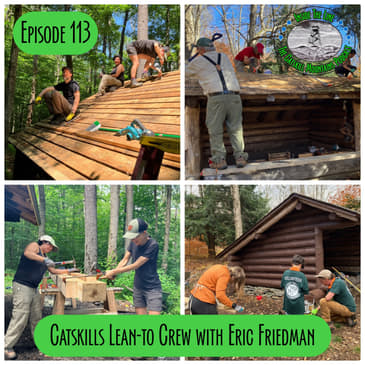
Welcome to episode 113 of Inside The Line: The Catskill Mountains Podcast! On this episode, I go live with Eric Friedman from the Catskills Lean-to Crew! Eric chats about lean-to restorations, and how you get involved! If you need a sticker, email me or go to Camp Catskill! Subscribe on any platform! Share! Donate! Do whatever you want! I'm just glad you're listening! And remember... VOLUNTEER!!!!!!
Links for the Podcast: https://linktr.ee/ISLCatskillsPodcast, Donate a coffee to support the show! https://www.buymeacoffee.com/ITLCatskills, Like to be a sponsor or monthly supporter of the show? Go here! - https://www.buymeacoffee.com/ITLCatskills/membership
Thanks to the sponsors of the show!
Outdoor chronicles photography - https://www.outdoorchroniclesphotography.com/, Trailbound Project - https://www.trailboundproject.com/, Camp Catskill - https://campcatskill.co/, Scenic Route Guiding - https://adventurewiththescenicroute.com/, Another Summit - https://www.guardianrevival.org/programs/another-summit
Links:
Catskill Lean-to Crew - https://www.newyork-newjerseytrailconference.org/trailcrew/catskills-leanto-crew-0, Clearwater Festival - https://www.clearwaterfestival.org/, Yosemite Stolen Car - https://www.businessinsider.com/yosemite-high-speed-chase-drive-off-cliff-indicted-2024-2?amp, Woman Completes ADT Solo - https://gearjunkie.com/endurance/briana-desanctis-first-woman-solo-thru-hike-adt, Hiker rescued on Mt Washington - https://www.wmur.com/article/rescue-hypothermia-rescue-dying-mount-washington/46841244?fbclid=IwAR1UedAktTiAqJa5tBvElJbJwcxuJJ2d8QRG5A5KU9CYYzFBdLi4R4wh7vQ
Volunteer Opportunities:
Trailhead stewards for 3500 Club - https://www.catskill3500club.com/adopt-a-trailhead?fbclid=IwAR31Mb5VkefBQglzgrfm-hGfooL49yYz3twuSAkr8rrKEnzg8ZSl97XbwUw, Catskills Trail Crew - https://www.nynjtc.org/trailcrew/catskills-trail-crew, NYNJTC Volunteering - https://www.nynjtc.org/catskills, Catskill Center - https://catskillcenter.org/, Catskill Mountain Club - https://catskillmountainclub.org/about-us/, Catskill Mountainkeeper - https://www.catskillmountainkeeper.org/,
Post Hike Brews and Bites - Brio’s - https://brios.net/
#leanto #leantorestoration #backpacking #visitcatskills #catskillstrails #catskillmountains #catskillspodcast #catskills #catskillpark #podcast #catskillshiker #volunteers #catskillmountainsnewyork #catskillmountainsnewyork #catskillspodcast #catskillshiker #catskillshiking #hiking #insidethelinecatskillmountainspodcast
[00:00:00] You know, it's amazing how productive people can be even if they don't have this skill. If there's someone there to guide them because they're motive in all these in every case, people are so motivated because they love the mountains. They're doing this to get something done and they're not there to just like hang out and slack, you know, slack. So it's amazing how productive people can be and how much joy they get from being productive.
[00:00:29] And with, you know, as long as I prepare properly by having the proper materials, having the proper tools, you know, it can go, we can get quite a bit done and, you know, and give people the information that they, you know, they need. Okay, this is what this is, you know, we're gonna put the shingles on but you got to pay attention to these things. You're gonna cut it with this knife but don't put your hand over there because that's when you're gonna get cut.
[00:00:57] Exactly. But also, you know, they could take some of these skills that you teach them and learn them or teach them and use them at home. Oh, for sure. Definitely. Exactly. So there's benefits, very many benefits.
[00:01:22] The bushwhacks were some of the worst days I've ever had in the mountains or life, really. I think the weather challenges on this incident were particularly difficult. It is really the development of New York State. Catskill's responsible.
[00:01:46] You're listening to Inside the Line, the Catskill Mountains Podcast. All right. So I got to crack open a Kovalon for this week. Sorry, Eric. I don't know if you drink. Do you drink at all? I do. I do. I got a IJ sitting right next to me. So I'm gonna crack it open in just a minute.
[00:02:15] We'll chat about that later. So good. I'm glad I'm glad you're you're you're cracking open one just like me. So here it goes. Oh, let's hear it. Got it. Nice. So welcome to Episode 113 of Inside the Line, the Catskill Mountain Podcast. Tonight I have Eric Friedman here and we're going to talk about lean to restoration and the lean to trail crew that they have, the lean to crew that they have for this restoration project with we have in the Catskills.
[00:02:44] Lean to are a very big project, a very big consideration in the Catskills because these lean to help out a bunch of people who want to have a good time backpacking in the backcountry. And Eric's here to talk about that. These lean to restoration projects are huge in the Catskills. So welcome to the show, Eric. It's nice to be here. Thanks, Nash. I can't wait to talk about this. Been waiting to get a hold of you for a while. So we actually got it going. So we're on the move. We're on the good the good way.
[00:03:14] So, yeah, indeed. So a lot of stuff has been going on the East Coast lately. Apparently, a hiker was rescued from Mount Washington in 90 mile per hour winds. The let's say, let's see on Saturday. Well, I mean, we're recording on Tuesday. So Saturday at 11 a.m., a 22 year old was hiking and fell off trail in a drainage ravine about 4,500 feet up.
[00:03:41] Now, I believe Mount Washington is 6,300 feet. So he was about like three quarters of the way up the mountain and became injured. He was above tree line. I'm an Amazon good Aminoosic ravine. And the weather was terrible. Negative temperatures, 90 mile per hour winds. And they said that the best way the rescuers could get up was a cog railway.
[00:04:07] This cog railway is a tourist area that brings them up to the top of Mount Washington, bring them back down. So the railway mounted a snowblower on the front and then brought crews up. It started at three in the afternoon and they got up there eight at night. It was cold 90 per hour winds. And it said the temperature was at nine negative nine degrees with a wind chill of negative 52 degrees.
[00:04:37] Unbelievable. They said that the fishing game said that if it weren't for the volunteer rescue teams on the cog railway and others, the hiker would have died. They got to him around 620, which is about three and a half hours, three hours after. And he was suffering from hypothermia and not injured, which is really weird. He was wearing numerous layers of frozen clothes and frozen hiking shoes. And it took more than three hours to warm him.
[00:05:04] Now, being with search and rescues, hypothermia is very difficult to deal with. You have to do so many different things to get the hiker, the person that is in this stage warmed up. You got to feed them with water, food, get them in a shelter away from the cold area. It's a very difficult task that takes a long time.
[00:05:31] And as they said, three hours brought down where he was treated for hypothermia. And after multiple recommendations, go to hospital. The hiker refused and was brought to his vehicle fishing game set. Now they are seeking to charge this person for their rescue and was definitely not prepared for the hike and saw other groups turn around. So that right there, you see other people turn around and they're probably well equipped. And they said, no way, we're not going to do this.
[00:06:00] And you just don't turn around. It's that summit fever once again that hits you, I'm guessing. I don't know what this is. He's 22 years old. I mean, at that age, Eric, I don't know if you felt invincible. I did too at that time. I wasn't hiking at that time, but I felt invincible. I guarantee this kid probably thought the same thing. Yeah. 22 years is 40 something years ago.
[00:06:27] So it's my memory is not that sharp on what I was doing back then. But I was, I've been in some, I haven't had to get rescued. Let's put it that way. I've been out in the mountains and cold, in cold weather by myself and up in the Catskills or up in the Adirondacks a bit. Yeah. I mean, when did you start hiking? If you don't mind.
[00:06:53] No, I grew up in the city and in the Bronx. So there was woods there and I used to play in the woods. We'd build tree houses. We explore the woods, explore the ponds, swim in these dirty ponds. And, you know, we'd get a chicken from the supermarket and cook it. And so I was always an outdoors person, even from just being a nine or 10 year old. Of course. Yeah.
[00:07:17] It's a, there's a time when you, you basically know to, to stop and to be like, this isn't safe for me and for other people that I got to turn around. And, you know, I've, I've done that several times. And, you know, I've, I've told people to do that several times and Mount Washington is a beast. And we all know this. I don't know why people don't understand that Mount Washington is the craziest mountain basically on, on mother earth. And people still don't, don't turn around with, with this crap.
[00:07:46] So amazing rescue jobs by the, by the volunteers and fishing game up in New Hampshire. Once again, we hear this every winter and every summer of, of just the, these events going on, on in, in New Hampshire. And I feel so sorry for these people have to deal with this all the time. They've been going nonstop. Um, was the hiker by himself? It was solo solo by himself.
[00:08:13] Uh, so several people turn around and, uh, just decided to keep on going at 4,500 feet. You're, you're getting just above tree line and to have an injury with, I don't even know. They didn't even say if he had traction or not. So I'm, I'm wondering if he was wearing traction. Mount Washington still has the, the white mountains, let alone. It still has a decent amount of snow. Uh, I saw my friends going up there, uh, doing Mount Washington and Monroe and stuff like that with still in snowshoes.
[00:08:42] So, and this person didn't say, they didn't say what, what this person had as, as a traction. So I'm, uh, we'll talk about this later, but I I'm, I'm wearing 100% traction from the start of my hike. So I got a hike that I did today. So we'll talk about that, but Hey, so, um, Eric, have you know that, that it's crazy. It's February 20th right now. We're recording and hikers are already starting the Appalachian trail. Did you, did you know about this? Um, I can imagine it.
[00:09:12] Um, I know they start in the spring at different times. My, my son started sometime, maybe he started in March. Um, and I know they see a lot. Some people see a lot of snow in, in, uh, Tennessee and the Smokies and further on. It sounds pretty rigorous. Yeah.
[00:09:30] You know, I didn't, I didn't know they started this early, but you know, with the change in climate and stuff like that, um, a lot of people are starting it early so they can finish, you know, Katahdin without that, that snow or maybe that freezing times of when they can finish in good weather and stuff and go to the whites in good weather. I mean, February 20th, that's really early, but I've been seeing people starting their hikes down in Georgia at this time. And it's just, it's crazy to think about that.
[00:09:58] They're already starting in late February, mid to late February. So good luck. Good luck for them. My wife and I plan on going down to the Shenandoahs in June to meet these through hikers. And we're going to give them some trail magic. We're going to give them some stuff. So, uh, if you're listening and you are doing the Appalachian trail, you listen to this podcast. Hopefully I'll meet you in the Shenandoahs and we'll have some trail magic for you, uh, within the four days, five days that we're going to be hiking in there.
[00:10:28] So give me a shout out. If you see me, uh, we'll be having, we're going to try to work out some costumes as well. So they know who we are. So I was thinking about going as Gandalf from Lord of the Rings. Do you think that's a good idea or do you think that'd be crazy? Uh, if, if that, if you'd like to do that, I'd say it's a good idea. I'm kind of a little more low fee. You know, I once, um, had a job, a volunteer job with the trail conference was, was, which was a corridor monitor.
[00:10:58] Which for the Appalachian trail where the, where the national park owns the property, they monitor the boundary of that property. And it turns out that the close, the Appalachian trail is in Dutchess County. And I was monitoring the one section. It was almost closest to my house. So I always thought that that would be a fun place to, uh, to do trail magic because you can drive right about where the trail is. And yet you're in the middle of the woods. It's a, but I haven't done it yet.
[00:11:25] I, I suggest you do what the, the, the look on people on, on the height through hiker spaces are absolutely phenomenal. We went down like two years ago and, and we, at first, the first two days we didn't do it, but we realized, you know, with the, some of the hikes are like, you know, two miles, we could give away stuff. Like I didn't need my M and M's. I didn't need my sour patch kids. And I was just like, you guys, and all of a sudden, like they would like, just have so much joy in them.
[00:11:52] And I'm just like looking at my wife and I'm like, why don't we just do this for the rest of the hike and give them like soda and beer and, and snacks and stuff like that. And sooner or later, these, these people were so much joy when, you know, I was just like, you want an IPA or you want a cola or you want, you know, some, some Skittles or something. They would like, it was just, it was just, I felt very, I don't know, just, I can't describe the word I felt.
[00:12:22] It was just appreciated. Yes. Yes. And just to see the joy on their face is just, is just phenomenal. And to help them out, you know, they're already, I don't know. I don't know how long the Shenandoah is, is into it, but I'm guessing it's, I think it's like five to 600 miles. The Shenandoah is what, so that's a long time. So speaking about through hikes, a little new thing that a woman hiker becomes the first to solo the 6,800 mile trail ADT.
[00:12:52] So the ADT is the American discovery trail. And that goes from, uh, believe from California all the way to Maine. So that's a, that's insane. So her, her name, uh, Brianna DeSantis. So maybe I'll try to get her on here.
[00:13:16] She reached the coast of California, moved her all her weathered all trail hiking shoes and wadded bare, waited barefoot into the cold water, the Pacific open ocean. And, uh, it was their end of her 6,800 mile journey that had taken the 40 year old ultra light hiker just over two years to complete 6,800 miles. Wow. That's two times the length of any through hike here in the United States, the CDT, the PCT and, uh, the Appalachian trail.
[00:13:45] So, uh, unbelievable, uh, accomplishment by, by this woman, Brianna, uh, killing it. And she looks so happy in her pictures. Uh, check out her, her Instagram or Facebook. Uh, she started, uh, Mount Katana on separate, uh, September 17th, 2022.
[00:14:07] And, uh, ended, uh, February 10th, 2024, uh, down in the Pacific ocean. Unbelievable, phenomenal stuff. So, uh, check out her stuff. Brianna DeSantis. Congratulations on, on completing that hike. Uh, unbelievable accomplishment. You know, I really didn't know about this until this, this hike. Did you? No, I never heard of that trail. What's it called again? The American discovery trail.
[00:14:37] So I think it travels more of the Northern part of the United States and goes from Maine down through Lake Michigan up through Montana and stuff like that. But I'm pretty sure right now it has a lot of, uh, road walking because it's not fully mapped out yet. Uh, but I, I'm, I know this links a bunch of long trails and stuff like that together. So pretty neat stuff. So crazy.
[00:15:05] Uh, last thing on, on, on the, the talk about the agenda is, uh, really odd incidents that I had to, uh, throw out here. So California man stole a Yosemite national park rangers vehicle and sparked a high speed chase before plummeting 200 feet off a cliff. Unbelievable.
[00:15:25] So, uh, let's see a federal grand jury and dictate a California man accused of stealing the Yosemite national parks ranger vehicle and leading high state speed chase. They said that Christian Colostro 28 had been charged of theft of personal property, unauthorized use of a motor vehicle and fleeing and eluding police officer. He faces up 13 years in prison and $510,000 in fine.
[00:15:52] So he, let's see, it says, uh, who pulled him over, uh, to remove a bike left in the roadway on December 26, 2022. And it prompted a high speed chase after he stole the police officer's car. He drove the wrong way on the bridge and collided with another vehicle. And, uh, while the other vehicle was disabled by the amount of damage caused, Colostro continued until he drove off a cliff, falling 200 feet to the bottom of the canyon.
[00:16:21] So that is absolutely insane. I, I, you know, I usually see some really crazy stuff on Instagram and Facebook about these people in, uh, national parks, but this, uh, kind of puts the icing on the cake there. What do you think about that, Eric? Um, no kind of crazy things happening. So, uh, it's bound to happen. Right. It, it, it doesn't surprise you. Right.
[00:16:48] Um, no, no, it doesn't surprise me. I mean, everything's different, but, uh, you know, there's always something crazy going on someplace. Exactly. Exactly. Didn't know about this stuff. So, uh, kudos to the, uh, the police officers for getting this man after 200 feet. That's a, that's a hell of a drop. Good Lord. Uh, surprise. He's still alive. Yep. Yep. So crazy stuff going on once again.
[00:17:17] All right. So thank you to the monthly supporters, Darren White, Vicki Ferrer, John Comiskey, Jim C, Michael Bongner, David Mead, Matt Smith, Denise Weiss, Joseph Hayda, and Beth Anderson. Thank you guys so much for supporting the show. Also, thank you to the amazing sponsors of the show. So is it time for some new gear hiking in Catskills? Say no more. Camp Catskill in Tannersville has all your hiking needs. Footwear socks, moisture-wicking shirts, freeze-dried meals, Catskill merchandise, and more. They have all the essentials for your hiking needs.
[00:17:47] Located in Tannersville and online, check out Camp Catskill if you want free stickers. So I went here today and I bought a winter hat and a micro or trail crampons. So this next week is going to be absolutely insane for hiking. And we're going to talk about that in a little bit. So check out Camp Catskill if you want trail crampons or micro spikes. They have it.
[00:18:10] Also check out another summit, a nonprofit program that leads outdoor adventures and activities for veterans and first responders for free. Activities like walking or hiking or even backpacking and paddling ship. Check out another summit.org for more information and dates on future events. If you're ready to hit the trails, make sure you take the scenic route. Our guides are here to help you with your goals big or small. Like Marcy or slide or low in the sewers.
[00:18:36] Check out scenic route guiding gear rentals on Instagram and Facebook for more information. Also, if you mentioned the podcast, you can get 10% off. Use the code MOUNTAINLION. So, uh, coffees, just, uh, buy me a coffee. Uh, well, it's actually buy me a hard cider. If you, you know, buy me a hard cider, it goes straight to the show or towards the donation that I might make towards the end of the year. Uh, this is, this show isn't free. So anyone who buys me a coffee, I really appreciate it.
[00:19:06] So, uh, Eric, what do you have in drink of the night, sir? Um, I'm having a Sierra Nevada hazy IPA. Nice. Nice. Is that a, is that a personal favorite? It is. It is. It's either that one or one of their other Sierra Nevadas. When we hike in on the, uh, on our link to work trips, if we're bringing a beer, it's gotta be a high percentage beer because you know, you gotta be efficient about that. Correct. Correct.
[00:19:31] You want something that's not gonna ease your mind off of what you're doing or the, the brutal hike that you did. Yeah. And I gotta relax at the end of the day. Exactly. So I'm glad that someone gets it besides me, you know, like when I get, when I get home from hike sometimes, you know, I gotta have a straight up liquor or something, take a shot for what I did or something like that.
[00:19:52] Uh, it's very rare, but it needs to ease the pain of what happened, uh, in the day, you know, being 41 years old, like, like, like I said, doesn't it, it kills you, but you love it. And so you love it tonight. I am having a Hudson North cherry vanilla cider. This is absolutely fantastic.
[00:20:13] It's, it's called the adventure series and, uh, it is 5% alcohol and, uh, not too much, not as much as your, your hazy IPA, but it is absolutely digital delicious. I saw this in our liquor store and I was just like, you know, Hudson North is somewhat local. I gotta try it. And it's absolutely delicious. I love ciders. I'm a, I'm a cider kind of guy. So Hudson North, I'm going to tag you in this.
[00:20:41] Hopefully you'll, you'll hear it or you'll, you'll get the tag and we'll, we'll talk later. So Eric, previous hikes, what have you done recently? Um, I've been hiking in my backyard, which is the Schwunga mountains. And, um, I can just, just from my backyard, I can hike five miles or 10 miles or, and just, there's lots of bushwhacking to be done. And, you know, craggy spots and valleys and marshes.
[00:21:10] It's, it's just an amazing area. So if I'm, if I'm home and I was working pretty hard up until recently and I've, I'm kicking, I'm in the kickback mode. So I'm getting some more hikes in. Nice. Yeah. And this past weekend I got out onto a high point as well. Nice. Uh, did they, uh, clear that viewpoint at the, at the top? I remember them saying that they were going to clear their viewpoint at the actual summit of there. Well, we didn't get that far. My son called me in the morning.
[00:21:39] He's he came with his wife and two, um, and two boys, five and seven. And the boys, it was a chilly day, but we warmed up as we hiked in, but we didn't get but a mile and a half in. And then we turned around, so we didn't get to the top. So I can't tell you. Nice. I mean, uh, still that, uh, canopy brook, uh, trail is absolutely phenomenal.
[00:22:02] That is a recommendation that I have for anybody and everybody to go on because it has just beautiful kind of like flat trails until you get going up to the, to the area of high point. But it has the, the running water of the canopy right next to you and, uh, an ape, whatever, uh, you know, what do you say canopy or can I don't know the right way, but I say can I, okay.
[00:22:30] You know, and I've heard it differently. Have you? Uh, not too much. I don't hear it too often. So no, I don't know. That's mostly what I hear. Okay. So, uh, can I, you know, there's, there's awesome areas up there. There's awesome historical areas up there as well.
[00:22:47] There's some decent amount of, uh, those massive Karens who we don't know if they're native American Karens or if they're, you know, the, the early settlers Karens that are up there to the, to the left when you walk on the trail. So if you're up there, take, I was checking those out. I, I've got a real interest in stone walls and early habitation. And I mean, and I saw those same kind of Karens where I used to live maybe, um, outside of New Paltz in the town of Esopus.
[00:23:17] And I always suspected that that was what a farmer would do if they didn't want to make, if it was, if there was a boulder and they just could pile the rocks on top of that and it was too far to bring it to a wall. You know, when they were trying to make some more pasture land. So there was a lot of amazing Karens there and stone walls. So I suspect that's what they are. That's my feeling. It's, it's a big, you know, we just talked about this in the last episode.
[00:23:46] It's a big topic, you know, the, the big massive Karens that it seems like they, a lot of people think they're native American, but you know, being there in that area where it was flatter and there was a little bit more soil, you know, you, you would think that was more of the farmer's doings of these, these Karens on, like he said,
[00:24:11] on top of these massive rocks that, you know, they had, they had a bunch of rocks and they just needed to throw them out of the way. You, you have to move them to a place of a higher ground to get them out of the way for your soil to be a little bit more thicker and richer. So, and it's, it's, it's tough to talk about this. Cause you know, there's some over on the West kill side, there's someone overlook. There is some over on pocket, you know, it's, it's a controversial topic. I mean, what are you going to say?
[00:24:41] It's just, there's so many different beliefs. And, you know, I, I gotta remember that one person I follow on Instagram and they put up some, so many interesting topics of, of the, the native Americans and the Karens and stuff like that, that, uh, give me one sec. I can look it up. I think it's like Northeast, uh, something.
[00:25:05] And it's, but it's, it's very, it's very interesting to see what they have because, you know, they talk about, uh, those serpentines, uh, uh, Karens that you see of all that I haven't seen them yet, but they talk about them, uh, that basically are shaped like snakes in, in the middle of nowhere that, that signalize maybe a burial ground or something. And it's, it's just like, like, it's, it's, it's a different topic.
[00:25:35] I've heard from the locals, you know, it's just a regular Karen that was, uh, put up there by a farmer back then. Or, you know, I've heard by different people that it's a native American sculpture, whatever, whatever. So good, glad at high points, amazing spot. I recommend anybody to go up there and check that spot out. Um, today got back here, you know, three, three, four hours ago from doing Indian head mountain, the whole loop.
[00:26:04] What a fantastic day to be outside, uh, beautiful temperatures. Trailhead was nine degrees up at the top was around 20 degrees. No wind, very little wind, beautiful views in every fricking direction. I just blown away by the blueness of the sky and the clearness. I could see everywhere. I could see into Vermont, uh, Mount Equinox all the way over there. I could see down to a bear mountain down there in the Hudson. I could see so far.
[00:26:34] I started off with micro spikes, uh, about three quarters of way up in Indian head. I switched to current trail crampons because the ice was getting a little nasty. And, uh, I gotta admit, you know, micro spikes, I was slipping a little bit. So the, the ice is getting a little, a little crazy up there. So I would, I would suggest after this week coming this coming weekend to bring trail crampons
[00:26:59] or if you have them, or I would suggest sharpening your micro spikes because it was a little dicey and, uh, did the whole loop, got every viewpoint in there. And, uh, I was just once again, blown away by, by what winter has to offer. Um, every viewpoint was absolutely phenomenal. Every just place was phenomenal. I only met like two people. It was as, is very, very nice.
[00:27:27] So it's just, it was secluded as heck. I flew down up and down the mountain, push myself to a little bit harder than I should. I guess I would say that, but beautiful day. The monorail was fantastic. No post holes just flew up the mountain. Uh, like I said, with micro spikes, three quarters of the way, switched trail crampons. And then I, I would say like about, uh, I would say going towards the loop or going towards the
[00:27:56] plaque clove area. I switched back to micro spikes because my trail crampons were a little bit grippy and I was tripping. So, uh, but once again, those, those dicey areas on devil path, you, you have to have something that'll grip or you're going to slip down that mountain and get injured.
[00:28:13] So, uh, I mean, Eric, you, you, you know, the whole differences in between your different traction devices, uh, right now is, is you don't need the snowshoes, but you definitely need the multiple devices of traction to get you up and down the mountain. If you're going to be doing the dicey stuff on the devil's path. I mean, yeah, I have, I, I always refer to them as crampons. Maybe we're referring to the same thing.
[00:28:39] Are you, are you like distinguishing between climbing crampons as opposed to trail? I mean, they've got like one inch spikes on them, right? Is that what you're talking about? So I have the, the micro spikes are, are, are pretty small, probably. Yeah. I'm familiar with those for sure. And then the, the trail crampons are a little bit bigger and sharper. Uh, I think they're, Oh, I got a like 12 point or something, something around that.
[00:29:07] They're not the big, huge 10 point ones that, uh, that you use with ice climbing. I I've only used them once in the cat skills, but I mean, these, like I was saying, I was, I was climbing up. Yeah. So hill sound trail crampons are more. Oh, those are, those are a little bit bigger. Jesus. So once again, God, the internet really kills you.
[00:29:33] One there's, there's, there's different types of trail crampons. So the ones I have are the hill sounds. Uh, they're called winter hiking spikes, but they're called trail crampons. They're not totally trail crampons like the big, huge ones. Uh, but yeah, I would, yeah, I was slipping on this ice and I, I didn't feel comfortable. I was seriously like the, these steep sections are gonna, you know, I'm not, I'm not going to have enough grip. So I, I switched to the current trail crampons instead of the micro spikes.
[00:30:04] And it was, uh, it was a good decision. I'm glad I went with that. So. It's good. You have it. It's good. You used them. Yeah. Yeah. Beautiful day on the mountain. Uh, I suggest anybody to get out there, but, uh, how much is, um, is not in the, in the woods there on the tops of the mountains or on the north sides. So if we're talking about the north sides, I w I went up from, uh, uh, what's it called?
[00:30:33] Uh, not Pico notch. Uh, the other notch. Damn. Uh, I'm once again, I'm sorry. I am so, uh, Jimmy Dolan notch. I went up from, uh, Roger road to Jimmy Dolan notch. And then I did the full loop of Indian head mountain on the north side. There's not much, there's about a foot. Once you get up a little bit higher, the wind picked up a little bit more. So in the, in the call, there was probably about a foot and a half.
[00:31:03] And if you went off trail, you would post hole. I went down into that viewpoint of Jimmy Dolan notch. And I did fall in probably a good in one of those actions areas down to my knees. When, uh, not many people went down to that little viewpoint. So I did fall up to my knees, but, uh, it was, it was pretty, I laughed really hard about it, but it was off trail. I was going off trail. So anywhere was solid, good, firm, packed monorail.
[00:31:33] It was absolutely fantastic. You could fly up that stuff. I love winter because of that, because there are no obstacles that you could roll your ankle on, you know, like roots or like jagged rocks. So this was nice pack. Thank you to everyone who has broken out these trails. They're absolutely phenomenal. I think, you know, after years of talking about snowshoes and such that they're actually, people are actually purchasing snowshoes and actually using them and finding out that they're
[00:32:01] actually fun to use. I mean, it was, it was such a long time that we would just sit there and just be like, wow, there's so many post holes. And then we have these awesome monorails going up the, the, these peaks that are just absolutely phenomenal, but no post hole in it all. Just a straight up ice going up there until, you know, I got to admit, there was a lot of different places that had different amounts of snow.
[00:32:29] You would see the places that had a little bit more sun had less snow. And then the darker places had a little bit of a little tiny bit of more snow, but I wouldn't say anything from eight to 12 inches of snow. If you went off trail, you wouldn't, you wouldn't post hole that much. So it's phenomenal. How about you? How much did you have when you went up there? Um, like I said, we didn't get that high, but it was about an inch at the bottom and maybe two inches.
[00:32:57] Well, as far as we got. Oh, wow. See the amazing difference in changes of weather that we have in different areas. Yeah. Yeah. Awesome. So, uh, once again, news volunteer, 3500 club Catskill trail crew, Catskill mountains club visitors center, uh, Catskill lean to crew. We're going to talk about tonight volunteer for them.
[00:33:23] Also, if you need stickers, check out camp Catskill or notify me, send me my email or Facebook messenger, Instagram, whatever. I'll get you a free sticker free of charge of anything. I'll mail it to you. So, uh, Eric, we're going to do a quick little session of Matt Catskill mountain history. Is that cool? That's great. Awesome. Awesome. So one of the things I've wondered about is always, uh, it's about the modern highways and automobiles that we had here in the Catskills.
[00:33:52] You got to wonder if these areas of like 23 and 28 and 23 a were always the kind of fast paths of everything. And I think they were. Um, so I looked up this, uh, my, my wife's mother got me this.
[00:34:10] My mother-in-law got me this book called history of Delaware County, New York, uh, by Tim and the 1900s spurred on by an event of automobile and the needs of rural postal delivery service.
[00:34:35] And 1904, the U S department of agriculture conducted the first census of roads in the United States, finding that some 93% of the nation's highways were nothing more than just dirt roads. The New York state government was also keen on improving the structure of the highway system at this time. And to this end, the Higbee Armstrong acts with the past a lot in a certain amount of financial assistance for road improvement to each county and town.
[00:35:02] And so in December of 1907, the Delaware County board of supervisors met to consider how in a portion of the county's 33.6 miles of allotted roadway assistant money resolutions were offered for road improvements for new construction and Walton Franklin, Bovina and elsewhere, and elsewhere also to the, the, the, the Southern parts of Delaware.
[00:35:26] One project received the green light from the supervisors with the improvement of the Del High Bloomville State road beginning Elk Creek road just north of the village of Del High and to the UND station of Bloomville. Now, once again, Now, once again, most of these places that have roads were once railroads that were previously played in the, in the 1900s by the Ulster and Delaware County railroad and by the Susquehanna railroad.
[00:35:52] Now, men and material included heavy steamroller began to arrive, uh, by rail in Bloomville by 1908 and work began grading crushing stone and digging by November 1909. The work had been completed and the travelers were able to enjoy a smoother ride along the almost six mile stretch of gravel roadway, six miles, only six miles of gravel roadway. That is insane.
[00:36:17] Most of the travelers along the route continued for several years to be conveyed by horse and carriage. Some, however, were already using new fangled, horseless carriage or automobile. During these early years of automotive ownership, it was wealthier members of society who would most likely see monitor in the Catskills or anywhere else for that matter. For example, members of the well, well off Gould, Fleischman and Cannon families were noted early automobile enthusiasts in the county.
[00:36:48] Walton doctor James A. Holly was another early owner of an automobile and the first in Walton. In 1901, he traveled to Detroit by all the Oldsmobile for $650 and it had been sent back in the East via railroad, $650. That sounds like the price of gases right nowadays going from here to Chicago. So Dr. Holly used his first old to make the house calls about the village traveling here and there on the improved gravel roads of the period.
[00:37:17] His car had a maximum speed of 15 miles per hour. Wow. 15 miles per hour. So infrequent a sight were automobiles in Delaware County at this time that Holly recalled horses and sometimes even people running off in fright as the approach of the noisy new convenience.
[00:37:36] Such a novelty was his old that in the summer of 1901 and again in 1902, he was paid the not inconsiderable sound amount, some of $25 to drive his car a couple of times around the track at the county fair.
[00:37:52] Another notable appearance of automobiles in the region occurred in October of 1903 when the route of that year's American endurance run from New York City to Buffalo and points further west passed through Delaware County. Through atrocious and wet conditions, some 26 of the starting number of 23 automobiles made it to Pine Hill and then to Delhi.
[00:38:17] The Delaware Republican newspaper wrote that of the race, it was more of a test of human flesh and blood against the raging elements of endurance during the disease. Unfair to both. The Delaware Republican newspaper was a test of human flesh and blood against the city. So basically this talks once again about automobiles being in the area during the 19 early 1900s and that was actually very rare.
[00:38:40] And now we see them, of course, everywhere, anywhere, basically stone or paved roads, almost all of the places we can think except in the backcountry roads. So amazing piece of Northwestern Catskill history. And just imagine that going from New York City up to probably about I remember Stanford was more of the Susquehanna Turnpike.
[00:39:07] And then going over towards Delhi was more of the Ulster Delaware County Railroad area. And it just shows you how far we have become, how far we've come in over 100 years of automobiles, planes and other different areas. And, you know, a lot of us can can relate to that with the once again, the Borscht Belt era when everybody came here in the 60s.
[00:39:33] And then all of a sudden they disappeared because planes became existent and more compatible to people instead of coming up to the Catskill. So crazy stuff, right? Yeah, I'm always amazed by the old wood roads and all roads, just how much effort has been put into them and how they've carved their way over time through all these places.
[00:40:01] And, you know, going up through Mink Hollow, that was a road at one point from one side to the other. Yeah, that was that was how they got from one valley to the next. Yep. And that's a that was an example I was going to use Mink Hollow. And then over on the the Balsam Lake area, there was was a Bear Spring Hollow, Bear Spring Road that once connected to the Beaverkill all the way over to Seeger.
[00:40:29] So a lot of these places were once old roads. And then a lot of people don't know that when they're just hiking these peaks, you know, you're going from Spruceton over to 214. 214. That was once an old railroad slash road for the Fenwick Lumber Company. And you don't you don't realize that, you know, a lot of people don't travel on Mink Hollow that often.
[00:40:53] And that was once a road that connected, like you said, once valley to the other 214 wasn't a road. 214 was a railroad that was the Delaware also kind of railroad that brought all that lumber and all that material up from Phoenicia. All the way up to Hunter. So seeing those historical pictures of when those railroads, those trains were going up through there was absolutely insane.
[00:41:22] I'm from the Bronx, but my wife, Judy, she's from from Hunter. So and her family, her family name on her was the Beckers and the Hoyts. So her father grew up in Becker Hollow and with it, along with his five brothers and sisters and her great grandfather. No, her grandfather was actually a crossing guard for the railroad in the notch.
[00:41:52] That was his job. And the foundation of that house is still there. We just looked at it a few years back. We I had never known where it was, but it's a it's actually very close to the the parking area by the lake. And I guess that's what it was is the road cross the railroad right there. And there was actually a crossing guard. Wow. You know, make sure your traffic was stopped. Unbelievable.
[00:42:20] How did it feel for her to see that old foundation of her family generations? Well, she loves the mountains and she feels, you know, the connection of her pretty deeply, because I say, you know, there's the Becker Hollow Trail where that farm was in there. And that was her family, her father's. Well, that's actually her grandmother's family name, but that's where her father grew up.
[00:42:45] And then White Hollow is on the on the willow side of Mount Tremper. And that's her father and grandfather owned land up in there and adjacent to the state land now. So it's I always imagine that when the why would it be called Hoyt Hollow?
[00:43:03] There's other Hoyts that were in the area, but it's possible when when I always imagine that when the USGS was mapping going through there, maybe in the 20s and mapping that they bumped into some local guys. And they said, George, George and Hiram. And so we're going to name this little know nothing creek. And we're going to make it Hoyt Hollow. I mean, that's awesome.
[00:43:30] That's a that's a great story to have for the family. Right. Mm hmm. Unbelievable. So it's crazy to see how this this area is connected, how small of this area is. Like you said, with your your wife being Becker Hollow being named in Hoyt Hollow, that's that's two big names, especially Becker Hollow is an awesome route up of going up to Hunter. So that's huge. Awesome. Crazy. These railroads have connections with everything. It's crazy. Yeah.
[00:44:00] Awesome. So thank you, Eric, for the for listening to me blabble about cats come out in history. Really appreciate it. And for throwing in your history as well. That's that's amazing. So last set of sponsors. So have you ever wanted to learn more about hiking or backpacking or even just brush up on some of your old skills in the backcountry? Check out Trail Bomb Project, a hiking and backpacking school.
[00:44:22] Scott and Joe from the New Jersey Search and Rescue team have amazing backgrounds in Wilderness First Aid, Wilderness First Responder and the Mountain Rescue Association. And they are here for you to learn all the new skills of hiking and backpacking. They teach anything from map and compass first aid and many other skills that could help you on others while on the trail. Check them out on their website and all social media platforms. Also check out Outdoor Chronicles Photography.
[00:44:48] Molly from Outdoor Chronicles Photography specializes in adventure eloping and adventure couple photography in the Catskills, Adirondack and White Mountains. She's an officiant for getting married and a licensed guide, but she is also a story maker. Molly won't just give you photos, she'll give me memories that will last forever. Don't hesitate to get a hold of Molly on all platforms. So let's finally get on to the guest of the night. Let's go! We've had a good chat so far, so Eric, let's keep it going.
[00:45:16] So I have Eric Friedman, a New York, New Jersey Trail Conference volunteer and leader of the Catskill Lean 2 Crew restoration, correct? Yes. My, that's a mouthful. You guys made that a mouthful. Catskill Lean 2 Crew. All right. Yeah. Yeah.
[00:45:37] Cause yeah, cause the trail conference is present all throughout, well, throughout a lot of New Jersey and New York and down into Harriman and the east and west of the Hudson. So we really, we're, we're focusing on the Catskill. So we're the Catskill Lean 2 Crew. Catskill Lean 2 Crew. I love it. Um, so Eric, trail crew, similar. Yeah. So you guys are specializing in the, in the truck or the, the lean twos.
[00:46:03] So why don't you give a little background about yourself, Eric, and, uh, we'll start the conversation. Okay. Like I said earlier, I, I, ever since I was young, I liked the, you know, playing outdoors and, you know, imagining myself, um, you know, being in the woods. So, um, and then I was a Boy Scout in New York City and we would go camping once a month with our troop.
[00:46:29] And when I got a little older, I could go with my, um, a friend and I started going to Harriman by ourselves. And, uh, kind of, I left the Boy Scouts behind cause I was, I was mostly in it for the camping. And that's since I could do it by myself, I did that. And when I was 16, we, uh, three friends and I traveled out to the Canadian Rockies to go backpacking.
[00:46:51] And, um, we, we all started off hitchhiking and, uh, in pairs to, um, we said, we'll meet, we'll meet up in Montreal. And here's a funny story. So we're, you know, I'm 16 years old. I'm hitchhiking across the border. And what do we, how do we get across the border? Well, you get a note from your mom. And I actually had a note from my mom. Yes. My son, Eric, and I give him permission to go.
[00:47:16] And, um, and sure enough, we got across and, um, you know, and, and continued on. My friends ended up taking the train and I continued, uh, hitchhiking and hopping freight. And I met him out there. So, uh, and just recently I met another friend about a little younger than me and he did the same thing. He had a note from his mom in the same era. He knew it was about 15 or 16, but it's just the foot things have changed. Yeah.
[00:47:46] Dramatically lean, uh, the, you know, the, uh, the hitchhiking is not really permitted. Now you'll get a like ticketed for that. But, uh, back then it was a huge thing. Like you could do it all the time. Yeah, you can do it all the time. You know, it was kind of, um, you get in trouble sometimes, but nothing too serious. Yeah. We would, we would leave the city, get on the highways and they would drop us off. We'd go to Harriman.
[00:48:15] They would drop us off just on the side of the highway. Okay. Just drop us off right here, right on the shoulder. And then, you know, we'd hike for a few days, camp out. We'd come back out onto the shoulder of the highway and hope that we would get a ride before a cop came. And it always worked out. See, I love hearing these stories about this. Like, like just like before a cop came, that was a bent.
[00:48:38] Like it's, it's just so good to hear about these experiences in the outdoors that were kind of like unlimited and free. You know what? I mean, it's a whole different era. We, we have, you know, cell phones and stuff like that, where we can contact people to pick us up.
[00:48:58] It wasn't like the other day, like the back of the days where, like you said, hitchhiking, a stranger picked you up and you kind of trusted that you were just like, yeah, whatever. This person is willing to take me. Well, I trust them nowadays. It's like, I really don't want to hitchhike. Let me call somebody else or let me pay for an Uber or something like that. You know, it's crazy. The, the, the times we have been through and like, like you, you know, we, we grow up outdoors.
[00:49:27] We, we were thrown out into the outdoors by our parents. I mean, I don't know if you were, but I was, I was just like, you know, go skirt off until it gets sunned down and then, and then you can maybe come back for dinner if you want. You know, I mean that, that, that, that's basically how it was, right? Uh, yeah. Yep. That's it. Yep. Exploring, you know, making trouble and not making too much trouble. Yeah. And, but you can find your way home. That's, that's the thing that it was.
[00:49:55] So, um, what got you, you hiking into the, the Catskill area? Well, I think I was going skiing at Hunter mountain as like a teenager. And, um, uh, I'm Jewish, but not religious. So instead of a bar mitzvah, I had a ski mitzvah. And my, my family, my father wants to do something a little special. So he took my friend Robbie and me and we, uh, we went up to Hunter for the weekend. And, uh, that was a big thing. Two days of skiing.
[00:50:25] So, um, but then the next summer, I think Robbie and I, we, we had the idea. We're going to go back up to the Catskills and go camping and hiking. And I think, uh, we hiked plateau mountain is what I remember. I remember it was summertime and I remember seeing ice up there, even in the summer. And some of the crevices. Wow. That was my first 3,500. Was that when the, the lean to was up there? There. No, I didn't. I didn't.
[00:50:54] I'm not aware of a lean to being on plateau then. No. Was there one? There was. Oh, I didn't know that. Yeah. Uh, I'm not sure where it was. Uh, I know Lori Rankin was telling me that there was a lean to up there, but there's no trace of it. Uh, nowadays I camped out in the lean to on top of slide when I was a teenager with some friends. Oh, wow. So I think there was two lean to is if I remember correct, but I know there was at least one.
[00:51:21] And now you can't even tell that there was a lean to up there. No, the grass grows. Yeah. How, uh, how far was that up? Uh, slide mountain. Wow. Unbelievable. Mm hmm. Just imagine the chaos that would happen up there now if there was a lean to. Wow. So the, so you were involved in the, in the outdoors as a young kid and then as a teenager.
[00:51:47] So this kept developing, uh, later into, into your life. So what, uh, got you in with the New Jersey trail conference, New York, New Jersey trail conference? Well, I was at the Clearwater festival. I don't know if you know what that is. It's, um, was started by, it was, it was an organization started primarily by Pete Seeger to help clean up the Hudson River.
[00:52:11] And there was an environmental music festival that would happen for about, oh, maybe 40 years. It just stopped a few years ago, but the trail conference was tabling there. And, and my, my kids were getting older and I was beginning to have more time to myself and, um, my two sons. And, um, so it caught my interest and I think they might've done a presentation right in New Paltz near my house.
[00:52:37] And I learned about, um, and then they gave a workshop for, if you want to be a trail maintainer at North Lake, South Lake. And, and that, and then from there I became a trail maintainer. And then soon after that, I became a shelter caretaker. And so that was about 12, 15 years ago in that neighborhood time.
[00:52:59] And, um, you know, we did a, for trail maintaining, I think we did, there was like a, they went through a lot of the, uh, requirements or the regulations and did some practice, you know, some practice clearing, some examples of what to do. And, and then after that, I was set loose on, um, I do, I did, I've been doing a one mile section from the main call of lean to, um, up to the view on plateau, the east facing blue view that faces Sugarloaf. Nice.
[00:53:28] And actually, and I get from plateau. I can see the Hudson river down by a soap is places that I say, I say on the Hudson. And when I'm on, when I'm on the river, I can see the cats goes when I'm in the cats, cause I can see the river. So it's like a real connected for me. Nice. So, I mean, you've been connected with this place for a very long time. Yeah. And volunteering, of course brings you a certain amount.
[00:53:58] And so joy because you stuck with it for this long. Yeah, absolutely. I mean, yeah. Yeah. But, you know, being able to, um, to be a part of the effort that, you know, that makes it, uh, accessible for people is just a great feeling. And it's, uh, you know, it makes just, it's a real good connection, strong connection. And I'm a carpenter. So it's natural that, um, that I can take the lean to work to the next level.
[00:54:27] Cause I know how to put, you know, to repair things and build things. So, you know, I started me. I've been a, uh, lean to caretaker. There's the trail conference. Um, I don't know about lean tos in other places if they're, if they, uh, care take for them, but in the Catskills, but they maintain 27 out of the 30 lean tos in the park in the Catskill park.
[00:54:56] There's ones outside the park that I'm not aware of going north on the, uh, on the long path. Wow. That I'm not, I don't think the trail conference maintain. So there's, there's caretakers for every one of those lean tos and there's supervisors who, who those caretakers can check in with as needed. And I'm, I was, I've been one of those for about 12 years or 15 years. And, uh, about three years ago, I said, you know, that outhouse needed to be replaced since I came here.
[00:55:26] And it's, you know, by then the tarp was on the roof for two years just to keep the out, rotting away. And I approached the, um, trail conference and they said, you know, they were aware that I was a bit a carpenter. And they said, yeah, we were thinking the same thing when I spoke to my supervisor and he was speaking to his, the program coordinator. So, um, it was kind of a, a natural progression.
[00:55:47] And that's, um, we place rebuilding that, uh, outhouse, uh, on Mount Tremper was our first project. Oh, wow. That's a, that's a crazy task too. Yeah. We, um, no, I took the initiative and, uh, but they supported me. The trail conference really is about supporting their volunteers.
[00:56:13] It's, you know, if you're working towards their, their, their mission, they're really about supporting the volunteers. And, uh, and it's really, um, evident. And, um, you know, so they, you know, the whole communications of reaching, they have a network of volunteers who want to volunteer, but not an intermittently. And those are the people we reach out to.
[00:56:35] Um, and then anybody else who hears about it in any other way, but, uh, it was an amazing feeling to, to, uh, you know, take this old nasty lean-to that was rotting away and reuse some of the wood and bring in other wood. And with the help of about 10 people, we ended up with a beautiful lean-to, uh, outhouse that, uh, you know, people could enjoy for, for years. So you said 27 lean-to's is how many you guys take care of? Correct.
[00:57:02] Uh, the, that's how many caretakers are. There's that many caretakers for that many lean-to's. Yes. And the crew themselves, we've been tackling bigger projects. Okay. Uh, it's not part of the routine maintenance. And, you know, we're just, since we're into it by three years now, you know, we've worked on about, about eight lean-to's, maybe eight or nine, give or take. Wow. In three years? Yes.
[00:57:28] That is, that is insane because, you know, the, the, the time and the effort that goes into these restorations are, are absolutely crazy, are phenomenal. And, and it, and it benefits everybody. So, well, being in your, your, your carpenter business, is that where you got to, uh, in, got you into restoring lean-to's? Um, it definitely provided me with the, uh, you know, the know-how and the skills to do it.
[00:57:55] And, and I've been in, um, you know, you interact with, you know, your peers or your, um, or your employees at times. And, uh, when I've had them and, you know, so, you know, I've always enjoyed bringing people who had less skills, um, giving them the knowledge to, you know, do more. Because it's, you know, well, you'd be, that's the way you're productive on a job. And so it's, um, you know, it's an, it's, um, enjoyable to teach people. Yeah.
[00:58:24] It's enjoyable for them to do something that they've never done before. And you see the physical results, you know, right in front of you. And here, it's something that we all share is the outdoors and, uh, you know, in the lean-to crew. So it's really like, it's a lot of joy that we, we all get and a lot of satisfaction. You know, you know, working together, but you really like, you know, keep it positive and have fun. And, um, you know, to date, no one's, no one's gotten hurt. Great too.
[00:58:53] Well, I mean, to be honest, bringing somebody some new skills and then having them, uh, adapt to those new skills and then completing those new skills brings them a whole bunch of joy. Mm-hmm . And, uh, it's just amazing to see, like, uh, to, to see something that someone didn't know, but then they can complete that that day. We'll bring them so much joy and then bring them back for even more.
[00:59:22] They'll be like, Ooh, when is the next time you guys are doing this? Or, you know, like, what else can I do? Uh, beyond that. So restoring the lean to is, is, is absolutely fantastic. I, I'm so sad that I haven't been involved in this yet. I, I, I will admit it. I have not been involved in this yet, but I look, I'm, I'm looking to get an, an, into involved. So when you do, I hope you have fun. Oh, I will. I will. Volunteering just brings so much joy to me.
[00:59:51] I don't know why. I mean, I think it's just, you know, paving that path for somebody else to enjoy it as much as I do, uh, makes it, makes it absolutely phenomenal. So it's just one of those things that volunteering just brings you so much joy. So when I, I know a lot of people don't like to talk about this. So what difficulties do you face when, uh, you doing these restoration of the lean twos?
[01:00:20] Well, I'll just, I'll tell you the kinds of work we've done on them. Just, uh, we've, we, we paired the floors. And so we, you'll have a floor that's all rotten out. It might have holes in it. Porcupines have eaten it. And, um, we, the first floor that we, we did, we pull up all the boards, turned them over and the back, the backside was much, much better. And we brought in a handful of boards.
[01:00:49] Well, you know, we didn't have to replace all the boards just by turning them over and repositioning them. And so that saved us a lot of effort. We've also re-roofed, um, a handful of lean twos. So we'll strip down the shingles. Um, if it's wood, we tend to burn the shingles, the old rotten wood shingles. We'll burn them there. If it's, uh, we tore off an asphalt roof and, um, we actually brought the shingles down the next winter, um, on sleds, sleds and backpack.
[01:01:19] Wow. That was, uh, someone's idea. So we got those shingles out of there. That's why, that's one of the reasons the DEC doesn't want to, I think, use asphalt. Cause they're concerned about them staying in the woods. We've done structural repairs where the replace major beams or, you know, we, we've stripped down one lean to down to the, uh, had almost all the beams and rafters off.
[01:01:42] Usually we'll just replace a couple of boards on a roof or half partially, but we had to go further and, uh, put new, new rafters on or new beams. And, uh, we will also do drainage work around it because lots of the backsides, the lean to's are often up against the hillside. Yeah. And as the leaves accumulate and moisture gets in there, that will promote, uh, rot.
[01:02:05] So by directing the water away, that, um, gives it more life. We will stain the lean to will. We've worked on new lean to's that needed to be finished. When the DEC has installed new lean to's there's still work to do. And, um, we've come behind them and we've put the oakum in the cracks and put saplings over the oakum. Oh, oakum. Um, which is like a fibrous material.
[01:02:33] Looks like an, um, like rope, but that's to keep the wind from blowing through. Well, we've done a number of stone patios. That's what, that's what, there's no better word for it, but that keeps you out of the mud when you're in that lean to and it's shit and you step out and you can step onto a nice hard stone rather than a wet puddle. You, you really life is, life is looking up as opposed to, as my friend used to say, we're, we're suffering in comfort.
[01:02:57] You gotta be, uh, you know, so, um, plus that leaves, that leaves the moisture out of the lean to. Yeah. Um, right. Yeah. You want to direct the water away, but also a nice, we'll make it a little higher than the surroundings and it'll be a nice hard surface. Um, we've improved springs where the spring maybe might be seasonal. We've tried to, you know, set the pipe in so that will last all summer through the dry season.
[01:03:26] And, uh, so that's a, it's a variety of things and. Variety of difficulties. So like, uh, so we're talking about the, the lean to. So what was your most difficult, uh, project that you've done yet so far? Probably the most, uh, well, we've had a hiking and it can be difficult. Sometimes we've, uh, we hiked up to the lean to on plateau. No, on table. And that was a good. That's it.
[01:03:56] Yeah. We were carrying supplies and lots of tools up in there. And that was, that in itself was, was a chore. But once we were up there, we had some beautiful weather and it was just amazing. We, um, I was finishing off a new lean to and, uh, rebuilding the privy. And what, what was the, what I discovered, which wasn't apparent at first was that rather than just go to do one project on a lean to. Once you get there, you say, Oh, well, you know, it's not just that we need to stay in it.
[01:04:25] Oh, the outhouse needs to get re rebuilt. Oh, that's great work. So we ended up coming back for two to three weekends. Um, usually it's a long weekend, you know, might be Friday to Monday or Thursday, starting on a Thursday. Some people come in for the day. Some people come, you know, might stay for a day or two or three. So we're, we're, you know, cooking food together and eating and spending the evenings together. And, uh, so that was, that was hard from that point of view.
[01:04:55] Uh, so you guys, some of the, some of the times you said, you always stay overnight at the lean to. Oh, we always stay overnight. Oh, wow. I mean, whoever wants to can, I always do. Cause I love to be out in the woods. I love cooking over the fire and it's just, uh, but if the, there is an advantage to people not staying over too, because they don't have the burden of carrying in their, their, their camping gear. And sometimes, sometimes someone will come, go out and come back the next day and say, Hey, please, you know, bring these batteries back charged.
[01:05:24] Cause we'll be, or we need to do a beer run or whatever. Right. You know, do something, you know, I've got something that might, you know, go, go to my truck and you're going to, you know, grab something from the toolbox, you know, or bring that up that we might need. So people are coming in and out and it's a, it's a, it's a, it's a corn. It's a challenging corn coordinating. Sometimes it's fun. Sometimes you have cell service. Sometimes you have no cell service. That's interesting too. Exactly.
[01:05:52] Cause then you can connect with somebody else that might need you. You guys might need something on the run. Absolutely. So you, you were talking about, uh, you know, I know, I know I didn't add this on the questions, but you were talking about, uh, the restoration of the lean to up on, I think it's called the Boughton Memorial lean to. Right. That's the, that's what I was just talking about. The Boughton is on, um, table on table. Yeah.
[01:06:19] And that was a new lean to and brand new, right? It was, it was about a year old when we got there. Oh, wow. Um, so the cracks again needed to get filled between the logs. Saplings needed to be applied to hold the, uh, the, uh, oakum in. It turned out that the, the, uh, privy was in terrible shape, but they had left some boards there maybe with that in mind.
[01:06:44] So we were able to be actually, it was really high up there because it was brought in and it was brought in by a helicopter that those materials. So those extra materials that were left behind were really helpful with that. Wow. And we ended up staying, Lord is, you know, Boughton is actually maintained by the 3500 club. Nice. And so Lourdes was there, um, from the 3500 club and, uh, she brought other folks from the club too. So that was a nice, a lot of times the caretakers don't get involved.
[01:07:14] They're not able to, they don't choose to, and that's okay. They, they're signed, they've signed up for one thing. We're, we've, we're signed up for something else, you know? So we each choose our own experience that we want. So sometimes working together, like really like kicks ass. I hate to say it like this, but it kicks ass, you know, two groups working together, three groups working together is really beneficial to the Catskills. And, uh, it shows with that lean-to because you know, we had 3500 club, you guys.
[01:07:43] And, uh, uh, who made, who made that lean-to? That was, uh, I can't remember. I was with the, the Bruderhof. Bruderhof. Yes. The Bruderhof community at the, at the high school down at, they call the school, the Mount, I believe, down in Esopus. So yeah. I think they're. Unbelievable work by everyone. So now my big question, uh, of course, is, uh, the Thunderboxes.
[01:08:11] That, that, that's gotta be, that's gotta be some, uh, difficulty on another level when you guys recreate this. Can you chat about that? Um, we, we only worked on one Thunderbox and that was at Biscuit Brook. Um, and it was kind of an, in, I, and what I usually do before we, we go as a crew, um, I'll go out and survey a project. And this way I'll see what's involved. Let's see what materials we need to bring in, what tools we need to bring in.
[01:08:39] So I, I think when I went out there, you know, is I had, I don't think I'd ever been out to Biscuit Brook before the lean-to, which is on a stream there. It's very nice. Beautiful. And I, I thought that'd be a great place to go in the summertime to be, you know, see if you're cool off. Yep. And, um, I think I dug, I dug the hole that when I was there just to check things out and I kind of made a materials list. And we came in with about four, four or five of us came in just before winter, a couple of years back.
[01:09:08] And, um, we rebuilt the, the, uh, Thunderbox, you know, it's kind of gets, it gets a little nasty, but we, we put a mid-of-fire and, uh, you know, cause you're working with an old, uh, you know. And it was shitter. So, uh, and so we either use gloves or we made, you know, had hot water and soap and we'd clean up afterwards. We had the stream there. So that was the first thing we did was make a fire. We had clean water to clean up, clean ourselves. And, um, you know, we set it, we did, you know, we rebuilt it and set it on the new hole.
[01:09:38] And that, there was no, I don't, I'm not, I don't see the great, I mean, if it was up to me, I like the privies better. I'm not sure why, you know, you get a little protection from the weather. Yep. Yep. So, yeah. So you, you've, you've redone privies as well. Uh, is, is that insanely difficult? Like I, I, I can't picture doing that. Well, we've, we've had existing privies, let's say up to two privies or three we've rebuilt at least. Wow.
[01:10:08] Up at Baldwin on Tremper, which was our first project. And then, uh, up at Devil's Acre, we, you know, I knew the floor needed to get rebuilt and I brought a hook and eye for the privy. And I figured that's all the privy needed, but you know, and on further inspection, we just, I took, we tore the, we tore the privy right apart, you know, separated out and figured out what we could reuse, you know, dug another hole, came back with more materials. And that's like a 2000 foot climb.
[01:10:37] That was a, you know, that was a challenging climb again, getting up there with me. And we, um, you know, it's got a great, you know, nice, solid, clean, pretty right now. Hopefully it's clean, but it's definitely in good shape. Not rotting. Yeah. Those, those privies are very important. I gotta admit, uh, not just to me, but of course people staying at the lean twos. I, I, I value privies and, uh, uh, thunder boxes.
[01:11:06] And I, as, as more than anybody at whatever thing, trust me, I love the thunder boxes. They're the best that, you know, they got the one over in the Batavia kill and the biscuit brook. I gotta admit is one of the greatest lean twos ever. So you like that? Uh, just the sound of the running water is kind of like a, uh, just that noise that I could, I, it makes me pass out. It's just phenomenal. Uh, unbelievable. So you guys do so much for the cat skill.
[01:11:35] So, uh, does this stuff, does this being in the cat skill lean to crew require any trading? No, not at all. I mean, we try and, uh, I try and keep the communications informative so that he, these things you need to bring, these are the things you need to pay attention to. And, you know, we're, we're going to be hiking in and you've got to keep, you know, there's things to carry. Yeah. Uh, you know, it's amazing how productive people can be, even if they don't have this skill.
[01:12:05] If there's someone there to guide them because they're motive in all these, in every case, people are so motivated. Because they, they love the mountains. They're doing this to get something done. And they're, they're not there to just like hang out and slack, you know, slack. So it's amazing how productive people can be and how much joy they get from being productive.
[01:12:28] And with, um, you know, I'm, as long as I prepare properly by having the proper materials, having the proper tools, you know, it can go, we can get quite a bit done and, you know, and, and give people the information that they, uh, you know, they need. Okay. But don't put your hand over there because that's when you're going to get cut. So. Exactly.
[01:12:57] But also, you know, they could take some of these skills that you teach them and, and learn them or teach them at, and use them at home. Oh, for sure. Definitely. Exactly. So there's benefits, very many benefits. You know, you're, you're not a one, just volunteering and, and making the Catskills a better place, but you're also learning new skills that you might not know. Absolutely. Yeah. Yeah.
[01:13:22] Those are, uh, outhouses that we've rebuilt, but last summer, based on the products that we had coming up, I knew that we'd be able to drive into a few, uh, a few of them. And, um, we had a privy, uh, an outhouse prefabrication event at my house. So people came on maybe on Friday, Friday to Monday. Um, people came for the day or people camped out of my yard even, and we built four outhouses.
[01:13:50] So by the end of the weekend, we had four outhouses built in all prefabricated in sections, all stained and stacked under a roof and ready to be installed. Wow. And we were just, you know, an organized, you know, production facility making outhouses and it worked out really great. And they're all installed all four of them last year. Wow. Unbelievable. It's amazing. The connections that you, you get, uh, with these volunteering efforts is just absolutely phenomenal.
[01:14:20] It just, it, it, it, it. Look at the, look at the smile on my face. Like it's just, it's just absolutely phenomenal. I volunteering is so beneficial for you. You're not just the trails, the cat skills, uh, but life and your life in general too, as, as well. It's just, it goes, it goes a long way. And once again, you said this doesn't require any training. So anybody and anybody can join this crew for a day or two or three.
[01:14:49] If you guys, if you guys do that. So it's that's, that's great. Um, so where can we find out about future events for the Catskill Trail Crew, lean to trails crew? The, on the, uh, New York, New Jersey trail conference website. If you go to the place that says get involved, it will say volunteer and it will say, you can, it lists the various crews. And one of them is the lean to crew.
[01:15:14] That's probably the, yeah, that's probably the best way to find out about it. Or if you call the trail conference or contact the trail conference and you say, Hey, I'd like to be involved with this. They'll definitely won't. They will not lose your name. They will keep track of it. And they will, you know, say contact Eric. There's what the trail conference has is there's a lot of different volunteer opportunities, like many, many. And one, one opportunities they call it the roving trail crew.
[01:15:43] And these are people who they'd like to do something, but they don't want to commit to a regular jobs. And they'll get an email, um, on occasions that will say, Hey, this, um, you know, they're working on a trail in Harriman State Park or now, uh, or their work, you know, the lean to crew is going out to work on, um, a trout pond, you know, and you'll be able to learn more about it. You'll be able to contact someone to learn more about it and you'll be able to sign up for it.
[01:16:08] And so people saw, um, I always leave my telephone number and my email is part of the communication. So people can contact me. And I, you know, just try and make myself, I just want, uh, I don't want to impede any volunteers. I want to make it as accessible as possible. Cause you know, it's all about, I can't do about myself, but I can definitely lead the crew. You know, it's what I'm doing. So I, you know, those were definitely, uh, need everybody's, everybody's help. Yeah.
[01:16:36] Anybody and everybody can, uh, can join for this. So awesome. So one last question, Eric, uh, post-hike bruising bites. Where do you suggest to, to eat after doing a lean to restoration or hiking in the Catskills? All right. Well, I got to tell you about one more project if that's okay. Okay. Go right ahead. Oh, well, so a couple of years ago we worked, we did a roof and it was the hottest time of the summer. It was up on Mount Trevor. It was 95 degrees.
[01:17:03] And then over the course of four days, we took, took the roof right down to rafters and beams and put the boards back up, stained them and roofed it. And, but it was brutally hot. So the next year they said, well, we need work done at trout pond. So I went out to trout pond, you know, looked it over and it was two lean twos. And they needed two outhouses, two roofs, structural work, drainage work. And, but it was on a lake.
[01:17:29] And, um, there was a road into it because it's part of a dis and access plan. Uh, it's an accessibility program for people with abilities, disabilities. Yeah. So if you have the right credentials, you can drive right to this lean to. So I said, well, if I can drive to this lean to, and the other one was just a little ways further, we can, um, you know, we can get all this work done. So I had to jump through a bunch of hoops and the DEC was, uh, you know, finally it
[01:17:57] all worked out, but, uh, we spent, uh, 11 days, uh, working on the two lean twos, swimming in the pond in, in trout pond. And it was just an amazing, it was just beautiful. So we had, we, we beat the summer heat on this one. And then we had to go back a second time for about four or five days, but it was just a, it's, it was a beautiful place. There was a beautiful spring running into the lake. We got to drink that water.
[01:18:22] And it was just, uh, I call it like lean to camp because it was like, you know, a wonderful time in the summer, you know, working together and getting things done and people coming and going, you know, all different people over the course of the, of course, the, of course, 11 days. Right. And, and seeing those random people might get them interested in doing this as well. So unbelievable. And, uh, it sounds like that, that was a fantastic time. 11 days. Wow. That's, that's awesome. And then it sounds magical.
[01:18:52] It was, it was, um, so, Oh, post hype, bruising bites. Um, well, when I'm heading up 28, yeah, I like to stop at bread alone sometimes and grab anything that's baked. It all tastes yummy. And not too long ago, I, I left the hike and I ended up at a Brio's in Phoenicia. And that was just so, so delicious.
[01:19:21] That's my favorite. Brio's is a, it's a magical place of the cats. So yeah. Awesome. So thank you, uh, Eric, once again for joining me tonight. Uh, I like to thank a big thank you to the monthly supporters and sponsors really appreciate you guys, uh, supporting the show. Thank you to everybody who has donated so far. I really appreciate it. And, uh, thank you to everyone who is still listening. Thank you. Big, huge.
[01:19:47] Thank you to Eric and his Catskill lean to crew for doing all their work in the Catskills and just making this a better place, making the Catskills a better place. And, uh, Eric really appreciate you joining me tonight and, uh, taking your time out to talk about your awesome project that you guys do for the Catskills and your volunteering. Uh, hopefully this, this catches some, some people's ears or eyes and, uh, it, it gets them
[01:20:14] involved in more volunteering efforts in the Catskills that we need more of. Well, thank you so much, Stash. I really appreciate you joining me and I hope you're going to be a great I hope you have a good night. Uh, I hope to see you soon. Okay. Hope to see you too. Hi everyone. I just want to thank you for listening to the show. If you enjoyed the show, subscribe and throw down a smooth review on Spotify, Apple Podcasts,
[01:20:41] or any podcast platform that you use. You can also check daily updates of the podcast, hikes, hiking news, and local news on Facebook, Instagram, Twitter, and the official website of the show. Remember this, you gotta just keep on living in the Catskills, man. And I'll be at it. Wicked, wicked, wicked, wicked. Wicked.